List of Presidents of India (1950–2026) – Static GK & General Awareness for Competitive Exams with Memory Tricks
This article presents the complete list of Presidents of India from Dr. Rajendra Prasad (the first President) to Droupadi Murmu (the 15th and current President), along with their tenures, key facts, firsts, and the three acting Presidents. It covers exam-critical details like the first woman President (Pratibha Patil), the Missile Man (Dr. A. P. J. Abdul Kalam), the only two-term President (Dr. Rajendra Prasad), and the Presidents who died in office, with memory tricks and one-liners for quick revision. All facts are arranged in exam-ready format to help UPSC, SSC, IBPS, RRB, PSU, and State PCS aspirants score better in General Awareness and Indian Polity sections.
Jump to section
Introduction
The President of India is the constitutional head of state, the first citizen of the country, and the Supreme Commander of the Indian Armed Forces. The office was established when India became a Republic on 26 January 1950, with Dr. Rajendra Prasad becoming the first President. Since then, India has had 15 Presidents, with Droupadi Murmu currently serving as the 15th and sitting President since 25 July 2022. She is the first person from a tribal community and the second woman to hold the office.
Questions on the Presidents of India appear regularly in UPSC Prelims, SSC CGL, IBPS PO, RRB NTPC, SBI Clerk, State PCS, and various Insurance and Defence exams. Aspirants are commonly asked about the first President, the current President, who served the longest term, which Presidents died in office, the first woman President, and the acting Presidents. This article brings together every important fact about each President in a structured, exam-ready format. To explore other related Static GK topics, you can refer to the Static GK section on thejobsme.com.
The topic is also closely linked to current affairs themes such as presidential elections, oath ceremonies, Bharat Ratna conferments on former Presidents, and references to Rashtrapati Bhavan in the news — making it doubly important for aspirants preparing for both Prelims (direct factual matching) and Mains (Indian Polity and Governance). Keeping track of the current President and Vice President is essential, which you can do through the daily current affairs updates on thejobsme.com.
Core Concepts: The Office of the President
The President of India is an indirectly elected constitutional head. Understanding the basic constitutional provisions helps students answer both factual and conceptual questions on this topic.
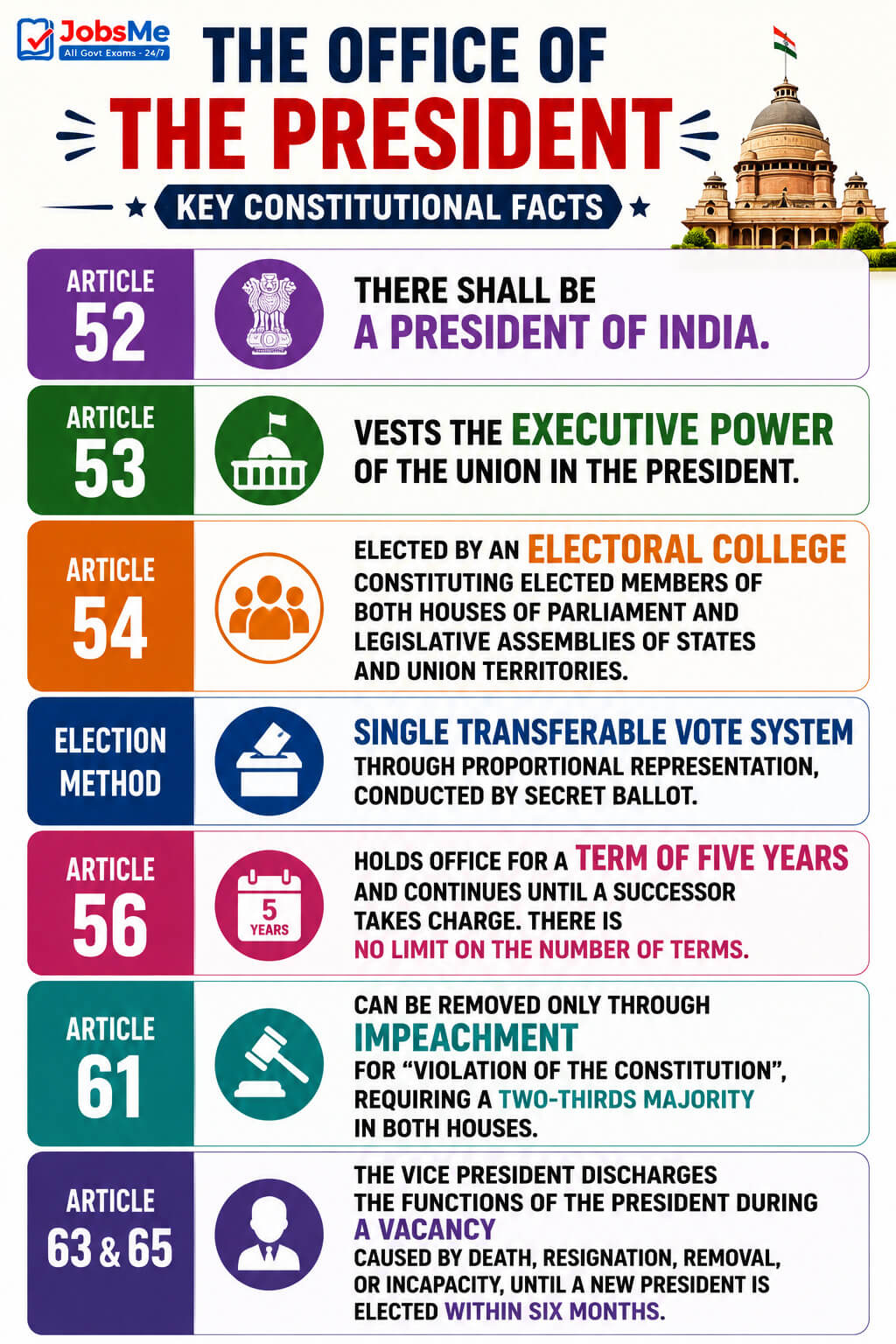
Key Constitutional Facts
- Article 52: States that "there shall be a President of India."
- Article 53: Vests the executive power of the Union in the President.
- Article 54: The President is elected by an Electoral College consisting of elected members of both Houses of Parliament (Lok Sabha and Rajya Sabha) and the elected members of the Legislative Assemblies of states and Union Territories.
- Election Method: Single transferable vote system through proportional representation, conducted by secret ballot.
- Article 56: The President holds office for a term of five years and continues until a successor takes charge. There is no limit on the number of terms.
- Article 61: The President can be removed only through impeachment for "violation of the Constitution," requiring a two-thirds majority in both Houses.
- Article 63 & 65: The Vice President discharges the functions of the President during a vacancy caused by death, resignation, removal, or incapacity, until a new President is elected within six months.
Eligibility to Become President
- Must be a citizen of India.
- Must have completed 35 years of age.
- Must be qualified for election as a member of the Lok Sabha.
- Must not hold any office of profit under the Government of India, any State Government, or any local authority.
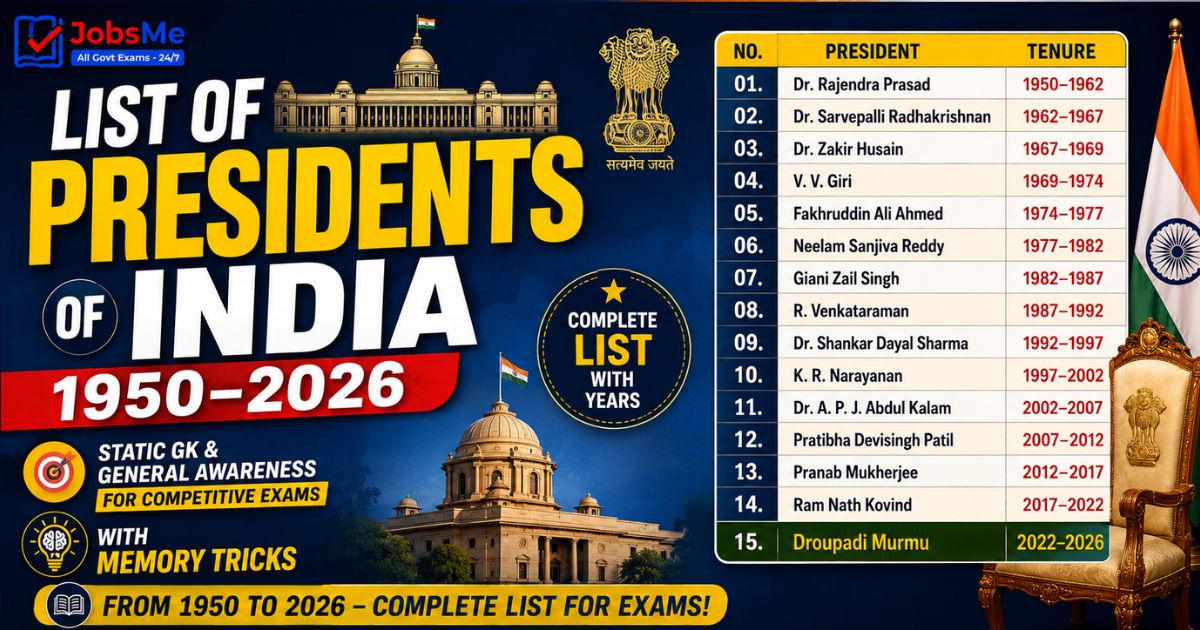
Complete List of Presidents of India (1950-2026)
The following table lists all 15 Presidents of India in chronological order, along with their exact tenures and the most exam-relevant facts about each.
| No. | President | Tenure | Key Facts / Highlights |
|---|---|---|---|
| 1 | Dr. Rajendra Prasad | 26 Jan 1950 - 13 May 1962 | First President of India and the only one to serve two full terms; presided over the Constituent Assembly; longest-serving President (about 12 years); awarded the Bharat Ratna in 1962. |
| 2 | Dr. Sarvepalli Radhakrishnan | 13 May 1962 - 13 May 1967 | Renowned philosopher and scholar; first Vice President of India (1952-1962); his birthday, 5 September, is celebrated as Teachers' Day; awarded the Bharat Ratna in 1954. |
| 3 | Dr. Zakir Husain | 13 May 1967 - 3 May 1969 | First Muslim President of India and the first President to die in office; had the shortest tenure among elected Presidents; co-founder of Jamia Millia Islamia; awarded the Bharat Ratna in 1963. |
| 4 | Varahagiri Venkata Giri (V. V. Giri) | 24 Aug 1969 - 24 Aug 1974 | The only President elected as an independent candidate; earlier served as Acting President in 1969 after Zakir Husain's death; known for his work on labour rights; awarded the Bharat Ratna in 1975. |
| 5 | Fakhruddin Ali Ahmed | 24 Aug 1974 - 11 Feb 1977 | Second President to die in office; declared the National Emergency under Article 352 in 1975 on the advice of PM Indira Gandhi; after his death, B. D. Jatti served as Acting President. |
| 6 | Neelam Sanjiva Reddy | 25 Jul 1977 - 25 Jul 1982 | Youngest President to assume office (64 years) and the only President elected unopposed; first Chief Minister of Andhra Pradesh; also served as Speaker of the Lok Sabha. |
| 7 | Giani Zail Singh | 25 Jul 1982 - 25 Jul 1987 | First Sikh President of India; tenure saw Operation Blue Star (1984) and the assassination of Indira Gandhi; used the pocket veto on the Indian Post Office (Amendment) Bill; former Chief Minister of Punjab. |
| 8 | R. Venkataraman | 25 Jul 1987 - 25 Jul 1992 | Freedom fighter and former Defence Minister and Finance Minister; served as Vice President (1984-1987) before becoming President; known for his constitutional and legal acumen during coalition governments. |
| 9 | Dr. Shankar Dayal Sharma | 25 Jul 1992 - 25 Jul 1997 | Former Vice President and former Chief Minister of Bhopal State; took the oath of office in Hindi; a noted scholar and Gandhian. |
| 10 | K. R. Narayanan | 25 Jul 1997 - 25 Jul 2002 | First Dalit President of India; also the first Malayali President; former diplomat and Vice President; known as the "working President" for his active interpretation of the office. |
| 11 | Dr. A. P. J. Abdul Kalam | 25 Jul 2002 - 25 Jul 2007 | Known as the "Missile Man of India" and the "People's President"; aerospace scientist who led India's missile and space programmes; awarded the Bharat Ratna in 1997; widely loved for his work with students. |
| 12 | Pratibha Patil | 25 Jul 2007 - 25 Jul 2012 | First woman President of India; former Governor of Rajasthan; first woman to fly in a Sukhoi fighter jet while in office. |
| 13 | Pranab Mukherjee | 25 Jul 2012 - 25 Jul 2017 | Veteran Congress leader and former Finance Minister and External Affairs Minister; awarded the Bharat Ratna in 2019; widely respected as a statesman across party lines. |
| 14 | Ram Nath Kovind | 25 Jul 2017 - 25 Jul 2022 | Second Dalit President of India after K. R. Narayanan; former Governor of Bihar and lawyer; was a member of the Rajya Sabha before his presidency. |
| 15 | Droupadi Murmu | 25 Jul 2022 - Present | 15th and current President; first person from a tribal community (Santhal) to hold the office; second woman President after Pratibha Patil; youngest President at the time of taking office (64); first President born in independent India; former Governor of Jharkhand. |
Acting Presidents of India
Apart from the 15 elected Presidents, three persons have served as Acting Presidents during temporary vacancies. Their terms are not numbered or counted as full presidential terms.
| Acting President | Tenure | Reason / Key Details |
|---|---|---|
| Varahagiri Venkata Giri (V. V. Giri) | 3 May 1969 - 20 Jul 1969 | First Acting President of India; was Vice President when President Zakir Husain died in office; later resigned to contest and win the presidential election as an independent candidate. |
| Mohammad Hidayatullah | 20 Jul 1969 - 24 Aug 1969 | Then Chief Justice of India; served as Acting President after V. V. Giri resigned to contest the election; later became the 6th Vice President of India. |
| Basappa Danappa Jatti (B. D. Jatti) | 11 Feb 1977 - 25 Jul 1977 | Was Vice President when President Fakhruddin Ali Ahmed died in office; former Chief Minister of Mysore State; served as Acting President until Neelam Sanjiva Reddy was elected. |
Important Firsts and Records Among Presidents
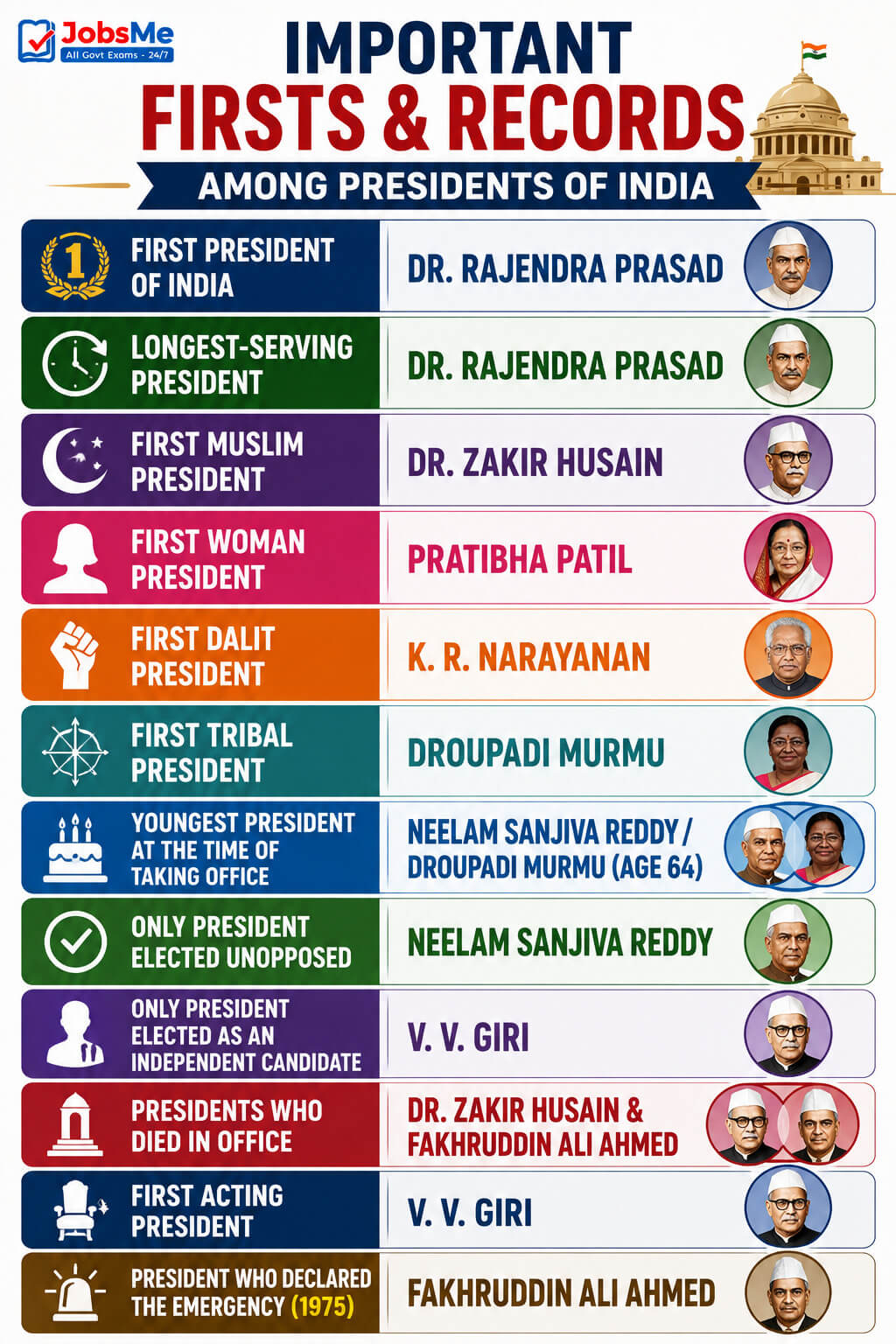
The following table summarises the most frequently asked "firsts" and records related to the Presidents of India.
| Record / First | President | Details |
|---|---|---|
| First President of India | Dr. Rajendra Prasad | Took office on 26 January 1950; the only President to serve two full terms. |
| Longest-serving President | Dr. Rajendra Prasad | Served about 12 years (1950-1962) across two terms. |
| First Muslim President | Dr. Zakir Husain | Also the first President to die in office, with the shortest elected tenure. |
| First woman President | Pratibha Patil | Served from 2007 to 2012; former Governor of Rajasthan. |
| First Dalit President | K. R. Narayanan | Served from 1997 to 2002; also the first Malayali President. |
| First tribal President | Droupadi Murmu | From the Santhal community of Odisha; current 15th President. |
| Youngest President at the time of taking office | Neelam Sanjiva Reddy / Droupadi Murmu | Both assumed office at the age of 64; Reddy was the youngest among earlier Presidents, and Murmu is also recorded as the youngest at 64. |
| Only President elected unopposed | Neelam Sanjiva Reddy | Elected unopposed in 1977. |
| Only President elected as an independent candidate | V. V. Giri | Won the 1969 presidential election as an independent. |
| Presidents who died in office | Dr. Zakir Husain and Fakhruddin Ali Ahmed | Both passed away during their terms; their Vice Presidents served as Acting Presidents. |
| First Acting President | V. V. Giri | Served as Acting President in 1969 after Zakir Husain's death. |
| President who declared the Emergency (1975) | Fakhruddin Ali Ahmed | Declared the National Emergency under Article 352 on the advice of PM Indira Gandhi. |
Memory Tricks and Mnemonics
Trick 1: The Two "Doctors" Who Started — "RR"
The first two Presidents were both academics with the title "Dr." Remember them as "RR":
- R → Dr. Rajendra Prasad (1st, the lawyer and freedom fighter).
- R → Dr. Radhakrishnan (2nd, the philosopher and Teachers' Day man).
"Two Doctors, two R's — Prasad first, philosophy next."
Trick 2: The Two Presidents Who Died in Office — "ZA"
Only two Presidents died while serving. Use the letters "ZA":
- Z → Zakir Husain (3rd, first to die in office).
- A → Fakhruddin Ali Ahmed (5th, second to die in office).
"Z came first, A came second — both never finished their terms."
Trick 3: The Three Acting Presidents — "GHJ"
Remember the three Acting Presidents in order as "GHJ":
- G → Giri (V. V. Giri, the first Acting President).
- H → Hidayatullah (Mohammad Hidayatullah, Chief Justice of India).
- J → Jatti (B. D. Jatti, after Fakhruddin Ali Ahmed's death).
"G-H-J — the three who stood in, but were never numbered."
Trick 4: The "First" Presidents — "MID-Tribe"
Group the famous "firsts" to remember them quickly:
- M → Muslim → Zakir Husain.
- I → Independent candidate → V. V. Giri.
- D → Dalit → K. R. Narayanan.
- Tribe → Tribal → Droupadi Murmu; and the first Woman → Pratibha Patil.
Trick 5: Scientist President — "Missile Man"
Only one President came from a pure science background:
- Dr. A. P. J. Abdul Kalam (11th) → "Missile Man of India" and "People's President."
"Missile Man = the 11th = the only scientist in Rashtrapati Bhavan."
Trick 6: Hindi and Pocket Veto — "Sharma and Singh"
- Dr. Shankar Dayal Sharma (9th) → first President to take the oath in Hindi.
- Giani Zail Singh (7th) → used the pocket veto on the Indian Post Office Bill; first Sikh President.
Trick 7: The Two-Term and Unopposed Pair — "Prasad and Reddy"
- Dr. Rajendra Prasad → the only President with two full terms.
- Neelam Sanjiva Reddy → the only President elected unopposed and the youngest to assume office.
"Prasad served twice; Reddy won without a fight."
Additional Notes
Frequently Confused Facts
- First Dalit President vs First tribal President: K. R. Narayanan was the first Dalit President (1997-2002); Droupadi Murmu is the first tribal President (2022-present).
- First woman President vs second woman President: Pratibha Patil was the first woman President; Droupadi Murmu is the second woman President.
- Presidents who died in office: Only Zakir Husain and Fakhruddin Ali Ahmed died in office — not any other President.
- V. V. Giri's two roles: He was both an Acting President (1969) and later an elected President (1969-1974) — the only person to do both.
- Teachers' Day vs Children's Day: Teachers' Day (5 September) is linked to President Dr. Sarvepalli Radhakrishnan, while Children's Day (14 November) is linked to PM Jawaharlal Nehru, not a President.
- Hidayatullah's two posts: Mohammad Hidayatullah served as both Chief Justice of India and Acting President, and later as Vice President of India.
- Longest-serving vs current President: Dr. Rajendra Prasad was the longest-serving President; Droupadi Murmu is the current President — these are different facts.
- Unopposed vs Independent: Neelam Sanjiva Reddy was elected unopposed; V. V. Giri was elected as an independent candidate — do not mix these two.
Repeating PYQ Patterns
Certain facts about the Presidents of India are asked repeatedly in competitive exams. Dr. Rajendra Prasad (first President, only two-term President), Dr. Sarvepalli Radhakrishnan (Teachers' Day), Dr. A. P. J. Abdul Kalam (Missile Man), Pratibha Patil (first woman President), K. R. Narayanan (first Dalit President), Droupadi Murmu (first tribal and current President), Zakir Husain and Fakhruddin Ali Ahmed (died in office), and the three Acting Presidents appear most often in UPSC Prelims, SSC CGL, and RRB NTPC papers. Banking exams (IBPS PO, SBI Clerk) frequently ask about the current President and Vice President and matching Presidents with their tenure or "firsts." State PCS exams add region-specific angles — for example, Andhra Pradesh PCS asks about Neelam Sanjiva Reddy as the first Chief Minister of Andhra Pradesh, and Kerala PSC asks about K. R. Narayanan as the first Malayali President.
Quick Insight
The list of Presidents of India is a snapshot of the nation's democratic journey — from a freedom fighter who chaired the Constituent Assembly (Dr. Rajendra Prasad), to a philosopher (Dr. Radhakrishnan), a scientist (Dr. A. P. J. Abdul Kalam), and finally a tribal woman from a remote village in Odisha (Droupadi Murmu). Each presidency reflects the widening inclusiveness of Indian democracy. Understanding the chronological order, the "firsts," and the constitutional role of the President is invaluable for both Prelims (direct matching questions) and Mains (Indian Polity and Governance answers). For more on related topics, you can explore the Banking Awareness notes and stay current with the latest appointments through the Latest Government Job Notifications on thejobsme.com.
One-Liners for Quick Revision
- Dr. Rajendra Prasad → 1st President (1950-1962) → only President to serve two full terms; longest-serving.
- Dr. Sarvepalli Radhakrishnan → 2nd President (1962-1967) → philosopher; birthday celebrated as Teachers' Day; first Vice President.
- Dr. Zakir Husain → 3rd President (1967-1969) → first Muslim President; first to die in office.
- V. V. Giri → 4th President (1969-1974) → only one elected as an independent candidate; first Acting President; Bharat Ratna 1975.
- Fakhruddin Ali Ahmed → 5th President (1974-1977) → declared the 1975 Emergency; second to die in office.
- Neelam Sanjiva Reddy → 6th President (1977-1982) → youngest at the time; only one elected unopposed; first CM of Andhra Pradesh.
- Giani Zail Singh → 7th President (1982-1987) → first Sikh President; used pocket veto on the Post Office Bill.
- R. Venkataraman → 8th President (1987-1992) → former Defence and Finance Minister; was Vice President earlier.
- Dr. Shankar Dayal Sharma → 9th President (1992-1997) → first to take the oath in Hindi; former CM of Bhopal State.
- K. R. Narayanan → 10th President (1997-2002) → first Dalit President; first Malayali President.
- Dr. A. P. J. Abdul Kalam → 11th President (2002-2007) → "Missile Man of India" and "People's President"; Bharat Ratna 1997.
- Pratibha Patil → 12th President (2007-2012) → first woman President; first woman to fly a Sukhoi fighter jet.
- Pranab Mukherjee → 13th President (2012-2017) → veteran statesman; former Finance Minister; Bharat Ratna 2019.
- Ram Nath Kovind → 14th President (2017-2022) → second Dalit President; former Governor of Bihar.
- Droupadi Murmu → 15th and current President (2022-present) → first tribal President; second woman President; youngest at 64; first born in independent India.
- Mohammad Hidayatullah → Acting President (1969) → Chief Justice of India; later Vice President.
- B. D. Jatti → Acting President (1977) → was Vice President after Fakhruddin Ali Ahmed's death.
- Article 52 → "There shall be a President of India."
- Article 53 → Executive power of the Union vested in the President.
- Article 54 → Election of the President by an Electoral College.
- Article 56 → Five-year term; no limit on number of terms.
- Article 61 → Impeachment of the President for violation of the Constitution.
For more Static GK topics like the Vice Presidents of India, Prime Ministers, and the Indian Constitution, explore the Static GK section on thejobsme.com. You can also test your knowledge with the Static GK Quiz and stay updated through the Daily Current Affairs Quiz.
Free quiz • No signup required
Put this topic into practice with Indian Cultural Institutions – Static GK MCQ Quiz. It is the quickest way to reinforce what you just learned.
Frequently Asked Questions
Who was the first President of India?
Who is the current President of India?
Who was the first woman President of India?
Which President of India was known as the Missile Man?
Who was the first Dalit President of India?
Which Presidents of India died while in office?
Who were the acting Presidents of India?
Which President of India was elected unopposed?
How is the President of India elected and for how long?
Which President of India was the only one elected as an independent candidate?

About the author