Power Plants of India Static GK: Complete List of Thermal, Hydro and Solar Power Plants with States and Capacities
This article gives you a complete, exam-ready list of India's major power plants - thermal, hydroelectric and solar - along with their states, rivers, installed capacities, operating agencies and key exam facts. It also covers Ultra Mega Power Projects, supercritical technology, floating solar plants, India's latest power sector data and the most common exam traps. Every fact is arranged in tables, mnemonics and one-liners so you can revise the entire topic in a single sitting before UPSC, SSC, IBPS, RRB, Insurance or State PSC exams.

Jump to section
Introduction
Questions on the power plants of India appear in almost every General Awareness paper. Examiners like this topic because it can be tested in many ways at once - the name of a plant, the state it stands in, the river it uses, the fuel it burns, the agency that runs it, and whether it holds a record such as "largest" or "first". A single line of preparation here can fetch you marks in UPSC Prelims, SSC CGL, IBPS PO and Clerk, RRB NTPC, Insurance and State PSC exams.
India is the third largest producer and consumer of electricity in the world, after China and the United States. As of mid-2026, India's total installed power capacity has crossed 540 GW. Of this, non-fossil sources (renewables plus nuclear) account for over 297 GW, which means India crossed the halfway mark of non-fossil installed capacity about five years ahead of its Paris Agreement promise. Coal, however, still supplies roughly 70 per cent of the electricity actually generated, which is why thermal plants remain the backbone of the grid.
This article organises the entire topic into three blocks - thermal, hydro and solar - with tables, memory tricks and one-liners. Since power sector data changes every few months, pair this with the daily current affairs section so that you always quote the latest capacity figures in your exam.
Core Concepts You Must Understand First
Before memorising plant names, fix these basic ideas in your mind. Most tricky questions are built on them.
- Installed capacity vs generation: Installed capacity is the maximum power a plant can produce, measured in MW or GW. Generation is the electricity actually produced, measured in units (kWh, MU or BU). Solar has a large installed capacity but produces less generation because the sun shines only part of the day. Coal has less installed share but higher generation share.
- Base load vs peak load: Thermal and nuclear plants run continuously and supply base load. Hydro and gas plants can be started and stopped quickly, so they serve peak load and balance the grid.
- Plant Load Factor (PLF): The ratio of actual generation to the maximum possible generation. A high PLF means the plant is being used efficiently.
- Pithead vs coastal plants: A pithead plant is built next to a coal mine (Vindhyachal, Sasan, Sipat). A coastal plant is built near a port and usually runs on imported coal (Mundra, Udupi).
- Thermal power principle: Fuel is burnt, water is heated into high-pressure steam, the steam spins a turbine, and the turbine drives a generator. The cycle used is the Rankine cycle.
- Hydro power principle: Stored or flowing water is dropped through penstocks onto turbines. The energy depends on the head (height of fall) and the discharge (volume of water).
- Solar power principle: Photovoltaic (PV) cells convert sunlight directly into electricity through the photovoltaic effect. Solar thermal plants instead concentrate sunlight to produce steam.
- Ultra Mega Power Project (UMPP): A coal-based project of 4,000 MW or more awarded through tariff-based competitive bidding, launched by the Ministry of Power in 2005-06 to add cheap bulk power through economies of scale.
- Pumped Storage Plant (PSP): Water is pumped uphill using surplus power and released downhill during peak demand. It works like a giant water battery, and India is expanding it rapidly to support solar and wind.
Classification of Hydro Projects in India
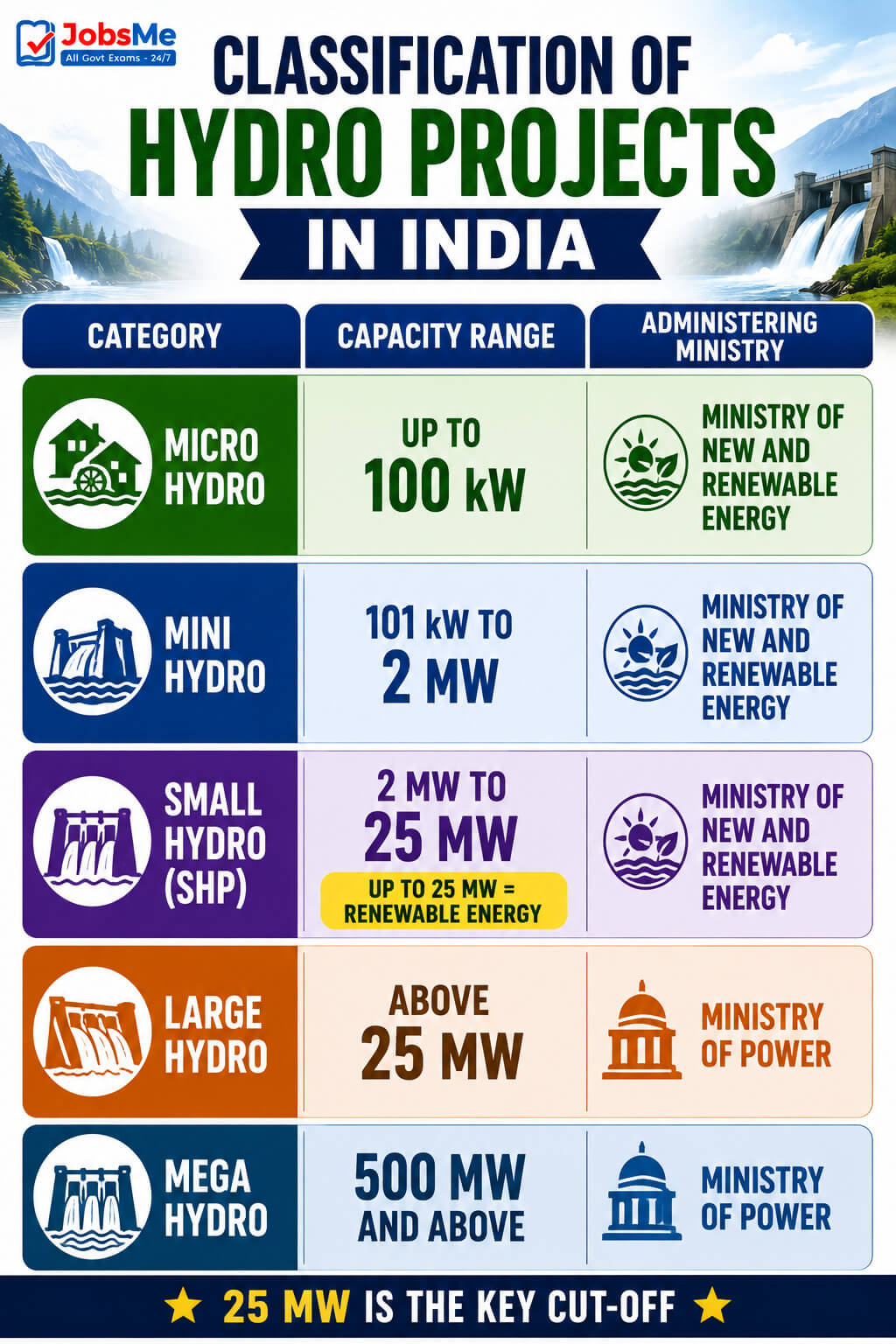
This classification is asked directly, especially the 25 MW cut-off and the two ministries involved.
| Category | Capacity Range | Administering Ministry | Key Point for Exams |
|---|---|---|---|
| Micro hydro | Up to 100 kW | Ministry of New and Renewable Energy | Used in remote hill villages and streams; smallest category |
| Mini hydro | 101 kW to 2 MW | Ministry of New and Renewable Energy | Small canal-based and stream-based schemes |
| Small hydro (SHP) | 2 MW to 25 MW | Ministry of New and Renewable Energy | Projects up to 25 MW are counted as renewable energy in India; installed SHP capacity is about 5.2 GW |
| Large hydro | Above 25 MW | Ministry of Power | Counted as non-fossil capacity; installed large hydro is about 51 GW |
| Mega hydro | 500 MW and above | Ministry of Power | Includes Koyna, Tehri, Srisailam, Nathpa Jhakri, Sardar Sarovar |
India's Power Sector at a Glance
Learn this table as a block. Aggregate figures are asked as standalone one-mark questions in banking and railway exams.
| Fact | Detail and Exam Angle |
|---|---|
| Total installed capacity | Crossed 540 GW in mid-2026, growing at over 14 per cent a year |
| Global rank | India is the third largest electricity generator in the world after China and the USA |
| Coal share | About 41 per cent of installed capacity but nearly 70 per cent of actual generation - the single most confused pair of figures in this topic |
| Non-fossil capacity | About 297 GW (June 2026), which is more than half of total installed capacity; the 50 per cent milestone was reached in June 2025, five years ahead of the NDC deadline |
| Renewable energy capacity | About 288 GW - solar 162 GW, wind 57 GW, hydro 57 GW (large plus small), the rest bio-energy |
| Nuclear capacity | About 8.78 GW - the smallest slice of the mix but a high-value exam topic |
| NDC target | 500 GW of non-fossil capacity by 2030, announced by the Prime Minister at COP26 in Glasgow; long-term vision of 1,800 GW by 2047 |
| Global renewable rank | India is third in the world in installed renewable energy capacity (IRENA), after China and the USA, having overtaken Brazil |
| Largest generator | NTPC Limited - about 17 per cent of national capacity and about 24 per cent of total generation |
| Transmission | Power Grid Corporation of India Limited (PGCIL) operates the national grid |
| Distribution | State-level DISCOMs (distribution companies) |
| Regulator | CERC at the Centre and SERCs in the states; the Central Electricity Authority (CEA) handles planning |
| Coal supply | Coal India Limited (CIL), the world's largest coal producer, supplies the bulk of power sector coal |
| Coal states | Jharkhand leads in coal reserves, while Chhattisgarh and Odisha are the top producing states |
| Nodal ministry | Ministry of Power for conventional power and large hydro; Ministry of New and Renewable Energy (MNRE) for solar, wind and small hydro |
| Peak demand projection | 277.2 GW by 2026-27 and 366.4 GW by 2031-32, as per the National Electricity Plan |
Thermal Power Plants in India
Thermal power plants convert the heat released by burning a fuel into electricity. In India the fuels used are coal, lignite, natural gas, naphtha and diesel, with coal dominating overwhelmingly. India has over 270 thermal power stations and a thermal installed capacity of more than 240 GW, of which coal-based plants alone make up around 210 GW. Government planning documents indicate a further addition of nearly 88,000 MW of thermal capacity by 2031-32, because renewables are intermittent and thermal plants are still needed for round-the-clock supply.
Types of Thermal Power Technology
| Technology | Fuel | Typical Efficiency | Indian Example | Exam Angle |
|---|---|---|---|---|
| Sub-critical coal | Coal | About 33 to 37 per cent | Vindhyachal, Ramagundam and most older plants | Operates around 180 to 220 bar and 540 degrees Celsius; the most common Indian technology; highest emissions per unit |
| Supercritical coal | Coal | About 40 to 45 per cent | NTPC Sipat Stage-I, Chhattisgarh | Operates above water's critical point, roughly 225 bar and 565 degrees Celsius; India's first supercritical units were the 3 x 660 MW units at Sipat |
| Ultra-supercritical coal | Coal | About 46 to 48 per cent | NTPC Khargone, Madhya Pradesh | Steam above 600 degrees Celsius; Khargone (2 x 660 MW) is NTPC's first ultra-supercritical station; the new standard for fresh coal projects |
| Advanced ultra-supercritical (AUSC) | Coal | Above 45 per cent, targeted higher | Planned 800 MW unit at Sipat, Chhattisgarh | Indigenous technology developed by NTPC, BHEL and IGCAR; announced in the Union Budget as a made-in-India breakthrough |
| Gas-based CCGT | Natural gas | About 55 to 60 per cent | Dadri Gas (NTPC), Bawana, Ratnagiri (RGPPL) | Combined Cycle Gas Turbine is the cleanest and most efficient thermal route, but Indian usage is limited by gas supply and price |
| Oil and diesel-based | Diesel, furnace oil, naphtha | About 28 to 32 per cent | Small peaking stations | The costliest option; used only for peak demand, islands and emergencies |
Major Thermal Power Stations in India
The table below is arranged roughly by capacity. Focus first on the top ten, then on your own state's plants, because State PSC papers almost always ask a local question.
| Power Station | State and District | Capacity (MW) | Fuel | Owner | Key Exam Facts |
|---|---|---|---|---|---|
| Vindhyachal Super TPS | Madhya Pradesh (Singrauli) | 4,760 | Coal | NTPC | Largest thermal power station in India; 13 coal units built in five stages between 1987 and 2015; coal from Nigahi and Dudhichua mines of Northern Coalfields; cooling water from the discharge canal of Singrauli STPS; with 15 MW solar and 8 MW hydro added on site the total becomes 4,783 MW |
| Mundra Thermal Power Station | Gujarat (Kutch) | 4,620 | Imported coal | Adani Power | Largest private sector thermal plant in India; nine units (4 x 330 and 5 x 660 MW); imported Indonesian coal; seawater from the Gulf of Kutch; often wrongly called a UMPP |
| Mundra UMPP | Gujarat (Kutch) | 4,000 | Imported coal | Tata Power (Coastal Gujarat Power Ltd) | India's first fully commissioned Ultra Mega Power Project, operational since March 2013; five supercritical units of 800 MW each; a separate plant from Adani's Mundra TPS in the same area |
| Sasan UMPP | Madhya Pradesh (Singrauli) | 3,960 | Coal | Reliance Power | Pithead UMPP with six units of 660 MW; captive coal from Moher and Moher-Amlohri mines; one of only two operational UMPPs |
| Tiroda Thermal Power Plant | Maharashtra (Gondia) | 3,300 | Coal | Adani Power Maharashtra | Five units of 660 MW using supercritical technology; water drawn from the Wainganga river; advanced pollution control systems |
| Chandrapur Super TPS | Maharashtra (Chandrapur) | 2,920 (3,340 installed) | Coal | MAHAGENCO | Maharashtra's largest thermal station; Vidarbha region; coal from Durgapur and Padmapur collieries of Western Coalfields; water from Erai dam; inaugurated by Prime Minister Indira Gandhi in 1984 |
| Talcher Super TPS (Kaniha) | Odisha (Angul) | 3,000 | Coal | NTPC | Located in the Talcher coalfield belt; NTPC's flagship station in the eastern region |
| Rihand Super TPS | Uttar Pradesh (Sonbhadra) | 3,000 | Coal | NTPC | Six units of 500 MW commissioned between 1988 and 2013; water from the Rihand reservoir; coal from Madhya Pradesh mines |
| Sipat Super TPS | Chhattisgarh (Bilaspur) | 2,980 | Coal | NTPC | India's first supercritical power units - Stage-I has 3 x 660 MW supercritical units, Stage-II has 2 x 500 MW; also called Rajiv Gandhi STPS; coal from Dipika mines of South Eastern Coalfields; an 800 MW advanced ultra-supercritical Stage-III will take it to 3,780 MW |
| Anpara Thermal Power Station | Uttar Pradesh (Sonbhadra) | 2,630 | Coal | UPRVUNL | Uttar Pradesh's largest state-run thermal station, in the Singrauli energy belt |
| Korba Super TPS | Chhattisgarh (Korba) | 2,600 | Coal | NTPC (state plants of CSPGCL also here) | Korba is India's leading power hub; both central and state stations operate in the same coal belt |
| Ramagundam Super TPS | Telangana (Peddapalli) | 2,600 | Coal | NTPC | One of NTPC's oldest super thermal stations in South India; also hosts a 100 MW floating solar plant on its reservoir |
| Shree Singaji TPS | Madhya Pradesh (Khandwa) | 2,520 | Coal | MPPGCL | Madhya Pradesh's largest state-owned thermal station; also called Dongalia TPS |
| Damodaram Sanjeevaiah TPS | Andhra Pradesh (Nellore) | 2,400 | Coal | APGENCO | Also known as Krishnapatnam TPS; Andhra Pradesh's major state thermal station on the coast |
| Tamnar (O P Jindal STPP) | Chhattisgarh (Raigarh) | 2,400 | Coal | Jindal Power Limited | One of India's first large private sector merchant power plants |
| Kudgi Super TPS | Karnataka (Vijayapura) | 2,400 | Coal | NTPC | NTPC's major supercritical station in South India |
| Kahalgaon Super TPS | Bihar (Bhagalpur) | 2,340 | Coal | NTPC | Bihar's largest thermal station, built in multiple stages |
| Mejia Thermal Power Station | West Bengal (Bankura) | 2,340 | Coal | Damodar Valley Corporation (DVC) | DVC's largest station; DVC was India's first multipurpose river valley project authority, set up in 1948 |
| Farakka Super TPS | West Bengal (Murshidabad) | 2,100 | Coal | NTPC | Located near the Farakka barrage and uses river water for cooling |
| Singrauli Super TPS | Uttar Pradesh (Sonbhadra) | 2,000 | Coal | NTPC | NTPC's first power station, commissioned in 1982; do not confuse it with Vindhyachal, which is nearby but in Madhya Pradesh |
| Simhadri Super TPS | Andhra Pradesh (Visakhapatnam) | 2,000 | Coal | NTPC | Unique because it uses sea water for cooling; a favourite one-liner in exams |
| Dadri (National Capital Power Station) | Uttar Pradesh (Gautam Buddh Nagar) | 1,820 coal + about 830 gas | Coal and natural gas | NTPC | A rare station with both coal-fired and gas-based combined cycle units; a key supplier to Delhi and the National Capital Region |
| North Chennai TPS | Tamil Nadu (Ennore, Chennai) | 1,830 | Coal | TANGEDCO | Tamil Nadu's largest state-run thermal station, serving Chennai |
| Odisha (Ib Valley) TPS | Odisha (Jharsuguda) | 420 (Stage-I) plus 1,320 MW Stage-II | Coal | OPGC (Odisha Power Generation Corporation) | Located in the Ib Valley coalfield; developed as a joint venture with AES |
| Raichur Thermal Power Station | Karnataka (Raichur) | 1,720 | Coal | KPCL | Karnataka's largest thermal station; the state's main coal-based supply |
| Bellary Thermal Power Station | Karnataka (Ballari) | 1,700 | Coal | KPCL | Located in the Tungabhadra region of northern Karnataka |
| Ukai Thermal Power Station | Gujarat (Tapi) | 1,695 | Coal | GSECL | Located on the Tapi river next to the Ukai dam, so the site has both thermal and hydro units |
| Yeramarus Thermal Power Station | Karnataka (Raichur) | 1,600 | Coal | KPCL | Two units of 800 MW using supercritical technology; among Karnataka's newest thermal stations |
| Wanakbori Thermal Power Station | Gujarat (Kheda) | 1,470 | Coal | GSECL | One of Gujarat's oldest large state-run thermal stations, on the Mahi river |
| Sanjay Gandhi TPS | Madhya Pradesh (Umaria, Birsinghpur) | 1,340 | Coal | MPPGCL | Major state-owned station of Madhya Pradesh, named after Sanjay Gandhi |
| Bhusawal Thermal Power Station | Maharashtra (Jalgaon) | 1,210 | Coal | MAHAGENCO | Important station in north Maharashtra, expanded with 500 MW units |
| Obra Thermal Power Station | Uttar Pradesh (Sonbhadra) | 1,198 | Coal | UPRVUNL | One of the oldest stations of the Singrauli-Sonbhadra energy belt |
| Udupi Power Plant | Karnataka (Udupi) | 1,200 | Imported coal | Adani Power | Coastal private station running on imported coal; formerly Nagarjuna Power |
| Trombay Thermal Power Station | Maharashtra (Mumbai) | 1,180 | Gas, coal and oil | Tata Power | Mumbai's principal power source and a rare multi-fuel station; the site installed India's first 500 MW unit and India's first electrostatic precipitator |
| Satpura Thermal Power Station | Madhya Pradesh (Betul, Sarni) | 1,142 | Coal | MPPGCL | One of the oldest thermal stations of central India |
| Tuticorin Thermal Power Station | Tamil Nadu (Thoothukudi) | 1,050 | Coal | TANGEDCO | The southernmost major thermal station in India |
| Bakreswar Thermal Power Station | West Bengal (Birbhum) | 1,050 | Coal | WBPDCL | Key state-run station of West Bengal, near the Bakreswar hot springs |
| Vallur Thermal Power Station | Tamil Nadu (Thiruvallur) | 1,500 | Coal | NTECL (NTPC and TANGEDCO joint venture) | Three units of 500 MW near Ennore port; power shared among Tamil Nadu, Andhra Pradesh, Karnataka, Kerala and Puducherry |
| Khaperkheda Thermal Power Station | Maharashtra (Nagpur) | 840 | Coal | MAHAGENCO | Vidarbha region station being expanded with a 660 MW supercritical unit |
| Mettur Thermal Power Station | Tamil Nadu (Salem) | 840 | Coal | TANGEDCO | Located near the Mettur dam on the Cauvery, so the area has both thermal and hydro generation |
| Budge Budge Generating Station | West Bengal (South 24 Parganas) | 750 | Coal | CESC (private) | Supplies Kolkata; CESC is India's oldest power utility, founded in 1897 |
| Barauni Thermal Power Station | Bihar (Begusarai) | 720 after revamp | Coal | BSPGCL | Old Bihar station near the Barauni refinery, revived with two 250 MW units |
| Badarpur Thermal Power Station | Delhi | 705 - decommissioned | Coal | NTPC | Shut down in 2018 following Supreme Court and NGT directions as one of Delhi's biggest pollution sources; the site is being redeveloped; Rajghat Power House in Delhi was closed earlier for the same reason |
| Panki Thermal Power Station | Uttar Pradesh (Kanpur) | 480 old units; 660 MW new unit | Coal | UPRVUNL | Old units retired and replaced by a modern supercritical unit |
| Talcher Thermal Power Station (old) | Odisha (Angul) | 460 | Coal | NTPC | The older, smaller station, separate from Talcher Super TPS at Kaniha |
| Paras Thermal Power Station | Maharashtra (Akola) | 500 | Coal | MAHAGENCO | Small MAHAGENCO station serving western Vidarbha |
| Bandel Thermal Power Station | West Bengal (Hooghly) | 335 | Coal | WBPDCL | One of the oldest stations of West Bengal, being modernised |
| Sabarmati Thermal Power Station | Gujarat (Ahmedabad) | 235 | Coal and gas | Torrent Power | Old urban station supplying Ahmedabad, operated by a private utility |
| Hussain Sagar Thermal Power Station | Telangana (Hyderabad) | 22.5 - closed | Coal | Hyderabad State Electricity Department | Widely quoted in exams as India's first thermal power station, opened in 1920 by the seventh Nizam of Hyderabad; decommissioned in 1992 and demolished in 1995 |
Ultra Mega Power Projects (UMPPs) in India
Eight UMPP sites were identified, but only two are operational. This "8 identified, 2 working" pattern is itself an exam question.
| UMPP | State | Capacity (MW) | Developer | Status | Key Exam Fact |
|---|---|---|---|---|---|
| Mundra UMPP | Gujarat | 4,000 | Tata Power (CGPL) | Operational | India's first UMPP to be awarded and fully commissioned; coastal plant using imported coal; five supercritical units of 800 MW |
| Sasan UMPP | Madhya Pradesh | 3,960 | Reliance Power | Operational | Pithead project with captive coal from the Moher coalfields |
| Krishnapatnam UMPP | Andhra Pradesh | 3,960 | Reliance Power | Cancelled | Fell through because of imported coal price and supply problems |
| Tilaiya UMPP | Jharkhand | 3,960 | Reliance Power | Cancelled | Revoked over coal linkage and land acquisition issues |
| Bedabahal UMPP | Odisha | 3,960 | Developer pending | Under development | Planned to use coal from Odisha coalfields |
| Cheyyur UMPP | Tamil Nadu | 3,960 | Developer pending | Stalled | Coastal site south of Chennai; delayed by land acquisition protests |
| Girye UMPP | Maharashtra | 3,960 | Developer pending | Stalled | Ratnagiri coast; held up by environmental objections |
| Tadri UMPP | Karnataka | 3,960 | Developer pending | Stalled | Coastal Karnataka site planned around imported coal |
NTPC Limited: Key Facts
NTPC alone can account for two or three questions in a paper, so treat this as a mini-topic. Aspirants preparing for PSU recruitment should also track it through the latest government job notifications, since NTPC recruits engineers and executive trainees every year.
| Fact | Detail |
|---|---|
| Full form | Formerly National Thermal Power Corporation Limited, now simply NTPC Limited to reflect its multi-fuel portfolio |
| Established | 1975 |
| Headquarters | New Delhi |
| Status | Maharatna Central Public Sector Enterprise since May 2010, upgraded from Navratna |
| Ministry | Ministry of Power |
| Installed capacity | NTPC Group crossed 90 GW in May 2026, with about 32 GW more under construction |
| Share of India's power | About 17 per cent of installed capacity and about 24 per cent of electricity generated |
| First power station | Singrauli Super TPS, Uttar Pradesh, commissioned in 1982 |
| Largest station | Vindhyachal Super TPS, Madhya Pradesh, 4,760 MW |
| Listing | IPO in October 2004, listed on BSE and NSE in November 2004 |
| Green energy arm | NTPC Green Energy Limited, with a target of 60 GW of renewable capacity by 2032 |
| Subsidiaries and JVs | THDC India, NEEPCO, Patratu Vidyut Utpadan Nigam, Kanti Bijlee Utpadan Nigam, NTPC-SAIL Power Company, NTPC Tamil Nadu Energy Company |
| Diversification | Coal mining, hydro, solar, wind, pumped storage, green hydrogen and nuclear power through joint ventures |
Advantages of Thermal Power
- Reliable and dispatchable: Unlike solar and wind, coal and gas plants can generate whenever needed, which keeps the grid stable.
- Cost effective: Capital and operating costs per MW are competitive, and India has the world's fourth largest coal reserves.
- Location flexibility: A thermal plant can be built almost anywhere with access to fuel and cooling water, unlike hydro which needs specific terrain.
- Employment generation: The sector directly employs an estimated 3.2 to 4 lakh people, apart from mining and transport jobs.
- Supports industry: Assured base load power enables manufacturing, railways and heavy industry to run continuously.
- Less land per MW: A thermal plant needs far less area than a hydro reservoir or a solar park of the same capacity.
- Mature technology: Decades of operating experience mean skilled manpower, spare parts and domestic manufacturing capability are all available.
Disadvantages of Thermal Power
- Air pollution: Coal plants are major sources of particulate matter (PM2.5 and PM10), sulphur dioxide and nitrogen oxides. Studies by the Centre for Research on Energy and Clean Air have found that thermal plants emit far more sulphur dioxide and fine particulate matter than crop residue burning.
- Fly ash: Huge volumes of fly ash cause respiratory illness, soil contamination and leaching of heavy metals into groundwater. Fly ash utilisation in cement and road building is now mandatory.
- Thermal pollution of water: Hot water discharged after cooling raises the temperature of rivers and coastal waters, harming aquatic life.
- Heavy water demand: Cooling requires large volumes of fresh water, a serious problem in water-stressed regions. This is why plants like Simhadri switched to sea water.
- Fuel dependence: Plants running on imported coal are exposed to price shocks, as the Mundra projects discovered when Indonesia changed its coal pricing law.
- High running costs: Fuel and maintenance make the per-unit cost higher than hydro or nuclear over the plant's life.
- Carbon emissions: Coal is the largest single source of India's carbon dioxide emissions, which conflicts with net-zero-by-2070 commitments.
Hydroelectric Power Plants in India
Hydropower was India's original mainstay. In 1947 it accounted for about 37 per cent of installed capacity and more than 53 per cent of generation. From the late 1960s coal displaced it, and today hydro contributes a much smaller share. India's assessed hydropower potential is about 1,45,320 MW, of which only around 29 per cent has been developed. At a 60 per cent load factor this potential could meet roughly 84,000 MW of demand. India ranks fifth in the world in hydropower capacity, behind China, Brazil, the United States and Canada, and has close to 200 hydro plants along with a growing fleet of pumped storage stations. Installed hydro capacity is expected to rise from about 42 GW to about 67 GW by 2031-32.
Major Hydroelectric Power Plants in India
| Project | State | River | Capacity (MW) | Key Exam Facts |
|---|---|---|---|---|
| Tehri Hydropower Complex | Uttarakhand | Bhagirathi and Bhilangana | 2,400 | India's tallest dam at 260.5 metres and the eighth tallest in the world; a rock and earth-fill embankment dam; the complex has the Tehri dam plant, the Tehri pumped storage plant and the 400 MW Koteshwar dam; built by THDC India, which became an NTPC subsidiary in 2019; in the 2016 drought the reservoir was left with no usable storage |
| Koyna Hydroelectric Project | Maharashtra (Satara) | Koyna | 1,960 | India's largest completed conventional hydroelectric plant; four dams and four stages; all generators are in underground powerhouses excavated inside the Western Ghats; construction began in 1954; the Koyna is called the lifeline of Maharashtra; run by MAHAGENCO |
| Srisailam Hydroelectric Project | Andhra Pradesh and Telangana | Krishna | 1,670 | India's third largest working hydro project; located in the Nallamala hills near the Srisailam temple; reservoir spreads over about 616 square kilometres |
| Nathpa Jhakri Hydroelectric Station | Himachal Pradesh (Kinnaur) | Satluj | 1,500 | India's largest underground hydroelectric project; six Francis turbines of 250 MW each; concrete gravity dam completed in 2004; operated by SJVN Limited |
| Sardar Sarovar Project | Gujarat | Narmada | 1,450 | The world's second largest concrete gravity dam by volume; riverbed powerhouse of 1,200 MW plus canal head powerhouse of 250 MW; benefits Gujarat, Madhya Pradesh, Maharashtra and Rajasthan; centre of the Narmada Bachao Andolan |
| Bhakra Nangal Project | Himachal Pradesh and Punjab | Satluj | 1,325 | Called a temple of modern India by Jawaharlal Nehru; Bhakra is India's second tallest dam at about 226 metres; the reservoir is Gobind Sagar; managed by the Bhakra Beas Management Board |
| Subansiri Lower Project | Arunachal Pradesh and Assam | Subansiri | 2,000 | India's largest hydro project under construction, being built by NHPC; long delayed over fears that its size could obstruct fish migration and affect downstream Assam |
| Indira Sagar Project | Madhya Pradesh (Khandwa) | Narmada | 1,000 | India's largest reservoir by water storage volume; built by NHDC, a joint venture of NHPC and the Madhya Pradesh government |
| Chamera Project | Himachal Pradesh (Chamba) | Ravi | Stage I 540, Stage II 300, Stage III 231 | A three-stage NHPC project; among NHPC's best performing stations |
| Dulhasti Project | Jammu and Kashmir (Kishtwar) | Chenab | 390 | NHPC run-of-the-river project; important in Indus Waters Treaty discussions |
| Nagarjuna Sagar Project | Telangana and Andhra Pradesh | Krishna | 815 | The world's largest masonry dam; a major multipurpose irrigation and power project |
| Hirakud Project | Odisha (Sambalpur) | Mahanadi | About 348 | India's longest earthen dam including its dykes, and the first major multipurpose river valley project after independence |
| Pong Dam (Maharana Pratap Sagar) | Himachal Pradesh (Kangra) | Beas | 396 | Its reservoir is a Ramsar site and a birding destination known for the bar-headed goose; shows how hydro reservoirs create wetlands and tourism |
| Idukki Project | Kerala (Idukki) | Periyar | 780 | Built around Asia's first arch dam; Kerala's largest hydro project and its main source of electricity |
| Teesta Urja (Teesta Stage III) | Sikkim | Teesta | 1,200 | A run-of-the-river project badly damaged in the October 2023 glacial lake outburst flood from South Lhonak Lake; the standard example of disaster risk in Himalayan hydro |
| Tapovan Vishnugad Project | Uttarakhand (Chamoli) | Dhauliganga | 520 | NTPC project damaged in the February 2021 Chamoli disaster; frequently asked in environment and disaster management questions |
| Sidrapong Hydroelectric Station | West Bengal (Darjeeling) | Sidrapong stream | About 1 | India's oldest hydroelectric power station, commissioned in 1897; it made Darjeeling one of Asia's first electrified towns |
| Shivanasamudra (Sivasamudram) | Karnataka (Mandya) | Cauvery | 42 | Commissioned in 1902, Asia's first major hydroelectric station; it first supplied power to the Kolar Gold Fields |
| Siang Upper Multipurpose Project | Arunachal Pradesh | Siang | 11,000 proposed | If built, this would become India's largest hydro project; a live current affairs topic because of local opposition and strategic concerns about Chinese dams upstream |
Hydropower Agencies and Facts
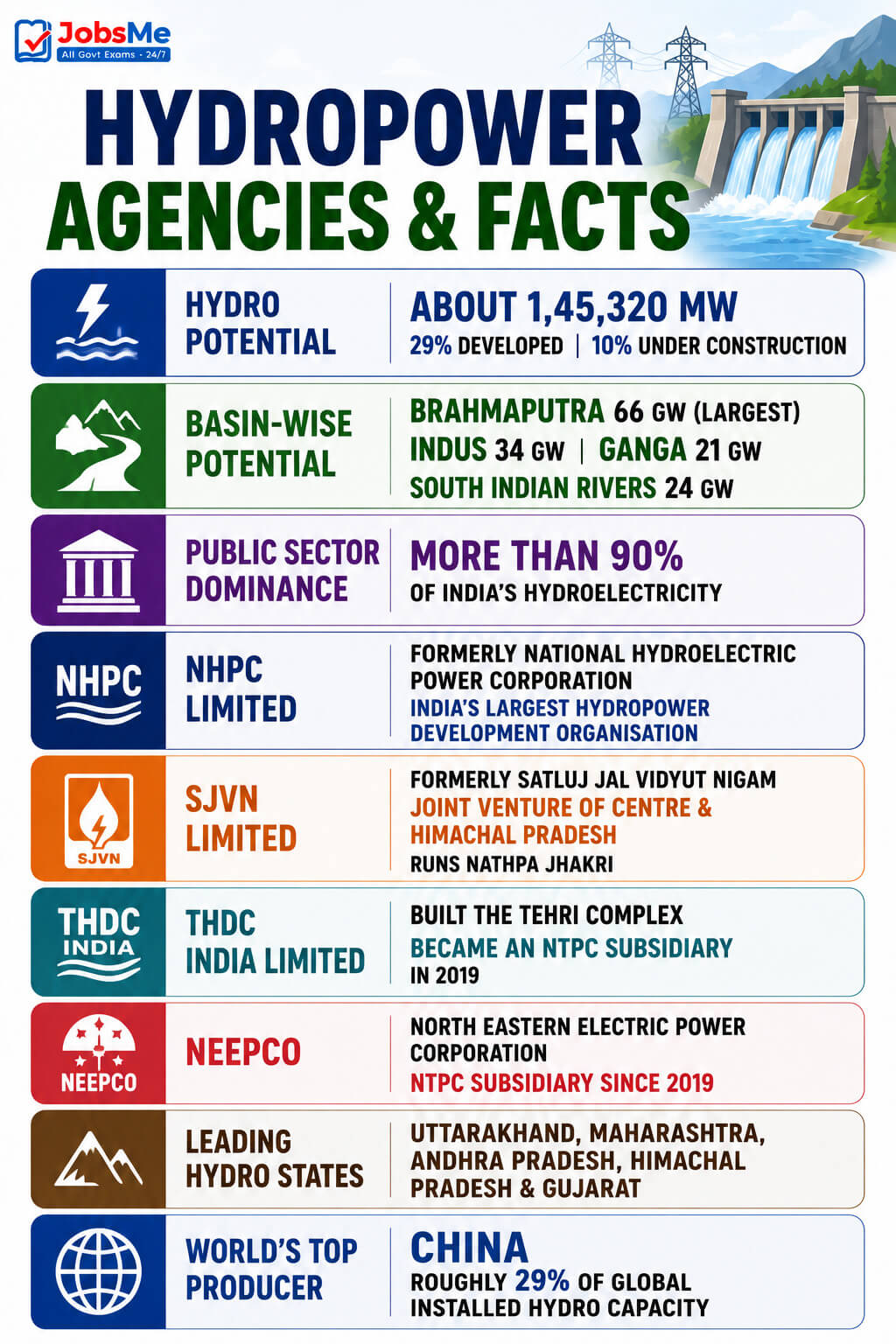
| Point | Detail |
|---|---|
| Hydro potential | About 1,45,320 MW, of which roughly 29 per cent is developed and about 10 per cent is under construction |
| Basin-wise potential | Brahmaputra basin about 66 GW (largest), Indus basin about 34 GW, Ganga basin about 21 GW, South Indian rivers about 24 GW |
| Public sector dominance | More than 90 per cent of India's hydroelectricity is generated by the public sector |
| NHPC Limited | Formerly National Hydroelectric Power Corporation, India's largest hydropower development organisation |
| SJVN Limited | Formerly Satluj Jal Vidyut Nigam, a joint venture of the Centre and Himachal Pradesh; runs Nathpa Jhakri |
| THDC India Limited | Built the Tehri complex; became an NTPC subsidiary in 2019 |
| NEEPCO | North Eastern Electric Power Corporation, also an NTPC subsidiary since 2019, develops power in the North East |
| Leading hydro states | Uttarakhand, Maharashtra, Andhra Pradesh, Himachal Pradesh and Gujarat host the largest projects |
| World's top producer | China, with roughly 29 per cent of global installed hydro capacity |
Advantages and Limitations of Hydropower
- Low running cost: Once built, a hydro plant has almost no fuel cost and can operate for a century, reducing India's fuel import bill.
- Clean and renewable: No combustion means no fly ash and negligible operating emissions.
- Fast response: Hydro units can be started or stopped within minutes, which makes them ideal for meeting peak demand and backing up solar and wind.
- Multipurpose benefits: Reservoirs also provide irrigation, drinking water, flood control, fisheries, navigation and tourism.
- High initial cost: Construction is capital intensive and slow, which looks unattractive next to falling solar prices.
- Drought risk: A weak monsoon directly cuts generation, as Tehri showed in 2016.
- Ecological disruption: Dams alter river flow, block fish migration and submerge forests.
- Displacement and culture: Large reservoirs displace tribal and rural communities with deep cultural ties to the land, which has led to long-running protests.
- Disaster risk: Dam failure or a glacial lake outburst can cause catastrophic damage, as seen in Sikkim in 2023 and Chamoli in 2021.
Solar Power Plants and Solar Parks in India
Solar is India's fastest growing energy source. Installed solar capacity rose from just 2.82 GW in 2013-14 to about 162 GW by June 2026, a rise of roughly 57 times, making India the third largest country in installed solar capacity. India met its original 20 GW target four years early, then raised it to 100 GW, and now works toward 500 GW of non-fossil capacity by 2030. The financial year 2025-26 saw a record addition of about 45 GW of solar. Rajasthan is the largest solar state by cumulative capacity, followed by Gujarat and Maharashtra, while Gujarat has led recent annual additions. Practise these fast-changing numbers using the daily current affairs quizzes rather than trying to memorise them once.
Largest Solar Parks in India
| Solar Park | State | Capacity (MW) | Commissioned | Key Exam Facts |
|---|---|---|---|---|
| Bhadla Solar Park | Rajasthan (Jodhpur) | 2,245 | 2020 | India's largest operational solar park and once the largest in the world; spread over about 14,000 acres or 56 square kilometres of the Thar desert; about 10 million panels; developed in four phases by RRECL with SECL, SECI, Adani, Saurya Urja and others; Phase 3 produced a record low tariff of about Rs 2.44 per unit; uses robotic dry cleaning because of dust |
| Pavagada Solar Park (Shakti Sthala) | Karnataka (Tumakuru) | 2,050 | 2019 | India's second largest solar park; developed by KSPDCL, a joint venture of SECI and KREDL; built on farmland leased from farmers, a model praised for land-owner participation |
| Khavda Renewable Energy Park | Gujarat (Kutch) | 30,000 planned | Under development | Set to become the world's largest renewable energy park, combining roughly 26 GW solar and 4 GW wind over about 538 to 724 square kilometres near the Rann of Kutch; developed mainly by Adani Green Energy with NTPC Green Energy; operational capacity crossed about 9.9 GW by mid-2026; will overtake Bhadla when complete |
| Kurnool Ultra Mega Solar Park | Andhra Pradesh | 1,000 | 2017 | Was the world's largest single-location solar park when commissioned |
| NP Kunta (Ananthapuramu Ultra Mega Solar Park) | Andhra Pradesh | 978 | 2021 | Major NTPC and APSPCL park in the Rayalaseema solar belt |
| Rewa Ultra Mega Solar | Madhya Pradesh | 750 | 2018 | Famous for record-low tariffs and for being the first Indian solar project to supply an institutional customer outside the state, the Delhi Metro; developed by RUMSL |
| Charanka Solar Park | Gujarat (Patan) | 690 | 2012 | India's first large solar park, part of the Gujarat Solar Park, and the model on which the national solar park scheme was built |
| Kamuthi Solar Power Project | Tamil Nadu (Ramanathapuram) | 648 | 2017 | Built by Adani in a record eight months; was the world's largest single-location solar plant at commissioning; uses a robotic cleaning system |
| Ananthapuramu II | Andhra Pradesh | 400 | 2019 | Part of Andhra Pradesh's cluster of ultra mega solar parks |
| Galiveedu Solar Park | Andhra Pradesh | 400 | 2020 | Located in the Annamayya region; another APSPCL park |
| Mandsaur Solar Farm | Madhya Pradesh | 250 | 2017 | Also called Neemuch-Mandsaur; an early low-tariff project in Madhya Pradesh |
| Kadapa Ultra Mega Solar Park | Andhra Pradesh | 250 | 2020 | Completes the Andhra Pradesh set of Kurnool, NP Kunta, Ananthapuramu, Galiveedu and Kadapa |
| Welspun Solar MP Project | Madhya Pradesh (Neemuch) | 151 | 2014 | Was Asia's largest single-location solar plant when commissioned |
| ReNew Power Nizamabad | Telangana | 143 | 2017 | A large independent power producer project in Telangana |
| Sakri Solar Plant | Maharashtra (Dhule) | 125 | 2013 | Maharashtra's first large state-owned solar plant, developed by MAHAGENCO |
Other Notable Solar Power Plants
India has more than 40 major solar plants of at least 10 MW. The following mid-size and early plants are useful for state-level questions.
| Solar Plant | State | Capacity (MW) | Commissioned | Description |
|---|---|---|---|---|
| NTPC solar plants (various sites) | Multiple states | 110 | 2015 | Early NTPC solar portfolio, later expanded massively under NTPC Green Energy |
| Maharashtra I solar plants | Maharashtra | 67 | 2017 | Cluster of state-supported utility scale projects |
| GEDCOL projects | Odisha | 50, 48 and 20 in separate phases | 2014 | Green Energy Development Corporation of Odisha, the state nodal agency for solar |
| Tata Power Solar, Rajgarh | Madhya Pradesh | 50 | 2014 | Early private utility scale plant by India's oldest solar manufacturer |
| Welspun Energy, Phalodi | Rajasthan | 50 | 2013 | Located in the same high-radiation belt as Bhadla |
| Jalaun Solar Power Project | Uttar Pradesh | 50 | 2016 | Part of the Bundelkhand solar push |
| Karnataka I solar plants | Karnataka | 40 | 2018 | State cluster supplementing Pavagada |
| Bitta Solar Power Plant | Gujarat (Kutch) | 40 | 2012 | An early Adani project in Kutch, the region now hosting Khavda |
| Dhirubhai Ambani Solar Park, Pokhran | Rajasthan (Jaisalmer) | 40 | 2012 | Reliance project in the Thar desert near Pokhran |
| Rajasthan photovoltaic plant | Rajasthan | 35 | 2013 | Early utility scale PV project in the desert belt |
| Welspun, Bathinda | Punjab | 34 | 2015 | Punjab's notable early solar plant |
| Moser Baer, Patan district | Gujarat | 30 | 2011 | One of the first plants inside the Charanka solar park |
| Lalitpur Solar Power Project | Uttar Pradesh | 30 | 2015 | Bundelkhand region project |
| Mithapur Solar Power Plant | Gujarat (Devbhumi Dwarka) | 25 | 2012 | Built by Tata Power alongside the Tata Chemicals complex |
| Kadodiya Solar Park | Madhya Pradesh | 15 | 2014 | Small state-level park near Shajapur |
| Telangana I and II solar plants | Telangana | 12 each | 2016 | Early projects after the state's formation |
| Ushodaya Project, Midjil | Telangana | 10 | 2013 | One of the first solar plants in the region |
| NTPC Odisha solar | Odisha | 10 | 2014 | Early NTPC solar unit in the eastern region |
| Sunark Solar and Bolangir project | Odisha | 10 each | 2011 | Among Odisha's earliest solar plants |
| RNS Infrastructure, Pavagada | Karnataka | 10 | 2016 | Independent block inside the Pavagada park |
| Azure Power, Sabarkantha | Gujarat | 10 | 2011 | One of the earliest independent solar producers in India |
| Green Infra Solar Energy, Rajkot | Gujarat | 10 | 2011 | Part of Gujarat's first-mover solar policy of 2009 |
| Waa Solar, Surendranagar | Gujarat | 10 | 2011 | Early Gujarat plant under the state solar policy |
| Sharda Construction, Latur | Maharashtra | 10 | 2015 | Marathwada region solar plant |
Floating Solar Power Plants in India
Floating solar means mounting photovoltaic panels on the surface of a water body using high-density polyethylene floats. It saves scarce land, cuts evaporation from reservoirs and gains a small efficiency boost because water cools the panels. India's floating solar potential is estimated at 280 to 300 GW, with about 90 GW considered readily developable.
| Floating Solar Plant | State | Capacity | Key Exam Facts |
|---|---|---|---|
| Omkareshwar Floating Solar Park | Madhya Pradesh (Khandwa) | 278 MW operational, 600 MW planned | India's largest floating solar project, on the Omkareshwar reservoir of the Narmada; coordinated by Rewa Ultra Mega Solar Limited with SJVN, NHDC and AMP Energy blocks; dedicated by the Prime Minister in December 2024; will be among the world's largest floating solar plants at 600 MW; reduces reservoir evaporation substantially |
| Ramagundam Floating Solar Project | Telangana (Peddapalli) | 100 MW | Commissioned by NTPC on the reservoir of the Ramagundam thermal station; was India's largest floating solar plant before Omkareshwar; a textbook example of a thermal site being greened |
| Kayamkulam Floating Solar Project | Kerala (Alappuzha) | 101.6 MWp | NTPC project on a backwater body at Kayamkulam, one of India's largest floating installations |
| Bhurbandha floating plant | Assam (Nagaon) | 10.5 kW | Installed in 2017, north-east India's first floating solar plant; small but frequently quoted as a first |
Other Renewable and Non-Fossil Landmarks
These sit just outside the thermal, hydro and solar list but are asked alongside them, so learn them together.
| Landmark | Location | Detail |
|---|---|---|
| Muppandal Wind Farm | Kanyakumari, Tamil Nadu | India's largest onshore wind farm at about 1,500 MW; uses the strong Arabian Sea winds funnelled through the Aralvaimozhi gap; developed by the Tamil Nadu Energy Development Agency |
| Jaisalmer Wind Park | Jaisalmer, Rajasthan | India's second largest wind farm, developed by Suzlon from 2001 onward; crossed 1,000 MW in 2012 |
| Leading wind states | Tamil Nadu and Gujarat | Together they dominate India's wind capacity of about 57 GW; India ranks fourth in the world in wind capacity |
| Tarapur Atomic Power Station | Palghar, Maharashtra | India's first nuclear power station, commissioned in 1969 |
| Kudankulam Nuclear Power Plant | Tirunelveli, Tamil Nadu | India's largest nuclear power station, built with Russian collaboration; more units are under construction |
| Nuclear operator | All India | Nuclear Power Corporation of India Limited (NPCIL) under the Department of Atomic Energy; total nuclear capacity about 8.78 GW |
Memory Tricks and Mnemonics
Facts stick only when they are chained together. Use these tricks and then test yourself on the static GK quizzes the same day.
Trick 1: Biggest Plant of Each Type - the VKB Chain
Remember the letters V-K-B for the three biggest plants in the three main categories.
- V for Vindhyachal - biggest thermal (Madhya Pradesh, 4,760 MW)
- K for Koyna - biggest hydro (Maharashtra, 1,960 MW)
- B for Bhadla - biggest solar (Rajasthan, 2,245 MW)
Extend it as "V-K-B plus M for Muppandal wind and K for Kudankulam nuclear" to cover all five sources.
Trick 2: Largest Plants State by State
Chain the state to its biggest plant in one sentence.
- MP means Vindhyachal, Gujarat means Mundra, Maharashtra means Chandrapur, Chhattisgarh means Sipat, Uttar Pradesh means Rihand or Anpara, Karnataka means Raichur, Tamil Nadu means North Chennai.
Trick 3: The Two Working UMPPs - "Only MS Passed"
Eight UMPPs were planned but only two are operational. Remember the initials M and S.
- M for Mundra (Gujarat, Tata Power), S for Sasan (Madhya Pradesh, Reliance Power) - "only MS passed the exam, the other six failed."
- The six that failed or stalled are Krishnapatnam, Tilaiya, Bedabahal, Cheyyur, Girye and Tadri.
Trick 4: NTPC Fact Chain - 1975 to 90 GW
- "NTPC = 1975 born, New Delhi based, Maharatna ranked, Singrauli first in 1982, Vindhyachal biggest, 90 GW crossed in 2026."
- Note the deliberate N-N-M-S-V order so you never mix up the first plant with the biggest plant.
Trick 5: Rivers and Their Projects - "Satluj Twins, Narmada Twins, Krishna Twins"
- Satluj twins: Bhakra Nangal and Nathpa Jhakri.
- Narmada twins: Sardar Sarovar (Gujarat) and Indira Sagar plus Omkareshwar (Madhya Pradesh).
- Krishna twins: Srisailam and Nagarjuna Sagar.
- Bhagirathi single: Tehri. Koyna single: Koyna. Mahanadi single: Hirakud. Periyar single: Idukki.
Trick 6: Dam Superlatives - the TBHNSI Story
Picture a tall dam getting shorter as you go down the list.
- T - Tehri is the Tallest dam (260.5 m).
- B - Bhakra is the second tallest and Nehru's temple of modern India.
- H - Hirakud is the longest earthen dam.
- N - Nagarjuna Sagar is the largest masonry dam.
- S - Sardar Sarovar is the world's second largest concrete dam.
- I - Idukki is built on Asia's first arch dam.
Trick 7: Supercritical Ladder - "Sipat Starts, Khargone Kicks Up"
- Sub-critical is standard and old. Sipat Started supercritical. Khargone Kicked it up to ultra-supercritical. Sipat again for Advanced ultra-supercritical.
- Numbers to attach: sub-critical about 33 to 37 per cent efficiency, supercritical about 40 to 45 per cent, ultra-supercritical about 46 to 48 per cent.
Trick 8: Firsts of Indian Power - the Ascending Years
- 1897 Sidrapong hydro, 1899 Kolkata's first commercial thermal station, 1902 Shivanasamudra hydro, 1920 Hussain Sagar thermal, 1969 Tarapur nuclear, 1982 NTPC's Singrauli, 2012 Charanka and India's first UMPP era.
- Notice that hydro came before thermal in India - a favourite trap.
Trick 9: Power Sector Players - Four Verbs
- "NTPC generates, PGCIL transmits, DISCOMs distribute, CERC regulates, and Coal India supplies the coal."
- For hydro add: "NHPC, SJVN, THDC and NEEPCO build the dams."
Additional Notes
Frequently Confused Facts
- Vindhyachal vs Mundra: Vindhyachal (Madhya Pradesh, NTPC, 4,760 MW) is the largest thermal plant overall. Adani's Mundra TPS (Gujarat, 4,620 MW) is the largest private sector thermal plant. Read the question carefully.
- Adani's Mundra TPS vs Tata's Mundra UMPP: Two separate plants in the same taluka of Kutch. Adani Power runs the 4,620 MW Mundra Thermal Power Station, which is not a UMPP. Tata Power's Coastal Gujarat Power runs the 4,000 MW Mundra UMPP, which is India's first commissioned UMPP. Many study notes wrongly merge the two.
- Singrauli vs Vindhyachal: Singrauli STPS is NTPC's first station and lies in Sonbhadra district of Uttar Pradesh. Vindhyachal is NTPC's largest station and lies in Singrauli district of Madhya Pradesh. Same name, different state, different record.
- Sipat vs Khargone: Sipat had India's first supercritical units. Khargone has NTPC's first ultra-supercritical units.
- Koyna vs Tehri: Koyna is the largest completed conventional hydroelectric plant at 1,960 MW. The Tehri complex has a larger total of 2,400 MW, but that includes pumped storage and the separate Koteshwar dam, and Tehri's own record is that it is India's tallest dam. If the question says "largest hydroelectric power plant", the expected answer is usually Koyna; if it says "largest hydropower complex" or "tallest dam", it is Tehri.
- Ramagundam is not a hydro project: Some lists place Ramagundam among hydro plants. It is actually a 2,600 MW NTPC coal-based station in Telangana that also hosts a 100 MW floating solar plant.
- India's first thermal power plant: Most exam keys accept Hussain Sagar Thermal Power Station, Hyderabad (1920). Historically, the first commercial thermal generating station was CESC's 1,000 kW plant at Emambagh Lane, Kolkata, in 1899. If both options appear, choose Hussain Sagar unless the question specifically says "first commercial power station".
- Sidrapong vs Shivanasamudra: Sidrapong in Darjeeling (1897) is India's oldest hydro station. Shivanasamudra in Karnataka (1902) is Asia's first major hydroelectric station. Both are called "first" in different senses.
- Bhadla vs Khavda: Bhadla is the largest operational solar park today. Khavda is the largest planned renewable energy park and will overtake it. Check whether the question says "operational".
- Capacity share vs generation share: Coal is about 41 per cent of installed capacity but about 70 per cent of generation. Renewables are over half of installed capacity but a much smaller share of units generated.
- Small hydro vs large hydro: Projects up to 25 MW are small hydro under MNRE. Above 25 MW they are large hydro under the Ministry of Power. Both count as non-fossil capacity.
Repeating PYQ Patterns
- SSC CGL, CHSL and MTS: Direct matching of plant to state and river. Vindhyachal, Koyna, Bhakra Nangal, Tehri, Hirakud, Sardar Sarovar and Bhadla appear most often.
- UPSC Prelims: Conceptual and current affairs framing rather than plain names - supercritical technology, UMPP design, fly ash rules, flue gas desulphurisation, pumped storage, the 500 GW NDC target and river-basin hydro potential.
- IBPS PO, Clerk and SBI: Latest capacity milestones, NTPC and NHPC facts, agreements and new commissioning news from the last six months. Support this with banking awareness notes, since power sector financing by PFC, REC and IREDA is a linked topic.
- RRB NTPC, Group D and ALP: Firsts and superlatives - first thermal plant, first nuclear plant, oldest hydro plant, tallest dam, largest solar park.
- Insurance exams (LIC, NIACL, NABARD): Renewable targets, state rankings in solar and wind, and floating solar projects.
- State PSCs: Almost always a question on the state's own largest plant, its main river project and its state generation company such as MAHAGENCO, KPCL, TANGEDCO, GSECL, MPPGCL, APGENCO or WBPDCL.
- PSU recruitment (NTPC, NHPC, PGCIL, SJVN): Company-specific facts such as year of establishment, Maharatna status, first and largest plants, and current capacity milestones, usually combined with a technical or aptitude section. Revise these with your computer awareness notes, since PSU papers pair General Awareness with basic computer and technical questions.
Quick Insight
India's power sector is at a turning point, and that is exactly why examiners keep returning to it. Non-fossil sources now make up more than half of installed capacity, reached about five years before the promised deadline, and renewables even met more than half of peak demand on some days. At the same time coal generation still supplies most of the electricity actually consumed, and the government has cleared nearly 88,000 MW of fresh thermal capacity for the years up to 2031-32. The real story is therefore not coal versus solar but the search for firming capacity - pumped storage, battery storage and flexible thermal units that can fill the evening gap when the sun sets. Expect questions on battery energy storage systems, pumped storage projects, flue gas desulphurisation deadlines, green hydrogen and the retirement of old urban plants like Badarpur. Every one of these has already appeared in some form in a recent paper, so read them alongside your static GK notes and check the computer awareness quizzes too, since smart grid and SCADA terms are creeping into technical recruitment papers.
One-Liners for Quick Revision
- India's electricity rank - Third largest producer and consumer of electricity in the world - after China and the USA.
- Total installed capacity - Crossed 540 GW in mid-2026 - growing at more than 14 per cent a year.
- Non-fossil capacity - About 297 GW in June 2026 - more than half of total capacity, achieved five years ahead of the NDC target.
- NDC target - 500 GW of non-fossil capacity by 2030 - announced at COP26, with a long-term vision of 1,800 GW by 2047.
- Coal share - About 41 per cent of installed capacity but roughly 70 per cent of generation - the classic capacity versus generation trap.
- Thermal capacity - Over 240 GW in total with about 210 GW coal-based - spread over more than 270 stations.
- Thermal expansion plan - Nearly 88,000 MW of new thermal capacity planned by 2031-32 - because renewables are intermittent.
- Projected peak demand - 277.2 GW by 2026-27 and 366.4 GW by 2031-32 - as per the National Electricity Plan.
- Vindhyachal STPS - India's largest thermal power station at 4,760 MW - NTPC, Singrauli district, Madhya Pradesh, coal from Nigahi mines, 13 units.
- Mundra TPS - India's largest private thermal plant at 4,620 MW - Adani Power, Kutch, Gujarat, imported Indonesian coal.
- Mundra UMPP - India's first fully commissioned UMPP at 4,000 MW - Tata Power's Coastal Gujarat Power, five supercritical units of 800 MW.
- Sasan UMPP - 3,960 MW pithead UMPP in Singrauli, Madhya Pradesh - Reliance Power, captive coal from Moher coalfields.
- Tiroda TPP - 3,300 MW in Gondia, Maharashtra - Adani Power Maharashtra, five supercritical units, Wainganga river water.
- Chandrapur Super TPS - Maharashtra's largest thermal station at about 2,920 MW - MAHAGENCO, Western Coalfields coal, Erai dam water.
- Talcher Super TPS - 3,000 MW in Angul, Odisha - NTPC's flagship eastern station in the Talcher coalfield.
- Rihand Super TPS - 3,000 MW in Sonbhadra, Uttar Pradesh - NTPC, six units of 500 MW, water from Rihand reservoir.
- Sipat Super TPS - 2,980 MW in Bilaspur, Chhattisgarh - site of India's first supercritical units and of the planned indigenous advanced ultra-supercritical unit.
- Khargone STPP - NTPC's first ultra-supercritical station - 2 units of 660 MW in Madhya Pradesh.
- Anpara TPS - 2,630 MW in Sonbhadra - Uttar Pradesh's largest state-run thermal station under UPRVUNL.
- Korba Super TPS - 2,600 MW in Chhattisgarh - NTPC station in India's densest power belt.
- Ramagundam Super TPS - 2,600 MW in Peddapalli, Telangana - NTPC, and site of a 100 MW floating solar plant.
- Shree Singaji TPS - 2,520 MW in Khandwa - Madhya Pradesh's largest state-owned thermal plant.
- Damodaram Sanjeevaiah TPS - 2,400 MW in Nellore, Andhra Pradesh - APGENCO's coastal station, also called Krishnapatnam TPS.
- Tamnar (O P Jindal STPP) - 2,400 MW in Raigarh, Chhattisgarh - Jindal Power, an early private merchant plant.
- Kudgi Super TPS - 2,400 MW in Vijayapura, Karnataka - NTPC's main supercritical station in the south.
- Kahalgaon Super TPS - 2,340 MW in Bhagalpur - Bihar's largest thermal station, run by NTPC.
- Mejia TPS - 2,340 MW in Bankura, West Bengal - the largest station of Damodar Valley Corporation, India's first multipurpose river valley authority (1948).
- Farakka Super TPS - 2,100 MW in Murshidabad - NTPC station beside the Farakka barrage.
- Singrauli Super TPS - 2,000 MW in Sonbhadra, Uttar Pradesh - NTPC's very first power station, commissioned in 1982.
- Simhadri Super TPS - 2,000 MW near Visakhapatnam - the NTPC station that uses sea water for cooling.
- Dadri NCPS - 1,820 MW coal plus about 830 MW gas in Gautam Buddh Nagar - NTPC's dual-fuel station supplying Delhi and the NCR.
- North Chennai TPS - 1,830 MW at Ennore - Tamil Nadu's largest state-run thermal station under TANGEDCO.
- Raichur TPS - 1,720 MW - Karnataka's largest thermal station, run by KPCL.
- Bellary TPS - 1,700 MW in the Tungabhadra region - another major KPCL station.
- Ukai TPS - 1,695 MW on the Tapi river - GSECL station at a site that has both thermal and hydro units.
- Yeramarus TPS - 1,600 MW in Raichur, Karnataka - two supercritical units of 800 MW under KPCL.
- Vallur TPS - 1,500 MW near Ennore, Tamil Nadu - a joint venture of NTPC and TANGEDCO called NTECL.
- Wanakbori TPS - 1,470 MW in Kheda, Gujarat - one of GSECL's oldest large stations.
- Sanjay Gandhi TPS - 1,340 MW at Birsinghpur, Madhya Pradesh - MPPGCL station named after Sanjay Gandhi.
- Bhusawal TPS - 1,210 MW in Jalgaon - MAHAGENCO's key north Maharashtra plant.
- Udupi Power Plant - 1,200 MW on the Karnataka coast - Adani Power plant running on imported coal.
- Obra TPS - 1,198 MW in Sonbhadra - one of the oldest UPRVUNL stations.
- Trombay TPS - 1,180 MW in Mumbai - Tata Power's multi-fuel station and the site of India's first 500 MW unit and first electrostatic precipitator.
- Satpura TPS - 1,142 MW at Sarni, Betul - one of central India's oldest thermal stations.
- Tuticorin TPS - 1,050 MW in Thoothukudi - India's southernmost major thermal station.
- Bakreswar TPS - 1,050 MW in Birbhum - a major WBPDCL station in West Bengal.
- Ib Valley TPS (OPGC) - 420 MW Stage-I plus 1,320 MW Stage-II in Jharsuguda, Odisha - located in the Ib Valley coalfield.
- Khaperkheda TPS - 840 MW near Nagpur - MAHAGENCO station being expanded with supercritical technology.
- Mettur TPS - 840 MW in Salem - TANGEDCO station near the Mettur dam on the Cauvery.
- Budge Budge station - 750 MW in South 24 Parganas - run by CESC, India's oldest power utility, founded in 1897.
- Barauni TPS - about 720 MW after revamp, in Begusarai - old Bihar plant revived with two 250 MW units.
- Badarpur TPS - 705 MW in Delhi, decommissioned in 2018 - closed on Supreme Court and NGT orders as a major Delhi pollution source; Rajghat Power House was shut earlier for the same reason.
- Panki TPS - Kanpur, Uttar Pradesh - old 480 MW units retired and replaced by a new 660 MW supercritical unit.
- Talcher TPS (old) - 460 MW in Angul - the smaller NTPC station, separate from Talcher Super TPS at Kaniha.
- Paras TPS - 500 MW in Akola - a smaller MAHAGENCO station in western Vidarbha.
- Bandel TPS - 335 MW in Hooghly - one of West Bengal's oldest stations, under modernisation.
- Sabarmati TPS - 235 MW in Ahmedabad - Torrent Power's coal and gas station.
- Hussain Sagar TPS - India's first thermal power station as per most exam keys - 22.5 MW, opened in Hyderabad in 1920 by the seventh Nizam, shut in 1992.
- First commercial power station - CESC's 1,000 kW plant at Emambagh Lane, Kolkata, 1899 - the true historical beginning of thermal generation in India.
- UMPP definition - Coal-based projects of 4,000 MW or more awarded through competitive bidding - eight identified, only Mundra and Sasan operational.
- Thermal technology ladder - Sub-critical about 33 to 37 per cent, supercritical about 40 to 45 per cent, ultra-supercritical about 46 to 48 per cent efficiency - higher efficiency means less coal and lower emissions per unit.
- Gas-based CCGT - The most efficient thermal route at about 55 to 60 per cent - examples are Dadri Gas, Bawana and Ratnagiri.
- NTPC - India's largest power producer, established in 1975, Maharatna since May 2010, headquartered in New Delhi - crossed 90 GW in May 2026 with about 32 GW under construction.
- NTPC share - About 17 per cent of India's installed capacity and about 24 per cent of generation - listed on BSE and NSE after its 2004 IPO.
- NTPC Green Energy - The renewable arm targeting 60 GW by 2032 - part of NTPC's shift beyond coal.
- NTPC subsidiaries - THDC India, NEEPCO, PVUNL, Kanti Bijlee Utpadan Nigam, NTPC-SAIL Power Company and NTECL.
- Hydro potential - About 1,45,320 MW assessed, only about 29 per cent developed - could meet nearly 84,000 MW of demand at a 60 per cent load factor.
- Hydro rank - India is fifth in the world in hydropower capacity - behind China, Brazil, the USA and Canada; China alone holds about 29 per cent of global capacity.
- Hydro basins - Brahmaputra about 66 GW, Indus about 34 GW, South Indian rivers about 24 GW, Ganga about 21 GW - Brahmaputra has the largest untapped potential.
- Hydro in 1947 - About 37 per cent of capacity and over 53 per cent of generation - coal overtook it from the late 1960s.
- Hydro expansion - Capacity expected to rise from about 42 GW to about 67 GW by 2031-32 - with over 90 per cent of hydro run by the public sector.
- Small hydro rule - Projects up to 25 MW fall under MNRE as small hydro; micro up to 100 kW, mini 101 kW to 2 MW, small 2 to 25 MW, mega 500 MW and above.
- Koyna Project - India's largest completed hydroelectric plant at 1,960 MW - Maharashtra, four dams, four stages, underground powerhouses in the Western Ghats, built from 1954.
- Tehri complex - 2,400 MW on the Bhagirathi in Uttarakhand - India's tallest dam at 260.5 metres, eighth tallest in the world, includes Tehri PSP and the 400 MW Koteshwar dam; built by THDC, now under NTPC.
- Srisailam Project - 1,670 MW on the Krishna - India's third largest working hydro project, in the Nallamala hills.
- Nathpa Jhakri - 1,500 MW on the Satluj in Kinnaur - India's largest underground hydro project, six turbines of 250 MW, run by SJVN, completed in 2004.
- Sardar Sarovar - 1,450 MW on the Narmada in Gujarat - world's second largest concrete gravity dam, with riverbed and canal head powerhouses.
- Bhakra Nangal - 1,325 MW on the Satluj - Nehru's temple of modern India, reservoir Gobind Sagar, managed by the Bhakra Beas Management Board.
- Subansiri Lower - 2,000 MW on the Subansiri in Arunachal Pradesh and Assam - NHPC's largest project under construction, delayed by fish migration and downstream concerns.
- Indira Sagar - 1,000 MW on the Narmada in Madhya Pradesh - India's largest reservoir by storage volume, built by NHDC.
- Chamera Project - Three NHPC stages on the Ravi in Chamba - 540 MW, 300 MW and 231 MW.
- Dulhasti Project - 390 MW on the Chenab in Kishtwar - NHPC run-of-the-river project relevant to the Indus Waters Treaty.
- Nagarjuna Sagar - 815 MW on the Krishna - the world's largest masonry dam.
- Hirakud - About 348 MW on the Mahanadi in Odisha - India's longest earthen dam and the first big multipurpose project after independence.
- Pong Dam - 396 MW on the Beas in Kangra - reservoir Maharana Pratap Sagar is a Ramsar site famous for the bar-headed goose.
- Idukki Project - 780 MW on the Periyar in Kerala - built around Asia's first arch dam.
- Teesta Urja (Stage III) - 1,200 MW run-of-the-river project in Sikkim - severely damaged in the 2023 South Lhonak glacial lake outburst flood.
- Tapovan Vishnugad - 520 MW NTPC project in Chamoli - damaged in the February 2021 Uttarakhand disaster.
- Sidrapong - India's oldest hydro station, commissioned in 1897 in Darjeeling - it electrified one of Asia's earliest hill towns.
- Shivanasamudra - Commissioned in 1902 on the Cauvery in Karnataka - Asia's first major hydro station, first supplying the Kolar Gold Fields.
- Siang Upper Project - Proposed 11,000 MW on the Siang in Arunachal Pradesh - would become India's largest hydro project; a live current affairs and strategic issue.
- Hydro agencies - NHPC is the largest hydro developer, SJVN runs Nathpa Jhakri, THDC built Tehri and NEEPCO covers the North East.
- Solar capacity - About 162 GW by June 2026, up from 2.82 GW in 2013-14 - roughly a 57-fold rise, making India third in the world in solar capacity.
- Record solar year - About 45 GW of solar added in FY 2025-26 and 6.65 GW in March 2026 alone - the highest ever annual and monthly additions.
- Leading solar states - Rajasthan first by cumulative capacity, then Gujarat and Maharashtra - together nearly 60 per cent of India's solar capacity.
- Solar Park Scheme - Launched by MNRE in December 2014 for parks of 500 MW and above - target later raised from 20,000 MW to 40,000 MW.
- Bhadla Solar Park - India's largest solar park at 2,245 MW - Jodhpur district, Rajasthan, about 14,000 acres of the Thar desert, once the world's largest, record low tariff of about Rs 2.44 per unit.
- Pavagada Solar Park - 2,050 MW in Tumakuru, Karnataka, also called Shakti Sthala - India's second largest, built on land leased from farmers.
- Khavda Renewable Energy Park - 30 GW planned in Kutch, Gujarat - the world's largest renewable energy park, about 26 GW solar plus 4 GW wind, with about 9.9 GW already operational by mid-2026.
- Kurnool Ultra Mega Solar Park - 1,000 MW in Andhra Pradesh, commissioned in 2017 - was the world's largest single-site solar park at the time.
- NP Kunta - 978 MW in Ananthapuramu, Andhra Pradesh - a major NTPC and APSPCL park.
- Rewa Ultra Mega Solar - 750 MW in Madhya Pradesh - first Indian solar project to supply the Delhi Metro, famous for record low tariffs.
- Charanka Solar Park - 690 MW in Patan, Gujarat, commissioned in 2012 - India's first large solar park and the model for the national scheme.
- Kamuthi Solar Project - 648 MW in Ramanathapuram, Tamil Nadu - built in about eight months and once the world's largest single-location solar plant.
- Andhra Pradesh solar cluster - Kurnool, NP Kunta, Ananthapuramu II, Galiveedu and Kadapa - the densest set of ultra mega solar parks in one state.
- Welspun Solar MP - 151 MW in Neemuch, Madhya Pradesh - was Asia's largest single-location solar plant when commissioned.
- Omkareshwar Floating Solar Park - India's largest floating solar project - 278 MW operational of a planned 600 MW on the Narmada in Khandwa, Madhya Pradesh, coordinated by RUMSL with SJVN, NHDC and AMP blocks.
- Ramagundam Floating Solar - 100 MW NTPC plant in Telangana - India's largest floating solar plant before Omkareshwar.
- Kayamkulam Floating Solar - 101.6 MWp NTPC project in Alappuzha, Kerala - one of India's largest floating installations.
- Floating solar potential - Estimated at 280 to 300 GW in India, with about 90 GW readily developable - saves land and cuts reservoir evaporation.
- Muppandal Wind Farm - India's largest onshore wind farm at about 1,500 MW - Kanyakumari, Tamil Nadu, developed by TEDA using Arabian Sea winds.
- Jaisalmer Wind Park - India's second largest wind farm in Rajasthan - developed by Suzlon, crossed 1,000 MW in 2012.
- Wind capacity - About 57 GW, led by Tamil Nadu and Gujarat - India ranks fourth in the world in wind power capacity.
- Tarapur Atomic Power Station - India's first nuclear power station, commissioned in 1969 in Palghar, Maharashtra.
- Kudankulam - India's largest nuclear power station, in Tirunelveli, Tamil Nadu - built with Russian collaboration, with more units under construction.
- Nuclear capacity - About 8.78 GW, operated by NPCIL under the Department of Atomic Energy.
- Power sector roles - NTPC generates, PGCIL transmits, DISCOMs distribute, CERC and SERCs regulate, CEA plans and Coal India supplies coal.
- Coal geography - Jharkhand leads in reserves while Chhattisgarh and Odisha lead in production - the Damodar and Mahanadi valleys are the core coal belts.
- Thermal employment - An estimated 3.2 to 4 lakh people are directly employed in thermal power - apart from mining and transport jobs.
- Pollution control - Flue Gas Desulphurisation systems are being installed across coal plants to cut sulphur dioxide - Vindhyachal's units are among those being fitted.
The fastest way to lock these facts in is to answer questions on them the same day you read them. Move straight to the static GK quiz section for plant-to-state matching practice, and if you are targeting bank exams, follow it with the banking awareness quizzes, because power sector financing and PSU news are tested together with General Awareness.
Capacity figures in this topic change every few months, so revise them through the current affairs quizzes rather than memorising them once. Once your General Awareness preparation is on track, check the latest government job notifications so you never miss an application deadline for NTPC, NHPC, SJVN, PGCIL or state power board recruitment.
Free quiz • No signup required
Put this topic into practice with Indian Cultural Institutions – Static GK MCQ Quiz. It is the quickest way to reinforce what you just learned.
Frequently Asked Questions
Which is the largest thermal power plant in India?
Which is the largest private sector thermal power plant in India?
What is the difference between Adani's Mundra plant and the Mundra UMPP?
Which is the largest hydroelectric power plant in India?
Which is the tallest dam in India and on which river is it built?
Which is the largest solar park in India?
Which is the first thermal power plant of India?
Where were India's first supercritical and ultra-supercritical units installed?
What is an Ultra Mega Power Project and how many are operational in India?
How much of India's electricity comes from thermal power and how much capacity is renewable?

About the author