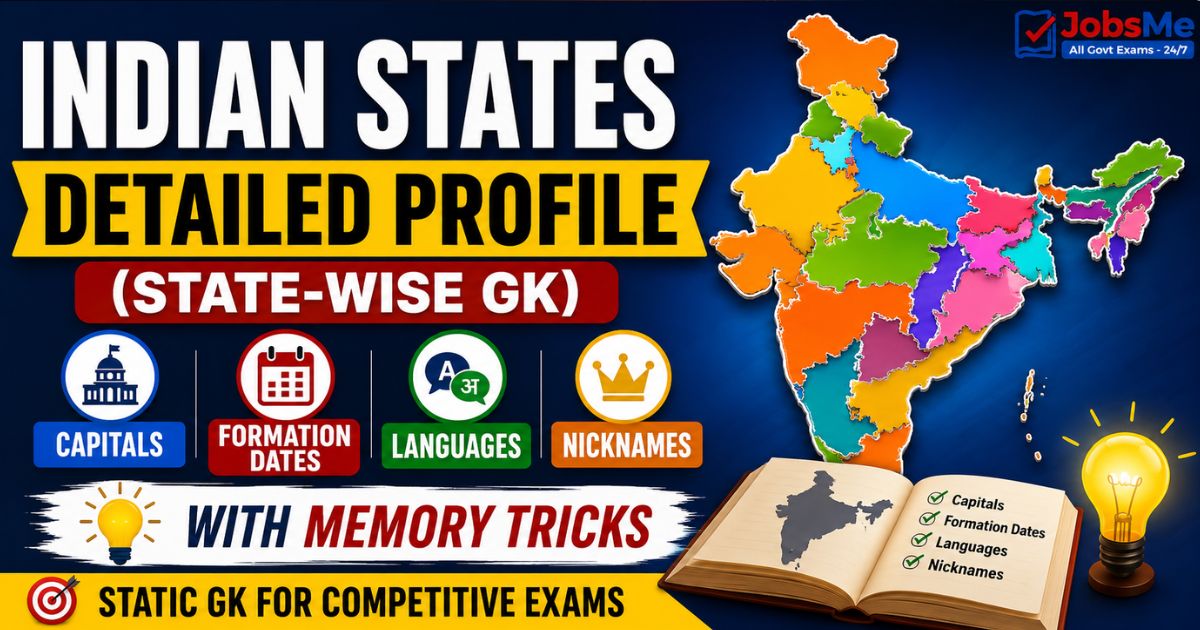
Indian States – Detailed Profile (State-wise GK): Capitals, Formation Dates, Languages & Nicknames – Static GK for Competitive Exams with Memory Tricks
This article gives a complete state-wise profile of all 28 Indian states and 8 Union Territories, covering their capitals, formation dates, official languages, popular nicknames, and key facts. It includes important superlatives such as the largest state (Rajasthan), smallest state (Goa), most populous state (Uttar Pradesh), and the newest state (Telangana, 2014), along with memory tricks and one-liners for quick revision. All facts are arranged in exam-ready format to help UPSC, SSC, IBPS, RRB, PSU, and State PCS aspirants score better in General Awareness, Geography, and Polity sections.
Jump to section
- Introduction
- Core Concepts: Understanding India's Administrative Structure
- State-wise Profile of Indian States - Capitals, Formation & Languages
- Union Territories of India - Capitals and Key Facts
- Important State Superlatives and Records
- Memory Tricks and Mnemonics
- Additional Notes
- One-Liners for Quick Revision
Introduction
India is a federal union made up of 28 states and 8 Union Territories, together forming 36 distinct administrative entities. Each state has its own capital, official language, formation history, and cultural identity — from the Thar Desert of Rajasthan (the largest state by area) to the coastal beaches of Goa (the smallest state by area), and from the most populous Uttar Pradesh to the least populous Sikkim. Understanding each state's profile is one of the most reliable ways to score marks in the General Awareness and Geography sections of competitive exams.
Questions on Indian states — their capitals, formation dates, official languages, and famous nicknames — appear regularly in UPSC Prelims, SSC CGL, IBPS PO, RRB NTPC, SBI Clerk, State PCS, and various Insurance and Defence exams. Typical questions ask which state has a particular capital, which state was formed in a specific year, which state is known by a famous nickname like the "Land of Five Rivers" or the "Rice Bowl of India," or which state holds a superlative record. This article brings together every important state-wise fact in a structured, exam-ready format. To explore other related Static GK topics, you can refer to the Static GK notes section on thejobsme.com.
State-wise GK is also closely linked to current affairs themes such as new capital projects (Amaravati in Andhra Pradesh), the renaming of Port Blair to Sri Vijaya Puram, statehood demands, the reorganisation of Jammu and Kashmir into two Union Territories in 2019, and Sixth Schedule debates for tribal autonomy — making this topic doubly important for aspirants preparing for UPSC Mains and Essay papers as well.
Core Concepts: Understanding India's Administrative Structure
Before memorising state profiles, it helps to understand a few core ideas about how India is administratively organised. This makes the facts easier to remember and connect during the exam.
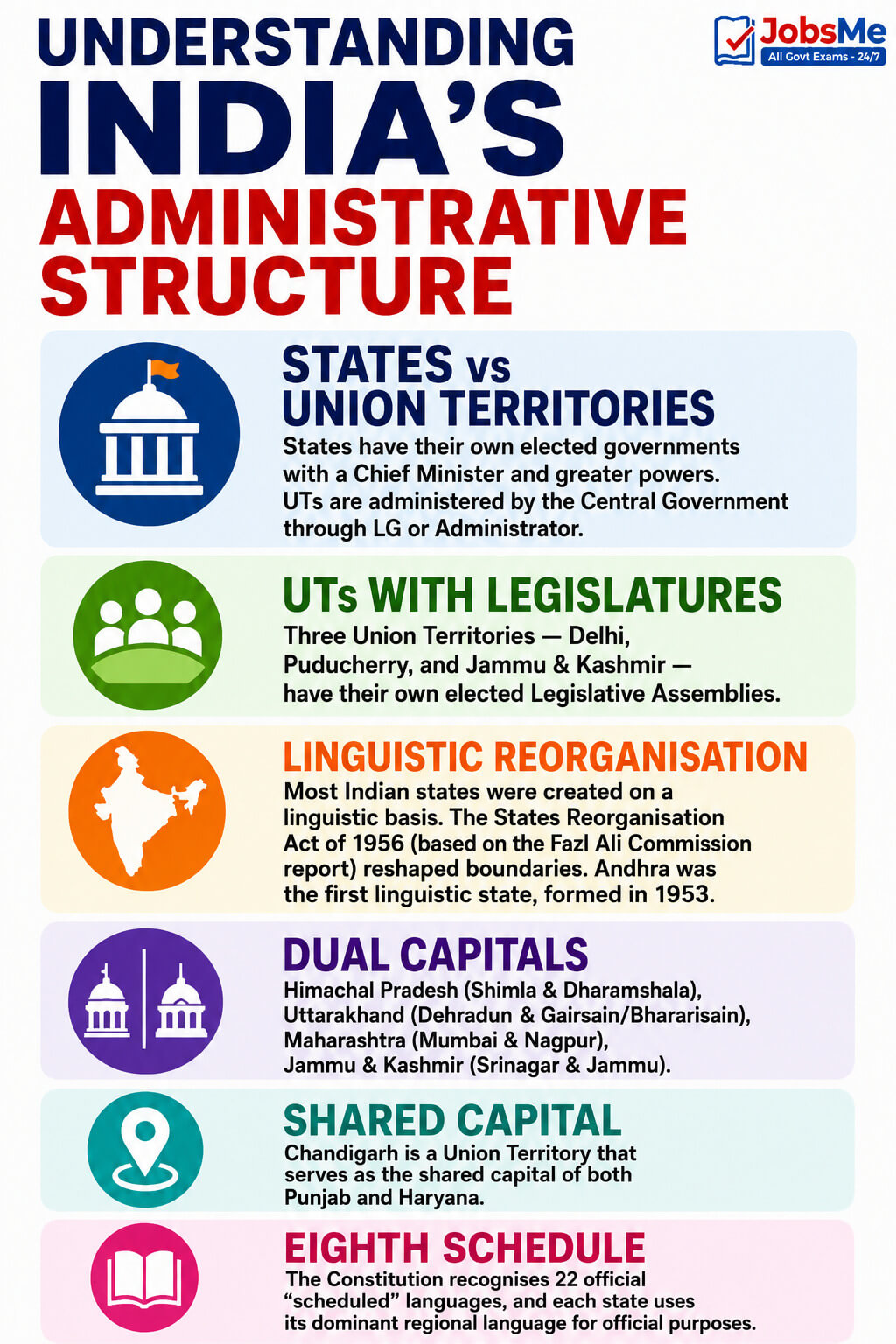
- States vs Union Territories: States have their own elected governments with a Chief Minister and greater legislative powers. Union Territories are administered directly by the Central Government through a Lieutenant Governor or Administrator appointed by the President.
- UTs with legislatures: Three Union Territories — Delhi, Puducherry, and Jammu and Kashmir — have their own elected Legislative Assemblies, giving them partial self-governance.
- Linguistic reorganisation: Most Indian states were created on a linguistic basis. The States Reorganisation Act of 1956 (based on the Fazl Ali Commission report) reshaped state boundaries by language. Andhra was the first linguistic state, formed in 1953.
- Dual capitals: Some states and UTs use seasonal or dual capitals — Himachal Pradesh (Shimla and Dharamshala), Uttarakhand (Dehradun and Gairsain/Bhararisain), Maharashtra (Mumbai and Nagpur), and Jammu and Kashmir (Srinagar and Jammu).
- Shared capital: Chandigarh is a Union Territory that serves as the shared capital of both Punjab and Haryana.
- Eighth Schedule: The Constitution recognises 22 official "scheduled" languages, and each state uses its dominant regional language for official purposes.
State-wise Profile of Indian States - Capitals, Formation & Languages
The following table lists all 28 Indian states along with their capitals, formation dates, official languages, and the most exam-relevant key facts. The states are arranged alphabetically, the format most commonly used in competitive exams.
| State | Capital | Formation Date | Official Language | Key Facts / Nickname |
|---|---|---|---|---|
| Andhra Pradesh | Amaravati | 1 October 1953 (first linguistic state); reorganised 1 November 1956 | Telugu | Known as the "Rice Bowl of India"; first state formed on a linguistic basis; Amaravati declared the sole capital after the three-capital model was scrapped. |
| Arunachal Pradesh | Itanagar | 20 February 1987 | English | Known as the "Land of the Dawn-Lit Mountains" / "Land of the Rising Sun"; easternmost state; shares international borders with China, Myanmar, and Bhutan. |
| Assam | Dispur | 26 January 1950 | Assamese | Gateway to North-East India; famous for Assam tea, Kaziranga National Park (one-horned rhinoceros), and the Brahmaputra river. |
| Bihar | Patna | 26 January 1950 (reorganised 2000) | Hindi | Ancient land of Magadha, Nalanda, and the Mauryan Empire; Jharkhand was carved out of Bihar in 2000. |
| Chhattisgarh | Raipur | 1 November 2000 | Hindi | Known as the "Rice Bowl of Central India"; carved out of Madhya Pradesh; rich in minerals and forests; Nava Raipur (Atal Nagar) is the planned new capital. |
| Goa | Panaji | 30 May 1987 | Konkani | Smallest Indian state by area; highest GDP per capita; a Portuguese colony until 1961; famous for beaches and tourism. |
| Gujarat | Gandhinagar | 1 May 1960 | Gujarati | Has the longest coastline in India (about 1,600 km); birthplace of Mahatma Gandhi and Sardar Patel; largest city is Ahmedabad; formed by splitting Bombay State. |
| Haryana | Chandigarh | 1 November 1966 | Hindi | Carved out of Punjab; shares Chandigarh as capital with Punjab; Gurugram is a major IT and automobile hub; part of the National Capital Region (NCR). |
| Himachal Pradesh | Shimla (summer), Dharamshala (winter) | 25 January 1971 | Hindi | Himalayan state with dual capitals; home of the Dalai Lama in Dharamshala; known for apple orchards and hill stations. |
| Jharkhand | Ranchi | 15 November 2000 | Hindi | Carved out of Bihar on the birth anniversary of Birsa Munda; rich in coal, iron, mica, and uranium; large tribal population. |
| Karnataka | Bengaluru | 1 November 1956 (renamed from Mysore State in 1973) | Kannada | "Silicon Valley of India"; Bengaluru is the IT capital; only southern state bordering all four other South Indian states. |
| Kerala | Thiruvananthapuram | 1 November 1956 | Malayalam | Highest literacy rate in India; known as "God's Own Country"; famous for backwaters, the Malabar Coast, and spices. |
| Madhya Pradesh | Bhopal | 1 November 1956 | Hindi | Known as the "Heart of India" due to its central location; second-largest state by area; has the most tiger reserves; Bhopal is the "City of Lakes." |
| Maharashtra | Mumbai (Nagpur is the winter/second capital) | 1 May 1960 | Marathi | Mumbai is India's financial capital, home to RBI, SEBI, and the Bombay Stock Exchange; Maharashtra Day is celebrated on 1 May; formed by splitting Bombay State. |
| Manipur | Imphal | 21 January 1972 | Manipuri (Meitei) | Known as the "Jewel of India"; birthplace of modern polo; Loktak Lake with floating phumdis is located here. |
| Meghalaya | Shillong | 21 January 1972 | English | Known as the "Abode of Clouds"; Mawsynram and Cherrapunji receive the highest rainfall in the world; carved out of Assam. |
| Mizoram | Aizawl | 20 February 1987 | Mizo | Known as the "Land of the Highlanders"; one of the highest literacy rates in India; predominantly Christian and tribal population. |
| Nagaland | Kohima | 1 December 1963 | English | Known as the "Land of Festivals"; famous for the Hornbill Festival; first North-Eastern state to achieve statehood after independence. |
| Odisha | Bhubaneswar | 26 January 1950 (Odisha Day / Utkal Divas: 1 April) | Odia | Known as the "Temple State of India" / "Soul of Incredible India"; famous for the Jagannath Temple (Puri), Konark Sun Temple, and Chilika Lake. |
| Punjab | Chandigarh | 1 November 1966 | Punjabi | Known as the "Land of Five Rivers" and the "Granary of India"; shares Chandigarh as capital with Haryana; home of the Golden Temple, Amritsar. |
| Rajasthan | Jaipur | 1 November 1956 | Hindi | Largest Indian state by area; known as the "Land of Kings" (Rajputana); contains the Thar Desert; Jaipur is the "Pink City." |
| Sikkim | Gangtok | 16 May 1975 | Nepali, English, Sikkimese, Lepcha | Least populous Indian state; became a full state through the 36th Constitutional Amendment (1975); India's first fully organic state; Kanchenjunga lies here. |
| Tamil Nadu | Chennai | 26 January 1950 (renamed from Madras State in 1969) | Tamil | Known as the "Land of Temples"; Chennai is the "Detroit of India" (automobile hub); shares a maritime border with Sri Lanka. |
| Telangana | Hyderabad | 2 June 2014 | Telugu, Urdu | Youngest / newest Indian state; carved out of Andhra Pradesh; Hyderabad is famous for Charminar and as a major IT and pharmaceutical hub. |
| Tripura | Agartala | 21 January 1972 | Bengali, Kokborok | Third-smallest state in the country; surrounded on three sides by Bangladesh; ruled by the Manikya dynasty before independence. |
| Uttar Pradesh | Lucknow | 26 January 1950 | Hindi | Most populous Indian state; shares borders with the highest number of states; home of the Taj Mahal (Agra), Varanasi, and Ayodhya. |
| Uttarakhand | Dehradun (winter), Gairsain/Bhararisain (summer) | 9 November 2000 | Hindi, Sanskrit | Known as "Devbhumi" (Land of the Gods); carved out of Uttar Pradesh; the only state to recognise Sanskrit as an official language; source of the Ganga and Yamuna. |
| West Bengal | Kolkata | 26 January 1950 | Bengali | Known as the "Cultural Capital of India"; home to the Sundarbans mangroves and Darjeeling Himalayas; Kolkata was the first capital of British India. |
Union Territories of India - Capitals and Key Facts
India has 8 Union Territories. The table below lists each UT with its capital and the most important exam facts. You can practise more such questions on the Static GK Quiz on thejobsme.com.
| Union Territory | Capital | Key Facts |
|---|---|---|
| Andaman and Nicobar Islands | Sri Vijaya Puram (formerly Port Blair) | Known as the "Emerald Islands"; located in the Bay of Bengal; capital renamed from Port Blair to Sri Vijaya Puram in 2024; home to the Cellular Jail. |
| Chandigarh | Chandigarh | Shared capital of Punjab and Haryana; designed by architect Le Corbusier; administered by the Punjab Governor; has no legislature or Chief Minister. |
| Dadra and Nagar Haveli and Daman and Diu | Daman | Formed by merging two former UTs on 26 January 2020; former Portuguese territories liberated in 1954 and 1961. |
| Delhi (NCT) | New Delhi | National Capital Territory governed under Article 239AA; has an elected Legislative Assembly and Chief Minister; New Delhi is the capital of India. |
| Jammu and Kashmir | Srinagar (summer), Jammu (winter) | Became a UT on 31 October 2019 after the J&K Reorganisation Act; has an elected Legislative Assembly; follows a dual-capital arrangement. |
| Ladakh | Leh (Kargil is the second headquarters) | Became a UT without a legislature on 31 October 2019; high-altitude cold desert; known as the "Land of High Passes." |
| Lakshadweep | Kavaratti | Smallest UT by area and population; group of coral islands in the Arabian Sea; the name means "a hundred thousand islands." |
| Puducherry | Puducherry | Former French colony handed over to India in 1954; has an elected Legislative Assembly; consists of four scattered districts — Puducherry, Karaikal, Mahe, and Yanam. |
Important State Superlatives and Records
Examiners love testing "which state is the largest/smallest/highest" type questions. The table below groups the most frequently asked superlatives.
| Record / Superlative | State / UT | Key Details |
|---|---|---|
| Largest state by area | Rajasthan | About 342,239 sq km; contains most of the Thar Desert; larger than several European countries. |
| Smallest state by area | Goa | About 3,702 sq km; also has the highest GDP per capita among Indian states. |
| Most populous state | Uttar Pradesh | Over 200 million people; would rank among the most populous countries if independent. |
| Least populous state | Sikkim | Just over 6 lakh residents as per the 2011 Census. |
| Highest literacy rate | Kerala | Consistently ranks first in literacy in India. |
| Longest coastline (state) | Gujarat | About 1,600 km, the longest among all Indian states. |
| Newest / youngest state | Telangana | Formed on 2 June 2014 from Andhra Pradesh. |
| State bordering the most states | Uttar Pradesh | Shares boundaries with eight states and one UT. |
| Largest UT by population | Delhi | Over 1.6 crore people; functions as the National Capital Territory. |
| Smallest UT by population | Lakshadweep | Fewest residents among all UTs; a coral-island archipelago. |
Memory Tricks and Mnemonics
Trick 1: States Formed in the Year 2000 — "CUJ"
Three states were created in the year 2000. Remember them with the acronym "CUJ" in their order of formation:
- C → Chhattisgarh (1 November 2000) — from Madhya Pradesh.
- U → Uttarakhand (9 November 2000) — from Uttar Pradesh.
- J → Jharkhand (15 November 2000) — from Bihar.
"CUJ all in 2000; Telangana came later in 2014."
Trick 2: The Seven Sisters of the North-East
The seven North-Eastern states are called the "Seven Sisters." Use the sentence "MMM ANT":
- M → Manipur.
- M → Meghalaya.
- M → Mizoram.
- A → Arunachal Pradesh and Assam.
- N → Nagaland.
- T → Tripura.
"Sikkim is the lone brother — geographically North-East, but not a Seven Sister."
Trick 3: States Formed on the Same Day — "MMT on 21 Jan 1972"
Three North-Eastern states gained statehood on the same date, 21 January 1972. Remember them as "MMT":
- M → Manipur.
- M → Meghalaya.
- T → Tripura.
Trick 4: Largest vs Smallest — "Raj is King, Goa is Guest"
To never confuse the largest and smallest states by area:
- Rajasthan → the "Raj" (King) of area — the largest state.
- Goa → the tiny "Guest" — the smallest state.
"Big Raj, tiny Goa."
Trick 5: Dual-Capital States — "HUM-J"
States and UTs with two capitals can be grouped as "HUM-J":
- H → Himachal Pradesh (Shimla summer, Dharamshala winter).
- U → Uttarakhand (Gairsain summer, Dehradun winter).
- M → Maharashtra (Mumbai main, Nagpur winter).
- J → Jammu and Kashmir (Srinagar summer, Jammu winter).
Trick 6: Southern States and Their Languages — "TKK-MT"

Match the five southern states with their official languages:
- Tamil Nadu → Tamil.
- Kerala → Malayalam.
- Karnataka → Kannada.
- Andhra Pradesh → Telugu.
- Telangana → Telugu (with Urdu).
"Two Telugu twins — Andhra and Telangana — split in 2014."
Trick 7: "Rice Bowls" of India
Several regions are called a "Rice Bowl." Group them to avoid confusion:
- Rice Bowl of India → Andhra Pradesh.
- Rice Bowl of Central India → Chhattisgarh.
- Granary of India → Punjab (also "Land of Five Rivers").
Additional Notes
Frequently Confused Facts
- Andhra Pradesh vs Telangana capital: Amaravati is the capital of Andhra Pradesh; Hyderabad is the capital of Telangana (it served as a shared capital for a transitional period after 2014).
- Chandigarh: It is the shared capital of both Punjab and Haryana and is itself a Union Territory — not a city within either state.
- Karnataka name change: It was created as Mysore State in 1956 and renamed Karnataka in 1973.
- Tamil Nadu name change: It was Madras State until it was renamed Tamil Nadu in 1969.
- Telangana vs Uttarakhand: Telangana (2014) is the newest state; Uttarakhand (2000) is older — do not confuse "newest state" with the 2000 batch.
- Goa formation: Goa became a full state on 30 May 1987, not in 1961 (1961 is when it was annexed from Portugal).
- Sikkim: It is the least populous state, not the smallest by area (that is Goa).
- Largest state vs largest by population: Rajasthan is the largest by area; Uttar Pradesh is the largest by population.
- Seven Sisters vs Sikkim: Sikkim is geographically in the North-East but is not counted among the "Seven Sisters."
- Jammu and Kashmir vs Ladakh: Both became UTs on 31 October 2019, but J&K has a Legislative Assembly while Ladakh does not.
- Port Blair renaming: The capital of the Andaman and Nicobar Islands was renamed from Port Blair to Sri Vijaya Puram in 2024.
- Sanskrit official language: Uttarakhand is the only state to recognise Sanskrit as one of its official languages.
Repeating PYQ Patterns
Certain state-wise facts are asked repeatedly in competitive exams. The current count of 28 states and 8 UTs, the newest state (Telangana, 2014), the states formed in 2000 (Chhattisgarh, Uttarakhand, Jharkhand), the shared capital Chandigarh, the largest state (Rajasthan), the smallest state (Goa), the most populous state (Uttar Pradesh), and the dual capitals of Jammu and Kashmir appear most often in UPSC Prelims, SSC CGL, and RRB NTPC papers. Banking exams (IBPS PO, SBI Clerk) frequently focus on matching states with their capitals and official languages. State PCS exams add region-specific facts — Andhra PCS asks about Amaravati and the Rice Bowl of India, Bihar PCS about the Jharkhand bifurcation, Tamil Nadu PCS about the Madras-to-Tamil-Nadu renaming, and North-East PCS exams about the Seven Sisters and Sixth Schedule areas.
Quick Insight
India's map is not fixed geometry — it is a living record of the Constitution in action. Article 3 allows Parliament to create new states, alter boundaries, and rename or merge territories, which is exactly how Telangana was born in 2014 and how Jammu and Kashmir was reorganised in 2019. Recent developments such as the renaming of Port Blair to Sri Vijaya Puram, the confirmation of Amaravati as Andhra Pradesh's sole capital, and ongoing statehood demands like Gorkhaland, Bodoland, and Vidarbha keep this topic constantly relevant for current affairs. Understanding each state's profile helps aspirants quickly connect any geography, polity, or current affairs reference to the correct state, which is invaluable for both Prelims (direct matching questions) and Mains (essays on federalism and reorganisation). For further reading on related Static GK topics, you can refer to the Static GK section and stay updated with the Daily Current Affairs notes on thejobsme.com.
One-Liners for Quick Revision
- Andhra Pradesh → Capital Amaravati → Telugu → Rice Bowl of India, first linguistic state.
- Arunachal Pradesh → Capital Itanagar → English → Land of the Dawn-Lit Mountains.
- Assam → Capital Dispur → Assamese → Famous for tea and the one-horned rhinoceros.
- Bihar → Capital Patna → Hindi → Ancient land of Magadha and Nalanda.
- Chhattisgarh → Capital Raipur → Hindi → Formed 2000, Rice Bowl of Central India.
- Goa → Capital Panaji → Konkani → Smallest state by area, formed 1987.
- Gujarat → Capital Gandhinagar → Gujarati → Longest coastline in India.
- Haryana → Capital Chandigarh → Hindi → Formed 1966, part of NCR.
- Himachal Pradesh → Capitals Shimla and Dharamshala → Hindi → Himalayan state, home of the Dalai Lama.
- Jharkhand → Capital Ranchi → Hindi → Formed 2000, rich in minerals.
- Karnataka → Capital Bengaluru → Kannada → Silicon Valley of India, renamed from Mysore in 1973.
- Kerala → Capital Thiruvananthapuram → Malayalam → Highest literacy, God's Own Country.
- Madhya Pradesh → Capital Bhopal → Hindi → Heart of India, most tiger reserves.
- Maharashtra → Capital Mumbai (Nagpur winter) → Marathi → Financial capital of India.
- Manipur → Capital Imphal → Manipuri → Jewel of India, birthplace of modern polo.
- Meghalaya → Capital Shillong → English → Abode of Clouds, highest rainfall (Mawsynram).
- Mizoram → Capital Aizawl → Mizo → Formed 1987, high literacy.
- Nagaland → Capital Kohima → English → Land of Festivals, statehood 1963.
- Odisha → Capital Bhubaneswar → Odia → Temple State, Jagannath and Konark temples.
- Punjab → Capital Chandigarh → Punjabi → Land of Five Rivers, Granary of India.
- Rajasthan → Capital Jaipur → Hindi → Largest state by area, Land of Kings.
- Sikkim → Capital Gangtok → Nepali → Least populous state, first organic state, statehood 1975.
- Tamil Nadu → Capital Chennai → Tamil → Land of Temples, renamed from Madras in 1969.
- Telangana → Capital Hyderabad → Telugu → Newest state, formed 2 June 2014.
- Tripura → Capital Agartala → Bengali, Kokborok → Surrounded by Bangladesh on three sides.
- Uttar Pradesh → Capital Lucknow → Hindi → Most populous state, borders most states.
- Uttarakhand → Capitals Dehradun and Gairsain → Hindi, Sanskrit → Devbhumi, formed 2000.
- West Bengal → Capital Kolkata → Bengali → Cultural Capital, Sundarbans and Darjeeling.
- Andaman and Nicobar Islands → Capital Sri Vijaya Puram → Emerald Islands, Cellular Jail.
- Chandigarh → Capital Chandigarh → Shared capital of Punjab and Haryana, designed by Le Corbusier.
- Dadra and Nagar Haveli and Daman and Diu → Capital Daman → Merged into one UT in 2020.
- Delhi → Capital New Delhi → National Capital Territory, Article 239AA.
- Jammu and Kashmir → Capitals Srinagar and Jammu → UT since 2019, has an Assembly.
- Ladakh → Capital Leh → UT since 2019, Land of High Passes, no legislature.
- Lakshadweep → Capital Kavaratti → Smallest UT, coral islands in the Arabian Sea.
- Puducherry → Capital Puducherry → Former French colony, has an Assembly.
For more Static GK topics like Indian rivers, dances, and national parks, explore the Static GK section on thejobsme.com. You can also test your knowledge with the Static GK Quiz and check out the latest exam notifications at Latest Government Job Notifications.
Free quiz • No signup required
Put this topic into practice with Indian Cultural Institutions – Static GK MCQ Quiz. It is the quickest way to reinforce what you just learned.
Frequently Asked Questions
How many states and union territories does India have in 2026?
Which is the newest state of India?
Which is the largest and which is the smallest state of India by area?
Which three states were formed in the year 2000?
Why is Chandigarh special among Indian capitals?
Which Indian state is known as the Land of Five Rivers?
Which state has the highest literacy rate and which is the least populous?
What is the capital of Andhra Pradesh and how is it different from Telangana's capital?
Which Union Territories have their own elected legislative assemblies?
What is the new name of Port Blair, the capital of the Andaman and Nicobar Islands?

About the author