RBI Governors List 1935 to 2026 and Functions of RBI: Complete Static GK Notes for Competitive Exams
This article gives the complete list of all 26 Reserve Bank of India Governors from Sir Osborne Smith in 1935 to Sanjay Malhotra in 2026, along with their exact tenures and key contributions. It also covers the establishment, structure, powers and core functions of the RBI in one place. Every fact here is directly exam-oriented for UPSC, SSC, IBPS, RRB, Insurance and State PCS General Awareness papers.
Jump to section
- Introduction
- Core Concept Explanation
- RBI at a Glance: Foundation Facts
- Complete List of RBI Governors from 1935 to 2026
- Current RBI Leadership in 2026
- Appointment, Eligibility and Tenure of the RBI Governor
- Powers and Responsibilities of the RBI Governor
- Functions of the Reserve Bank of India
- Structure and Offices of the RBI
- RBI Surplus Transfer and Autonomy
- Significance and Criticism of the RBI
- Memory Tricks and Mnemonics
- Additional Notes
- One-Liners for Quick Revision
Introduction
The Reserve Bank of India (RBI) is the central bank of India and the single most important institution in the country's financial system. It was established on 1 April 1935 under the Reserve Bank of India Act, 1934, on the recommendation of the Hilton Young Commission. The RBI began life as a privately owned bank and was nationalised on 1 January 1949. Its headquarters were originally in Kolkata (then Calcutta) and were shifted to Mumbai in 1937, where the Central Office remains today.
For anyone preparing for a government job, the topic of RBI Governors and Functions is unavoidable. Questions on the first Governor, the first Indian Governor, the current Governor, the longest and shortest tenures, and the core functions of the RBI appear year after year in SSC CGL, IBPS PO and Clerk, RRB NTPC, Insurance, PSU and UPSC Prelims. This topic sits at the intersection of Static GK and Banking Awareness, which makes it doubly valuable. If you want to build your foundation in this area first, our banking awareness study notes are the right place to begin.
This article organises the entire topic into clean tables, memory tricks and one-liners so that you can revise it in ten minutes before an exam. Alongside your reading, keep tracking daily current affairs updates, because RBI leadership changes and monetary policy decisions are among the most frequently asked current affairs items in every banking exam.
Core Concept Explanation
Before memorising the list of Governors, it helps to be clear about what the RBI is and what the Governor actually does. A central bank is not an ordinary commercial bank. You cannot open a savings account with the RBI. Instead, it is the bank that regulates all other banks, issues the country's currency, and manages the money supply of the entire economy.
- Central Bank: The apex monetary institution of a country. In India, this is the RBI, which controls currency, credit and the banking system.
- Governor: The chief executive of the RBI. The Governor is also the ex-officio Chairman of the Central Board of Directors and the Chief Executive Officer of the Bank.
- Hilton Young Commission: Formally the Royal Commission on Indian Currency and Finance, 1926. It recommended the creation of an Indian central bank, which led directly to the RBI Act, 1934.
- Nationalisation: The transfer of RBI ownership from private shareholders to the Government of India under the Reserve Bank of India (Transfer to Public Ownership) Act, 1948, effective 1 January 1949. The RBI has been fully government-owned since then.
- Monetary Policy: The set of tools, such as the repo rate and open market operations, by which the RBI controls the money supply, credit availability and inflation.
- Signature on Currency: Indian banknotes carry the signature of the sitting RBI Governor. The one rupee note is the exception: it is issued by the Government of India and bears the signature of the Finance Secretary.
RBI at a Glance: Foundation Facts
These are the single-line facts that examiners convert into one-mark questions. Learn this table cold before moving to the Governors list.

| Particular | Detail and Key Features |
|---|---|
| Established On | 1 April 1935, under the Reserve Bank of India Act, 1934. Operations formally commenced on this date, making it the apex monetary authority of British India. |
| Governing Act | Reserve Bank of India Act, 1934. The Act was passed in 1934 and the Bank began functioning the following year, so the Act year and the establishment year are deliberately different. |
| Recommended By | Hilton Young Commission, formally the Royal Commission on Indian Currency and Finance, which proposed an Indian central bank in 1926. |
| Original Headquarters | Calcutta (Kolkata) at the time of foundation in 1935. This is a very common trap in objective papers. |
| Present Headquarters | Mumbai, shifted in 1937. The Central Office in Mumbai houses the Governor and is where all major decisions are taken. |
| Initial Ownership | Privately owned bank with shares held by individuals and private institutions. It was not a government body at birth. |
| Nationalised On | 1 January 1949, under the Reserve Bank of India (Transfer to Public Ownership) Act, 1948. Note that the Act is of 1948 but it took effect in 1949. |
| Colonial Distinction | India was the first British colony to establish its own central bank. The RBI also served as the central bank of Burma (Myanmar) until April 1947 and of Pakistan until June 1948. |
| Total Governors So Far | 26, counting from Sir Osborne Smith in 1935 to Sanjay Malhotra in 2026, including the short-serving interim Governors. |
| Current Governor | Sanjay Malhotra, the 26th Governor, in office since 11 December 2024. |
| Number of Deputy Governors | Four, appointed by the Central Government and forming part of the official directors on the Central Board. |
| Governor's Salary | Approximately Rs 2.5 lakh per month. The basic pay was Rs 90,000 before 2016 and was raised through two hikes implemented in 2017. |
Complete List of RBI Governors from 1935 to 2026
Since 1935, the RBI has been headed by a mix of British bankers, Indian civil servants, professional economists and career administrators. The table below merges the tenure dates and the exact length of each tenure with the contribution each Governor is remembered for. The four very short interim tenures, at serial numbers 5, 9, 11 and 16, are low-yield individually but are heavily used in "longest and shortest" questions, so do not skip them.
Full Chronological List with Tenure and Key Facts
| S. No. | Governor | Tenure | Length of Tenure | Key Exam Points |
|---|---|---|---|---|
| 1 | Sir Osborne Smith | 1 April 1935 to 30 June 1937 | 2 years and 91 days | First Governor of the RBI and an Australian professional banker. He worked at the Bank of New South Wales for two decades and the Commonwealth Bank of Australia for another decade, then became Managing Governor of the Imperial Bank of India. He differed with the Government on exchange rates and interest rates and resigned before completing his three-and-a-half-year term. He never signed a single banknote. |
| 2 | Sir James Braid Taylor | 1 July 1937 to 17 February 1943 | 5 years and 232 days | Second Governor and the only Governor to die while in office. He guided the Bank through the early years of the Second World War and through the shift from silver-based to paper currency. |
| 3 | Sir C. D. Deshmukh | 11 August 1943 to 30 June 1949 | 5 years and 325 days | First Indian Governor of the RBI. He handled the currency arrangements of Partition and the nationalisation of the Bank in January 1949. He later became the Union Finance Minister of India. |
| 4 | Sir Benegal Rama Rau | 1 July 1949 to 14 January 1957 | 7 years and 199 days | Longest-serving Governor in RBI history, at over seven years. A member of the Indian Civil Services, he resigned after differences with the then Finance Minister. |
| 5 | K. G. Ambegaonkar | 14 January 1957 to 28 February 1957 | 45 days | Interim Governor appointed to bridge the gap after Rama Rau's resignation. He did not serve a full term. |
| 6 | H. V. R. Iyengar | 1 March 1957 to 28 February 1962 | 5 years | Oversaw the introduction of decimal coinage in India and the adoption of the Minimum Reserve System for note issue. A former ICS officer. |
| 7 | P. C. Bhattacharya | 1 March 1962 to 30 June 1967 | 5 years and 122 days | Governor during the 1966 devaluation of the rupee and the early moves towards greater social control of banks. |
| 8 | L. K. Jha (Lakshmi Kant Jha) | 1 July 1967 to 3 May 1970 | 2 years and 307 days | Held office during the nationalisation of 14 major commercial banks in 1969, one of the most significant events in Indian banking history. |
| 9 | B. N. Adarkar | 4 May 1970 to 15 June 1970 | 42 days | Interim Governor and a professional economist. His 42-day term is the second shortest in RBI history. |
| 10 | S. Jagannathan (Sarukkai Jagannathan) | 16 June 1970 to 19 May 1975 | 4 years and 338 days | Presided over the post-nationalisation expansion of branch banking. He later represented India as Executive Director at the International Monetary Fund. |
| 11 | N. C. Sen Gupta | 19 May 1975 to 19 August 1975 | 92 days | Interim Governor who held charge for three months during a transitional period. |
| 12 | K. R. Puri | 20 August 1975 to 2 May 1977 | 1 year and 256 days | Governor through the Emergency period, when credit policy was tightly controlled by the Government. |
| 13 | M. Narasimham | 3 May 1977 to 30 November 1977 | 212 days | The only Governor to be promoted from within the RBI's own ranks. He later chaired the two Narasimham Committees on banking sector reform, which shaped India's post-liberalisation banking framework. |
| 14 | I. G. Patel | 1 December 1977 to 15 September 1982 | 4 years and 289 days | Oversaw the 1978 demonetisation of Rs 1,000, Rs 5,000 and Rs 10,000 notes. He later served as Director of the London School of Economics. |
| 15 | Manmohan Singh | 16 September 1982 to 14 January 1985 | 2 years and 120 days | The only RBI Governor who later became Prime Minister of India, serving from 2004 to 2014. He was also the Finance Minister who launched the 1991 economic reforms. A guaranteed favourite in exams. |
| 16 | Amitav Ghosh | 15 January 1985 to 4 February 1985 | 20 days | Shortest tenure of any RBI Governor. He served as an interim Governor for just twenty days. Do not confuse him with the novelist of a similar name. |
| 17 | R. N. Malhotra | 4 February 1985 to 22 December 1990 | 5 years and 321 days | Later chaired the Malhotra Committee on insurance sector reform, whose recommendations led to the opening up of insurance and the creation of the regulator for that sector. |
| 18 | S. Venkitaramanan | 22 December 1990 to 21 December 1992 | 2 years | Governor during the 1991 balance of payments crisis and the devaluation of the rupee that preceded liberalisation. |
| 19 | C. Rangarajan | 22 December 1992 to 21 November 1997 | 4 years and 335 days | Introduced the Liberalised Exchange Rate Management System and modernised monetary policy. He later chaired the Prime Minister's Economic Advisory Council and the Twelfth Finance Commission. |
| 20 | Bimal Jalan | 22 November 1997 to 6 September 2003 | 5 years and 289 days | Steered the economy through the Asian financial crisis and the post-1998 sanctions period. He later became a Member of Parliament and chaired the committee on the RBI's economic capital framework. |
| 21 | Y. V. Reddy | 6 September 2003 to 5 September 2008 | 5 years and 1 day | His tight prudential norms on bank lending are widely credited with insulating India from the worst of the 2008 global financial crisis. He later chaired the Fourteenth Finance Commission. |
| 22 | D. Subbarao | 5 September 2008 to 4 September 2013 | 5 years | Took charge days before the collapse of Lehman Brothers and managed India's response to the 2008 global financial crisis and the 2013 currency volatility. |
| 23 | Raghuram Rajan | 4 September 2013 to 4 September 2016 | 3 years and 1 day | Introduced a formal inflation-targeting framework and launched the Asset Quality Review that exposed hidden Non-Performing Assets (NPAs). A former Chief Economist of the International Monetary Fund, he pushed hard for banking transparency and restored investor confidence. |
| 24 | Urjit Patel | 4 September 2016 to 10 December 2018 | 2 years and 97 days | The Monetary Policy Committee became fully operational under him, improving transparency in interest-rate decisions. His term covered the 2016 demonetisation. He resigned before completing his term, an event linked in public debate to differences with the Government. |
| 25 | Shaktikanta Das | 12 December 2018 to 10 December 2024 | 6 years and 1 day | The longest-serving Governor of the post-liberalisation era. He guided the economy through the COVID-19 pandemic with an accommodative policy and heavy liquidity support, and oversaw the boom in digital payments and the launch of Digital Rupee pilots. |
| 26 | Sanjay Malhotra | 11 December 2024 to Present | In office | Current and 26th Governor of the RBI. A 1990-batch IAS officer of the Rajasthan cadre and former Revenue Secretary in the Ministry of Finance. He holds a Computer Science degree from IIT Kanpur and a Master's in Public Policy from Princeton University. His focus areas are digital financial infrastructure, cybersecurity and stronger regulatory oversight. |
Key Highlights of the Governors List
- First Governor: Sir Osborne Smith, a British-era Australian banker.
- First Indian Governor: Sir C. D. Deshmukh.
- Longest tenure: Sir Benegal Rama Rau, over seven years.
- Shortest tenure: Amitav Ghosh, only 20 days.
- Current Governor: Sanjay Malhotra, the 26th Governor, appointed on 11 December 2024.
- Only Governor to become Prime Minister: Dr Manmohan Singh.
- Only Governor to die in office: Sir James Braid Taylor.
Current RBI Leadership in 2026
Alongside the Governor, the RBI's top management includes four Deputy Governors, each holding a defined portfolio. This composition is asked directly in banking exams, and it changes from time to time, so revise it alongside your regular current affairs preparation.
| Position | Name | Portfolio and Key Features |
|---|---|---|
| Governor | Sanjay Malhotra | 26th Governor, in office since 11 December 2024. Chief Executive Officer of the RBI, ex-officio Chairman of the Central Board and Chairperson of the Monetary Policy Committee. |
| Deputy Governor | Rohit Jain | Appointed with effect from 3 May 2026. Oversees financial markets regulation, foreign exchange, fintech, payment and settlement systems, risk monitoring, information technology, and government and bank accounts. He replaced T. Rabi Sankar, whose tenure ended in April 2026 after extensions granted in 2024 and 2025. |
| Deputy Governor | Swaminathan Janakiraman | Handles supervision, financial inclusion and the legal functions of the Bank. |
| Deputy Governor | Poonam Gupta | Oversees monetary policy and economic research, including the Monetary Policy Department. |
| Deputy Governor | Shirish Chandra Murmu | In charge of currency management, regulation and payment systems. |
Appointment, Eligibility and Tenure of the RBI Governor
Appointment Process
The Governor of the RBI is appointed by the Central Government. In practice, the Financial Sector Regulatory Appointments Search Committee (FSRASC), headed by the Cabinet Secretary, shortlists candidates, and the final approval is given by the Appointments Committee of the Cabinet (ACC), which is headed by the Prime Minister. The Ministry of Finance is closely involved in the process. The appointment involves a formal notification, after which the appointee assumes charge as both Chief Executive Officer and Chairman of the Central Board.
Eligibility Criteria
There is no rigid statutory qualification laid down in the RBI Act. In the early decades the post went almost exclusively to members of the Indian Civil Services, such as C. D. Deshmukh and Benegal Rama Rau. Over time the pool widened, and the criteria that are generally listed for exam purposes are given below.
- The candidate must be a citizen of India.
- A graduate or postgraduate degree, or a Chartered Accountancy qualification, is the basic educational requirement.
- The candidate should have worked in at least one of the following: the IMF or the World Bank, as Chairman or General Manager of a bank, in a reputed financial or banking organisation, or in the Ministry of Finance, Government of India.
- One commonly cited minimum age is 35 years and above, while another widely quoted benchmark is an age band of 40 to 60 years with roughly 20 years of experience in banking, finance, economics or a related sector, including a senior position in a banking or financial institution.
- The candidate must not be a member of Parliament or a State Legislature and must not hold any other office of profit.
- The candidate should not be connected with any political party or political organisation.
Tenure and Removal
- The tenure is fixed by the Reserve Bank of India Act, 1934, and not by the Constitution. This is a frequent trap in objective papers.
- The conventional term is three years, and it can be extended by up to two more years. Reappointment is permitted.
- Actual tenures have varied enormously, from 20 days at the shortest to over seven years at the longest.
- A Governor can leave office in two ways: dismissal by the President, or resignation submitted to the President.
Powers and Responsibilities of the RBI Governor
Powers of the Governor
- Acts as the banker's banker for the entire banking system.
- Heads and directs all commercial banks in matters of regulation and supervision.
- Exercises influence over both micro and macro economic conditions.
- Exercises influence over the stock market through interest-rate and liquidity decisions.
- Places his or her signature on currency notes, the most visible symbol of the office.
- Holds control over the monetary, currency and credit systems of the country.
Responsibilities of the Governor
- Maintaining monetary stability in the economy and formulating the policies of the Reserve Bank.
- Issuing licences for new foreign and private banks.
- Controlling interest rates on advances and deposits, though this power is limited to prescribing minimum lending rates and interest rates on savings accounts.
- Regulating and administering the financial system and setting the parameters within which it operates.
- Managing external trade and payments and developing an orderly foreign exchange market under the Foreign Exchange Management Act, 1999.
- Monitoring the adequate supply of currency notes and coins, and the issuance and destruction of notes unfit for circulation.
- Keeping rules and regulations under review to make them more customer-friendly.
- Leading and supervising primary co-operative banks through the Urban Banks Department.
- Facilitating and monitoring the flow of credit to small-scale industries and to the rural and agricultural sectors, and regulating state co-operative banks, regional rural banks and local area banks.
- Representing the RBI at national and international forums and safeguarding the integrity of the financial system.
Functions of the Reserve Bank of India
The functions of the RBI are the second half of this topic and are asked just as often as the Governors list. Every function below has appeared in one form or another in banking and SSC papers. To test yourself on these after reading, try our banking awareness practice quizzes.
| Function | Description and Key Features |
|---|---|
| Monetary Authority | Formulates, implements and monitors India's monetary policy. The primary goal is price stability while keeping the objective of economic growth in view. Tools include repo rate adjustments and open market operations to influence money supply and inflation. |
| Regulator and Supervisor of the Financial System | Sets broad parameters for banks and financial institutions to maintain public confidence, protect depositors and promote cost-effective banking services. The core banking solution platform e-Kuber enables real-time centralised operations, seamless fund transfers and improved risk management. |
| Manager of Foreign Exchange | Administers the Foreign Exchange Management Act (FEMA), 1999, facilitates external trade and payments, and promotes the orderly development of the foreign exchange market in India. |
| Issuer of Currency | Issues, exchanges and destroys currency notes, ensuring an adequate supply of clean notes. Has launched pilots for the Central Bank Digital Currency (CBDC), the Digital Rupee (e-rupee), in both wholesale and retail segments. |
| Developmental Role | Undertakes promotional functions supporting national objectives, including financial inclusion, poverty alleviation, rural credit and infrastructure development. |
| Regulator of Payment and Settlement Systems | Introduces and upgrades safe and efficient payment modes, maintaining public confidence in the safety, efficiency and reliability of the payment and settlement system. |
| Banker to the Government | Performs merchant banking functions for the Central and State Governments, manages government banking transactions, handles public debt management and the issuance of government securities. |
| Banker to Banks | Maintains the banking accounts of all scheduled banks and acts as the lender of last resort, providing liquidity support to banks when required. |
Objectives of the RBI
- Monetary Stability: Maintaining price stability and ensuring an adequate flow of credit to productive sectors through reserve measures.
- Financial Stability: Regulating and supervising the financial system and protecting the interests of depositors.
- Currency Management: Managing the currency and ensuring its smooth distribution across the country.
- Economic Growth: Supporting the economic policies of the Government aimed at growth and development.
- Regulation of Financial Institutions: Ensuring the stability and soundness of the financial system.
- Developmental Role: Promoting financial inclusion and extending banking services to rural and semi-urban areas.
Structure and Offices of the RBI
Central Board and Local Boards
| Body | Composition and Key Features |
|---|---|
| Central Board of Directors | A 21-member body appointed by the Government of India under the RBI Act for a four-year term. It consists of official directors, namely the Governor and up to four Deputy Governors, and non-official directors, namely ten nominees from various fields, four representatives of the Local Boards and two Government officials. The Governor is its ex-officio Chairman. |
| Local Boards | Four Local Boards representing the Western, Eastern, Northern and Southern areas. Each Local Board has five members appointed by the Central Government for a term of four years. They represent regional and territorial interests before the Central Board. |
Offices of the RBI
| Type of Office | Location and Key Features |
|---|---|
| Central Office | Located in Mumbai. Serves as the headquarters, houses the Governor, and is where the entire organisation is managed and major policy decisions are taken. |
| Zonal Offices (4) | Mumbai (West), Delhi (North), Chennai (South) and Kolkata (East). These four offices oversee operations across their respective regions. |
| Regional Offices (around 22) | Mainly located in state capital cities. They implement RBI policy at the local level and coordinate with banks and financial institutions in their regions. |
| Other Offices and Centres | Specialised departments for rural credit and planning, training centres for bank officials, and facilities to monitor specific financial sectors in important cities. |
Acts Administered by the RBI
| Act | Year and Key Features |
|---|---|
| Reserve Bank of India Act | 1934. The parent legislation that created the RBI and defines its powers, structure and functions. |
| Public Debt Act / Government Securities Act | 1944 and 2006. Govern the management of government borrowing and the issue of government securities. |
| Government Securities Regulations | 2007. Operational rules framed under the Government Securities Act. |
| Banking Regulation Act | 1949. The principal law for licensing, regulating and supervising banking companies in India. |
| Foreign Exchange Management Act (FEMA) | 1999. Governs foreign exchange transactions, external trade and payments, and foreign direct investment compliance. |
| SARFAESI Act (Chapter II) | 2002. Securitisation and Reconstruction of Financial Assets and Enforcement of Security Interest Act, used in recovering bad loans. |
| Credit Information Companies (Regulation) Act | 2005. Regulates credit bureaus and the sharing of credit information. |
| Payment and Settlement Systems Act | 2007. Gives the RBI statutory authority over payment systems in India. |
| Factoring Regulation Act | 2011. Regulates factoring businesses and the assignment of receivables. |
Major RBI Publications
- Annual Report: A detailed summary of the Reserve Bank's functions, key operations and an overview of the economy for the financial year.
- Financial Stability Report (FSR): Reviews potential threats to the financial system and assesses how the system holds up under stress.
- Monetary Policy Report (MPR): Outlines monetary policy decisions, the current economic scenario and future inflation expectations.
- Handbook of Statistics on the Indian Economy: Long-term data on economic indicators for researchers and policymakers.
RBI Surplus Transfer and Autonomy
RBI Surplus Transfer
The RBI surplus is what remains after deducting the Bank's total expenditure from its total income. Because RBI expenses are roughly one-seventh of its income, the remaining amount is substantial. A portion is retained as equity capital to preserve financial strength and the rest is transferred to the Central Government.
- Government's view: The RBI should transfer a higher dividend, since reserves such as the Contingency Fund are argued to be larger than needed for credit stability.
- RBI's view: Higher transfers could raise inflation by increasing the money supply, and surplus funds are needed to manage currency fluctuations and unexpected financial shocks.
- Advantages: Boosts government spending and revives growth, reduces government borrowing needs and leaves more credit space for the private sector, and supports recapitalisation of public sector banks.
- Disadvantages: Weakens the RBI's financial buffer and independence, limits crisis-management capacity, and improper use of funds could fuel inflation and dent market confidence.
Autonomy of the RBI
- Although the Ministry of Finance oversees the RBI, the Bank is expected to operate independently, especially on monetary policy, so that decisions remain unbiased and effective.
- Section 7(1) of the RBI Act, 1934 empowers the Union Government to give directions to the central bank in the public interest, after consultation with the Governor. This provision is the focal point of every autonomy debate.
- Surplus transfers, the size of the contingency fund and the RBI's credibility have all been the subject of public debate between the Bank and the Government.
Significance and Criticism of the RBI
Significance
- Monetary policy and stability: The flexible inflation-targeting framework has helped keep inflation within target ranges and support economic stability.
- Foreign exchange management: The RBI is the primary regulatory authority for monitoring Foreign Direct Investment (FDI) compliance under FEMA, working with the Government of India. As of May 2025, India's foreign exchange reserves stood at around 685 billion US dollars, providing an import cover of about ten months.
- Currency management: Ensures the public has access to sufficient and good-quality currency. During the 2016 demonetisation, the RBI managed the withdrawal of Rs 500 and Rs 1,000 notes, which formed 86 per cent of the currency in circulation.
- Financial inclusion: Initiatives such as the Pradhan Mantri Jan Dhan Yojana (PMJDY) brought millions of unbanked people into the formal system. By March 2025, PMJDY had opened over 55.02 crore bank accounts.
Criticism
- Government interference: Concerns that political pressure undermines RBI autonomy. The 2018 resignation of Governor Urjit Patel was reportedly linked to disagreements with the Government.
- Policy delays and effectiveness: A conservative approach can slow implementation, and the efficacy of policy is questioned when economic conditions and capital flows change rapidly.
- Regulatory gaps: Difficulty in effectively regulating non-banking financial companies (NBFCs) and in preventing banking frauds has raised questions about regulatory capacity.
- Growth versus inflation targeting: Critics argue that inflation targeting can hurt growth. Between 2017 and 2019, inflation stayed within target while GDP growth slowed sharply, reopening the debate on whether growth should be prioritised more aggressively.
Memory Tricks and Mnemonics
Trick 1: The Founding Date Chain, "Act 34, Born 35, Nation 49"
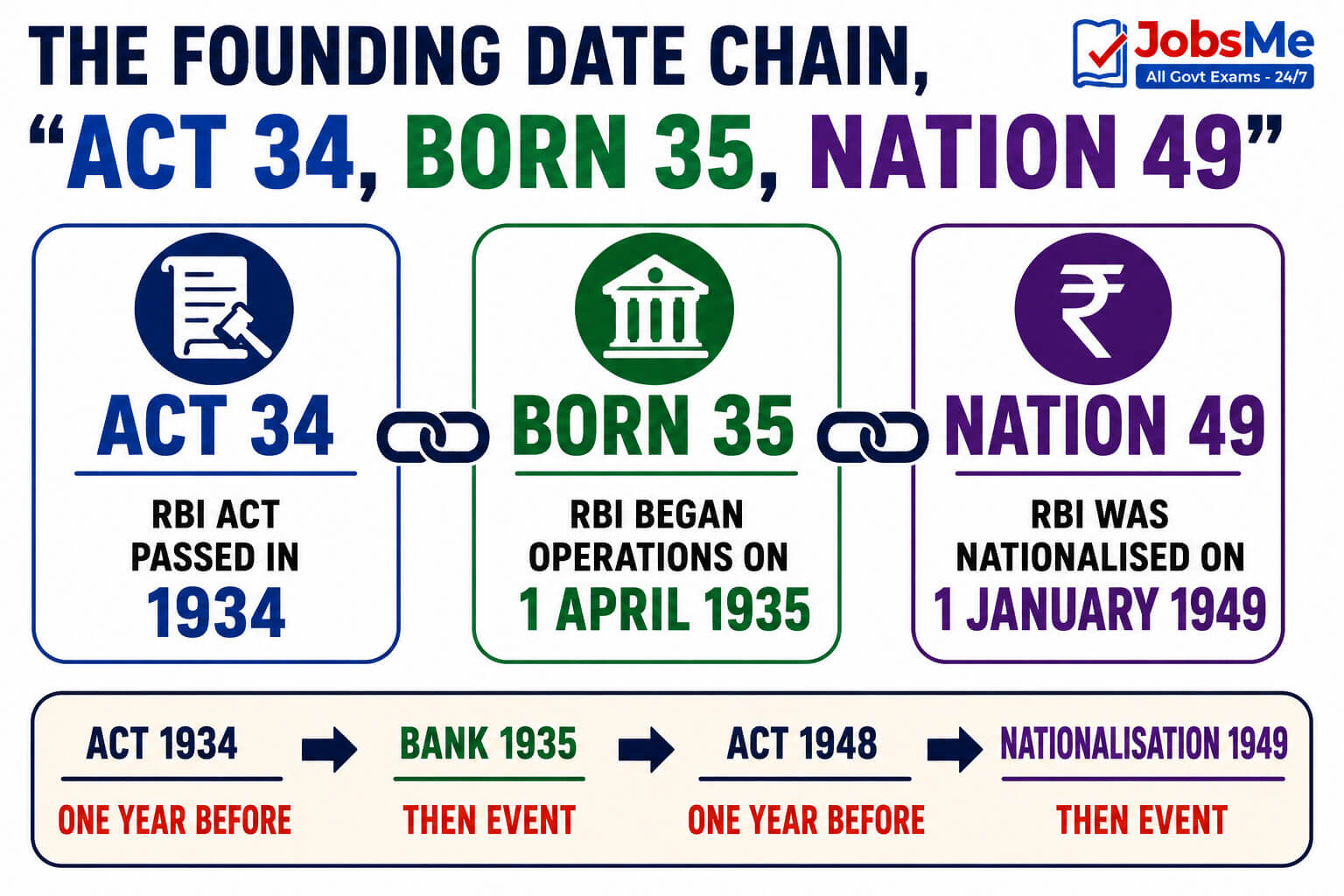
Three dates get mixed up constantly. Fix them in a sequence instead of learning them separately.
- Act 34 - The RBI Act was passed in 1934.
- Born 35 - The RBI began operations on 1 April 1935.
- Nation 49 - The RBI was nationalised on 1 January 1949, under an Act of 1948.
Notice the pattern: in both pairs, the Act comes one year before the event. Act 1934 then Bank 1935. Act 1948 then Nationalisation 1949.
Trick 2: "Hilton Young was YOUNG in 26, RBI was BORN in 35"
The Hilton Young Commission, formally the Royal Commission on Indian Currency and Finance, gave its recommendation in 1926, and the RBI opened in 1935. Remember: a nine-year wait between the idea and the institution. Never confuse the Hilton Young Commission with the Narasimham Committee, which came much later and dealt with banking reforms, not with the creation of the central bank.
Trick 3: "Smith Signed Nothing, Deshmukh was Desh ka Pehla"
- Smith Signed Nothing - Sir Osborne Smith, the first Governor, famously never signed a banknote. Three S sounds lock the fact in place.
- Deshmukh means Desh - Sir C. D. Deshmukh, whose very name begins with "Desh", was the first Indian Governor.
Trick 4: "Rau Ruled Long, Ghosh was a Ghost"
- Rau Ruled Long - Sir Benegal Rama Rau served the longest, 7 years and 199 days. Both "Rau" and "Ruled" start with R.
- Ghosh was a Ghost - Amitav Ghosh served the shortest, only 20 days. He vanished as quickly as a ghost.
Trick 5: "AAGS" for the Four Interim Governors
Four Governors served for only weeks, and examiners love to hide one of them in a "shortest tenure" question. Use the acronym AAGS, read as "All Are Gone Soon".
- A - Ambegaonkar, K. G. (45 days)
- A - Adarkar, B. N. (42 days)
- G - Ghosh, Amitav (20 days, the shortest of all)
- S - Sen Gupta, N. C. (92 days, the longest of the four)
Within AAGS, remember the order of length as Ghosh, Adarkar, Ambegaonkar, Sen Gupta, that is 20, 42, 45 and 92 days.
Trick 6: "My Regulator Friend Issues Digital Payment Bills" for RBI Functions
Take the first letter of each word to recall all core functions in the correct order.
- My - Monetary Authority
- Regulator - Regulator and Supervisor of the Financial System
- Friend - Foreign Exchange Manager under FEMA
- Issues - Issuer of Currency
- Digital - Developmental Role
- Payment - Payment and Settlement Systems Regulator
- Bills - Banker to the Government and Banker to Banks
Trick 7: "K before M, 35 before 37" for the Headquarters Shift
Kolkata came first in 1935, Mumbai came next in 1937. The alphabet order K then M matches the chronological order. Any question that says "RBI headquarters at the time of establishment" is asking for Kolkata, not Mumbai.
Trick 8: "Burma before Freedom, Pakistan after Freedom"
The RBI acted as the central bank for two neighbouring countries. Burma (Myanmar) until April 1947, which is before Indian independence in August 1947, and Pakistan until June 1948, which is after it. B comes before P in the alphabet and 1947 comes before 1948, so the order takes care of itself.
Trick 9: The Zonal Office Map Trick
The four Zonal Offices match the four corners of India exactly as geography suggests. Mumbai faces the Arabian Sea, so it is West. Kolkata faces the Bay of Bengal, so it is East. Chennai is deep South. Delhi is the capital in the North. Read them clockwise from Delhi: Delhi, Kolkata, Chennai, Mumbai, that is North, East, South, West.
Trick 10: The Board Numbers, "21-4 and 4-5-4"
- 21-4 - The Central Board has 21 members serving a 4-year term.
- 4-5-4 - There are 4 Local Boards, each with 5 members, each serving 4 years.
Additional Notes
Frequently Confused Facts
| Commonly Confused Pair | The Clear Distinction |
|---|---|
| 1935 vs 1949 | 1935 is the year the RBI was established. 1949 is the year it was nationalised. Establishment first, nationalisation fourteen years later. |
| RBI Act 1934 vs Banking Regulation Act 1949 | The RBI Act, 1934 created the central bank itself. The Banking Regulation Act, 1949 governs commercial banking companies. Different laws, different purposes. |
| Osborne Smith vs C. D. Deshmukh | Smith was the first Governor overall. Deshmukh was the first Indian Governor. The question wording decides the answer. |
| Kolkata vs Mumbai | Kolkata was the original headquarters in 1935. Mumbai has been the headquarters since 1937. |
| Hilton Young Commission vs Narasimham Committee | Hilton Young (1926) recommended creating the RBI. The Narasimham Committees recommended banking sector reforms decades later. |
| M. Narasimham the Governor vs the Committee | They are the same person. He was Governor for 212 days in 1977 and later chaired the banking reform committees named after him. Many students assume they are unrelated. |
| Amitav Ghosh the Governor vs the novelist | The 20-day RBI Governor of 1985 is not the well-known author. The exam only ever refers to the Governor. |
| Longest tenure overall vs post-independence | Benegal Rama Rau holds the overall record at 7 years and 199 days. Shaktikanta Das, at 6 years and 1 day, is the longest-serving Governor of recent decades. |
| 26 Governors vs 25 Governors | Several older sources still print 25. The correct current count including Sanjay Malhotra is 26. |
| Constitution vs RBI Act on tenure | The Governor's tenure is fixed under the RBI Act, 1934, not under the Constitution of India. Options mentioning the Constitution are distractors. |
| Transition-date overlaps | A few handover dates differ by a day across sources, such as Urjit Patel's exit on 10 December 2018 and Shaktikanta Das taking charge on 12 December 2018. The order and the years are what matter in exams, not the single-day overlap. |
| Who signs currency notes | The Governor signs all RBI-issued notes. The one rupee note is issued by the Government of India and signed by the Finance Secretary. |
Repeating PYQ Patterns
- SSC CGL, CHSL and MTS: Stick almost entirely to the basics. Expect the establishment year (1935), the Hilton Young Commission, the first Governor, the first Indian Governor, the headquarters and the current Governor. One question from this cluster is close to guaranteed in General Awareness.
- IBPS PO, IBPS Clerk and SBI exams: Go deeper into functions. Banker to Banks, lender of last resort, issuer of currency, the four Deputy Governors, the Monetary Policy Committee and the Digital Rupee pilots are recurring favourites.
- RRB NTPC and Group D: Prefer straight factual recall. The current Governor, the number of Governors so far, the year of nationalisation and the location of the headquarters dominate.
- Insurance exams such as LIC and NIACL: Frequently pair the RBI with regulator-matching questions and with the Malhotra Committee, since R. N. Malhotra was an RBI Governor before chairing insurance reform.
- UPSC Prelims: Tests conceptual understanding rather than names. Expect statement-based questions on the RBI's autonomy, Section 7(1) of the RBI Act, monetary policy tools, surplus transfer and the RBI's role as Banker to the Government.
- State PCS: Usually mirrors the SSC pattern with an added focus on Manmohan Singh as the only Governor who became Prime Minister.
- The single highest-yield fact set: First Governor, first Indian Governor, longest tenure, shortest tenure and current Governor. If time is short, learn only these five and the foundation dates.
Quick Insight
This topic is unusual because it sits in Static GK but has a live current affairs edge. The RBI's Monetary Policy Committee, chaired by the Governor, meets six times a financial year, and each decision on the repo rate immediately becomes exam material. Through 2026 the repo rate has been held steady at 5.25 per cent with a neutral stance, which means the more likely question in the current cycle is about the stance and the reasoning rather than a rate change. The same applies to leadership: the appointment of Rohit Jain as Deputy Governor from 3 May 2026, replacing T. Rabi Sankar, is exactly the kind of item that shows up in banking exam current affairs sections within weeks.
The practical takeaway is to learn the historical list once and then keep the current leadership and policy layer refreshed. Reading our static GK notes collection alongside daily current affairs coverage is the most efficient way to hold both halves of this topic in memory at the same time.
Bonus Exam-Critical Facts
- The RBI is not a bank for the general public. Individuals cannot open accounts with it. It deals only with banks, the Government and select institutions.
- The RBI issues currency notes under the Minimum Reserve System, holding assets worth Rs 200 crore, of which Rs 115 crore is in gold and the rest in foreign securities.
- The Monetary Policy Committee (MPC) has six members, three from the RBI and three nominated by the Central Government. The Governor chairs it and holds a casting vote in the event of a tie.
- India's inflation target is 4 per cent, with a tolerance band of plus or minus 2 per cent, meaning a range of 2 to 6 per cent.
- The RBI's emblem features a palm tree and a tiger, adapted from the East India Company's double mohur.
- The Governor is the Chief Executive Officer as well as the ex-officio Chairman of the Central Board of Directors. Both descriptions appear in questions.
One-Liners for Quick Revision
- RBI establishment - 1 April 1935 - under the Reserve Bank of India Act, 1934.
- Recommending body - Hilton Young Commission - formally the Royal Commission on Indian Currency and Finance, 1926.
- Original headquarters - Kolkata (Calcutta) - the seat of the RBI at foundation in 1935.
- Present headquarters - Mumbai - shifted in 1937 and location of the Central Office today.
- Initial ownership - Privately owned bank - shares held by individuals and private institutions.
- Nationalisation - 1 January 1949 - under the RBI (Transfer to Public Ownership) Act, 1948, making it fully government-owned.
- Central bank of Burma - until April 1947 - the RBI served Myanmar before Indian independence.
- Central bank of Pakistan - until June 1948 - the RBI served Pakistan for nearly a year after Partition.
- Total Governors - 26 - from Osborne Smith in 1935 to Sanjay Malhotra in 2026.
- Sir Osborne Smith - 1 April 1935 to 30 June 1937 - first Governor, Australian banker, never signed a banknote, resigned early over exchange and interest rate differences.
- Sir James Braid Taylor - 1 July 1937 to 17 February 1943 - second Governor and the only one to die in office.
- Sir C. D. Deshmukh - 11 August 1943 to 30 June 1949 - first Indian Governor, later Union Finance Minister, oversaw nationalisation.
- Sir Benegal Rama Rau - 1 July 1949 to 14 January 1957 - longest tenure at 7 years and 199 days.
- K. G. Ambegaonkar - 14 January to 28 February 1957 - interim Governor for 45 days.
- H. V. R. Iyengar - 1 March 1957 to 28 February 1962 - exactly 5 years, oversaw decimal coinage.
- P. C. Bhattacharya - 1 March 1962 to 30 June 1967 - 5 years and 122 days, term covered the 1966 rupee devaluation.
- L. K. Jha - 1 July 1967 to 3 May 1970 - 2 years and 307 days, term covered the 1969 bank nationalisation.
- B. N. Adarkar - 4 May to 15 June 1970 - interim Governor for 42 days, an economist by background.
- S. Jagannathan - 16 June 1970 to 19 May 1975 - 4 years and 338 days, later Executive Director at the IMF.
- N. C. Sen Gupta - 19 May to 19 August 1975 - interim Governor for 92 days.
- K. R. Puri - 20 August 1975 to 2 May 1977 - 1 year and 256 days, served through the Emergency.
- M. Narasimham - 3 May to 30 November 1977 - 212 days, the only Governor promoted from within the RBI, later chaired the Narasimham Committees on banking reform.
- I. G. Patel - 1 December 1977 to 15 September 1982 - 4 years and 289 days, oversaw the 1978 demonetisation of high-value notes.
- Manmohan Singh - 16 September 1982 to 14 January 1985 - 2 years and 120 days, the only RBI Governor to become Prime Minister of India.
- Amitav Ghosh - 15 January to 4 February 1985 - shortest tenure ever at just 20 days.
- R. N. Malhotra - 4 February 1985 to 22 December 1990 - 5 years and 321 days, later chaired the Malhotra Committee on insurance reform.
- S. Venkitaramanan - 22 December 1990 to 21 December 1992 - exactly 2 years, handled the 1991 balance of payments crisis.
- C. Rangarajan - 22 December 1992 to 21 November 1997 - 4 years and 335 days, later chaired the PM's Economic Advisory Council.
- Bimal Jalan - 22 November 1997 to 6 September 2003 - 5 years and 289 days, guided India through the Asian financial crisis.
- Y. V. Reddy - 6 September 2003 to 5 September 2008 - 5 years and 1 day, his prudential norms shielded India from the 2008 crash.
- D. Subbarao - 5 September 2008 to 4 September 2013 - exactly 5 years, managed the global financial crisis response.
- Raghuram Rajan - 4 September 2013 to 4 September 2016 - 3 years and 1 day, introduced inflation targeting and the Asset Quality Review for NPAs.
- Urjit Patel - 4 September 2016 to 10 December 2018 - 2 years and 97 days, MPC became fully operational, resigned before term end.
- Shaktikanta Das - 12 December 2018 to 10 December 2024 - 6 years and 1 day, led the COVID-19 liquidity response and the digital payments push.
- Sanjay Malhotra - 11 December 2024 to present - 26th and current Governor, 1990-batch IAS officer of the Rajasthan cadre, former Revenue Secretary, IIT Kanpur and Princeton alumnus.
- Deputy Governors in 2026 - four in number - Rohit Jain, Swaminathan Janakiraman, Poonam Gupta and Shirish Chandra Murmu.
- Rohit Jain - Deputy Governor from 3 May 2026 - handles financial markets, foreign exchange, fintech, payments, risk monitoring and IT, and replaced T. Rabi Sankar.
- Swaminathan Janakiraman - Deputy Governor - portfolio covers supervision, financial inclusion and legal functions.
- Poonam Gupta - Deputy Governor - portfolio covers monetary policy and economic research.
- Shirish Chandra Murmu - Deputy Governor - portfolio covers currency management, regulation and payment systems.
- Governor's appointment - by the Central Government - through the Appointments Committee of the Cabinet on the recommendation of a search committee, with the Ministry of Finance closely involved.
- Governor's tenure - three years conventionally - extendable by up to two more years under the RBI Act, 1934, not the Constitution.
- Removal of the Governor - two routes - dismissal by the President, or resignation submitted to the President.
- Governor's minimum age - commonly cited as 35 years and above - with another widely quoted benchmark of a 40 to 60 age band and 20 years of relevant experience.
- Governor's disqualifications - no membership of Parliament or a State Legislature, no other office of profit and no political affiliation.
- Governor's salary - about Rs 2.5 lakh per month - raised from a basic pay of Rs 90,000 through two hikes in 2017.
- Governor's dual role - Chief Executive Officer and ex-officio Chairman of the Central Board of Directors.
- Powers of the Governor - banker's banker, heads all commercial banks, influences micro and macro economies, influences the stock market, signs currency notes and controls the monetary, currency and credit systems.
- Central Board of Directors - 21 members for a 4-year term - the Governor, up to four Deputy Governors, ten nominated directors, four Local Board representatives and two Government officials.
- Local Boards - four boards for the Western, Eastern, Northern and Southern areas - five members each, appointed by the Central Government for four years.
- Zonal Offices - four in number - Mumbai for West, Delhi for North, Chennai for South and Kolkata for East.
- Regional Offices - around 22 - mostly in state capitals, implementing RBI policy locally.
- Monetary Authority function - formulates and monitors monetary policy - aims at price stability with growth, using repo rate changes and open market operations.
- Regulator and Supervisor function - sets parameters for banks - protects depositors and promotes cost-effective banking, supported by the e-Kuber core banking platform.
- Foreign Exchange Manager function - administers FEMA, 1999 - facilitates external trade and payments and develops the forex market.
- Issuer of Currency function - issues, exchanges and destroys notes - and runs the Digital Rupee CBDC pilots in wholesale and retail segments.
- Developmental Role function - promotional work - covering financial inclusion, poverty alleviation, rural credit and infrastructure development.
- Payment Systems function - regulates and upgrades payment modes - maintaining safety, efficiency and reliability of settlement systems.
- Banker to the Government function - merchant banking for Centre and States - including public debt management and issuing government securities.
- Banker to Banks function - maintains accounts of all scheduled banks - and acts as lender of last resort.
- Acts administered by the RBI - nine major laws - RBI Act 1934, Public Debt Act 1944, Banking Regulation Act 1949, FEMA 1999, SARFAESI Act 2002, Credit Information Companies Act 2005, Government Securities Act 2006, Government Securities Regulations 2007, Payment and Settlement Systems Act 2007 and Factoring Regulation Act 2011.
- RBI publications - four key titles - Annual Report, Financial Stability Report, Monetary Policy Report and the Handbook of Statistics on the Indian Economy.
- RBI surplus - income minus expenditure - RBI expenses are roughly one-seventh of income, and the balance after retaining equity capital goes to the Central Government.
- Surplus transfer advantages - more government spending, lower government borrowing and recapitalisation of public sector banks.
- Surplus transfer disadvantages - a weaker RBI buffer, reduced independence and possible inflation from improper use of funds.
- Section 7(1) of the RBI Act - allows the Union Government to issue directions - in the public interest, after consultation with the Governor.
- Foreign exchange reserves - around 685 billion US dollars as of May 2025 - giving an import cover of about ten months.
- 2016 demonetisation - withdrawal of Rs 500 and Rs 1,000 notes - which made up 86 per cent of currency in circulation.
- PMJDY financial inclusion - over 55.02 crore accounts by March 2025 - a landmark in bringing the unbanked into the formal system.
- Main criticisms of the RBI - government interference, policy delays, weak NBFC regulation and the growth versus inflation targeting debate, illustrated by slowing GDP between 2017 and 2019.
- Minimum Reserve System - Rs 200 crore of assets backing note issue - of which Rs 115 crore is held in gold.
- Monetary Policy Committee - six members - three from the RBI and three nominated by the Government, chaired by the Governor who holds the casting vote.
- Inflation target - 4 per cent with a band of plus or minus 2 per cent - giving a tolerance range of 2 to 6 per cent.
- One rupee note - issued by the Government of India - and signed by the Finance Secretary, not the RBI Governor.
Revise this list once a week and then convert it into recall practice, because passive reading alone will not hold sixty facts in place. Attempt the static GK quiz set to test the Governors list and the daily current affairs quiz to keep the 2026 leadership and policy updates fresh. Once your General Awareness preparation is on track, check the latest government job notifications so that no application deadline slips past you.
Free quiz • No signup required
Put this topic into practice with Indian Cultural Institutions – Static GK MCQ Quiz. It is the quickest way to reinforce what you just learned.
Frequently Asked Questions
Who is the current Governor of the Reserve Bank of India?
Who was the first Governor of the RBI and who was the first Indian Governor?
When was the RBI established and under which Act?
When was the RBI nationalised?
Who had the longest and the shortest tenure as RBI Governor?
Which RBI Governor later became the Prime Minister of India?
What is the tenure of an RBI Governor and how is the appointment made?
How many Deputy Governors does the RBI have and who holds these posts in 2026?
Where are the headquarters of the RBI located?
What are the main functions of the Reserve Bank of India?

About the author