Nobel Prize Recent Winners 2023, 2024, 2025 - All 6 Categories Static GK for Competitive Exams
This article gives you the complete list of Nobel Prize recent winners across all six categories - Physics, Chemistry, Physiology or Medicine, Literature, Peace and Economic Sciences - for the years 2023, 2024 and 2025. It covers the laureates, their countries, award citations, announcement dates and awarding bodies, along with corrected Indian Nobel laureate data, memory tricks and quick-revision one-liners. Use it to answer every Nobel Prize question that appears in UPSC Prelims, SSC CGL, IBPS, RRB, Insurance and State PCS exams.
Jump to section
Introduction
The Nobel Prize is one of the most heavily tested topics in the awards and honours section of every Indian government exam. Whether you are attempting UPSC Prelims, SSC CGL, IBPS PO or Clerk, RRB NTPC, Insurance exams or a State PCS paper, at least one question on recent Nobel laureates is almost guaranteed. The reason is simple: the prizes are announced on fixed dates every October, the list is short and factual, and it is easy to frame a one-mark objective question from it.
The problem for most aspirants is not understanding the Nobel Prize - it is remembering who won what, in which year, and for which discovery. Six categories multiplied by three years gives you more than forty laureates to track, and the names are unfamiliar to Indian students. This article organises all of that data year by year and category by category, so that revision becomes a five-minute exercise instead of a five-hour one. If you want to stay updated with the newest announcements as they happen, bookmark our daily current affairs section.
Every fact below has been cross-checked against official award citations. Where popular exam material carries mistakes - and there are several common ones, especially in Indian Nobel laureate lists - the corrected version has been given along with a note, so that you do not memorise a wrong year. This topic sits at the intersection of current affairs and Static GK notes, which is exactly why examiners like it.
Core Concept Explanation
The Nobel Prizes were created by the will of Alfred Nobel, a Swedish chemist, engineer and industrialist best known for inventing dynamite. He signed his final will in Paris on 27 November 1895 and died at San Remo, Italy, on 10 December 1896. He left the bulk of his fortune to fund prizes for those who confer "the greatest benefit to humankind". The first Nobel Prizes were awarded in 1901.
Nobel's will created five prizes. A sixth, the prize in Economic Sciences, was added much later and is technically not one of Nobel's own prizes. Understanding this distinction is important because it is a frequent trick question in general awareness papers.
- Original five categories (from Nobel's will, first awarded 1901): Physics, Chemistry, Physiology or Medicine, Literature and Peace.
- Sixth category: The Sveriges Riksbank Prize in Economic Sciences in Memory of Alfred Nobel, instituted in 1968 by Sweden's central bank and first awarded in 1969. It is funded by the Riksbank, not by Nobel's estate.
- Announcement window: Early October each year, in a fixed sequence - Medicine, Physics, Chemistry, Literature, Peace and finally Economic Sciences.
- Award ceremonies: Held every year on 10 December, the death anniversary of Alfred Nobel. Five prizes are presented at the Stockholm Concert Hall in Sweden; the Peace Prize alone is presented at Oslo City Hall in Norway.
- What a laureate receives: A gold medal, a diploma and a cash award. The cash component was 11 million Swedish kronor per category in 2023, 2024 and 2025 - roughly one million US dollars.
- Sharing rule: A single prize may be shared by a maximum of three laureates. It can be split into halves or thirds.
- Posthumous rule: Since 1974, the Nobel Prize cannot be awarded posthumously, unless the laureate dies after the announcement but before the ceremony.
- Organisations: Only the Nobel Peace Prize can be awarded to organisations. The International Committee of the Red Cross has won it three times - a record.
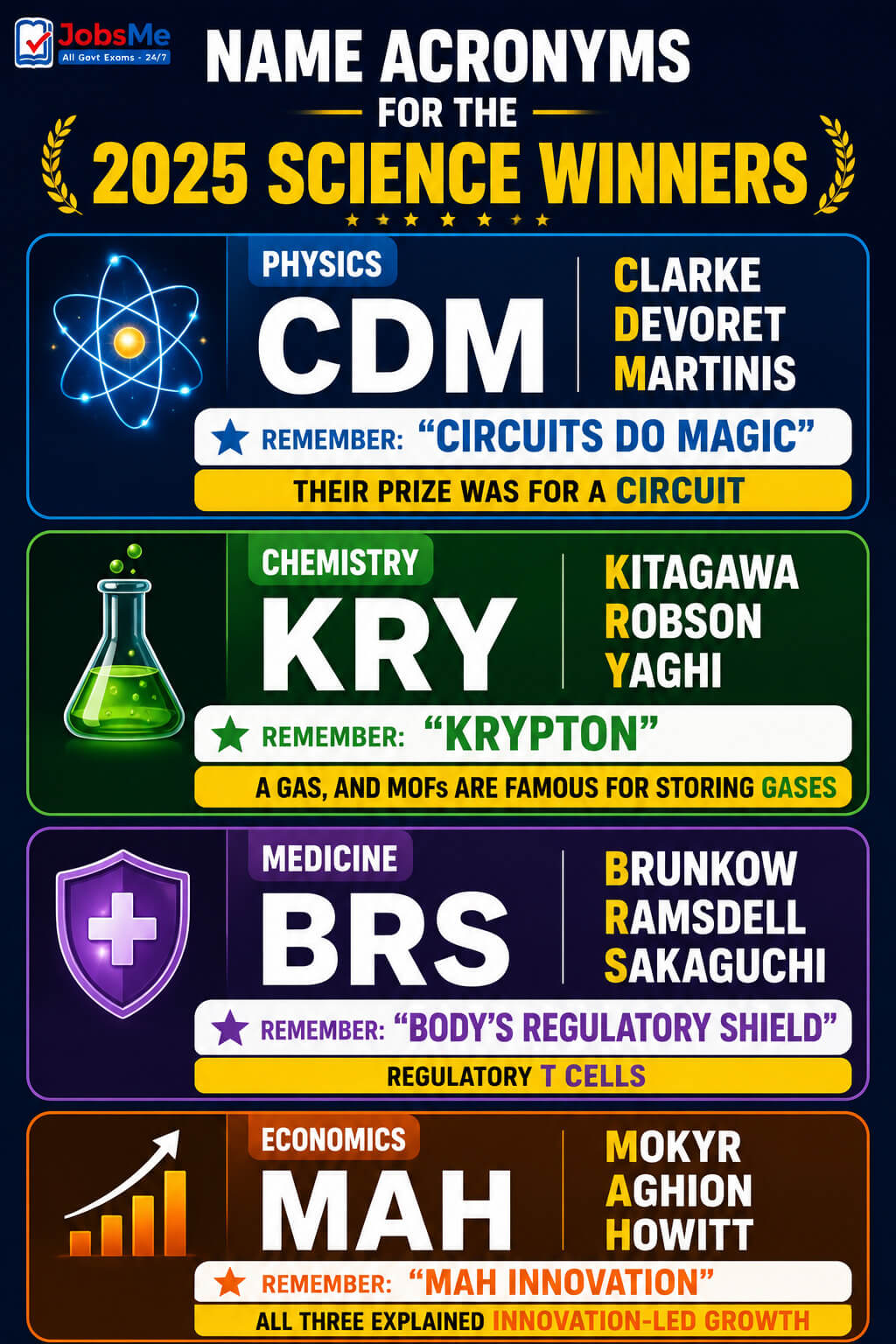
Who Decides Each Prize
Different institutions select laureates in different categories, and examiners regularly test this mapping directly.
| Category | Awarding Body | Country and City | Key Point to Remember |
|---|---|---|---|
| Physics | Royal Swedish Academy of Sciences | Stockholm, Sweden | The same body also decides Chemistry and Economic Sciences, making it the single largest awarding institution among the six. |
| Chemistry | Royal Swedish Academy of Sciences | Stockholm, Sweden | Announced one day after Physics in the standard October sequence. |
| Physiology or Medicine | Nobel Assembly at Karolinska Institutet | Solna, Stockholm, Sweden | The Karolinska Institutet is a medical university; do not confuse it with the Royal Swedish Academy of Sciences. |
| Literature | Swedish Academy | Stockholm, Sweden | The Swedish Academy is a separate literary body from the Royal Swedish Academy of Sciences, despite the similar name. |
| Peace | Norwegian Nobel Committee | Oslo, Norway | A five-member committee appointed by the Norwegian Parliament. This is the only prize decided and presented outside Sweden. |
| Economic Sciences | Royal Swedish Academy of Sciences | Stockholm, Sweden | Officially the Sveriges Riksbank Prize; announced last, usually on the Monday following the Peace Prize. |
Nobel Prize Recent Winners - Year-wise Complete List
Nobel Prize 2025 Winners - All Six Categories
The 2025 Nobel Prizes were announced between 6 and 13 October 2025 and honoured a total of 14 laureates. The ceremonies were held on 10 December 2025 in Stockholm and Oslo.
| Category | Announced | Laureate(s) | Country | Awarded For and Key Details |
|---|---|---|---|---|
| Physiology or Medicine | 6 October 2025 | Mary E. Brunkow, Fred Ramsdell, Shimon Sakaguchi | USA, USA, Japan | For their discoveries concerning peripheral immune tolerance. Sakaguchi discovered regulatory T cells (Tregs) in 1995; Brunkow and Ramsdell identified the Foxp3 gene mutation in 2001 that causes the IPEX disease in humans; Sakaguchi then linked Foxp3 to Treg development in 2003. Their work explains how the immune system avoids attacking the body's own tissues. |
| Physics | 7 October 2025 | John Clarke, Michel H. Devoret, John M. Martinis | UK-born, France-born, USA | For the discovery of macroscopic quantum mechanical tunnelling and energy quantisation in an electric circuit. Their 1984-85 experiments used a superconducting circuit with a Josephson junction and showed that quantum behaviour can appear in a system large enough to hold in the hand. This is a direct scientific foundation of modern quantum computing and quantum sensors. |
| Chemistry | 8 October 2025 | Susumu Kitagawa, Richard Robson, Omar M. Yaghi | Japan, UK-born (Australia), Jordan-born (USA) | For the development of metal-organic frameworks (MOFs). These are crystals in which metal ions are joined by long carbon-based molecules, creating huge internal cavities. Applications include harvesting drinking water from desert air, capturing carbon dioxide, storing toxic gases, removing PFAS from water and catalysing reactions. |
| Literature | 9 October 2025 | László Krasznahorkai | Hungary | For his compelling and visionary body of work that, in the midst of apocalyptic terror, reaffirms the power of art. He is the second Hungarian to win the Literature Nobel after Imre Kertesz (2002). Known for very long sentences and dystopian themes; major works include Satantango and The Melancholy of Resistance. |
| Peace | 10 October 2025 | Maria Corina Machado | Venezuela | For her tireless work promoting democratic rights for the people of Venezuela and her struggle to achieve a just and peaceful transition from dictatorship to democracy. She united a fragmented opposition behind the demand for free elections. Because she had been in hiding, the medal and diploma were received at Oslo City Hall on 10 December 2025 by her daughter, Ana Corina Sosa. |
| Economic Sciences | 13 October 2025 | Joel Mokyr, Philippe Aghion, Peter Howitt | USA, France, Canada-born (USA) | For having explained innovation-driven economic growth. One half went to Mokyr for identifying the prerequisites for sustained growth through technological progress; the other half jointly to Aghion and Howitt for the theory of sustained growth through creative destruction. |
Nobel Prize 2025 Laureates - Affiliations at a Glance
Affiliation-based questions appear in higher-level papers such as UPSC Prelims and Insurance exams, so this table is worth one careful reading.
| Laureate | Category | Born | Main Affiliation |
|---|---|---|---|
| John Clarke | Physics | 1942, Cambridge, United Kingdom | University of California, Berkeley, USA |
| Michel H. Devoret | Physics | 1953, Paris, France | Yale University and University of California, Santa Barbara, USA |
| John M. Martinis | Physics | 1958, USA | University of California, Santa Barbara, and Qolab, USA |
| Susumu Kitagawa | Chemistry | 1951, Kyoto, Japan | Kyoto University, Japan |
| Richard Robson | Chemistry | 1937, Glusburn, United Kingdom | University of Melbourne, Australia |
| Omar M. Yaghi | Chemistry | 1965, Amman, Jordan | University of California, Berkeley, USA |
| Mary E. Brunkow | Medicine | USA | Institute for Systems Biology, Seattle, USA |
| Fred Ramsdell | Medicine | USA | Sonoma Biotherapeutics, San Francisco, USA |
| Shimon Sakaguchi | Medicine | 1951, Japan | Osaka University, Japan |
| Joel Mokyr | Economic Sciences | 1946, Netherlands | Northwestern University, USA |
| Philippe Aghion | Economic Sciences | 1956, France | College de France, INSEAD and London School of Economics |
| Peter Howitt | Economic Sciences | 1946, Canada | Brown University, USA |
Nobel Prize 2024 Winners - All Six Categories
The 2024 Nobel Prizes were announced between 7 and 14 October 2024. This year is often called the "AI Nobel year" because two separate prizes went to artificial intelligence research.
| Category | Announced | Laureate(s) | Country | Awarded For and Key Details |
|---|---|---|---|---|
| Physiology or Medicine | 7 October 2024 | Victor Ambros, Gary Ruvkun | USA, USA | For the discovery of microRNA and its role in post-transcriptional gene regulation. Their work on the roundworm C. elegans revealed a completely new layer of control over how genes are switched on and off in multicellular organisms. |
| Physics | 8 October 2024 | John J. Hopfield, Geoffrey E. Hinton | USA, UK-Canada | For foundational discoveries and inventions that enable machine learning with artificial neural networks. Hopfield created an associative memory network that stores and reconstructs patterns; Hinton invented the Boltzmann machine. Hopfield, then aged 91, became the oldest Physics Nobel laureate ever; Hinton is widely called a "godfather of AI". |
| Chemistry | 9 October 2024 | David Baker; Demis Hassabis and John M. Jumper | USA; UK, UK-USA | One half to David Baker for computational protein design; the other half jointly to Demis Hassabis and John M. Jumper for protein structure prediction using the AlphaFold AI model. Hassabis is the co-founder and CEO of Google DeepMind. |
| Literature | 10 October 2024 | Han Kang | South Korea | For her intense poetic prose that confronts historical traumas and exposes the fragility of human life. She is the first South Korean and the first Asian woman to win the Literature Nobel. Her breakthrough novel is The Vegetarian (2007), which won the Man Booker International Prize in 2016. |
| Peace | 11 October 2024 | Nihon Hidankyo | Japan | For its efforts to achieve a world free of nuclear weapons and for demonstrating through witness testimony that nuclear weapons must never be used again. Founded in 1956, it is the Japan Confederation of A- and H-Bomb Sufferers Organizations, a grassroots movement of Hibakusha - survivors of Hiroshima and Nagasaki. This was an organisation, not an individual. |
| Economic Sciences | 14 October 2024 | Daron Acemoglu, Simon Johnson, James A. Robinson | Turkey-USA, UK-USA, UK-USA | For studies of how institutions are formed and affect prosperity. They showed that inclusive institutions with rule of law generate growth, while extractive institutions built to exploit the population do not. Acemoglu and Robinson co-authored the well-known book Why Nations Fail. |
Nobel Prize 2023 Winners - All Six Categories
The 2023 Nobel Prizes were announced between 2 and 9 October 2023. This set is still frequently asked, especially the mRNA vaccine prize in Medicine.
| Category | Announced | Laureate(s) | Country | Awarded For and Key Details |
|---|---|---|---|---|
| Physiology or Medicine | 2 October 2023 | Katalin Kariko, Drew Weissman | Hungary-USA, USA | For their discoveries concerning nucleoside base modifications that enabled the development of effective mRNA vaccines against COVID-19. Kariko is only the thirteenth woman to win the Medicine Nobel and is associated with the University of Szeged and the University of Pennsylvania. |
| Physics | 3 October 2023 | Pierre Agostini, Ferenc Krausz, Anne L'Huillier | France, Hungary, France | For experimental methods that generate attosecond pulses of light for the study of electron dynamics in matter. Agostini is at Ohio State University, Krausz at the Max Planck Institute of Quantum Optics and LMU Munich, and L'Huillier at Lund University. L'Huillier became only the fifth woman ever to win the Physics Nobel. |
| Chemistry | 4 October 2023 | Moungi G. Bawendi, Louis E. Brus, Alexei I. Ekimov | France-born (USA), USA, Russia-born (USA) | For the discovery and synthesis of quantum dots - nanoparticles so small that their colour and properties are decided by their size. Quantum dots are used in QLED televisions, LED lighting and in tagging tissue for medical imaging and tumour surgery. |
| Literature | 5 October 2023 | Jon Fosse | Norway | For his innovative plays and prose which give voice to the unsayable. Fosse writes in Nynorsk and is the fourth Norwegian to win the Literature Nobel; the Septology series is his best-known prose work. |
| Peace | 6 October 2023 | Narges Mohammadi | Iran | For her fight against the oppression of women in Iran and her fight to promote human rights and freedom for all. She was imprisoned in Iran at the time and could not attend; her teenage children, Ali and Kiana Rahmani, received the prize on her behalf in Oslo. |
| Economic Sciences | 9 October 2023 | Claudia Goldin | USA | For having advanced our understanding of women's labour market outcomes. A Harvard economic historian, she is the third woman to win the Economics Nobel and the first woman to win it alone, without sharing. |
Three-Year Snapshot - Category-wise Comparison
This single table is the fastest revision tool for the whole topic. If you remember nothing else, remember this grid.
| Category | 2023 | 2024 | 2025 |
|---|---|---|---|
| Physics | Agostini, Krausz, L'Huillier - attosecond light pulses | Hopfield, Hinton - artificial neural networks and machine learning | Clarke, Devoret, Martinis - macroscopic quantum tunnelling in a circuit |
| Chemistry | Bawendi, Brus, Ekimov - quantum dots | Baker; Hassabis and Jumper - protein design and AlphaFold prediction | Kitagawa, Robson, Yaghi - metal-organic frameworks |
| Physiology or Medicine | Kariko, Weissman - mRNA COVID-19 vaccines | Ambros, Ruvkun - microRNA discovery | Brunkow, Ramsdell, Sakaguchi - peripheral immune tolerance |
| Literature | Jon Fosse (Norway) | Han Kang (South Korea) | Laszlo Krasznahorkai (Hungary) |
| Peace | Narges Mohammadi (Iran) | Nihon Hidankyo (Japan, organisation) | Maria Corina Machado (Venezuela) |
| Economic Sciences | Claudia Goldin (sole winner) | Acemoglu, Johnson, Robinson - institutions and prosperity | Mokyr, Aghion, Howitt - innovation-driven growth |
Nobel Prize Winners Connected to India
Indian laureate questions appear in almost every SSC and Railways paper. Note carefully that several widely circulated exam lists contain wrong years - the years given below are the correct ones.
| Year | Laureate | Category | Status | Contribution and Key Details |
|---|---|---|---|---|
| 1913 | Rabindranath Tagore | Literature | Indian citizen | Awarded for his profoundly sensitive and beautiful verse, chiefly Gitanjali. He was the first Indian, first Asian and first non-European Nobel laureate in any category. |
| 1930 | C. V. Raman | Physics | Indian citizen | For the scattering of light and the discovery of the Raman Effect. This remains the only Nobel Prize in science awarded for research carried out entirely on Indian soil. National Science Day on 28 February marks this discovery. |
| 1968 | Har Gobind Khorana | Physiology or Medicine | Indian-born, US citizen | For interpreting the genetic code and its function in protein synthesis, shared with Robert W. Holley and Marshall W. Nirenberg. He later synthesised the first artificial gene. |
| 1979 | Mother Teresa | Peace | Indian citizen (born in Skopje) | For humanitarian work among the poorest in Kolkata through the Missionaries of Charity, which she founded in 1950. She took Indian citizenship in 1948. |
| 1983 | Subrahmanyan Chandrasekhar | Physics | Indian-born, US citizen | For theoretical studies of the structure and evolution of stars, shared with William A. Fowler. The Chandrasekhar Limit is named after him. He was the nephew of C. V. Raman. The correct year is 1983, not 1937 or 1984 as some lists wrongly state. |
| 1998 | Amartya Sen | Economic Sciences | Indian citizen | For contributions to welfare economics, social choice theory and the study of famines and poverty. He is the only Indian citizen to win the Economics prize. |
| 2001 | V. S. Naipaul | Literature | Trinidad-born of Indian origin, UK citizen | For work uniting perceptive narrative and incorruptible scrutiny in works that compel us to see the presence of suppressed histories. The correct year is 2001, not 2000. |
| 2009 | Venkatraman Ramakrishnan | Chemistry | Indian-born, US and UK citizen | For studies of the structure and function of the ribosome, shared with Thomas A. Steitz and Ada E. Yonath. Born in Chidambaram, Tamil Nadu; later President of the Royal Society. |
| 2014 | Kailash Satyarthi | Peace | Indian citizen | For the struggle against the suppression of children and for the right of all children to education, shared with Malala Yousafzai of Pakistan. He founded Bachpan Bachao Andolan. He is the most recent Indian-citizen laureate. |
| 2019 | Abhijit Banerjee | Economic Sciences | Indian-born, US citizen | For an experimental approach to alleviating global poverty, shared with Esther Duflo and Michael Kremer. The correct year is 2019, not 2017. He is the most recent laureate of Indian origin. |
Three more laureates are linked to India without being Indian: Ronald Ross (Medicine, 1902) was born in Almora and did his malaria work in India; Rudyard Kipling (Literature, 1907) was born in Bombay; and the 14th Dalai Lama (Peace, 1989) has lived in India since 1959. No Indian or Indian-origin laureate has been named in any category between 2020 and 2025.
Memory Tricks and Mnemonics
Trick 1: The Announcement Order Never Changes - "My Physics Class Loves Playing Economics"
Every single year the Nobel announcements follow the same sequence, starting on the first Monday of October.
- My = Medicine, Physics = Physics, Class = Chemistry, Loves = Literature, Playing = Peace, Economics = Economic Sciences
- Medicine is always first and Economic Sciences is always last, announced on the following Monday.
- Once you fix this order, you can reconstruct any year's announcement dates from a single date.
Trick 2: The 2025 Science Trio - "Tunnel, Sponge, Shield"
Picture a quantum tunnel that opens into a sponge house guarded by a shield of soldiers.
- Tunnel = Physics 2025, macroscopic quantum tunnelling in a circuit.
- Sponge = Chemistry 2025, metal-organic frameworks, which behave like molecular sponges that soak up gases and water.
- Shield = Medicine 2025, regulatory T cells that shield the body from its own immune system.
Trick 3: Name Acronyms for the 2025 Science Winners
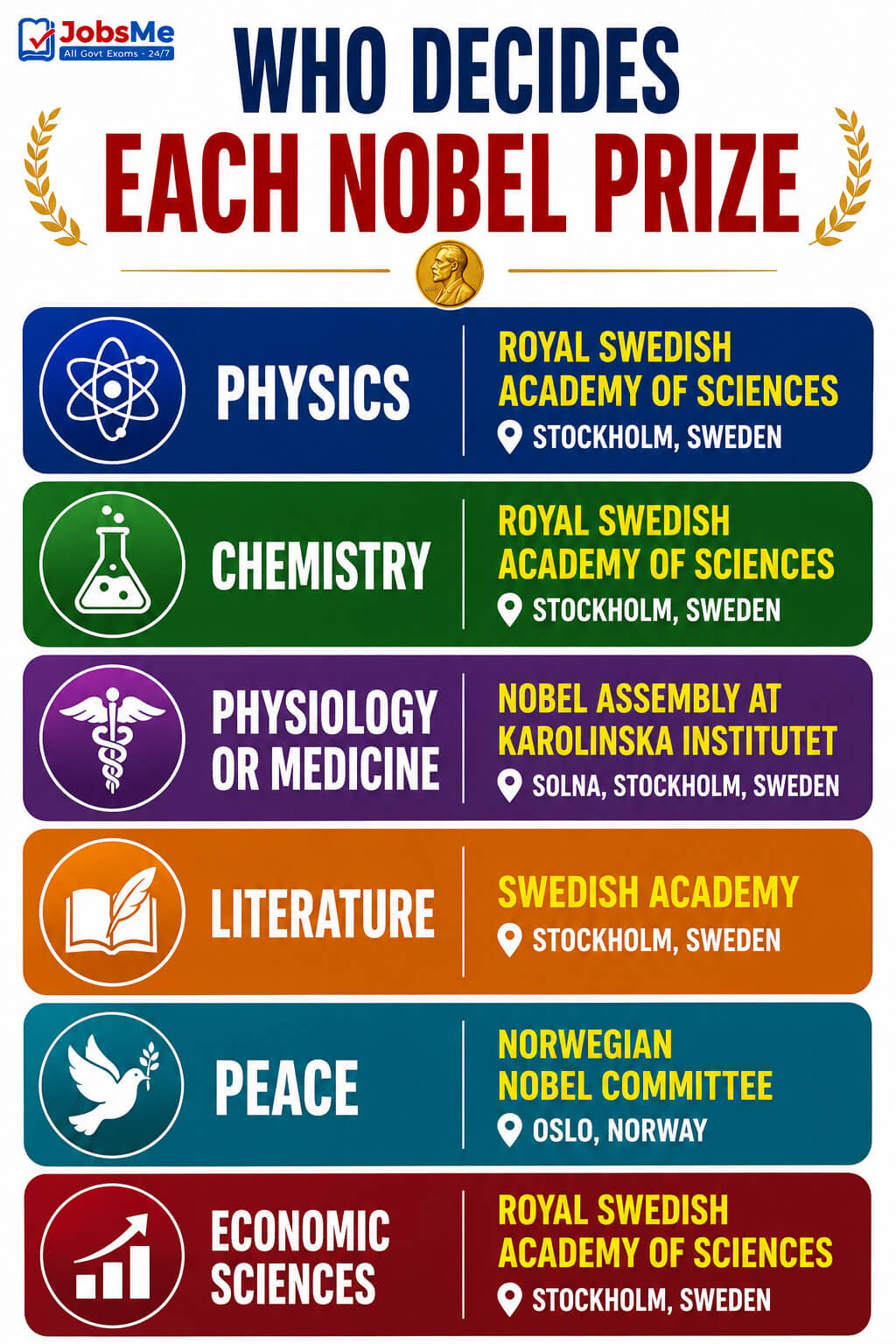
- Physics: Clarke, Devoret, Martinis = CDM. Remember "Circuits Do Magic" - their prize was for a circuit.
- Chemistry: Kitagawa, Robson, Yaghi = KRY. Remember "KRYpton" - a gas, and MOFs are famous for storing gases.
- Medicine: Brunkow, Ramsdell, Sakaguchi = BRS. Remember "Body's Regulatory Shield" - regulatory T cells.
- Economics: Mokyr, Aghion, Howitt = MAH. Remember "MAH innovation" - all three explained innovation-led growth.
Trick 4: 2024 Was the Artificial Intelligence Year - "Two Nobels for AI"
2024 is the easiest year to remember because AI dominated two separate categories.
- Physics 2024 went to Hopfield and Hinton for neural networks - the theory behind AI.
- Chemistry 2024 went partly to Hassabis and Jumper for AlphaFold - an application of AI.
- "Hopfield and Hinton got the Hardware idea; Hassabis and Jumper got the Health application." All four surnames begin with H or J, which makes the pairing sticky.
Trick 5: Peace Prize Sequence - "Iran, Japan, Venezuela" or M-H-M
Three consecutive Peace Prizes, three different continents.
- M-H-M = Mohammadi (2023) - Hidankyo (2024) - Machado (2025)
- I-J-V = Iran - Japan - Venezuela
- The middle one is the odd one out: Nihon Hidankyo is an organisation, while the other two are individual women.
- Bonus contrast: both women were absent from the Oslo ceremony. Mohammadi was in prison and her children accepted it; Machado was in hiding and her daughter accepted it.
Trick 6: Literature Sequence - "No-Ko-Hu"
- No = Norway (Jon Fosse, 2023), Ko = Korea (Han Kang, 2024), Hu = Hungary (Laszlo Krasznahorkai, 2025).
- To lock the names: F-K-K = Fosse, Kang, Krasznahorkai, in alphabetical-looking order that matches the year order.
- Han Kang is the short name for the short year gap; Krasznahorkai has the longest name and writes the longest sentences.
Trick 7: Awarding Bodies - "Only Peace Goes to Oslo"
- Royal Swedish Academy of Sciences handles P-C-E: Physics, Chemistry, Economics. Remember "PCE = Physical, Chemical, Economical - all Scientific Academy."
- Medicine goes to the Karolinska Institutet - "K for Karolinska, K for Kaya (body)."
- Literature goes to the Swedish Academy, a literary body, not the Academy of Sciences.
- Peace is the only one decided by Norway and presented in Oslo. Everything else is Stockholm.
Trick 8: The Sixth Prize Is Not a Real Nobel - "68-69, Bank Design"
- The Economic Sciences prize was instituted in 1968 and first awarded in 1969 - remember the pair "68-69".
- It is funded by Sveriges Riksbank, Sweden's central bank, not by Alfred Nobel's will. Aspirants preparing for bank exams will find this fact useful alongside our banking awareness notes.
- The five real Nobel Prizes are P-C-M-L-P: Physics, Chemistry, Medicine, Literature, Peace.
Trick 9: Indian Laureates Year Chain
- "Tagore - Raman - Khorana - Mother - Chandra - Sen - Naipaul - Rama - Kailash - Banerjee"
- Years: 1913, 1930, 1968, 1979, 1983, 1998, 2001, 2009, 2014, 2019.
- Five held Indian citizenship at the time of the award: Tagore, Raman, Mother Teresa, Amartya Sen and Kailash Satyarthi. The other five were Indian-born or of Indian origin but foreign citizens.
- Uncle-nephew pair: C. V. Raman (1930) and Subrahmanyan Chandrasekhar (1983), both in Physics, exactly 53 years apart.
Additional Notes
Frequently Confused Facts
- mRNA vs microRNA: mRNA vaccines won Medicine in 2023 (Kariko and Weissman). MicroRNA won Medicine in 2024 (Ambros and Ruvkun). Different molecules, consecutive years.
- Quantum dots vs quantum tunnelling: Quantum dots won Chemistry 2023. Macroscopic quantum tunnelling won Physics 2025. Both use the word "quantum" but belong to different subjects and years.
- Swedish Academy vs Royal Swedish Academy of Sciences: The first awards Literature; the second awards Physics, Chemistry and Economic Sciences. Neither awards Medicine, which goes to the Karolinska Institutet.
- Stockholm vs Oslo: Five prizes are presented in Stockholm; only the Peace Prize is presented in Oslo, on the same date, 10 December.
- Nobel's will vs Riksbank: Physics, Chemistry, Medicine, Literature and Peace come from Alfred Nobel's 1895 will. Economic Sciences was added by the Swedish central bank in 1968.
- Individual vs organisation: Only the Peace Prize can go to an organisation. Nihon Hidankyo in 2024 is the recent example to quote.
- AI in Physics or Chemistry: Hopfield and Hinton won Physics for neural networks; Hassabis and Jumper won Chemistry for AlphaFold. Do not swap the categories.
- Two Hungarians in 2023: Katalin Kariko (Medicine) and Ferenc Krausz (Physics) are both Hungarian, and Krasznahorkai (Literature, 2025) is also Hungarian. Keep the years distinct.
- Chandrasekhar's year: It is 1983. Lists showing 1937 or 1984 are wrong. C. V. Raman won only once, in 1930 - there is no 1947 Raman prize.
- Abhijit Banerjee's year: It is 2019, not 2017. V. S. Naipaul's year is 2001, not 2000.
- Nobel Prize vs Nobel Peace Prize: In questions, "Nobel Prize" is the umbrella term for all six; "Nobel Peace Prize" refers only to the Oslo award.
Repeating PYQ Patterns
- SSC CGL, CHSL and MTS: Straight one-liners such as "Who won the Nobel Peace Prize in 2025?" or "The Nobel Prize in Literature 2024 was awarded to which author?" Name-to-category matching is the most common format.
- IBPS PO, Clerk, SBI and RRB: Descriptive-clue questions such as "Which organisation of atomic bomb survivors won the 2024 Nobel Peace Prize?" The Economics prize is asked more often in banking papers than elsewhere.
- UPSC Prelims: Concept-linked framing rather than plain recall - for example, a question on metal-organic frameworks under environment and technology, or on creative destruction under the economy section. The awarding-institution mapping is also a favourite.
- RRB NTPC and Group D: Indian laureates dominate, especially Tagore, C. V. Raman, Mother Teresa and Kailash Satyarthi, along with "first Indian to win" type questions.
- Insurance and State PCS: Mixed static and current framing - the year the Economics prize was instituted, the maximum number of people who can share a prize, and the ceremony date of 10 December are recurring items.
- Practise these patterns under timed conditions with the daily current affairs quiz and reinforce the older data using the static GK quiz series.
Quick Insight
The last three years of Nobel Prizes read almost like a summary of the technologies now shaping India's own policy debates. The 2024 Physics and Chemistry prizes legitimised artificial intelligence as a mainstream scientific tool, a shift visible in India's national AI programmes and in AlphaFold-driven drug discovery work at Indian research institutes. The 2025 Physics prize traces the exact line of research that underpins quantum computing, which matters directly for India's National Quantum Mission. The 2025 Chemistry prize on metal-organic frameworks connects to carbon capture and atmospheric water harvesting - both live concerns for a water-stressed country. Meanwhile the Peace Prizes of 2023, 2024 and 2025 all reward civil-society resistance rather than governments or treaties, a pattern worth noting for essay and interview preparation. Reading these prizes as themes rather than as isolated names is what separates a candidate who scores the one-mark question from one who can also write a well-argued answer.
One-Liners for Quick Revision
- Nobel Prize founder -> Alfred Nobel, Swedish chemist and inventor of dynamite -> will signed in Paris on 27 November 1895.
- Alfred Nobel's death -> 10 December 1896 at San Remo, Italy -> this is why all ceremonies are held on 10 December.
- First Nobel Prizes awarded -> 1901 -> in five categories only.
- Economic Sciences prize -> instituted 1968 by Sveriges Riksbank, first awarded 1969 -> not funded by Nobel's will.
- Maximum sharers of one prize -> three -> the prize may be split into halves or thirds.
- Posthumous awards -> not allowed since 1974 -> exception only if death occurs after the announcement.
- Cash award in 2023, 2024 and 2025 -> 11 million Swedish kronor per category -> plus a gold medal and a diploma.
- Physics, Chemistry and Economic Sciences -> Royal Swedish Academy of Sciences, Stockholm.
- Physiology or Medicine -> Nobel Assembly at Karolinska Institutet, Solna, Sweden.
- Literature -> Swedish Academy, Stockholm -> a separate body from the Academy of Sciences.
- Peace -> Norwegian Nobel Committee, Oslo -> five members appointed by the Norwegian Parliament.
- Nobel Prize 2025 total laureates -> 14 -> announced between 6 and 13 October 2025.
- Physics 2025 -> John Clarke, Michel H. Devoret, John M. Martinis -> macroscopic quantum mechanical tunnelling and energy quantisation in an electric circuit.
- Physics 2025 experiments -> conducted in 1984 and 1985 -> superconducting circuit separated by a Josephson junction.
- Quantum tunnelling -> a particle's wave leaks through a barrier it cannot climb -> explains radioactive decay, solar fusion and flash memory.
- Chemistry 2025 -> Susumu Kitagawa, Richard Robson, Omar M. Yaghi -> development of metal-organic frameworks.
- MOF origin -> Richard Robson's 1989 copper-ion experiment -> made stable and flexible by Kitagawa and Yaghi between 1992 and 2003.
- MOF uses -> water harvesting from desert air, carbon dioxide capture, PFAS removal, toxic gas storage, catalysis.
- Medicine 2025 -> Mary E. Brunkow, Fred Ramsdell, Shimon Sakaguchi -> discoveries concerning peripheral immune tolerance.
- Regulatory T cells -> discovered by Shimon Sakaguchi in 1995 -> they stop the immune system from attacking the body's own tissues.
- Foxp3 gene -> identified by Brunkow and Ramsdell in 2001 -> its mutation in humans causes the IPEX disorder.
- Central tolerance vs peripheral tolerance -> central happens in the thymus, peripheral is policed by regulatory T cells outside it.
- Literature 2025 -> Laszlo Krasznahorkai of Hungary -> second Hungarian Literature laureate after Imre Kertesz in 2002.
- Krasznahorkai's style -> Central European epic tradition of Kafka and Thomas Bernhard -> known works are Satantango and The Melancholy of Resistance.
- Peace 2025 -> Maria Corina Machado of Venezuela -> for promoting democratic rights and a peaceful transition from dictatorship to democracy.
- Machado's award ceremony -> 10 December 2025 at Oslo City Hall -> received by her daughter Ana Corina Sosa as Machado was in hiding.
- Economic Sciences 2025 -> Joel Mokyr, Philippe Aghion, Peter Howitt -> for explaining innovation-driven economic growth.
- Mokyr's contribution -> half the prize -> propositional and prescriptive useful knowledge, plus societal openness to change.
- Aghion and Howitt -> other half -> mathematical model of sustained growth through creative destruction.
- Creative destruction risk -> overly concentrated markets suppress innovation -> remedies include balanced competition, flexicurity and social mobility.
- Nobel Prize 2024 window -> 7 to 14 October 2024 -> two of the six prizes went to artificial intelligence work.
- Physics 2024 -> John J. Hopfield and Geoffrey E. Hinton -> foundational work on machine learning with artificial neural networks.
- Hopfield record -> oldest Physics Nobel laureate at 91 -> created the associative memory network.
- Geoffrey Hinton -> invented the Boltzmann machine -> widely called a godfather of AI.
- Chemistry 2024 -> David Baker for computational protein design -> Demis Hassabis and John M. Jumper for protein structure prediction.
- AlphaFold -> the AI system behind the 2024 Chemistry prize -> developed at Google DeepMind, co-founded by Demis Hassabis.
- Medicine 2024 -> Victor Ambros and Gary Ruvkun -> discovery of microRNA and its role in post-transcriptional gene regulation.
- Literature 2024 -> Han Kang of South Korea -> first South Korean and first Asian woman to win the Literature Nobel.
- Han Kang's breakthrough novel -> The Vegetarian (2007) -> won the Man Booker International Prize in 2016.
- Peace 2024 -> Nihon Hidankyo of Japan -> the only organisation among the last three Peace laureates.
- Nihon Hidankyo -> founded 1956 -> Japan Confederation of A- and H-Bomb Sufferers Organizations, representing the Hibakusha of Hiroshima and Nagasaki.
- Economic Sciences 2024 -> Daron Acemoglu, Simon Johnson, James A. Robinson -> studies of how institutions are formed and affect prosperity.
- Acemoglu and Robinson -> co-authors of Why Nations Fail -> inclusive institutions build growth, extractive ones block it.
- Nobel Prize 2023 window -> 2 to 9 October 2023.
- Medicine 2023 -> Katalin Kariko and Drew Weissman -> nucleoside base modifications enabling mRNA COVID-19 vaccines.
- Physics 2023 -> Pierre Agostini, Ferenc Krausz, Anne L'Huillier -> attosecond pulses of light to study electron dynamics in matter.
- Anne L'Huillier -> fifth woman to win the Physics Nobel -> affiliated with Lund University, Sweden.
- Chemistry 2023 -> Moungi G. Bawendi, Louis E. Brus, Alexei I. Ekimov -> discovery and synthesis of quantum dots.
- Quantum dots -> nanoparticles whose colour depends on size -> used in QLED screens, LED lighting and medical imaging.
- Literature 2023 -> Jon Fosse of Norway -> innovative plays and prose that give voice to the unsayable; writes in Nynorsk.
- Peace 2023 -> Narges Mohammadi of Iran -> fight against the oppression of women in Iran; she was in prison and her children accepted the award.
- Economic Sciences 2023 -> Claudia Goldin of Harvard -> advanced understanding of women's labour market outcomes; third woman and first sole woman winner in this category.
- First Indian and first Asian Nobel laureate -> Rabindranath Tagore -> Literature, 1913, for Gitanjali.
- C. V. Raman -> Physics, 1930 -> Raman Effect; the only science Nobel for work done wholly in India.
- Har Gobind Khorana -> Medicine, 1968 -> interpretation of the genetic code, shared with Holley and Nirenberg.
- Mother Teresa -> Peace, 1979 -> Missionaries of Charity, founded 1950; took Indian citizenship in 1948.
- Subrahmanyan Chandrasekhar -> Physics, 1983 -> structure and evolution of stars; nephew of C. V. Raman.
- Amartya Sen -> Economic Sciences, 1998 -> welfare economics and social choice theory.
- V. S. Naipaul -> Literature, 2001 -> Trinidad-born writer of Indian origin.
- Venkatraman Ramakrishnan -> Chemistry, 2009 -> structure and function of the ribosome; born in Chidambaram, Tamil Nadu.
- Kailash Satyarthi -> Peace, 2014 -> shared with Malala Yousafzai; founder of Bachpan Bachao Andolan.
- Abhijit Banerjee -> Economic Sciences, 2019 -> shared with Esther Duflo and Michael Kremer for the experimental approach to poverty.
- Most recent Indian-citizen laureate -> Kailash Satyarthi, 2014 -> most recent Indian-origin laureate is Abhijit Banerjee, 2019.
- Laureates linked to India but not Indian -> Ronald Ross (Medicine, 1902, born in Almora), Rudyard Kipling (Literature, 1907, born in Bombay), the 14th Dalai Lama (Peace, 1989, resident in India).
- Marie Curie -> the only person to win Nobel Prizes in two different sciences -> Physics 1903 and Chemistry 1911.
- Most Peace Prizes by one body -> International Committee of the Red Cross, three times.
Once you have finished this list, test yourself before you forget it - the banking awareness quiz and the computer awareness quiz both carry regular awards-and-honours questions. Keep tracking new announcements every October through our latest government jobs notifications page so that your current affairs and your exam calendar stay in sync.
Free quiz • No signup required
Put this topic into practice with Indian Cultural Institutions – Static GK MCQ Quiz. It is the quickest way to reinforce what you just learned.
Frequently Asked Questions
Who won the Nobel Peace Prize 2025?
Who won the Nobel Prize in Physics 2025 and for what discovery?
What are metal-organic frameworks and why did they win the Chemistry Nobel 2025?
Why is 2024 called the artificial intelligence Nobel year?
Which organisation won the Nobel Peace Prize 2024?
Is the Nobel Prize in Economic Sciences a real Nobel Prize?
Which institution awards each Nobel Prize category?
How many people can share a single Nobel Prize and can it be awarded after death?
In which year did Subrahmanyan Chandrasekhar win the Nobel Prize?
Has any Indian won a Nobel Prize between 2020 and 2025?

About the author