Major Industries and Industrial Hubs of India – Static GK & General Awareness for Competitive Exams with Memory Tricks
This article is a complete, exam-ready guide to India's major industries and industrial hubs, covering all integrated steel plants such as Bhilai, Rourkela, Durgapur, Bokaro, Jamshedpur, Salem and Visakhapatnam with their years and foreign collaborations, the eight major industrial regions from Mumbai-Pune to Kollam-Thiruvananthapuram, and hub-wise coverage of textiles, jute, sugar, aluminium, copper, cement, fertiliser, oil refineries, petrochemicals, automobiles, shipyards, railway equipment, electronics and IT. It also covers the 11 industrial corridors under NICDP, industrial location factors, industrial policies from 1948 to 1991, and the transport network that supports industry, with all figures updated to 2026. Memory tricks, city nicknames, frequently confused facts and one-liners are included so that UPSC, SSC, IBPS, RRB, PSU and State PCS aspirants can revise the entire topic in one sitting.
Jump to section
- Introduction
- Core Concept: What Decides Where an Industry Locates
- Industrial Development in India: The Historical Timeline
- Iron and Steel Industry: Plants and Hubs
- Non-Ferrous Metal Industries and Their Hubs
- Oil Refineries and Petrochemical Hubs
- Agro-Based Industries and Their Hubs
- Engineering and Transport Equipment Hubs
- Electronics, IT and Software Hubs
- Chemical, Cement and Fertiliser Industries
- Forest-Based and Cottage Industries
- Major Industrial Regions of India
- Industrial Corridors and the NICDP
- Transport Network Supporting Industry
- Memory Tricks and Mnemonics
- Additional Notes
- One-Liners for Quick Revision
Introduction
Questions on India's major industries and industrial hubs are among the most predictable in the General Awareness and Geography sections of competitive exams. Which steel plant was built with Soviet assistance, which city is the Manchester of South India, where is India's largest aluminium plant located, which state leads in silk production, which corridor connects Delhi and Mumbai: these are direct factual questions with a single correct answer. Once the plant-to-place mapping is memorised, the marks are guaranteed.
The topic appears in UPSC Prelims and Mains under Indian Geography and Indian Economy, in SSC CGL and CHSL General Awareness, in RRB NTPC and Group D, in IBPS and SBI exams under General and Economic Awareness, and in State PCS papers where the state's own industrial belts get special attention. What makes the topic scoring is that it changes slowly. A steel plant commissioned in 1959 stays commissioned in 1959. If you are building your General Awareness base across topics, the Static GK notes section follows the same structure for every other high-yield subject.
This article organises the topic exactly the way examiners approach it: first the location factors and historical timeline, then industry-by-industry hubs with tables of plants and places, then the eight major industrial regions, then the industrial corridors under the National Industrial Corridor Development Programme, and finally the transport network that makes industrial clustering possible. Production figures, ranks and policy targets have been updated to the 2026 position, since older study material carries several outdated numbers. For the newest announcements in this sector, follow the daily current affairs updates.
Core Concept: What Decides Where an Industry Locates
Industries in India are not spread evenly. They cluster where several advantages happen to overlap. Understanding the eight location factors below lets you reason out an answer even when you have not memorised the specific plant.

- Raw materials - Industries that use weight-losing raw materials, such as iron and steel or sugar, locate right next to the source, because transporting bulky low-value inputs is uneconomical.
- Power - Reliable and cheap electricity is decisive for smelting industries. Aluminium and steel are extremely power-hungry, which is why aluminium smelters sit beside thermal or hydel projects.
- Market - Industries making perishable, fragile or bulky finished goods locate near consumers. This is why the Delhi region hosts light, market-oriented industries.
- Transport - Mumbai, Chennai, Delhi and Kolkata became nodal industrial points primarily because colonial-era rail and port links converged there.
- Capital - Modern capital-intensive industry needs banking, insurance and investor networks, which is why financial centres attract manufacturing headquarters.
- Water - Textiles, paper, chemicals and steel all consume large volumes of water, so plants are sited near rivers, canals or reservoirs.
- Labour - Availability of cheap semi-skilled labour built the cotton mills of Mumbai; availability of skilled technical labour built the software industry of Bengaluru.
- Historical and government factors - Colonial trade patterns created the port-city concentration, while post-independence public sector plants were deliberately placed in mineral-rich but backward regions to reduce regional disparity.
Industrial Complex, Industrial Region and Industrial District
- An industrial complex is a compact, intensively developed area devoted to industry, usually with no residential land inside the core.
- An industrial region is much larger. It is a cluster of related industries and cities that share infrastructure, suppliers and labour markets, and it emerges where several locational advantages converge.
- An industrial district is a smaller administrative unit within which diverse industrial activity flourishes, such as Jammu, Amritsar, Ludhiana, Agra, Raipur, Cuttack, Jabalpur, Gwalior, North Arcot, Tirunelveli and Ramanathapuram.
Geographers identify an industrial cluster or region using five measurable parameters, and these are worth remembering because they occasionally appear as a direct question:
- Number of industrial units
- Number of industrial workers
- Power consumption for industrial purposes
- Total industrial output
- Value added by manufacturing
Industrial Development in India: The Historical Timeline
Landmark Firsts Before Independence
Before the British arrived, India accounted for roughly a quarter of world industrial output, exporting cotton, silk, woollen cloth and artistic ware. British policy and the Industrial Revolution flooded Indian markets with cheap machine-made goods, destroying the handicraft base without replacing it with modern industry, because colonial policy favoured importing British manufactures and exporting Indian raw materials.
| Landmark | Year and Place | Key Features |
|---|---|---|
| First cotton mill attempt | 1818, Fort Gloster (near Kolkata) | India's earliest attempt at a mechanised cotton mill. It failed commercially and is remembered only as the first attempt. |
| First successful cotton mill | 1854, Mumbai | Set up by Cowasji Nanabhai Davar, this launched the modern Indian textile industry and earned Mumbai the title Cottonopolis of India. |
| First jute mill | 1855, Rishra (near Kolkata) | Established on the banks of the Hooghly, it began the jute concentration that still defines West Bengal's industrial map. |
| First iron and steel unit | 1874, Kulti (Bengal) | Set up by the Bengal Iron Works Company, it produced pig iron, not finished steel. |
| First woollen mill | 1876, Kanpur | Operated under the brand name Lal Imli by the Cawnpore Woollen Mills. |
| First cement plant | 1904, Chennai | The starting point of an industry that today makes India the world's second-largest cement producer. |
| Tata Iron and Steel Company (TISCO) | 1907, Sakchi (now Jamshedpur, Jharkhand) | Founded by Jamshedji Tata. It produced pig iron in 1911 and steel in 1912, and is the true beginning of India's integrated steel industry. |
| First paper mill | 1832, Serampore (Bengal) | The first attempt failed; a renewed effort in 1870 created a successful mill at Ballygunge near Kolkata. |
| First glass works | 1908, Talegaon (Maharashtra) | The Paisa Fund Glass Works, set up through the swadeshi initiative of Lokmanya Bal Gangadhar Tilak. The organised factory sector took shape from 1941. Glass making in India itself dates back to the 17th century in Firozabad, the glass city of India. |
| First shipbuilding yard | 1941, Visakhapatnam | India's first modern shipyard, later becoming Hindustan Shipyard Limited. |
| First railway line | 1853, Bombay to Thane (34 km) | The first passenger railway in India, which also gave the Mumbai region its earliest industrial advantage. |
| First airmail flight | 1911, Allahabad to Naini (about 10 km) | The earliest recorded airmail flight in India and in the world. |
Demand from the two World Wars temporarily lifted textiles and allied industries, but the need for planned and balanced industrial growth after independence led to the creation of the Planning Commission in 1950.
Industrial Policies of India
| Policy | Year | Key Features |
|---|---|---|
| Industrial Policy Resolution | 1948 | India's first industrial policy, announced on 6 April 1948 by Dr Shyama Prasad Mukherjee. It divided industry between the state and private sector for the first time. |
| Industrial Policy Resolution | 1956 | The most important pre-reform policy. It formalised the socialistic pattern of society, greatly expanded the public sector, promoted a growing cooperative sector, and reserved specified industries exclusively for the state. It is often called the economic constitution of India. |
| New Industrial Policy | December 1977 | Announced by the Janata Government, it emphasised small-scale, cottage and village industries over large industry. |
| Industrial Policy | 1980 | Aimed at promoting the concept of economic federation, raising public sector efficiency and reversing the decline in industrial production. |
| New Industrial Policy | 1991 | The decisive structural break for the Indian economy. It abolished industrial licensing for most industries and rested on three pillars: Liberalisation (free entry of foreign technology and investment), Privatisation (reduced government shareholding, de-reservation of public sector industries, opening of mining, banking, telecom and defence to private investment) and Globalisation (integration with the world economy through FDI and joint ventures abroad). Its stated objectives were faster industrial growth, correction of distortions, sustained productivity growth, gainful employment and international competitiveness. |
| National Steel Policy | 2017 | Targets 300 million tonnes of crude steel capacity by 2030-31 and per capita steel consumption of 160 kg by the same year, with emphasis on energy and raw-material efficiency and quality standards for domestic steel. |
| National Policy on Electronics | 2019 | Proposed by the Ministry of Electronics and Information Technology, replacing NPE 2012. It sought to make India a global hub for Electronics System Design and Manufacturing (ESDM), with a stated turnover target of 400 billion dollars and 1 billion mobile handsets by 2025, employment for one crore people, and a Sovereign Patent Fund for acquiring intellectual property in the ESDM sector. The 2025 targets were not met, and the sector is now driven mainly by the Production Linked Incentive schemes and the Semicon India Programme. |
| National Jute Policy | 2005 | Aimed at raising productivity and yield per hectare, improving quality and ensuring fair prices for jute farmers. |
Five Year Plans and Industrial Strategy
| Plan and Period | Model or Alias | Industrial Focus and Key Features |
|---|---|---|
| First Plan (1951-56) | Harrod-Domar model | Priority to agriculture, transport and communication. Existing industries were stabilised and modernised rather than new heavy industries built. Cotton textiles, jute and basic chemicals received attention. |
| Second Plan (1956-61) | Mahalanobis model | The heavy-industry plan. Rapid expansion of basic and capital goods industries to cut import dependence. The three public sector steel plants of Durgapur (United Kingdom), Bhilai (USSR) and Rourkela (West Germany) belong to this plan, along with the Industrial Policy Resolution of 1956. |
| Third Plan (1961-66) | Gadgil Plan | Completion of earlier projects and expansion of steel, machine tools, fertilisers, locomotives and aircraft. Hindustan Machine Tools (HMT) units were established. The plan was wrecked by drought, famine and the wars with China (1962) and Pakistan (1965). |
| Plan Holiday (1966-69) | Three Annual Plans | The Fourth Plan was suspended. Rupee devaluation was used to tackle balance of payments stress. Industrial growth was limited. |
| Fourth Plan (1969-74) | Gadgil-Mukherjee formula era | Focus on agro-based and consumer industries such as sugar, cotton and vanaspati. Moderate progress in aluminium, alloys, automobiles and steel. Industrial growth of about 5 per cent against a 9 per cent target. |
| Fifth Plan (1974-79) | Input-Output model (C. Subramaniam) | Rapid growth of steel capacity, export goods and mass-consumption items. Proposals for the Salem, Vijayanagar and Visakhapatnam steel plants, and the constitution of the Steel Authority of India Limited (SAIL). Drugs, oil refining, chemical fertilisers and heavy engineering gained attention. |
| Rolling Plan (1979-80) | Janata Government approach | Flexible annual planning with emphasis on agriculture. Industrial progress was limited. |
| Sixth Plan (1980-85) | Structural diversification | Modernisation and market-oriented production, relaxation of price controls and reduction of rationing: the earliest signals of liberalisation. New industry clustered in already developed centres, widening regional disparities. |
| Seventh Plan (1985-90) | Technology and employment | Emphasis on technology upgradation, employment generation and electronics and hi-tech industry, but continued concentration of economic power in large centres. |
| Annual Plans (1990-92) | Political instability | The Eighth Plan was postponed; two annual plans ran instead. The balance of payments crisis of 1991 triggered the reforms. |
| Eighth Plan (1992-97) | Liberalisation plan | Associated with P. V. Narasimha Rao and Manmohan Singh. Formal turn to liberalisation, encouragement of FDI and a marked decline in the public sector share of total investment. |
| Ninth Plan (1997-2002) | Private participation | Reliance on market forces. Priority to cement, coal, crude oil, consumer goods, electricity and refineries. The 8.5 per cent industrial growth target was not met. |
| Tenth Plan (2002-07) | Deregulation | Removal of infrastructural constraints and further deregulation. Industrial growth averaged around 8.2 per cent against a target near 10 per cent. |
| Eleventh Plan (2007-12) | Inclusive growth | Reduction of regional disparity, with public investment and fiscal incentives targeted at backward states and marginalised groups. |
| Twelfth Plan (2012-17) | Faster, more inclusive and sustainable growth | Manufacturing growth target of about 10 per cent per annum, with emphasis on energy efficiency and the power sector. This was India's last Five Year Plan. |
| NITI Aayog (2015 onwards) | Replaced the Planning Commission | Persistent shortfalls between targets and achievements led to the Planning Commission being replaced by NITI Aayog in 2015. The new framework uses a 15-year vision, a 7-year strategy and a 3-year action agenda, with emphasis on cooperative federalism and state-level planning. |
Iron and Steel Industry: Plants and Hubs
The iron and steel industry is called a basic industry because every other heavy, medium and light industry depends on it for machinery. It needs iron ore, coking coal, limestone, dolomite, manganese and fire clay. Since all of these are heavy and expensive to move, steel plants are located close to the raw material sources, which is why almost every integrated plant in India sits in or near the mineral belt of Jharkhand, Odisha, Chhattisgarh and West Bengal.
Current position as of 2026: India is the world's second-largest producer of crude steel after China, and the largest producer of sponge iron. In 2025, China produced about 960.8 million tonnes and India about 164.9 million tonnes, followed by the United States and Japan. India's installed crude steel capacity has crossed 220 million tonnes per annum, against the National Steel Policy target of 300 million tonnes by 2030-31. Per capita finished steel consumption in India is around 115 kg, well below the world average of about 215 kg, which is exactly why the policy sets a 160 kg target. India is also the world's fourth-largest iron ore producer.
Major Integrated Steel Plants of India
| Steel Plant | Location | Year and Collaboration | Key Features and Raw Material Sources |
|---|---|---|---|
| TISCO / Tata Steel | Jamshedpur (originally Sakchi), Jharkhand | 1907, private Indian (Jamshedji Tata) | India's first integrated steel plant. Pig iron from 1911, steel from 1912. Grew on the strength of nearby iron ore and coal, the developing rail network, abundant labour and proximity to Kolkata port. Jamshedpur is called the Steel City of India and the Pittsburgh of India. |
| IISCO | Burnpur and Kulti area, West Bengal | Three plants in 1864, 1908 and 1937, later merged | The Indian Iron and Steel Company. It was taken under government control in July 1972. Iron ore came from the Guna mines of Singhbhum district and the Mayurbhanj area of Odisha. |
| VISL | Bhadravati, Shivamogga district, Karnataka | 1923, princely state of Mysore | Visvesvaraya Iron and Steel Plant, originally the Mysore Iron and Steel Company (MISCO). Located on the Bhadra river. It specialises in steel for defence purposes and alloy steels. |
| Bhilai Steel Plant | Durg district, Chhattisgarh | Set up 1957, production from 1959, with Soviet Union (USSR) support | Located in the Mahanadi basin. Iron ore comes from Dalli-Rajhara. Bhilai is India's largest producer of steel rails and heavy plates. |
| Rourkela Steel Plant | Sundargarh district, Odisha | 1959, with West German assistance (Krupp and Demag) | Established during the Second Five Year Plan. India's first plant to use the LD (Linz-Donawitz) process. Draws iron ore from the Odisha belt. |
| Durgapur Steel Plant | Bardhaman district, West Bengal | Set up 1959, production from 1962, with United Kingdom assistance | Benefits from Damodar Valley hydroelectricity and proximity to Kolkata port. Known for alloy steel and wheels and axles. |
| Bokaro Steel Plant | Bokaro, Jharkhand | 1964, with Soviet Union (USSR) assistance | India's largest steel-making centre and a major rail producer. Iron ore comes from the Kiriburu mine in Odisha and coal from the Jharia coalfields. Built on the confluence of the Damodar and Bokaro rivers. |
| Visakhapatnam Steel Plant | Visakhapatnam, Andhra Pradesh | Construction began 1982, under Rashtriya Ispat Nigam Limited (RINL) | India's first shore-based steel plant, located directly at a seaport, which allows cheap import of coking coal and export of finished steel. |
| Salem Steel Plant | Salem, Tamil Nadu | Proposed in the Fifth Plan | A leading producer of high-quality stainless steel. It draws on local iron ore and limestone and on hydroelectricity from the Mettur dam. |
| Vijayanagar Steel Plant | Near Hospet, Ballari district, Karnataka | Proposed in the Fifth Plan | Known for mild steel. Iron ore comes from the Hospet region, and coal from Singareni in Telangana and the Kanhan valley. |
| Kulti (Bengal Iron Works) | Kulti, West Bengal | 1874 | The first iron and steel unit in India, producing pig iron only. Historically the starting point of the industry. |
The Steel Authority of India Limited (SAIL), constituted during the Fifth Plan, is the holding company for Bhilai, Rourkela, Durgapur, Bokaro, IISCO Burnpur, Salem and VISL Bhadravati. Remembering that SAIL owns these while Tata Steel and RINL sit outside it is a common exam distinction.
Non-Ferrous Metal Industries and Their Hubs
Aluminium Industry
Aluminium smelting is India's most important non-ferrous metallurgical industry, valued for the metal's light weight, corrosion resistance, heat conductivity, malleability and strength when alloyed. The industry began in 1938 with the Indian Aluminium Company (INDAL), whose early smelting operations came up in Kerala. India today has around eight aluminium smelting plants, spread across Odisha, West Bengal, Kerala, Uttar Pradesh, Chhattisgarh, Maharashtra and Tamil Nadu. Because smelting needs enormous power, every plant is tied to a nearby thermal or hydel source.
| Company | Location | Year | Key Features, Bauxite and Power Source |
|---|---|---|---|
| HINDALCO | Renukoot, Uttar Pradesh | 1958 | Hindustan Aluminium Company, India's largest integrated primary aluminium and semi-fabricated product manufacturer, part of the Aditya Birla Group. |
| BALCO | Korba, Chhattisgarh | 1965 | Bharat Aluminium Company, originally a public sector undertaking. Bauxite from Amarkantak and power from the Korba thermal power plant. |
| NALCO | Koraput, Odisha | 1981 | National Aluminium Company, the largest aluminium plant in the country. Bauxite from the Panchpatmali mines, alumina refinery at Damanjodi and smelter at Angul. |
| MALCO | Mettur, near Salem, Tamil Nadu | 1965 | Madras Aluminium Company. Bauxite from the Shevaroy Hills and power from the Mettur hydel project. |
| Vedanta Aluminium (VAL) | Jharsuguda, Odisha | Modern era | A business of Vedanta Limited and currently India's largest aluminium producer by output. |
Copper, Lead and Zinc Industries
| Metal | Beginning and Key Centres | Key Features |
|---|---|---|
| Copper | Indian Copper Corporation, 1924, Ghatsila (Jharkhand). Hindustan Copper Limited (HCL) formed in 1967. | The oldest metallurgical industry in India. HCL's centres include the Khetri Copper Complex in Rajasthan and Balaghat (Malanjkhand) in Madhya Pradesh; Ghatsila was absorbed into HCL in 1972. India meets only about half its copper requirement domestically, importing the rest from countries such as Zambia, the Democratic Republic of Congo, Chile and the United States. Key private capacity includes the Sterlite complex at Tuticorin, Birla Copper (Hindalco) at Dahej, Gujarat, and SWIL at Jhagadia, Bharuch. |
| Lead | Smelting began in 1942 at Tundoo, near Dhanbad (Jharkhand). | Lead ore in India comes mainly from the Zawar and Rajpura-Dariba belts of Rajasthan. |
| Zinc | Formal start in the mid-1960s with Hindustan Zinc Limited at Zawar (Udaipur) and Visakhapatnam. | Prominent smelting centres are Zawar in Udaipur (Rajasthan), Kochi (Kerala) and Visakhapatnam (Andhra Pradesh). Rajasthan dominates Indian zinc output. |
Oil Refineries and Petrochemical Hubs
Oil refineries distil crude oil into petrol, diesel, kerosene, aviation turbine fuel and petrochemical feedstock. India's refining capacity has grown from a modest 62 MMTPA in 1998 to roughly 250 MMTPA today, spread across 23 refineries comprising 18 in the public sector, 3 in the private sector and 2 joint ventures. This makes India the fourth-largest refiner in the world and the second-largest in Asia. More than 60 per cent of crude docking happens in the Gulf of Kutch, Gujarat, which is why that coast is India's single most important energy cluster. The Jamnagar refinery in Gujarat is the largest single-site refinery in the world, and Digboi in Assam, set up in 1901, is India's oldest refinery.
Major Oil Refineries of India
| Refinery | Sector | State | Key Features |
|---|---|---|---|
| Jamnagar | Private | Gujarat | Operated by Reliance Industries. The world's largest single-location refinery complex, with the highest refining complexity index globally. |
| Vadinar | Private | Gujarat | India's second-largest single-site private refinery, on the Gulf of Kutch coast. |
| Gujarat Refinery (Koyali) | Public | Gujarat | A key IOCL refinery near Vadodara, fed by the Ankleshwar and Mumbai High pipelines. |
| Mumbai Refinery | Public | Maharashtra | Mumbai is also India's petrochemical hub, with refinery-linked downstream industry. |
| Kochi Refinery | Public | Kerala | The largest public sector refinery in South India, with a major petrochemical expansion. |
| Mangalore Refinery | Public | Karnataka | A coastal refinery serving the west coast and connected to the strategic crude reserve at Mangaluru. |
| Manali Refinery | Public | Tamil Nadu | Operated by Chennai Petroleum, it serves the southern industrial belt. |
| Nagapattinam (Cauvery Basin) Refinery | Public | Tamil Nadu | The original small unit is being replaced by a much larger 9 MMTPA refinery. |
| Visakhapatnam Refinery | Public | Andhra Pradesh | An east coast refinery supporting the Visakhapatnam industrial region. |
| Paradip Refinery | Public | Odisha | A modern coastal refinery anchoring the Odisha Economic Corridor. |
| Panipat Refinery | Public | Haryana | Combines a refinery with a petrochemical complex, and is the industrial anchor of the Delhi region. |
| Digboi Refinery | Public | Assam | Set up in 1901 by the Assam Oil Company and taken over by IOCL in 1981. India's oldest refinery. |
Petrochemical Industry and Cracker Units
Petrochemicals are derived from crude petroleum, using natural gas and naphtha as feedstock and fuel. The industry is divided into four sub-groups: polymers, synthetic fibres, elastomers and surfactant intermediates. Mumbai is the petrochemical hub of India, with cracker units located at:
- Auraiya - Uttar Pradesh
- Jamnagar, Gandhinagar and Hazira - Gujarat
- Nagothane and Ratnagiri - Maharashtra
- Haldia - West Bengal
- Visakhapatnam - Andhra Pradesh
The plastic industry, which draws on petrochemicals, is called the sunrise industry because plastics are non-corrosive and moisture-proof. It is classified into thermoplastic and thermoset categories, is used in chemicals, textiles, construction, vehicles, electronics, mining, defence, marine, engineering and sports goods, and has been one of the fastest-growing industrial segments, with Gujarat as the leading plastic processing hub.
Agro-Based Industries and Their Hubs
Cotton Textile Industry
The textile industry is India's oldest, most organised and most comprehensive industry, and is second only to agriculture in providing employment. It has three structural segments:
- Handloom - covers spinning, weaving and finishing. It is labour-intensive, employs semi-skilled workers and needs very little capital.
- Powerloom - uses machines, so it is less labour-intensive and produces a much higher volume than handloom.
- Mill sector - highly capital-intensive, produces fine cloth in bulk and is the most organised of the three.
Silk, Wool, Jute and Sugar
| Industry | Leading States and Hubs | Key Features |
|---|---|---|
| Silk textiles | Karnataka is the foremost silk-producing state; other centres include Tamil Nadu, West Bengal, Jharkhand and Assam. | India's silk industry flourished in the medieval period and India produces all five commercially known varieties of silk: mulberry, tasar, oak tasar, eri and muga. Muga silk, golden in colour, is unique to Assam. India is the world's second-largest silk producer after China. |
| Woollen textiles | Most mills lie in Punjab, along the Amritsar-Gurdaspur-Ludhiana belt, and at Patiala and Dhariwal. | The first woollen mill was set up at Kanpur in 1876 under the brand Lal Imli. The industry employs about 12 lakh workers in the organised sector and 4 lakh in the decentralised sector, and is divided into cottage and factory segments. |
| Jute industry | About 70 jute mills, overwhelmingly in West Bengal along the Hooghly river. | India is the largest producer of raw jute and jute goods in the world but the second-largest exporter after Bangladesh. Kolkata supplies the banking, insurance and port facilities for export. The industry directly supports about 2.61 lakh workers and roughly 40 lakh small and marginal farmers growing jute and mesta. The National Jute Policy, 2005 targets higher productivity, better quality and fair farmer prices. Main export markets are the United States, Canada, Russia, the United Arab Republic, the United Kingdom and Australia. |
| Sugar industry | Uttar Pradesh leads, followed by Maharashtra, Karnataka and Tamil Nadu. | The second most important agro-based industry after cotton textiles. India and Brazil are the world's top two sugar producers, with the ranking changing from year to year, and India is the largest consumer of sugar in the world. Sugarcane is a weight-losing crop that must be crushed within 24 hours of harvesting for good sugar recovery, which is why mills sit inside the cane belt rather than near markets. Uttar Pradesh, Maharashtra and Karnataka together account for more than four-fifths of national output. |
Engineering and Transport Equipment Hubs
The engineering sector is the largest of India's industrial segments, employing over 4 million skilled and unskilled workers. Its major names include Bharat Heavy Electricals Limited (BHEL), Engineers India Limited, Hindustan Aeronautics Limited, Crompton Greaves, Elgi Equipments, HMT, Kirloskar Oil Engines (KOEL), Larsen and Toubro (L&T), Thermax, Cummins India, Alfa Laval (India), Asea Brown Boveri (ABB) and Siemens.
Railway Equipment Industry
India is self-sufficient and a major exporter of railway equipment. Learning the unit-to-place mapping below is one of the highest-return tasks in this whole topic, because it is asked almost verbatim in RRB and SSC papers.
| Unit | Product | Location |
|---|---|---|
| Chittaranjan Locomotive Works | Diesel and electric locomotives | Chittaranjan, Bardhaman district, West Bengal |
| Diesel Locomotive Works | Diesel engines and locomotives | Varanasi, Uttar Pradesh |
| Diesel-Loco Modernisation Works | Diesel engine modernisation | Patiala, Punjab |
| Integral Coach Factory | Rail coaches | Perambur, Chennai, Tamil Nadu |
| Rail Coach Factory | Rail coaches | Kapurthala, Punjab |
| Bharat Earth Movers Limited (BEML) | Rail coaches and earth-moving equipment | Bengaluru, Karnataka |
| TELCO (Tata Engineering and Locomotive Company) | Steam engines and boilers, later commercial vehicles | Jamshedpur, Jharkhand |
| M/S Jessop and Company Limited | Wagons and coaches | Kolkata, West Bengal |
Shipbuilding Industry
India's first shipbuilding factory was established at Visakhapatnam in 1941. The major shipbuilding centres today are Visakhapatnam, Kolkata, Goa, Mumbai and Kochi. The Indian Maritime University was set up as a central university in 2008 at Chennai, with campuses at Chennai and Visakhapatnam.
| Shipyard | Location | Key Features |
|---|---|---|
| Hindustan Shipyard Limited | Visakhapatnam, Andhra Pradesh | India's oldest shipyard, tracing back to the 1941 unit. Builds and repairs merchant and naval vessels. |
| Cochin Shipyard Limited | Kochi, Kerala | India's largest shipbuilding and ship-repair yard; builder of India's first indigenous aircraft carrier. |
| Garden Reach Shipbuilders and Engineers Limited | Kolkata, West Bengal | A defence public sector yard specialising in warships and patrol vessels. |
| Mazagon Dock | Mumbai, Maharashtra | Specialises in naval equipment, destroyers and submarines. |
| Goa Shipyard Limited | Vasco-da-Gama, Goa | Known for advanced offshore patrol vessels. |
| ABG Shipyard | Magdalla and Dahej, Gujarat | A private sector yard on the Gujarat coast. |
| Bharati Shipyard | Ratnagiri, Maharashtra | A private sector yard on the Konkan coast. |
Aircraft Industry
Aircraft manufacturing in India is wholly government-owned and is operated by Hindustan Aeronautics Limited (HAL). HAL began as Hindustan Aircraft Limited, incorporated on 23 December 1940, and became a fully government-owned company renamed Hindustan Aeronautics Limited in 1964. It is one of the oldest and largest aerospace and defence manufacturers in the world, headquartered at Bengaluru.
Automobile Industry
The automobile industry covers commercial vehicles, passenger cars and defence vehicles, and contributes roughly 7 per cent of India's GDP along with a very large share of manufacturing value added. Older material citing 5 per cent is outdated. The industry is organised into four regional clusters:
- North - Gurugram, Manesar and Noida
- West - Mumbai, Pune, Aurangabad and Ahmedabad
- South - Chennai and Bengaluru, with Chennai known as the Detroit of India
- East and Central - Kolkata, Jamshedpur and Indore
| Manufacturer | Location | Key Features |
|---|---|---|
| TELCO (Tata Motors) and Mahindra | Mumbai and Pune region | TELCO historically dominated the medium and heavy commercial vehicle market. |
| Ashok Leyland and Standard Motors | Chennai, Tamil Nadu | Anchors of the Chennai automobile cluster; Ashok Leyland is a leading bus and truck maker. |
| Hindustan Motors | Uttarpara, Kolkata, West Bengal | Maker of the Ambassador, historically India's first car manufacturer. |
| Bajaj Tempo (Force Motors) | Pune, Maharashtra | Light commercial vehicles and utility vehicles. |
| Defence vehicles (Shaktiman truck, Nissan jeep) | Jabalpur, Madhya Pradesh | Vehicle Factory Jabalpur, the traditional producer of army trucks. |
| Maruti Udyog (Maruti Suzuki) | Gurugram and Manesar, Haryana | Dominates the passenger car segment in India. |
Electronics, IT and Software Hubs
India's electronics industry began with radio set production in the 1950s. The key milestones are all clustered in two cities, which makes them easy to remember:
- Indian Telephone Industries (ITI) - established at Bengaluru in 1948, India's first public sector telecom equipment maker.
- Bharat Electronics Limited (BEL) - established at Bengaluru in 1954, focused on basic communication equipment. BEL turned Bengaluru into India's electronics manufacturing hub, later earning the city the titles Silicon Valley of India and Electronic City.
- Electronics Corporation of India Limited (ECIL) - founded at Hyderabad in 1967 for advanced ground and aerospace electronics. It makes air traffic control systems, tank communication systems and modular systems.
The IT and ITES industry has earned India recognition as a knowledge economy. It has two major components: IT services and Business Process Outsourcing (BPO). Within software, services such as custom software development and consultancy account for more than 80 per cent of software export revenue, rather than packaged products. Software and IT services remain among India's largest net foreign exchange earners. If you are preparing the technology-linked portions of bank and SSC papers, the computer awareness notes pair well with this section.
Chemical, Cement and Fertiliser Industries
Cement Industry
Cement is one of the eight core industries and has strong backward and forward linkages with construction, transportation, coal and power. Chemically it is a compound mixture of the silicates and aluminates of calcium, made from calcium oxide, silica, aluminium oxide and iron oxide. The first cement plant came up at Chennai in 1904, and the industry expanded rapidly after partial decontrol in 1982 and total decontrol in 1989. India is the world's second-largest cement producer after China, accounting for roughly 8 per cent of global production. Plants locate near limestone deposits because limestone is the bulkiest input.
| State | Major Cement Centres |
|---|---|
| Rajasthan | Lakheri, Udaipur, Sirohi, Modak, Chittorgarh, Nagaur |
| Madhya Pradesh | Satna, Katni, Jabalpur, Ratlam, Banmore |
| Chhattisgarh | Jamul, Bhatapara, Jilda-Neora, Mandar, Akaltara |
| Gujarat | Dwarka, Porbandar, Ranavav, Vadodara, Bhavnagar |
| Uttar Pradesh | Churk, Dalla, Chunar |
Fertiliser Industry
India is the world's third-largest producer of nitrogenous fertilisers. There are currently around 10 public sector undertakings in the sector plus one cooperative sector unit at Hazira, Gujarat. Just five states, Gujarat, Tamil Nadu, Uttar Pradesh, Punjab and Kerala, contribute about half of national fertiliser production. The Fertiliser Corporation of India Limited, established in 1961, has manufacturing units in five states:
- Sindri - Jharkhand
- Ramagundam - Telangana
- Gorakhpur - Uttar Pradesh
- Korba - Chhattisgarh
- Talcher - Odisha
Glass, Pharmaceutical and Leather Industries
| Industry | Hubs | Key Features |
|---|---|---|
| Glass | Firozabad (the glass city of India), plus Satara, Vadodara, Morbi, Howrah, Raniganj and Shikohabad. | Glass is an inorganic product formed by melting silica, soda and lime. Production in Firozabad dates to the 17th century; the swadeshi-era Paisa Fund Glass Works began at Talegaon in 1908, and the organised factory sector took shape from 1941. |
| Pharmaceuticals | Hyderabad (the pharma capital of India), Ahmedabad, Mumbai, Pune, Baddi and Sikkim. | India is the third-largest producer of medicines by volume, with roughly a 10 per cent global share, and around fourteenth by value with about 1.5 per cent share. India's strength lies in cost-effective generic drugs, especially antiretroviral medicines for HIV and AIDS, which is why India is called the pharmacy of the developing world. |
| Leather | Major tanneries at Kanpur, Agra, Chennai, Kolkata, Mumbai and Tonk. | India contributes about 13 per cent of world leather production. The industry spans organised and unorganised sectors and is an important employer of weaker sections and women. Raw material comes from dead and slaughtered animals. Kanpur is called the leather city of India. |
Forest-Based and Cottage Industries
| Industry | Raw Material and Hubs | Key Features |
|---|---|---|
| Paper | Bamboo, salai wood and grasses, wastepaper, rags, pulp and bagasse. Leading states are West Bengal, Maharashtra, Andhra Pradesh, Madhya Pradesh, Karnataka, Uttar Pradesh, Bihar, Odisha, Haryana, Tamil Nadu, Gujarat and Kerala. | A core industry in which raw material availability matters more than market proximity. The first mill at Serampore (1832) failed; the successful restart came in 1870 at Ballygunge near Kolkata. |
| Match | Timber, paper, amorphous phosphorus and potassium chlorate. Key centres are Bareilly and Prayagraj (Uttar Pradesh), Bilaspur (Chhattisgarh), Jabalpur (Madhya Pradesh) and Kota (Rajasthan), along with Sivakasi in Tamil Nadu. | Split between a highly modernised factory sector and a decentralised cottage sector. Sivakasi is known as Kutti Japan or Little Japan for its match, firework and printing cluster. |
| Lac | Secreted by the lac insect. The main region is Chhota Nagpur, followed by eastern Madhya Pradesh, West Bengal, Maharashtra, Odisha, Assam and eastern Uttar Pradesh. | Used in medicines, silk dyes, bangles, cosmetics, fireworks, gramophone records, sealing wax, electrical appliances and shipbuilding. |
| Resin | Tapped from trees such as khair in Uttar Pradesh, Bihar and Himachal Pradesh. | Used to make turpentine, paints, varnishes, pharmaceutical preparations, soaps, linoleum and adhesives. |
| Medicinal drugs | Derived from herbs including atropa, belladonna, cinchona, juniper, sarpagandha and mentha. | Forms the raw material base of India's traditional and modern pharmaceutical sectors. |
| Tobacco | Introduced to India by the Portuguese in 1605. Grown mainly in Andhra Pradesh, Gujarat, Uttar Pradesh, Karnataka and West Bengal, with Bihar and Maharashtra also notable. | Tobacco and tendu leaves together are the raw material for beedi making, a major cottage employer. |
Cottage and Small Scale Industries
Cottage industries, also called household, rural or traditional industries, use local raw materials and simple tools, and are run at home with family or part-time labour. Their components include handicrafts, khadi and cotton weaving, the match industry, poultry, silk weaving, beedi making, glasswork, toy making and lock and knife making. The Khadi and Village Industries Commission (KVIC) is the statutory body that promotes village and cottage industries.
Note the current MSME thresholds, since older material still quotes the pre-2025 numbers. Under the classification effective 1 April 2025, a composite criterion of investment in plant and machinery and annual turnover applies:
- Micro enterprise - investment up to Rs 2.5 crore and turnover up to Rs 10 crore
- Small enterprise - investment up to Rs 25 crore and turnover up to Rs 100 crore
- Medium enterprise - investment up to Rs 125 crore and turnover up to Rs 500 crore
Tourism as an Industry
- Eco-tourism - the term was coined by Hector Ceballos-Lascurain in 1983. It emphasises personal growth, environmentally responsible travel, minimal negative impact and protection of cultural integrity.
- Medical tourism - also called health tourism. India is a global hub, drawing patients for Ayurveda, surgery, naturopathy and yoga because of low cost and high clinical quality.
Major Industrial Regions of India
India has eight major industrial regions. Every one of them exists because a specific set of locational advantages converged there. The table below gives the nucleus, the reason for growth, the industries and the nodes for each region, which is exactly the format in which these questions appear.
The Eight Major Industrial Regions
| Region | Nucleus and Extent | Reasons for Growth | Industries and Major Nodes |
|---|---|---|---|
| Mumbai-Pune Industrial Region | Nucleus Mumbai, extending to Pune, Nashik and Solapur districts, Maharashtra | The early Bombay-Thane railway of 1853, excellent port facilities, an old cotton-textile tradition, cheap labour from the rural hinterland and hydel power from the Western Ghats. Mumbai became the Cottonopolis of India. | Cotton textiles, chemicals, engineering goods, leather, electronics, shipbuilding, oil refineries, petrochemicals, drugs, fertilisers, cinematography, toys, armaments, soaps and detergents. Nodes: Mumbai, Kurla, Thane, Ghatkopar, Vile Parle, Jogeshwari, Andheri, Bhandup, Kalyan, Pimpri-Chinchwad, Pune, Nashik, Manmad, Solapur, Ahmednagar, Satara and Sangli. Constraints: spatial congestion in Mumbai and loss of cotton-growing areas after partition in 1947. |
| Hugli (Hooghly) Industrial Region | Nucleus Kolkata-Howrah along the Hooghly river, West Bengal | Riverine port advantage, access to the Ganga-Brahmaputra plains, proximity to coal and iron ore of Chotanagpur, jute from Bengal, tea from Assam and Darjeeling, and abundant British capital in the colonial era. | Jute mills (the first modern jute mill at Rishra, 1855), paper, engineering, textile machinery, chemicals, pharmaceuticals, fertilisers, petrochemicals, printing and sewing machines, leather, match and woodwork, automobiles and boat building. Nodes: Kolkata, Howrah, Haldia, Serampore, Rishra, Shibpur, Budge Budge, Birnagar, Bansbaria, Belur and Hugli. Challenges: loss of jute-growing areas to East Pakistan, now Bangladesh, environmental pressure and transport bottlenecks. |
| Bengaluru-Tamil Nadu (Bengaluru-Coimbatore) Region | Parts of Karnataka and Tamil Nadu | Hydroelectric power from Mettur, Shivanasamudra and Sharavati, skilled labour, an equable climate and a large domestic market. Historically a cotton and textile region, now dominated by automobiles, electronics and software. | Cotton textiles (Coimbatore, the Manchester of South India), silk, sugar refining, leather, chemicals, rubber goods, medicines, aluminium, cement, glass, paper, matchboxes, machine tools, watches, telecommunication equipment, auto and aircraft parts, and software at Bengaluru. Nodes: Bengaluru, Coimbatore, Madurai, Tiruchirappalli, Mettur, Mysuru, Mandya and Sivakasi. |
| Gujarat Industrial Region | Nucleus Ahmedabad-Vadodara, Gujarat | A traditional textile belt with raw cotton close at hand, cheap land, skilled labour, the discovery of oilfields in the Gulf of Khambhat leading to refineries and petrochemical complexes, and port infrastructure at Kandla. | Textiles in cotton, silk and synthetics, petrochemicals, refineries at Koyali and Jamnagar, chemicals, pesticides, engineering goods, dairy and food processing, jewellery, diamond cutting, pharmaceuticals, glassware and plastics. Nodes: Ahmedabad, Vadodara, Jamnagar, Rajkot and Ankleshwar. Ahmedabad is called the Manchester of India and Surat the diamond city of India. |
| Chotanagpur (Damodar Valley) Industrial Region | Chotanagpur plateau across Jharkhand, northern Odisha and western West Bengal | The richest mineral base in India: coal in the Damodar Valley and iron ore in the Jharkhand-Odisha belt. This is why it is called the Ruhr of India. | Steel plants at Jamshedpur (TISCO), Durgapur, Rourkela, Bokaro and Kulti, plus heavy engineering, machine tools, fertilisers, cement, paper, locomotives, heavy electricals, automobiles and electronics. Nodes: Jamshedpur, Dhanbad, Ranchi, Chaibasa, Sindri, Hazaribagh and Daltonganj. |
| Visakhapatnam-Guntur Industrial Region | Coastal Andhra Pradesh from Visakhapatnam in the north to Kurnool and Prakasam districts in the south | Port-led growth at Visakhapatnam and Machilipatnam, a rich agricultural hinterland, local minerals, a petroleum refinery at Visakhapatnam and high-grade iron ore from Bailadila in Chhattisgarh. | Petroleum refining and petrochemicals, sugar, textiles, paper, fertilisers, cement, aluminium, steel and light engineering. Nodes: Visakhapatnam, Vijayawada, Guntur and Kurnool. Development of natural gas in the Krishna-Godavari basin is expected to reinforce industrial growth here. |
| Gurugram-Delhi-Meerut Industrial Region | Two belts adjoining Delhi: Agra-Mathura-Meerut-Saharanpur and Faridabad-Gurugram-Ambala | The region is far from major mineral and power sources, so its industries are deliberately light and market-oriented, serving the huge Delhi market. It has grown very fast since independence as a manufacturing and services hub. | Sugar, agricultural implements, vanaspati, textiles, glass, chemicals, engineering, paper, electronics, cycles, tractors, sports goods, flour milling, petrochemicals, automobiles and software. Nodes: Delhi (nucleus), Faridabad, Gurugram, Ghaziabad, Mathura, Panipat (refinery and petrochemical complex), Modinagar, Sonipat, Ballabgarh, Saharanpur and Yamunanagar. |
| Kollam-Thiruvananthapuram Industrial Region | South Kerala, covering Thiruvananthapuram, Kollam, Alappuzha, Ernakulam and Kottayam districts | Located away from mineral belts, so industries are mainly agro-based and light, built on local plantation produce and coastal trade. This is the smallest of the eight major regions. | Textiles, rubber products, coir, cashew processing, sugar, matchboxes, cement, fish processing, coconut products and other agricultural processing. Nodes: Kollam, Thiruvananthapuram, Kochi, Alappuzha and Punalur. |
Minor Industrial Regions
| Minor Region | State | Characteristic Industries |
|---|---|---|
| Ambala-Amritsar | Haryana and Punjab | Woollen textiles, hosiery, agricultural implements, cycles and sports goods. |
| Saharanpur-Muzaffarnagar-Bijnor | Uttar Pradesh | Sugar, paper, wood carving and light engineering. |
| Indore-Dewas-Ujjain | Madhya Pradesh | Cotton textiles, scooters, engineering goods and consumer goods. |
| Jaipur-Ajmer (also Jaipur-Alwar) | Rajasthan | Textiles, gems and jewellery, marble, cement and light engineering. |
| Kolhapur-South Kanara | Maharashtra and Karnataka | Cotton textiles and leather goods. |
| Northern Malabar | Kerala | Plantation-based processing, timber, tiles and handloom. |
| Middle Malabar | Kerala | Coir, cashew, plywood and food processing. |
| Adilabad-Nizamabad | Telangana | Cement, sugar, paper and cotton-based industry. |
| Allahabad (Prayagraj)-Varanasi-Mirzapur | Uttar Pradesh | Silk weaving, carpets, glass, cement and diesel locomotives. |
| Bhojpur-Munger | Bihar | Cigarettes, arms and ammunition, food processing and light engineering. |
| Durg-Raipur | Chhattisgarh | Steel, cement and heavy engineering, anchored by the Bhilai plant. |
| Bilaspur-Korba | Chhattisgarh | Coal, thermal power, aluminium and cement. |
| Brahmaputra Valley (Assam Valley) | Assam | Tea processing, rice shelling, textiles, oil refining at Digboi and Numaligarh, and consumer goods. |
| Chennai | Tamil Nadu | Cotton textiles, rail coaches at Perambur, rubber tyres and tubes, automobiles, electronics and oil refining at Manali. |
| Godavari-Krishna Delta | Andhra Pradesh | Tobacco, sugar, vegetable oil, textiles and flour milling. |
| Kanpur | Uttar Pradesh | Sugar, leather goods, textiles including Lal Imli woollens, and aircraft parts. |
| Nagpur-Wardha | Maharashtra | Textiles, engineering goods, glass and clay industries. |
| Solapur (Sholapur) | Maharashtra | Cotton textiles, leather goods and engineering. |
Industrial Nicknames of Indian Cities
These nicknames are among the most frequently asked one-mark questions in the whole topic, so learn them as a set.
| Nickname | City or Region | Reason |
|---|---|---|
| Manchester of India | Ahmedabad, Gujarat | Its cotton mill concentration mirrored Manchester in England. |
| Manchester of South India | Coimbatore, Tamil Nadu | The largest cotton textile cluster in southern India. |
| Cottonopolis of India | Mumbai, Maharashtra | Home of India's first successful cotton mill and its early mill industry. |
| Ruhr of India | Chotanagpur / Damodar Valley | Coal and iron ore together, exactly like Germany's Ruhr basin. |
| Steel City / Pittsburgh of India | Jamshedpur, Jharkhand | India's first integrated steel plant, TISCO. |
| Detroit of India | Chennai, Tamil Nadu | The country's largest automobile manufacturing and export cluster. |
| Silicon Valley of India | Bengaluru, Karnataka | The centre of the Indian software and electronics industry. |
| Glass City of India | Firozabad, Uttar Pradesh | Bangle and glassware production dating to the 17th century. |
| Diamond City of India | Surat, Gujarat | Cuts and polishes the overwhelming majority of the world's diamonds. |
| Leather City of India | Kanpur, Uttar Pradesh | India's oldest and largest tannery cluster. |
| Pharma Capital of India | Hyderabad, Telangana | The largest concentration of bulk drug and formulation units. |
| Kutti Japan / Little Japan | Sivakasi, Tamil Nadu | Its match, firework and printing industries. |
| Knitwear Capital of India | Tiruppur, Tamil Nadu | India's largest hosiery and cotton knitwear export hub. |
| Manchester of Punjab / Cycle City | Ludhiana, Punjab | Hosiery, woollens and the bulk of India's bicycle output. |
| Lock City of India | Aligarh, Uttar Pradesh | Traditional lock and hardware manufacturing. |
| Brass City of India | Moradabad, Uttar Pradesh | Brassware handicraft exports. |
| Textile City / Loom City | Panipat, Haryana | Handloom furnishings, blankets and carpets, plus a major refinery. |
Industrial Corridors and the NICDP
An industrial corridor is a linear development zone that connects major economic centres through an integrated network of roads, railways, ports and airports, allowing smooth movement of goods, services and people while supporting large-scale industry along the route. Corridors mark a deliberate shift from scattered industrialisation to planned, infrastructure-driven development, and they exist to cut logistics costs, improve connectivity, attract investment and plug India into global value chains.
Characteristics of Industrial Corridors
- Faster industrial expansion by tightly integrating manufacturing with high-quality physical infrastructure.
- World-class facilities along a planned stretch, creating a stable, investor-friendly environment.
- Industrial clustering and agglomeration, so related industries grow together and share services, suppliers and skilled labour.
- Targeted development based on each region's natural and economic strengths.
- Alignment with major freight and railway corridors to cut transit time.
Significance of Industrial Corridors
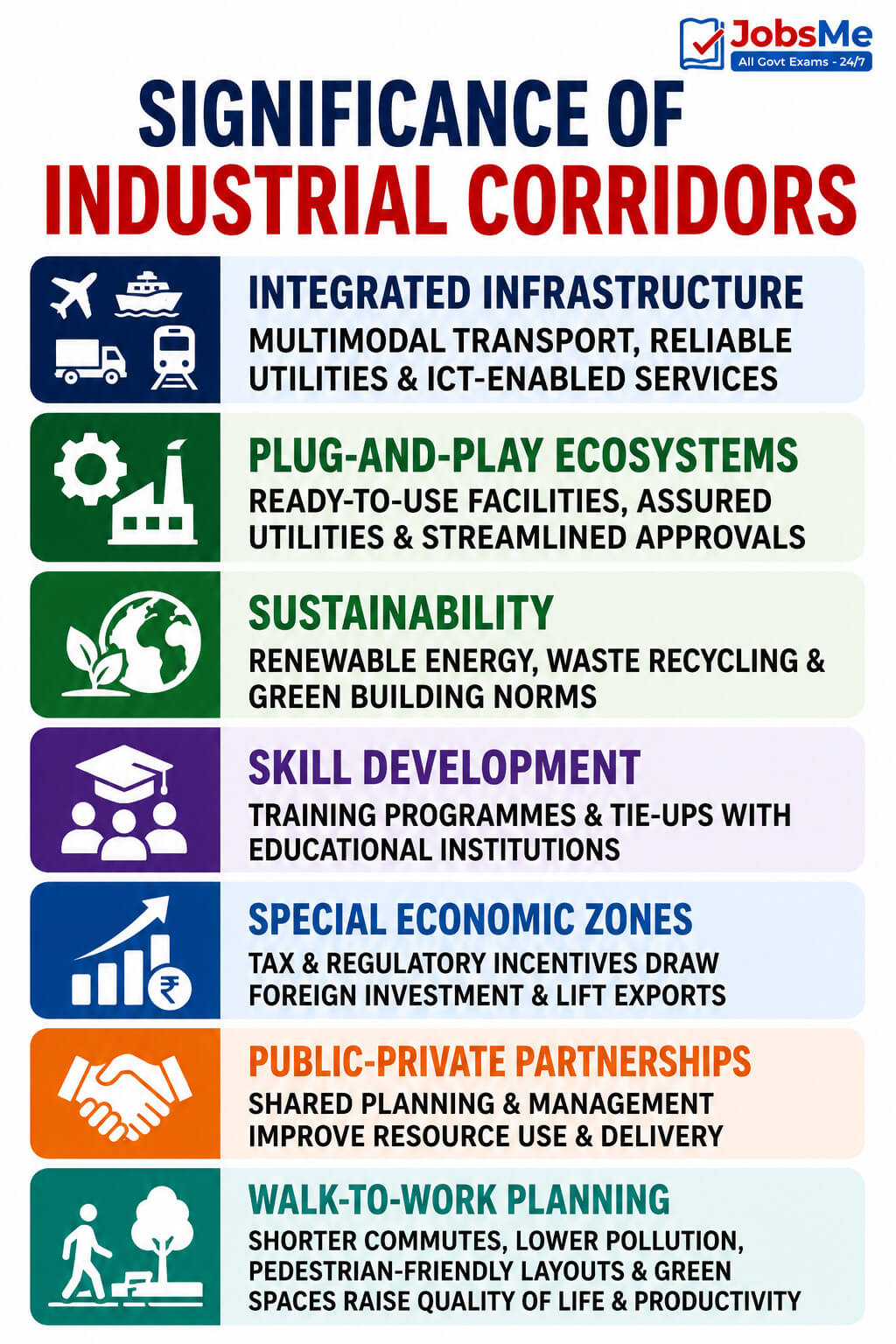
- Integrated infrastructure - multimodal transport, reliable utilities and ICT-enabled services form a single efficient ecosystem.
- Plug-and-play ecosystems - ready-to-use facilities, assured utilities and streamlined approvals cut setup time sharply.
- Sustainability - renewable energy, waste recycling and green building norms limit environmental damage.
- Skill development - training programmes and tie-ups with educational institutions build a local skilled workforce.
- Special Economic Zones - tax and regulatory incentives draw foreign investment and lift exports.
- Public-Private Partnerships - shared planning and management improve resource use and delivery.
- Walk-to-work planning - shorter commutes, lower pollution, pedestrian-friendly layouts and green spaces raise both quality of life and productivity.
The 11 Industrial Corridors under NICDP
| Corridor | Abbreviation | Focus and Key Features |
|---|---|---|
| Delhi-Mumbai Industrial Corridor | DMIC | Connects North and West India and is the backbone of freight-led industrial growth, built along the Western Dedicated Freight Corridor. India's largest and oldest corridor project. |
| Chennai-Bengaluru Industrial Corridor | CBIC | Boosts automobile, electronics and general manufacturing in South India. It is being extended to Kochi via Coimbatore. |
| Amritsar-Kolkata Industrial Corridor | AKIC | Promotes industrialisation across the northern and eastern states along the Eastern Dedicated Freight Corridor. |
| Bengaluru-Mumbai Economic Corridor | BMEC / BMIC | Links Karnataka and Maharashtra and supports heavy industry. |
| Vizag-Chennai Industrial Corridor | VCIC | Port-led development along the East Coast; it forms Phase 1 of the East Coast Economic Corridor. |
| Hyderabad-Nagpur Industrial Corridor | HNIC | Strengthens central India logistics and manufacturing. |
| Hyderabad-Bengaluru Industrial Corridor | HBIC | Enhances aerospace, defence and IT-linked manufacturing. |
| Odisha Economic Corridor | OEC | Focus on mineral-based and port-led industries. |
| Delhi-Nagpur Industrial Corridor | DNIC | Improves connectivity between North and Central India. |
| Chennai-Kanyakumari Industrial Corridor | CKIC | Expands industrial development across Tamil Nadu. |
| East Coast Economic Corridor | ECEC | Integrates the eastern coastal states with global markets; India's first coastal economic corridor. |
A separate Hyderabad-Warangal Industrial Corridor (HWIC) also features in several official listings of corridor projects. For exam purposes, remember the count as 11 corridors under NICDP.
Institutions Behind the Corridors
| Body | Established | Role and Key Features |
|---|---|---|
| NICDP (National Industrial Corridor Development Programme) | Flagship programme | The Government of India's flagship programme for building industrial corridors. It aims to create large, well-planned industrial regions with strong transport connectivity, is aligned with the PM GatiShakti National Master Plan for multimodal connectivity, and emphasises plug-and-play infrastructure and planned urban development. It covers 11 corridors, and its projects follow a Low-Carbon City (LCC) framework based on extensive green spaces, public transit, transit-oriented development, renewable energy integration, reduced dependence on conventional power, water conservation and recycling, and systematic solid waste recovery. In 2024 the Government approved 12 additional greenfield smart industrial city projects under NICDP. |
| NICDC (National Industrial Corridor Development Corporation Limited) | January 2008 | Originally the Delhi Mumbai Industrial Corridor Development Corporation (DMICDC). It functions under the Department for Promotion of Industry and Internal Trade (DPIIT), Ministry of Commerce and Industry, and plans, coordinates and implements NICDP projects: developing smart industrial cities and manufacturing clusters, building multimodal logistics hubs, creating business-ready environments, promoting sustainable urban planning and strengthening India's manufacturing and export base. |
| NICDIT (National Industrial Corridor Development and Implementation Trust) | December 2016 | Formed by expanding the earlier trust fund created for the DMIC project. It provides the financial backbone, releasing funds for infrastructure and overseeing implementation. An allocation of Rs 3,000 crore was made for its activities in the Budget Estimates for 2026-27. |
Transport Network Supporting Industry
No industrial region can function without transport. The distribution of goods, integration of regions and reduction of poverty all depend on a multimodal network, and each mode has a distinct role by distance, terrain and cargo type.
Road Transport
Roads carry nearly 85 per cent of India's passenger traffic and more than 60 per cent of freight, making road connectivity the single most important transport variable for industry. The first comprehensive road development proposal of the modern era was the Nagpur Plan of 1943. Roads are classified by responsibility and function:
- National Highways - maintained by the Central Government through the NHAI. They connect state capitals, major cities, ports and defence installations, and although they form only about 2 per cent of total road length they carry roughly 40 per cent of road traffic.
- State Highways - built and maintained by state governments, linking district headquarters and important towns to National Highways.
- District Roads - connect district headquarters with local centres and form a large part of the secondary network.
- Rural Roads - provide village connectivity, critical for agrarian markets and rural services.
Rail Transport
Indian Railways is one of the largest rail networks in the world and remains the principal mode for long-distance passenger travel and bulk freight. The first passenger railway ran in 1853 between Bombay and Thane over 34 km. The network is administered through zones, each headed by a General Manager and subdivided into divisions under Divisional Railway Managers; zonal reorganisation began with six zones on 14 April 1951. The newest zone is the South Coast Railway (SCoR), headquartered at Visakhapatnam, notified in 2019 and made operational on 1 June 2026. Counting Metro Railway Kolkata, the only zone running purely suburban metro services, the total is usually given as 19 zones; listings that exclude Metro Railway give 18.
Track gauges historically used in India were:
- Broad gauge - 1.676 metre, the standard for main lines and the target of the nationwide gauge conversion programme
- Metre gauge - 1.0 metre
- Narrow gauge - 0.762 metre and 0.610 metre
Recent decades have brought large-scale gauge conversion, dedicated freight corridors, high-speed rail, urban metro systems and landmark projects such as the Konkan Railway from Mumbai to Mangaluru, which transformed west coast connectivity. Rail density is highest in the Indo-Gangetic plains and lowest in the hill states, the North-East, parts of central India and Rajasthan.
Water Transport
Waterways are the cheapest mode for heavy and bulky cargo.
- Inland waterways - rivers, canals and backwaters used for passengers and freight. The Inland Waterways Authority of India develops and maintains navigable routes. Kerala's backwaters form an important inland network and a major tourist draw, associated with the Vallamkali boat races.
- Oceanic routes - critical for international trade and island connectivity. India's official coastline length was revised from 7,516.6 km to 11,098.81 km following a change in measurement methodology, a figure circulated by the Government in 2025. The coast is served by 12 operational major ports, with Vadhavan in Maharashtra and Galathea Bay in Great Nicobar approved as new major ports, alongside more than 200 non-major ports under State Maritime Boards. Roughly 95 per cent of India's trade by volume moves by sea.
Air Transport
Air transport is the fastest mode and indispensable in a country with such varied terrain. The earliest recorded airmail flight in India took place in 1911 from Allahabad to Naini, a distance of about 10 km. The Airports Authority of India (AAI) manages airport operations, air traffic management and aeronautical communication. Rapid airport expansion and the growth of low-cost carriers have widened access for both passengers and business.
Oil and Gas Pipelines
Pipelines are the most efficient and safest way to move hydrocarbons over long distances, and can carry liquids, gases and even solids in slurry form.
- Oil India Limited (OIL) was established in 1959 for exploration, production and transportation of crude oil and natural gas.
- Asia's first major cross-country crude oil pipeline linked the Naharkatiya oilfield in Assam to the Barauni refinery in Bihar, running nearly 1,157 km, and was later extended to Kanpur in 1966.
- Important corridors include Ankleshwar-Koyali, the Mumbai High-Koyali lines and the long HVJ (Hazira-Vijaipur-Jagdishpur) corridor, which supplies crude oil and natural gas to refineries, fertiliser plants and industrial clusters across western and northern India.
- GAIL (India) Limited operates the largest natural gas transmission network in the country, alongside state and private pipeline companies.
Memory Tricks and Mnemonics
Trick 1: Steel Plant Collaborations - "RUB the Steel: Russia, UK, Bhilai-Bokaro"
The three Second Plan steel plants and their foreign partners are the single most asked fact in this topic. Fix them with one sentence:
- Durgapur - Democratic UK. D goes with the United Kingdom.
- Rourkela - Republic of Germany, that is West Germany, via Krupp and Demag. R goes with the German Republic.
- Bhilai and Bokaro - Both got the USSR. Two B's, one Big Soviet friend.
"DUR-GAPUR takes the UK, ROUR-KELA takes the Republic of Germany, and Both B's take the Bolsheviks." Chronologically remember 1957 Bhilai set up, 1959 all three producing, 1964 Bokaro.
Trick 2: The Eight Major Industrial Regions - "MHB GC VGK"
Read the initials as three short groups, moving roughly west, then east, then south:
- Mumbai-Pune, Hugli, Bengaluru-Tamil Nadu
- Gujarat, Chotanagpur
- Visakhapatnam-Guntur, Gurugram-Delhi-Meerut, Kollam-Thiruvananthapuram
"My Home Boasts Great Cities: Vizag, Gurugram, Kollam." Also remember the two extremes: Mumbai-Pune is the largest and Kollam-Thiruvananthapuram the smallest.
Trick 3: The Nickname Chain - "Two Manchesters, One Ruhr, One Detroit"
- Ahmedabad = All-India Manchester (Manchester of India)
- Coimbatore = Manchester of the Chennai side, that is South India
- Chotanagpur = Coal plus ore = Ruhr of India
- Chennai = Cars = Detroit of India
Three C's in a row: Coimbatore for cotton, Chotanagpur for coal, Chennai for cars. Add Bengaluru for bytes as the Silicon Valley of India.
Trick 4: Aluminium Plants - "HBNMV" said as "Hey, Bring NALCO My Vedanta"
- HINDALCO - Renukoot, Uttar Pradesh, 1958, largest integrated producer
- BALCO - Korba, Chhattisgarh, 1965, bauxite from Amarkantak
- NALCO - Koraput, Odisha, largest aluminium plant in the country, bauxite from Panchpatmali
- MALCO - Mettur, Tamil Nadu, 1965, bauxite from Shevaroy Hills, power from Mettur
- Vedanta - Jharsuguda, Odisha, largest producer by output
Contrast trick: NALCO is the largest plant, Vedanta is the largest producer, HINDALCO is the largest integrated manufacturer. Examiners exploit exactly this three-way distinction.
Trick 5: Railway Units - "Coaches go South and North, Engines go East and Holy City"
- Coaches - Integral Coach Factory at Perambur, Chennai (south) and Rail Coach Factory at Kapurthala (north), plus BEML at Bengaluru.
- Engines - Chittaranjan Locomotive Works in West Bengal (east) and Diesel Locomotive Works at Varanasi, the holy city. Diesel-Loco Modernisation Works is at Patiala.
"Coaches from Perambur and Kapurthala, engines from Chittaranjan and Varanasi."
Trick 6: Textile Firsts - "18-54, 18-55, 18-76"
- 1854 - first successful cotton mill, Mumbai, by Cowasji Nanabhai Davar
- 1855 - first jute mill, Rishra near Kolkata
- 1876 - first woollen mill, Kanpur, brand Lal Imli
"Cotton, Jute, Wool in that order, one year apart then twenty-one years later." The alphabetical order C-J-W happens to match the chronological order, which makes it self-checking. Remember also the two failures: cotton at Fort Gloster 1818 and paper at Serampore 1832.
Trick 7: Corridor Initials - "DC-ABV, HH-OD, CE"
Group the eleven NICDP corridors into pairs so the list stops feeling random:
- DMIC and CBIC - the two flagship corridors, one north-west, one south
- AKIC, BMEC, VCIC - Amritsar-Kolkata, Bengaluru-Mumbai, Vizag-Chennai
- HNIC and HBIC - the two Hyderabad corridors, to Nagpur and to Bengaluru
- OEC and DNIC - Odisha and Delhi-Nagpur
- CKIC and ECEC - Chennai-Kanyakumari and the East Coast
Both corridors starting with H start from Hyderabad. That one observation removes half the confusion in this list.
Trick 8: Weight-Losing vs Market-Oriented - "Heavy Stays Home, Light Goes to Market"
If the raw material is heavy and loses weight in processing, the industry sits at the raw material source: steel at Bhilai, sugar in the cane belt, cement at the limestone deposit. If the raw material is light but the product is bulky, fragile or perishable, the industry sits near the market: the light engineering, electronics and consumer goods of the Delhi region. Sugarcane cannot travel, so the mill travels to the cane; a television can travel, so the factory sits near the buyer.
Trick 9: The 24-Hour Sugar Rule
Sugarcane must be crushed within 24 hours of harvesting or sucrose recovery collapses. That single technical fact explains why sugar mills are scattered through Uttar Pradesh and Maharashtra rather than concentrated near ports. One day, one crush. Pair it with the ranking: Uttar Pradesh first, Maharashtra second in sugar production.
Trick 10: Shore, Rail, Stainless, Mild - The Four Speciality Steel Plants
- Visakhapatnam - the only shore-based plant, sitting on a seaport
- Bhilai and Bokaro - rails, with Bokaro the largest steel-making centre
- Salem - stainless steel
- Vijayanagar - mild steel; Bhadravati (VISL) - defence and alloy steel
"Shore, Rails, Stainless, Mild, Defence." Five plants, five products, no overlap.
Additional Notes
Frequently Confused Facts
- Bhilai vs Rourkela vs Durgapur - Bhilai is USSR and Chhattisgarh; Rourkela is West Germany and Odisha; Durgapur is the United Kingdom and West Bengal. All three belong to the Second Five Year Plan.
- Bhilai vs Bokaro - both had Soviet assistance, but Bhilai came in 1957 in Chhattisgarh and Bokaro in 1964 in Jharkhand. Bokaro is the largest steel-making centre.
- Kulti 1874 vs TISCO 1907 - Kulti was the first iron and steel unit but made only pig iron; TISCO Jamshedpur was the first integrated steel plant.
- Fort Gloster 1818 vs Mumbai 1854 - Fort Gloster was the first cotton mill attempt and it failed; Mumbai 1854 was the first successful mill.
- Manchester of India vs Manchester of South India - Ahmedabad is the Manchester of India; Coimbatore is the Manchester of South India.
- NALCO vs Vedanta vs HINDALCO - NALCO Koraput is the largest plant, Vedanta Jharsuguda is the largest producer, HINDALCO Renukoot is the largest integrated primary manufacturer.
- Industrial complex vs industrial region - a complex is compact and usually has no residential land in the core; a region is a much larger cluster of related industries and cities.
- Repo of corridors: VCIC vs ECEC - VCIC (Vizag-Chennai) is Phase 1 of the wider East Coast Economic Corridor, not a separate rival project.
- NICDC vs NICDIT - NICDC (2008, formerly DMICDC) is the implementing corporation; NICDIT (2016) is the funding trust. Implementation versus finance is the distinction.
- Jute production vs jute export - India is the largest producer of raw jute and jute goods but only the second-largest exporter, after Bangladesh.
- Sugarcane vs sugar - India and Brazil trade the top spot for sugar production year to year, and India is the world's largest consumer of sugar.
- Steel rank vs sponge iron rank - India is second in crude steel but first in sponge iron.
- Cement rank vs pharma rank - India is second in cement production and third by volume in pharmaceuticals.
- Amortisation of policy years - 1948 was the first industrial policy, 1956 the socialistic one, and 1991 the liberalising one. Do not mix 1956 with 1991.
- Planning Commission vs NITI Aayog - the Planning Commission was set up in 1950 and replaced by NITI Aayog in 2015. The Twelfth Plan (2012-17) was the last Five Year Plan.
- Digboi vs Jamnagar - Digboi (1901) is India's oldest refinery; Jamnagar is the largest single-site refinery in the world.
- Broad gauge width - it is 1.676 metre, not 1.6 metre. Older notes round it off incorrectly.
- Coastline length - the current official figure is 11,098.81 km, not the older 7,516.6 km.
Repeating PYQ Patterns
- UPSC Prelims - reasoning-based questions: why a particular industry located where it did, which factors explain the Chotanagpur concentration, matching industrial regions with their dominant industries, and statements on industrial corridors and NICDP.
- SSC CGL and CHSL - direct one-liners: which country helped build Bhilai, where is the Integral Coach Factory, which city is the Manchester of South India, which state leads in silk production.
- RRB NTPC and Group D - heavy emphasis on railway equipment units and their locations, the 1853 first railway, gauge widths, and steel plant locations.
- State PCS - the industrial belts, minor industrial regions and mineral-based plants of the specific state, so read your state's rows closely.
- Banking and Insurance exams - the eight core industries, cement and steel rankings, the industrial policy of 1991, MSME classification limits and industrial corridor names, since these overlap with economic awareness.
- PSU and Engineering Services - steel plant technologies and capacities, the National Steel Policy target of 300 million tonnes, and refinery capacities.
- Most repeated single facts across all exams - Bhilai and Bokaro with USSR help; Rourkela with West German help; Durgapur with UK help; Chotanagpur as the Ruhr of India; Ahmedabad as the Manchester of India; Visakhapatnam as the only shore-based steel plant; TISCO 1907; first cotton mill 1854 Mumbai; first jute mill 1855 Rishra.
Quick Insight
India's industrial geography is being redrawn right now, and examiners have noticed. The old logic was that industry followed minerals, which is why the Damodar Valley and coastal Andhra grew as they did. The new logic follows logistics corridors and policy incentives: the Delhi-Mumbai Industrial Corridor tracks a dedicated freight line rather than a coalfield, the twelve greenfield smart industrial cities approved in 2024 were chosen for connectivity rather than raw material, and the Production Linked Incentive schemes have pulled electronics assembly to Tamil Nadu, Uttar Pradesh and Karnataka rather than to any traditional mineral belt. At the same time the semiconductor fabrication units sanctioned under the Semicon India Programme, the green hydrogen and green steel initiatives, and the shift of shipbuilding and defence manufacturing towards Gujarat and Tamil Nadu are creating industrial hubs that simply did not exist in older textbooks. Expect questions that mix the classical map with these new nodes, and keep tracking announcements through the daily current affairs quiz alongside your static revision.
One-Liners for Quick Revision
- First cotton mill attempt - Fort Gloster, 1818 - it failed commercially.
- First successful cotton mill - Mumbai, 1854 - set up by Cowasji Nanabhai Davar.
- First jute mill - Rishra near Kolkata, 1855 - on the banks of the Hooghly.
- First iron and steel unit - Kulti, 1874 - Bengal Iron Works Company, produced pig iron only.
- First woollen mill - Kanpur, 1876 - brand name Lal Imli.
- First cement plant - Chennai, 1904 - India is now the second-largest cement producer.
- First paper mill - Serampore, 1832 - failed; successful restart at Ballygunge in 1870.
- First glass works - Paisa Fund Glass Works, Talegaon, 1908 - a swadeshi initiative of Bal Gangadhar Tilak; organised sector from 1941.
- First shipyard - Visakhapatnam, 1941 - later Hindustan Shipyard Limited.
- TISCO / Tata Steel - Jamshedpur, 1907 - pig iron 1911, steel 1912, founded by Jamshedji Tata.
- IISCO - West Bengal, plants of 1864, 1908 and 1937 - brought under government control in July 1972.
- VISL Bhadravati - Shivamogga district, Karnataka, 1923 - originally MISCO, makes defence and alloy steel.
- Bhilai Steel Plant - Durg, Chhattisgarh, 1957 with USSR help - Mahanadi basin, India's leading rail producer.
- Rourkela Steel Plant - Sundargarh, Odisha, 1959 with West German help - Krupp and Demag, first to use the LD process.
- Durgapur Steel Plant - Bardhaman, West Bengal, 1959 with UK help - production from 1962, uses Damodar Valley power.
- Bokaro Steel Plant - Bokaro, Jharkhand, 1964 with USSR help - largest steel-making centre, ore from Kiriburu, coal from Jharia.
- Visakhapatnam Steel Plant - Andhra Pradesh, construction from 1982 - India's only shore-based steel plant, run by RINL.
- Salem Steel Plant - Tamil Nadu - stainless steel, powered by the Mettur dam.
- Vijayanagar Steel Plant - near Hospet, Ballari, Karnataka - mild steel, ore from Hospet, coal from Singareni and the Kanhan valley.
- SAIL - constituted during the Fifth Plan - holding company for Bhilai, Rourkela, Durgapur, Bokaro, Burnpur, Salem and Bhadravati.
- Crude steel rank - India second after China - about 164.9 million tonnes in 2025 against China's 960.8 million tonnes.
- National Steel Policy 2017 - 300 million tonnes capacity by 2030-31 - and 160 kg per capita consumption, against about 115 kg today.
- Sponge iron - India ranks first in the world - and fourth in iron ore production.
- HINDALCO - Renukoot, Uttar Pradesh, 1958 - largest integrated primary aluminium manufacturer.
- BALCO - Korba, Chhattisgarh, 1965 - bauxite from Amarkantak, power from Korba thermal plant.
- NALCO - Koraput, Odisha - largest aluminium plant, bauxite from Panchpatmali, refinery at Damanjodi, smelter at Angul.
- MALCO - Mettur near Salem, 1965 - bauxite from Shevaroy Hills, power from Mettur hydel project.
- Vedanta Aluminium - Jharsuguda, Odisha - India's largest aluminium producer by output.
- Aluminium industry origin - 1938, Indian Aluminium Company - early smelting in Kerala; about eight smelters nationwide.
- Copper - oldest metallurgical industry - Indian Copper Corporation 1924 at Ghatsila; HCL formed 1967 with Khetri and Balaghat centres.
- Lead - smelting began 1942 at Tundoo near Dhanbad - ore from Zawar and Rajpura-Dariba in Rajasthan.
- Zinc - Hindustan Zinc Limited, mid-1960s - smelters at Zawar (Udaipur), Kochi and Visakhapatnam.
- Refining capacity - about 250 MMTPA across 23 refineries - fourth-largest in the world, second-largest in Asia.
- Jamnagar refinery - Gujarat, private sector - world's largest single-site refinery.
- Digboi refinery - Assam, 1901 - India's oldest refinery.
- Crude docking - over 60 per cent through the Gulf of Kutch, Gujarat - India's most important energy cluster.
- Petrochemical hub - Mumbai - cracker units at Auraiya, Jamnagar, Gandhinagar, Hazira, Nagothane, Ratnagiri, Haldia and Visakhapatnam.
- Plastic industry - called the sunrise industry - thermoplastic and thermoset types, Gujarat the leading processing hub.
- Textile industry - India's oldest and most organised industry - second only to agriculture in employment; handloom, powerloom and mill sectors.
- Silk - Karnataka is the foremost producer - India makes all five commercial varieties; muga silk is unique to Assam.
- Woollen textiles - concentrated in Punjab - Amritsar-Gurdaspur-Ludhiana belt plus Patiala and Dhariwal.
- Jute - about 70 mills, mostly in West Bengal along the Hooghly - largest producer, second-largest exporter after Bangladesh.
- National Jute Policy - 2005 - aimed at higher yield per hectare and fair prices for jute farmers.
- Sugar - second most important agro-based industry - Uttar Pradesh leads; cane must be crushed within 24 hours.
- Engineering sector - largest industrial segment - over 4 million workers; BHEL, HAL, L&T, ABB and Siemens among the key names.
- Chittaranjan Locomotive Works - West Bengal - diesel and electric locomotives.
- Diesel Locomotive Works - Varanasi - diesel engines; Diesel-Loco Modernisation Works is at Patiala.
- Integral Coach Factory - Perambur, Chennai - rail coaches; Rail Coach Factory is at Kapurthala.
- Bharat Earth Movers Limited - Bengaluru - rail coaches and earth-moving equipment.
- Shipyards - Hindustan Shipyard Visakhapatnam, Cochin Shipyard Kochi, Garden Reach Kolkata, Mazagon Dock Mumbai, Goa Shipyard Vasco-da-Gama.
- Indian Maritime University - central university, 2008, Chennai - campuses at Chennai and Visakhapatnam.
- Hindustan Aeronautics Limited - incorporated 23 December 1940 as Hindustan Aircraft Limited - renamed HAL in 1964, headquartered at Bengaluru.
- Automobile industry - about 7 per cent of GDP - clusters at Gurugram-Manesar-Noida, Mumbai-Pune-Aurangabad-Ahmedabad, Chennai-Bengaluru, Kolkata-Jamshedpur and Indore.
- Detroit of India - Chennai - home of Ashok Leyland and the largest auto export cluster.
- Indian Telephone Industries - Bengaluru, 1948 - India's first public sector telecom equipment maker.
- Bharat Electronics Limited - Bengaluru, 1954 - basic communication equipment; made Bengaluru the electronics hub.
- Electronics Corporation of India Limited - Hyderabad, 1967 - air traffic control and tank communication systems.
- National Policy on Electronics 2019 - replaced NPE 2012 - targeted a 400 billion dollar ESDM sector and a Sovereign Patent Fund.
- IT-ITES industry - two components, IT services and BPO - services account for over 80 per cent of software export revenue.
- Cement - one of the eight core industries - partial decontrol 1982, total decontrol 1989; about 8 per cent of world output.
- Fertiliser - India third in nitrogenous fertilisers - FCI established 1961 with units at Sindri, Ramagundam, Gorakhpur, Korba and Talcher.
- Glass city - Firozabad - production dating to the 17th century.
- Pharmaceuticals - third-largest by volume with about 10 per cent global share - fourteenth by value; strong in generic AIDS medicines.
- Leather - about 13 per cent of world production - tanneries at Kanpur, Agra, Chennai, Kolkata, Mumbai and Tonk.
- Paper industry - raw materials include bamboo, grasses, wastepaper, rags and bagasse - raw material availability matters more than market.
- Match industry - factory plus cottage sectors - centres at Bareilly, Prayagraj, Bilaspur, Jabalpur, Kota and Sivakasi.
- Lac - main region Chhota Nagpur - used in bangles, cosmetics, fireworks, sealing wax and gramophone records.
- Resin - tapped from khair trees in Uttar Pradesh, Bihar and Himachal Pradesh - used for turpentine, paints and varnishes.
- Tobacco - introduced by the Portuguese in 1605 - grown in Andhra Pradesh, Gujarat, Uttar Pradesh, Karnataka and West Bengal.
- Eco-tourism - term coined by Hector Ceballos-Lascurain in 1983 - emphasises low impact and cultural integrity.
- KVIC - statutory body for khadi and village industries - promotes cottage industry across India.
- MSME classification from 1 April 2025 - micro up to Rs 2.5 crore investment and Rs 10 crore turnover - small up to Rs 25 crore and Rs 100 crore; medium up to Rs 125 crore and Rs 500 crore.
- Industrial Policy Resolution 1948 - announced 6 April 1948 by Dr Shyama Prasad Mukherjee - India's first industrial policy.
- Industrial Policy Resolution 1956 - the socialistic pattern policy - expanded the public sector and reserved industries for the state.
- New Industrial Policy 1991 - liberalisation, privatisation and globalisation - abolished licensing for most industries.
- Planning Commission - established 1950 - replaced by NITI Aayog in 2015 with a 15-year vision, 7-year strategy and 3-year action agenda.
- Second Five Year Plan - Mahalanobis model - gave India Durgapur, Bhilai and Rourkela.
- Third Five Year Plan - the Gadgil Plan - disrupted by the 1962 China war and 1965 Pakistan war.
- Fifth Five Year Plan - Input-Output model of C. Subramaniam - created SAIL and proposed Salem, Vijayanagar and Visakhapatnam plants.
- Eight major industrial regions - Mumbai-Pune, Hugli, Bengaluru-Tamil Nadu, Gujarat, Chotanagpur, Visakhapatnam-Guntur, Gurugram-Delhi-Meerut and Kollam-Thiruvananthapuram.
- Ruhr of India - Chotanagpur or Damodar Valley region - coal plus iron ore in one belt.
- Manchester of India - Ahmedabad - while Coimbatore is the Manchester of South India.
- Smallest major industrial region - Kollam-Thiruvananthapuram - agro-based and light industry, away from mineral belts.
- Industrial corridors under NICDP - eleven in total - DMIC, CBIC, AKIC, BMEC, VCIC, HNIC, HBIC, OEC, DNIC, CKIC and ECEC.
- NICDC - set up January 2008 as DMICDC - functions under DPIIT, Ministry of Commerce and Industry.
- NICDIT - formed December 2016 - the funding trust; Rs 3,000 crore allocated in Budget Estimates 2026-27.
- NICDP and 2024 approval - twelve additional greenfield smart industrial cities - aligned with the PM GatiShakti National Master Plan and a Low-Carbon City framework.
- Nagpur Plan - 1943 - the first comprehensive modern road development plan for India.
- Roads - carry nearly 85 per cent of passenger traffic and over 60 per cent of freight - National Highways are 2 per cent of length but 40 per cent of traffic.
- First railway - 1853, Bombay to Thane, 34 km - zonal reorganisation began on 14 April 1951.
- Newest railway zone - South Coast Railway, headquartered at Visakhapatnam - notified in 2019 and operational from 1 June 2026.
- Track gauges - broad 1.676 m, metre 1.0 m, narrow 0.762 m and 0.610 m - gauge conversion has standardised most lines to broad gauge.
- Konkan Railway - Mumbai to Mangaluru - transformed west coast connectivity.
- Coastline - officially revised to 11,098.81 km from 7,516.6 km - includes the Andaman and Nicobar Islands and Lakshadweep.
- Ports - 12 operational major ports and over 200 non-major ports - Vadhavan and Galathea Bay approved as new major ports.
- Inland waterways - developed by the Inland Waterways Authority of India - Kerala's backwaters host the Vallamkali boat races.
- Airmail - 1911, Allahabad to Naini, about 10 km - the world's first official airmail flight.
- Airports Authority of India - manages airports, air traffic and aeronautical communication.
- Oil India Limited - established 1959 - exploration, production and transportation of crude oil and gas.
- First cross-country oil pipeline in Asia - Naharkatiya in Assam to Barauni in Bihar, about 1,157 km - extended to Kanpur in 1966.
- HVJ pipeline - Hazira to Vijaipur to Jagdishpur - supplies gas to refineries, fertiliser plants and industrial clusters.
- GAIL - operates India's largest natural gas transmission network.
Once these one-liners feel automatic, move to practice. Test yourself on the plant-to-place mapping with the static GK quizzes and keep your economy-linked awareness sharp with the banking awareness notes, since questions on core industries and industrial policy appear in both papers.
If you are still deciding which exams to target with this preparation, check the current openings in the latest government job notifications and align your revision to the papers whose syllabus weights Geography and Indian Economy the most.
Free quiz • No signup required
Put this topic into practice with Indian Cultural Institutions – Static GK MCQ Quiz. It is the quickest way to reinforce what you just learned.
Frequently Asked Questions
Which countries helped India build the Bhilai, Rourkela and Durgapur steel plants?
Why is the Chotanagpur region called the Ruhr of India?
Which is the only shore-based steel plant in India?
Which city is called the Manchester of India and which is the Manchester of South India?
How many major industrial regions does India have and which is the largest?
How many industrial corridors are being developed under the NICDP?
What is the difference between NICDC and NICDIT?
Where is India's largest aluminium plant located?
Why must sugarcane be crushed within 24 hours of harvesting?
Which are the important firsts in India's textile industry?

About the author