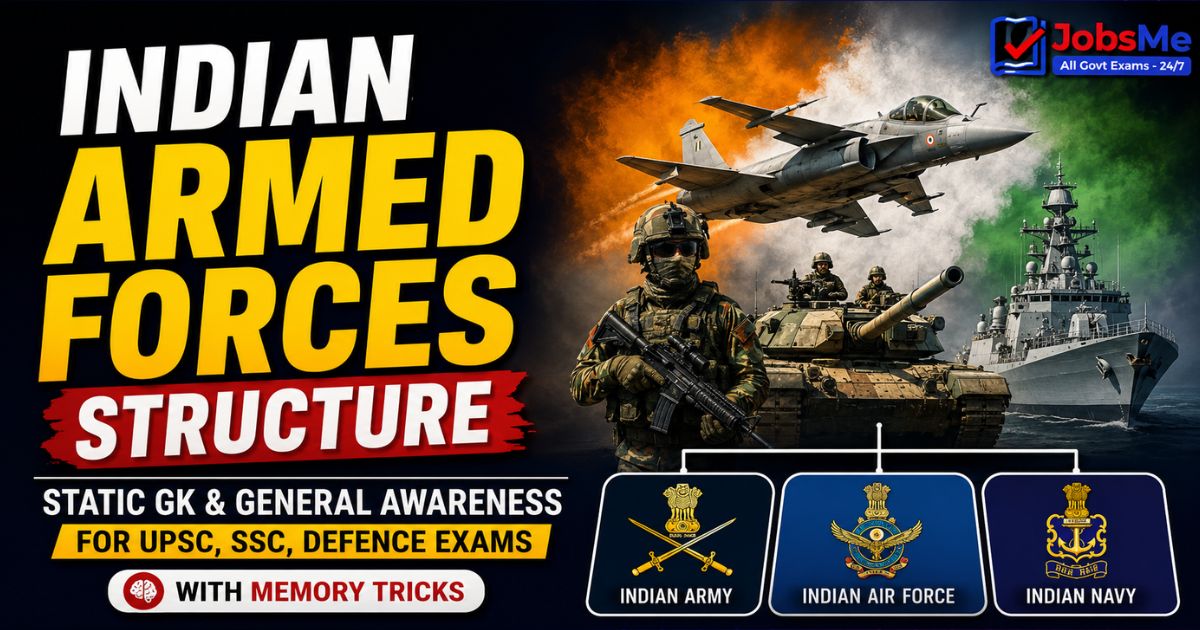
Indian Armed Forces Structure – Static GK & General Awareness for UPSC, SSC, Defence Exams with Memory Tricks
This article explains the Indian Armed Forces Structure in an exam-ready format, covering the Indian Army, Indian Navy, Indian Air Force, CAPFs, special forces, commands, ranks, and key security agencies. It is useful for UPSC, SSC, RRB, Defence, State PCS, Insurance, and other government exam aspirants because questions are often asked from command headquarters, service roles, internal security, border management, and one-liner Static GK facts.
Jump to section
Introduction
The Indian Armed Forces Structure is a major topic in Static GK, General Awareness, Defence Awareness, Internal Security, and UPSC GS Paper III. It explains how India organizes its land, naval, and air power through the Indian Army, Indian Navy, and Indian Air Force, along with supporting forces such as the Indian Coast Guard, Central Armed Police Forces, and specialized units.
For competitive exams, this topic is important because questions are commonly asked on the Supreme Commander of the Armed Forces, the role of the Ministry of Defence, the Chief of Defence Staff, Army/Navy/Air Force commands, headquarters, corps, divisions, special forces, CAPFs, and agencies like NSG, SPG, RPF, and NDRF. Aspirants preparing for UPSC, SSC CGL, CDS, NDA, AFCAT, CAPF, RRB, State PCS, and Police exams should revise this topic along with other Static GK notes.
The Armed Forces are not just war-fighting organizations. They protect India from external threats, support civil authorities during disasters, help in counter-terrorism and peacekeeping missions, and play a vital role in border and maritime security. This makes the topic useful for both fact-based Prelims questions and analytical Mains answers. You can also connect this topic with daily current affairs for updated developments on defence reforms, theatre commands, exercises, and appointments.
Core Concept Explanation
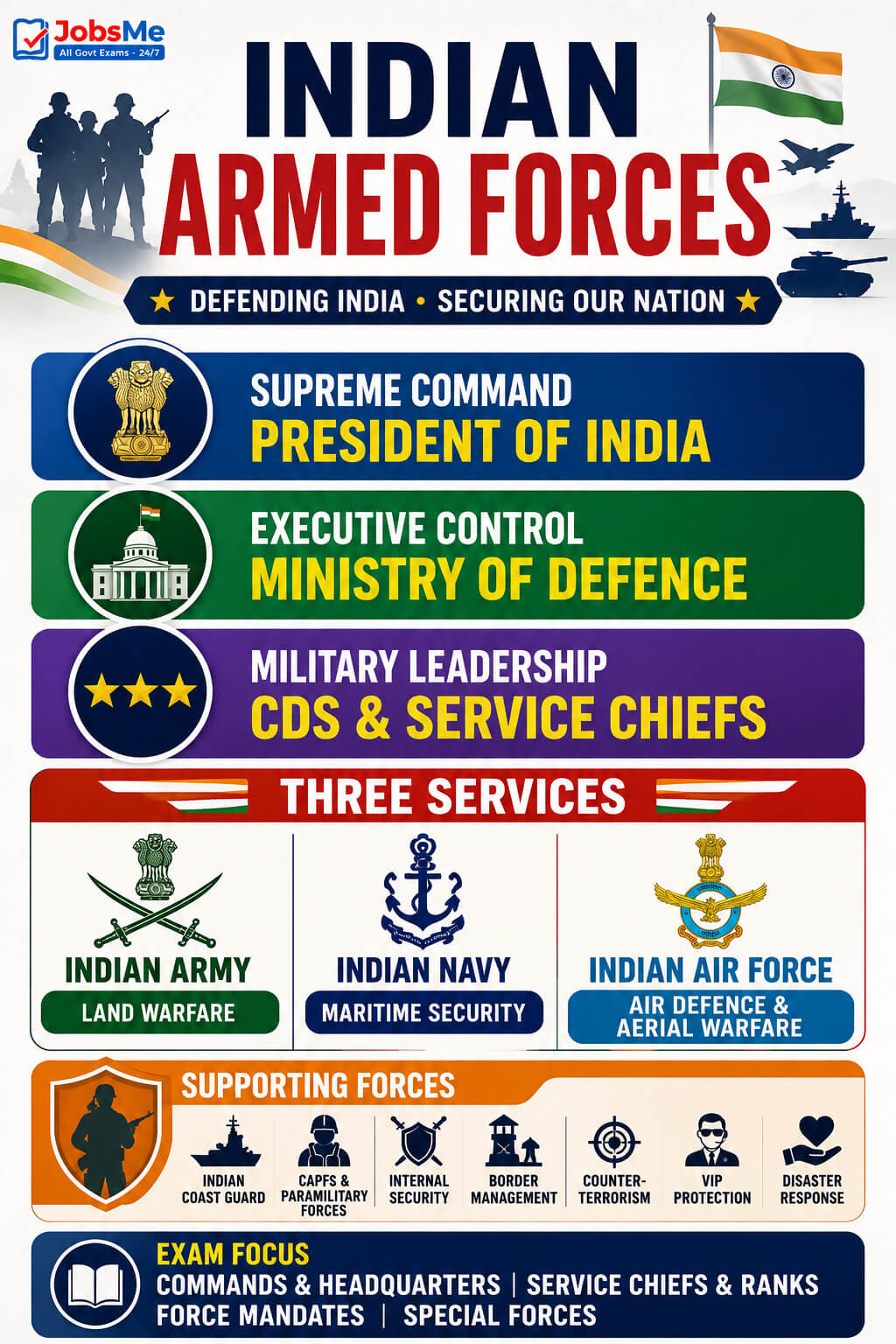
The Indian Armed Forces are the military forces of the Union of India. They primarily consist of three uniformed services: the Indian Army, the Indian Navy, and the Indian Air Force. Their main purpose is to defend India’s sovereignty, territorial integrity, and national interests across land, sea, and air.
- Supreme Command: The President of India is the Supreme Commander of the Armed Forces.
- Executive Control: The Ministry of Defence is responsible for defence policy, administration, budget, personnel, and resource management.
- Military Leadership: The Chief of Defence Staff and the service chiefs support strategic planning and operational coordination.
- Three Services: The Army handles land warfare, the Navy handles maritime security, and the Air Force handles air defence and aerial warfare.
- Supporting Forces: The Indian Coast Guard, CAPFs, paramilitary forces, and special security agencies assist in maritime law enforcement, internal security, border management, counter-terrorism, VIP protection, and disaster response.
- Exam Focus: Most exams ask direct matching questions on commands and headquarters, service chiefs and ranks, force mandates, and special forces.
Main Data Section
Overall Command and Control Structure
| Level / Authority | Key Position or Body | Role / Key Features | Exam Importance |
|---|---|---|---|
| Supreme Command | President of India | The President is the Supreme Commander of the Indian Armed Forces. This is a constitutional and ceremonial command position. | Frequently asked in UPSC, SSC, Defence, Railway, and State PCS exams. |
| Political and Executive Control | Central Government and Ministry of Defence | The Ministry of Defence manages defence policy, administration, budgetary control, personnel matters, and coordination among the services. | Important for Polity, Governance, and Internal Security topics. |
| Joint Military Coordination | Chief of Defence Staff and Department of Military Affairs | The CDS supports jointness among the Army, Navy, and Air Force and plays a role in integrated planning, defence reforms, and theatre command discussions. | Important for UPSC Mains and defence current affairs. |
| Service-Level Leadership | Chief of the Army Staff, Chief of the Naval Staff, Chief of the Air Staff | The three service chiefs head their respective services and oversee operational readiness, administration, and modernization. | Questions are asked on designation, service, and rank. |
| Primary Services | Indian Army, Indian Navy, Indian Air Force | The three services secure India’s land borders, maritime interests, and airspace. They also support disaster relief, peacekeeping, and civil authorities. | Core topic for Static GK and Defence Awareness. |
| Supporting Security Forces | Indian Coast Guard, CAPFs, Special Agencies | These forces assist with coastal security, border guarding, internal security, counter-terrorism, VIP protection, railway security, and disaster response. | Important for UPSC GS III and CAPF/Police exams. |
Indian Armed Forces: Three Main Services
| Service | Domain | Headed By | Main Role / Key Features |
|---|---|---|---|
| Indian Army | Land | Chief of the Army Staff, a four-star General | The land-based component of the Armed Forces. It defends territorial integrity, conducts land operations, counters external aggression, supports internal security when required, and helps in humanitarian assistance and disaster relief. |
| Indian Navy | Sea | Chief of the Naval Staff, an Admiral | Protects India’s maritime borders, shipping lanes, maritime trade, offshore assets, and strategic interests in the Indian Ocean Region. It also conducts anti-piracy, disaster relief, and international cooperation missions. |
| Indian Air Force | Air | Chief of the Air Staff, an Air Chief Marshal | Secures Indian airspace, conducts aerial warfare, provides air defence, air superiority, transport, surveillance, strategic airlift, and support to land and naval operations. |
Indian Army Hierarchy: From Headquarters to Section
| Level | Commanded By | Typical Composition | Key Features / Description |
|---|---|---|---|
| Army Headquarters | Chief of the Army Staff | Principal Staff Officers and Directorates | Located in New Delhi. It controls overall command, administration, policy, operations, intelligence, logistics, and personnel matters of the Indian Army. |
| Command | General Officer Commanding-in-Chief, usually a Lieutenant General | Multiple Corps | A large geographical or functional command. The Army has six operational commands and one training command. Each reports to Army Headquarters. |
| Corps | Lieutenant General | Usually 2 to 5 divisions; around 20,000 to 45,000 soldiers depending on role | A major field formation responsible for a specific operational zone within a command theatre. Corps may be Strike, Holding, or Mixed. |
| Division | Major General | Usually 3 to 4 brigades; often around 10,000 to 15,000 combat troops plus support elements | A primary combat formation. Common types include Infantry, Armoured, Mountain, Artillery, and RAPID formations. |
| Brigade | Brigadier | Usually 3 to 4 battalions and support arms | A brigade is an important tactical formation. Types include infantry, armoured, artillery, engineer, parachute, and air defence formations. |
| Battalion | Colonel or Lieutenant Colonel depending on context | Usually 4 to 6 rifle companies; around 800 to 1,000 soldiers | The basic fighting unit of the infantry. A battalion may be associated with a regiment and may include specialized platoons such as a Ghatak Platoon. |
| Company | Major or Captain | Usually around 120 soldiers; about 4 platoons | A company is a sub-unit of a battalion and is used for tactical control in field operations. |
| Platoon | Lieutenant, Captain, or sometimes Junior Commissioned Officer | Usually around 30 to 32 soldiers; about 4 sections | A platoon is an intermediate unit between a company and section. It is useful in small-unit operations. |
| Section | Non-Commissioned Officer such as Havildar or Sergeant | Usually 10 to 12 soldiers | The smallest regular field unit in the Army hierarchy. It is frequently asked in Defence exam one-liners. |
| Battery | Battery Commander | Usually 3 or 4 sections in artillery or air defence units | A battery is commonly used in artillery and air defence units instead of a company-type structure. |
| Buddy Pair / Squad | Mission-dependent leader | Small team; a squad may have around 5 to 6 soldiers | Used for training, patrols, and specific missions. A squad may include weapon, demolition, medical, communication, language, or sniper specialists depending on the mission. |
Indian Army Commands and Headquarters
| Command | Type | Headquarters | Key Features / Operational Importance |
|---|---|---|---|
| Northern Command | Operational Command | Udhampur, Jammu & Kashmir | Handles one of India’s most sensitive operational theatres, including areas linked to the Line of Control and northern border security challenges. |
| Western Command | Operational Command | Chandimandir, Haryana | Responsible for the western front and conventional operational preparedness along important sectors facing Pakistan. |
| Eastern Command | Operational Command | Kolkata, West Bengal | Responsible for eastern and north-eastern security concerns, including areas linked to China, Myanmar, and the eastern theatre. |
| Southern Command | Operational Command | Pune, Maharashtra | Responsible for southern India and associated operational, logistical, and internal support roles. |
| Central Command | Operational Command | Lucknow, Uttar Pradesh | Acts as an important central theatre command and reserve/support command for wider operational requirements. |
| South Western Command | Operational Command | Jaipur, Rajasthan | Handles the Rajasthan-Punjab axis and is important for western desert operations. |
| Army Training Command | Training Command | Shimla, Himachal Pradesh | Also called ARTRAC. It is responsible for doctrine, institutional training, training standards, and modernization of training in the Army. |
Important Army Field Formation Concepts
| Concept | Types / Examples | Description / Key Features | Exam Note |
|---|---|---|---|
| Corps Types | Strike Corps, Holding Corps, Mixed Corps | Strike Corps are offensive formations; Holding Corps are defensive formations; Mixed Corps perform a combination of offensive and defensive roles. | Asked in Defence and UPSC internal security preparation. |
| Division Types | Infantry, Armoured, Mountain, Artillery, RAPID | Divisions are primary combat formations. Infantry works across terrains; armoured divisions use tanks and mechanized forces; mountain divisions specialize in high-altitude terrain; artillery divisions provide heavy fire support; RAPID means Reorganized Army Plains Infantry Division. | Useful for matching-type questions. |
| Brigade Types | Infantry, Armoured, Artillery, Engineer, Air Defence, Parachute | Brigades are tactical formations under divisions or independent corps-level control. Independent brigades may function directly under a Corps Commander depending on operational need. | Know that a brigade is commanded by a Brigadier. |
| Battalion and Regiment | Infantry Battalion, Administrative Regiment | A battalion is a fighting unit. A regiment is often an administrative grouping of battalions from a similar tradition, role, or recruitment base. | Battalion vs regiment is a frequently confused fact. |
| Ghatak Platoon | Infantry commando-style platoon | Many infantry battalions have a Ghatak Platoon trained for special tactical tasks, raids, reconnaissance, and shock action. | Important for defence awareness. |
| Battery | Artillery and Air Defence unit | Battery is a sub-unit commonly used in artillery and air defence branches, generally comparable to a company-level concept in infantry terms. | Remember artillery uses battery terminology. |
Indian Army Arms and Services
| Category | Important Corps / Units | Key Features / Description |
|---|---|---|
| Combat Arms | Infantry, Armoured Corps, Regiment of Artillery, Mechanized Infantry, Army Aviation Corps, Corps of Army Air Defence | These arms are directly involved in combat or combat support on the battlefield. Infantry is the backbone, armoured corps provides tank power, artillery provides firepower, and Army Aviation gives helicopter-based support. |
| Combat Support Arms | Army Ordnance Corps, Corps of Electronics and Mechanical Engineers, Army Service Corps, Corps of Signals, Army Medical Corps, Corps of Engineers | These arms ensure that combat units can fight effectively through engineering, communications, maintenance, logistics, medical services, supplies, and equipment support. |
| Supporting Arms and Services | Intelligence Corps, Army Dental Corps, Corps of Military Police, Army Education Corps, Military Nursing Service, Territorial Army, Pioneer Corps, Judge Advocate General’s Department, Army Postal Service Corps, Defence Security Corps, Remount and Veterinary Corps | These services support intelligence, law, discipline, education, nursing, reserve participation, postal support, security, veterinary care, and other essential administrative or specialist functions. |
Specialized Units and Training Establishments of the Indian Army
| Unit / Establishment | Location / Service | Role / Key Features |
|---|---|---|
| Para (Special Forces) | Indian Army | Part of the Parachute Regiment. Trained for airborne operations, counter-terrorism, hostage rescue, reconnaissance, and special missions behind enemy lines. |
| Army Aviation Corps | Indian Army | Provides helicopter-based reconnaissance, transport, logistics, troop movement, casualty evacuation, and combat support. |
| Regiment of Artillery | Indian Army | Provides battlefield firepower through guns, howitzers, rockets, and missile systems. Examples in exam notes include Bofors guns and Pinaka MBRL. |
| Corps of Engineers | Indian Army | Handles combat engineering, bridges, fortifications, construction, demolition, minefield tasks, and field engineering support. |
| Corps of Signals | Indian Army | Maintains secure communication networks across the chain of command. |
| Army Medical Corps | Indian Army | Provides medical support to soldiers in peace, field, and combat zones. |
| Army Service Corps | Indian Army | Handles logistics, supply chain management, transport of troops, and movement of equipment and essential supplies. |
| Indian Military Academy | Dehradun | Premier training academy for commissioning officers into the Indian Army. |
| Officers Training Academy | Chennai and Gaya | Trains Short Service Commission officers. OTA Chennai is well known in Defence exam preparation. |
| Army War College | Mhow | Provides advanced professional military education and training for senior officers. |
| College of Military Engineering | Pune | Trains engineer officers and personnel in military engineering, construction, field engineering, and related subjects. |
| National Defence Academy | Khadakwasla, Pune | Joint services academy for cadets of the Army, Navy, and Air Force before they move to respective service academies. |
| Defence Services Staff College | Wellington | Important tri-service institution for staff training and inter-service understanding among officers. |
Indian Navy Commands and Key Components
| Command / Component | Headquarters / Example | Role / Key Features | Exam Note |
|---|---|---|---|
| Western Naval Command | Mumbai, Maharashtra | Responsible for operations in the Arabian Sea and the western maritime theatre. | One of the two major operational commands of the Navy. |
| Eastern Naval Command | Visakhapatnam, Andhra Pradesh | Responsible for the Bay of Bengal and eastern maritime theatre. | Often asked as headquarters-based GK. |
| Southern Naval Command | Kochi, Kerala | The training command of the Indian Navy. It handles major training-related responsibilities. | Remember Kochi means Navy training. |
| Aircraft Carriers | INS Vikramaditya, INS Vikrant | Serve as floating air bases and help project maritime power far from the coast. | Important for Defence current affairs and Static GK. |
| Submarine Fleet | Scorpene-class submarines, INS Arihant | Includes conventional submarines and nuclear-powered platforms. INS Arihant is associated with strategic deterrence. | Important for strategic forces questions. |
| Surface Warships | Destroyers, frigates, corvettes, missile boats | Examples include INS Kolkata-class destroyers, INS Shivalik-class frigates, and Kamorta-class corvettes. | Asked in Defence and Navy-specific exams. |
| Naval Aviation | MiG-29K, P-8I Poseidon, Sea King helicopters | Supports maritime patrol, anti-submarine warfare, surveillance, carrier operations, and naval air defence. | Useful for matching aircraft with service. |
| MARCOS | Marine Commando Force | Elite special operations unit of the Indian Navy, trained for maritime warfare, amphibious assaults, counter-terrorism, and anti-piracy operations. | Remember: MARCOS belongs to Navy. |
Indian Air Force Commands and Key Units
| Command / Unit | Headquarters / Examples | Role / Key Features | Exam Note |
|---|---|---|---|
| Western Air Command | New Delhi | Largest operational command, responsible for major air defence responsibilities over northern and western India. | Frequently asked in Air Force command questions. |
| Eastern Air Command | Shillong, Meghalaya | Handles the eastern air theatre and air defence responsibilities toward India’s eastern front. | Remember Shillong for Eastern Air Command. |
| Central Air Command | Prayagraj, Uttar Pradesh | Provides central air operations, reinforcement, and support responsibilities. | Older exam materials may mention Allahabad; current city name is Prayagraj. |
| Southern Air Command | Thiruvananthapuram, Kerala | Responsible for air defence and operations over the southern peninsula and related maritime airspaces. | Important for command-HQ matching. |
| South Western Air Command | Gandhinagar, Gujarat | Covers the western desert and south-western air defence zone. | Different from Army South Western Command at Jaipur. |
| Training Command | Bengaluru, Karnataka | Responsible for training pilots, technical staff, and other IAF personnel. | Training command of IAF is Bengaluru. |
| Maintenance Command | Nagpur, Maharashtra | Handles maintenance, repair, logistics, and technical support for IAF aircraft and equipment. | Only IAF has a separate Maintenance Command among the three services. |
| Fighter Aircraft | Su-30MKI, Rafale, Mirage 2000, MiG-29, Tejas | Used for air superiority, interception, strike, and tactical missions. Tejas is an indigenously developed Light Combat Aircraft. | Important for Defence Awareness and current affairs. |
| Transport Aircraft | C-130J Super Hercules, C-17 Globemaster III, IL-76 | Used for strategic and tactical airlift, troop movement, and logistics support. | Asked in aircraft-service matching questions. |
| Helicopters | Apache AH-64E, Chinook, Dhruv | Apache is an attack helicopter; Chinook is a heavy-lift helicopter; Dhruv is a multi-role Indian helicopter. | Important for Defence exam one-liners. |
| Surveillance Assets | AWACS, UAVs | Used for airborne warning, control, reconnaissance, and real-time surveillance. | Useful for technology and defence questions. |
| Garud Commando Force | Indian Air Force | Special forces unit of the IAF. It performs airfield protection, search and rescue, counter-terrorism, suppression of enemy air defence support, and special missions. | Remember: Garud belongs to Air Force. |
| Air Force Network | AFNet | A fibre-optic based digital information grid launched to improve communication, threat response, and networked operations. | Useful for defence technology and computer awareness linkage. |
Central Armed Police Forces, Paramilitary Forces and Security Agencies
| Force / Agency | Ministry / Control | Key Facts | Main Role / Description |
|---|---|---|---|
| Assam Rifles | Administrative control: Ministry of Home Affairs; operational control: Indian Army / Ministry of Defence | Established in 1835; oldest paramilitary force; also known as Friends of the Hill People, Friends of the North East People, and Sentinels of the North East. | Performs counter-insurgency and border security duties in the North East and guards the Indo-Myanmar border. It has a dual-control structure and is headed by an Army officer of Lieutenant General rank. |
| Border Security Force | Ministry of Home Affairs | Established on 1 December 1965 after the 1965 Indo-Pakistan War; called India’s First Line of Defence. | Guards India’s borders, supports the Army during wartime, and assists in counter-insurgency and border management tasks. |
| Central Industrial Security Force | Ministry of Home Affairs | Established in 1969 under the Central Industrial Security Force Act, 1968; has a dedicated fire wing; works as a compensatory cost force. | Provides security to PSUs, airports, nuclear installations, space establishments, seaports, power plants, sensitive government buildings, heritage monuments, SEZs, and protected persons as assigned. |
| Central Reserve Police Force | Ministry of Home Affairs | Originated as Crown Representative’s Police in 1939 and was reorganized under the CRPF Act, 1949; has COBRA for anti-Maoist operations. | Largest internal security force of India. It assists states and Union Territories in law and order, counter-insurgency, anti-Maoist operations, and UN peacekeeping missions. |
| Indo-Tibetan Border Police | Ministry of Home Affairs | Established on 24 October 1962 after the Sino-Indian conflict; created to guard high-altitude border areas. | Guards the India-China border from the Karakoram sector to the eastern sector, including Ladakh/Jammu & Kashmir region, Himachal Pradesh, Uttarakhand, Sikkim, and Arunachal Pradesh. It also checks border violations, illegal immigration, and smuggling. |
| Sashastra Seema Bal | Ministry of Home Affairs | Set up in March 1963; earlier known as Special Service Bureau. | Guards the Indo-Nepal and Indo-Bhutan borders, supports election security, acts against smuggling and illegal activities, and works with border populations. |
| National Security Guard | Ministry of Home Affairs | Established on 22 September 1986; raised to handle exceptional counter-terror situations; played a major role during the 26/11 Mumbai terror attack response. | Elite counter-terrorism and special response force used when local police and other forces require specialized assistance. |
| Special Protection Group | Cabinet Secretariat | Raised in 1985; governed by the Special Protection Group Act, 1988. | Provides immediate security to the Prime Minister of India and other protected categories as defined by law. |
| Railway Protection Force | Ministry of Railways | Armed force of the Union with powers relating to railway security. | Protects railway passengers, passenger areas, and Indian Railways property. It has powers to arrest, investigate, and prosecute in railway property-related offences. |
| National Disaster Response Force | Ministry of Home Affairs / Disaster Management framework | Set up under the Disaster Management Act, 2005; composed of specialized battalions drawn from CAPFs. | Provides specialist response to natural and man-made disasters. It supports a proactive, multi-disaster, and technology-driven disaster management approach. |
| Indian Coast Guard | Ministry of Defence | Supports India’s coastal and maritime security framework. | Responsible for maritime law enforcement, coastal security, search and rescue, anti-smuggling, and protection of India’s maritime zones. |
| Strategic Forces Command | Tri-service strategic command | Part of India’s strategic command structure. | Oversees operational readiness and security of India’s strategic and nuclear arsenal. |
| Special Frontier Force | Specialized force | Associated with covert, high-risk, and high-altitude operations. | Conducts special missions in challenging terrain and sensitive operational environments. |
| Integrated Defence Staff | Tri-service organization | Supports joint planning and inter-service coordination. | Works toward integrated functioning among Army, Navy, and Air Force structures. |
| Andaman and Nicobar Command | Tri-service command | India’s tri-service command in a strategically important island region. | Important for maritime security, eastern Indian Ocean strategy, and joint command understanding. |
Special Forces of India: Quick Table
| Special Force | Parent Service / Authority | Core Role | Memory Point |
|---|---|---|---|
| Para (Special Forces) | Indian Army | Airborne operations, counter-terrorism, reconnaissance, hostage rescue, and missions behind enemy lines. | Para means Army. |
| MARCOS | Indian Navy | Maritime warfare, amphibious operations, counter-terrorism, anti-piracy, and special naval missions. | Marine commandos belong to Navy. |
| Garud Commando Force | Indian Air Force | Airfield protection, search and rescue, counter-terrorism, and airborne special operations. | Garud flies with Air Force. |
| National Security Guard | Ministry of Home Affairs | Counter-terrorism and special response for exceptional security situations. | NSG is counter-terror force under MHA. |
| Special Protection Group | Cabinet Secretariat | Prime Minister security and protection duties as defined by law. | SPG means protection, not battlefield combat. |
| Special Frontier Force | Specialized force | High-risk and high-altitude special missions. | SFF is linked with frontier and covert operations. |
Integrated Theatre Command Concept

| Aspect | Meaning | Key Features / Description |
|---|---|---|
| Integrated Theatre Command | Joint command concept | A structure in which resources from the Army, Navy, and Air Force are placed under a single operational commander for a defined theatre or domain. |
| Purpose | Jointness and efficiency | Improves resource use, combat effectiveness, coordination, and quick decision-making compared with completely separate service-level command structures. |
| Operational Benefit | Enhanced readiness | Joint planning and training can improve response speed during war, border crisis, cyber threat, maritime incident, or special operation. |
| Proposed Geographic Theatre Commands | Western and Eastern theatres | Exam notes often mention a Western Theatre Command focused on Pakistan and an Eastern Theatre Command focused on China. The implementation is discussed as a phased reform under the broader jointness agenda. |
| Specialized Commands | Cyber, space, logistics, and special operations concepts | Modern warfare requires focused commands or structures for cyber security, space assets, logistics integration, and special operations across services. |
Memory Tricks and Mnemonics
Trick 1: Three Services - "Land, Sea, Air = Army, Navy, Air Force"
Remember the basic structure with one simple line:
- Land → Indian Army.
- Sea → Indian Navy.
- Air → Indian Air Force.
"Land Army, Sea Navy, Air Force."
Trick 2: Army Hierarchy - "Head Commands Corps Divide Brigades Before Companies, Platoons, Sections"
Use this sentence to remember the order from top to bottom:
- Head → Army Headquarters.
- Commands → Commands.
- Corps → Corps.
- Divide → Divisions.
- Brigades → Brigades.
- Before → Battalions.
- Companies → Companies.
- Platoons → Platoons.
- Sections → Sections.
"HQ → Command → Corps → Division → Brigade → Battalion → Company → Platoon → Section."
Trick 3: Army Commands Headquarters - "U-Cha-Ko-Pu-Lu-Ja-Shi"
Remember the Army command headquarters in this order:
- U → Udhampur → Northern Command.
- Cha → Chandimandir → Western Command.
- Ko → Kolkata → Eastern Command.
- Pu → Pune → Southern Command.
- Lu → Lucknow → Central Command.
- Ja → Jaipur → South Western Command.
- Shi → Shimla → ARTRAC.
"U-Cha-Ko-Pu-Lu-Ja-Shi keeps the seven Army commands in order."
Trick 4: Navy Commands - "Arabian Mumbai, Bay Vizag, Training Kochi"
Use sea-location logic:
- Western Naval Command → Mumbai → Arabian Sea side.
- Eastern Naval Command → Visakhapatnam → Bay of Bengal side.
- Southern Naval Command → Kochi → Training command.
"West Mumbai, East Vizag, South Kochi trains."
Trick 5: Air Force Commands - "We Eat Curry, South-West Trains and Maintains"
This sentence helps remember the seven IAF commands:
- We → Western Air Command → New Delhi.
- Eat → Eastern Air Command → Shillong.
- Curry → Central Air Command → Prayagraj.
- South → Southern Air Command → Thiruvananthapuram.
- West → South Western Air Command → Gandhinagar.
- Trains → Training Command → Bengaluru.
- Maintains → Maintenance Command → Nagpur.
"We Eat Curry, South-West Trains and Maintains."
Trick 6: Special Forces - "Pa-Mar-Gar"
Use this three-part memory trick:
- Pa → Para SF → Army.
- Mar → MARCOS → Navy.
- Gar → Garud → Air Force.
"Pa-Mar-Gar: Para, MARCOS, Garud."
Trick 7: CAPF Border Memory - "B-A-I-S Guards Borders"
Use this acronym for common border-related forces:
- B → BSF → Border guarding and India’s First Line of Defence.
- A → Assam Rifles → North East and Indo-Myanmar border.
- I → ITBP → India-China high-altitude border.
- S → SSB → Indo-Nepal and Indo-Bhutan borders.
"B-A-I-S: Border, Assam, Ice mountains, Seema Bal."
Trick 8: NSG vs SPG - "T for Terror, P for PM"
Many students confuse NSG and SPG. Use this contrast:
- NSG → Counter-Terrorism and special response.
- SPG → Prime Minister protection.
"NSG handles Terror; SPG protects PM."
Additional Notes
Frequently Confused Facts
- Armed Forces vs CAPF: Armed Forces mainly means Army, Navy, and Air Force under the defence framework. CAPFs like CRPF, BSF, CISF, ITBP, SSB, Assam Rifles, and NSG largely work under the Ministry of Home Affairs.
- Indian Army vs Indian National Army: The modern Indian Army evolved from colonial-era forces and reorganized after independence. The Indian National Army or Azad Hind Fauj was a separate freedom-struggle force associated with Subhas Chandra Bose.
- CDS vs Service Chiefs: The CDS promotes jointness among services, while COAS, CNS, and CAS head the Army, Navy, and Air Force respectively.
- Command vs Corps: A command is a larger geographical/functional formation; a corps is a field formation under a command.
- Battalion vs Regiment: A battalion is a fighting unit; a regiment is often an administrative or traditional grouping of battalions.
- Army Training Command vs Southern Naval Command: ARTRAC at Shimla is the Army training command; Southern Naval Command at Kochi is the Navy training command.
- IAF Training vs Maintenance Command: Training Command is at Bengaluru, while Maintenance Command is at Nagpur.
- Para SF vs MARCOS vs Garud: Para SF belongs to Army, MARCOS belongs to Navy, and Garud belongs to Air Force.
- NSG vs SPG: NSG is a counter-terror force under MHA; SPG is for Prime Minister security under the Cabinet Secretariat framework.
- Indian Coast Guard vs Indian Navy: Navy is a combat maritime service; Coast Guard handles maritime law enforcement, coastal security, search and rescue, and peacetime maritime duties.
- Assam Rifles Dual Control: Assam Rifles has administrative control under MHA and operational control linked with the Army/defence framework, making it unique among security forces.
- Air Marshal vs Air Chief Marshal: The Chief of the Air Staff is normally an Air Chief Marshal, not merely an Air Marshal.
Repeating PYQ Patterns
In UPSC, CDS, NDA, AFCAT, SSC, RRB, State PCS, and Police exams, questions commonly focus on the Supreme Commander of the Armed Forces, Army command headquarters, Navy command headquarters, Air Force command headquarters, special forces and their parent services, and CAPF mandates. UPSC Mains often connects this topic with border management, internal security, disaster management, cyber security, theatre commands, and civil-military coordination.
Defence exams frequently ask direct one-liners such as “Where is ARTRAC located?”, “Which command of the Navy is the training command?”, “Who commands a brigade?”, “Which is the smallest Army unit?”, and “Which special force belongs to the Indian Navy?”. To strengthen your practice, revise this topic with Static GK quizzes and daily current affairs quizzes.
Quick Insight
The structure of the Indian Armed Forces is changing with modern security needs. Jointness, integrated theatre commands, cyber warfare, space-based assets, drones, network-centric warfare, and rapid deployment are becoming more important. For UPSC and Defence aspirants, the best approach is to learn static facts first and then connect them with recent defence reforms, exercises, border incidents, new equipment, and appointments through current affairs updates.
One-Liners for Quick Revision
- President of India → Supreme Commander of the Indian Armed Forces → Most repeated polity-defence fact.
- Ministry of Defence → Handles defence policy, administration, resources, and budget → Executive control of defence matters.
- Chief of Defence Staff → Promotes jointness among Army, Navy, and Air Force → Important for theatre command reforms.
- Indian Army → Land-based component of Armed Forces → Defends territorial integrity and conducts land warfare.
- Indian Navy → Maritime component of Armed Forces → Protects sea lanes, coast, maritime trade, and Indian Ocean interests.
- Indian Air Force → Air component of Armed Forces → Secures airspace and conducts aerial warfare.
- Chief of the Army Staff → Heads Indian Army → Rank is General.
- Chief of the Naval Staff → Heads Indian Navy → Rank is Admiral.
- Chief of the Air Staff → Heads Indian Air Force → Rank is Air Chief Marshal.
- Army Headquarters → Located in New Delhi → Top administrative and command body of Indian Army.
- Army Directorates → Military Operations, Military Intelligence, General Staff, Adjutant General, Quartermaster General → Important Army HQ branches.
- Army Commands → Six operational commands plus one training command → All report to Army HQ.
- Northern Command → Udhampur → Sensitive northern operational theatre.
- Western Command → Chandimandir → Western front operational command.
- Eastern Command → Kolkata → Eastern and north-eastern operational command.
- Southern Command → Pune → Southern theatre and support responsibilities.
- Central Command → Lucknow → Central theatre and reserve/support role.
- South Western Command → Jaipur → Rajasthan-Punjab axis and desert operations.
- ARTRAC → Shimla → Army Training Command.
- Corps → Commanded by Lieutenant General → Usually consists of multiple divisions.
- Strike Corps → Offensive role → Designed for major offensive operations.
- Holding Corps → Defensive role → Holds important territory and defensive sectors.
- Mixed Corps → Offensive plus defensive role → Performs combined operational tasks.
- Division → Commanded by Major General → Usually consists of multiple brigades.
- Infantry Division → Foot-soldier centric combat formation → Backbone of ground operations.
- Armoured Division → Tank-heavy formation → Used for mechanized and high-intensity combat.
- Mountain Division → High-altitude formation → Important for Himalayan border security.
- Artillery Division → Heavy firepower formation → Supports battlefield operations with guns, rockets, and missiles.
- RAPID → Reorganized Army Plains Infantry Division → Plains warfare-oriented formation concept.
- Brigade → Commanded by Brigadier → Usually consists of three to four battalions.
- Battalion → Basic fighting unit of infantry → Usually around 800 to 1,000 soldiers.
- Company → Commanded by Major or Captain → Usually around 120 soldiers.
- Platoon → Led by Lieutenant, Captain, or JCO in some cases → Usually around 30 to 32 soldiers.
- Section → Smallest regular Army unit → Usually 10 to 12 soldiers, led by NCO.
- Battery → Artillery or air defence sub-unit → Comparable to company-level structure in artillery terms.
- Ghatak Platoon → Infantry special assault platoon → Attached to infantry battalions.
- Buddy Pair / Squad → Small mission team → Used for patrols, training, and special tasks.
- Combat Arms → Infantry, Armoured Corps, Artillery, Mechanized Infantry, Army Aviation, Army Air Defence → Direct combat role.
- Combat Support Arms → Ordnance, EME, Service Corps, Signals, Medical Corps, Engineers → Keep combat forces operational.
- Supporting Arms → Intelligence, Dental, Military Police, Education, Nursing, Territorial Army, Pioneer, JAG, Postal, Defence Security, Remount and Veterinary → Specialist and administrative support.
- Para Special Forces → Indian Army special force → Airborne and behind-enemy-lines operations.
- Army Aviation Corps → Helicopter support arm → Reconnaissance, transport, casualty evacuation, and combat support.
- Regiment of Artillery → Provides battlefield firepower → Uses guns, howitzers, rockets, and missiles.
- Corps of Engineers → Construction, demolition, bridges, fortifications → Vital for combat engineering.
- Corps of Signals → Communication network arm → Maintains command communication.
- Army Medical Corps → Medical support arm → Provides care in peace and combat zones.
- Army Service Corps → Logistics and supply → Handles transport of troops, equipment, and supplies.
- Indian Military Academy → Dehradun → Trains Army officers.
- Officers Training Academy → Chennai and Gaya → Trains Short Service Commission officers.
- Army War College → Mhow → Advanced training for senior officers.
- College of Military Engineering → Pune → Trains engineer officers and personnel.
- National Defence Academy → Khadakwasla, Pune → Joint services training academy.
- Defence Services Staff College → Wellington → Tri-service staff training institution.
- Western Naval Command → Mumbai → Arabian Sea side operational command.
- Eastern Naval Command → Visakhapatnam → Bay of Bengal side operational command.
- Southern Naval Command → Kochi → Training command of Indian Navy.
- INS Vikramaditya and INS Vikrant → Aircraft carriers → Floating air bases of the Navy.
- Scorpene Class and INS Arihant → Submarine fleet examples → Conventional and strategic submarine capability.
- INS Kolkata, INS Shivalik, Kamorta Class → Surface warship examples → Destroyer, frigate, and corvette categories.
- MiG-29K and P-8I Poseidon → Naval aviation assets → Carrier aviation and maritime patrol.
- MARCOS → Navy special force → Maritime commando operations.
- Western Air Command → New Delhi → Largest IAF operational command.
- Eastern Air Command → Shillong → Eastern air theatre.
- Central Air Command → Prayagraj → Central air operations and support.
- Southern Air Command → Thiruvananthapuram → Southern peninsula and maritime airspace.
- South Western Air Command → Gandhinagar → Western desert air defence area.
- Training Command of IAF → Bengaluru → Pilot and technical training.
- Maintenance Command of IAF → Nagpur → Maintenance and logistics support.
- Su-30MKI, Rafale, Mirage 2000, MiG-29, Tejas → IAF fighter aircraft → Air superiority and strike roles.
- C-130J, C-17, IL-76 → Transport aircraft → Strategic and tactical airlift.
- Apache, Chinook, Dhruv → Helicopter examples → Attack, heavy-lift, and multi-role categories.
- AWACS and UAVs → Surveillance assets → Reconnaissance and airborne warning.
- Garud Commando Force → Air Force special force → Airfield protection and special operations.
- AFNet → Air Force Network → Fibre-optic digital information grid for faster threat response.
- Assam Rifles → Established in 1835 → Oldest paramilitary force and Sentinels of the North East.
- Assam Rifles Dual Control → Administrative MHA and operational Army/defence control → Unique security force feature.
- BSF → Established on 1 December 1965 → India’s First Line of Defence.
- CISF → Established in 1969 → Secures PSUs, airports, nuclear sites, space establishments, and critical infrastructure.
- CRPF → Originated as Crown Representative’s Police in 1939 and reorganized in 1949 → Major internal security and counter-insurgency force.
- COBRA → CRPF special unit → Focused on anti-Maoist operations.
- ITBP → Established on 24 October 1962 → Guards the India-China high-altitude border.
- SSB → Set up in March 1963 → Guards Indo-Nepal and Indo-Bhutan borders.
- NSG → Established on 22 September 1986 → Counter-terrorism and special response force.
- SPG → Raised in 1985 and linked with SPG Act, 1988 → Prime Minister security force.
- RPF → Railway security force → Protects passengers, railway areas, and railway property.
- NDRF → Set up under Disaster Management Act, 2005 → Specialist disaster response force.
- Indian Coast Guard → Maritime law enforcement and coastal security → Handles SAR and peacetime maritime duties.
- Strategic Forces Command → Strategic and nuclear arsenal readiness → Important for national security structure.
- Special Frontier Force → Covert and high-altitude missions → Specialized force for sensitive operations.
- Andaman and Nicobar Command → Tri-service command → Important for joint operations in the Indian Ocean Region.
- Integrated Theatre Command → Joint command concept → Integrates Army, Navy, and Air Force assets under one operational commander.
- Western Theatre Command Concept → Proposed Pakistan-focused theatre → Part of jointness discussions.
- Eastern Theatre Command Concept → Proposed China-focused theatre → Important for UPSC internal security and defence reforms.
- Cyber, Space, Logistics and Special Operations Commands → Modern warfare-focused structures → Highlight the future of integrated defence planning.
For practice, revise this topic with Static GK quizzes, follow daily current affairs for defence updates, and check latest government job notifications for defence and police recruitment updates.
Free quiz • No signup required
Put this topic into practice with Indian Cultural Institutions – Static GK MCQ Quiz. It is the quickest way to reinforce what you just learned.
Frequently Asked Questions
What are the three main branches of the Indian Armed Forces?
Who is the Supreme Commander of the Indian Armed Forces?
How many commands does the Indian Army have?
What is the correct hierarchy of the Indian Army from top to bottom?
Where is the Army Training Command located?
Which are the three commands of the Indian Navy?
How many commands does the Indian Air Force have?
Which special force belongs to each armed service?
What is the difference between Armed Forces and CAPFs?
What is an Integrated Theatre Command?

About the author