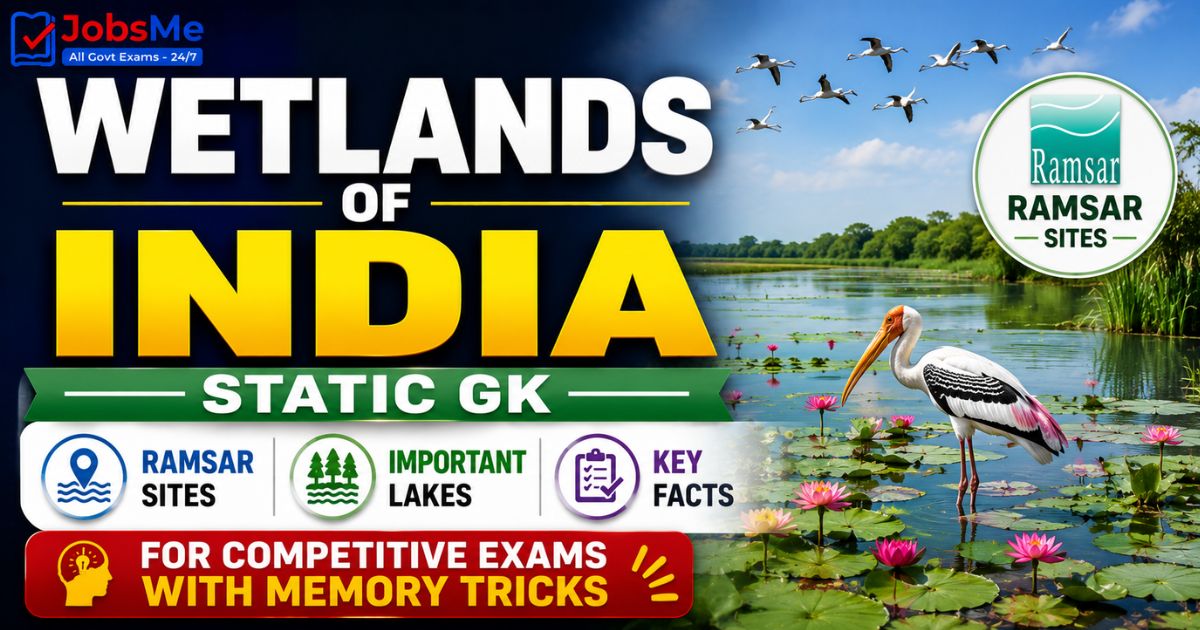
Wetlands of India Static GK: Ramsar Sites, Lakes & Key Facts for Competitive Exams
This article covers the complete Static GK on Wetlands of India, including all 100 Ramsar Sites (as of June 2026), the largest, smallest, oldest and newest wetlands, important lakes, and the Ramsar Convention. It is packed with exam one-liners, memory tricks, and frequently asked facts useful for UPSC, SSC, IBPS, RRB, Insurance and State PCS exams.
Jump to section
Introduction to Wetlands of India
Wetlands are among the most productive ecosystems on Earth, and questions on the Wetlands of India appear almost every year in the Static GK and General Awareness sections of major competitive exams. A wetland is a land area that is saturated or flooded with water, either permanently or seasonally, and includes lakes, marshes, mangroves, lagoons, reservoirs and floodplains. These ecosystems support rich biodiversity, recharge groundwater, control floods and act as crucial stopovers for migratory birds.
The most exam-relevant aspect of this topic is the list of Ramsar Sites — wetlands of international importance recognised under the Ramsar Convention. As of June 2026, India has 100 Ramsar Sites, the highest in Asia and the third-highest in the world after the United Kingdom and Mexico. Examiners frequently test the names of these sites, the states they belong to, their year of designation and the species associated with them.
This comprehensive guide organises every important fact into clear tables, memory tricks and one-liners so you can revise quickly before your exam. For regular updates on environment-related current affairs, you can also follow the daily current affairs section, which often connects Static GK with the latest developments.
Core Concepts: Wetlands and the Ramsar Convention

Before memorising the data, it is important to understand the basic concepts that examiners build their questions around.
- Wetland: An area of land where water covers the soil or is present at or near the surface for all or part of the year. It includes both natural and human-made water bodies.
- Ramsar Convention: An international treaty for the conservation and wise use of wetlands. It was signed on 2 February 1971 in the city of Ramsar, Iran, which is why World Wetlands Day is observed every year on 2 February.
- Ramsar Site: A wetland designated to be of international importance under the convention. A site qualifies if it meets any one of the nine criteria laid down by the convention.
- India and Ramsar: India signed and ratified the convention, and it came into force in India on 1 February 1982. The first two Indian sites were designated in 1981.
- Montreux Record: A register within the Ramsar Convention that lists wetlands of international importance facing ecological threats due to pollution, human interference or technological change. Sites on this record remain part of the Ramsar List.
- Legal protection: A Ramsar designation gives international recognition but does not automatically grant legal protection under Indian law. For domestic protection, a wetland must be separately notified under the Wildlife Protection Act, 1972 or the Environment Protection Act, 1986.
Understanding these terms helps you eliminate wrong options in tricky multiple-choice questions, which is why this topic is a reliable scoring area in the Static GK portion of most exams.
Key Facts About Wetlands of India
The table below summarises the most frequently tested headline facts about Indian wetlands and Ramsar Sites as of June 2026.
| Fact | Detail and Key Features |
|---|---|
| Total Ramsar Sites in India | 100 sites as of June 2026, covering roughly 13.6 lakh hectares; the highest number in Asia and the third-highest in the world. |
| India's global rank | Third in the world after the United Kingdom and Mexico; first in Asia. |
| State with most Ramsar Sites | Tamil Nadu, with 20 sites, well ahead of second-placed Uttar Pradesh; many Tamil Nadu sites were added in 2022 and 2025 batches. |
| First Ramsar Sites in India | Chilika Lake (Odisha) and Keoladeo National Park / Keoladeo Ghana (Rajasthan), both designated in 1981. |
| Largest Ramsar Site in India | Sundarbans Wetland in West Bengal, located within the world's largest mangrove forest; covers about 4.23 lakh hectares. |
| Smallest Ramsar Site in India | Renuka Wetland in Himachal Pradesh, with an area of only about 20 hectares. |
| Second-largest Ramsar Site / longest lake | Vembanad-Kol Wetland in Kerala; it is also the longest lake in India and hosts the Nehru Trophy Boat Race. |
| Sites on the Montreux Record | Two Indian sites: Keoladeo National Park (Rajasthan) and Loktak Lake (Manipur). Chilika Lake was added in 1993 and removed in 2002 after successful restoration. |
| India's 100th Ramsar Site | Jai Prakash Narayan Bird Sanctuary (Surha Tal), Ballia, Uttar Pradesh, took India's tally to 100 in 2026. |
| Ramsar Convention signed | 2 February 1971 in Ramsar, Iran; the date is observed as World Wetlands Day. |
Major Lakes and Wetlands of India
Apart from Ramsar Sites, several individual lakes and wetlands are tested for their unique characteristics. The table below lists the most important ones.
| Wetland / Lake | State / Location | Key Features |
|---|---|---|
| Sundarbans Wetland | West Bengal | Largest Ramsar Site in India and largest mangrove forest; shared with Bangladesh; the only Indian site holding all five designations together: Ramsar Site, UNESCO World Heritage Site, Tiger Reserve, National Park and Biosphere Reserve. Home to the Royal Bengal Tiger, Irrawaddy Dolphin and Fishing Cat. |
| Chilika Lake | Odisha | Asia's largest brackish-water coastal lagoon; one of India's first two Ramsar Sites (1981); famous for Irrawaddy dolphins and migratory birds; was once on the Montreux Record and later removed. |
| Keoladeo National Park (Ghana) | Rajasthan | One of India's first two Ramsar Sites (1981); a major bird sanctuary and UNESCO World Heritage Site; currently on the Montreux Record. |
| Wular Lake | Jammu and Kashmir | Largest freshwater lake in India; fed by the Jhelum River; a Ramsar Site important for fisheries and flood control. |
| Loktak Lake | Manipur | Largest freshwater lake in North-East India; famous for its floating islands called phumdis; site of Keibul Lamjao, the only floating national park; currently on the Montreux Record. |
| Vembanad-Kol Wetland | Kerala | Longest lake in India and second-largest Ramsar Site; the Kuttanad region nearby is famous for below-sea-level farming recognised by the FAO; hosts the Nehru Trophy Boat Race. |
| Sambhar Lake | Rajasthan | Largest inland salt lake in India; a major source of salt production; important wintering ground for flamingos. |
| Lonar Lake | Maharashtra | A saline and alkaline (soda) lake formed by a meteorite impact; a Ramsar Site valued for its unique geology and microbiology. |
| Tso Moriri | Ladakh | High-altitude mountain lake on the Changthang Plateau; a breeding ground for the Bar-headed Goose and Black-necked Crane. |
| Tso Kar | Ladakh | High-altitude hypersaline lake; its name means "white lake" because of salt deposits on its margins; an important breeding area for the Black-necked Crane. |
| Renuka Wetland | Himachal Pradesh | Smallest Ramsar Site in India at about 20 hectares; a natural lake shaped like a reclining woman, of religious importance. |
| Point Calimere | Tamil Nadu | A coastal wetland and bird sanctuary; breeding ground for commercially important fish and a habitat for the Spoon-billed Sandpiper and Grey Pelican. |
| Pichavaram | Tamil Nadu | Second-largest mangrove forest in India; a popular eco-tourism wetland and an important fish nursery. |
| Pallikaranai Marsh | Tamil Nadu | One of the few surviving natural wetlands in Chennai; a threatened urban wetland important for flood control. |
| Chhari-Dhand Wetland | Gujarat | A saline desert wetland in the Kutch region; ecologically unique among Indian Ramsar Sites; added to the list in 2026. |
State-wise Distribution of Ramsar Sites

The leading states are tested often, especially Tamil Nadu and Uttar Pradesh. The table below shows the top states as of June 2026.
| State | Position and Key Detail |
|---|---|
| Tamil Nadu | Highest number of Ramsar Sites in India with 20 sites; many added in batch designations in 2022 and 2025. |
| Uttar Pradesh | Second-highest number of Ramsar Sites; home to India's 100th site, Jai Prakash Narayan Bird Sanctuary (Surha Tal). |
| West Bengal | Protects the largest total wetland area among Indian states, mainly due to the Sundarbans. |
| States with no Ramsar Site (recent) | Telangana, Arunachal Pradesh, Meghalaya and Nagaland have had no designated Ramsar Sites in the recent period, making them common "odd one out" options. |
Memory Tricks and Mnemonics
The following tricks make the Wetlands of India topic easy to recall under exam pressure.
Trick 1: First Two Ramsar Sites of India
"Chilika Chirps, Keoladeo Calls — both 1981, both first."
- Chilika Lake (Odisha) and Keoladeo Ghana (Rajasthan) were the first two sites, both designated in 1981.
Trick 2: Largest vs Smallest
"Sundar is the biggest, Renuka is the tiniest."
- Sundarbans (West Bengal) is the largest Ramsar Site; Renuka (Himachal Pradesh) is the smallest.
Trick 3: Montreux Record Sites
"Keep Looking — Keoladeo and Loktak."
- The two Indian sites currently on the Montreux Record are Keoladeo (Rajasthan) and Loktak (Manipur). Remember "K and L."
Trick 4: Salty vs Sweet Lakes
"Salt in Sambhar, Sweet in Wular."
- Sambhar is the largest inland salt lake; Wular is the largest freshwater lake in India.
Trick 5: Floating and Special Lakes
"Loktak Floats, Lonar is a meteor's gift, Vembanad is the Longest."
- Loktak has floating phumdis; Lonar formed from a meteorite impact; Vembanad is the longest lake in India.
Trick 6: Convention Date
"Two-Two of Seventy-One in Ramsar."
- The Ramsar Convention was signed on 2/2/1971 (2 February) in Ramsar, Iran. The same date is World Wetlands Day.
Trick 7: India's Global Standing
"India is Asia's Number One, World's Number Three — behind UK and Mexico."
- India has the most Ramsar Sites in Asia and ranks third globally after the UK and Mexico.
Additional Notes
Frequently Confused Facts
- Largest lake vs largest freshwater lake: Chilika is the largest coastal lagoon in Asia, but Wular is the largest freshwater lake in India.
- Smallest site confusion: The smallest Ramsar Site is Renuka Wetland (Himachal Pradesh, about 20 ha), not Nanda Lake in Goa.
- Floating vs high-altitude: Loktak is the only floating lake; the highest-altitude saline lakes are Tso Kar and Tso Moriri in Ladakh.
- Salt lake confusion: Sambhar is the largest inland salt lake, while Lonar is a saline lake formed by a meteorite impact.
- Designation vs protection: Ramsar designation gives international recognition only; legal protection in India needs separate notification under the Wildlife Protection Act, 1972 or Environment Protection Act, 1986.
Repeating PYQ Patterns
- UPSC Prelims: Conceptual questions on the Montreux Record, the meaning of "wise use," and matching wetlands to their states.
- SSC CGL and Railways GK: Direct one-liner facts such as the largest, smallest and first Ramsar Sites, and the state with the most sites.
- IBPS and Insurance GK: Current-affairs-linked questions on newly added Ramsar Sites and the total count.
- State PCS: Wetlands located within the candidate's own state are tested frequently.
Quick Insight
Wetlands are increasingly in the news because of climate change, urban flooding and biodiversity loss. India crossing the milestone of 100 Ramsar Sites in 2026 reflects a strong national push for wetland conservation, and such milestones are exactly the kind of fact that examiners convert into questions. Keeping track of new designations through the banking awareness and current affairs sections will keep your Static GK current. You can also test yourself with the topic-wise Static GK quiz to lock these facts in.
One-Liners for Quick Revision
- Total Ramsar Sites in India → 100 → as of June 2026, highest in Asia.
- India's global rank in Ramsar Sites → third → after the United Kingdom and Mexico.
- State with most Ramsar Sites → Tamil Nadu → 20 sites, ahead of Uttar Pradesh.
- Second-most Ramsar Sites → Uttar Pradesh → also home to India's 100th site.
- First Ramsar Sites of India → Chilika and Keoladeo → both designated in 1981.
- Largest Ramsar Site → Sundarbans (West Bengal) → within the world's largest mangrove forest.
- Smallest Ramsar Site → Renuka Wetland (Himachal Pradesh) → about 20 hectares.
- India's 100th Ramsar Site → Jai Prakash Narayan Bird Sanctuary, Surha Tal (Uttar Pradesh) → added in 2026.
- Ramsar Convention signed → 2 February 1971 → in Ramsar, Iran; observed as World Wetlands Day.
- Ramsar Convention enforced in India → 1 February 1982 → India is a contracting party.
- Montreux Record sites in India → Keoladeo and Loktak → wetlands facing ecological threats.
- Chilika Lake → Odisha → Asia's largest brackish coastal lagoon, removed from Montreux Record in 2002.
- Wular Lake → Jammu and Kashmir → largest freshwater lake in India, fed by the Jhelum.
- Loktak Lake → Manipur → only floating lake with phumdis; site of Keibul Lamjao National Park.
- Vembanad-Kol → Kerala → longest lake in India; hosts the Nehru Trophy Boat Race.
- Sambhar Lake → Rajasthan → largest inland salt lake in India.
- Lonar Lake → Maharashtra → saline soda lake formed by a meteorite impact.
- Tso Moriri and Tso Kar → Ladakh → high-altitude lakes; breeding grounds for the Black-necked Crane.
- Chhari-Dhand → Gujarat → saline desert wetland in Kutch; added in 2026.
- Sundarbans special status → only Indian site with five designations → Ramsar, World Heritage, Tiger Reserve, National Park and Biosphere Reserve.
- World Wetlands Day → 2 February → marks the signing of the Ramsar Convention.
To convert this revision into marks, attempt the daily current affairs quiz and the Static GK quiz, and keep an eye on the latest govt jobs notifications so you never miss an upcoming exam.
Free quiz • No signup required
Put this topic into practice with Indian Cultural Institutions – Static GK MCQ Quiz. It is the quickest way to reinforce what you just learned.
Frequently Asked Questions
How many Ramsar Sites does India have as of 2026?
Which were the first Ramsar Sites in India?
Which is the largest Ramsar Site in India?
Which is the smallest Ramsar Site in India?
Which Indian state has the most Ramsar Sites?
When and where was the Ramsar Convention signed?
What is the Montreux Record and which Indian sites are on it?
Does a Ramsar designation give legal protection in India?
Which is the only Indian wetland with five major designations?
What is special about Loktak Lake?

About the author