List of Other Important International Awards – Static GK & General Awareness for Competitive Exams with Memory Tricks
This article covers the other major international awards beyond the well-known Nobel, Oscar, Grammy and Pulitzer Prizes, including the Right Livelihood Award, Abel Prize, Fields Medal, Templeton Prize, Pritzker Prize, Goldman Environmental Prize, Gandhi Peace Prize and more. It lists each award's field, founding year, awarding body and most recent winners (2025–2026), along with memory tricks and one-liners for quick revision. All facts are arranged in exam-ready format to help UPSC, SSC, IBPS, RRB, PSU, Insurance and State PCS aspirants score better in the Awards and Honours section of General Awareness.

Jump to section
Introduction
When most aspirants think of international awards, the Nobel Prize, Oscars, Grammy and Pulitzer Prize come to mind first. However, competitive exams increasingly test the "other" important global honours — the Right Livelihood Award (Alternative Nobel), the Abel Prize and Fields Medal in mathematics, the Templeton Prize, the Pritzker Prize in architecture, the Goldman Environmental Prize (Green Nobel), and India's own Gandhi Peace Prize and Indira Gandhi Prize. These awards recognise excellence in mathematics, environment, spirituality, architecture, human rights and public service — fields the Nobel Prizes do not directly cover.
Questions on these awards appear regularly in UPSC Prelims, SSC CGL, IBPS PO, RRB NTPC, SBI Clerk, State PCS and various Insurance and Defence exams. Examiners usually ask which award is given in which field, who instituted it, the year it was founded, or who won it most recently. Because these honours are announced across different months, they also overlap heavily with current affairs. To build your base, you can review the broader Static GK section on thejobsme.com and stay updated through the Daily Current Affairs page.
This article brings together every important "other" international award in a single, structured, exam-ready format — with founding years, awarding bodies, prize purposes, popular nicknames and the latest 2025-2026 winners — so that a candidate can revise the entire topic in one sitting before the exam.
Core Concepts: Understanding the "Other" International Awards
The "other" international awards are prestigious global honours given for achievements in domains that the Nobel Prizes either do not cover or cover only partially. For example, there is no Nobel Prize in mathematics, so the Abel Prize and Fields Medal fill that gap; there is no Nobel for architecture, so the Pritzker Prize is called the "Nobel of Architecture." Understanding the field and the nickname of each award is the fastest way to remember it.
Why These Awards Matter for Exams
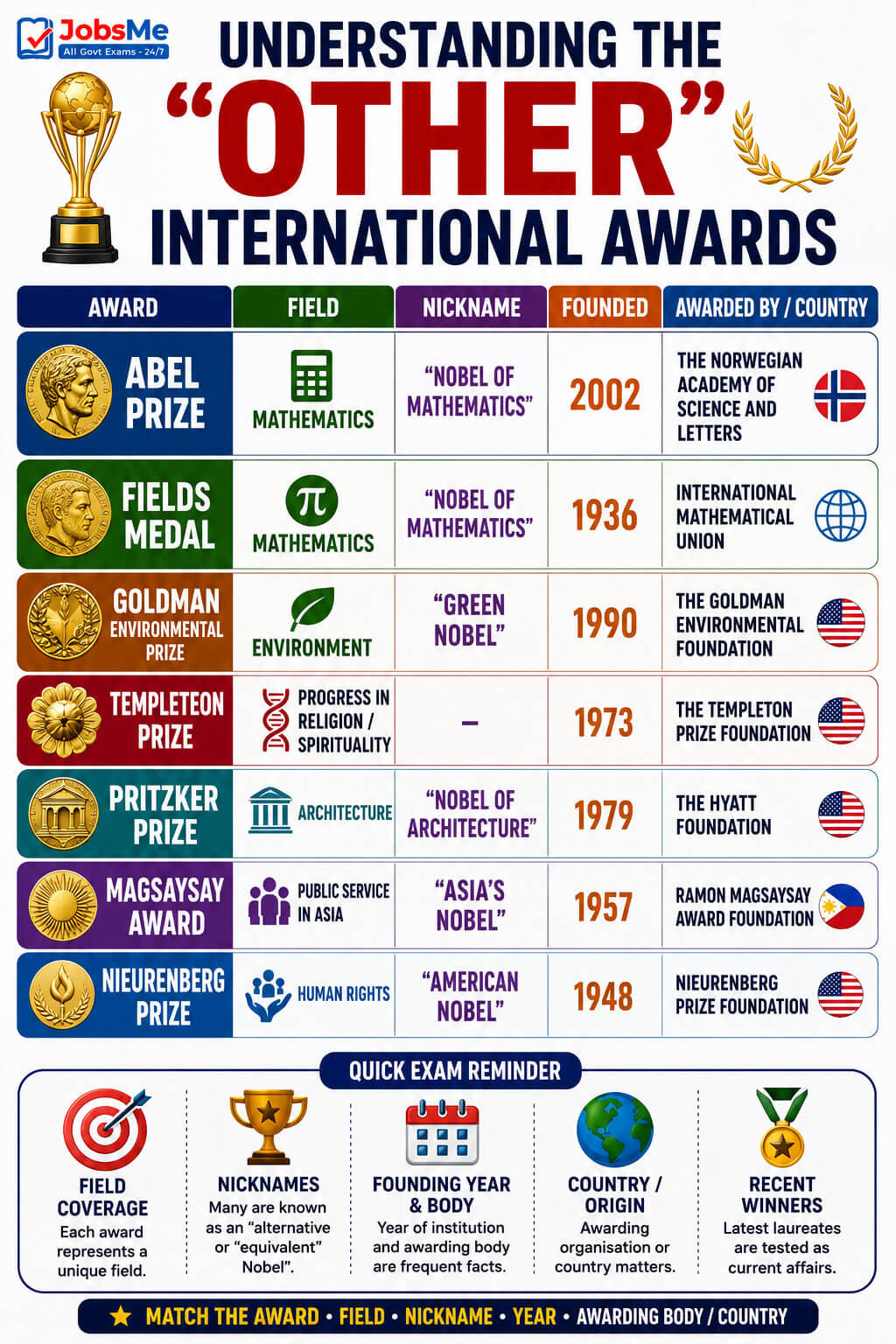
- Field coverage: Each award represents a distinct field — mathematics, environment, spirituality, architecture, human rights, or public service — making "match the award with its field" a favourite exam question.
- Nicknames: Many are known as an "alternative" or "equivalent" Nobel, such as the Green Nobel (Goldman), Asia's Nobel (Magsaysay) and the Nobel of Mathematics (Abel and Fields).
- Founding year and body: The year of institution and the awarding organisation or country are frequently asked static facts.
- Recent winners: The latest laureates are tested as current affairs, so pairing static details with current winners is essential.
Major "Other" International Awards - Field, Year and Awarding Body
The following table lists the most exam-relevant "other" international awards along with the field they recognise, the year they were founded, the awarding body or country, and key details.
| Award | Field | Founded / Awarding Body | Key Details |
|---|---|---|---|
| Right Livelihood Award | Environment, human rights, sustainable development, peace | 1980; Right Livelihood Foundation, Sweden (Stockholm) | Widely called the "Alternative Nobel Prize"; established by Swedish-German philanthropist Jakob von Uexkull; usually four laureates share the prize; ceremony held in Stockholm in early December, just before the Nobel Prizes. |
| Abel Prize | Mathematics | Established 2001, first awarded 2003; Norwegian Academy of Science and Letters (Government of Norway) | Often called the "Nobel Prize of Mathematics"; named after Norwegian mathematician Niels Henrik Abel; carries about 7.5 million Norwegian kroner; awarded annually in March. Karen Uhlenbeck (2019) was the first woman laureate. |
| Fields Medal | Mathematics | First awarded 1936; International Mathematical Union (IMU) | Also called the "Nobel Prize of Mathematics"; given only to mathematicians aged under 40; awarded every four years at the International Congress of Mathematicians (ICM); up to four medals per cycle. Maryam Mirzakhani (2014) was the first and only woman laureate. |
| Templeton Prize | Science and spirituality / religion | 1972; John Templeton Foundation (USA) | One of the world's largest annual individual awards (over US$1.4 million); deliberately kept higher than the Nobel; honours work bridging science and spirituality. Mother Teresa won the inaugural 1973 prize; the Dalai Lama won in 2012. |
| Pritzker Architecture Prize | Architecture | 1979; Hyatt Foundation / Pritzker family (USA) | Known as the "Nobel Prize of Architecture"; awarded to a living architect; carries US$100,000 and a bronze medallion. Balkrishna Doshi (2018) was the first Indian laureate; Zaha Hadid (2004) was the first woman laureate. |
| Goldman Environmental Prize | Grassroots environmental activism | 1989; Goldman Environmental Foundation, San Francisco (USA) | Called the "Green Nobel"; awarded annually to grassroots activists from six geographic regions — Africa, Asia, Europe, Islands and Island Nations, North America, and South and Central America. Alok Shukla of Chhattisgarh won in 2024. |
| Ramon Magsaysay Award | Public service and leadership in Asia | 1957; Ramon Magsaysay Award Foundation, Philippines | Regarded as "Asia's Nobel Prize"; named after former Filipino President Ramon Magsaysay; honours integrity in governance and selfless service to the people. The Indian NGO Educate Girls was among the 2025 laureates. |
| UN Human Rights Prize | Promotion and protection of human rights | Established 1966, first awarded 1968; United Nations | Awarded once every five years on Human Rights Day (10 December); recognises outstanding contributions to human dignity, equality and social justice. The 11th ceremony was held in December 2023. |
| UN Population Award | Population and reproductive health | 1981 (first awarded 1983); United Nations (UNFPA) | Recognises individuals and institutions for outstanding contributions to population and reproductive health issues; awarded in individual and institutional categories. |
| Nelson Mandela Prize | Service to humanity | 2015; United Nations | Awarded once every five years to honour those who dedicate their lives to serving humanity, reflecting Nelson Mandela's values; first awarded in 2015 and again in 2020. |
| Erasmus Prize | Contributions to culture, society or social science in Europe | 1958; Praemium Erasmianum Foundation, Netherlands | Awarded annually to individuals or institutions that have made exceptional contributions to the humanities, social sciences or arts in Europe; presented by the Dutch monarch. |
| Gandhi Peace Prize (International) | Social, economic and political transformation through non-violence | 1995; Government of India (Ministry of Culture) | Instituted on the 125th birth anniversary of Mahatma Gandhi; carries Rs 1 crore, a plaque and a citation; open to all persons and institutions worldwide. Nelson Mandela and Grameen Bank were jointly honoured in 2000; ISRO won in 2014; Gita Press, Gorakhpur won for 2021. |
| Indira Gandhi Prize for Peace, Disarmament and Development | International peace, disarmament and development | 1986; Indira Gandhi Memorial Trust, India | Carries a cash award of Rs 1 crore and a citation; honours creative efforts towards peace, disarmament and development. Daniel Barenboim and Ali Abu Awwad were jointly honoured for 2023. |
Recent Winners (2025-2026) at a Glance
The most recent laureates of the major "other" international awards are important from a current affairs perspective and are frequently paired with static details in exams.
| Award | Recent Winner(s) | Details |
|---|---|---|
| Abel Prize 2026 | Gerd Faltings (Germany) | Of the Max Planck Institute for Mathematics, Bonn; honoured for introducing powerful tools in arithmetic geometry and resolving the Mordell and Lang conjectures; the Mordell conjecture he proved is now called Faltings' theorem. |
| Abel Prize 2025 | Masaki Kashiwara (Japan) | Recognised for foundational work in algebraic analysis and representation theory. |
| Templeton Prize 2026 | Simon Conway Morris (United Kingdom) | A Cambridge paleontologist honoured for his work on the Cambrian explosion, the Burgess Shale fauna, and the concept of evolutionary convergence. |
| Templeton Prize 2025 | Ecumenical Patriarch Bartholomew of Constantinople | Honoured for bridging scientific and spiritual understanding of humanity's relationship with nature ("Green Patriarch"). |
| Pritzker Prize 2026 | Smiljan Radic Clarke (Chile) | The second Chilean laureate after Alejandro Aravena (2016); praised for his material experimentation and unorthodox approach to design. |
| Pritzker Prize 2025 | Liu Jiakun (China) | Of Chengdu, China; recognised for architecture rooted in local community and everyday life. |
| Right Livelihood Award 2025 | Julian Aguon & Pacific Islands Students Fighting Climate Change; Justice for Myanmar; Sudan's Emergency Response Rooms; Audrey Tang (Taiwan) | Honoured for climate justice, exposing Myanmar's military, mutual aid in war-torn Sudan, and digital democracy respectively. |
| Goldman Environmental Prize 2026 | Six women activists including Iroro Tanshi (Nigeria), Borim Kim (South Korea), Sarah Finch (UK), Theonila Roka Matbob (Papua New Guinea), Alannah Hurley (USA) and Yuvelis Morales Blanco (Colombia) | For the first time ever, all six regional recipients were women. |
| Goldman Environmental Prize 2024 | Alok Shukla (India) | Of the Chhattisgarh Bachao Andolan; recognised for saving over four lakh acres of forest in the Hasdeo Aranya region from coal mining. |
Memory Tricks and Mnemonics
Trick 1: The "Nobel of…" Family — "MAAP"
Several awards are called the "Nobel" of their field. Remember the group with the word "MAAP":
- M → Mathematics → Abel Prize and Fields Medal (Nobel of Mathematics).
- A → Architecture → Pritzker Prize (Nobel of Architecture).
- A → Asia (public service) → Ramon Magsaysay Award (Asia's Nobel).
- P → Planet / environment → Goldman Prize (Green Nobel) and Right Livelihood (Alternative Nobel).
"Every field wants its own Nobel."
Trick 2: Two Maths Awards — "Age vs Any-age" (A-F Rule)
Do not confuse the two mathematics awards. Use the alphabet order A then F:
- A = Abel Prize → Annual, Any age (no age limit), given in Norway.
- F = Fields Medal → Four-yearly, only for those under Forty, given by the International Mathematical Union.
"Abel = Any age; Fields = Forty and Four years."
Trick 3: "Five-Year Awards" — "HMN"
Three human-focused awards are given once every five years. Remember them as "HMN" (Human):
- H → UN Human Rights Prize (every 5 years).
- M → Nelson Mandela Prize (every 5 years).
- N → (contrast) These are Not annual — unlike most other UN honours.
Trick 4: Indian Government Peace Awards — "GI Pair"
India confers two big peace-related awards. Remember them as the "GI Pair":
- G → Gandhi Peace Prize → since 1995, by the Government of India, Rs 1 crore.
- I → Indira Gandhi Prize → since 1986, by the Indira Gandhi Memorial Trust, Rs 1 crore.
"Gandhi is Government; Indira is the Trust."
Trick 5: Founding-Year Ladder — "57-72-79-80-89"
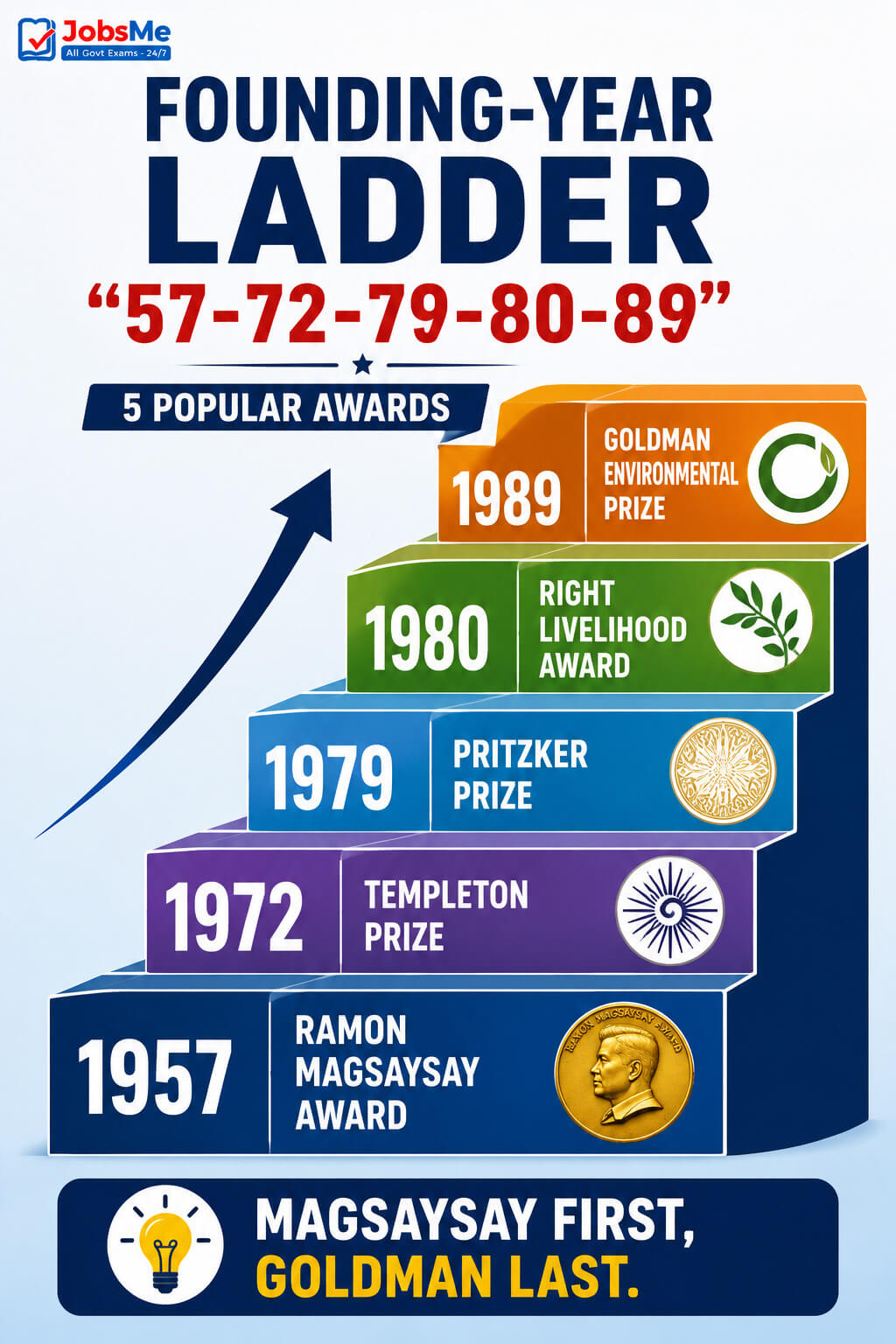
Memorise the founding years of five popular awards as a rising ladder:
- 1957 → Ramon Magsaysay Award.
- 1972 → Templeton Prize.
- 1979 → Pritzker Prize.
- 1980 → Right Livelihood Award.
- 1989 → Goldman Environmental Prize.
"Magsaysay first, Goldman last."
Trick 6: "Alternative / Green" Nobels — "Ring the Green Bell"
- Alternative Nobel → Right Livelihood Award.
- Green Nobel → Goldman Environmental Prize.
- Asia's Nobel → Ramon Magsaysay Award.
"Alternative is Right, Green is Goldman, Asia is Magsaysay."
Trick 7: Prize Money "Bigger than Nobel" — Templeton
The Templeton Prize is deliberately set higher than the Nobel Prize (over US$1.4 million). Remember: "Templeton tops the Nobel in cash, because it rewards the spirit science ignores."
Additional Notes
Frequently Confused Facts
- Abel Prize vs Fields Medal: Both are the "Nobel of Mathematics." Abel is annual with no age limit (Norway); Fields is every four years, only for those under 40 (International Mathematical Union).
- Gandhi Peace Prize vs Indira Gandhi Prize: Gandhi Peace Prize (1995) is by the Government of India for non-violent transformation; the Indira Gandhi Prize (1986) is by the Indira Gandhi Memorial Trust for peace, disarmament and development. Both carry Rs 1 crore.
- Right Livelihood vs Nobel: The Right Livelihood Award has no organisational link to the Nobel Foundation, though it is called the "Alternative Nobel" and its ceremony precedes the Nobel ceremony in Stockholm.
- Goldman Prize vs Right Livelihood: Goldman is the "Green Nobel" for grassroots environmental activists from six regions; Right Livelihood is broader, covering environment, human rights and peace together.
- Templeton Prize vs Nobel: Templeton honours science and spirituality (a field the Nobel avoids) and is intentionally worth more than the Nobel.
- UN Human Rights Prize vs Nelson Mandela Prize: Both are given by the UN once every five years, but the Human Rights Prize (since 1966) is for human rights work, while the Mandela Prize (since 2015) is for lifelong service to humanity.
- Magsaysay Award vs Nobel Peace Prize: Magsaysay is "Asia's Nobel," limited to public service and leadership within Asia, whereas the Nobel Peace Prize is global.
Repeating PYQ Patterns
Certain award-field pairings are asked repeatedly in competitive exams. Abel Prize and Fields Medal (mathematics), Pritzker Prize (architecture), Templeton Prize (science and spirituality), Goldman Prize (environment/Green Nobel), Ramon Magsaysay Award (Asia's Nobel), and Right Livelihood Award (Alternative Nobel) appear most often in UPSC Prelims, SSC CGL and RRB NTPC papers. Banking exams (IBPS PO, SBI Clerk) and Insurance exams focus on the latest winners and the awarding body. State PCS exams often add the Indian angle — the Gandhi Peace Prize, the Indira Gandhi Prize, and Indian winners such as Balkrishna Doshi (Pritzker 2018) and Alok Shukla (Goldman 2024). A very common question type is "match the award with its field" or "which award is given every four years / five years."
Quick Insight
These "other" international awards fill the gaps left by the Nobel Prizes, honouring mathematicians, architects, environmentalists and spiritual thinkers who would otherwise go unrecognised at the global level. For aspirants, the smartest strategy is to pair each award's static details — field, founding year and awarding body — with its most recent winner, since exams increasingly blend static GK with current affairs. Practising both together builds speed and accuracy. For deeper preparation, explore the Banking Awareness notes on thejobsme.com and attempt the Static GK Quiz to test how well you can match awards with their fields and winners.
One-Liners for Quick Revision
- Right Livelihood Award → Alternative Nobel Prize → founded 1980 in Sweden by Jakob von Uexkull; 2025 laureates included Julian Aguon and Audrey Tang.
- Abel Prize → Nobel of Mathematics → founded 2001, awarded by Norway; annual, no age limit; 2026 winner Gerd Faltings, 2025 winner Masaki Kashiwara.
- Fields Medal → Nobel of Mathematics → awarded by the International Mathematical Union every four years to mathematicians under 40.
- Templeton Prize → Science and spirituality → founded 1972; worth over US$1.4 million; 2026 winner Simon Conway Morris, 2025 winner Patriarch Bartholomew.
- Pritzker Prize → Nobel of Architecture → founded 1979 by the Hyatt Foundation; 2026 winner Smiljan Radic (Chile), 2025 winner Liu Jiakun (China).
- Goldman Environmental Prize → Green Nobel → founded 1989 in San Francisco; six regional winners each year; 2024 Indian winner Alok Shukla.
- Ramon Magsaysay Award → Asia's Nobel → founded 1957 in the Philippines; honours public service in Asia; Educate Girls (India) among 2025 laureates.
- UN Human Rights Prize → Human rights → founded 1966; given every five years on 10 December.
- UN Population Award → Population and reproductive health → founded 1981; awarded by the UN/UNFPA in individual and institutional categories.
- Nelson Mandela Prize → Service to humanity → founded 2015; given by the UN every five years.
- Erasmus Prize → Culture and social sciences in Europe → founded 1958 in the Netherlands; presented by the Dutch monarch.
- Gandhi Peace Prize → Non-violent transformation → founded 1995 by the Government of India; Rs 1 crore; ISRO (2014) and Gita Press (2021) are notable winners.
- Indira Gandhi Prize → Peace, disarmament and development → founded 1986 by the Indira Gandhi Memorial Trust; Rs 1 crore; 2023 to Barenboim and Abu Awwad.
For more Static GK topics like important days, boundary lines and famous personalities, explore the Static GK section on thejobsme.com. You can also revise current winners on the Daily Current Affairs Quiz and check the latest openings at Latest Government Job Notifications.
Free quiz • No signup required
Put this topic into practice with Indian Cultural Institutions – Static GK MCQ Quiz. It is the quickest way to reinforce what you just learned.
Frequently Asked Questions
Which award is known as the Alternative Nobel Prize?
What is the difference between the Abel Prize and the Fields Medal?
Who won the Abel Prize 2026?
Which award is called the Nobel Prize of Architecture?
Why is the Goldman Environmental Prize called the Green Nobel?
Which international award is the highest in monetary value?
When was the Gandhi Peace Prize instituted and what does it carry?
Which awards are given once every five years?
Which award is known as Asia's Nobel Prize?
Who was the first Indian to win the Pritzker Architecture Prize?

About the author