GI Tags of India – Complete State-Wise List of Geographical Indications for Competitive Exams with Memory Tricks
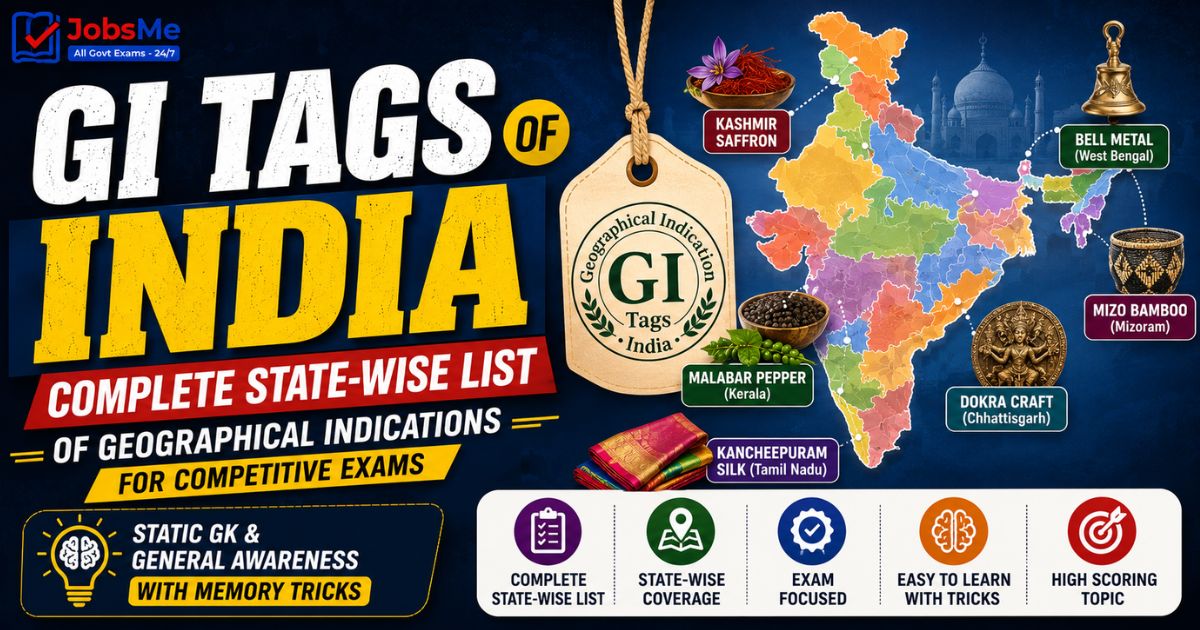
This article presents a complete, exam-ready list of Geographical Indication (GI) Tags of India, covering agricultural products, handicrafts, textiles, foodstuffs, and manufactured goods across all states and Union Territories. It explains the GI Act of 1999, the role of the GI Registry in Chennai, India's famous "firsts" like Darjeeling Tea (first GI) and Kashmir Saffron (first EU GI), and state-wise products such as Banarasi Saree, Kanchipuram Silk, Mysore Silk, Madhubani Painting, Pochampally Ikat, and Tirupati Laddu, with memory tricks and one-liners for quick revision. All facts are arranged to help UPSC, SSC, IBPS, RRB, PSU, and State PCS aspirants score better in Static GK and General Awareness sections.
Jump to section
Introduction
A Geographical Indication (GI) Tag is a special sign or certification given to products that originate from a specific geographical region and possess qualities, reputation, or characteristics that are essentially linked to that place of origin. From the muscatel aroma of Darjeeling Tea to the golden zari of the Banarasi Saree, from Mysore Silk to Tirupati Laddu, GI tags protect India's traditional knowledge, handicrafts, and agricultural produce from imitation and counterfeiting. A GI tag is a form of Intellectual Property Right (IPR) that ensures only authorised producers from the defined region can legally use the product's name.
Questions on GI Tags of India appear regularly in UPSC Prelims, SSC CGL, IBPS PO, RRB NTPC, SBI Clerk, State PCS, and various Insurance and Defence exams. Examiners typically ask which product is GI-tagged to which state, which was India's first GI product, who issues GI tags, and which category has the most registered products. This Static GK guide brings together every important GI fact in a structured, exam-ready format. To explore more General Awareness topics, you can refer to the Static GK section on thejobsme.com.
GI tags are also deeply tied to current affairs — themes such as the Prada-Kolhapuri chappal controversy of 2025, the Mithila Makhana GI conferment, the One District One Product (ODOP) initiative, and EU recognition of Indian products keep this topic relevant for both Prelims matching questions and Mains essays on heritage, economy, and rural development. For daily updates, aspirants can check Daily Current Affairs on thejobsme.com.
Core Concepts: Understanding GI Tags
A GI tag is fundamentally different from a trademark. While a trademark identifies a single business or company, a GI identifies a product from a specific geographic origin and can be used by all producers in that region who meet the prescribed standards. GI rights are collective community property — they cannot be sold, transferred, or licensed to anyone outside the defined geographical area.
Key Facts About GI Tags
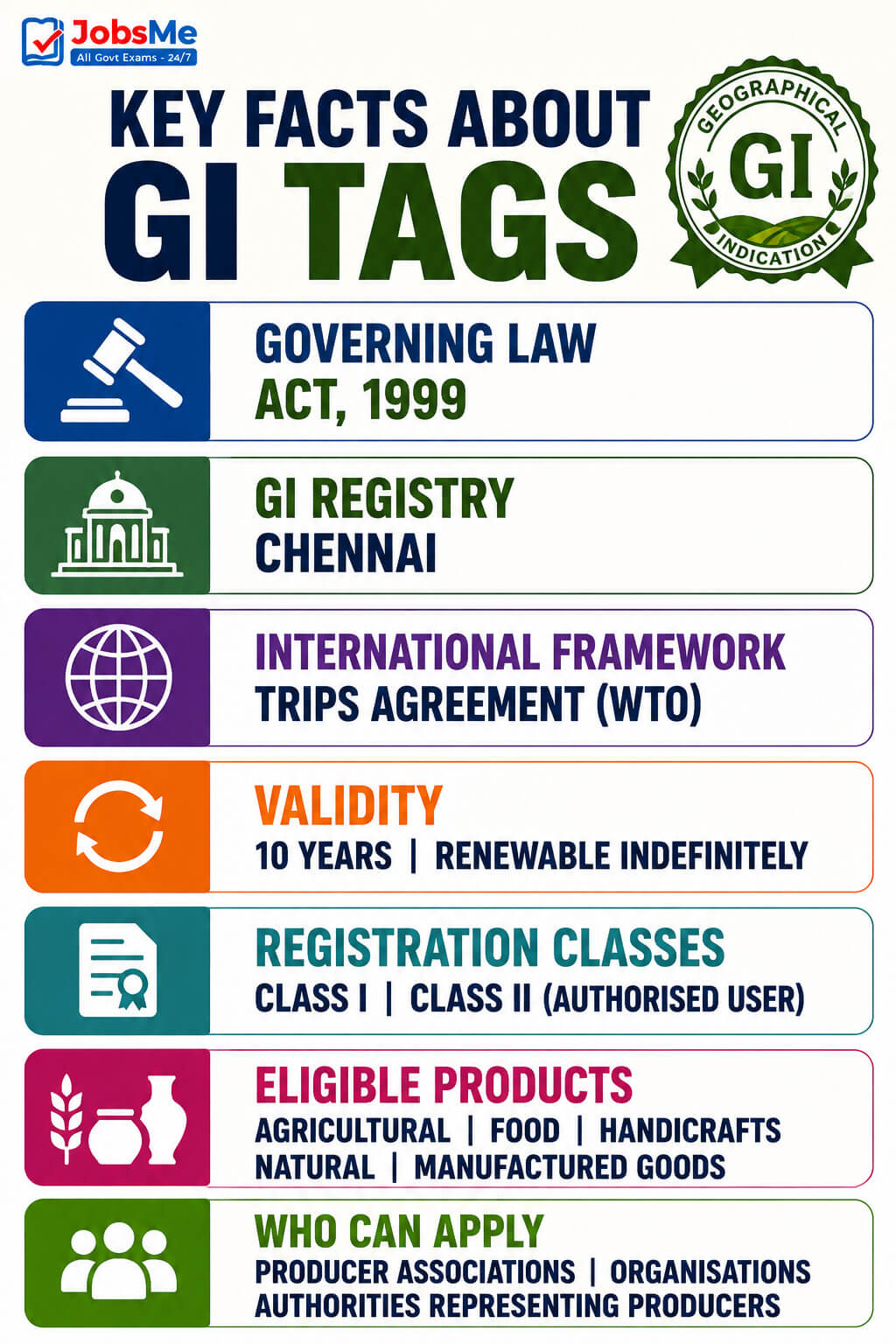
- Governing Law: The Geographical Indications of Goods (Registration and Protection) Act, 1999, which came into force on 15 September 2003.
- GI Registry: Located in Chennai, functioning under the Controller General of Patents, Designs and Trade Marks (CGPDTM), Department for Promotion of Industry and Internal Trade (DPIIT), Ministry of Commerce and Industry.
- International Framework: GI protection is mandated by the TRIPS Agreement (Trade-Related Aspects of Intellectual Property Rights) of the World Trade Organization (WTO).
- Validity: A GI registration is valid for 10 years and can be renewed indefinitely for successive 10-year periods.
- Registration Classes: Class I (registration of the GI itself) and Class II (Authorised User — manufacturers or traders permitted to use the GI).
- Eligible Products: Agricultural goods, foodstuffs, handicrafts, natural products, and manufactured goods.
- Who Can Apply: Producer associations, organisations, or authorities representing the interests of producers — individual applicants generally cannot apply, to ensure collective benefit.
Famous "Firsts" and Records in Indian GI Tags
These landmark facts are the most frequently asked GI questions in competitive exams and should be memorised first.
| Record / First | Product | Key Details |
|---|---|---|
| First GI Tag in India | Darjeeling Tea (West Bengal) | Registered in 2004-05 as GI No. 1; applied for by the Tea Board of India; world-famous for its unique muscatel flavour and aroma; only tea grown in the Darjeeling hills can be sold as "Darjeeling Tea." |
| First Indian product with EU GI (PDO) | Kashmir Saffron (Jammu & Kashmir) | Became the first Indian product to receive European Union Protected Designation of Origin (PDO) protection in 2020; world's most expensive spice; grown in the Pampore/Karewa region. |
| World's only naturally golden silk | Muga Silk (Assam) | Endemic to Assam; prized for its natural golden sheen and durability; a flagship GI product of the Northeast. |
| State with the highest number of GI tags | Tamil Nadu / Uttar Pradesh | Tamil Nadu and Uttar Pradesh lead the rankings, followed by Karnataka and Maharashtra; together the top states account for nearly half of India's total GI tags. |
| Category with the most GI tags | Handicrafts | Handicrafts form the single largest category of registered GI products in India, followed by agricultural goods. |
| First tribal handicraft GI from Kerala | Kannadippaya / Mirror Mat (Kerala) | First tribal handicraft product from Kerala to receive a GI tag; woven from the soft inner layers of reed bamboo. |
| Disputed inter-country GI | Basmati Rice | Both India and Pakistan claim GI rights; India holds its domestic GI; both nations have sought EU GI protection — an ongoing trade dispute. |
| Famous dual-state GI dispute | Rasagola / Rasgulla | Both West Bengal and Odisha received separate GIs recognising parallel traditions — Banglar Rasogolla and Odisha Rasagola. |
State-Wise GI Tags of India
The following tables list the most exam-relevant GI products grouped by region and state, with their category and key features. As of early 2026, India has over 650 registered GI tags, spanning every state and Union Territory. For more such revision lists, you can also visit the Banking Awareness section on thejobsme.com.
North India
| State / UT | GI Products | Category & Key Features |
|---|---|---|
| Uttar Pradesh | Banarasi Saree & Brocade, Lucknow Chikankari, Lucknow Zardozi, Allahabad Surkha (guava), Malihabadi Dussehri Mango, Kala Namak Rice, Agra Petha, Bhadohi Carpet, Moradabad Brass, Khurja Pottery, Mathura Peda, Banaras Thandai, Banaras Tabla, Banaras Shehnai | Handicraft, textile, agricultural and foodstuff; Varanasi alone accounts for many GI products; Banarasi Saree is famed for gold and silver zari brocade with Mughal-inspired motifs. |
| Jammu & Kashmir | Kashmir Saffron, Kashmir Pashmina, Kani Shawl, Kashmir Sozani Craft, Kashmir Walnut Wood Carving, Mushqbudji Rice, Bhaderwah Rajmash, Basohli Pashmina & Painting | Natural products and handicrafts; Pashmina is woven from fine cashmere wool; Saffron is the world's costliest spice. |
| Himachal Pradesh | Kullu Shawl, Chamba Rumal, Kinnauri Shawl, Kangra Paintings, Kangra Tea, Chamba Chappal, Himachali Kala Zeera | Handlooms, paintings and agricultural goods; Kullu Shawl is hand-woven from local wool; Kangra Tea has also received EU GI recognition. |
| Rajasthan | Jaipur Blue Pottery, Kota Doria (saree), Bikaneri Bhujia, Molela Clay Work, Sanganeri Hand Block Printing, Bagru Hand Block Print, Kathputli | Handicraft and foodstuff; Kota Doria is lightweight and transparent; Bikaneri Bhujia is a famous spicy snack. |
| Punjab & Haryana | Phulkari (embroidery), Basmati Rice (joint GI) | Textile and agricultural; Phulkari is a vibrant floral embroidery; Basmati is a seven-state joint GI of the Indo-Gangetic plains. |
| Ladakh | Ladakh Wood Carving, Ladakh Seabuckthorn, Ladakh Pashmina | Handicraft and natural products from the high-altitude cold desert region. |
South India
| State / UT | GI Products | Category & Key Features |
|---|---|---|
| Tamil Nadu | Kanchipuram Silk Saree, Thanjavur Paintings, Thanjavur Doll, Madurai Sungudi, Madurai Malli (jasmine), Mahabalipuram Stone Sculpture, Salem Fabric, Toda Embroidery, Swamimalai Bronze Icons, Dindigul Locks, Kandangi Saree, Nilgiri Tea, Erode Turmeric, Ooty Varkey | Handicraft, textile, agricultural and foodstuff; Kanchipuram Silk uses pure mulberry silk and the korvai border technique; Salem Fabric (2006) was the first GI product of Tamil Nadu. |
| Karnataka | Mysore Silk, Mysore Sandalwood / Mysore Sandal Soap, Mysore Agarbathi, Bidriware, Channapatna Toys & Dolls, Coorg Arabica Coffee, Coorg Orange, Coorg Green Cardamom, Ilkal Saree, Molakalmuru Saree, Kasuti Embroidery, Byadagi Chilli, Udupi Mattu Gulla Brinjal | Handicraft, textile, agricultural and manufactured goods; Mysore Silk is soft with golden borders; Channapatna toys are lacquered wooden toys; Bidriware is a metal handicraft. |
| Andhra Pradesh | Srikalahasti Kalamkari, Kondapalli Bommallu (toys), Tirupati Laddu, Bandar Laddu, Banaganapalle Mangoes, Guntur Sannam Chilli, Etikoppaka Toys, Bobbili Veena, Venkatagiri Saree, Araku Valley Arabica Coffee, Uppada Jamdani Saree | Handicraft, foodstuff and agricultural; Tirupati Laddu is the sacred prasadam of the Tirumala temple; Kalamkari is a hand-painted/block-printed textile art. |
| Telangana | Pochampally Ikat, Hyderabadi Haleem, Nirmal Toys & Craft, Gadwal Saree, Cheriyal Paintings, Pembarthi Metal Craft, Adilabad Dokra, Telia Rumal, Karimnagar Silver Filigree | Textile, foodstuff and handicraft; Pochampally Ikat is a double-ikat tie-and-dye weave; Hyderabadi Haleem is a famous Ramzan delicacy and was the first Indian dish to get a GI tag. |
| Kerala | Aranmula Kannadi (metal mirror), Malabar Pepper, Alleppey Green Cardamom, Pokkali Rice, Palakkadan Matta Rice, Wayanad Robusta Coffee, Nilambur Teak, Kannadippaya (Mirror Mat), Vazhakulam Pineapple | Handicraft, agricultural and spices; Malabar Pepper is the "King of Spices"; Aranmula Kannadi is a unique handmade metal-alloy mirror. |
East & Northeast India
| State / UT | GI Products | Category & Key Features |
|---|---|---|
| West Bengal | Darjeeling Tea, Nakshi Kantha, Baluchari Saree, Dhaniakhali Saree, Purulia Chau Mask, Banglar Rasogolla, Joynagar Moa, Gobindobhog Rice, Tulaipanji Rice, Bardhaman Sitabhog | Agricultural, textile, handicraft and foodstuff; Darjeeling Tea is India's first GI; Baluchari sarees depict mythological scenes in the pallu. |
| Bihar | Madhubani Painting, Bhagalpur Silk (Tussar), Sujini Embroidery, Sikki Grass Products, Mithila Makhana, Katarni Rice, Shahi Litchi, Magahi Paan, Marcha Rice, Silao Khaja | Handicraft, textile, agricultural and foodstuff; Madhubani is a famous folk-art painting style; Mithila Makhana is an aquatic fox nut of the Mithila region. |
| Odisha | Odisha Pattachitra, Sambalpuri Saree, Konark Stone Carving, Odisha Rasagola, Kandhamal Haladi (turmeric), Similipal Kai Chutney, Koraput Kala Jeera Rice | Handicraft, textile and foodstuff; Similipal Kai Chutney is made by tribal communities using red weaver ants; Pattachitra is a cloth-based scroll painting. |
| Assam | Muga Silk of Assam, Assam (Orthodox) Tea, Gamosa, Joha Rice, Kaji Nemu (lemon), Tezpur Litchi, Majuli Mask, Bodo Dokhona, Bodo Eri Silk, Asharikandi Terracotta Craft | Natural products, agricultural and handicraft; Muga Silk is the world's only naturally golden silk; Assam leads the Northeast in GI registrations. |
| Other Northeast States | Manipur Black Rice (Chak-Hao), Naga Tree Tomato (Nagaland), Bhut Jolokia / Naga Mircha (Nagaland), Sikkim Large Cardamom, Tripura Queen Pineapple, Arunachal Yak Churpi, Khaw Tai / Khamti Rice (Arunachal Pradesh), Mizo Chilli (Mizoram), Khasi Mandarin (Meghalaya) | Agricultural and natural products; Bhut Jolokia is among the world's hottest chillies (Guinness Record 2007); Sikkim is India's largest producer of large cardamom. |
West & Central India
| State / UT | GI Products | Category & Key Features |
|---|---|---|
| Maharashtra | Paithani Saree, Kolhapuri Chappal (joint with Karnataka), Alphonso Mango (Ratnagiri), Nagpur Orange, Warli Painting, Solapur Chaddar, Mahabaleshwar Strawberry, Nashik Grapes, Sangli Turmeric | Textile, handicraft and agricultural; Paithani is known for its peacock-motif tapestry weave; Alphonso is the "King of Mangoes"; Kolhapuri chappals gained global attention after the 2025 Prada controversy. |
| Gujarat | Patan Patola (double ikat), Kutch Embroidery, Tangaliya Shawl, Jamnagari Bandhani, Surat Zari Craft, Kutch Rogan Craft, Gir Kesar Mango, Bhalia Wheat, Kachchhi Kharek (dates), Sankheda Furniture | Handicraft, textile and agricultural; Patan Patola is a labour-intensive double-ikat silk weave; Kutch Rogan is a rare painted cloth art. |
| Madhya Pradesh | Chanderi Fabric / Saree, Maheshwari Saree, Gond Painting, Dhokra Metal Casting (also Chhattisgarh), Ratlami Sev, Nagpur Orange (border region) | Textile and handicraft; Chanderi is a lightweight sheer fabric of silk and cotton with golden zari; Maheshwari sarees feature distinctive stripes and checks. |
| Chhattisgarh | Bastar Iron Craft, Bastar Dhokra, Bastar Wooden Craft, Jeeraphool Rice, Champa Silk Saree | Handicraft and agricultural; Bastar Dhokra is an ancient lost-wax metal casting craft of the tribal belt. |
| Goa | Feni, Goa Cashew (Kaju), Khola Chilli, Goa Mankurad Mango, Myndoli Banana, Harmal Chilli | Foodstuff and agricultural; Feni is a traditional cashew/coconut-based spirit unique to Goa. |
| Jharkhand | Sohrai Khovar Painting | Handicraft; a traditional tribal mural and wall painting art form. |
Memory Tricks and Mnemonics
Trick 1: India's Two "Firsts" — "Tea First, Saffron EU-First"
The two most-asked GI firsts can be locked together:
- First GI of India (2004-05) → Darjeeling Tea (West Bengal).
- First Indian product with EU GI (PDO, 2020) → Kashmir Saffron.
"Tea was first at home; Saffron was first abroad."
Trick 2: Silk Saree Map — "BMP-KC"

Remember the five most famous GI silk sarees by their states using "BMP-KC":
- B → Banarasi (Uttar Pradesh).
- M → Mysore Silk (Karnataka).
- P → Paithani (Maharashtra) and Patola/Patan Patola (Gujarat).
- K → Kanchipuram (Tamil Nadu).
- C → Chanderi / Chanderi (Madhya Pradesh).
Trick 3: "Ikat" Family — Tie-and-Dye Trio
Three famous ikat (tie-and-dye yarn) weaves come from three different states:
- Pochampally Ikat → Telangana.
- Patan Patola (double ikat) → Gujarat.
- Sambalpuri → Odisha.
"Pochampally-Patola-Sambalpuri — tied before they are woven."
Trick 4: Painting Pin-Map — Match Art to State
- Madhubani → Bihar.
- Thanjavur → Tamil Nadu.
- Pattachitra → Odisha (also West Bengal).
- Kalamkari → Andhra Pradesh.
- Warli → Maharashtra.
- Gond → Madhya Pradesh.
- Cheriyal Scrolls → Telangana.
Trick 5: "Sweet Spots" — GI Foodstuffs
Group the famous GI sweets and snacks to remember them faster:
- Tirupati Laddu → Andhra Pradesh (temple prasadam).
- Bikaneri Bhujia → Rajasthan.
- Hyderabadi Haleem → Telangana (first Indian dish to get a GI).
- Rasagola → both West Bengal (Banglar Rasogolla) and Odisha (Odisha Rasagola).
- Mithila Makhana → Bihar.
Trick 6: "Mango Belt" — King of Fruits GIs
- Alphonso → Ratnagiri, Maharashtra.
- Banaganapalle → Andhra Pradesh.
- Gir Kesar → Gujarat.
- Malihabadi Dussehri → Uttar Pradesh.
"Four states, four mangoes, one crown."
Trick 7: Northeast "Golden & Hot" Combo
Two flagship Northeast GIs are easy to confuse, so pair them by their defining quality:
- Golden: Muga Silk (Assam) — world's only naturally golden silk.
- Hot: Bhut Jolokia / Naga Mircha (Nagaland) — one of the world's hottest chillies.
- Black: Chak-Hao / Black Rice (Manipur).
"Assam glows golden, Nagaland burns hot, Manipur turns black."
Additional Notes
Frequently Confused Facts
- First GI vs First EU GI: Darjeeling Tea is India's first GI (2004-05); Kashmir Saffron is the first Indian product to get EU GI/PDO protection (2020).
- Little vs Big silk states: Kanchipuram Silk is Tamil Nadu; Mysore Silk is Karnataka; Banarasi Silk is Uttar Pradesh — do not interchange them.
- Pochampally vs Patola: Pochampally Ikat is from Telangana; Patan Patola (double ikat) is from Gujarat.
- Rasagola: Both West Bengal (Banglar Rasogolla) and Odisha (Odisha Rasagola) hold separate GIs — neither one "won" exclusively.
- Kolhapuri Chappal: A joint GI of Maharashtra and Karnataka, not Maharashtra alone.
- Basmati Rice: A seven-state joint GI within India and a disputed GI between India and Pakistan internationally.
- Tea trio: Darjeeling Tea (West Bengal), Assam Orthodox Tea (Assam), and Nilgiri Tea (Tamil Nadu) / Kangra Tea (Himachal Pradesh) are all separate GIs.
- Madhubani vs Mithila Makhana: Madhubani is a painting; Mithila Makhana is an edible fox nut — both from the Mithila region of Bihar.
- GI vs Trademark: A GI is collective community property tied to a region and cannot be sold; a trademark belongs to one company and can be sold or licensed.
Repeating PYQ Patterns
Certain GI facts are asked repeatedly in competitive exams. Darjeeling Tea (first GI), Kashmir Saffron (first EU GI), Muga Silk (golden silk), the GI Act of 1999, the Chennai GI Registry, the 10-year validity, and handicrafts being the largest category appear most often in UPSC Prelims, SSC CGL, and RRB NTPC. Banking exams (IBPS PO, SBI Clerk) frequently focus on matching products with states — Banarasi Saree (UP), Pochampally Ikat (Telangana), Mysore Silk (Karnataka), Tirupati Laddu (Andhra Pradesh), and Madhubani Painting (Bihar). State PCS exams add local GIs — Odisha PCS asks about Pattachitra and Koraput Kala Jeera Rice, Bihar PCS about Mithila Makhana and Madhubani, Tamil Nadu PCS about Kanchipuram Silk and Madurai Malli, and Assam PCS about Muga Silk and Joha Rice. The 2019 UPSC Prelims directly featured GI-tagged products.
Quick Insight
GI tags are far more than legal labels — they are engines of rural development and cultural diplomacy. The 2025 controversy over Italian brand Prada showcasing footwear inspired by GI-tagged Kolhapuri chappals reignited global debate on cultural misappropriation and the limits of territorial GI protection. At the same time, initiatives like One District One Product (ODOP) and the GI Atlas launched by the Ministry of Commerce show how GIs are being woven into India's economic strategy, benefiting an estimated three to four crore artisans and producers. Understanding GI tags helps aspirants connect Polity, Economy, Geography, and Art & Culture in a single topic. For related reading, explore the Static GK section and stay current with the Daily Current Affairs page on thejobsme.com.
One-Liners for Quick Revision
- GI Tag full form → Geographical Indication Tag → a sign certifying a product's geographical origin and linked qualities.
- Governing Act → Geographical Indications of Goods (Registration and Protection) Act, 1999 → came into force 15 September 2003.
- GI Registry → Located in Chennai → under CGPDTM, DPIIT, Ministry of Commerce and Industry.
- International framework → TRIPS Agreement of the WTO.
- Validity → 10 years → renewable indefinitely.
- First GI of India → Darjeeling Tea (West Bengal) → 2004-05.
- First Indian product with EU GI (PDO) → Kashmir Saffron → 2020.
- World's only golden silk → Muga Silk → Assam.
- Largest GI category → Handicrafts.
- First Indian dish with GI → Hyderabadi Haleem → Telangana.
- Banarasi Saree → Uttar Pradesh → gold/silver zari brocade with Mughal motifs.
- Lucknow Chikankari → Uttar Pradesh → delicate white-thread embroidery.
- Kanchipuram Silk → Tamil Nadu → pure mulberry silk with korvai border.
- Thanjavur Painting → Tamil Nadu → gold-foil religious art.
- Madurai Malli → Tamil Nadu → fragrant jasmine.
- Mysore Silk → Karnataka → soft silk with golden border.
- Mysore Sandal Soap / Sandalwood → Karnataka → manufactured GI.
- Bidriware → Karnataka → blackened metal handicraft with silver inlay.
- Channapatna Toys → Karnataka → lacquered wooden toys.
- Coorg Arabica Coffee → Karnataka.
- Tirupati Laddu → Andhra Pradesh → Tirumala temple prasadam.
- Srikalahasti Kalamkari → Andhra Pradesh → hand-painted textile art.
- Banaganapalle Mango → Andhra Pradesh.
- Araku Valley Arabica Coffee → Andhra Pradesh.
- Pochampally Ikat → Telangana → double-ikat tie-and-dye weave.
- Hyderabadi Haleem → Telangana → Ramzan delicacy.
- Malabar Pepper → Kerala → "King of Spices."
- Aranmula Kannadi → Kerala → handmade metal-alloy mirror.
- Pokkali Rice / Palakkadan Matta Rice → Kerala.
- Darjeeling Tea → West Bengal → first GI; muscatel flavour.
- Baluchari Saree → West Bengal → mythological motifs on pallu.
- Banglar Rasogolla → West Bengal (also Odisha Rasagola in Odisha).
- Madhubani Painting → Bihar → folk mural art.
- Mithila Makhana → Bihar → aquatic fox nut.
- Bhagalpur Silk (Tussar) → Bihar.
- Odisha Pattachitra → Odisha → cloth scroll painting.
- Sambalpuri Saree → Odisha → ikat weave.
- Similipal Kai Chutney → Odisha → made with red weaver ants.
- Muga Silk / Assam Tea / Gamosa / Joha Rice → Assam.
- Chak-Hao (Black Rice) → Manipur.
- Bhut Jolokia / Naga Mircha → Nagaland → one of world's hottest chillies.
- Sikkim Large Cardamom → Sikkim → India's largest producer.
- Tripura Queen Pineapple → Tripura.
- Paithani Saree → Maharashtra → peacock-motif tapestry weave.
- Alphonso Mango → Ratnagiri, Maharashtra → "King of Mangoes."
- Nagpur Orange → Maharashtra.
- Warli Painting → Maharashtra → tribal art.
- Kolhapuri Chappal → joint GI of Maharashtra and Karnataka.
- Patan Patola → Gujarat → double-ikat silk.
- Kutch Embroidery / Kutch Rogan Craft → Gujarat.
- Gir Kesar Mango → Gujarat.
- Chanderi Fabric → Madhya Pradesh → sheer silk-cotton with zari.
- Maheshwari Saree → Madhya Pradesh → stripes and checks.
- Gond Painting → Madhya Pradesh → tribal art.
- Bastar Dhokra → Chhattisgarh → lost-wax metal casting.
- Feni → Goa → cashew/coconut spirit.
- Sohrai Khovar Painting → Jharkhand → tribal mural art.
- Kashmir Saffron / Pashmina / Kani Shawl → Jammu & Kashmir.
- Kullu Shawl / Kangra Tea / Chamba Rumal → Himachal Pradesh.
- Jaipur Blue Pottery / Kota Doria / Bikaneri Bhujia → Rajasthan.
- Phulkari → Punjab → floral embroidery.
- Basmati Rice → seven-state joint GI; disputed with Pakistan.
- Ladakh Wood Carving / Seabuckthorn / Pashmina → Ladakh.
For more Static GK revision lists like Indian dances, festivals, and folk arts, explore the Static GK section on thejobsme.com. You can test your preparation with the Static GK Quiz and the Daily Current Affairs Quiz, and check the latest openings at Latest Government Job Notifications.
Free quiz • No signup required
Put this topic into practice with Indian Cultural Institutions – Static GK MCQ Quiz. It is the quickest way to reinforce what you just learned.
Frequently Asked Questions
Which was the first product in India to receive a GI tag?
Who issues GI tags in India and where is the GI Registry located?
Which law governs Geographical Indications in India?
How long is a GI tag valid in India?
Which Indian product was the first to receive European Union GI protection?
What is the difference between a GI tag and a trademark?
Which category has the highest number of GI tags in India?
Why is Muga Silk of Assam special among GI products?
Which states have the highest number of GI tags in India?
Why did both West Bengal and Odisha receive a GI tag for Rasagola?

About the author