Books by PMs and Presidents of India: Complete Static GK List with Memory Tricks
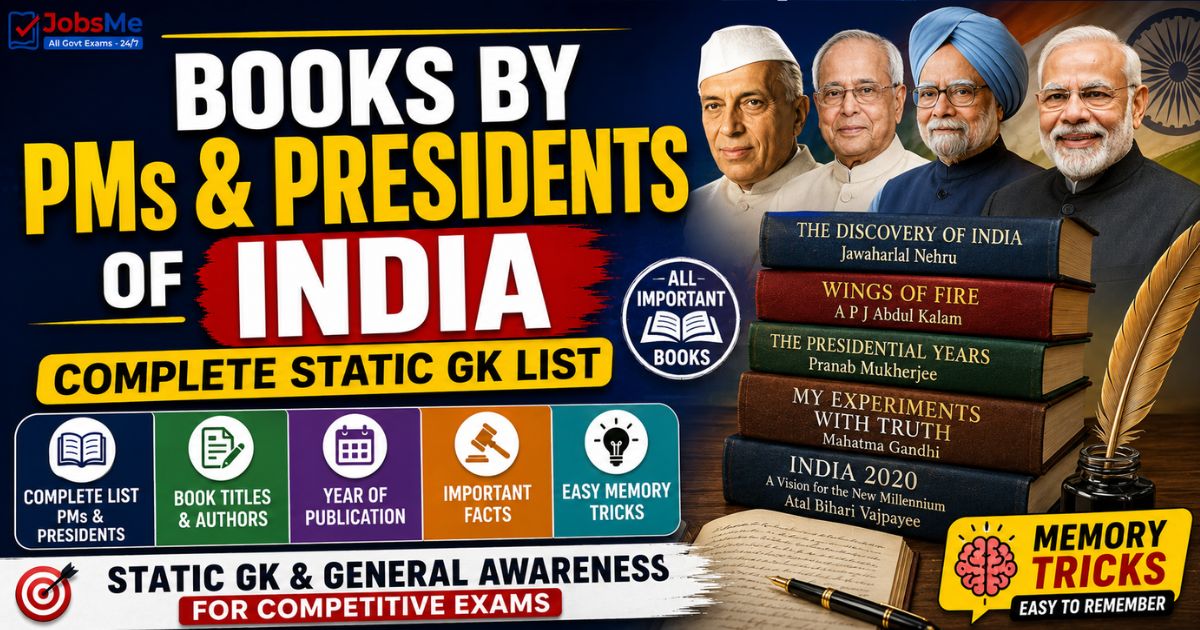
This article gives you the complete, verified list of books written by Indian Prime Ministers and Presidents, from Nehru and Rajendra Prasad to Abdul Kalam, Pranab Mukherjee and Narendra Modi. Every author is presented in a clean table with book titles, publication context and exam notes, followed by memory tricks and one-liners for fast revision. It also corrects the wrong attributions that circulate in most GK material, so you do not lose marks on trap questions in SSC, IBPS, RRB and UPSC Prelims.
Jump to section
Introduction
Books and Authors is one of the most reliable scoring areas in Static GK and General Awareness. Within this topic, the single most repeated sub-section is Books by PMs and Presidents of India. The reason is simple: these names are fixed, the list is finite, and once you learn it, the same questions keep returning year after year in SSC CGL, SSC CHSL, IBPS PO, IBPS Clerk, RRB NTPC, RRB Group D, Insurance exams, State PCS and UPSC Prelims.
Indian heads of state and heads of government have been unusually prolific writers. Jawaharlal Nehru wrote three classics from inside British prisons. Dr. S. Radhakrishnan was a world-recognised philosopher before he was a President. Dr. A.P.J. Abdul Kalam wrote a book that became one of the best-selling autobiographies in India. Dr. Manmohan Singh's first book was his Oxford doctoral thesis. Choudhary Charan Singh published six books on land reform and rural economics. Learning who wrote what is therefore not just trivia; it is a shortcut into modern Indian political history. If you are also tracking new book releases and awards month by month, pair this page with our daily current affairs notes.
This article does three things that most lists do not. First, it separates books actually written by a leader from books written about that leader, which is where most students lose marks. Second, it corrects two wrong attributions that are copied endlessly across GK material. Third, it gives you mnemonics and one-liners so the list actually stays in memory until exam day.
Core Concept Explanation

Before the tables, fix four definitions in your mind. Examiners deliberately design options around these distinctions.
- Authored book: the leader personally wrote the text. Example: Nehru's The Discovery of India, Rao's The Insider.
- Autobiography: the leader's own life story in their own words. Example: Wings of Fire by Dr. A.P.J. Abdul Kalam, Atmakatha by Dr. Rajendra Prasad, The Story of My Life by Morarji Desai.
- Biography: someone else writes about the leader. These are never the correct answer when the question asks "written by". Example: The Indian President: An Insider's Account of the Zail Singh Years is by K.C. Singh, not by Zail Singh.
- Compiled speeches and writings: published under the leader's name but assembled by a publisher or the Publications Division. Example: Rajiv Gandhi: Selected Speeches and Writings, Lok Sabha Mein Atalji, Changing India.
Two more points that examiners love:
- Prison writing: a large share of pre-Independence books by Indian leaders were written in jail. Nehru is the classic case, and Vajpayee's Qaidi Kavirai Ki Kundaliyan comes from his imprisonment during the Emergency.
- Posthumous publication: some titles appeared after the author's death. Rao's Ayodhya: 6 December 1992 and Pranab Mukherjee's The Presidential Years are the two most asked examples.
Books Written by Indian Prime Ministers
Complete PM-Wise List
| Prime Minister (Tenure) | Books Written | Key Features and Exam Notes |
|---|---|---|
| Jawaharlal Nehru (1947-1964) | The Discovery of India; Glimpses of World History; An Autobiography (also published as Toward Freedom); Letters from a Father to His Daughter; The Unity of India: Collected Writings 1937-1940 | India's first Prime Minister and the most quoted author in this topic. The Discovery of India (1946) was written in Ahmednagar Fort prison and traces Indian civilisation from the Indus Valley onward. Glimpses of World History (1934) is a set of letters on world history written from prison to his daughter Indira. An Autobiography (1936) was also written in jail. Letters from a Father to His Daughter (1929) is the earliest of the letter-books. Note carefully that The Unity of India belongs to Nehru, not to Rajendra Prasad. |
| Indira Gandhi (1966-1977, 1980-1984) | My Truth; Letters to an American Friend; Eternal India | My Truth is drawn from her recorded conversations and sets out her political philosophy. Letters to an American Friend collects her long correspondence with the American writer Dorothy Norman and is the more frequently asked of the two. Eternal India is a reflective work on Indian civilisation and heritage. |
| Morarji Desai (1977-1979) | The Story of My Life (published in volumes) | India's first non-Congress Prime Minister and the head of the Janata Party government. The Story of My Life is his autobiography, covering his Gandhian training, his years as Chief Minister of Bombay State and his time as Finance Minister and Deputy Prime Minister. |
| Choudhary Charan Singh (1979-1980) | Abolition of Zamindari: Two Alternatives (1947); Joint Farming X-Rayed: The Problem and Its Solution (1959); India's Poverty and Its Solution (1964); India's Economic Policy: The Gandhian Blueprint (1978); Economic Nightmare of India: Its Cause and Cure (1981); Land Reforms in UP and the Kulaks (1986) | The most published Prime Minister on agrarian economics and the leader most associated with the peasantry. Every one of his six books deals with land reform, farming or rural poverty. His birthday, 23 December, is observed as Kisan Diwas. His first major publication was the report of the Zamindari Abolition and Land Reforms Committee in Uttar Pradesh. |
| Rajiv Gandhi (1984-1989) | Rajiv Gandhi: Selected Speeches and Writings (five volumes, Publications Division) | India's youngest Prime Minister. He did not author a standalone book. His writings exist as a five-volume official compilation of speeches, articles and interviews covering 1984 to 1989. He was awarded the Bharat Ratna in 1991. Do not link him to India: The Future is Now, which is a common trap. |
| P.V. Narasimha Rao (1991-1996) | The Insider (1998); Ayodhya: 6 December 1992 (2006); Sahasra Phan (Hindi translation of the Telugu novel Veyi Padagalu) | The Prime Minister who launched the 1991 economic liberalisation and the only PM known for a full-length novel. The Insider is a semi-autobiographical political novel of over 800 pages. Ayodhya: 6 December 1992 was published posthumously in 2006 on his own instruction and gives his account of the Babri Masjid demolition. He was also a translator and a scholar of many languages. |
| Atal Bihari Vajpayee (1996, 1998-2004) | Meri Ikyavan Kavitayen (1995); Qaidi Kavirai Ki Kundaliyan; Twenty-One Poems; New Dimensions of India's Foreign Policy; Lok Sabha Mein Atalji; Meri Sansadiya Yatra; Four Decades in Parliament; Mrityu Ya Hatya; Amar Balidan; Shakti se Shanti; Sankalp Kaal | The poet-Prime Minister, and the single most asked name for poetry. Meri Ikyavan Kavitayen is his best-known collection of fifty-one Hindi poems. Qaidi Kavirai Ki Kundaliyan was written during his imprisonment in the Emergency. Twenty-One Poems is the English selection translated by Pavan K. Varma. Meri Sansadiya Yatra and Four Decades in Parliament are multi-volume compilations of his parliamentary speeches. He received the Bharat Ratna in 2015, and his birthday, 25 December, is observed as Good Governance Day. |
| Inder Kumar Gujral (1997-1998) | A Foreign Policy for India; Matters of Discretion: An Autobiography (2011) | Author of the Gujral Doctrine, the five-principle framework of non-reciprocal goodwill towards India's smaller neighbours. A Foreign Policy for India sets out that doctrine. Matters of Discretion is his candid autobiography, published in 2011 when he was 91. |
| Dr. Manmohan Singh (2004-2014) | India's Export Trends and Prospects for Self-Sustained Growth (1964); Changing India (five volumes) | The economist Prime Minister. India's Export Trends grew out of his doctoral research at Oxford and remains the standard one-book answer for him. Changing India is a five-volume collection of his speeches, articles and interviews from the 1950s through 2014, spanning his years as RBI Governor, Finance Minister and Prime Minister. |
| Narendra Modi (2014-present) | Exam Warriors (2018); Jyotipunj; Convenient Action: Gujarat's Response to Challenges of Climate Change; Convenient Action: Continuity for Change; Social Harmony (Samajik Samrasta); Sakshi Bhaav, translated as Letters to Mother; Abode of Love (Premtirth); Aankh Aa Dhanya Chhe; A Journey: Poems | The most asked title is Exam Warriors, a 2018 book of stress-management advice for students, later issued in a Braille edition. Jyotipunj profiles the RSS workers who influenced him. The two Convenient Action books deal with climate change and governance. Sakshi Bhaav and Aankh Aa Dhanya Chhe are Gujarati poetry collections. |
Note for completeness: Lal Bahadur Shastri, Gulzarilal Nanda, Chandra Shekhar, V.P. Singh, H.D. Deve Gowda and other Prime Ministers are not associated with widely tested authored titles. In objective papers, the ten names in the table above cover effectively every PM-related books question. For related institutional and constitutional facts, keep revising through our static GK notes.
Books Written by Indian Presidents
Complete President-Wise List
| President (Order and Tenure) | Books Written | Key Features and Exam Notes |
|---|---|---|
| Dr. Rajendra Prasad (1st, 1950-1962) | India Divided; Atmakatha (Autobiography); Satyagraha in Champaran; Bapu ke Kadmon Mein | India's first President and the only one to serve two full terms. India Divided (1946) is his argument against the partition of India. Atmakatha is his Hindi autobiography. Satyagraha in Champaran documents the 1917 Champaran movement, in which he worked directly with Mahatma Gandhi. Bapu ke Kadmon Mein records his years alongside Gandhi. He received the Bharat Ratna in 1962. |
| Dr. Sarvepalli Radhakrishnan (2nd, 1962-1967) | Indian Philosophy (two volumes); The Hindu View of Life; An Idealist View of Life; Search for Truth; Towards a New World; The Principal Upanishads; Eastern Religions and Western Thought; The Philosophy of Rabindranath Tagore | The philosopher-President and the most prolific writer among all Presidents. He was India's first Vice-President (1952-1962) before becoming the second President. His birthday, 5 September, is celebrated as Teachers' Day. He received the Bharat Ratna in 1954, in the very first set of awardees. Indian Philosophy and The Hindu View of Life are treated as classics of comparative religion. |
| Dr. Zakir Husain (3rd, 1967-1969) | The Bravest Goat in the World; The Dynamic University; Blowing Hot, Blowing Cold; A Flower's Song; Little Chicken in a Hurry | India's first Muslim President and the first President to die in office. An educationist by training, he co-founded Jamia Millia Islamia. Unusually for this list, several of his titles are children's stories, which makes them easy to recognise in options. He also wrote extensively on education. He received the Bharat Ratna in 1963. |
| V.V. Giri (4th, 1969-1974) | Jobs for Our Millions; Voice of Conscience; Sound of Soul; My Life and Times; Industrial Relations; Labour Problems in Indian Industry | The trade-union President. He was a founder of the All India Railwaymen's Federation and served as Union Labour Minister. Every one of his titles connects to labour, employment or industrial relations, which makes his set the easiest to identify by theme. My Life and Times is his memoir, published in 1976. He received the Bharat Ratna in 1975. |
| Neelam Sanjiva Reddy (6th, 1977-1982) | Without Fear or Favour: Reminiscences and Reflections of a President | The only President elected unopposed, and a former Speaker of the Lok Sabha and Chief Minister of Andhra Pradesh. His single book is a memoir of his presidency and of the Janata Party years. |
| Giani Zail Singh (7th, 1982-1987) | Memoirs of Giani Zail Singh | India's first Sikh President and a former Chief Minister of Punjab. His memoirs cover the freedom struggle, Punjab politics and, most importantly for exams, the constitutional relationship between the President and the Prime Minister. |
| R. Venkataraman (8th, 1987-1992) | My Presidential Years | A former Finance Minister and Defence Minister who became President. My Presidential Years is an insider record of a period of unstable coalitions, in which he appointed four Prime Ministers. |
| Dr. Shankar Dayal Sharma (9th, 1992-1997) | Horizons of Indian Education; Rule of Law and Role of Police; Ideas, Thoughts and Images; For a Better Future | A constitutional lawyer and academic who had been Chief Minister of Bhopal State and Vice-President before becoming President. His subjects are education, law and governance, which is a useful theme clue. Rule of Law and Role of Police is the title most often set in options. |
| K.R. Narayanan (10th, 1997-2002) | Images and Insights; Nehru and His Vision; India and America: Essays in Understanding | India's first Dalit President and a career diplomat who served as Ambassador to the United States and to China. His writing is dominated by foreign policy. India and America: Essays in Understanding is the standard answer for him. |
| Dr. A.P.J. Abdul Kalam (11th, 2002-2007) | Wings of Fire; India 2020: A Vision for the New Millennium; Ignited Minds; The Luminous Sparks; Indomitable Spirit; Inspiring Thoughts; Guiding Souls; Turning Points: A Journey Through Challenges; Transcendence: My Spiritual Experiences with Pramukh Swamiji; My Journey; Target 3 Billion | The Missile Man of India and the People's President. Wings of Fire, written with Arun Tiwari, is his autobiography and traces his path from Rameswaram in Tamil Nadu to leading India's missile programme, including Agni and Prithvi, and the PSLV. India 2020 sets out his development vision, Ignited Minds is addressed to the youth, Turning Points continues the story of Wings of Fire into his presidency, and Transcendence records his association with Pramukh Swami Maharaj. He received the Bharat Ratna in 1997, and his birthday, 15 October, is observed as World Students' Day. |
| Pranab Mukherjee (13th, 2012-2017) | The Dramatic Decade: The Indira Gandhi Years; The Turbulent Years: 1980-1996; The Coalition Years: 1996-2012; The Presidential Years: 2012-2017; Midterm Poll; Beyond Survival: Emerging Dimensions of Indian Economy; Challenges Before the Nation; Saga of Struggle and Sacrifice; Off the Track | The most systematic memoirist among all Presidents. His four main memoirs form a single continuous chronology: The Dramatic Decade covers the 1970s and the Emergency, The Turbulent Years covers 1980 to 1996, The Coalition Years covers 1996 to 2012, and The Presidential Years covers 2012 to 2017 and was published posthumously in 2021. He received the Bharat Ratna in 2019. |
Note for completeness: Dr. Fakhruddin Ali Ahmed (5th), Pratibha Devisingh Patil (12th, India's first woman President), Ram Nath Kovind (14th) and Droupadi Murmu (15th and current President) are not associated with widely tested authored titles. Questions on them are usually about firsts and tenures rather than books.
Books About PMs and Presidents, Not By Them
This is the highest-yield trap table in the whole topic. Learn it as carefully as the two tables above.
| Book Title | Actual Author | Why Students Get It Wrong |
|---|---|---|
| India: The Future is Now | Shashi Tharoor (editor and contributor) | Very widely mis-attributed to Rajiv Gandhi because the title sounds like a 1980s technology-and-development slogan. In fact it is a 2013 collection of essays by young Indian parliamentarians. Rajiv Gandhi's works are the five-volume Selected Speeches and Writings. |
| The Unity of India: Collected Writings 1937-1940 | Jawaharlal Nehru | Often listed under Dr. Rajendra Prasad because it sits beside India Divided in many notes and the two titles look like a matched pair. Remember: Prasad wrote India Divided, Nehru wrote The Unity of India. |
| The Indian President: An Insider's Account of the Zail Singh Years | K.C. Singh | A diplomat's account of the Zail Singh presidency, not a memoir by the President. Zail Singh's own book is Memoirs of Giani Zail Singh. |
| Wings of Fire and Transcendence | Dr. A.P.J. Abdul Kalam with Arun Tiwari | Both are correctly credited to Kalam, but questions sometimes ask for the co-author. The answer for both is Arun Tiwari. |
| Twenty-One Poems | Atal Bihari Vajpayee, translated by Pavan K. Varma | Vajpayee wrote the poems in Hindi; Pavan K. Varma produced the English translation. Questions may ask for either name. |
| Changing India | Dr. Manmohan Singh, with editors including C. Rangarajan and Nicholas Stern | The content is Manmohan Singh's, but the five volumes were assembled by a team of editors. He remains the correct answer for authorship. |
Memory Tricks and Mnemonics
Trick 1: Nehru's Prison Trio — "D-G-A behind bars"
Nehru's three most asked books all begin with the letters D, G and A, and all three were written in British prisons.
- D — Discovery of India
- G — Glimpses of World History
- A — An Autobiography
"Nehru went to jail and came back with DGA." Extra hook: the two letter-books are addressed to his daughter Indira, so Letters from a Father to His Daughter and Glimpses of World History travel together.
Trick 2: Pranab Mukherjee's Timeline — "D-T-C-P in date order"

Pranab Mukherjee's four memoirs are already in chronological order if you read the first letters as D-T-C-P.
- Dramatic Decade — the Indira Gandhi years, the 1970s
- Turbulent Years — 1980 to 1996
- Coalition Years — 1996 to 2012
- Presidential Years — 2012 to 2017, published posthumously
"Don't Trust Cheap Politics" gives you D-T-C-P, and therefore the exact sequence of decades.
Trick 3: Theme-Lock for the Presidents
Four Presidents each own one theme completely. If the option's subject matches the theme, the author is almost certainly that President.
- Philosophy and religion → Dr. S. Radhakrishnan
- Labour, jobs and industry → V.V. Giri
- Education, law and police → Dr. Shankar Dayal Sharma
- India and America, foreign policy → K.R. Narayanan
"Philosophy Radha, Labour Giri, Law Sharma, America Narayanan."
Trick 4: The Two Singhs — Contrast Trick
Both are Prime Ministers named Singh and both wrote on economics, so the exam pairs them deliberately.
- Manmohan Singh → exports and growth → India's Export Trends and Prospects for Self-Sustained Growth. Think Oxford, RBI, liberalisation.
- Charan Singh → land, farmers and poverty → India's Poverty and Its Solution, Abolition of Zamindari, Economic Nightmare of India. Think Kisan Diwas.
"Manmohan exports, Charan farms."
Trick 5: Vajpayee the Poet — "51 Poems, 1 Poet"
Meri Ikyavan Kavitayen literally means "my fifty-one poems", so the number 51 is built into the title. Link it to the English selection Twenty-One Poems and you have both his poetry answers.
"Atal wrote 51 in Hindi, 21 came out in English." Add the Emergency hook: the prison collection is Qaidi Kavirai Ki Kundaliyan, and qaidi means prisoner.
Trick 6: Kalam's Fire-to-Sky Ladder
Read Kalam's four core titles as a rising ladder, which also matches their tone from personal to spiritual.
- Wings of Fire — where he came from, his autobiography
- Ignited Minds — the youth he wanted to reach
- India 2020 — the nation he wanted to build
- Transcendence — the spiritual life he ended with
"Fire ignites minds, minds build 2020, 2020 transcends." Then remember Turning Points as the direct sequel to Wings of Fire.
Trick 7: Modi's Four-Word Hook
Take the four most asked Modi titles as E-J-C-S.
- Exam Warriors — for students
- Jyotipunj — on RSS workers who shaped him
- Convenient Action — on climate change and governance
- Sakshi Bhaav — Gujarati poetry, translated as Letters to Mother
"Every Justified Choice Succeeds."
Trick 8: The Trap Pair — "Divided vs Unity"
This one line protects you from the most common wrong option in the topic.
- India Divided → Rajendra Prasad, the first President, arguing against partition
- The Unity of India → Jawaharlal Nehru, the first Prime Minister
"Prasad divided, Nehru united." Pair it with the second trap: "Future is Now belongs to Tharoor, not to Rajiv."
Additional Notes
Frequently Confused Facts
- India Divided vs The Unity of India: India Divided is Rajendra Prasad; The Unity of India is Nehru.
- India: The Future is Now vs Selected Speeches and Writings: the first is Shashi Tharoor; the second is the correct Rajiv Gandhi entry.
- The Insider vs Ayodhya: 6 December 1992: both are P.V. Narasimha Rao. The first is a novel published in his lifetime; the second is a factual account published after his death.
- Wings of Fire vs Turning Points: both are Kalam. Wings of Fire ends before his presidency; Turning Points is the sequel covering the presidency.
- Atmakatha vs An Autobiography: Atmakatha is Rajendra Prasad's Hindi autobiography; An Autobiography is Nehru's.
- My Presidential Years vs The Presidential Years: My Presidential Years is R. Venkataraman; The Presidential Years is Pranab Mukherjee.
- Voice of Conscience vs Without Fear or Favour: Voice of Conscience is V.V. Giri; Without Fear or Favour is Neelam Sanjiva Reddy.
- Radhakrishnan's two "view of life" books: The Hindu View of Life and An Idealist View of Life are both his. Do not split them between two authors.
- Memoirs of Giani Zail Singh vs The Indian President: the first is by Zail Singh; the second is by the diplomat K.C. Singh.
- Beyond Survival: the full title is Beyond Survival: Emerging Dimensions of Indian Economy, and it is a single Pranab Mukherjee book, not two separate titles.
Repeating PYQ Patterns
- SSC CGL and SSC CHSL: direct one-line "Who wrote X?" questions. The recurring favourites are Wings of Fire, The Discovery of India, India Divided, The Insider and Exam Warriors.
- IBPS PO, IBPS Clerk and Insurance exams: current-affairs-linked book questions, especially newly released or recently reissued political memoirs. The Presidential Years was heavily asked in the cycle following its release.
- RRB NTPC and RRB Group D: match-the-following sets pairing three or four books with three or four authors. Theme-locking, as in Trick 3, solves these fastest.
- UPSC Prelims and State PCS: the emphasis shifts from the title to the context — which book was written in prison, which was published posthumously, which grew out of a doctoral thesis.
- Descriptive and interview stages: Wings of Fire, The Discovery of India and India Divided are the three titles most often used as essay or interview references.
Quick Insight
This topic keeps refreshing itself, which is exactly why it stays in the news-linked portion of general awareness. Pranab Mukherjee's The Presidential Years appeared in 2021, four years after he left office and shortly after his death, and generated wide political debate. Charan Singh's six books were re-published as a set, bringing a 1960s agrarian debate back into current policy discussion. Anniversary dates keep the authors in circulation too: 5 September for Radhakrishnan as Teachers' Day, 15 October for Kalam as World Students' Day, 23 December for Charan Singh as Kisan Diwas, and 25 December for Vajpayee as Good Governance Day. Expect at least one question every cycle that connects a book to one of these dates. Build the habit of noting every new book by a serving or former constitutional office-holder in our banking awareness section if it touches economic policy, and test yourself on the older list through our static GK quizzes.
One-Liners for Quick Revision
- The Discovery of India → Jawaharlal Nehru → written in Ahmednagar Fort prison, 1946.
- Glimpses of World History → Jawaharlal Nehru → letters on world history written from prison to Indira, 1934.
- An Autobiography (Toward Freedom) → Jawaharlal Nehru → written in jail, 1936.
- Letters from a Father to His Daughter → Jawaharlal Nehru → earliest of his letter-books, 1929.
- The Unity of India: Collected Writings 1937-1940 → Jawaharlal Nehru → frequently mis-attributed to Rajendra Prasad.
- My Truth → Indira Gandhi → her political philosophy, drawn from recorded conversations.
- Letters to an American Friend → Indira Gandhi → correspondence with the American writer Dorothy Norman.
- Eternal India → Indira Gandhi → reflections on Indian civilisation and heritage.
- The Story of My Life → Morarji Desai → autobiography of India's first non-Congress Prime Minister.
- Abolition of Zamindari: Two Alternatives → Charan Singh → 1947, on ending landlordism.
- Joint Farming X-Rayed → Charan Singh → 1959, his critique of collective farming.
- India's Poverty and Its Solution → Charan Singh → 1964, his best-known economic work.
- India's Economic Policy: The Gandhian Blueprint → Charan Singh → 1978, village-centred economics.
- Economic Nightmare of India: Its Cause and Cure → Charan Singh → 1981.
- Land Reforms in UP and the Kulaks → Charan Singh → 1986, his last major work.
- Rajiv Gandhi: Selected Speeches and Writings → Rajiv Gandhi → five volumes, Publications Division, covering 1984 to 1989.
- India: The Future is Now → Shashi Tharoor, not Rajiv Gandhi → 2013 essay collection by young parliamentarians.
- The Insider → P.V. Narasimha Rao → semi-autobiographical political novel, 1998.
- Ayodhya: 6 December 1992 → P.V. Narasimha Rao → published posthumously in 2006 on his own instruction.
- Sahasra Phan → P.V. Narasimha Rao → his Hindi translation of the Telugu novel Veyi Padagalu.
- Meri Ikyavan Kavitayen → Atal Bihari Vajpayee → collection of fifty-one Hindi poems, 1995.
- Qaidi Kavirai Ki Kundaliyan → Atal Bihari Vajpayee → written during his Emergency imprisonment.
- Twenty-One Poems → Atal Bihari Vajpayee → English selection translated by Pavan K. Varma.
- New Dimensions of India's Foreign Policy → Atal Bihari Vajpayee → from his years as External Affairs Minister.
- Lok Sabha Mein Atalji → Atal Bihari Vajpayee → collection of his Lok Sabha speeches.
- Meri Sansadiya Yatra → Atal Bihari Vajpayee → multi-volume record of over forty years in Parliament.
- Four Decades in Parliament → Atal Bihari Vajpayee → three volumes of speeches from 1957 to 1995.
- Mrityu Ya Hatya and Amar Balidan → Atal Bihari Vajpayee → speeches, articles and patriotic writing.
- Shakti se Shanti and Sankalp Kaal → Atal Bihari Vajpayee → political writings and reflections.
- A Foreign Policy for India → I.K. Gujral → sets out the Gujral Doctrine of non-reciprocal goodwill to neighbours.
- Matters of Discretion: An Autobiography → I.K. Gujral → published 2011, a candid account of his political life.
- India's Export Trends and Prospects for Self-Sustained Growth → Dr. Manmohan Singh → grew out of his Oxford doctoral research.
- Changing India → Dr. Manmohan Singh → five volumes of speeches, articles and interviews from the 1950s to 2014.
- Exam Warriors → Narendra Modi → 2018, stress-management advice for students, also issued in Braille.
- Jyotipunj → Narendra Modi → profiles of the RSS workers who influenced him.
- Convenient Action (two books) → Narendra Modi → Gujarat's climate change response, and Continuity for Change.
- Social Harmony (Samajik Samrasta) → Narendra Modi → on caste and social cohesion.
- Sakshi Bhaav / Letters to Mother → Narendra Modi → Gujarati poems, later translated into English.
- Abode of Love (Premtirth) and Aankh Aa Dhanya Chhe → Narendra Modi → Gujarati devotional and poetic writing.
- A Journey: Poems → Narendra Modi → English collection of his poetry.
- India Divided → Dr. Rajendra Prasad → 1946, his argument against the partition of India.
- Atmakatha → Dr. Rajendra Prasad → his Hindi autobiography.
- Satyagraha in Champaran → Dr. Rajendra Prasad → record of the 1917 Champaran movement with Gandhi.
- Bapu ke Kadmon Mein → Dr. Rajendra Prasad → his years alongside Mahatma Gandhi.
- Indian Philosophy (two volumes) → Dr. S. Radhakrishnan → a classic of comparative philosophy.
- The Hindu View of Life → Dr. S. Radhakrishnan → his most quoted single work.
- An Idealist View of Life → Dr. S. Radhakrishnan → often paired in options with The Hindu View of Life.
- Search for Truth, Towards a New World → Dr. S. Radhakrishnan → philosophical and political essays.
- The Principal Upanishads → Dr. S. Radhakrishnan → his translation and commentary on the Upanishads.
- Eastern Religions and Western Thought → Dr. S. Radhakrishnan → comparative study of East and West.
- The Philosophy of Rabindranath Tagore → Dr. S. Radhakrishnan → his early study of Tagore.
- The Bravest Goat in the World → Dr. Zakir Husain → children's story by the third President.
- The Dynamic University → Dr. Zakir Husain → on higher education reform.
- Blowing Hot, Blowing Cold, A Flower's Song, Little Chicken in a Hurry → Dr. Zakir Husain → children's writing, easy to identify by title.
- Jobs for Our Millions → V.V. Giri → 1970, on employment generation.
- Voice of Conscience → V.V. Giri → reflections on governance and social justice.
- Sound of Soul → V.V. Giri → philosophical reflections.
- My Life and Times → V.V. Giri → his memoirs, published 1976.
- Industrial Relations and Labour Problems in Indian Industry → V.V. Giri → his two standard works on labour.
- Without Fear or Favour → Neelam Sanjiva Reddy → memoir by the only President elected unopposed.
- Memoirs of Giani Zail Singh → Giani Zail Singh → India's first Sikh President, on Punjab and Centre-State relations.
- My Presidential Years → R. Venkataraman → the President who appointed four Prime Ministers.
- Horizons of Indian Education → Dr. Shankar Dayal Sharma → on educational policy.
- Rule of Law and Role of Police → Dr. Shankar Dayal Sharma → his most frequently set title.
- Ideas, Thoughts and Images, For a Better Future → Dr. Shankar Dayal Sharma → essays on governance and society.
- Images and Insights → K.R. Narayanan → essays and addresses.
- Nehru and His Vision → K.R. Narayanan → on Nehru's legacy.
- India and America: Essays in Understanding → K.R. Narayanan → India-US relations, by a former Ambassador to Washington.
- Wings of Fire → Dr. A.P.J. Abdul Kalam with Arun Tiwari → autobiography covering Agni, Prithvi and the PSLV.
- India 2020: A Vision for the New Millennium → Dr. A.P.J. Abdul Kalam → his development roadmap for India.
- Ignited Minds → Dr. A.P.J. Abdul Kalam → addressed to India's youth.
- The Luminous Sparks, Indomitable Spirit, Inspiring Thoughts, Guiding Souls → Dr. A.P.J. Abdul Kalam → motivational and reflective writing.
- Turning Points: A Journey Through Challenges → Dr. A.P.J. Abdul Kalam → the sequel to Wings of Fire, covering his presidency.
- Transcendence: My Spiritual Experiences with Pramukh Swamiji → Dr. A.P.J. Abdul Kalam with Arun Tiwari → on his association with Pramukh Swami Maharaj.
- My Journey and Target 3 Billion → Dr. A.P.J. Abdul Kalam → memoir pieces and rural development ideas.
- The Dramatic Decade: The Indira Gandhi Years → Pranab Mukherjee → the 1970s and the Emergency.
- The Turbulent Years: 1980-1996 → Pranab Mukherjee → second volume of his memoirs.
- The Coalition Years: 1996-2012 → Pranab Mukherjee → the era of coalition governments.
- The Presidential Years: 2012-2017 → Pranab Mukherjee → published posthumously in 2021.
- Midterm Poll, Beyond Survival: Emerging Dimensions of Indian Economy → Pranab Mukherjee → his earlier political and economic writing.
- Challenges Before the Nation, Saga of Struggle and Sacrifice, Off the Track → Pranab Mukherjee → essays on politics, party history and economic policy.
- The Indian President: An Insider's Account of the Zail Singh Years → K.C. Singh, a diplomat → not written by Zail Singh himself.
Once this list is fixed in memory, test it under time pressure rather than re-reading it. Attempt a full set of author-matching questions in our daily current affairs quizzes, then broaden into constitutional and institutional facts about the President and Prime Minister through our banking and general awareness quizzes. If you are preparing while also applying, keep checking the latest government job notifications so your revision plan stays aligned with your actual exam dates.
Free quiz • No signup required
Put this topic into practice with Indian Cultural Institutions – Static GK MCQ Quiz. It is the quickest way to reinforce what you just learned.
Frequently Asked Questions
Which books were written by Jawaharlal Nehru in prison?
Who wrote India Divided and who wrote The Unity of India?
Is India: The Future is Now written by Rajiv Gandhi?
Which Prime Minister of India wrote a novel?
What are the four memoirs written by Pranab Mukherjee and in what order?
Who co-authored Wings of Fire with Dr. A.P.J. Abdul Kalam?
Which book did Dr. Manmohan Singh write, and what was it based on?
Which Prime Minister is known as the poet Prime Minister and what is his most famous collection?
Why are Dr. S. Radhakrishnan's books important for exams?
How can I identify the correct President from a book title in a match-the-following question?

About the author