Financial Markets, FDI and FPI – Complete Banking Awareness Notes 2026 for IBPS, SBI PO and RBI Grade B
Financial Markets, FDI and FPI covers all aspects of India's financial market ecosystem that are tested in banking awareness exams. Topics include money market instruments (T-Bills, Cash Management Bills, Commercial Paper, Certificate of Deposit, Call Money, Notice Money, TREPS), capital market instruments (equity, debentures, government securities, mutual funds), SEBI's role and structure, the FDI vs FPI comparison, types of foreign investment, Balance of Payments (BoP), Capital Account and Current Account, GIFT City International Financial Services Centre, FII vs FPI distinction and the Liberalised Remittance Scheme (LRS).
Financial Markets - Introduction and Classification
A financial market is a platform where buyers and sellers of financial assets — securities, currencies, commodities — interact to determine prices and transfer ownership. Financial markets perform the critical economic function of channeling savings from those who have surplus funds into productive investments by those who need funds. They are classified primarily into two broad categories based on the maturity of instruments traded.
Feature
Money Market
Capital Market
Maturity of Instruments
Less than 1 year (short-term)
More than 1 year (long-term)
Instruments
T-Bills, CP, CD, Call Money, TREPS
Equity shares, bonds, G-Secs, debentures
Risk Level
Low — short tenure, mostly government-backed
Higher — long tenure, market risk and credit risk
Return
Lower — commensurate with lower risk
Higher potential — commensurate with higher risk
Primary Regulator
Reserve Bank of India (RBI)
Securities and Exchange Board of India (SEBI)
Purpose
Short-term liquidity management; working capital financing
Long-term capital raising; infrastructure and business financing
91-day T-Bill yield is one of the approved external benchmarks for EBR (External Benchmark Rate) for bank loans
2. Cash Management Bills (CMBs)
Short-term government borrowing instruments with maturity of less than 91 days
Issued by the Government of India through RBI to meet temporary cash flow mismatches in government receipts and payments
Not issued on a regular schedule — issued as and when needed
Zero-coupon like T-Bills; issued at discount; redeemed at face value
Not part of the government's market borrowing program — purely a cash management tool
3. Commercial Paper (CP)
Parameter
Details
Definition
An unsecured short-term promissory note issued by highly rated corporates, NBFCs and Primary Dealers to raise working capital directly from the market
Maturity
Minimum 7 days to maximum 1 year
Eligible Issuers
Listed companies with minimum net worth of Rs. 100 crore; NBFCs; All-India Financial Institutions; Primary Dealers
Credit Rating
Must have minimum P2 rating from an approved credit rating agency (CRISIL, ICRA, CARE, FITCH)
Nature
Issued at discount; redeemed at face value; no periodic coupon payments
Denomination
Minimum denomination of Rs. 5 lakh; issued in multiples of Rs. 5 lakh
Purpose
Cheaper source of short-term working capital for corporates compared to bank loans; bypasses bank intermediation
Key Advantage
Corporates can access funds at money market rates (cheaper than bank lending rates) if they have a high credit rating
4. Certificate of Deposit (CD)
Parameter
Details
Definition
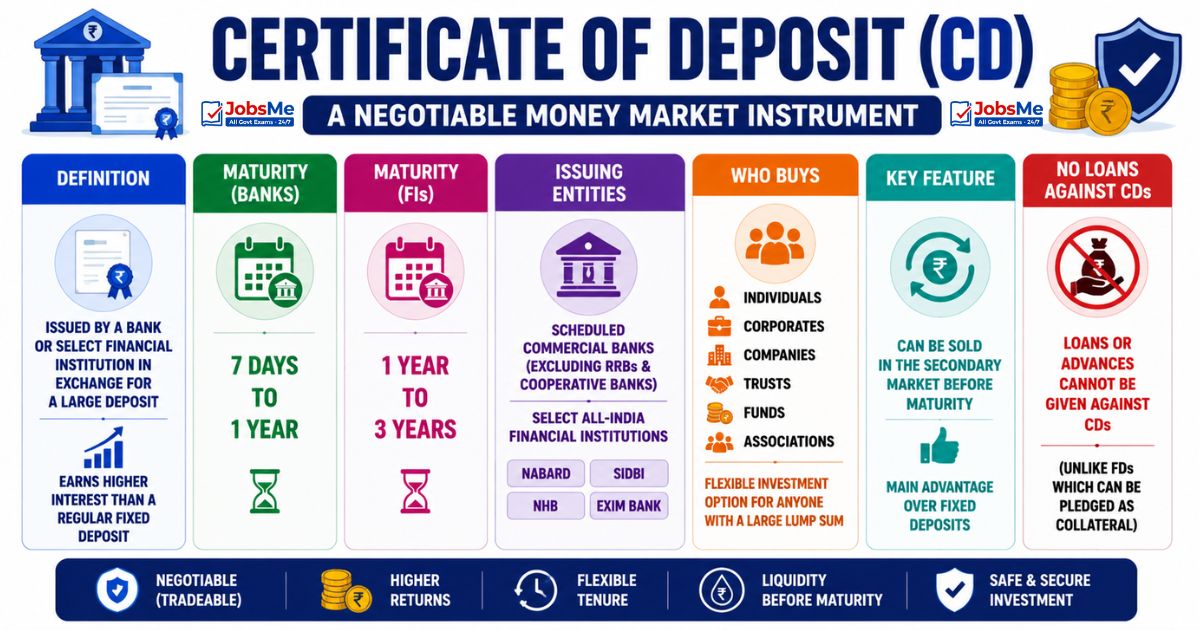
A negotiable (tradeable) money market instrument issued by a bank or select financial institution in exchange for a large deposit; earns higher interest than a regular fixed deposit
Maturity (Banks)
7 days to 1 year
Maturity (FIs)
1 year to 3 years
Issuing Entities
Scheduled commercial banks (excluding RRBs and cooperative banks) and select All-India Financial Institutions (NABARD, SIDBI, NHB, EXIM Bank)
Who Buys
Individuals, corporates, companies, trusts, funds, associations — CDs are a flexible investment option for anyone with a large lump sum
Key Feature
Can be sold in the secondary market before maturity — unlike regular FDs which cannot be transferred. This liquidity is the main advantage over FDs
No Loans Against CDs
Loans or advances cannot be given against CDs (unlike FDs which can be pledged as collateral)
5. Call Money and Notice Money
Feature
Call Money
Notice Money
Tenure
Overnight (1 day)
2 to 14 days
Participants
Banks and Primary Dealers only
Banks and Primary Dealers only
Collateral
Uncollateralized — no security required
Uncollateralized — no security required
Rate
Call Rate — market-determined overnight rate; fluctuates within LAF corridor (Reverse Repo to MSF)
Market-determined rate for 2-14 day borrowings
Purpose
Banks with CRR/SLR shortfalls or sudden liquidity needs borrow; banks with surplus funds lend
Same as call money but for slightly longer periods
RBI Role
RBI monitors and publishes call rates; intervenes through LAF operations if call rates deviate too far
Same monitoring by RBI
6. TREPS - Tri-Party Repo
Full Form: Tri-Party Repo System
Replaced CBLO (Collateralized Borrowing and Lending Obligation) from November 2018
A collateralized overnight to short-term (up to 90 days) borrowing and lending instrument — unlike call money which is uncollateralized
Three parties: the borrower (pledges G-Secs as collateral), the lender (provides funds) and CCIL (Clearing Corporation of India Limited) as the tri-party agent (central counterparty that manages collateral).
CCIL guarantees all TREPS transactions — so it is effectively risk-free from counterparty default perspective
Open to a wider range of participants than call money — banks, NBFCs, mutual funds, insurance companies, corporates can all participate
Most liquid short-term money market segment after call money; key reference rate for overnight secured lending
Capital Market - Instruments and Structure
Primary Market vs Secondary Market
Feature
Primary Market
Secondary Market
Definition
Market where new securities are issued for the first time; companies raise fresh capital directly from investors
Market where already-issued securities are bought and sold between investors; company does not receive any new funds
Instruments
IPOs (Initial Public Offerings), FPOs (Follow-on Public Offerings), Rights Issues, Private Placements
Trading of stocks and bonds on NSE, BSE and other exchanges
Price
Fixed by the company (or through book building process)
Determined by demand and supply forces in the market
Liquidity
Low — investor must wait for allotment
High — can buy or sell at any time during trading hours
Capital Market Instruments
Instrument
Description
Risk Level
Returns
Equity Shares
Ownership stake in a company; shareholders vote on company decisions; receive dividends (variable) and capital appreciation
Highest — market-linked; can lose entire investment
Potentially highest — no upper limit
Preference Shares
Hybrid security — gets preference over equity shares in dividend payment and in case of company liquidation; fixed dividend; typically no voting rights
Lower than equity; higher than debt
Fixed dividend; no capital appreciation beyond redemption value
Debentures
Long-term debt instrument of a company; pays fixed interest (coupon) to holders; does not give ownership stake
Medium — depends on company's creditworthiness
Fixed coupon (interest)
Bonds
Long-term debt instruments; issued by governments, PSUs and corporates; pays periodic coupon; principal repaid at maturity
Long-term debt securities issued by central and state governments; no credit risk; most secure fixed-income investment; used by banks for SLR compliance
Zero credit risk (sovereign)
Market-determined coupon; price fluctuates with interest rates
Mutual Funds
Pooled investment vehicles that invest in diversified portfolios; NAV-based; multiple categories: equity, debt, hybrid, index, ELSS
Varies by fund type
Market-linked; not guaranteed
ETFs (Exchange Traded Funds)
Funds that track an index (like Nifty 50 or Sensex); traded on stock exchange like a share; low cost
Same as underlying index
Index returns minus expense ratio
REITs (Real Estate Investment Trusts)
Investment vehicle for real estate; listed on exchanges; distributes 90% of income to unit holders; regulated by SEBI
Medium
Regular rental income + capital appreciation
InvITs (Infrastructure Investment Trusts)
Investment vehicle for infrastructure assets (roads, pipelines, power plants); listed on exchanges; regular income distribution; regulated by SEBI
Medium
Infrastructure revenue distributions
SEBI - Securities and Exchange Board of India
Parameter
Details
Established
April 12, 1992 under the SEBI Act 1992 (initially set up as non-statutory body in 1988)
Headquarters
Mumbai (Bandra Kurla Complex)
Type
Statutory autonomous body — neither government department nor court; quasi-judicial, quasi-legislative, quasi-executive
Regional Offices
New Delhi, Kolkata, Chennai, Ahmedabad
Board Composition
Chairman (government nominee) + 2 members from Ministry of Finance + 1 from RBI + 5 other members
SEBI's Three Functions
Quasi-Legislative: Issues regulations, guidelines and circulars governing all market participants
Quasi-Judicial: Adjudicates disputes; can impose penalties and ban market participants; orders can be appealed to Securities Appellate Tribunal (SAT)
Quasi-Executive: Conducts investigations, inspections and enforcement actions; can attach bank accounts and properties of offenders
Merchant bankers, underwriters, registrar to an issue
Credit Rating Agencies: CRISIL, ICRA, CARE, FITCH India, Brickwork
Alternate Investment Funds (AIFs): Category I (infrastructure, venture capital), Category II (private equity, debt), Category III (hedge funds)
REITs and InvITs
Foreign Investment - FDI and FPI Detailed Comparison
Parameter
FDI (Foreign Direct Investment)
FPI (Foreign Portfolio Investment)
Definition
Long-term investment by a foreign entity acquiring a significant and lasting interest in a business enterprise — typically 10% or more equity — with intent of management control
Investment by a foreign entity in Indian financial securities (stocks, bonds, mutual fund units) with purely financial return motive; no management control intended
Nature
Long-term; real economy investment (physical assets, technology, employment)
Short to medium term; financial securities; can be very short-term (hot money)
Management Control
Yes — FDI investor gets board representation and management involvement
No — FPI investor is a passive financial investor; no voting rights sought
Equity Threshold
10% or more equity ownership (OECD/IMF definition)
Less than 10% equity holding in any company (SEBI FPI regulations)
Stability
Stable — real assets cannot be quickly liquidated; committed long-term presence
Volatile — can exit very quickly; large sudden FPI outflows cause currency depreciation and stock market crashes
Impact on Economy
Creates jobs, transfers technology, builds productive capacity; supplements domestic savings for real investment
Provides liquidity and price discovery in capital markets; does not directly create jobs or build productive capacity
Regulator
DPIIT (Department for Promotion of Industry and Internal Trade) for policy; RBI for FEMA compliance; CCI for competition issues
SEBI for equity and debt investments in markets; RBI for certain debt investment limits
Route
Automatic Route (pre-approved sectors, no government approval needed) or Government Route (approval from DIPP/concerned ministry)
Registration as Registered Foreign Portfolio Investor (RFPI) with a SEBI-designated depository participant
Formerly Called
FDI
FII (Foreign Institutional Investor) — term changed to FPI by SEBI in 2014 to align with global standards
Examples
Samsung's factory in Noida; Foxconn's manufacturing in India; Walmart's acquisition of Flipkart stake of 77%
Foreign mutual funds, pension funds, sovereign wealth funds buying Reliance or HDFC Bank shares on NSE
FDI Routes in India
Route
Description
Sectors
Automatic Route
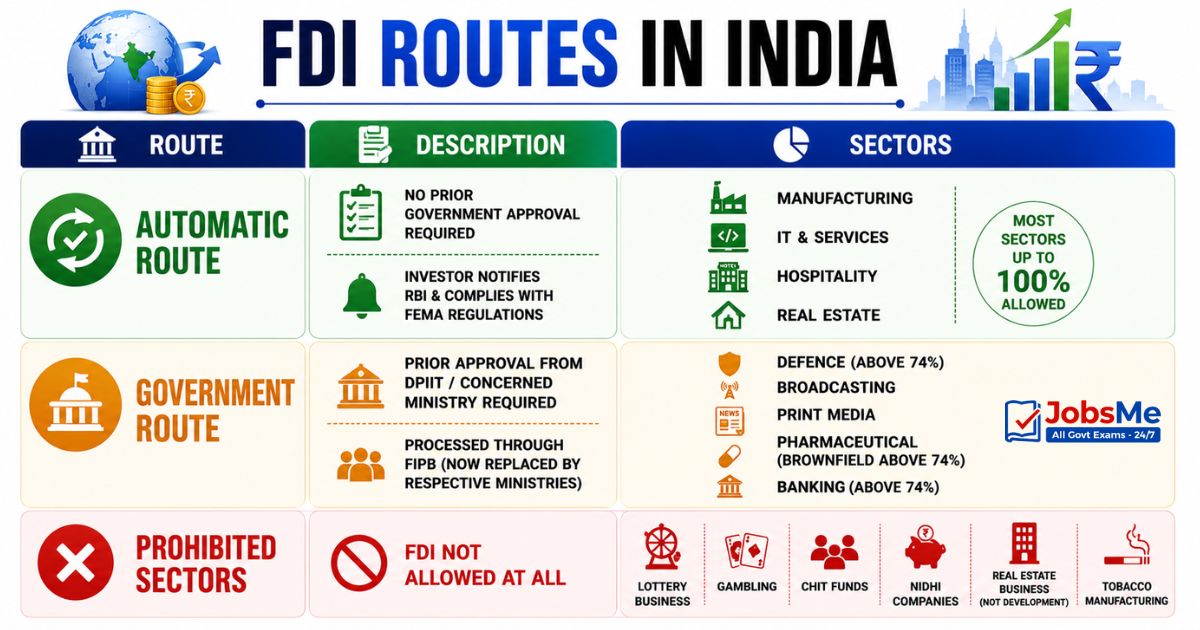
No prior government approval required; investor only needs to notify RBI and comply with FEMA regulations; covers most sectors
Manufacturing, IT, services, hospitality, real estate (most sectors up to 100% allowed)
Government Route
Prior approval from DPIIT / concerned ministry required before making investment; processed through FIPB (now replaced by respective ministries)
Lottery business, gambling, chit funds, Nidhi companies, real estate business (not development), tobacco manufacturing
Balance of Payments (BoP)
The Balance of Payments (BoP) is a systematic record of all economic transactions between residents of a country and the rest of the world during a given period (typically one year). It reflects the country's international financial position.
Structure of BoP
Account
What It Records
Examples
Current Account
Trade in goods and services, primary income and secondary income (transfers)
Export/import of goods; software exports; tourism earnings; NRI remittances; dividend income from abroad
Current Account — Invisibles (Services + Transfers)
Services, investment income and transfers
IT/BPM service exports; interest payments on external debt; NRI remittances
Capital and Financial Account
Cross-border flows of financial assets — investments, loans, banking capital
FDI, FPI, ECB (External Commercial Borrowings), banking capital flows, official reserve changes
Errors and Omissions
Statistical discrepancy; balancing item
Unrecorded transactions; estimation errors
Current Account Deficit (CAD)
India typically runs a Current Account Deficit (CAD) — imports of goods and services exceed exports. This CAD is financed by net inflows in the Capital and Financial Account (FDI, FPI, ECB, NRI deposits). When capital inflows are insufficient to cover CAD, India draws on its foreign exchange reserves to meet the gap.
India's current account deficit is primarily driven by the large oil import bill and gold imports
IT/software exports and NRI remittances are the two largest sources of foreign exchange for India, partially offsetting the trade deficit
India is the world's largest recipient of remittances — NRI remittances exceed USD 100 billion per year
GIFT City - India's International Financial Services Centre
Parameter
Details
Full Name
Gujarat International Finance Tec-City
Location
Gandhinagar, Gujarat
Status
India's first and only operational International Financial Services Centre (IFSC)
Regulator
International Financial Services Centres Authority (IFSCA) — established under IFSCA Act 2019; unified regulator for all financial services in GIFT City IFSC
Currency
All transactions in foreign currencies (USD primarily); no Indian Rupee transactions
Key Features
Banking, insurance, capital markets and fund management allowed; liberalised regulatory regime; significant tax incentives (10-year tax holiday for units)
Purpose
Capture offshore financial transactions involving India that currently happen in Singapore, Dubai, Mauritius and London — bring them back to India
NSE and BSE Presence
Both NSE (India International Exchange — INX) and BSE (India International Exchange — India INX) have exchanges at GIFT City IFSC
LRS - Liberalised Remittance Scheme
Parameter
Details
Introduced
2004 by RBI
Who Can Use
Resident individual Indians (not companies or firms)
Annual Limit
USD 2,50,000 per financial year per person
Permissible Uses
Foreign education, medical treatment abroad, travel, purchase of foreign securities, opening foreign bank accounts, gifts to foreign relatives, maintenance of close relatives abroad
Prohibited Under LRS
Remittance to countries under FATF watch, remittance for lottery, prohibited investments
TCS on LRS
Tax Collected at Source applies on LRS remittances — 20% TCS on remittances above Rs. 7 lakh per year (except education and medical treatment which have lower TCS rates); TCS is adjustable against income tax
Route
Must be through an Authorized Dealer (AD) bank in India
Important Market Indices
Index
Exchange
Composition
Base Year
Sensex
BSE (Bombay Stock Exchange)
30 largest and most actively traded stocks on BSE
1979 (Base value 100)
Nifty 50
NSE (National Stock Exchange)
50 largest companies by market capitalization across 13 sectors
1995 (Base value 1000)
Nifty Bank
NSE
12 most liquid and large-cap banking stocks listed on NSE
2000
BSE 100 / BSE 200
BSE
100 / 200 largest companies by market cap on BSE
Various
Memory Tricks - Financial Markets
Remember Money Market Instruments
Trick: T-C-C-N-T = T-Bills, Commercial Paper, Certificate of Deposit, Notice/Call Money, TREPS. Five instruments, starting with T-C-C-N-T. "The Corporation Calls No Trouble" — each first letter matches.
Remember FDI vs FPI
Trick: FDI = Direct = Durable = Factories = Develops economy. FPI = Portfolio = Paper assets = Passive = Potentially volatile. The D in FDI stands for "Direct, Durable, Develops." The P in FPI stands for "Portfolio, Passive, Potentially-hot-money."
Remember TREPS vs Call Money
Trick: Call = Uncollateralized. TREPS = Collateralized (uses G-Secs as collateral; CCIL is middle-man). Call is risky (no collateral); TREPS is safe (G-Sec backed). CBLO was the old name before TREPS replaced it in November 2018.
Remember SEBI
Trick: SEBI = April 12, 1992. Established 4+1+2=7 (12 April). Headquarters: Mumbai. Three functions: Legislative (makes rules), Judicial (punishes violators), Executive (investigates). Quasi means "sort of" — SEBI acts like all three but is not formally any of them.
Remember BoP Accounts
Trick: BoP = Current Account (goods, services, transfers) + Capital Account (investments, loans). Current = what you currently earn and spend. Capital = long-term financial flows. India: Current Account Deficit (spends more on imports than earns from exports); financed by Capital Account surplus (FDI, FPI, ECB inflows).
One-Liners for Quick Revision
Money market: instruments with maturity under 1 year; regulated by RBI.
Capital market: instruments with maturity over 1 year; regulated by SEBI.
T-Bills: 91-day, 182-day, 364-day; zero-coupon; issued at discount; risk-free.
91-day T-Bill yield is an approved External Benchmark Rate (EBR) for bank loans.
CMBs: maturity less than 91 days; for government cash flow mismatches.
Commercial Paper: unsecured; issued by highly rated corporates, NBFCs, PDs; 7 days to 1 year.
Certificate of Deposit: issued by banks; tradeable in secondary market; cannot pledge for loans.
Call Money: overnight; uncollateralized; only banks and PDs.
TREPS replaced CBLO in November 2018; CCIL is the tri-party agent.
SEBI established: April 12, 1992; headquarters Mumbai.
Stay updated, revise regularly, and attempt quizzes for better accuracy in UPSC, SSC CGL, IBPS PO/Clerk, SBI, RBI Grade B, RRB NTPC, Defence, and State PSC exams.
Frequently Asked Questions
What is the difference between the Money Market and the Capital Market?
The Money Market deals in short-term debt instruments with a maturity period of less than one year. It provides a mechanism for borrowers to meet their short-term funding needs and for investors to deploy surplus funds safely for short periods. Key instruments include Treasury Bills (91-day, 182-day, 364-day), Commercial Paper, Certificate of Deposit, Call Money, Notice Money and TREPS (Tri-Party Repo). The Capital Market deals in long-term financial instruments with a maturity period of more than one year. It provides long-term financing to governments and businesses through equity shares, debentures, bonds and government securities. SEBI regulates the capital market in India.
What is the difference between FDI and FPI?
FDI (Foreign Direct Investment) is a long-term investment by a foreign entity in productive business assets in India — such as factories, subsidiaries, joint ventures and acquisitions — with the intention of gaining significant management control (usually 10% or more equity stake). FDI is stable, contributes to real economic growth, creates jobs and is difficult to reverse quickly. FPI (Foreign Portfolio Investment) is investment by a foreign entity in Indian financial assets — stocks, bonds, mutual funds — primarily for financial returns without any management control. FPI is volatile and can enter and exit markets rapidly, sometimes destabilizing the exchange rate.
What is SEBI and what does it regulate?
SEBI (Securities and Exchange Board of India) is the statutory regulator of India's capital markets, established on April 12, 1992 under the SEBI Act 1992. SEBI is headquartered in Mumbai with regional offices in New Delhi, Kolkata, Chennai and Ahmedabad. SEBI regulates and supervises stock exchanges (NSE, BSE), stock brokers, depository participants, mutual funds, investment advisors, merchant bankers, portfolio managers, registrar to an issue, underwriters, Alternate Investment Funds (AIFs) and Credit Rating Agencies (CRAs). SEBI's primary objectives are to protect the interests of investors in securities, promote the development of the securities market and regulate the securities market.
What is GIFT City and why is it significant for banking?
GIFT City (Gujarat International Finance Tec-City) located in Gandhinagar, Gujarat is India's first operational International Financial Services Centre (IFSC). IFSC is a designated zone where financial services can be conducted in foreign currencies with a regulatory framework similar to offshore financial centres. GIFT City IFSC is regulated by the International Financial Services Centres Authority (IFSCA), a unified regulator established under the IFSCA Act 2019. Foreign banks and financial institutions can set up branches in GIFT City IFSC and provide services in foreign currencies with tax incentives and lighter regulatory compliance. It aims to bring offshore financial transactions — currently happening in Singapore, Dubai and Mauritius — back to India.
What is the Liberalised Remittance Scheme (LRS)?
The Liberalised Remittance Scheme (LRS) is an RBI scheme that allows resident Indian individuals (not companies) to remit up to USD 2,50,000 per financial year abroad for any permissible current or capital account transaction. Permissible purposes include foreign education, foreign travel, medical treatment abroad, purchase of foreign securities, opening foreign bank accounts and maintenance of relatives abroad. All LRS remittances must be routed through an Authorized Dealer (AD) bank. Tax Collected at Source (TCS) is applicable on LRS remittances above specified thresholds.
What is the Balance of Payments (BoP)?
The Balance of Payments (BoP) is a systematic statistical record of all economic transactions between residents of a country and the rest of the world during a given period (usually one year). It has two main accounts: the Current Account records trade in goods (merchandise), trade in services (invisibles), primary income (investment income, compensation of employees) and secondary income (remittances, grants). The Capital Account and Financial Account record cross-border flows of financial assets — FDI, FPI, loans, banking capital, official reserves. A BoP surplus means more money is flowing into the country than flowing out; a BoP deficit means more is flowing out.