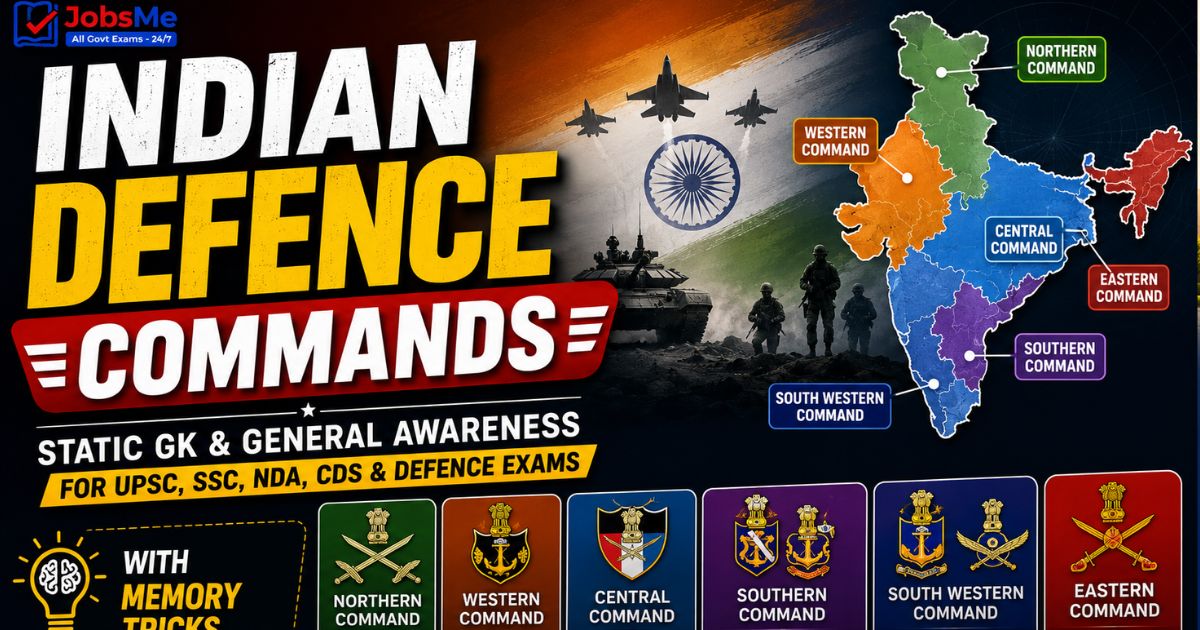
Indian Defence Commands – Static GK & General Awareness for UPSC, SSC, NDA, CDS and Defence Exams with Memory Tricks
This article explains Indian Defence Commands in a clear exam-ready format, covering Army, Air Force, Navy, Coast Guard, CAPF, strategic commands, field formations, training institutions, defence production units, and high-yield one-liners. It is useful for UPSC, SSC, NDA, CDS, AFCAT, CAPF, RRB, State PCS, Police, and other government exam aspirants because command headquarters and defence organization questions are repeatedly asked in General Awareness.
Jump to section
Introduction
Indian Defence Commands are an important part of Static GK, General Awareness, Defence Awareness, and Internal Security. A command is a large military formation created for better command, control, administration, training, logistics, and operational readiness. In India, the command structure exists separately in the Indian Army, Indian Navy, Indian Air Force, and the Indian Coast Guard, while joint and strategic commands handle tri-service coordination and strategic deterrence.
For competitive exams, students must remember the number of commands, headquarters, type of command, and major responsibilities. Questions are common in UPSC Prelims, SSC CGL, NDA, CDS, AFCAT, CAPF, RRB NTPC, State PCS, Police, and Defence recruitment exams. Aspirants can revise this article along with other Static GK notes on thejobsme.com.
Indian Defence Commands are also linked with current affairs because India is moving toward greater jointness among the three services through reforms such as integrated planning, tri-service organizations, and proposed theatre command structures. For updated exam-oriented defence developments, students should also follow daily current affairs regularly.
Core Concept Explanation
The Indian defence command system works at different levels. At the constitutional level, the President of India is the Supreme Commander of the Indian Armed Forces. At the executive level, the Ministry of Defence manages the Armed Forces, while the Ministry of Home Affairs manages most internal security forces such as CAPFs. At the military level, each service has its own headquarters and commands.
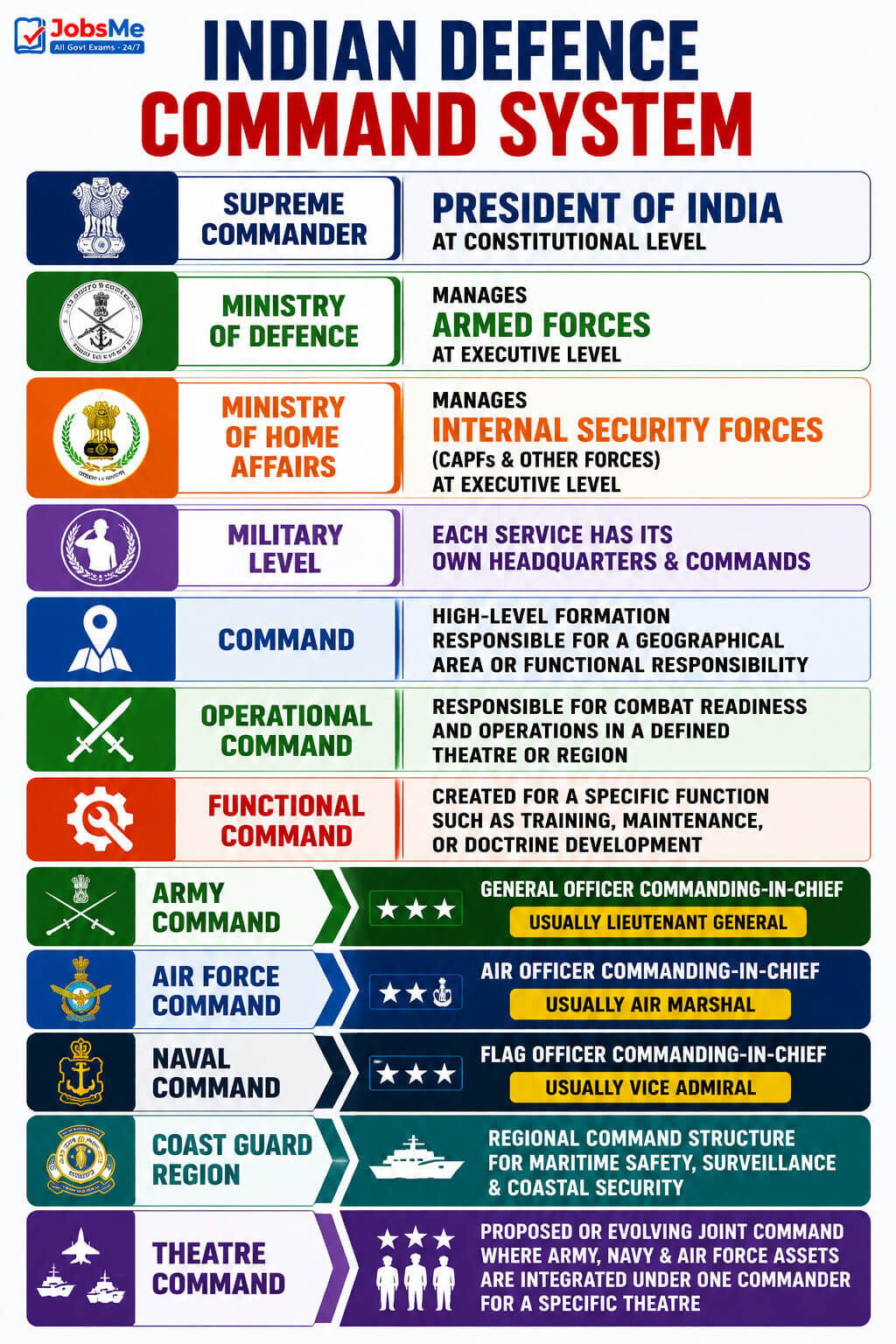
- Command: A high-level formation responsible for a geographical area or a functional responsibility such as training or maintenance.
- Operational Command: A command responsible for combat readiness and operations in a defined theatre or region.
- Functional Command: A command created for a specific function such as training, maintenance, or doctrine development.
- Army Command: Headed by a General Officer Commanding-in-Chief, usually a Lieutenant General.
- Air Force Command: Headed by an Air Officer Commanding-in-Chief, usually an Air Marshal.
- Naval Command: Headed by a Flag Officer Commanding-in-Chief, usually a Vice Admiral.
- Coast Guard Region: Regional command structure used by the Indian Coast Guard for maritime safety, surveillance, and coastal security.
- Theatre Command: A proposed or evolving joint command concept where Army, Navy, and Air Force assets are integrated under one commander for a specific theatre.
Main Data Section
National Defence Command and Control
| Level / Body | Key Head / Authority | Role / Key Features | Exam Importance |
|---|---|---|---|
| Supreme Command | President of India | The President of India is the Supreme Commander of the Indian Armed Forces. This is a constitutional command position and is repeatedly asked in exams. | UPSC, SSC, NDA, CDS, State PCS, Police, Railways |
| Executive Defence Management | Ministry of Defence | The Ministry of Defence coordinates and supervises government functions directly related to national security and the Indian Armed Forces. | Important for Polity, Governance, Defence Awareness and Internal Security |
| Internal Security Management | Ministry of Home Affairs | Most CAPFs and internal security forces come under the Ministry of Home Affairs. They manage internal security, border guarding, counter-insurgency, industrial security, and special security tasks. | Important for CAPF, UPSC GS III and Police exams |
| Army Headquarters | Chief of the Army Staff | Located in New Delhi. It manages policy-making, planning, training, operations, intelligence, logistics, and administration of the Indian Army. | Direct one-liner question |
| Air Headquarters | Chief of the Air Staff | Located in New Delhi. It controls Indian Air Force administration, operational readiness, air defence planning, and command coordination. | Asked in Defence and SSC GK |
| Naval Headquarters | Chief of the Naval Staff | Located in New Delhi. It administers the Indian Navy and coordinates maritime strategy, fleet deployment, training, and logistics. | Important for Navy and Defence Awareness |
| Joint / Strategic Coordination | Chief of Defence Staff and Joint Structures | Supports jointness among the Army, Navy, and Air Force. Strategic and tri-service structures are important for integrated operations and modern defence reforms. | Very important for current affairs and UPSC Mains |
Indian Army Commands and Headquarters
| Command | Headquarters | Type | Key Features / Exam Notes |
|---|---|---|---|
| Northern Command | Udhampur, Jammu and Kashmir | Operational Command | One of the most sensitive Army commands. It is linked with northern border security, Line of Control, Line of Actual Control, high-altitude deployment, and counter-infiltration operations. |
| Western Command | Chandimandir, Haryana | Operational Command | Important for the western front and India-Pakistan border sectors. Often asked with headquarters in matching questions. |
| Eastern Command | Kolkata, West Bengal | Operational Command | Responsible for eastern and north-eastern operational areas. Important for questions linked with China, Myanmar, Bangladesh, and North-East security. |
| Southern Command | Pune, Maharashtra | Operational Command | India’s southern Army command. It is linked with southern and western areas, coastal coordination, logistics, and operational formations. |
| Central Command | Lucknow, Uttar Pradesh | Operational Command | Important for central India and reserve/support roles. Many exam tables ask Central Command headquarters as Lucknow. |
| South Western Command | Jaipur, Rajasthan | Operational Command | Also known as Sapta Shakti Command in defence awareness. It is important for western desert and Rajasthan-Punjab axis related operational readiness. |
| Army Training Command (ARTRAC) | Shimla, Himachal Pradesh | Functional / Training Command | The only functional command of the Indian Army. It deals with training, doctrine, simulation, evaluation, and human resource development. In some old notes the abbreviation is wrongly written as ATRAC; the correct abbreviation is ARTRAC. |
Indian Army Field Formation Structure
| Formation Level | Normally Commanded By | Typical Composition | Key Features / Description |
|---|---|---|---|
| Army Headquarters | Chief of the Army Staff | Principal Staff Officers and directorates | Top administrative and command body of the Indian Army in New Delhi. It manages planning, training, intelligence, logistics, personnel, and operations. |
| Command | General Officer Commanding-in-Chief | Multiple corps | Highest regular command formation below Army HQ. The Army has six operational commands and one training command. |
| Corps | Lieutenant General | Usually multiple divisions | Large field formation responsible for a specific operational area. Corps may be strike, holding, or mixed depending on role. |
| Division | Major General | Usually 3 to 4 brigades | Primary combat formation. Types include infantry, armoured, mountain, artillery, and RAPID formations. |
| Brigade | Brigadier | Usually 3 to 4 battalions with support arms | Important tactical formation used for field operations. Brigades may be infantry, armoured, artillery, engineer, air defence, or parachute-based. |
| Battalion | Colonel / Lieutenant Colonel | Multiple companies; usually around 800 to 1,000 soldiers depending on unit type | Basic fighting unit of the Army, especially in infantry. In some contexts a battalion may be associated with a regiment. |
| Company | Major or Captain | Multiple platoons; commonly around 120 soldiers | Sub-unit of a battalion used for tactical control during operations. |
| Platoon | Lieutenant / Captain / JCO depending on situation | Multiple sections; commonly around 30 to 32 soldiers | Small tactical unit between company and section. |
| Section | Non-Commissioned Officer | Usually 10 to 12 soldiers | Smallest regular field unit. Frequently asked in Army and Defence exam one-liners. |
| Battery | Battery Commander | Usually 3 to 4 sections in artillery or air defence units | Battery is commonly used in artillery and air defence units instead of the company-type term used in infantry. |
Indian Army Rank Structure
| Category | Ranks Mentioned in Reference | Key Features / Exam Notes |
|---|---|---|
| Commissioned Officers | Field Marshal, General, Lieutenant General, Major General, Brigadier, Colonel, Lieutenant Colonel, Major, Captain, Lieutenant | Commissioned officers lead formations from platoon/company level to the entire Army. General is the regular rank of the Chief of the Army Staff; Field Marshal is an honorary five-star rank. |
| Junior Commissioned Officers | Subedar Major, Subedar, Naib Subedar | JCOs form an important leadership bridge between commissioned officers and other ranks. |
| Other Ranks | Havildar, Naik, Lance Naik, Sepoy | Other Ranks form the soldier base of the Army. Questions may ask the correct sequence of ranks. |
Major Army Commands: Corps and Division Notes from Reference
| Army Command | Important Corps / Subordinate Units Mentioned | Important Divisions Mentioned | Exam-Relevant Description |
|---|---|---|---|
| Central Command | Reference notes mention no major field corps currently working directly under it in that older table and link older assignments with South Western Command. | Not emphasized in the reference table. | For exams, remember Central Command → Lucknow. It is often asked as a simple command-headquarters pair. |
| Eastern Command | IV Corps at Tezpur, XXXIII Corps at Siliguri, III Corps at Dimapur, XVII Corps at Panagarh | 2nd Mountain Division at Dibrugarh, 5th Mountain Division at Bomdila, 17th Mountain Division at Gangtok, 20th Mountain Division at Binnaguri, 21st Mountain Division at Rangia, 23rd Infantry Division at Ranchi, 27th Mountain Division at Kalimpong, 56th Mountain Division at Zakhama, 57th Mountain Division at Leimakhong, 59th Infantry Division at Panagarh, 71st Mountain Division at Missamari, 72 Infantry Division listed as being raised in older notes | Eastern Command is linked with the eastern and north-eastern frontier. Questions often focus on Kolkata as headquarters. |
| Northern Command | XV Corps at Srinagar, XVI Corps at Nagrota, XIV Corps at Leh | 8th Mountain Division at Dras, 28th Mountain Division at Gurez/Gurais, 25th Infantry Division at Rajauri, 39th Infantry Division at Yol, 3rd Infantry Division at Leh, 10th Infantry Division at Akhnoor, 19th Infantry Division at Baramulla | Northern Command is highly important for border security and high-altitude operations. Remember Udhampur as headquarters. |
| Southern Command | XII Corps at Jodhpur and XXI Corps at Bhopal | 11th Infantry Division at Ahmedabad, 12th RAPID at Jodhpur, 31st Armoured Division at Jhansi, 36th RAPID at Sagar, 41st Artillery Division at Pune, 54th Infantry Division at Hyderabad/Secunderabad | Southern Command is headquartered at Pune. It has strong links with armoured, mechanised, artillery, and southern/western area responsibilities. |
| South Western Command | I Corps at Mathura and X Corps at Bhatinda/Bathinda are commonly associated in exam-oriented notes; some older sources may contain typographical confusion with XXI Corps. | 42nd Artillery Division at Jaipur, 18th RAPID at Kota, 4th Infantry Division at Prayagraj, 16th Infantry Division at Sri Ganganagar, 6th Mountain Division at Bareilly, 33rd Armoured Division at Hisar, 24th RAPID at Bikaner | South Western Command is headquartered at Jaipur. It is important for the Rajasthan-Punjab axis and desert-sector defence awareness. |
| Western Command | II Corps at Ambala, XI Corps at Jalandhar, IX Corps at Yol | 40th Artillery Division at Ambala, 14th RAPID at Dehradun, 26th Infantry Division at Jammu, 7th Infantry Division at Firozpur, 15th Infantry Division at Amritsar, 1st Armoured Division at Patiala, 29th Infantry Division at Pathankot, 9th Infantry Division at Meerut, 22nd Infantry Division at Meerut | Western Command is headquartered at Chandimandir. It is repeatedly asked with Haryana/Punjab western front context. |
| Army Training Command | Training establishments, doctrine development, simulation, and training policy structure | Not a field division-based operational command | ARTRAC is headquartered at Shimla and is the only training/functional Army command. |
Indian Air Force Commands and Headquarters
| Air Force Command | Headquarters | Type | Key Features / Exam Notes |
|---|---|---|---|
| Western Air Command | New Delhi | Operational Command | Important operational command responsible for air operations in northern and western sectors. It is one of the most asked IAF command-headquarters pairs. |
| Eastern Air Command | Shillong, Meghalaya | Operational Command | Responsible for eastern and north-eastern air operations. Do not confuse it with Eastern Army Command, which is at Kolkata. |
| Central Air Command | Prayagraj, Uttar Pradesh | Operational Command | Older notes may mention Allahabad; the current city name used in exams may be Prayagraj. It supports central air operations. |
| Southern Air Command | Thiruvananthapuram, Kerala | Operational Command | Responsible for southern peninsular and maritime airspace-related operations. |
| South Western Air Command | Gandhinagar, Gujarat | Operational Command | Important for south-western air defence and western desert/coastal airspace. |
| Training Command | Bengaluru, Karnataka | Functional Command | Responsible for training pilots and technical staff. It is one of the two functional commands of the IAF. |
| Maintenance Command | Nagpur, Maharashtra | Functional Command | Responsible for maintenance, logistics, repair, and support of IAF equipment and assets. |
Indian Air Force: Basic Facts and Assets from Reference
| Topic | Facts / Examples | Key Features / Exam Notes |
|---|---|---|
| Establishment | 8 October 1932 | The Indian Air Force was established as an auxiliary air force during British rule. Air Force Day is observed on 8 October. |
| Motto | Touch the Sky with Glory | The motto is taken from the eleventh chapter of the Bhagavad Gita. It is a popular Static GK question. |
| Role | Air defence, aerial warfare, transport, reconnaissance, support to Army and Navy, disaster relief | The IAF secures Indian airspace and also participates in humanitarian assistance and disaster relief. |
| Operational Experience | Wars with Pakistan, conflict with China, UN peacekeeping and relief missions | Reference examples include Gujarat cyclone 1998, tsunami 2004, floods in North India, and Operation Rainbow in Sri Lanka. |
| Helicopters Mentioned | Mi-26, Mi-17, Mi-8, Chetak, Cheetah, ALH Dhruv | Useful for defence awareness, especially in air mobility, troop lift, and rescue contexts. |
| Trainer Aircraft Mentioned | HT-2, HPT-32 Deepak, HJT-16 Kiran, Hawk Advanced Jet Trainer | These are asked less frequently but are useful in deeper Defence GK. |
| Fighter / Ground Attack Aircraft Mentioned | Su-30, Mirage-2000, MiG-29 Baaz, MiG-27, MiG-23 MF, MiG-21 BIS, Jaguar | Modern Static GK questions often ask aircraft origin, role, or Indian service name. |
| Transport / Special Assets Mentioned | IL-76, AN-32, Boeing 737-200, C-130J Hercules, AWACS, Flight Refuelling Aircraft | Important for airlift, surveillance, refuelling, and strategic mobility topics. |
| Network and Modernization | Network-centric warfare systems, radars, accurate weapons, transport aircraft and helicopters | Useful for current affairs and technology-based defence questions. |
Indian Navy Commands and Headquarters
| Naval Command | Headquarters | Type | Key Features / Exam Notes |
|---|---|---|---|
| Western Naval Command | Mumbai, Maharashtra | Operational Command | Controls naval operations mainly in the Arabian Sea and western maritime areas. Western Fleet is based at Mumbai. |
| Eastern Naval Command | Visakhapatnam, Andhra Pradesh | Operational Command | Controls naval operations mainly in the Bay of Bengal and eastern maritime areas. Eastern Fleet is based at Visakhapatnam. |
| Southern Naval Command | Kochi, Kerala | Training Command | The training command of the Indian Navy. It is frequently asked as a command-headquarters pair and should not be confused with Southern Air Command at Thiruvananthapuram. |
Indian Navy: Fleet, History and Naval Assets from Reference
| Topic | Facts / Examples | Key Features / Description |
|---|---|---|
| Naval Headquarters | New Delhi | The Indian Navy is headed by the Chief of the Naval Staff, a four-star Admiral. The Chief is assisted by Principal Staff Officers including Vice-Chief, Chief of Personnel, Chief of Material, Deputy Chief and Controller of Logistic Support. |
| Historical Origin | East India Company’s Marine founded in 1612; colonial navy later titled His Majesty’s Indian Navy; renamed Indian Navy when India became a republic in 1950 | Useful for historical Defence GK. Remember 1950 for the name Indian Navy in republican India. |
| Fleets | Western Fleet and Eastern Fleet | The Western Fleet is based at Mumbai and the Eastern Fleet is based at Visakhapatnam. |
| Aircraft Carriers Mentioned | INS Vikrant, INS Viraat, INS Vikramaditya | INS Vikrant was India’s first aircraft carrier historically. INS Viraat was decommissioned in 2017. INS Vikramaditya and the indigenous INS Vikrant are important current-era aircraft carrier names. |
| Missile Boats Mentioned | Chamak Class: Chamak and Chapal | Useful for older fleet-based GK notes; less commonly asked than command headquarters. |
| Training Ships Mentioned | Tir Class: Tir; Leander Class: Krishna; Sail Training Ship: Tarangini | Important for Navy training and static defence data. |
| Fleet Auxiliaries Mentioned | Fleet tankers Jyoti, Aditya, Shakti; Diving Support Ship Nireekshak; Torpedo Recovery Vessel Astravahini / TRV A-72; oceangoing tugs Matanga and Gaj | Auxiliary ships support operations, logistics, diving, recovery, and fleet endurance. |
| Survey and Research Ships Mentioned | Sagardhwani; Sandhayak, Nirdeshak, Nirupak, Investigator, Jamuna, Sutlej, Darshak, Sarvekshak | These ships are useful for hydrographic, survey, and ocean research-related defence notes. |
| Seaward Defence Vessels Mentioned | Tarasa Class FAC(G): Tarasa, Trinkat; Seaward Defence Boats T 54-59 and Mithun FACs T 80-84 | Used in coastal and seaward defence roles in older naval GK references. |
| Naval Aircraft and Helicopters Mentioned | Sea Harrier, Sea King 42/42A/42B/42C, Chetak, Kamov Ka-28/Helix B, Ka-25 Hormone, Islander, HAL ALH, Dornier 228, IL-38, TU-142, Kiran | Useful for deeper Navy awareness; command headquarters are more commonly asked in general exams. |
| Submarine Classes Mentioned | Shishumar Class: Shishumar, Shankush, Shalki, Shankul; Sindhughosh Class: Sindhughosh, Sindhudhvaj, Sindhuraj, Sindhuvir, Sindhuratna, Sindhukesari, Sindhukirti, Sindhuvijay, Sindhurakshak, Sindhushastra | Submarine class names are useful for defence exams and Navy-specific recruitment awareness. |
| Submarine-Based Missiles Mentioned | Klub SS-N-27, Sagarika, Lakshya variants, BrahMos | Connects naval platforms with missile and strategic deterrence topics. |
| INS Kursura | Commissioned at Riga, USSR, on 18 December 1969; played a role in the 1971 Indo-Pak War; decommissioned on 27 February 2001; converted into a submarine museum at RK Beach, Visakhapatnam in 2002 | Important static fact for Andhra Pradesh, Navy heritage, and museum-related questions. |
Indian Coast Guard Regions and Headquarters
| Indian Coast Guard Region | Regional Headquarters | Key Features / Exam Notes |
|---|---|---|
| North East Region | Kolkata, West Bengal | Important for eastern coastal surveillance and maritime safety along the north-eastern/eastern seaboard areas. |
| North West Region | Gandhinagar, Gujarat | Important for Gujarat coast and maritime zones near the western maritime boundary. |
| Andaman and Nicobar Region | Port Blair, Andaman and Nicobar Islands | Strategically important for Bay of Bengal, island territories, and tri-service coordination near the Andaman and Nicobar Command. |
| Eastern Region | Chennai, Tamil Nadu | Handles maritime surveillance and safety along the eastern coast. |
| Western Region | Mumbai, Maharashtra | Handles maritime security and safety along the western coast. |
Joint, Strategic and Theatre Command Concepts
| Command / Concept | Type | Headquarters / Status | Key Features / Exam Notes |
|---|---|---|---|
| Andaman and Nicobar Command | Tri-Service Command | Port Blair | India’s first tri-service theatre-style command. It integrates Army, Navy, Air Force and Coast Guard elements in the strategically important island region. |
| Strategic Forces Command | Strategic / Tri-Service Command | Linked with India’s strategic and nuclear deterrence structure | It is associated with the operational management of India’s strategic forces. It should not be treated as a regular Army field command. |
| Integrated Theatre Commands | Proposed / Evolving Joint Command Structure | Under defence reform discussion and phased implementation planning | Theatre commands aim to integrate assets of the Army, Navy, and Air Force under one operational commander for faster decision-making, efficient resource use, and joint war-fighting. |
| Proposed Western Theatre Command | Proposed Geographical Theatre Command | Focused on Pakistan-facing theatre in policy discussions | Useful for current affairs; treat as proposed/evolving unless officially notified in exam context. |
| Proposed Northern / Eastern Theatre Command | Proposed Geographical Theatre Command | Focused on China-facing theatre in policy discussions | Important for border management and current affairs questions on China-facing operational integration. |
| Proposed Maritime Theatre Command | Proposed Maritime Theatre Command | Focused on Indian Ocean and maritime security in policy discussions | Connects Navy, Air Force and Army assets for maritime and peninsular operations. |
Central Armed Police Forces and Special Security Forces
| Force | Established / Headquarters Mentioned | Main Role / Mandate | Key Features / Exam Notes |
|---|---|---|---|
| Assam Rifles | Established in 1835; Headquarters: Shillong | North-East border security, counter-insurgency and Indo-Myanmar border-related role | Oldest paramilitary force in India. Known for North-East security. It has a special dual-control character in exam discussions. |
| Border Security Force (BSF) | Established on 1 December 1965; Headquarters: New Delhi | India’s primary border guarding force on borders with Pakistan and Bangladesh | Often called India’s first line of defence. It keeps watch against intrusion and supports wartime defensive tasks. |
| Central Industrial Security Force (CISF) | Set up on 10 March 1969; made an armed force by Act in 1983; Headquarters: New Delhi | Security of central government industrial complexes, airports, PSUs, strategic installations and sensitive infrastructure | Known for industrial and infrastructure security. Also associated with fire wing and VIP security categories in broader notes. |
| Central Reserve Police Force (CRPF) | Set up in 1939 as Crown Representative’s Police; CRPF Act in 1949; Headquarters: CGO Complex, New Delhi | Internal security, law and order assistance to states/UTs, counter-insurgency and UN peacekeeping roles | Largest internal security force in many exam notes. The Mahila Battalion, 88th Battalion, was commissioned on 30 March 1986. |
| Indo-Tibetan Border Police (ITBP) | Established in 1962 after the Sino-Indian conflict; Headquarters: New Delhi | Guards the India-China border, monitors high-altitude northern borders and checks smuggling/illegal immigration | Important for Himalayan border and high-altitude security questions. |
| National Security Guard (NSG) | Established in 1984/1986 in different exam notes; Headquarters: New Delhi | Counter-terrorism, hostage rescue, special intervention and crisis response | Elite force under MHA. Commonly remembered for counter-terror operations and 26/11 Mumbai attacks. |
| Sashastra Seema Bal (SSB) | Established in 1963; earlier called Special Service Bureau; Headquarters: New Delhi | Guards Indo-Nepal and Indo-Bhutan borders and works among border populations | Important for border-specific matching questions. Earlier role included checking anti-national activities and building national feeling among border populations. |
| Special Protection Group (SPG) | Raised in 1985; SPG Act, 1988 | Specialized protection for the Prime Minister and eligible former Prime Ministers as per law | Not a regular CAPF command; important for VIP protection questions. |
| Railway Protection Force (RPF) | Railway security force | Protects railway passengers, passenger areas and railway property | Only armed force of the Union with powers to arrest, investigate and prosecute certain railway-related offences. |
| National Disaster Response Force (NDRF) | Set up under Disaster Management Act, 2005 | Specialist response to natural and man-made disasters | Composed of battalions drawn from CAPFs and used for disaster response and rescue operations. |
Special Forces of India

| Special Force | Parent Service / Body | Main Role | Exam Notes |
|---|---|---|---|
| Para Special Forces | Indian Army | Airborne operations, special missions behind enemy lines, counter-terrorism, counter-insurgency and rescue operations | Most famous Army special force; often asked as Army → Para SF. |
| MARCOS | Indian Navy | Maritime special operations, anti-terrorism, anti-piracy and amphibious operations | Remember Navy → MARCOS / Marine Commandos. |
| Garud Commando Force | Indian Air Force | Airfield protection, search and rescue, counter-terrorism, airborne assault and suppression support tasks | Remember Air Force → Garud. |
| NSG | Ministry of Home Affairs | Counter-terrorism and special intervention in exceptional situations | Remember NSG for internal counter-terrorism and high-risk crisis response. |
| SPG | Cabinet Secretariat / Special Protection Setup | Protection of the Prime Minister and eligible protectees as per law | Important distinction: SPG is for protection, not a battlefield special force. |
Defence Training Establishments and Institutes
| Service / Category | Institution / Establishment | Location | Key Features / Exam Notes |
|---|---|---|---|
| Army | Indian Military Academy | Dehradun | Premier Army officer training academy for permanent commission officers. |
| Army | Army Officers’ Training School / Officers Training Academy | Chennai | Important for officer training and short service commission context. |
| Army | Armoured Corps Centre and School | Ahmednagar | Training centre for armoured corps-related personnel and tactics. |
| Army | College of Military Engineering | Pune | Important engineering training establishment. |
| Army | School of Signals | Mhow | Associated with signals and military communication training. |
| Army | School of Artillery | Deolali | Artillery training institution; often asked as Deolali. |
| Army | Infantry School | Mhow | Important infantry training establishment. |
| Army | Army Ordnance Corps School | Jabalpur | Important for logistics, ordnance and supply-related training. |
| Army | Army Education Corps and Training Centre | Pachmarhi | Education and training establishment mentioned in the reference. |
| Army | Service Corps School | Bareilly | Associated with Army Service Corps training. |
| Army | Remount, Veterinary and Farms Corps Centre and School | Meerut | Important for RVC-related static GK. |
| Army | School of Physical Training | Pune | Physical training establishment. |
| Army | School of Mechanical Transport | Bangalore | Transport and mechanical training establishment. |
| Army | Corps Military Police Centre and School | Faizabad | Military police training establishment. |
| Army | Military School of Music | Pachmarhi | Unique Army establishment; sometimes appears in static lists. |
| Army | Electrical and Mechanical Engineering School | Trimulghery and Secunderabad | Important for EME training and technical support context. |
| Navy | Indian Naval Academy | Ezhimala/Kannur in current context; older notes may mention Kochi | For accuracy, remember the present Indian Naval Academy is at Ezhimala, Kerala. Older notes may mention Kochi in historical or incomplete form. |
| Navy | INS Venduruthy | Kochi | Important naval establishment under Southern Naval Command area. |
| Navy | INS Shivaji | Lonavla | Naval engineering training establishment; some older notes may mix the city listing, so remember Lonavla for INS Shivaji. |
| Navy | INS Valsura | Jamnagar | Electrical training establishment; older notes sometimes mix nearby station lines. |
| Navy | INS Hamla | Mumbai | Naval logistics training establishment; some older notes contain location mix-ups. |
| Navy | Naval Gunnery School and Torpedo / Anti-Submarine School | Kochi | Important for naval weapons and anti-submarine warfare training context. |
| Air Force | Pilot Training Establishment | Allahabad / Prayagraj | Important air training location mentioned in reference. |
| Air Force | Air Force Administrative College | Coimbatore | Important IAF administrative training institution. |
| Air Force | School of Aviation Medicine | Bangalore | Important for aviation medicine and IAF training. |
| Air Force | Jet Training and Transport Training Wings | Hyderabad | IAF training wings mentioned in the reference. |
| Air Force | Air Force Technical Training College / Air Force Station | Jalahalli | Important technical training location. |
| Air Force | Air Force School | Tambaram and Agra | Locations mentioned in the reference for Air Force training ecosystem. |
| Air Force | Paratrooper’s Training School | Agra | Important airborne and paratrooper training location. |
| Inter-Services | National Defence Academy | Khadakvasla | Tri-service officer training academy; very frequently asked. |
| Inter-Services | National Defence College | New Delhi | Higher defence and strategic studies institution. |
| Inter-Services | Defence Services Staff College | Wellington | Important for staff training of officers from the three services. |
| Inter-Services | School of Land/Air Warfare | Secunderabad | Inter-service training institution mentioned in the reference. |
| Inter-Services | School of Foreign Language | New Delhi | Language training establishment. |
| Inter-Services | Rashtriya Indian Military College | Dehradun | Important military preparatory institution. |
| Inter-Services | Armed Forces Medical College | Pune | Premier medical institution for Armed Forces medical education and services. |
| Inter-Services / Training | Himalayan Mountaineering Institute | Darjeeling | Included in defence establishment lists for mountaineering and adventure training context. |
Defence Production Undertakings and Shipbuilding Factories
| Organization / Factory | Locations Mentioned | Key Features / Exam Notes |
|---|---|---|
| Hindustan Aeronautics Ltd. (HAL) | Bangalore, Koraput, Nashik, Karwa/Korwa, Kanpur, Lucknow, Barrackpore, Hyderabad | Major aerospace and defence public sector organization associated with aircraft, helicopters, engines, avionics, and aviation support. |
| Bharat Electronics Ltd. (BEL) | Bangalore, Ghaziabad, Pune, Machilipatnam, Taloja, Panchkula, Kotdwara, Hyderabad, Chennai | Important defence electronics public sector undertaking. Linked with radar, communication, electronic warfare, and systems integration. |
| Bharat Earth Movers Ltd. (BEML) | Bangalore, Mysore, Kolar Gold Fields, Hyderabad | Associated with defence mobility, heavy engineering, rail and mining equipment. Useful for PSU and Defence GK. |
| Mazagon Dock Shipbuilders Ltd. (MDL) | Mumbai | Major shipbuilding yard associated with warships and submarines. The reference spells it as Mazagaon; common official spelling is Mazagon. |
| Garden Reach Shipbuilders and Engineers Ltd. (GRSE) | Kolkata | Important defence shipyard for Indian Navy and Coast Guard vessels. |
| Goa Shipyard Ltd. (GSL) | Goa | Important shipbuilding facility for patrol vessels, naval platforms and Coast Guard vessels. |
India’s Missile Programme and Defence Systems from Reference
| System / Programme | Key Facts Mentioned | Exam-Relevant Description |
|---|---|---|
| Integrated Guided Missile Development Programme (IGMDP) | Started in 1982-83 / 1983 by DRDO under the leadership of Dr. A. P. J. Abdul Kalam | Major Indian missile development programme. Agni, Prithvi, Trishul, Akash and Nag are the classic IGMDP missiles; some notes also include Astra in broader missile lists. |
| Agni Missile Family | India’s main missile-based nuclear deterrent; includes Agni-I, Agni-II, Agni-IIAT, Agni-III, Agni-IV, Agni-V and technology demonstrator variants | Agni missiles are ballistic missiles and are important for strategic deterrence questions. |
| Agni-I | Single-stage, solid-fuel, road/rail mobile short-range ballistic missile; reference range 700-800 km | Short-range ballistic missile. Useful for matching range and type. |
| Agni-II | Two-stage, solid-fuel, road/rail mobile intermediate-range ballistic missile; reference range 2000-3000 km | Medium/intermediate range ballistic missile; important for nuclear deterrent one-liners. |
| Agni-III | Two-stage solid-fuel missile; reference range 3500-5000 km; inducted in June 2011 in the reference | Longer-range Agni variant linked with strategic deterrence against larger threats. |
| Agni-IV and Agni-V | Reference describes Agni-IV and Agni-V as longer range/upgraded developments | Agni-V is commonly asked as a long-range ballistic missile in modern GK. |
| BrahMos | Supersonic cruise missile launchable from submarine, ship, aircraft and land-based mobile launchers; first flight test on 12 June 2001; second successful flight test on 29 March 2004 | Important Indo-Russian supersonic cruise missile. Frequently asked in Defence Awareness. |
| Prithvi Missile Family | Prithvi was the first missile developed under IGMDP; includes Prithvi-I, Prithvi-II, Prithvi-III, Sagarika, Project K-15 and Dhanush references | Prithvi is a surface-to-surface ballistic missile family. Useful for early missile programme questions. |
| Akash | Medium-range air defence missile; works with Rajendra radar | Important surface-to-air missile system for air defence. |
| Trishul | Short-range missile designed to shoot down low-flying aircraft and missiles; reference mentions project stopped in 2008 | Useful for older IGMDP missile facts. |
| Multiple Rocket Launch Systems | Smerch 9K58, Pinaka, BM-21; reference mentions BM-21 being phased out | Pinaka is India’s indigenous multi-barrel rocket launcher and frequently appears in defence news. |
| Artillery and Air Defence Systems Mentioned | Bofors FH-77B, M-46 Catapult, IFG field guns, D-30, Tunguska M1, upgraded ZSU-23-4M Schilka, Bofors L40/70 AA guns | Useful for static defence equipment lists and artillery awareness. |
| Combat Vehicles Mentioned | T-90S Bhishma, Arjun Mk1, upgraded T-72M1 Ajeya, PT-76, AMX-13, Ferret, BRDM-2, BMP-1, BMP-2, OT-64 SKOT | Important for Army equipment and armoured warfare-related static GK. |
Memory Tricks and Mnemonics
Trick 1: Army Commands - “No West East South Central South-West Train”
Use this sequence to remember the seven Indian Army commands:
- No → Northern Command → Udhampur.
- West → Western Command → Chandimandir.
- East → Eastern Command → Kolkata.
- South → Southern Command → Pune.
- Central → Central Command → Lucknow.
- South-West → South Western Command → Jaipur.
- Train → Army Training Command → Shimla.
“No West East South Central South-West Train” keeps all seven commands in one line.
Trick 2: Army Headquarters Pair - “U Cha Ko Pu Lu Ja Shi”
Remember the Army command headquarters in this short rhythm:
- U → Udhampur → Northern.
- Cha → Chandimandir → Western.
- Ko → Kolkata → Eastern.
- Pu → Pune → Southern.
- Lu → Lucknow → Central.
- Ja → Jaipur → South Western.
- Shi → Shimla → ARTRAC.
“U Cha Ko Pu Lu Ja Shi” sounds like a code; decode it into Army command headquarters.
Trick 3: IAF Commands - “WE CSS TM”
Indian Air Force has 5 operational and 2 functional commands. Use “WE CSS TM”:
- W → Western Air Command → New Delhi.
- E → Eastern Air Command → Shillong.
- C → Central Air Command → Prayagraj.
- S → Southern Air Command → Thiruvananthapuram.
- S → South Western Air Command → Gandhinagar.
- T → Training Command → Bengaluru.
- M → Maintenance Command → Nagpur.
“WE CSS TM” means Western-Eastern plus Central-Southern-South Western, then Training-Maintenance.
Trick 4: Navy Commands - “Arabian Sea, Bay of Bengal, Training at Kochi”
- Western Naval Command → Mumbai → Arabian Sea side.
- Eastern Naval Command → Visakhapatnam → Bay of Bengal side.
- Southern Naval Command → Kochi → Training Command.
“West-Mumbai, East-Vizag, Training-Kochi” is the easiest Navy command formula.
Trick 5: Coast Guard Regions - “Ga Mu Che Ko Po”
Use “Ga Mu Che Ko Po” for the five Indian Coast Guard regional headquarters:
- Ga → Gandhinagar → North West Region.
- Mu → Mumbai → Western Region.
- Che → Chennai → Eastern Region.
- Ko → Kolkata → North East Region.
- Po → Port Blair → Andaman and Nicobar Region.
“Ga Mu Che Ko Po” works like a coastal route from Gujarat to islands.
Trick 6: Special Forces - “Army Para, Navy MARCOS, Air Garud”
- Army → Para Special Forces.
- Navy → MARCOS.
- Air Force → Garud Commando Force.
“Land Para, Sea MARCOS, Sky Garud.”
Trick 7: CAPF Borders - “BSF West-East, ITBP North, SSB Nepal-Bhutan”
- BSF → Pakistan and Bangladesh borders.
- ITBP → India-China / Himalayan border.
- SSB → Indo-Nepal and Indo-Bhutan borders.
- Assam Rifles → North-East and Indo-Myanmar border context.
“BSF guards two big land borders, ITBP goes to the ice, SSB stays with Nepal-Bhutan.”
Trick 8: Training Places - “Kha-De-Wel-Pu”
Use this for common defence training institutions:
- Kha → Khadakvasla → National Defence Academy.
- De → Dehradun → Indian Military Academy and RIMC.
- Wel → Wellington → Defence Services Staff College.
- Pu → Pune → Armed Forces Medical College and College of Military Engineering.
“Kha-De-Wel-Pu” helps remember inter-services and Army training locations.
Additional Notes
Frequently Confused Facts
- Army Training Command vs Training Command of IAF: Army Training Command is ARTRAC at Shimla; IAF Training Command is at Bengaluru.
- Southern Command vs Southern Naval Command vs Southern Air Command: Army Southern Command is Pune; Southern Naval Command is Kochi; Southern Air Command is Thiruvananthapuram.
- Eastern Command confusion: Eastern Army Command is Kolkata; Eastern Air Command is Shillong; Eastern Naval Command is Visakhapatnam.
- Western Command confusion: Western Army Command is Chandimandir; Western Air Command is New Delhi; Western Naval Command is Mumbai.
- Central Command confusion: Central Army Command is Lucknow; Central Air Command is Prayagraj.
- ARTRAC vs ATRAC: The correct abbreviation is ARTRAC, meaning Army Training Command.
- Mhow vs Shimla: Mhow is linked with training institutions such as Infantry School and School of Signals, while ARTRAC headquarters is Shimla.
- CAPF vs Armed Forces: Army, Navy and Air Force are Armed Forces under the Ministry of Defence; most CAPFs are under the Ministry of Home Affairs.
- NSG vs SPG: NSG is a counter-terrorism force; SPG is a specialized protection force for the Prime Minister and eligible protectees.
- Strategic Forces Command vs Army Command: Strategic Forces Command is linked with India’s strategic deterrence structure and is not one of the seven regular Army commands.
- Integrated Theatre Command vs Service Command: Service commands belong to one branch; theatre commands aim at joint tri-service operational control.
- INS Viraat fact: Some older notes say INS Viraat is current, but it is a historical aircraft carrier and was decommissioned. Treat such old fleet notes as historical unless the exam asks a historical question.
Repeating PYQ Patterns
Exams repeatedly ask direct matching questions such as Command → Headquarters, Service → Special Force, Force → Border, and Institution → Location. In NDA, CDS, AFCAT and CAPF exams, questions commonly focus on Army commands, IAF commands, Navy commands, ARTRAC, NCC/defence institutions, and CAPF mandates. In UPSC and State PCS exams, the same facts are linked with internal security, border management, disaster response, and defence reforms.
- SSC and Railways GK: Usually ask one-liner pairs such as Northern Command-Udhampur or Southern Naval Command-Kochi.
- NDA/CDS/AFCAT: Often ask command type, headquarters, service chiefs, ranks, and training institutions.
- UPSC Prelims: Statement-based questions may test MoD vs MHA, CAPF roles, theatre command concept, and Coast Guard regions.
- UPSC Mains / CAPF AC: Analytical questions may ask about theatre commands, jointness, border management, coastal security, and internal security forces.
Quick Insight
Indian Defence Commands are evolving from service-specific structures toward greater integration. This shift is important because modern warfare requires combined land, air, sea, cyber, space, logistics, and intelligence coordination. Aspirants should connect this Static GK topic with daily current affairs and practice command-headquarters questions through the Static GK Quiz.
One-Liners for Quick Revision
- President of India → Supreme Commander of the Indian Armed Forces → Important Polity and Defence GK fact.
- Ministry of Defence → Administrative control over Armed Forces → Handles defence policy, coordination and resources.
- Ministry of Home Affairs → Controls most CAPFs → Important for internal security questions.
- Indian Army Headquarters → New Delhi → Headed by Chief of the Army Staff.
- Indian Air Force Headquarters → New Delhi → Headed by Chief of the Air Staff.
- Indian Navy Headquarters → New Delhi → Headed by Chief of the Naval Staff.
- Indian Army Commands → Seven commands → Six operational and one training command.
- Northern Command → Udhampur → Sensitive northern operational theatre.
- Western Command → Chandimandir → Important for western front.
- Eastern Command → Kolkata → Important for eastern and north-eastern frontier.
- Southern Command → Pune → Important southern Army command.
- Central Command → Lucknow → Often asked command-headquarters pair.
- South Western Command → Jaipur → Linked with Rajasthan-Punjab axis.
- Army Training Command → Shimla → Only functional/training command of the Indian Army.
- ARTRAC → Army Training Command → Correct abbreviation, not ATRAC.
- Corps → Commanded by Lieutenant General → Composed of multiple divisions.
- Division → Commanded by Major General → Composed of multiple brigades.
- Brigade → Commanded by Brigadier → Usually has multiple battalions.
- Battalion → Basic fighting unit → Usually contains multiple companies.
- Company → Commanded by Major or Captain → Usually contains platoons.
- Platoon → Small tactical unit → Usually around 30 to 32 soldiers.
- Section → Smallest regular field unit → Usually 10 to 12 soldiers.
- Field Marshal → Five-star honorary rank → Higher than General.
- General → Regular top Army rank → COAS rank.
- Subedar Major, Subedar, Naib Subedar → JCO ranks → Bridge between officers and other ranks.
- Havildar, Naik, Lance Naik, Sepoy → Other Ranks → Important rank sequence.
- Eastern Command Corps → IV Tezpur, XXXIII Siliguri, III Dimapur, XVII Panagarh → Reference-based command detail.
- Northern Command Corps → XV Srinagar, XVI Nagrota, XIV Leh → High-altitude and border focus.
- Southern Command Corps → XII Jodhpur and XXI Bhopal → Reference-based corps detail.
- Western Command Corps → II Ambala, XI Jalandhar, IX Yol → Western front detail.
- South Western Command → I Mathura and X Bhatinda/Bathinda → Corrected common exam note.
- Indian Air Force Commands → Seven commands → Five operational and two functional.
- Western Air Command → New Delhi → Operational IAF command.
- Eastern Air Command → Shillong → Do not confuse with Eastern Army Command at Kolkata.
- Central Air Command → Prayagraj → Older notes may say Allahabad.
- Southern Air Command → Thiruvananthapuram → Operational IAF command.
- South Western Air Command → Gandhinagar → Operational IAF command.
- IAF Training Command → Bengaluru → Functional command.
- IAF Maintenance Command → Nagpur → Functional command.
- Indian Air Force → Established on 8 October 1932 → Air Force Day is on 8 October.
- IAF Motto → Touch the Sky with Glory → Taken from Bhagavad Gita.
- Su-30, Mirage-2000, MiG-29, Jaguar → Fighter/ground attack aircraft examples → Useful defence GK.
- Mi-17, Mi-8, Mi-26, Chetak, Cheetah, ALH Dhruv → Helicopter examples → Air mobility and relief operations.
- C-130J Hercules and AWACS → Strategic airlift and surveillance assets → Modern IAF capability.
- Indian Navy Commands → Three commands → Western, Eastern and Southern.
- Western Naval Command → Mumbai → Operational command, Arabian Sea side.
- Eastern Naval Command → Visakhapatnam → Operational command, Bay of Bengal side.
- Southern Naval Command → Kochi → Training command of the Navy.
- Western Fleet → Mumbai → Major fleet of Indian Navy.
- Eastern Fleet → Visakhapatnam → Major fleet of Indian Navy.
- INS Vikrant → India’s first aircraft carrier historically; also name of indigenous aircraft carrier in current era → Important Navy fact.
- INS Viraat → Historical aircraft carrier → Decommissioned and should not be treated as current.
- INS Vikramaditya → Important aircraft carrier → Modern Navy GK.
- INS Kursura → Submarine museum at RK Beach, Visakhapatnam → Commissioned in 1969 and decommissioned in 2001.
- Shishumar Class → Shishumar, Shankush, Shalki, Shankul → Submarine class in reference.
- Sindhughosh Class → Sindhughosh and related submarines → Important submarine class in older GK lists.
- Indian Coast Guard Regions → Five regions → North West, West, East, North East, Andaman and Nicobar.
- North West Coast Guard Region → Gandhinagar → Gujarat maritime zone focus.
- Western Coast Guard Region → Mumbai → Western coast focus.
- Eastern Coast Guard Region → Chennai → Eastern coast focus.
- North East Coast Guard Region → Kolkata → Eastern/north-eastern coastal focus.
- Andaman and Nicobar Coast Guard Region → Port Blair → Island maritime security focus.
- Andaman and Nicobar Command → Port Blair → India’s tri-service command.
- Strategic Forces Command → Strategic deterrence structure → Not a regular Army command.
- Integrated Theatre Commands → Joint command concept → Important current affairs topic.
- Assam Rifles → Established in 1835, HQ Shillong → Oldest paramilitary force and North-East security role.
- BSF → Established on 1 December 1965, HQ New Delhi → Pakistan and Bangladesh border guarding force.
- CISF → Set up on 10 March 1969, HQ New Delhi → Industrial and infrastructure security.
- CRPF → Origin in 1939, CRPF Act 1949 → Law and order, internal security and counter-insurgency.
- ITBP → Established in 1962, HQ New Delhi → India-China border and high-altitude security.
- NSG → Counter-terrorism force, HQ New Delhi → Special intervention and crisis response.
- SSB → Established in 1963, HQ New Delhi → Indo-Nepal and Indo-Bhutan borders.
- SPG → Raised in 1985, SPG Act 1988 → Prime Minister protection.
- RPF → Railway security force → Protects railway passengers, areas and property.
- NDRF → Disaster Management Act, 2005 → Specialist disaster response force.
- Army Para Special Forces → Indian Army → Special missions and airborne operations.
- MARCOS → Indian Navy → Maritime special operations.
- Garud Commando Force → Indian Air Force → Airfield protection, rescue and counter-terrorism.
- Indian Military Academy → Dehradun → Army officer training.
- National Defence Academy → Khadakvasla → Tri-service training academy.
- Defence Services Staff College → Wellington → Inter-service staff training.
- Armed Forces Medical College → Pune → Defence medical education.
- College of Military Engineering → Pune → Army engineering training.
- School of Artillery → Deolali → Artillery training.
- Infantry School → Mhow → Infantry training.
- HAL → Aerospace PSU → Factories include Bangalore, Nashik, Koraput and others.
- BEL → Defence electronics PSU → Important for radar, communication and electronics.
- BEML → Defence mobility and heavy engineering PSU → Important PSU GK.
- Mazagon Dock → Mumbai → Major defence shipyard.
- GRSE → Kolkata → Important shipbuilding PSU.
- Goa Shipyard → Goa → Important defence shipbuilding unit.
- IGMDP → Started by DRDO under Dr. A. P. J. Abdul Kalam → Major missile programme.
- Agni → Ballistic missile family → Strategic nuclear deterrence.
- Prithvi → First missile developed under IGMDP → Surface-to-surface missile family.
- BrahMos → Supersonic cruise missile → Can be launched from land, sea, submarine and aircraft platforms.
- Akash → Medium-range air defence missile → Works with Rajendra radar.
- Trishul → Short-range low-level missile project → Older IGMDP fact.
- Pinaka → Multi-barrel rocket launcher → Indigenous artillery/rocket system.
- T-90S Bhishma and Arjun → Main battle tanks → Important Army equipment GK.
- BMP-1 and BMP-2 → Infantry fighting vehicles → Armoured combat support.
For more practice, revise related Static GK topics, attempt the Static GK Quiz, and check latest government job notifications for Defence, Police, CAPF, SSC, and Railway recruitment updates.
Free quiz • No signup required
Put this topic into practice with Indian Cultural Institutions – Static GK MCQ Quiz. It is the quickest way to reinforce what you just learned.
Frequently Asked Questions
How many commands are there in the Indian Army?
Which is the only functional command of the Indian Army?
Where is the headquarters of Northern Command of the Indian Army?
How many commands are there in the Indian Air Force?
Which are the five operational commands of the Indian Air Force?
How many commands are there in the Indian Navy?
Which Indian Navy command is the training command?
What is the difference between a service command and a theatre command?
Which force has regions at Gandhinagar, Mumbai, Chennai, Kolkata, and Port Blair?
Why are Indian Defence Commands important for competitive exams?

About the author