
List of Tiger Reserves in India – Static GK & General Awareness for Competitive Exams with Memory Tricks
This article presents a complete and updated list of all 58 Tiger Reserves in India under Project Tiger, covering their states, year of notification, area, and key ecological features, along with important superlatives like the largest, smallest, first, and newest reserves. It includes the latest additions such as Madhav (58th) and Ratapani (57th), the role of the National Tiger Conservation Authority (NTCA), and the All India Tiger Estimation, with memory tricks and one-liners for quick revision. All facts are arranged in exam-ready format to help UPSC, SSC, IBPS, RRB, PSU, and State PCS aspirants score better in General Awareness, Environment, and Static GK sections.

Jump to section
- Introduction
- Core Concepts: What is a Tiger Reserve
- Project Tiger and Key Milestones
- Important Superlatives of Tiger Reserves
- The Original Nine Tiger Reserves (1973-74)
- Recent Additions to the Tiger Reserve Network
- State-Wise Distribution of Tiger Reserves
- Memory Tricks and Mnemonics
- Additional Notes
- One-Liners for Quick Revision
Introduction
India is the global stronghold of the wild tiger, home to nearly 75% of the world's tiger population. To protect the endangered Bengal Tiger and its habitat, the Government of India launched Project Tiger on 1 April 1973, beginning with just nine reserves. As of 2026, this network has grown to 58 Tiger Reserves spread across 18 states, covering roughly 2.3% of India's total geographical area (around 84,000 sq km). These reserves protect not only tigers but entire ecosystems, prey species, and the catchment areas of major rivers.
Tiger Reserves are one of the most heavily tested topics in UPSC Prelims, SSC CGL, IBPS PO, RRB NTPC, SBI Clerk, State PCS, and various Defence and Insurance exams. Questions typically ask the largest or smallest reserve, the first reserve under Project Tiger, the state with the most reserves, the newest addition, or simple state-matching of a named reserve. This article brings together every important fact in a structured, exam-ready format. To explore other related Static GK topics, you can refer to the Static GK section on thejobsme.com.
The subject is also strongly linked to current affairs themes such as new tiger reserve notifications, the All India Tiger Estimation (tiger census), the St. Petersburg Declaration and TX2 goal, M-STrIPES technology, and Supreme Court rulings on mining near reserves — making it doubly important for aspirants preparing for both Prelims and Mains. You can stay updated through the Daily Current Affairs section.
Core Concepts: What is a Tiger Reserve

A Tiger Reserve is a protected area notified under Project Tiger and the Wildlife (Protection) Act, 1972, specifically for the conservation of tigers, their prey, and their habitat. Tiger Reserves are declared by State Governments with the in-principle approval of the National Tiger Conservation Authority (NTCA), the apex statutory body functioning under the Ministry of Environment, Forest and Climate Change.
- Core Area (Critical Tiger Habitat / CTH): A strictly protected zone kept free from human activity, focused entirely on breeding and conservation.
- Buffer Area: The surrounding zone where regulated ecotourism and sustainable human activities are permitted, encouraging coexistence with local communities.
- NTCA: Statutory body constituted in 2005-06 (following the Sariska scandal), responsible for approving Tiger Conservation Plans, conducting the tiger census, deploying the Tiger Protection Force, and managing M-STrIPES monitoring.
- Tiger Census: The All India Tiger Estimation is conducted every four years by NTCA and the Wildlife Institute of India (WII). The 2022 census recorded 3,682 tigers, up from 2,967 in 2018.
Understanding the distinction between a National Park and a Tiger Reserve helps in answering tricky questions: a National Park may protect many species, whereas a Tiger Reserve is created specifically for tiger conservation and includes a core-buffer structure.
Project Tiger and Key Milestones
The following table summarises the foundational facts of India's tiger conservation programme, frequently asked in objective form across exams.
| Fact | Detail | Key Notes |
|---|---|---|
| Project Tiger Launch | 1 April 1973 | Launched to protect the declining Bengal Tiger; started with nine reserves; the Bengal Tiger was declared the National Animal of India in 1973. |
| Governing Law | Wildlife (Protection) Act, 1972 | Tigers are placed under Schedule I, granting the highest level of legal protection; reserves notified under Sections 38V and 38W. |
| Managing Authority | National Tiger Conservation Authority (NTCA) | Statutory body set up in 2005-06 under the Ministry of Environment, Forest and Climate Change; chaired by the Union Environment Minister. |
| Monitoring Tool | M-STrIPES | Monitoring System for Tigers - Intensive Protection and Ecological Status; launched in 2010; uses GPS, GPRS and remote sensing for real-time patrol tracking. |
| Tiger Census 2022 | 3,682 tigers | Conducted every four years by NTCA and the Wildlife Institute of India; up from 2,967 (2018), 2,226 (2014) and 1,411 (2006). |
| Global Commitment | St. Petersburg Declaration (2010) | Signed by 13 tiger range countries; set the TX2 goal to double the world's wild tiger population by 2022, which India achieved early. |
| IUCN Status | Endangered | The tiger remains classified as Endangered on the IUCN Red List despite India's conservation success. |
Important Superlatives of Tiger Reserves
These "first, largest, smallest and most" facts are the single most repeated category in objective papers. They are summarised below for quick recall.
| Superlative | Tiger Reserve / Answer | Key Details |
|---|---|---|
| First Tiger Reserve | Jim Corbett (Uttarakhand) | India's first reserve established under Project Tiger in 1973; named after hunter-conservationist Jim Corbett; located in the Terai region. |
| Largest Tiger Reserve | Nagarjunsagar-Srisailam (Andhra Pradesh and Telangana) | Covers about 3,296.31 sq km; spread over the Nallamala Hills of the Eastern Ghats; home to the Srisailam and Nagarjunasagar reservoirs. |
| Smallest Tiger Reserve | Bor (Maharashtra) | Spans only about 138 sq km; located in the Vidarbha region; often listed alongside Orang (Assam) among the smallest reserves. |
| Most Tigers in a Reserve | Jim Corbett (Uttarakhand) | Holds the highest tiger count of any single reserve (around 231 in the 2022 census), making it the most visited tiger destination. |
| State with Most Reserves | Madhya Pradesh (9 reserves) | Known as the "Tiger State of India"; also records the highest tiger population (785 in 2022); followed by Maharashtra and Karnataka. |
| State with Highest Tiger Population | Madhya Pradesh (785 tigers) | As per the 2022 census, followed by Karnataka (563), Uttarakhand (560) and Maharashtra (444). |
| Newest Tiger Reserve (58th) | Madhav (Madhya Pradesh) | Declared in March 2025 in Shivpuri district; Madhya Pradesh's 9th reserve; reconnects the corridor between Ranthambore and Central India. |
| Unique Reserve (Four Big Cats) | Namdapha (Arunachal Pradesh) | The only reserve in the world to host the Tiger, Leopard, Snow Leopard and Clouded Leopard together. |
The Original Nine Tiger Reserves (1973-74)
The very first batch of reserves created when Project Tiger began is a popular exam area. These nine formed the foundation of India's tiger conservation network.
| Tiger Reserve | State | Key Details |
|---|---|---|
| Jim Corbett | Uttarakhand | First reserve under Project Tiger; located in the Terai region; holds the highest tiger population of any reserve. |
| Bandipur | Karnataka | Part of the Nilgiri Biosphere Reserve; one of the oldest and largest reserves in South India. |
| Kanha | Madhya Pradesh | Famous sal and bamboo forests; said to have inspired Rudyard Kipling's "The Jungle Book"; home to the rare barasingha (swamp deer). |
| Manas | Assam | A UNESCO World Heritage Site and trans-boundary habitat bordering Bhutan; shares a rhino-tiger landscape. |
| Melghat | Maharashtra | Located in the Satpura ranges of the Vidarbha region; one of the first reserves and an important Central Indian habitat. |
| Palamau | Jharkhand | One of the original reserves; located in the Chota Nagpur plateau; site of one of the earliest tiger census exercises. |
| Ranthambore | Rajasthan | Known for its historic fort and high visibility of tigers; a leading dry-deciduous habitat in western India. |
| Simlipal | Odisha | Part of a biosphere reserve; known for melanistic (black) tigers and rich sal forests. |
| Sundarbans | West Bengal | The world's largest mangrove forest; a UNESCO World Heritage Site; home to swamp-adapted, swimming tigers. |
Recent Additions to the Tiger Reserve Network
New reserves are notified almost every year and are extremely high-yield for current affairs based GK. The most recent additions are listed below in order.
| Number | Tiger Reserve and State | Key Details |
|---|---|---|
| 58th | Madhav (Madhya Pradesh) | Declared in March 2025 in Shivpuri district; Madhya Pradesh's 9th reserve; a former royal hunting ground of the Scindia dynasty; reconnects the Ranthambore-Central India corridor. |
| 57th | Ratapani (Madhya Pradesh) | Declared in December 2024 near Bhopal; encompasses the Bhimbetka Rock Shelters (a UNESCO World Heritage Site); known for teak forests and high leopard density. |
| 56th | Guru Ghasidas-Tamor Pingla (Chhattisgarh) | Notified in 2024; acts as a critical wildlife corridor between Madhya Pradesh and Jharkhand, improving genetic diversity among tiger populations. |
| 55th | Dholpur-Karauli (Rajasthan) | Located in the Aravalli Range; acts as a spillover habitat for the crowded Ranthambore tiger population. |
| 54th | Veerangana Durgavati (Madhya Pradesh) | Carved partly from the Nauradehi sanctuary; designed to link the Panna and Nauradehi tiger landscapes. |
| 53rd | Ranipur (Uttar Pradesh) | Located in the Chitrakoot district; the fourth tiger reserve in Uttar Pradesh after Dudhwa, Pilibhit and Amangarh. |
State-Wise Distribution of Tiger Reserves
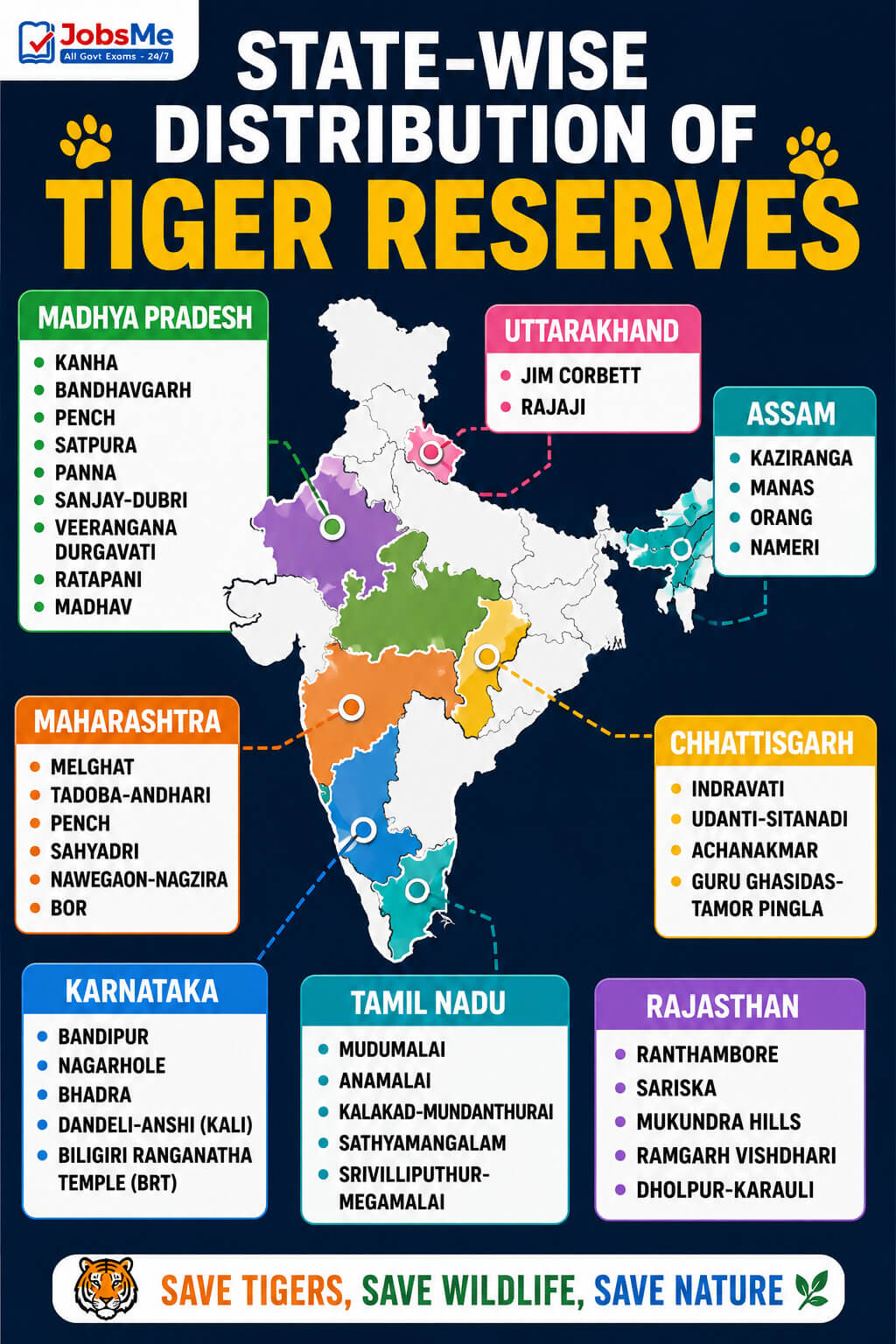
Map-based and matching questions are common, so it helps to remember which states lead the count and which famous reserves belong to them.
| State | Notable Tiger Reserves | Key Details |
|---|---|---|
| Madhya Pradesh | Kanha, Bandhavgarh, Pench, Satpura, Panna, Sanjay-Dubri, Veerangana Durgavati, Ratapani, Madhav | Has the most reserves (9) and the highest tiger population (785); rightly called the "Tiger State of India." |
| Maharashtra | Melghat, Tadoba-Andhari, Pench, Sahyadri, Nawegaon-Nagzira, Bor | Six reserves, mostly in the Vidarbha region; includes Bor, the smallest tiger reserve in India. |
| Karnataka | Bandipur, Nagarhole, Bhadra, Dandeli-Anshi (Kali), Biligiri Ranganatha Temple (BRT) | Five reserves with very high tiger densities; second-highest tiger population in India; Nagarhole is famous for black panther sightings. |
| Tamil Nadu | Mudumalai, Anamalai, Kalakad-Mundanthurai, Sathyamangalam, Srivilliputhur-Megamalai | Five reserves across the Western Ghats and Eastern Ghats; rich biodiversity and elephant corridors. |
| Rajasthan | Ranthambore, Sariska, Mukundra Hills, Ramgarh Vishdhari, Dholpur-Karauli | Five reserves; Sariska is known for tiger reintroduction; mining around Sariska was halted by the Supreme Court. |
| Uttarakhand | Jim Corbett, Rajaji | Corbett is the first reserve and holds the most tigers; Uttarakhand has the third-highest tiger population. |
| Assam | Kaziranga, Manas, Orang, Nameri | Kaziranga uniquely shares a tiger-rhino habitat; Manas is a UNESCO World Heritage Site. |
| Chhattisgarh | Indravati, Udanti-Sitanadi, Achanakmar, Guru Ghasidas-Tamor Pingla | Central Indian tiger landscape; provides corridors connecting Madhya Pradesh and Jharkhand. |
Memory Tricks and Mnemonics
The following tricks make it easy to recall the most frequently tested facts about Tiger Reserves.
Trick 1: Project Tiger Year - "Teen-Saath-Teen"
Project Tiger started in 1973. Remember "1973 = 19 + 73", the same year the tiger became the National Animal. Two big events, one easy year.
Trick 2: Largest vs Smallest - "Big Naga, Tiny Bor"
The largest is Nagarjunsagar-Srisailam (think "Naga = Naga big") and the smallest is Bor (think "Bor = bore, too small to be interesting").
- Naga is the giant, Bor is the dwarf.
Trick 3: First Reserve - "Corbett comes first"
Alphabetically and historically, Jim Corbett comes first. "C for Corbett, C for the commencement of Project Tiger."
Trick 4: Tiger State - "MP = Most Parks"
Madhya Pradesh has the most reserves (9) and the most tigers (785). "MP = Most Parks and Most Pugmarks."
Trick 5: Newest Two - "Ratapani Reads, Madhav Mends"
Ratapani (57th) contains the Bhimbetka rock shelters ("Ratapani = Reading ancient rock art"), while Madhav (58th) mends the corridor between Ranthambore and Central India.
Trick 6: Four Big Cats - "Namdapha = Number-one for cats"
Only Namdapha in Arunachal Pradesh hosts all four big cats. "Namdapha has the Number of all four: Tiger, Leopard, Snow Leopard, Clouded Leopard."
Trick 7: Census Numbers Ladder - "Climbing tigers"
The tiger count keeps climbing: 1411 (2006) to 1706 (2010) to 2226 (2014) to 2967 (2018) to 3682 (2022). Remember the steady upward staircase.
Additional Notes
Frequently Confused Facts
- Largest by area vs Most tigers: The largest reserve by area is Nagarjunsagar-Srisailam, but the reserve with the most tigers is Jim Corbett. They are not the same.
- First Tiger Reserve vs First National Park: Jim Corbett is both India's first national park (1936, as Hailey National Park) and the first Project Tiger reserve (1973) - but the question wording matters.
- 57th vs 58th: Ratapani is the 57th (Dec 2024) and Madhav is the 58th (March 2025) - both are in Madhya Pradesh, which causes confusion.
- Tiger Reserve vs National Park: A Tiger Reserve has a core-buffer structure created specifically for tigers, while a National Park may protect a broader range of species.
- NTCA vs WII: NTCA is the managing statutory authority; the Wildlife Institute of India (WII) is the technical partner that helps conduct the census.
Repeating PYQ Patterns
- UPSC Prelims: Tends to ask conceptual or map-based questions - which reserve links the Eastern and Western Ghats, which has the largest Critical Tiger Habitat, or statements on NTCA and the Wildlife Protection Act.
- SSC and Railways: Prefer direct factual matching - largest, smallest, first reserve, Tiger State, and the newest reserve.
- Banking and Insurance: Focus on current affairs angles such as the newest notification, the latest census figure, and Project Tiger anniversaries.
Quick Insight
Tiger Reserves are far more than tourist destinations - they are India's biodiversity hubs and natural "water towers," protecting the catchment areas of major rivers such as the Krishna, Ramganga, Periyar and Indravati. The growth from nine reserves in 1973 to 58 today is one of the world's most successful conservation stories, and India's early achievement of the TX2 goal of doubling its tiger population has made its model globally significant. For aspirants, the topic connects environment, ecology, geography and current affairs in a single high-yield package. For more, you can explore the Static GK notes and test yourself with the Static GK Quiz on thejobsme.com.
One-Liners for Quick Revision
- Project Tiger → Launched 1 April 1973 → started with nine reserves to protect the Bengal Tiger.
- Bengal Tiger → National Animal of India → declared in 1973; Endangered on the IUCN Red List.
- Total Tiger Reserves (2026) → 58 reserves across 18 states → about 2.3% of India's land area.
- Governing Law → Wildlife (Protection) Act, 1972 → tigers under Schedule I.
- NTCA → National Tiger Conservation Authority → statutory body set up in 2005-06 under MoEFCC.
- M-STrIPES → Tiger monitoring software → launched 2010, uses GPS and remote sensing.
- Tiger Census 2022 → 3,682 tigers → up from 2,967 in 2018.
- St. Petersburg Declaration → 2010, 13 tiger range nations → TX2 goal to double tigers by 2022.
- First Tiger Reserve → Jim Corbett (Uttarakhand) → established 1973 under Project Tiger.
- Largest Tiger Reserve → Nagarjunsagar-Srisailam (Andhra Pradesh and Telangana) → about 3,296 sq km in the Nallamala Hills.
- Smallest Tiger Reserve → Bor (Maharashtra) → about 138 sq km.
- Most Tigers in a Reserve → Jim Corbett (Uttarakhand) → around 231 tigers.
- State with Most Reserves → Madhya Pradesh → 9 reserves, the "Tiger State of India."
- State with Most Tigers → Madhya Pradesh → 785 tigers (2022 census).
- 58th Tiger Reserve → Madhav (Madhya Pradesh) → declared March 2025, Shivpuri district.
- 57th Tiger Reserve → Ratapani (Madhya Pradesh) → declared December 2024, includes Bhimbetka rock shelters.
- 56th Tiger Reserve → Guru Ghasidas-Tamor Pingla (Chhattisgarh) → MP-Jharkhand corridor.
- 55th Tiger Reserve → Dholpur-Karauli (Rajasthan) → Aravalli Range, Ranthambore spillover.
- 54th Tiger Reserve → Veerangana Durgavati (Madhya Pradesh) → links Panna and Nauradehi landscapes.
- 53rd Tiger Reserve → Ranipur (Uttar Pradesh) → Chitrakoot district.
- Four Big Cats Reserve → Namdapha (Arunachal Pradesh) → Tiger, Leopard, Snow Leopard, Clouded Leopard.
- UNESCO Heritage Reserves → Sundarbans, Manas, Kaziranga → also World Heritage Sites.
- Sundarbans → West Bengal → world's largest mangrove, swimming tigers.
- Kanha → Madhya Pradesh → inspired "The Jungle Book"; home of the barasingha.
- Kaziranga → Assam → shares a tiger-rhino habitat.
- Sariska → Rajasthan → famous for tiger reintroduction; Supreme Court halted nearby mining.
- Nagarhole → Karnataka → known for black panther sightings.
- Original Nine (1973-74) → Corbett, Bandipur, Kanha, Manas, Melghat, Palamau, Ranthambore, Simlipal, Sundarbans.
For more Static GK topics like national parks, biosphere reserves, and important rivers, explore the Static GK section on thejobsme.com. You can also test your knowledge with the Daily Current Affairs Quiz and check out the latest exam updates at Latest Government Job Notifications.
Free quiz • No signup required
Put this topic into practice with Indian Cultural Institutions – Static GK MCQ Quiz. It is the quickest way to reinforce what you just learned.
Frequently Asked Questions
How many tiger reserves are there in India in 2026?
Which is the first tiger reserve in India?
Which is the largest tiger reserve in India?
Which is the smallest tiger reserve in India?
Which state has the highest number of tiger reserves in India?
Which is the newest tiger reserve in India?
What is the difference between the 57th and 58th tiger reserves?
Which body manages tiger reserves in India?
How many tigers are there in India as per the latest census?
Which tiger reserve is home to all four big cats?

About the author