World Currencies Static GK: Strongest, Lowest and Replaced Currencies of the World
This article covers the complete World Currencies Static GK topic for competitive exams: the strongest currencies of the world led by the Kuwaiti Dinar, the lowest-valued currencies such as the Iranian Rial and Lebanese Pound, and the long list of currencies that have been replaced or redenominated, including all national currencies replaced by the Euro. It also explains currency pegs, redenomination reforms, and the currencies that were replaced in Indian monetary history. Exam-ready tables, memory tricks, PYQ patterns and one-liners are included so that aspirants can revise the entire topic in one sitting.
Jump to section
Introduction
Questions on world currencies appear in almost every competitive examination in India. In SSC CGL, SSC CHSL, RRB NTPC and Group D, the questions are usually direct country-currency matching. In IBPS PO, IBPS Clerk, SBI PO and Insurance exams, the same topic is asked as Banking Awareness or General Awareness, often linked to currency pegs, central banks and recent monetary reforms. In UPSC Prelims and State PCS examinations, the topic appears indirectly through questions on the Eurozone, reserve currencies, the IMF Special Drawing Rights basket and de-dollarisation.
The topic has three clear parts, and confusion between them is the single biggest reason students lose marks. The first part is the strongest currencies, meaning currencies with the highest exchange value against the US Dollar. The second is the lowest-valued or weakest currencies, meaning currencies that need the largest number of units to buy one US Dollar. The third is replaced currencies, meaning currencies that have been withdrawn and substituted by a new currency, either through a monetary union such as the Euro, or through a redenomination such as the removal of zeros from the Turkish Lira.
All exchange values in this article are approximate and rounded, calculated against the US Dollar and the Indian Rupee as of late July 2026, when one US Dollar was worth roughly 95.5 Indian Rupees. Exchange rates move daily, so examinations almost never ask for exact decimals. What is actually asked is the ranking, the country, the central bank, the peg and the reform year. Aspirants who want to build a broader base on this subject should study this topic along with the other high-yield chapters in our Static GK notes collection, and revise monetary policy terms from the Banking Awareness study material.
Core Concept Explanation
Before memorising lists, an aspirant must be clear about what the words strongest, weakest and replaced actually mean in an examination context. A currency that is high in value is not automatically important, and a currency that is low in value does not automatically belong to a failed economy.
What "Strongest Currency" Means
The strongest currency is the currency that has the highest value per unit when compared against a global benchmark, normally the US Dollar. If one unit of a currency buys more than one US Dollar, that currency is nominally stronger than the dollar. This is called nominal exchange value, and it is the measure used in every standard ranking list.
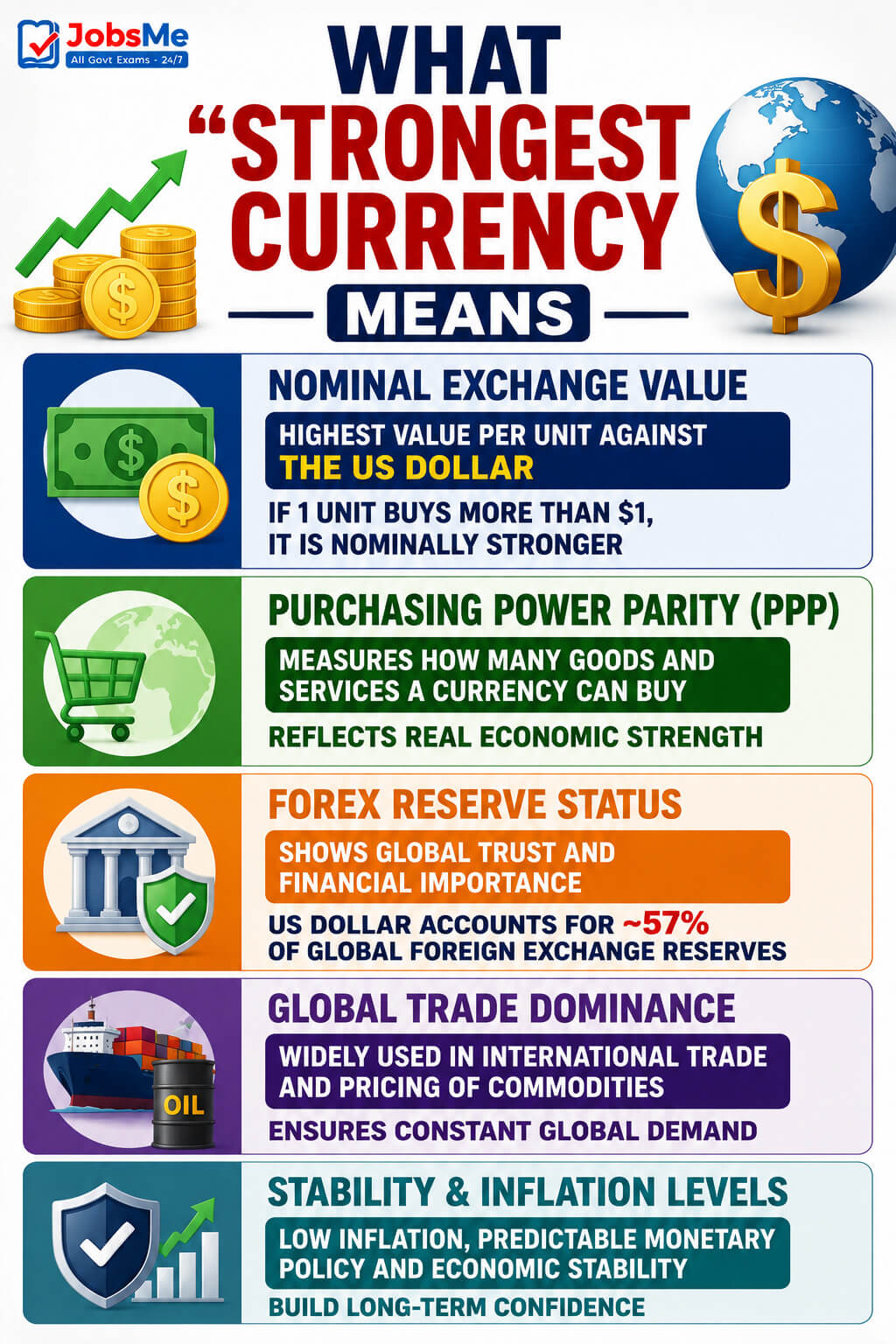
However, exchange value is only one of several ways to measure strength. The other recognised measures are:
- Purchasing Power Parity (PPP): It measures how many goods and services a currency can actually buy inside its own country, which reflects real economic strength rather than only the market price.
- Forex reserve status: When central banks across the world hold a currency as part of their reserves, it shows global trust and financial importance. The US Dollar accounts for roughly 57 per cent of global foreign exchange reserves.
- Global trade dominance: Currencies used frequently in international trade and in the pricing of commodities such as crude oil enjoy constant global demand, which supports their importance.
- Stability and inflation levels: Low inflation, predictable monetary policy and economic stability strengthen long-term confidence in a currency.
Therefore the truly important currencies are those that combine high exchange value, purchasing power, global acceptance and stability. This is why the US Dollar remains the world's most important currency even though it ranks only ninth or tenth by nominal value.
What "Lowest" or "Weakest Currency" Means
The lowest-valued currency is the one that needs the largest number of units to buy one US Dollar. Weakness in a currency usually indicates hyperinflation, sanctions, banking collapse, weak foreign exchange reserves or political instability. But there is an important exception. Some currencies have a very low face value simply because of old inflation that was never corrected by a redenomination, or because of a deliberate export-friendly exchange rate policy. The Vietnamese Dong is the classic example: it is among the lowest-valued currencies in the world, yet Vietnam is a fast-growing manufacturing economy.
What "Replaced Currency" Means
A currency is described as replaced when it stops being legal tender and another currency takes its place. There are four distinct routes, and examinations test the difference between them:
- Monetary union: A country gives up its national currency and adopts a shared currency. Example: Germany replaced the Deutsche Mark with the Euro.
- Redenomination: The same currency continues but zeros are removed to simplify accounting. Example: Turkey removed six zeros in 2005. A redenomination is not a devaluation, because the purchasing power of the money does not change on the day of conversion.
- Full replacement by a new national currency: A discredited currency is scrapped and a new one is created. Example: Zimbabwe replaced the Zimbabwe Dollar with Zimbabwe Gold (ZiG) in April 2024.
- Dollarisation: A country abandons its own currency and adopts a foreign currency. Example: Ecuador replaced the sucre with the US Dollar in 2000.
Strongest Currencies in the World
The list of the strongest currencies in the world is dominated by three groups: Middle Eastern dinars and rials backed by oil and gas revenues, European safe-haven currencies such as the Swiss Franc, and small, tightly managed offshore or territory currencies such as the Cayman Islands Dollar and the Gibraltar Pound.
Top 10 Strongest Currencies of the World
| Rank | Currency (Code) | Country | Approx. Value (1 unit) | Key Features and Exam Points |
|---|---|---|---|---|
| 1 | Kuwaiti Dinar (KWD) | Kuwait | 3.23 USD / 309 INR | Strongest currency in the world by exchange value. Introduced in 1961 replacing the Gulf Rupee; the Central Bank of Kuwait was established in 1968. Pegged to an undisclosed weighted basket of currencies, not to the dollar alone. Divided into 1,000 fils. Backed by vast oil reserves and the sovereign wealth fund managed by the Kuwait Investment Authority. All banknotes were replaced after the 1990 Gulf War to stop misuse of currency looted during the Iraqi invasion. |
| 2 | Bahraini Dinar (BHD) | Bahrain | 2.66 USD / 254 INR | Second strongest currency in the world. Introduced in 1965, replacing the Gulf Rupee at the rate of 10 rupees to 1 dinar. Issued by the Central Bank of Bahrain and fixed to the US Dollar at about 0.376 BHD per dollar since 2001. Divided into 1,000 fils. Strength rests on a large banking and financial services sector plus Gulf Cooperation Council support, but the economy remains oil and gas dependent. |
| 3 | Omani Rial (OMR) | Oman | 2.60 USD / 249 INR | Third strongest currency. Replaced the Gulf Rupee in 1970 as the Saidi Rial and was renamed the Omani Rial in the early 1970s under Sultan Qaboos bin Said. Issued by the Central Bank of Oman and pegged at roughly 2.6008 dollars per rial since 1986, one of the world's longest unchanged pegs. Divided into 1,000 baisa. Despite Oman's modest economic size, the rial stays near the top of the value table because of disciplined monetary management. |
| 4 | Jordanian Dinar (JOD) | Jordan | 1.41 USD / 135 INR | Introduced in 1950, replacing the Palestinian Pound, along with the creation of the Central Bank of Jordan. Pegged to the US Dollar since 1995. Unusual subdivision: 1 dinar equals 10 dirhams, 100 qirsh and 1,000 fils. Jordan has almost no oil, so the dinar's strength comes from foreign aid inflows, remittances and conservative central banking rather than natural resources. |
| 5 | British Pound Sterling (GBP) and Gibraltar Pound (GIP) | United Kingdom / Gibraltar | 1.34 USD / 128 INR | The Gibraltar Pound is pegged 1:1 to the British Pound, so both sit at the same value and are often shown as joint fifth. Sterling is one of the oldest currencies still in use, tracing back to Anglo-Saxon silver pennies, and is issued by the Bank of England, founded in 1694. The symbol comes from the Latin word libra, meaning weight. Gibraltar is a British Overseas Territory, and its pound is not legal tender inside the United Kingdom despite being equal in value. |
| 6 | Swiss Franc (CHF) | Switzerland and Liechtenstein | 1.24 USD / 118 INR | The world's leading safe-haven currency. Introduced in 1850 to standardise the many local and foreign coins then circulating in Switzerland. Issued by the Swiss National Bank. Strength rests on political neutrality, low inflation and a strong banking system. Swiss banknotes are known for their vertical design and advanced security features. Excessive appreciation hurts Swiss exports, so the central bank intervenes frequently. |
| 7 | Cayman Islands Dollar (KYD) | Cayman Islands | 1.20 USD / 115 INR | Currency of a British Overseas Territory and a leading offshore financial hub. Introduced in 1972, replacing the Jamaican Dollar. Issued by the Cayman Islands Monetary Authority and fixed at 1.20 US Dollars per Cayman dollar. Divided into 100 cents, unlike most other high-value currencies. The US Dollar circulates alongside it across the islands. |
| 8 | Euro (EUR) | Eurozone, 21 countries | 1.15 USD / 110 INR | Second most traded currency in the world after the US Dollar and the second largest reserve currency. Launched on 1 January 1999 for electronic and financial market transactions and introduced as physical cash on 1 January 2002. Issued by the European Central Bank together with national central banks. Banknote designs are common across the Eurozone, while coins carry a country-specific national side. Bulgaria became the twenty-first member on 1 January 2026. |
| 9 | United States Dollar (USD) | United States | 1.00 USD / 95.5 INR | The world's primary reserve currency and the benchmark against which all other currencies are measured. Created by the Coinage Act of 1792 and issued by the Federal Reserve System, established in 1913. The dollar is on one side of close to 90 per cent of all global foreign exchange transactions and is used as a parallel currency in many countries. Main risks are high public debt and de-dollarisation efforts triggered by the frequent use of dollar-based sanctions. |
| 10 | Singapore Dollar (SGD) and Bruneian Dollar (BND) | Singapore / Brunei | 0.78 USD / 74.5 INR | Both are interchangeable at par under the Currency Interchangeability Agreement, a rare arrangement in the world, so they share the same value. The Singapore Dollar was introduced in 1967 after separation from Malaysia and is managed by the Monetary Authority of Singapore, which uniquely uses the exchange rate rather than the interest rate as its main policy tool. The Bruneian Dollar, also introduced in 1967 replacing the Malaya and British Borneo Dollar, is issued by Autoriti Monetari Brunei Darussalam and is backed by oil and gas wealth. |
Ranks one to four are stable and are the only ones examinations normally ask about. Positions five to ten can swap places by a few decimal points because the Pound, Franc and Euro float in the market while the Cayman dollar peg is fixed. The examination-safe fact is simply that the Kuwaiti Dinar is the strongest currency in the world, followed by the Bahraini Dinar and the Omani Rial.
Other High-Value and Widely Traded Currencies
| Currency (Code) | Country | Central Bank | Approx. Value in USD | Key Features and Exam Points |
|---|---|---|---|---|
| Canadian Dollar (CAD) | Canada | Bank of Canada | 0.71 | Nicknamed the Loonie after the loon bird on the one-dollar coin. Introduced in 1858, replacing the Canadian Pound to align with the US Dollar. A commodity currency that moves closely with crude oil prices and with the US economy. |
| Australian Dollar (AUD) | Australia | Reserve Bank of Australia | 0.70 | Introduced in 1966, replacing the Australian Pound when the country shifted to a decimal system. One of the first currencies in the world to adopt polymer banknotes. Backed by iron ore, coal and gold exports and treated by traders as a proxy for global growth and Chinese demand. |
| New Zealand Dollar (NZD) | New Zealand | Reserve Bank of New Zealand | 0.59 | Nicknamed the Kiwi after the national bird. Introduced in 1967, replacing the New Zealand Pound. New Zealand was the world's pioneer of formal inflation targeting, a framework later copied by central banks worldwide, including the RBI. |
| Bulgarian Lev (BGN) - retired | Bulgaria | Bulgarian National Bank | 0.59 (fixed conversion value) | Introduced in 1881 after independence from the Ottoman Empire and redenominated in 1999, when it was pegged first to the Deutsche Mark and then to the Euro under a strict currency board. The word lev means lion. It ceased to be legal tender on 1 February 2026 after Bulgaria adopted the Euro, ending about 146 years of use. |
| Fijian Dollar (FJD) | Fiji | Reserve Bank of Fiji | 0.45 | Introduced in 1969, replacing the Fijian Pound. Managed against a basket of major currencies rather than a single currency. Supported by tourism and remittances but vulnerable to cyclones and climate risk. Uses polymer notes suited to tropical humidity. |
| Israeli New Shekel (ILS) | Israel | Bank of Israel | 0.33 | Introduced in 1985 to replace the old shekel during an emergency stabilisation programme that ended hyperinflation, at the rate of 1,000 old shekels to 1 new shekel. Named after an ancient biblical unit of weight. Supported by a strong technology and startup economy but sensitive to regional conflict. |
| Qatari Riyal (QAR) | Qatar | Qatar Central Bank | 0.275 | Introduced in 1973, replacing the Qatar and Dubai Riyal after full independence. Pegged to the US Dollar since 2001. Backed by the world's largest liquefied natural gas export revenues and a large sovereign wealth fund. |
| UAE Dirham (AED) | United Arab Emirates | Central Bank of the UAE | 0.272 | Introduced in 1973, replacing the Qatar and Dubai Riyal after the formation of the UAE. Pegged to the US Dollar since 1997. Unlike other Gulf currencies, its stability is supported not only by oil but also by tourism, logistics and finance, making it the most widely used currency in the Gulf region. |
| Saudi Riyal (SAR) | Saudi Arabia | Saudi Central Bank (SAMA) | 0.267 | Traced to 1925 and restructured under later monetary reforms. Fixed at about 3.75 riyals per US Dollar since 1986, unchanged for nearly four decades even through Vision 2030 reforms. Since global oil is priced in dollars, this fixed rate is central to Saudi trade confidence. |
| Danish Krone (DKK) | Denmark | Danmarks Nationalbank | 0.154 | Introduced in 1875, replacing the rigsdaler after Denmark joined the Scandinavian Monetary Union. Denmark is an EU member that has voted twice to keep its own currency, and the krone is held in a very narrow band against the Euro under ERM II. |
| Chinese Yuan Renminbi (CNY) | China | People's Bank of China | 0.148 | Introduced in 1948 by the People's Bank of China to unify the monetary system. Renminbi is the name of the currency and yuan is the unit of account. Added to the IMF Special Drawing Rights basket in 2016. China was the first major economy to actively promote a central bank digital currency, the digital yuan or e-CNY. Capital controls limit full convertibility. |
| Hong Kong Dollar (HKD) | Hong Kong | Hong Kong Monetary Authority | 0.128 | Launched in 1863, among the oldest modern currencies in Asia. Held under the Linked Exchange Rate System pegged to the US Dollar since 1983, maintained through every major crisis since. Rare feature: banknotes are issued by three commercial banks rather than by a single central bank. |
| Norwegian Krone (NOK) | Norway | Norges Bank | 0.105 | Introduced in 1875 after Norway joined the Scandinavian Monetary Union. Unlike most European currencies it is free-floating. Backed by oil and gas and by the Government Pension Fund Global, one of the world's largest sovereign wealth funds, yet it remains volatile because it tracks commodity cycles. |
| Swedish Krona (SEK) | Sweden | Sveriges Riksbank | 0.105 | Introduced in 1873, replacing the riksdaler. Sveriges Riksbank, founded in 1668, is the oldest central bank in the world. Sweden is an EU member that retained the krona and is one of the most cashless societies on earth. |
| Turkish Lira (TRY) | Turkey | Central Bank of the Republic of Turkey | 0.021 | First introduced in 1923 after the Republic was formed, replacing the Ottoman lira. Turkey removed six zeros in 2005 through the New Turkish Lira, later renamed simply the Turkish Lira, and adopted the symbol in 2012. Free-floating, and weakened by high inflation and political influence on monetary policy. |
| Russian Ruble (RUB) | Russia | Central Bank of Russia | 0.0125 | One of the oldest national currencies still in use, with a history reaching back to the 13th century, making it older than both the US Dollar and the modern pound. Redenominated in 1998 by removing three zeros after the post-Soviet financial crisis. Operates on a managed float and is affected by sanctions and capital controls. |
| Japanese Yen (JPY) | Japan | Bank of Japan | 0.0062 | Introduced in 1871 during the Meiji Restoration, replacing the complex feudal-era money system. The third most traded currency in the world after the US Dollar and the Euro, and a recognised safe-haven currency. Long-standing low interest rates make it the favourite funding currency for carry trades. |
| South Korean Won (KRW) | South Korea | Bank of Korea | 0.0007 | Introduced in 1962, replacing the hwan during South Korea's industrialisation reforms. The name shares the same root as yuan and yen, meaning round coin. Free-floating and strongly influenced by semiconductor and electronics exports. |
Currency Pegs Behind the Strongest Currencies
Most of the strongest currencies are strong because of a peg, not because of free market demand. A peg is a commitment by a central bank to hold the currency at a fixed value against another currency or a basket. Pegged years are frequently asked in Banking Awareness sections.
| Currency | Type of Peg | Anchor | In Force Since |
|---|---|---|---|
| Kuwaiti Dinar | Basket peg | Undisclosed weighted basket of currencies | Reintroduced in 2007 after an earlier dollar-only peg |
| Omani Rial | Fixed peg | US Dollar | 1986 |
| Saudi Riyal | Fixed peg | US Dollar | 1986 |
| Jordanian Dinar | Fixed peg | US Dollar | 1995 |
| UAE Dirham | Fixed peg | US Dollar | 1997 |
| Bahraini Dinar | Fixed peg | US Dollar | 2001 |
| Qatari Riyal | Fixed peg | US Dollar | 2001 |
| Hong Kong Dollar | Linked Exchange Rate System | US Dollar | 1983 |
| Cayman Islands Dollar | Fixed peg | US Dollar at 1.20 | Since the 1970s |
| Gibraltar Pound | Par peg, 1:1 | British Pound Sterling | Long-standing |
| Bruneian Dollar | Interchangeability at par, 1:1 | Singapore Dollar | 1967 |
| Danish Krone | Narrow band under ERM II | Euro | 1999 |
| Singapore Dollar | Managed float against a basket | Trade-weighted basket | Managed by MAS |
| Fijian Dollar | Managed against a basket | Basket of major currencies | Managed by RBF |
Lowest-Valued Currencies in the World
The lowest-valued currencies need thousands, and in one case more than a million, units to buy a single US Dollar. In 2026 the ranking depends on which exchange rate is used, and this is exactly where examination questions become tricky. By official or central bank rates the Lebanese Pound has long been quoted as the weakest. By open-market or parallel rates, the Iranian Rial is by a wide margin the lowest-valued currency in the world, since open-market quotes crossed one million rials per dollar during 2025 and moved well beyond that level through 2026.
| Rank | Currency | Country | Code | Approx. Units per 1 USD | Primary Reasons for Weakness |
|---|---|---|---|---|---|
| 1 | Iranian Rial | Iran | IRR | Above 1,200,000 on reference rates and higher on open-market quotes | Long-running international sanctions, reimposition of United Nations sanctions through the snapback mechanism, inflation running far above 40 per cent, restricted access to oil revenues and a wide gap between official and parallel market rates. Iran has approved removal of four zeros from the rial. |
| 2 | Lebanese Pound | Lebanon | LBP | About 89,500 | Was fixed near 1,507.50 per dollar for more than 25 years until the 2019 financial crisis. Then came banking collapse, sovereign default, capital controls and hyperinflation, wiping out more than 98 per cent of its pre-crisis value before the rate was unified at the current level. |
| 3 | Vietnamese Dong | Vietnam | VND | About 26,000 | Not a crisis currency. The low value reflects a deliberately managed, undervalued exchange rate that supports Vietnam's export-driven manufacturing model, combined with decades of old inflation never corrected by redenomination. |
| 4 | Laotian Kip | Laos | LAK | About 22,000 | Heavy external debt, fiscal stress, very low foreign exchange reserves and imported inflation. |
| 5 | Sierra Leonean Leone | Sierra Leone | SLE (earlier SLL) | About 24 new leones, equal to about 24,000 old leones | Persistent inflation, governance challenges and external debt. Sierra Leone redenominated in 2022, removing three zeros, so the old code SLL and the new code SLE both appear in exam material. |
| 6 | Indonesian Rupiah | Indonesia | IDR | About 18,000 | Capital outflows, inflation pressure and a low face value inherited from the Asian financial crisis era. Indonesia remains a large G20 economy despite the low nominal value. |
| 7 | Uzbekistani Som | Uzbekistan | UZS | About 12,000 | Adjustment after major currency liberalisation reforms that ended earlier exchange controls. |
| 8 | Guinean Franc | Guinea | GNF | About 8,800 | Heavy dependence on bauxite and other commodities, high inflation and limited economic diversification. |
| 9 | Paraguayan Guarani | Paraguay | PYG | About 6,000 | Current account pressure and historic inflation. The guarani is named after the indigenous Guarani people and language. |
| 10 | Malagasy Ariary | Madagascar | MGA | About 4,300 | Economic instability, cyclone and climate shocks and a weak policy framework. Rare feature: the ariary is one of only two world currencies not based on a decimal division, being divided into five iraimbilanja. |
Several ranking lists also include the Cambodian Riel, at roughly 4,000 per US Dollar, just outside the standard top ten. Aspirants should treat the top three as fixed for examination purposes and the rest as an approximate group.
Replaced Currencies of the World
This is the highest-scoring part of the topic in current affairs sections, because currency replacement is a dated event that can be asked as a one-mark question. Candidates preparing this section should also track monthly monetary news through our Daily Current Affairs updates.
National Currencies Replaced by the Euro
The Euro replaced national currencies at fixed and irrevocable conversion rates decided by the Council of the European Union. These rates never change, which makes them permanent Static GK facts. The Eurozone now has 21 member countries.
| Country | Currency Replaced | Fixed Conversion Rate for 1 Euro | Year of Euro Adoption |
|---|---|---|---|
| Germany | Deutsche Mark | 1.95583 | 1999 |
| France | French Franc | 6.55957 | 1999 |
| Italy | Italian Lira | 1,936.27 | 1999 |
| Spain | Spanish Peseta | 166.386 | 1999 |
| Netherlands | Dutch Guilder | 2.20371 | 1999 |
| Belgium | Belgian Franc | 40.3399 | 1999 |
| Luxembourg | Luxembourg Franc | 40.3399 | 1999 |
| Austria | Austrian Schilling | 13.7603 | 1999 |
| Portugal | Portuguese Escudo | 200.482 | 1999 |
| Finland | Finnish Markka | 5.94573 | 1999 |
| Ireland | Irish Pound or Punt | 0.787564 | 1999 |
| Greece | Greek Drachma | 340.750 | 2001 |
| Slovenia | Slovenian Tolar | 239.640 | 2007 |
| Cyprus | Cyprus Pound | 0.585274 | 2008 |
| Malta | Maltese Lira | 0.429300 | 2008 |
| Slovakia | Slovak Koruna | 30.1260 | 2009 |
| Estonia | Estonian Kroon | 15.6466 | 2011 |
| Latvia | Latvian Lats | 0.702804 | 2014 |
| Lithuania | Lithuanian Litas | 3.45280 | 2015 |
| Croatia | Croatian Kuna | 7.53450 | 2023 |
| Bulgaria | Bulgarian Lev | 1.95583 | 2026 |
Bulgaria's euro entry is the most important current affairs point in this topic. The Council of the European Union approved it on 8 July 2025. The Euro became Bulgaria's currency on 1 January 2026, the lev and the Euro circulated together for cash payments during January 2026, and from 1 February 2026 the Euro became the sole legal tender. Bulgaria is therefore the 21st member of the Eurozone, and Croatia in 2023 was the previous entrant.
Six European Union member states still do not use the Euro: Denmark, Sweden, Poland, Hungary, Czechia and Romania. Denmark has an opt-out and has rejected the Euro in two referendums, while Sweden retained the krona despite having no formal opt-out.
Currencies Replaced or Reformed Outside Europe
| Country | Change | Year | What Actually Happened |
|---|---|---|---|
| Turkey | Turkish Lira to New Turkish Lira and back to Turkish Lira | 2005 | Removed six zeros, so one million old lira became one new lira. The aim was simpler accounting and restored confidence after years of high inflation. The name reverted to Turkish Lira and the symbol was adopted in 2012. |
| Zimbabwe | Zimbabwe Dollar (ZWL) to Zimbabwe Gold (ZiG, code ZWG) | April 2024 | Announced by the Reserve Bank of Zimbabwe on 5 April 2024. A structured currency backed by about 2.5 tonnes of gold plus foreign currency reserves. It is Zimbabwe's sixth attempt since 2009 to establish a working local currency, and the government aims to make it the sole legal tender by 2030. An upgraded banknote series was launched in April 2026. |
| Iran | Rial redenomination | Approved 2025, rollout from 2026 | Parliament approved removal of four zeros, so 10,000 old rials equal one new rial, with a new subunit called the qeran at one hundredth of a rial. Notably, the earlier proposal to rename the currency the toman was dropped and the name rial was retained. Old and new rials will circulate together during a transition period of up to three years. |
| Sierra Leone | Old Leone (SLL) to new Leone (SLE) | 2022 | Removed three zeros, so 1,000 old leones became one new leone. Both codes still appear in data sources, which is why the currency's quoted value differs across websites. |
| Venezuela | Bolivar Soberano to Bolivar Digital | 2021 | Removed six zeros, following an earlier redenomination in 2018. One of the most extreme cases of hyperinflation in modern history. |
| Russia | Ruble redenomination | 1998 | Removed three zeros to stabilise the currency after the post-Soviet financial crisis. |
| Israel | Old Shekel to New Shekel | 1985 | 1,000 old shekels became one new shekel as part of a stabilisation programme that successfully ended hyperinflation, making the new shekel a symbol of economic reform. |
| Ecuador | Sucre replaced by the US Dollar | 2000 | A case of full dollarisation, where the country abandoned its own currency after a banking crisis. |
| El Salvador | Colon replaced by the US Dollar | 2001 | Also fully dollarised. In 2021 it additionally became the first country to adopt Bitcoin as legal tender, but in January 2025 the law was amended under an IMF programme so that acceptance by businesses is voluntary and taxes can no longer be paid in Bitcoin. |
| Central African Republic | Bitcoin recognition withdrawn | 2023 | Briefly recognised Bitcoin as legal tender in 2022 and revoked that status in 2023. The country continues to use the CFA Franc. |
Predecessor Currencies of Today's Major Currencies

Examinations often ask which currency came before the present one. This table collects every such pair from the strongest-currency list.
| Present Currency | Currency It Replaced | Year |
|---|---|---|
| Kuwaiti Dinar | Gulf Rupee | 1961 |
| Bahraini Dinar | Gulf Rupee | 1965 |
| Omani Rial | Gulf Rupee, then the Saidi Rial | 1970 |
| Jordanian Dinar | Palestinian Pound | 1950 |
| Cayman Islands Dollar | Jamaican Dollar | 1972 |
| Bruneian Dollar | Malaya and British Borneo Dollar | 1967 |
| Canadian Dollar | Canadian Pound | 1858 |
| Australian Dollar | Australian Pound | 1966 |
| New Zealand Dollar | New Zealand Pound | 1967 |
| Fijian Dollar | Fijian Pound | 1969 |
| Israeli New Shekel | Old Shekel | 1985 |
| Danish Krone | Rigsdaler | 1875 |
| Swedish Krona | Riksdaler | 1873 |
| UAE Dirham | Qatar and Dubai Riyal | 1973 |
| Qatari Riyal | Qatar and Dubai Riyal | 1973 |
| South Korean Won | Hwan | 1962 |
| Turkish Lira | Ottoman Lira | 1923 |
| Japanese Yen | Feudal-era Tokugawa currency system | 1871 |
| Swiss Franc | Assorted local cantonal and foreign coins | 1850 |
| Zimbabwe Dollar | Rhodesian Dollar | 1980 |
India Connection: Currencies Replaced in Indian Monetary History
Indian examinations reward candidates who can link a world topic back to India. The Gulf link is the most important one here.
- Gulf Rupee: Issued by the Reserve Bank of India from 1959 for circulation in the Gulf states and Oman, so that gold smuggling would not drain Indian rupee reserves. After India devalued the rupee in 1966, the Gulf states moved to their own currencies, which is why the Kuwaiti Dinar, Bahraini Dinar and Omani Rial all trace their origins to a currency issued by the RBI.
- Decimalisation of the Indian Rupee: In 1957 India replaced the old system of 16 annas and 64 paise to the rupee with 100 naye paise to the rupee.
- Hyderabadi Rupee: The currency of the princely state of Hyderabad, the last of the parallel Indian princely currencies, withdrawn after integration.
- Portuguese Indian Escudo: Circulated in Goa, Daman and Diu until the territories were integrated into India in 1961, after which the Indian Rupee replaced it.
- Demonetisation of 2016: The 500 and 1,000 rupee notes ceased to be legal tender on 8 November 2016 and were replaced by new 500 and 2,000 rupee notes.
- Withdrawal of the 2,000 rupee note: The RBI withdrew it from circulation in May 2023 under its clean note policy. Importantly, it remains legal tender and was not demonetised.
- Digital Rupee: The RBI launched pilots of the e-rupee, India's central bank digital currency, for the wholesale segment in November 2022 and for the retail segment in December 2022. A CBDC supplements cash rather than replacing a currency.
Memory Tricks and Mnemonics
Trick 1: Remember the Top Four with One Sentence
The four strongest currencies are all from West Asia and all begin the alphabet neatly.
- "Kuwait Buys Oman's Jewels" gives you Kuwaiti Dinar, Bahraini Dinar, Omani Rial, Jordanian Dinar in exact order.
- Extra hook: three of the four are dinars, and the only rial among them belongs to Oman.
Trick 2: The Thousand Club
Most world currencies are divided into 100 subunits, but the strongest ones are divided into 1,000.
- Kuwaiti Dinar and Bahraini Dinar are divided into 1,000 fils.
- Omani Rial is divided into 1,000 baisa.
- "The stronger the currency, the more pieces it breaks into."
- Contrast hook: the high-value Cayman Islands Dollar uses only 100 cents, so it does not join the thousand club.
Trick 3: The 1.95583 Twins
This single number answers two different questions.
- 1 Euro equalled 1.95583 Deutsche Mark in 1999.
- 1 Euro equals 1.95583 Bulgarian Lev in 2026.
- "Germany opened the Euro and Bulgaria closed the queue, at the very same number."
- Reason to remember: the lev was pegged to the Deutsche Mark before being pegged to the Euro, so it inherited the same rate.
Trick 4: Rial Versus Riyal Versus Dinar Versus Dirham
Spelling questions are common in SSC and Railways papers.
- Rial without the letter y belongs to Oman and Iran.
- Riyal with the letter y belongs to Saudi Arabia and Qatar.
- Dinar belongs to Kuwait, Bahrain, Jordan, Iraq, Libya, Tunisia, Algeria and Serbia.
- Dirham belongs to the UAE and Morocco.
- "Yes to Saudi, no to Oman" fixes the y.
Trick 5: The Lassi Mnemonic for the Ten Lowest Currencies
Take the first letters of the ten weakest currencies in order: Iran, Lebanon, Vietnam, Sierra Leone, Laos, Indonesia, Uzbekistan, Guinea, Paraguay, Madagascar.
- "I Love Very Sweet Lassi In Ujjain, Goa, Pune, Madurai."
- Remember that the first two are the crisis cases and Vietnam is the odd one out, because the dong is low by policy design and not by economic collapse.
Trick 6: The Zero Counter
Redenomination questions always ask how many zeros were removed. Group them by number.
- Six zeros: Turkey in 2005 and Venezuela in 2021. "Six for the two big inflation stories."
- Four zeros: Iran, approved in 2025. "Iran is four, and the new coin is the qeran."
- Three zeros: Israel in 1985, Russia in 1998 and Sierra Leone in 2022. "Israel, Russia, Sierra Leone: three each, spaced thirteen and twenty-four years apart."
Trick 7: The Two One-to-One Twins
Two pairs of currencies always share the same value, and examiners like to ask why.
- Gibraltar Pound and British Pound are pegged at par, but the Gibraltar Pound is not accepted in the United Kingdom.
- Bruneian Dollar and Singapore Dollar are interchangeable at par under the Currency Interchangeability Agreement of 1967, and both are accepted in each other's country.
- "Gibraltar copies the value only. Brunei and Singapore share the wallet."
Trick 8: Nickname Recall
- Loonie is the Canadian Dollar, from the loon bird on the one-dollar coin.
- Kiwi is the New Zealand Dollar, from the national bird.
- Greenback is the US Dollar.
- "Two birds and one green note."
Trick 9: The Oldest Central Bank Ladder
- 1668 Sveriges Riksbank of Sweden, the oldest central bank in the world.
- 1694 Bank of England.
- 1913 Federal Reserve System of the United States.
- 1935 Reserve Bank of India.
- "Sweden, England, America, India: 1668, 1694, 1913, 1935."
Additional Notes
Frequently Confused Facts
- Strongest versus most traded: The Kuwaiti Dinar is the strongest by value, but the US Dollar is the most traded and most held reserve currency. The Euro is second most traded and the Japanese Yen third.
- Weakest by official rate versus open-market rate: By official quotations the Lebanese Pound near 89,500 is often listed first, while by open-market pricing the Iranian Rial above one million is clearly the lowest. Read the question wording carefully.
- Redenomination versus devaluation: Redenomination only removes zeros and does not change purchasing power. Devaluation actually reduces the currency's value against others.
- Renminbi versus yuan: Renminbi is the name of the Chinese currency and yuan is its unit of account, in the same way that sterling is the currency and pound is the unit.
- Krone versus krona: Krone belongs to Denmark and Norway, krona belongs to Sweden and Iceland.
- Euro 1999 versus 2002: The Euro was introduced in 1999 for electronic and accounting use, and physical notes and coins arrived in 2002.
- Eurozone versus European Union: The EU has 27 members but the Eurozone has only 21. Denmark, Sweden, Poland, Hungary, Czechia and Romania are in the EU but outside the Euro.
- Low value does not mean weak economy: The Japanese Yen and South Korean Won have very low unit values but belong to advanced economies. The Vietnamese Dong and Indonesian Rupiah are similar cases.
- Note issuance: Hong Kong is unusual because its banknotes are issued by three commercial banks, not by the monetary authority alone.
- Zimbabwe Gold is not a cryptocurrency: ZiG is a gold-backed fiat currency issued by the Reserve Bank of Zimbabwe, not a digital token.
Repeating PYQ Patterns
- SSC CGL, SSC CHSL, RRB NTPC and RRB Group D: Direct country-currency matching. Highest frequency items are Kuwait, Bahrain, Oman, Saudi Arabia, UAE, Qatar, Japan, China, Thailand, Vietnam, Turkey and Israel. Also asked: which country's currency is the dinar, and which is the strongest currency in the world.
- IBPS PO, IBPS Clerk, SBI PO and SBI Clerk: Currency pegs, reserve currency share, the IMF Special Drawing Rights basket of five currencies, which are the US Dollar, Euro, Chinese Yuan, Japanese Yen and British Pound, with the yuan added in 2016.
- Insurance exams such as LIC AAO and NIACL: Euro adoption news and central bank names, especially the newest Eurozone entrant.
- UPSC Prelims and State PCS: Conceptual questions on currency pegs, currency boards, dollarisation, de-dollarisation, and the difference between nominal exchange rate and purchasing power parity.
- Defence exams such as CDS, AFCAT and NDA: Straight currency matching plus questions on the currency of West Asian countries.
- Interview and descriptive stages: Why an oil-rich small country has a very strong currency, and whether a strong currency is good for a developing economy.
Quick Insight
The 2025 and 2026 news cycle made this a live topic rather than a static one. Bulgaria joined the Eurozone on 1 January 2026 as its 21st member, retiring a currency in use since 1881. Iran cleared a plan to strike four zeros off the rial, with rollout beginning in the Iranian year that started in March 2026. Zimbabwe rolled out an upgraded gold-backed ZiG banknote series in April 2026 as it works towards making ZiG its only legal tender by 2030. At the same time, the debate over de-dollarisation continues, with several countries settling more trade in local currencies, and the RBI expanding rupee-based trade settlement and the e-rupee pilot.
A strong currency is not automatically good news for a country. It makes imports and foreign borrowing cheaper but makes exports less competitive, which is why Switzerland intervenes to hold down the franc and why Vietnam deliberately keeps the dong low. That trade-off is the reasoning-based angle examiners increasingly prefer. To lock these facts in, attempt the timed sets in our Static GK quiz section and check your accuracy on economy and monetary questions in the Banking Awareness quizzes.
One-Liners for Quick Revision
- Strongest currency in the world → Kuwaiti Dinar → about 3.23 US Dollars, pegged to an undisclosed currency basket, divided into 1,000 fils.
- Kuwaiti Dinar history → introduced 1961 replacing the Gulf Rupee → Central Bank of Kuwait set up 1968, all notes replaced after the 1990 Gulf War.
- Second strongest currency → Bahraini Dinar → replaced the Gulf Rupee in 1965 at 10 rupees per dinar, pegged near 0.376 per US Dollar since 2001.
- Third strongest currency → Omani Rial → replaced the Gulf Rupee in 1970, pegged at about 2.6008 dollars since 1986, divided into 1,000 baisa.
- Fourth strongest currency → Jordanian Dinar → replaced the Palestinian Pound in 1950, pegged since 1995, equals 10 dirhams or 100 qirsh or 1,000 fils.
- Gibraltar Pound → pegged 1:1 with the British Pound → not legal tender inside the United Kingdom.
- British Pound Sterling → oldest currency still in use, traced to Anglo-Saxon silver pennies → Bank of England founded 1694, symbol from the Latin libra meaning weight.
- Swiss Franc → introduced 1850, issued by the Swiss National Bank → world's foremost safe-haven currency, currency of Switzerland and Liechtenstein.
- Cayman Islands Dollar → introduced 1972 replacing the Jamaican Dollar → fixed at 1.20 US Dollars, divided into 100 cents, issued by the Cayman Islands Monetary Authority.
- Euro → introduced 1999 electronically and 2002 as cash → currency of 21 countries, issued by the European Central Bank, second most traded currency in the world.
- US Dollar → created by the Coinage Act of 1792, issued by the Federal Reserve since 1913 → world's primary reserve currency at roughly 57 per cent of global reserves.
- Canadian Dollar → nicknamed the Loonie, introduced 1858 replacing the Canadian Pound → commodity currency linked to crude oil, issued by the Bank of Canada.
- Bruneian Dollar → introduced 1967 replacing the Malaya and British Borneo Dollar → interchangeable at par with the Singapore Dollar, issued by Autoriti Monetari Brunei Darussalam.
- Singapore Dollar → introduced 1967 after separation from Malaysia → the Monetary Authority of Singapore uses the exchange rate, not the interest rate, as its main policy tool.
- Australian Dollar → introduced 1966 replacing the Australian Pound → early adopter of polymer notes, issued by the Reserve Bank of Australia.
- New Zealand Dollar → nicknamed the Kiwi, introduced 1967 replacing the New Zealand Pound → New Zealand pioneered inflation targeting.
- Bulgarian Lev → introduced 1881, name means lion → replaced by the Euro on 1 January 2026 at 1.95583 per Euro, ceased to be legal tender on 1 February 2026.
- Fijian Dollar → introduced 1969 replacing the Fijian Pound → managed against a basket of currencies, issued by the Reserve Bank of Fiji.
- Israeli New Shekel → introduced 1985 replacing the old shekel at 1,000 to 1 → ended hyperinflation, named after an ancient unit of weight, issued by the Bank of Israel.
- Hong Kong Dollar → launched 1863, pegged to the US Dollar since 1983 under the Linked Exchange Rate System → notes issued by three commercial banks.
- Danish Krone → introduced 1875 replacing the rigsdaler → held in a narrow band against the Euro under ERM II, Denmark rejected the Euro in two referendums.
- Norwegian Krone → introduced 1875, free-floating, issued by Norges Bank → supported by the Government Pension Fund Global sovereign wealth fund.
- Swedish Krona → introduced 1873 replacing the riksdaler → issued by Sveriges Riksbank, founded 1668 and the world's oldest central bank.
- Saudi Riyal → issued by the Saudi Central Bank, SAMA → fixed at about 3.75 per US Dollar since 1986, unchanged for nearly four decades.
- UAE Dirham → introduced 1973 replacing the Qatar and Dubai Riyal → pegged since 1997, most widely used currency in the Gulf region.
- Qatari Riyal → introduced 1973 replacing the Qatar and Dubai Riyal → pegged since 2001, backed by liquefied natural gas exports.
- Russian Ruble → one of the oldest currencies, dating to the 13th century → redenominated in 1998 by removing three zeros, managed float.
- Chinese Yuan Renminbi → introduced 1948 by the People's Bank of China → added to the IMF Special Drawing Rights basket in 2016, pioneer of the digital yuan e-CNY.
- Turkish Lira → introduced 1923 replacing the Ottoman lira → six zeros removed in 2005, symbol adopted in 2012, free-floating with high inflation.
- South Korean Won → introduced 1962 replacing the hwan → name means round coin, same root as yuan and yen, issued by the Bank of Korea.
- Japanese Yen → introduced 1871 during the Meiji Restoration → third most traded currency, safe haven, favourite carry-trade funding currency.
- Lowest-valued currency by open-market rate → Iranian Rial → above one million per US Dollar due to sanctions and inflation above 40 per cent.
- Lowest-valued currency by official quotation → Lebanese Pound → about 89,500 per US Dollar, was fixed at 1,507.50 before the 2019 crisis.
- Vietnamese Dong → about 26,000 per US Dollar → low by managed export-friendly policy, not by economic collapse.
- Laotian Kip → about 22,000 per US Dollar → weakened by external debt and very low foreign exchange reserves.
- Sierra Leonean Leone → redenominated in 2022 by removing three zeros → old code SLL, new code SLE.
- Indonesian Rupiah → about 18,000 per US Dollar → low face value inherited from the Asian financial crisis, yet Indonesia is a G20 economy.
- Uzbekistani Som → about 12,000 per US Dollar → adjustment after currency liberalisation reforms.
- Guinean Franc → about 8,800 per US Dollar → commodity dependence, mainly bauxite, plus high inflation.
- Paraguayan Guarani → about 6,000 per US Dollar → named after the Guarani people and language.
- Malagasy Ariary → about 4,300 per US Dollar → one of only two non-decimal world currencies, divided into five iraimbilanja.
- Cambodian Riel → about 4,000 per US Dollar → often listed just outside the ten lowest currencies.
- Deutsche Mark → replaced by the Euro in 1999 at 1.95583 per Euro → same rate as the Bulgarian Lev in 2026.
- Italian Lira → replaced by the Euro in 1999 at 1,936.27 per Euro → the highest conversion figure among founding members.
- French Franc → 6.55957 per Euro, Spanish Peseta → 166.386, Dutch Guilder → 2.20371, all replaced in 1999.
- Belgian Franc and Luxembourg Franc → both 40.3399 per Euro → the only two founding currencies sharing an identical rate.
- Austrian Schilling → 13.7603, Portuguese Escudo → 200.482, Finnish Markka → 5.94573, Irish Punt → 0.787564, all replaced in 1999.
- Greek Drachma → replaced by the Euro in 2001 at 340.750 per Euro → Greece was the twelfth founding-era entrant.
- Slovenian Tolar → 2007 at 239.640, Cyprus Pound → 2008 at 0.585274, Maltese Lira → 2008 at 0.429300.
- Slovak Koruna → 2009 at 30.1260, Estonian Kroon → 2011 at 15.6466, Latvian Lats → 2014 at 0.702804, Lithuanian Litas → 2015 at 3.45280.
- Croatian Kuna → replaced by the Euro on 1 January 2023 at 7.53450 per Euro → Croatia was the twentieth Eurozone member.
- Newest Eurozone member → Bulgaria from 1 January 2026 → approved by the Council of the European Union on 8 July 2025.
- EU members outside the Euro → Denmark, Sweden, Poland, Hungary, Czechia and Romania → six countries in total.
- Zimbabwe Gold, ZiG → launched 5 April 2024 replacing the Zimbabwe Dollar → backed by about 2.5 tonnes of gold, sixth currency attempt since 2009, upgraded note series in April 2026.
- Iran redenomination → four zeros removed, 10,000 old rials equal 1 new rial → new subunit qeran, name toman was rejected, rollout from 2026.
- Venezuela → six zeros removed in 2021 creating the Bolivar Digital → followed an earlier redenomination in 2018.
- Ecuador → replaced the sucre with the US Dollar in 2000 → a case of full dollarisation.
- El Salvador → replaced the colon with the US Dollar in 2001 and adopted Bitcoin in 2021 → Bitcoin acceptance made voluntary in January 2025 under an IMF programme.
- Central African Republic → recognised Bitcoin in 2022 and revoked it in 2023 → continues with the CFA Franc.
- Gulf Rupee → issued by the Reserve Bank of India from 1959 for the Gulf states → withdrawn after India's 1966 devaluation, leading to the Kuwaiti, Bahraini and Omani currencies.
- Indian Rupee decimalisation → 1957 → 16 annas replaced by 100 naye paise.
- Portuguese Indian Escudo → replaced by the Indian Rupee after Goa, Daman and Diu joined India in 1961.
- Indian demonetisation → 8 November 2016 → 500 and 1,000 rupee notes withdrawn, new 500 and 2,000 rupee notes issued.
- 2,000 rupee note → withdrawn from circulation in May 2023 under the clean note policy → still legal tender, not demonetised.
- Digital Rupee, e-rupee → RBI central bank digital currency → wholesale pilot November 2022, retail pilot December 2022.
- IMF Special Drawing Rights basket → five currencies → US Dollar, Euro, Chinese Yuan, Japanese Yen and British Pound.
- Oldest central bank → Sveriges Riksbank, 1668 → followed by the Bank of England in 1694 and the RBI in 1935.
Currency questions rarely appear alone in the examination hall. They come bundled with capitals, central banks and recent economic news, so pair this chapter with the daily updates and then test yourself on the Daily Current Affairs quizzes to convert reading into marks. Aspirants who are still choosing their target examination can review eligibility and vacancy details on the latest government job notifications page and then build a revision plan around it.
Free quiz • No signup required
Put this topic into practice with Indian Cultural Institutions – Static GK MCQ Quiz. It is the quickest way to reinforce what you just learned.
Frequently Asked Questions
Which is the strongest currency in the world?
Which is the lowest-valued currency in the world?
Why is the Kuwaiti Dinar stronger than the US Dollar if the United States has a much bigger economy?
Which country adopted the Euro most recently?
How many European Union countries still do not use the Euro?
What is the difference between redenomination and devaluation?
How many zeros did Turkey and Iran remove from their currencies?
Which currency replaced the Zimbabwe Dollar and what backs it?
Which Indian currency once circulated in the Gulf countries?
Is the Vietnamese Dong low in value because Vietnam has a weak economy?

About the author