Ramsar Sites of India – Complete State-wise List, Static GK & General Awareness for Competitive Exams with Memory Tricks
This article presents a complete, exam-ready guide to the Ramsar Sites of India, covering the Ramsar Convention basics, India's 100 Ramsar Sites (as of June 2026), the state-wise distribution, and the most important wetlands such as Chilika Lake, Keoladeo National Park, Sundarban Wetland, Wular Lake, Sambhar Lake, Loktak Lake, and Vembanad-Kol. It includes the superlatives (largest, smallest, oldest, newest), the Montreux Record sites, the Central Asian Flyway link, memory tricks, frequently confused facts, and one-liners for quick revision. All facts are arranged in a structured format to help UPSC, SSC, IBPS, RRB, PSU, and State PCS aspirants score better in the Environment, Ecology, and General Awareness sections.
Jump to section
Introduction
The Ramsar Sites of India are wetlands of international importance designated under the Ramsar Convention on Wetlands, an intergovernmental treaty signed in the Iranian city of Ramsar on 2 February 1971. These wetlands — ranging from Himalayan high-altitude lakes and coastal mangroves to desert wetlands, bird sanctuaries, and floodplain marshes — are protected for their ecological, biological, hydrological, and environmental significance. Famous examples include Chilika Lake (Odisha), Keoladeo National Park (Rajasthan), Sundarban Wetland (West Bengal), and Loktak Lake (Manipur).
As of June 2026, India has 100 Ramsar Sites, the highest number in Asia and the third highest in the world after the United Kingdom and Mexico. Questions on Ramsar Sites — their names, states, the convention itself, associated species, and superlatives like the largest and smallest sites — appear regularly in UPSC Prelims, SSC CGL, IBPS PO, RRB NTPC, SBI Clerk, State PCS, and various Insurance and Defence exams, especially in the Environment and Ecology and Static GK sections. To explore more such topics, you can refer to the Static GK section on thejobsme.com.
Ramsar Sites are also closely tied to current affairs themes — World Wetlands Day (2 February), new site designations announced by the Ministry of Environment, Forest and Climate Change, the Montreux Record, and the Central Asian Flyway migratory bird programme. This makes the topic doubly important for aspirants preparing for both Prelims matching questions and Mains environment answers. Stay updated on related developments through the Daily Current Affairs page on thejobsme.com.
Core Concepts: The Ramsar Convention and Wetlands
A clear understanding of the Ramsar Convention's basics helps students answer both direct and conceptual questions confidently. The convention is named after the city where it was signed and is also known simply as the Convention on Wetlands.

- Treaty name: Ramsar Convention on Wetlands, also called the Convention on Wetlands.
- Signed: 2 February 1971 at Ramsar, Iran; entered into force in 1975.
- India's entry: India became a contracting party on 1 February 1982.
- World Wetlands Day: Celebrated every year on 2 February, marking the anniversary of the convention's signing.
- Global membership: 172 contracting parties (countries), with more than 2,400 Ramsar Sites worldwide.
- Mission: "Conservation and wise use of all wetlands through local and national actions and international cooperation."
- Selection criteria: A wetland can be declared a Ramsar Site if it meets any one of the nine criteria laid down under the convention.
- World's first Ramsar Site: Cobourg Peninsula, Australia (1974).
An important conceptual point frequently tested is that Ramsar designation does not automatically grant legal protection under Indian law. It is international recognition only. For domestic legal protection, the wetland must be separately notified under the Wildlife Protection Act, 1972 or the Environment Protection Act, 1986. The Indian government's own definition of wetlands, under the Wetlands (Conservation and Management) Rules of 2017, excludes river channels, paddy fields, and areas used for commercial activities.
The Montreux Record
The Montreux Record is a register within the Ramsar Convention that lists wetlands of international importance facing threats or ecological changes due to pollution, technological development, or human interference. Sites on the Montreux Record remain on the Ramsar List and are prioritised for conservation. Two Indian sites are currently on the Montreux Record: Keoladeo National Park (Rajasthan) and Loktak Lake (Manipur). Chilika Lake (Odisha) was earlier placed on the record but was removed in 2002 after successful restoration efforts.
Ramsar Sites of India - Key Facts and Superlatives
The following table summarises the most exam-relevant facts and superlatives about the Ramsar Sites of India. These records are among the most frequently asked points in competitive exams.
| Fact / Superlative | Answer | Key Details |
|---|---|---|
| Total Ramsar Sites in India | 100 (as of June 2026) | Highest in Asia and third highest in the world after the United Kingdom and Mexico; together they cover over 13.6 lakh hectares. |
| First Ramsar Sites of India | Chilika Lake (Odisha) and Keoladeo National Park (Rajasthan) | Both designated in 1981; they were India's earliest wetlands of international importance. |
| Largest Ramsar Site in India | Sundarban Wetland (West Bengal) | Area around 4,230 sq km; located within the world's largest mangrove forest; holds multiple designations including World Heritage Site and Tiger Reserve. |
| Smallest Ramsar Site in India | Renuka Lake / Renuka Wetland (Himachal Pradesh) | Area only about 20 hectares (0.2 sq km); a natural wetland with freshwater springs. |
| State with most Ramsar Sites | Tamil Nadu (20 sites) | Highest among Indian states; followed by Uttar Pradesh; many Tamil Nadu sites were added in batch designations in 2022 and 2025. |
| Largest inland salt lake | Sambhar Lake (Rajasthan) | India's largest inland salt lake; a key wintering area for tens of thousands of flamingos and other waterbirds. |
| Largest freshwater lake (Ramsar) | Wular Lake (Jammu and Kashmir) | The largest freshwater lake in India, with extensive marshes of emergent and floating vegetation. |
| Only floating lake / floating national park | Loktak Lake (Manipur) | Famous for its floating phumdis (vegetation mats); home to Keibul Lamjao, the only floating national park, and the endangered Sangai deer; on the Montreux Record. |
| Largest coastal lagoon in Asia | Chilika Lake (Odisha) | A brackish water lagoon and a wintering ground for migratory birds; once on the Montreux Record but removed in 2002 after restoration. |
| Longest lake in India | Vembanad-Kol Wetland (Kerala) | Largest lake in Kerala; venue of the Nehru Trophy Boat Race; spans Alappuzha, Kottayam, and Ernakulam districts. |
| Crater / meteorite-impact lake | Lonar Lake (Maharashtra) | An almost circular endorheic (closed-basin) lake formed by a meteorite impact; both saline and alkaline. |
| Highest-altitude Ramsar wetlands | Tsomoriri and Tso Kar (Ladakh) | High-altitude wetlands above 4,500 metres; breeding grounds for the Black-necked Crane and Bar-headed Goose. |
State-wise Distribution of Ramsar Sites in India
The table below shows the number of Ramsar Sites in each state and union territory along with notable wetlands. Tamil Nadu leads, while several northeastern states are yet to receive a designation.
| State / UT | No. of Sites | Notable Ramsar Sites and Key Details |
|---|---|---|
| Tamil Nadu | 20 | Highest in India. Includes Point Calimere, Vedanthangal (oldest bird sanctuary), Pichavaram and Gulf of Mannar Marine Biosphere Reserve, Pallikaranai Marsh (Chennai's urban wetland), and several bird sanctuaries added in 2022 and 2025. |
| Uttar Pradesh | 12 | Second highest. Includes Upper Ganga River (Brijghat to Narora), Haiderpur Wetland, Bakhira Sanctuary, Nawabganj, Sur Sarovar (Keetham Lake), Patna Bird Sanctuary (Etah), and Shekha Jheel (Aligarh). |
| Bihar | 6 | Includes Kanwar (Kabar) Taal, Nagi and Nakti Bird Sanctuaries, Udaypur Lake, Gokul Reservoir, and Gogabeel Lake. |
| Odisha | 6 | Includes Chilika Lake, Bhitarkanika Mangroves, Hirakud Reservoir, Satkosia Gorge, Ansupa Lake, and Tampara Lake. |
| Punjab | 6 | Includes Harike Wetland, Ropar, Kanjli, Beas Conservation Reserve, Nangal, and Keshopur-Miani Community Reserve. |
| Gujarat | 5 | Includes Nalsarovar (largest natural wetland in the state), Thol Lake, Wadhvana, Khijadiya Bird Sanctuary, and Chhari-Dhand (a saline desert wetland in Kutch). |
| Jammu and Kashmir | 5 | Includes Wular Lake, Hokera (Hokersar) Wetland, Surinsar-Mansar Lakes, Hygam, and Shallabugh Conservation Reserves. |
| Madhya Pradesh | 5 | Includes Bhoj Wetland (Bhopal), Sakhya Sagar, Sirpur Lake, Yashwant Sagar, and Tawa Reservoir. |
| Rajasthan | 5 | Includes Keoladeo National Park, Sambhar Lake, Khichan Wetland (demoiselle cranes), Menar Wetland Complex, and Siliserh Lake (Alwar). |
| Karnataka | 4 | Includes Ranganathittu Bird Sanctuary, Ankasamudra, Aghanashini Estuary, and Magadi Kere Conservation Reserve. |
| Himachal Pradesh | 3 | Includes Pong Dam Lake, Chandra Taal (high-altitude), and Renuka Lake (the smallest Ramsar Site in India). |
| Kerala | 3 | Includes Ashtamudi Wetland, Sasthamkotta Lake (largest freshwater lake in Kerala), and Vembanad-Kol Wetland. |
| Maharashtra | 3 | Includes Lonar Lake (meteorite crater), Nandur Madhameshwar, and Thane Creek. |
| Haryana | 2 | Includes Sultanpur National Park and Bhindawas Wildlife Sanctuary. |
| Ladakh | 2 | Includes Tsomoriri and Tso Kar — both high-altitude wetlands above 4,500 metres. |
| West Bengal | 2 | Includes Sundarban Wetland (largest in India) and East Kolkata Wetlands (a model multiple-use wetland). |
| Andhra Pradesh | 1 | Kolleru Lake — a large freshwater lake between the Krishna and Godavari deltas. |
| Assam | 1 | Deepor Beel — a permanent freshwater lake near Guwahati. |
| Chhattisgarh | 1 | Kopra Reservoir (Bilaspur district) — Chhattisgarh's first Ramsar Site. |
| Goa | 1 | Nanda Lake (Curchorem) — among the smallest sites by area. |
| Jharkhand | 1 | Udhwa Lake — Jharkhand's first Ramsar Site. |
| Manipur | 1 | Loktak Lake — the largest freshwater lake in the northeast, famous for floating phumdis; on the Montreux Record. |
| Mizoram | 1 | Pala Wetland — the largest natural wetland in Mizoram. |
| Sikkim | 1 | Khecheopalri Wetland — a sacred high-altitude "wish-fulfilling" lake. |
| Tripura | 1 | Rudrasagar Lake — a lowland sedimentation reservoir in the northeast hills. |
| Uttarakhand | 1 | Asan Barrage (Asan Conservation Reserve) — a stretch of the Asan River. |
States and union territories such as Telangana, Arunachal Pradesh, Meghalaya, and Nagaland did not have any designated Ramsar Site at the time of writing. To test your understanding of such topics, try the Static GK Quiz on thejobsme.com.
Important Individual Ramsar Sites - Detailed Notes
Some Ramsar Sites are asked far more often than others because of their unique features. The following table covers these high-yield sites in detail.
| Ramsar Site (State) | Type / Designation Year | Key Features and Exam Points |
|---|---|---|
| Chilika Lake (Odisha) | Brackish lagoon; 1981 | Asia's largest brackish water coastal lagoon; one of India's first two Ramsar Sites; home to Irrawaddy dolphins; was on the Montreux Record but removed in 2002 after restoration. |
| Keoladeo National Park (Rajasthan) | Bird habitat; 1981 | Formerly Bharatpur Bird Sanctuary; one of India's first two Ramsar Sites; a UNESCO World Heritage Site; currently on the Montreux Record. |
| Sundarban Wetland (West Bengal) | Mangrove delta; 2019 | The largest Ramsar Site in India (around 4,230 sq km); the only Indian site holding five designations together — Ramsar Site, World Heritage Site, Tiger Reserve, National Park, and Biosphere Reserve; shared with Bangladesh. |
| Loktak Lake (Manipur) | Floating lake; 1990 | The largest freshwater lake in northeast India; famous for floating phumdis; site of Keibul Lamjao, the only floating national park, and habitat of the endangered Sangai deer; on the Montreux Record. |
| Wular Lake (Jammu and Kashmir) | Freshwater lake; 1990 | The largest freshwater lake in India; fed by the Jhelum River; vital for flood absorption in the Kashmir Valley. |
| Sambhar Lake (Rajasthan) | Salt lake; 1990 | India's largest inland salt lake; a major site of salt production and a key wintering ground for thousands of flamingos. |
| Vembanad-Kol Wetland (Kerala) | Backwater lake; 2002 | The longest lake in India and the largest lake in Kerala; venue of the Nehru Trophy Boat Race; spreads across three districts. |
| Bhitarkanika Mangroves (Odisha) | Mangrove; 2002 | Second largest mangrove forest in India; famous for saltwater crocodiles and Olive Ridley turtle nesting nearby. |
| Lonar Lake (Maharashtra) | Crater lake; 2020 | A meteorite-impact crater lake; an endorheic closed basin that is both saline and alkaline. |
| Tsomoriri (Ladakh) | High-altitude lake; 2002 | A high-altitude freshwater-to-brackish lake on the Changthang Plateau at about 4,595 metres; breeding ground for the Black-necked Crane and Bar-headed Goose. |
| Harike Wetland (Punjab) | Reservoir; 1990 | Largest wetland in northern India; formed at the confluence of the Beas and Sutlej rivers; the adjoining Beas Conservation Reserve hosts India's only Indus river dolphin population. |
| East Kolkata Wetlands (West Bengal) | Multiple-use wetland; 2002 | A world-renowned model of resource recovery; uses city sewage for fisheries and agriculture, acting as a natural treatment system for Kolkata. |
| Nalsarovar Bird Sanctuary (Gujarat) | Freshwater lake; 2012 | The largest natural wetland in Gujarat; a relict sea and an important stopover on the Central Asian Flyway. |
| Chhari-Dhand Wetland (Gujarat) | Desert saline wetland; 2026 | A saline desert wetland in Kutch, ecologically unique in India; among the latest additions to the Ramsar List. |
Memory Tricks and Mnemonics
Trick 1: First Two Ramsar Sites of India — "Chilika and Keoladeo, Both 1981"
To remember India's first two Ramsar Sites, both designated in 1981:
- Chilika Lake → Odisha.
- Keoladeo National Park → Rajasthan.
"Chilika Chirps, Keoladeo Calls — both 1981, both first."
Trick 2: Montreux Record Sites — "KL on the Record"
Only two Indian sites are currently on the Montreux Record. Remember "KL":
- K → Keoladeo National Park (Rajasthan).
- L → Loktak Lake (Manipur).
"Keoladeo and Loktak are in trouble; Chilika escaped (removed in 2002)."
Trick 3: The "Largest and Smallest" Frame
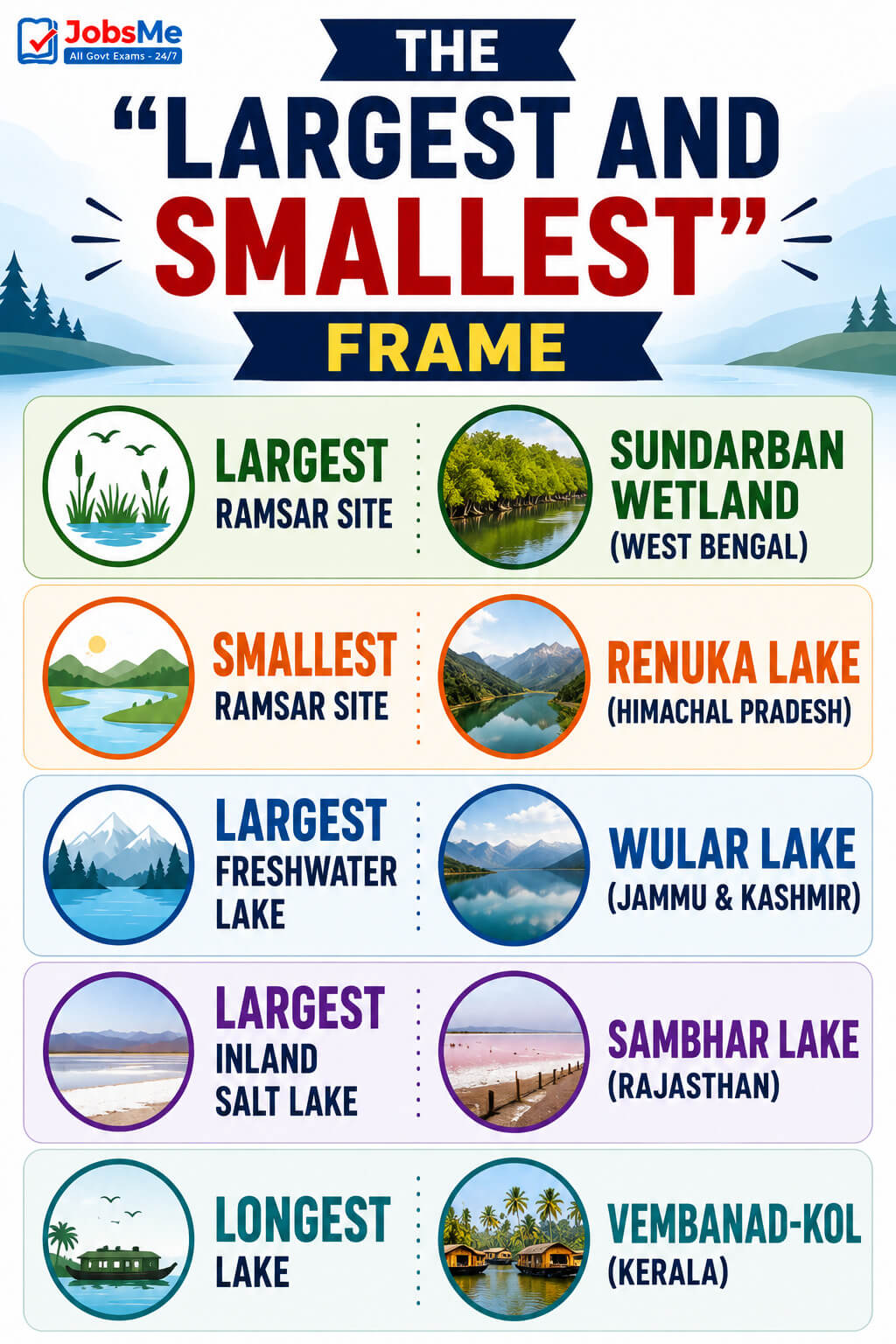
Cluster the superlatives so they do not get confused:
- Largest Ramsar Site → Sundarban Wetland (West Bengal).
- Smallest Ramsar Site → Renuka Lake (Himachal Pradesh).
- Largest freshwater lake → Wular Lake (Jammu and Kashmir).
- Largest inland salt lake → Sambhar Lake (Rajasthan).
- Longest lake → Vembanad-Kol (Kerala).
Trick 4: Convention Dates — "1971 Sign, 1982 India, 2 Feb Day"
- 1971 → Ramsar Convention signed at Ramsar, Iran.
- 1982 → India became a contracting party (1 February 1982).
- 2 February → World Wetlands Day (anniversary of signing).
"Sign in 71, India in 82, celebrate on Feb 2."
Trick 5: State Toppers — "Tamil Nadu Twenty, UP Twelve"
Remember the top states by site count:
- Tamil Nadu → 20 (highest).
- Uttar Pradesh → 12 (second).
- Bihar, Odisha, Punjab → 6 each (shared third).
"TN leads, UP follows, then the trio of six."
Trick 6: Unique-Type Lakes — "Float, Crater, Salt, Sky"
- Float → Loktak Lake (only floating lake, Manipur).
- Crater → Lonar Lake (meteorite impact, Maharashtra).
- Salt → Sambhar Lake (largest inland salt lake, Rajasthan).
- Sky → Tsomoriri and Tso Kar (high-altitude, Ladakh).
Trick 7: Sundarban's Five Tags — "RWTNB"
Sundarban is the only Indian site with five designations together. Use "RWTNB":
- R → Ramsar Site.
- W → World Heritage Site.
- T → Tiger Reserve.
- N → National Park.
- B → Biosphere Reserve.
Additional Notes
Frequently Confused Facts
- Largest vs Smallest Ramsar Site: Largest is Sundarban Wetland (West Bengal); smallest is Renuka Lake (Himachal Pradesh, around 20 hectares). Do not confuse Renuka with Nanda Lake (Goa), which is also very small but not the smallest.
- Wular vs Sambhar vs Chilika: Wular is the largest freshwater lake; Sambhar is the largest inland salt lake; Chilika is Asia's largest brackish coastal lagoon — three different "largest" categories.
- Loktak Lake: It is the only floating lake (phumdis), not the highest-altitude lake. The highest-altitude wetlands are Tsomoriri and Tso Kar in Ladakh.
- First Ramsar Site of India vs World: India's first sites were Chilika and Keoladeo (1981); the world's first Ramsar Site was the Cobourg Peninsula, Australia (1974).
- Montreux Record sites: Currently Keoladeo and Loktak. Chilika was removed in 2002 — a very common trap in exams.
- Ramsar tag vs Legal protection: Ramsar designation is international recognition only; legal protection in India requires separate notification under the Wildlife Protection Act, 1972 or Environment Protection Act, 1986.
- Keoladeo National Park: Earlier known as Bharatpur Bird Sanctuary; it is both a Ramsar Site and a UNESCO World Heritage Site.
- Lonar Lake: A meteorite-impact crater lake, not a volcanic or rain-fed lake; it is saline and alkaline.
Repeating PYQ Patterns
Certain Ramsar facts are asked repeatedly in competitive exams. Chilika Lake, Keoladeo National Park, Sundarban Wetland, Loktak Lake, Wular Lake, Sambhar Lake, and the basics of the Ramsar Convention (1971, Iran, 2 February) appear most often in UPSC Prelims, SSC CGL, and RRB NTPC papers. Banking exams (IBPS PO, SBI Clerk) frequently ask the total number of sites, the state with the most sites (Tamil Nadu), and the Montreux Record. State PCS exams focus on local wetlands — for example, Tamil Nadu PCS on Point Calimere and Vedanthangal, Odisha PCS on Chilika and Bhitarkanika, and Manipur PCS on Loktak. Current-affairs questions often test the latest newly added sites and World Wetlands Day.
Quick Insight
Ramsar Sites are far more than tourist lakes — they are India's natural infrastructure for flood control, groundwater recharge, carbon storage, and fisheries, supporting the livelihoods of tens of millions of people. India's wetlands are critically placed along the Central Asian Flyway, used by roughly 71% of the migratory waterbirds travelling between Central Asia and South Asia, which is why many sites such as Thol Lake and Wadhvana were designated specifically for their flyway significance. Understanding this ecological role helps aspirants connect Ramsar questions to broader themes of climate resilience, biodiversity, and sustainable development in both Prelims and Mains. For more environment and current affairs topics, see the Daily Current Affairs page, and revise related facts using the Static GK notes on thejobsme.com.
One-Liners for Quick Revision
- Ramsar Convention → Signed 2 February 1971 at Ramsar, Iran → also called the Convention on Wetlands.
- India joined Ramsar → 1 February 1982 → became a contracting party.
- World Wetlands Day → 2 February → marks the convention's signing anniversary.
- Total Ramsar Sites in India → 100 (June 2026) → highest in Asia, third in the world after UK and Mexico.
- First Ramsar Sites of India → Chilika Lake (Odisha) and Keoladeo National Park (Rajasthan) → both 1981.
- World's first Ramsar Site → Cobourg Peninsula, Australia → 1974.
- Largest Ramsar Site in India → Sundarban Wetland (West Bengal) → about 4,230 sq km.
- Smallest Ramsar Site in India → Renuka Lake (Himachal Pradesh) → about 20 hectares.
- State with most Ramsar Sites → Tamil Nadu → 20 sites.
- Second-most Ramsar Sites → Uttar Pradesh → 12 sites.
- Montreux Record (India) → Keoladeo National Park and Loktak Lake → list of threatened wetlands.
- Removed from Montreux Record → Chilika Lake → in 2002 after restoration.
- Largest freshwater lake (Ramsar) → Wular Lake (Jammu and Kashmir).
- Largest inland salt lake → Sambhar Lake (Rajasthan) → flamingo wintering site.
- Asia's largest brackish lagoon → Chilika Lake (Odisha) → home to Irrawaddy dolphins.
- Only floating lake → Loktak Lake (Manipur) → phumdis and Keibul Lamjao floating national park.
- Longest lake in India → Vembanad-Kol (Kerala) → Nehru Trophy Boat Race.
- Meteorite-crater lake → Lonar Lake (Maharashtra) → saline and alkaline.
- Highest-altitude wetlands → Tsomoriri and Tso Kar (Ladakh) → Black-necked Crane breeding.
- Sundarban's five tags → Ramsar, World Heritage Site, Tiger Reserve, National Park, Biosphere Reserve.
- Keoladeo National Park → former Bharatpur Bird Sanctuary → Ramsar plus World Heritage Site.
- Bhitarkanika Mangroves → Odisha → second largest mangrove forest in India; saltwater crocodiles.
- Harike Wetland → Punjab → largest wetland in northern India; confluence of Beas and Sutlej.
- Beas Conservation Reserve → Punjab → India's only Indus river dolphin population.
- East Kolkata Wetlands → West Bengal → model of sewage-fed fisheries and resource recovery.
- Nalsarovar → Gujarat → largest natural wetland in Gujarat; Central Asian Flyway stopover.
- Chhari-Dhand → Gujarat (Kutch) → saline desert wetland; among the newest sites.
- Ramsar tag → international recognition only → no automatic legal protection in India.
- Central Asian Flyway → about 71% of migratory waterbirds use Indian wetlands as stopovers.
- States with no Ramsar Site → Telangana, Arunachal Pradesh, Meghalaya, Nagaland.
For more Static GK topics like national parks, biosphere reserves, and rivers of India, explore the Static GK section and sharpen your speed with the Static GK Quiz. To stay updated on newly added wetlands and environment news, follow the Daily Current Affairs page and check the Latest Government Job Notifications on thejobsme.com.
Free quiz • No signup required
Put this topic into practice with Indian Cultural Institutions – Static GK MCQ Quiz. It is the quickest way to reinforce what you just learned.
Frequently Asked Questions
How many Ramsar Sites are there in India in 2026?
Which were the first Ramsar Sites of India?
Which is the largest Ramsar Site in India?
Which is the smallest Ramsar Site in India?
Which Indian state has the highest number of Ramsar Sites?
When was the Ramsar Convention signed and when did India join?
What is the Montreux Record and which Indian sites are on it?
Does a Ramsar tag automatically protect a wetland under Indian law?
Why is Loktak Lake famous among Ramsar Sites?
What is the link between Ramsar Sites and the Central Asian Flyway?

About the author