Ramon Magsaysay Award – Static GK & General Awareness for Competitive Exams with Indian Winners and Memory Tricks
This article gives a complete overview of the Ramon Magsaysay Award, often called the "Nobel Prize of Asia", covering its history, categories, prize money, selection process, and the full list of important Indian winners from Vinoba Bhave (1958) to Educate Girls (2025). It includes the 2025 awardees, category-wise Indian recipients, memory tricks, frequently confused facts, and exam one-liners for quick revision. All facts are arranged in exam-ready format to help UPSC, SSC, IBPS, RRB, PSU, and State PCS aspirants score better in the General Awareness and Current Affairs sections.

Jump to section
Introduction
The Ramon Magsaysay Award is one of Asia's most prestigious honours and is popularly called the "Nobel Prize of Asia" or "Asia's Nobel Prize". It was established in 1957 by the trustees of the Rockefeller Brothers Fund based in New York City, with the concurrence of the Government of the Philippines, to honour the memory and legacy of Ramon Magsaysay, the seventh President of the Philippines, who died in a plane crash in 1957. The award recognises individuals and organisations in Asia who have shown integrity, courage, and selfless service to their societies.
Questions on the Ramon Magsaysay Award appear regularly in UPSC Prelims, SSC CGL, IBPS PO, RRB NTPC, SBI Clerk, State PCS, and various Insurance and Defence exams. Examiners commonly ask about the first Indian winner, recent recipients, the year and country of origin, the categories, and the prize money. This topic is doubly important because new awardees are announced every year, making it part of both Static GK and Current Affairs. To explore related topics, you can refer to the Static GK section on thejobsme.com.
The award is closely tied to current affairs because the winners are declared annually and the ceremony is held in Manila, Philippines. In 2025, an Indian organisation received this honour for the first time, which makes the recent list highly relevant for aspirants. Keeping track of the latest awardees alongside the historical Indian winners gives candidates an edge in the General Awareness paper. You can stay updated through the Daily Current Affairs page on thejobsme.com.
Core Concepts: About the Ramon Magsaysay Award

Understanding the basic framework of the award helps students answer both direct and matching questions with confidence. The following points cover the essential facts that are most frequently tested.
- Named After: Ramon del Fierro Magsaysay Sr. (born 31 August 1907, Iba, Zambales), the seventh President of the Philippines who served from 1953 to 1957 and died in a plane crash on 17 March 1957.
- Established: April 1957 by the trustees of the Rockefeller Brothers Fund, New York, with the concurrence of the Philippine government.
- First Awards Given: 31 August 1958 to individuals and an organisation working in India, Indonesia, Philippines, Republic of China (Taiwan), and Sri Lanka.
- Administered By: The Ramon Magsaysay Award Foundation (RMAF), headquartered in Manila, Philippines.
- Nickname: "Nobel Prize of Asia" or "Asia's Nobel Prize".
- Award Components: A medallion bearing an embossed likeness of Ramon Magsaysay, a certificate, and a cash prize (commonly cited as around USD 50,000).
- Announcement and Ceremony: Awardees are traditionally announced around 31 August (Magsaysay's birth anniversary), with the formal ceremony held in Manila, usually in November.
- Eligibility: Open to Asian individuals and organisations regardless of race, creed, sex, or nationality; recipients are chosen through a confidential nomination process.
History and Categories of the Award
The categories of the award have changed over time, which is a favourite area for exam questions. Candidates should clearly note the six original categories and the change that took place in 2009.
Original Six Categories (1958-2008)
From 1958 to 2008, the Ramon Magsaysay Award was given in six fixed categories, each recognising a distinct field of service.
| Category | Description / Key Features | Example Awardees |
|---|---|---|
| Government Service | Recognised outstanding service in a government role, including administration and public governance reforms. | C. D. Deshmukh, Kiran Bedi (1994), T. N. Seshan (1996), J. M. Lyngdoh (2003). |
| Public Service | Honoured selfless service to the public good, especially for the marginalised and disadvantaged sections of society. | Mother Teresa (1962), Jayaprakash Narayan (1965), M. S. Subbulakshmi (1974). |
| Community Leadership | Recognised those who empowered communities for social justice, economic development, and cultural preservation. | Vinoba Bhave (1958), Verghese Kurien (1963), Ela Bhatt (1977), Jockin Arputham (2000). |
| Journalism, Literature and Creative Communication Arts | Honoured excellence in journalism, literature, or creative arts used to inform, educate, or inspire the public. | Amitabha Chowdhury (1961), Satyajit Ray (1967), Ravi Shankar (1992), Mahasweta Devi (1997), Ravish Kumar (2019). |
| Peace and International Understanding | Recognised efforts to promote peace, harmony, and understanding among nations and peoples. | Awarded to leaders and reformers who advanced peace and cross-border goodwill in Asia. |
| Emergent Leadership | Added in 2001; recognises outstanding young individuals aged 40 or below; supported by a grant from the Ford Foundation. | Arvind Kejriwal (2006), Sonam Wangchuk (2018). |
Change in Categories (from 2009)
A very important exam fact is that since 2009, five of the six fixed categories were discontinued. The award is now given without fixed categories to allow more flexible recognition of diverse contributions, while the Emergent Leadership category (for individuals aged 40 or below, and organisations less than 10 years old) continues separately with support from the Ford Foundation.
Important Indian Winners of the Ramon Magsaysay Award
India has one of the highest numbers of recipients among all countries, with more than 50 Indians honoured since 1958. The following table lists the most exam-relevant Indian winners along with the year, field, and key details.
| Indian Winner | Year | Field / Key Details |
|---|---|---|
| Acharya Vinoba Bhave | 1958 | First Indian recipient; honoured under Community Leadership for the Bhoodan (Land Gift) Movement and Gandhian social reform. |
| Mother Teresa | 1962 | First Indian woman recipient; honoured under Peace and International Understanding for serving the poor and sick through the Missionaries of Charity; later won the Nobel Peace Prize. |
| Verghese Kurien | 1963 | Community Leadership; "Father of the White Revolution" for the Amul dairy cooperative movement and Operation Flood. |
| Jayaprakash Narayan | 1965 | Public Service; leader of the "Total Revolution" (Sampoorna Kranti) movement; known as Loknayak. |
| Satyajit Ray | 1967 | Journalism, Literature and Creative Communication Arts; legendary filmmaker recognised for his contribution to cinema. |
| M. S. Subbulakshmi | 1974 | Public Service; the first Indian musician to receive the award; celebrated Carnatic vocalist. |
| Ela Ramesh Bhatt | 1977 | Community Leadership; founder of the Self-Employed Women's Association (SEWA) to empower working women. |
| Pramod Karan Sethi | 1981 | Recognised for co-developing the "Jaipur Foot", a low-cost artificial limb for amputees. |
| Ravi Shankar | 1992 | Journalism, Literature and Creative Communication Arts; world-renowned sitar maestro. |
| Kiran Bedi | 1994 | Government Service; first woman IPS officer of India, honoured for prison reforms at Tihar Jail. |
| T. N. Seshan | 1996 | Government Service; former Chief Election Commissioner honoured for major electoral reforms in India. |
| Mahasweta Devi | 1997 | Journalism, Literature and Creative Communication Arts; noted Bengali writer and social activist. |
| Aruna Roy | 2000 | Social activist; co-founder of the Mazdoor Kisan Shakti Sangathan (MKSS); led the campaign for the Right to Information (RTI) Act. |
| Rajendra Singh | 2001 | Known as the "Waterman of India" for his water conservation and "Right to Water" campaign. |
| J. M. Lyngdoh | 2003 | Government Service; former Chief Election Commissioner honoured for conducting free and fair elections. |
| Arvind Kejriwal | 2006 | Emergent Leadership; recognised for his role in the Right to Information (RTI) movement through Parivartan. |
| Prakash and Mandakini Amte | 2008 | Honoured for their medical and social work among tribal communities through the Lok Biradari Prakalp. |
| Anshu Gupta | 2015 | Founder of the NGO Goonj, recognised for turning urban waste (clothing) into a resource for rural development. |
| Bezwada Wilson | 2016 | Led the Safai Karmachari Andolan, a nationwide campaign to end manual scavenging and uphold the dignity of sanitation workers. |
| T. M. Krishna | 2016 | Carnatic vocalist recognised for using music to bridge deep social divisions. |
| Sonam Wangchuk | 2018 | Emergent Leadership; engineer and education reformer from Ladakh, inspiration behind educational innovation and community learning. |
| Bharat Vatwani | 2018 | Psychiatrist honoured for rescuing and rehabilitating mentally ill destitute people through the Shraddha Rehabilitation Foundation. |
| Ravish Kumar | 2019 | Journalist honoured for ethical, independent journalism giving voice to the common people. |
| Educate Girls (Foundation to Educate Girls Globally) | 2025 | First Indian organisation to win the award; founded by Safeena Husain in 2007 in Rajasthan; works to bring out-of-school girls into classrooms in rural India. |
Ramon Magsaysay Award 2025
The 2025 edition marked a historic moment for India. The following table lists the three awardees of 2025 and their contributions, which is a high-probability current affairs question.
| Awardee | Country | Field / Key Details |
|---|---|---|
| Educate Girls (Foundation to Educate Girls Globally) | India | First Indian organisation to win the award; brings out-of-school girls into classrooms in underserved and remote villages; founded by Safeena Husain in 2007 in Rajasthan. |
| Shaahina Ali | Maldives | Environmental advocate and ocean conservationist working against plastic pollution and protecting fragile marine ecosystems. |
| Flaviano Antonio L. Villanueva (Fr. Flavie Villanueva) | Philippines | Catholic priest honoured for restoring dignity to the poor and homeless in Metropolitan Manila and upholding human rights. |
Memory Tricks and Mnemonics
Trick 1: Remember the Founding Facts — "5-7-8"
Use the number pattern "5-7-8" to lock in the key years:
- 5 → Established in 1957 (Rockefeller Brothers Fund).
- 7 → Magsaysay was the 7th President of the Philippines.
- 8 → First awards given in 1958.
"Set up in 57, given from 58, for the 7th President."
Trick 2: The Six Original Categories — "GP-CJ-PE"
Remember the six original categories with "GP-CJ-PE":
- G → Government Service.
- P → Public Service.
- C → Community Leadership.
- J → Journalism, Literature and Creative Communication Arts.
- P → Peace and International Understanding.
- E → Emergent Leadership (the only one continuing after 2009).
Trick 3: The First Three "Firsts" — "VMV"
Remember the three most-asked "first" facts with "VMV":
- V → Vinoba Bhave (1958) — first Indian recipient.
- M → Mother Teresa (1962) — first Indian woman recipient.
- V → Educate Girls — first Indian organisation (2025). (Remember as "V for very first organisation.")
Trick 4: The RTI Duo — "Aruna and Arvind"
Two Magsaysay winners are linked to the Right to Information movement:
- Aruna Roy (2000) → MKSS and the RTI campaign.
- Arvind Kejriwal (2006) → Emergent Leadership, RTI through Parivartan.
"Two A's for the Right to Information."
Trick 5: The "Revolution" Winners — "White, Water, Total"
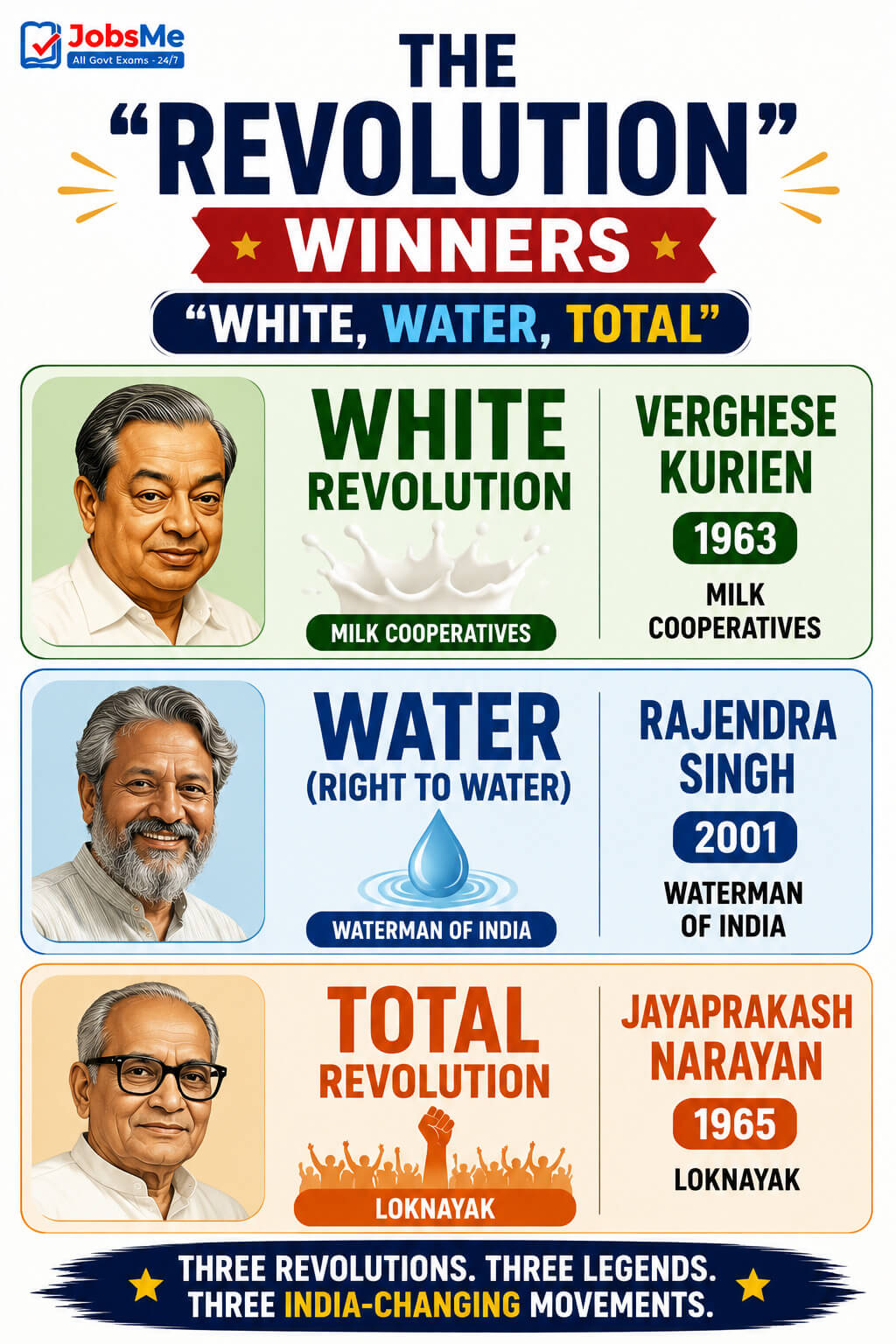
- White Revolution → Verghese Kurien (1963), milk cooperatives.
- Water (Right to Water) → Rajendra Singh (2001), Waterman of India.
- Total Revolution → Jayaprakash Narayan (1965), Loknayak.
Trick 6: Music and Media — "Sub-Ravi-Ray-Ravish"
Group the arts and journalism winners together:
- Sub → M. S. Subbulakshmi (1974), first Indian musician.
- Ravi → Ravi Shankar (1992), sitar.
- Ray → Satyajit Ray (1967), cinema.
- Ravish → Ravish Kumar (2019), journalism.
Trick 7: Government Service Officers — "KISS-J"
Remember the famous administrators honoured under Government Service:
- KI → Kiran Bedi (1994), Tihar Jail reforms.
- S → Seshan (T. N. Seshan, 1996), electoral reforms.
- J → J. M. Lyngdoh (2003), free and fair elections.
Additional Notes
Frequently Confused Facts
- First Indian vs First Indian Woman: The first Indian recipient was Vinoba Bhave (1958); the first Indian woman recipient was Mother Teresa (1962).
- First Indian Organisation: Educate Girls (2025) is the first Indian organisation to win — earlier Indian winners were all individuals.
- Established vs First Awarded: The award was established in 1957, but the first awards were given in 1958.
- Founder vs Administrator: The Rockefeller Brothers Fund established the award, while the Ramon Magsaysay Award Foundation (RMAF) in Manila administers it.
- Categories Discontinued: Five categories were discontinued in 2009; only Emergent Leadership continues separately, so do not assume the award still has six fixed categories today.
- Only Politician-Background Winner: Arvind Kejriwal is often noted as the winner with a distinct political background (though awarded in 2006 for the RTI movement, before entering active politics).
- Nobel Prize of Asia: This is the popular nickname of the Ramon Magsaysay Award; it should not be confused with the actual Nobel Prize.
Repeating PYQ Patterns
Certain facts about this award are asked repeatedly in competitive exams. The first Indian winner (Vinoba Bhave, 1958), Mother Teresa (1962), the founding year (1957), the country of origin (Philippines), the nickname "Nobel Prize of Asia", and the most recent awardees appear most often in UPSC Prelims, SSC CGL, and RRB NTPC papers. Banking exams (IBPS PO, SBI Clerk) frequently ask matching questions pairing winners with their year or field, and current affairs questions about the latest awardees such as Educate Girls (2025). State PCS exams often add regionally significant winners like Sonam Wangchuk (Ladakh) and social reformers relevant to their region. Practising these repeatedly through the Static GK Quiz improves recall.
Quick Insight
The Ramon Magsaysay Award is more than a list of names — it is a record of Asia's social progress. Each Indian winner represents a movement: Vinoba Bhave the Bhoodan land reform, Kurien the White Revolution, Kiran Bedi prison reform, Bezwada Wilson the fight against manual scavenging, and Educate Girls the mission for girls' education. The 2025 award to Educate Girls, India's first organisational winner, highlights education and women's empowerment as tools for social change — a theme that overlaps directly with government schemes and current affairs. Linking each winner to the cause they championed helps aspirants answer both Prelims matching questions and Mains essays on social reform. For related topics, you can explore the Static GK section and read the latest updates on the Daily Current Affairs page on thejobsme.com.
One-Liners for Quick Revision
- Ramon Magsaysay Award → Known as the "Nobel Prize of Asia"; honours selfless service in Asia.
- Named After → Ramon Magsaysay, 7th President of the Philippines (died in a 1957 plane crash).
- Established → 1957 by the Rockefeller Brothers Fund with the Philippine government's concurrence.
- First Awards Given → 31 August 1958 (to individuals from India, Indonesia, Philippines, Taiwan, Sri Lanka).
- Administered By → Ramon Magsaysay Award Foundation (RMAF), Manila, Philippines.
- Award Components → Medallion with Magsaysay's likeness, a certificate, and a cash prize (about USD 50,000).
- Announced → Around 31 August (Magsaysay's birth anniversary); ceremony usually in November in Manila.
- Original Categories (1958-2008) → Government Service, Public Service, Community Leadership, Journalism/Literature/Creative Arts, Peace and International Understanding, Emergent Leadership.
- Since 2009 → Five categories discontinued; only Emergent Leadership continues; awards given without fixed categories.
- Emergent Leadership → For individuals aged 40 or below; supported by the Ford Foundation.
- Vinoba Bhave (1958) → First Indian winner; Community Leadership; Bhoodan Movement.
- Mother Teresa (1962) → First Indian woman winner; Peace and International Understanding.
- Verghese Kurien (1963) → White Revolution; Amul; Operation Flood.
- Jayaprakash Narayan (1965) → Total Revolution; Loknayak.
- Satyajit Ray (1967) → Cinema; Journalism/Literature/Creative Arts.
- M. S. Subbulakshmi (1974) → First Indian musician to win; Carnatic vocalist.
- Ela Bhatt (1977) → Founder of SEWA; women's empowerment.
- Pramod Karan Sethi (1981) → Jaipur Foot, low-cost prosthetic limb.
- Ravi Shankar (1992) → Sitar maestro; creative arts.
- Kiran Bedi (1994) → First woman IPS officer; Tihar Jail reforms; Government Service.
- T. N. Seshan (1996) → Electoral reforms; former Chief Election Commissioner.
- Mahasweta Devi (1997) → Bengali writer and social activist.
- Aruna Roy (2000) → MKSS; Right to Information campaign.
- Rajendra Singh (2001) → Waterman of India; Right to Water.
- J. M. Lyngdoh (2003) → Free and fair elections; Government Service.
- Arvind Kejriwal (2006) → Emergent Leadership; RTI through Parivartan.
- Prakash and Mandakini Amte (2008) → Tribal welfare; Lok Biradari Prakalp.
- Anshu Gupta (2015) → Founder of NGO Goonj.
- Bezwada Wilson (2016) → Safai Karmachari Andolan; against manual scavenging.
- T. M. Krishna (2016) → Carnatic vocalist; music for social harmony.
- Sonam Wangchuk (2018) → Emergent Leadership; education reform in Ladakh.
- Bharat Vatwani (2018) → Rehabilitation of mentally ill destitute; Shraddha Rehabilitation Foundation.
- Ravish Kumar (2019) → Ethical, independent journalism.
- Educate Girls (2025) → First Indian organisation to win; founded by Safeena Husain (2007) in Rajasthan.
- 2025 Awardees → Educate Girls (India), Shaahina Ali (Maldives), Flaviano Antonio L. Villanueva (Philippines).
For more Static GK topics like Indian awards, honours, and current affairs, explore the Static GK section on thejobsme.com. You can test your preparation with the Daily Current Affairs Quiz and check the latest openings at Latest Government Job Notifications.
Free quiz • No signup required
Put this topic into practice with Indian Cultural Institutions – Static GK MCQ Quiz. It is the quickest way to reinforce what you just learned.
Frequently Asked Questions
Why is the Ramon Magsaysay Award called the Nobel Prize of Asia?
Who was the first Indian to receive the Ramon Magsaysay Award?
When and by whom was the Ramon Magsaysay Award established?
Who was the first Indian woman to win the Ramon Magsaysay Award?
How many categories does the Ramon Magsaysay Award have now?
Who won the Ramon Magsaysay Award in 2025?
Which was the first Indian organisation to win the Ramon Magsaysay Award?
What does a Ramon Magsaysay Award recipient receive?
Which Indian journalists have won the Ramon Magsaysay Award?
Where and on which day is the Ramon Magsaysay Award ceremony held?

About the author