Pulitzer Prize Winners – Static GK & General Awareness for Competitive Exams with Latest 2025 Winners and Memory Tricks
This article presents a complete guide to the Pulitzer Prize, covering its history, categories, prize money, notable global winners, and the full list of 2025 winners across Journalism, Books, Drama, and Music. It also highlights every Indian-origin Pulitzer winner from Gobind Behari Lal (1937) to Vijay Seshadri (2014), along with memory tricks and exam-ready one-liners. All facts are arranged in exam-ready format to help UPSC, SSC, IBPS, RRB, PSU, and State PCS aspirants score better in General Awareness and Current Affairs sections.
Jump to section
Introduction
The Pulitzer Prize is widely regarded as the highest honour in American journalism, literature, and music. Established in 1917 from a bequest by the Hungarian-American journalist and newspaper publisher Joseph Pulitzer, it is administered by Columbia University in New York. Every year the awards recognise the finest work in reporting, books, drama, and musical composition, and they carry immense prestige for journalists and authors across the world. For competitive exam aspirants, the Pulitzer Prize is a recurring topic in the awards and honours segment of General Awareness.
Questions on the Pulitzer Prize appear regularly in UPSC Prelims, SSC CGL, IBPS PO, RRB NTPC, SBI Clerk, State PCS, and various Insurance and Defence exams. Typical questions ask about the founding year, the administering university, the number of categories, the prize money, the first winner, and — most importantly for current affairs — the latest year's winners and the Indian-origin recipients. To explore other related Static GK topics, you can refer to the Static GK section on thejobsme.com.
Because the winners are announced fresh every May, the Pulitzer Prize sits at the intersection of Static GK and Current Affairs. Aspirants should memorise the permanent facts (history, categories, prize money) as static knowledge and update the latest winners each year. This makes the topic doubly valuable for both objective prelims papers and descriptive current affairs sections. For daily updates, aspirants can follow the Daily Current Affairs page.
Core Concepts: Understanding the Pulitzer Prize
The Pulitzer Prize was created according to the will of Joseph Pulitzer, who left funds to Columbia University upon his death in 1911. A portion of the bequest was used to found the Columbia School of Journalism in 1912, and the prizes were awarded for the first time in 1917. Understanding the structure of the award helps students answer factual questions quickly and confidently.

Key Facts about the Pulitzer Prize
- Founder: Joseph Pulitzer, a Hungarian-American journalist and newspaper publisher.
- Established: 1917 (first awarded); funds endowed on Pulitzer's death in 1911.
- Administered by: Columbia University, New York, USA.
- Categories: Awarded annually across 21 categories in Journalism, Books, Drama, and Music.
- Prize money: Each winner receives a certificate and a cash award of USD 15,000.
- Public Service award: The winner in the Public Service category (journalism) receives a gold medal instead of cash — this is the most prestigious of all the categories.
- Selection: Recommended by the 18-member Pulitzer Prize Board, composed of leading journalists, news executives, academics, and persons in the arts.
- Announcement: Winners are announced every year in May from Columbia University.
Pulitzer Prize - Important Static Facts
The following table summarises the permanent, unchanging facts about the Pulitzer Prize that are most frequently tested in exams.
| Aspect | Detail | Key Points for Exams |
|---|---|---|
| Founder | Joseph Pulitzer | Hungarian-American journalist and newspaper publisher; left money to Columbia University in his will; a crusader against dishonest government. |
| Year Established | 1917 (first awarded) | Funds were endowed on Pulitzer's death in 1911; the Columbia School of Journalism was founded in 1912. |
| Administered By | Columbia University, New York | The dean of Columbia's journalism school and the prize administrator are non-voting members of the board. |
| Number of Categories | 21 categories | Spread across Journalism, Books (Letters), Drama, and Music. |
| Prize Money | USD 15,000 + certificate | Applies to all categories except Public Service. |
| Public Service Award | Gold Medal | The only category awarded a gold medal; regarded as the most prestigious Pulitzer honour and given only to a news organisation. |
| First Prize Winner (1917) | Jean Jules Jusserand | French Ambassador; awarded for the best book on American history; received USD 2,000 at the time. |
| Announcement Month | May (annually) | Winners are declared from Columbia University; work of the previous calendar year is honoured. |
Pulitzer Prize 2025 Winners - Books, Drama and Music
The 2025 Pulitzer Prizes were awarded on 5 May 2025 for works created during 2024. The following table lists the most exam-relevant winners in the Books, Drama, and Music categories along with their achievements. For more awards and honours updates, visit the Daily Current Affairs section.
| Category | Winner | Work / Key Details |
|---|---|---|
| Fiction | Percival Everett | Won for the novel "James", a powerful re-imagining of Mark Twain's "Huckleberry Finn" told from the perspective of the enslaved character Jim. |
| Drama | Branden Jacobs-Jenkins | Won for the play "Purpose", about a prominent African-American family whose patriarch was a Civil Rights figure; his first Pulitzer win after being a finalist in 2016 and 2018. |
| History | Edda L. Fields-Black | Won for "Combee: Harriet Tubman, the Combahee River Raid, and Black Freedom During the Civil War"; a co-winner with Kathleen DuVal. |
| History (co-winner) | Kathleen DuVal | Won for "Native Nations: A Millennium in North America", a thousand-year portrait of Native American nations and communities. |
| Biography | Jason Roberts | Won for "Every Living Thing: The Great and Deadly Race to Know All Life", a double biography of Carl Linnaeus and Georges-Louis de Buffon. |
| Memoir or Autobiography | Tessa Hulls | Won for "Feeding Ghosts: A Graphic Memoir", depicting three generations of Chinese women — the author, her mother, and grandmother. |
| Poetry | Marie Howe | Won for "New and Selected Poems", a collection drawn from decades of work on loneliness, mortality, and holiness. |
| General Nonfiction | Benjamin Nathans | Won for "To the Success of Our Hopeless Cause: The Many Lives of the Soviet Dissident Movement", a history of Soviet dissent. |
| Music | Susie Ibarra | Won for "Sky Islands", a composition about ecosystems and biodiversity blending musicianship with improvisation. |
Pulitzer Prize 2025 - Notable Journalism Winners
The journalism categories are the heart of the Pulitzer Prize. The following table covers the most exam-relevant journalism winners of 2025.
| Category | Winner | Key Details |
|---|---|---|
| Public Service (Gold Medal) | ProPublica | Awarded for reporting by Kavitha Surana, Lizzie Presser, Cassandra Jaramillo, and Stacy Kranitz on pregnant women who died after care was delayed under strict abortion laws. |
| Breaking News Reporting | Staff of The Washington Post | Awarded for coverage of the 13 July attempted assassination of then-presidential candidate Donald Trump, combining police reporting with audio and visual forensics. |
| Special Citation | Chuck Stone (posthumous) | Honoured for his Civil Rights journalism, being the first Black columnist at the Philadelphia Daily News, and co-founding the National Association of Black Journalists. |
| Special Citation | Julie K. Brown | Miami Herald reporter honoured for the "Perversion of Justice" series that exposed the Jeffrey Epstein abuse case. |
Indian-Origin Pulitzer Prize Winners
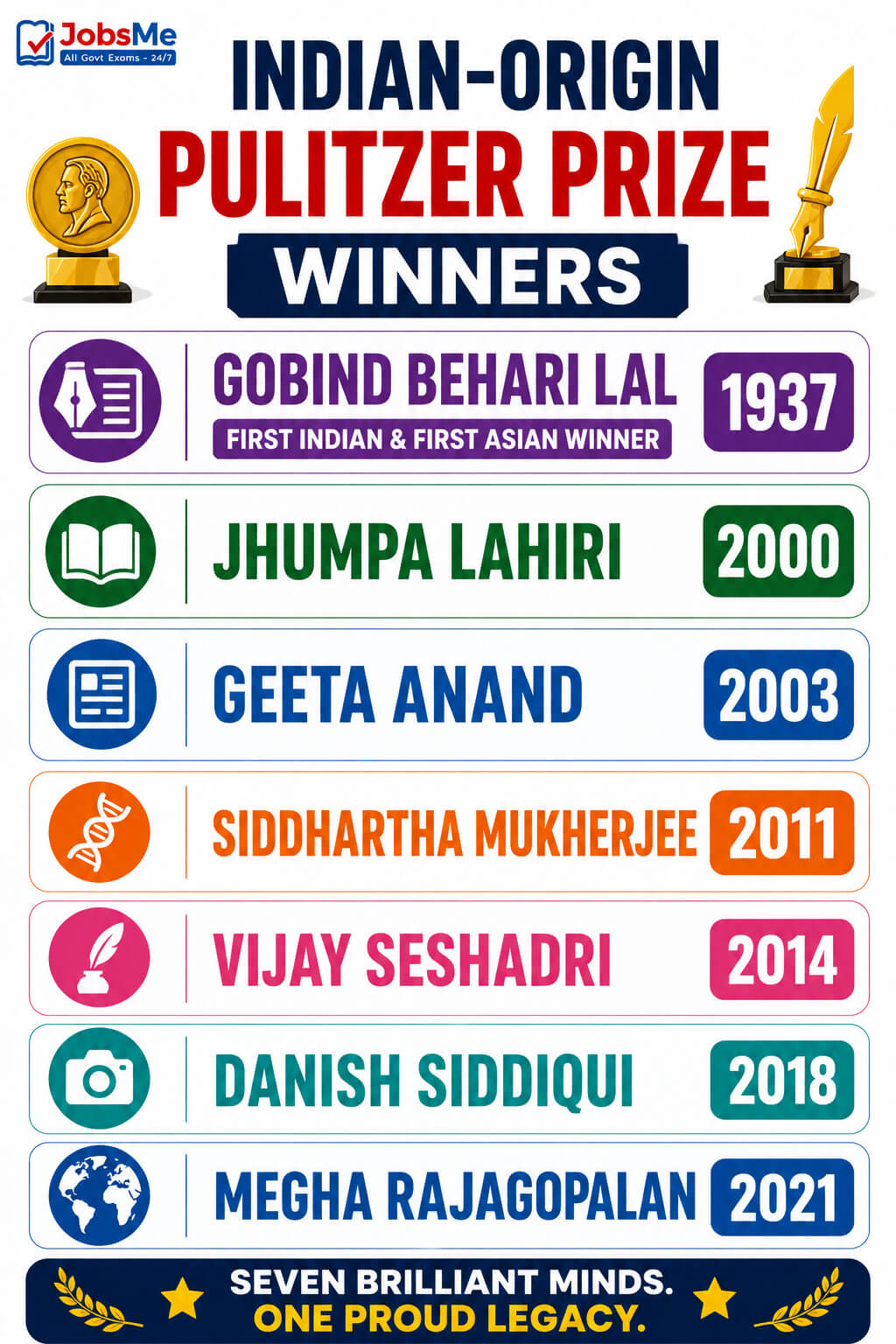
Several people of Indian origin have won the Pulitzer Prize across journalism and literature. This is a high-frequency exam sub-topic, especially the identity of the first Indian winner. The following table lists the major Indian-origin recipients.
| Winner | Year | Category / Work and Key Details |
|---|---|---|
| Gobind Behari Lal | 1937 | First Indian and first Asian to win a Pulitzer Prize; Indian-American journalist, science writer, and independence activist linked to the Ghadar Party; won in Reporting for coverage of science at Harvard University's 300th anniversary. |
| Jhumpa Lahiri | 2000 | Won the Pulitzer Prize for Fiction for her debut short story collection "Interpreter of Maladies", exploring immigrant identity and cultural adaptation. |
| Geeta Anand | 2003 | Indian-American journalist; won as part of a Wall Street Journal team for explanatory journalism on corporate scandals. |
| Siddhartha Mukherjee | 2011 | Physician and author; won the Pulitzer for General Nonfiction for "The Emperor of All Maladies", a biography of cancer. |
| Vijay Seshadri | 2014 | Indian-American poet; won the Pulitzer Prize for Poetry for his collection "3 Sections". |
| Danish Siddiqui | 2018 | Photojournalist of Indian descent; won in Feature Photography as part of the Reuters team for documenting the Rohingya refugee crisis. |
| Megha Rajagopalan | 2021 | Journalist of Indian descent; won in International Reporting for exposing China's mass detention camps for Uyghur Muslims in Xinjiang. |
Memory Tricks and Mnemonics
Use the following tricks to remember the key facts about the Pulitzer Prize quickly during the exam.
Trick 1: Remember the Founder with "Joseph = Journalism"
Both start with "Jo". "Joseph Pulitzer gave us the Prize for Journalism." This instantly links the founder to the field.
Trick 2: "1917 = World War 1 + 7"
"First awarded in the year of World War One's peak — 1917." Connecting it to WWI helps lock the year in memory.
Trick 3: "Columbia = Column of News"
The prize is run by Columbia University. "A newspaper column is written at Columbia." This ties the university to journalism.
Trick 4: "Gold for Good — Public Service"
Only the Public Service category gets a gold medal. "Public service is the golden duty, so it earns the gold medal." Everyone else gets USD 15,000.
Trick 5: "GJ First" — Gobind Behari Lal, the First Indian
"Gobind was the beGinning." Remember Gobind Behari Lal won in 1937 — the first Indian and first Asian. Use the phrase "Gobind Goes First."
Trick 6: "JIVA" — Indian Literature Winners
Use the acronym "JIVA" for the literary Indian winners: Jhumpa Lahiri (Fiction), Interpreter of Maladies, Vijay Seshadri (Poetry), and Author Siddhartha Mukherjee (Nonfiction).
Trick 7: "James Won for Fiction in 2025"
The 2025 Fiction winner is "James" by Percival Everett. "James is a re-telling of Huckleberry Finn." Linking it to the classic novel makes it memorable.
Additional Notes
Frequently Confused Facts
- Founded vs First Awarded: Joseph Pulitzer died in 1911 and funds were endowed then, but the prizes were first awarded in 1917. Exams usually ask for 1917.
- Cash vs Gold Medal: Most categories give USD 15,000 in cash, but only the Public Service category awards a gold medal.
- First Indian vs First Indian in Literature: Gobind Behari Lal (1937) was the first Indian overall (in journalism); Jhumpa Lahiri (2000) is often cited as the first Indian-origin fiction winner.
- Pulitzer vs Nobel: The Pulitzer is American and administered by Columbia University; the Nobel is international and Swedish/Norwegian. Do not confuse the two award bodies.
Repeating PYQ Patterns
- SSC CGL and RRB NTPC frequently ask about the founding year (1917) and the administering university (Columbia).
- IBPS and Insurance exams often ask about the first Indian winner (Gobind Behari Lal) and Jhumpa Lahiri's "Interpreter of Maladies".
- UPSC Prelims and State PCS occasionally test the prize money and the gold medal for Public Service.
- Current affairs sections across all exams test the latest year's winners — for 2025, remember Percival Everett (Fiction) and Branden Jacobs-Jenkins (Drama).
Quick Insight
The Pulitzer Prize stays in the news each May when winners are announced, and Indian-origin winners regularly make headlines in national media, reinforcing India's growing footprint in global journalism and literature. The 2025 edition was noted for honouring courageous reporting during a difficult period for press freedom. Aspirants can pair this topic with related awards like the Booker Prize and Jnanpith Award for a complete awards revision. For more such topics, explore the Static GK notes and test yourself with the Daily Current Affairs Quiz on thejobsme.com.
One-Liners for Quick Revision
- Pulitzer Prize Founder → Joseph Pulitzer → Hungarian-American journalist and newspaper publisher.
- Established → 1917 (first awarded) → funds endowed on Pulitzer's death in 1911.
- Administered By → Columbia University, New York → most prestigious honour in American journalism.
- Number of Categories → 21 → covering Journalism, Books, Drama, and Music.
- Prize Money → USD 15,000 + certificate → for all categories except Public Service.
- Public Service Award → Gold Medal → given only to a news organisation; the top honour.
- First Ever Winner (1917) → Jean Jules Jusserand → French Ambassador, for a book on American history.
- First Indian / Asian Winner → Gobind Behari Lal → 1937, Reporting, for Harvard science coverage.
- Jhumpa Lahiri → 2000, Fiction → for "Interpreter of Maladies".
- Geeta Anand → 2003, Explanatory Journalism → part of a Wall Street Journal team.
- Siddhartha Mukherjee → 2011, General Nonfiction → for "The Emperor of All Maladies".
- Vijay Seshadri → 2014, Poetry → for "3 Sections".
- Danish Siddiqui → 2018, Feature Photography → Reuters team, Rohingya crisis.
- Megha Rajagopalan → 2021, International Reporting → Uyghur detention camps in China.
- 2025 Fiction Winner → Percival Everett → for the novel "James".
- 2025 Drama Winner → Branden Jacobs-Jenkins → for the play "Purpose".
- 2025 History Winners → Edda L. Fields-Black ("Combee") and Kathleen DuVal ("Native Nations").
- 2025 Biography Winner → Jason Roberts → for "Every Living Thing".
- 2025 Memoir Winner → Tessa Hulls → for "Feeding Ghosts".
- 2025 Poetry Winner → Marie Howe → for "New and Selected Poems".
- 2025 General Nonfiction Winner → Benjamin Nathans → for "To the Success of Our Hopeless Cause".
- 2025 Music Winner → Susie Ibarra → for "Sky Islands".
- 2025 Public Service (Gold Medal) → ProPublica → reporting on maternal deaths under abortion laws.
- 2025 Breaking News Reporting → Staff of The Washington Post → Trump assassination attempt coverage.
- Awards Announced → Every year in May → from Columbia University.
For more Static GK topics like important awards, books and authors, and international organisations, explore the Static GK section on thejobsme.com. You can also test your knowledge with the Static GK Quiz, stay updated with the Daily Current Affairs page, and check out the latest exam notifications at Latest Government Job Notifications.
Free quiz • No signup required
Put this topic into practice with Indian Cultural Institutions – Static GK MCQ Quiz. It is the quickest way to reinforce what you just learned.
Frequently Asked Questions
Who founded the Pulitzer Prize and in which year was it first awarded?
Which university administers the Pulitzer Prize?
How much prize money does a Pulitzer Prize winner receive?
Who was the first Indian to win the Pulitzer Prize?
For which work did Jhumpa Lahiri win the Pulitzer Prize?
Who won the 2025 Pulitzer Prize for Fiction?
Who won the 2025 Pulitzer Prize for Drama?
In how many categories is the Pulitzer Prize awarded?
Which Indian-origin author won the Pulitzer for The Emperor of All Maladies?
Which category of the Pulitzer Prize is awarded a gold medal?

About the author