Oil and Petroleum Refineries in India: Complete Static GK List of Refineries, States, Companies and Capacity
This article gives you the complete, updated list of all oil and petroleum refineries in India with their operating company, state, year of commissioning and installed capacity, along with the oilfields and sedimentary basins that supply them. It also covers refinery firsts and records, foreign collaborations, upcoming projects, PNGRB, exploration policies, strategic petroleum reserves and environmental concerns. Every fact is arranged in exam-ready tables, mnemonics and one-liners so that you can revise the entire topic for UPSC, SSC, Banking, Railways and Insurance exams in one sitting.
Jump to section
Introduction
Oil and petroleum refineries are among the most frequently tested topics in the General Awareness and Static GK sections of Indian government exams. A refinery is an industrial plant where crude oil is converted into usable products such as petrol, diesel, kerosene, liquefied petroleum gas, aviation turbine fuel, naphtha, bitumen and lubricants. Because every refinery has a fixed location, a fixed operating company and a fixed capacity, questions on this topic are direct, factual and completely scoring if you have memorised the list once.
India today has 24 operating refineries and an installed refining capacity of roughly 267 million metric tonnes per annum (MMTPA), which makes India the fourth-largest refiner in the world after the United States, China and Russia. India is also the third-largest consumer and importer of crude oil globally. The official refinery-wise list published by the Petroleum Planning and Analysis Cell showed 23 refineries with 258.1 MMTPA capacity as on 1 April 2025; the count rose to 24 when the HPCL Rajasthan Refinery at Pachpadra achieved commercial operations in June 2026.
Examiners usually ask three kinds of questions from this topic: which state a particular refinery is located in, which company operates it, and which refinery holds a particular record such as oldest, largest or smallest. This article organises all of it in one place. If you are building your foundation subject by subject, keep revising alongside our Static GK notes for competitive exams, because refineries connect directly with topics like mineral distribution, industries and Indian geography.
Core Concepts You Must Understand First
Before memorising the list, get the basic vocabulary right. Many candidates lose marks because they confuse an oilfield with a refinery, or upstream activity with downstream activity.
- Crude oil (mineral oil or petroleum): A complex mixture of hydrocarbons formed over millions of years from decomposed organic matter buried under high pressure and temperature in sedimentary rocks.
- Oil refinery: A large industrial process plant, similar in technology to a chemical plant, with extensive piping that carries fluid streams between processing units such as distillation columns. Refineries convert crude oil into petrol (gasoline), diesel, kerosene, heating oil, jet fuel, LPG, petroleum naphtha, asphalt base and fuel oils.
- Oilfield: The place where crude oil is extracted from the ground or seabed. An oilfield is not a refinery. Mumbai High is India's largest oilfield, not a refinery.
- Upstream activity: Exploration and extraction of crude oil and natural gas.
- Downstream activity: Refining, processing, distribution and marketing of petroleum products. Refineries belong to the downstream sector.
- Onshore drilling: Extracting oil from beneath the land surface, away from the ocean.
- Offshore drilling: Extracting oil from beneath the seabed using floating or fixed platforms. It is costlier and technically harder than onshore drilling but remains profitable. Both methods are also used for natural gas.
Composition of Mineral Oil
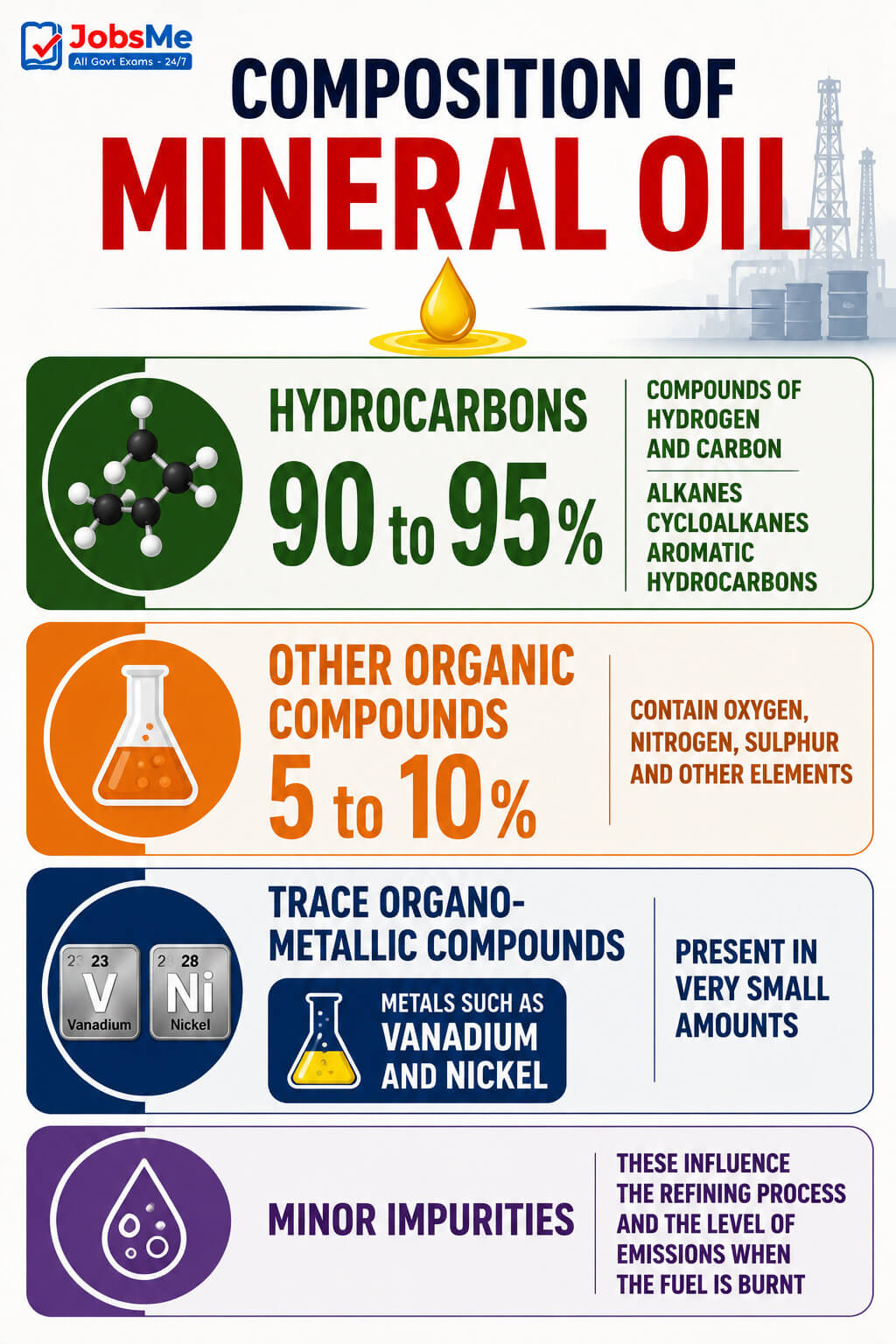
- Hydrocarbons (90 to 95 per cent): Compounds of hydrogen and carbon forming alkanes, cycloalkanes and aromatic hydrocarbons.
- Other organic compounds (5 to 10 per cent): Contain oxygen, nitrogen, sulphur and other elements.
- Trace organo-metallic compounds: Metals such as vanadium and nickel present in very small amounts.
- Minor impurities: These influence the refining process and the level of emissions when the fuel is burnt.
Conditions Required for Petroleum Formation
- Origin: Remains of microscopic plants and animals deposited in sediments millions of years ago.
- Sedimentary rock: Petroleum occurs only in porous and permeable sedimentary rocks; it is never found in igneous or metamorphic rocks.
- Porosity: The rock must have tiny pores or gaps to hold sufficient oil.
- Permeability: The pores must be interconnected so that oil and gas can flow out when a well is drilled.
- Impervious cap rock: An impermeable layer must seal the porous rock from above so that oil does not escape.
- Traps: Oil accumulates in geological traps such as anticlines and fault traps.
- Favourable geological period: Most of India's petroleum was formed during the Tertiary period.
- Transformation: Buried organic matter is converted into hydrocarbons by heat and pressure over millions of years.
Main Refining Processes
- Fractional distillation: Crude is heated in a Crude Distillation Unit and separated into fractions according to boiling point. This is the first step in every refinery.
- Cracking: Heavy, long-chain molecules are broken into lighter, more valuable ones. Common units are the Fluidised Catalytic Cracking Unit, hydrocracker and delayed coker.
- Reforming: Low-octane naphtha is upgraded into high-octane petrol components and hydrogen.
- Treating: Sulphur and other impurities are removed, for example in hydrotreater units that make BS-VI grade fuels possible.
- Nelson Complexity Index: A measure of how sophisticated a refinery is. A high value means the refinery can process cheap heavy or sour crude and still produce high-value products. Jamnagar is among the most complex refineries in the world.
Complete List of Oil Refineries in India
The tables below follow the official refinery-wise data of the Ministry of Petroleum and Natural Gas and the Petroleum Planning and Analysis Cell. Capacities are name-plate installed capacities in MMTPA.
Public Sector Refineries
| Refinery | Company | State | Year | Capacity (MMTPA) | Key Features and Exam Points |
|---|---|---|---|---|---|
| Digboi | Indian Oil Corporation Ltd (IOCL) | Assam | 1901 | 0.65 | The oldest refinery in India and one of the oldest operating refineries in the world. Set up by Assam Oil Company and taken over by IOCL on 14 October 1981. Digboi is called the Oil City of Assam and has the oldest oil well still in operation. |
| Guwahati (Noonmati) | IOCL | Assam | 1962 | 1.20 | The first public sector refinery of India, commissioned on 1 January 1962 with Romanian collaboration and inaugurated by Jawaharlal Nehru. Initial capacity was 0.75 MMTPA; it was raised to 1.0 MMTPA and then to 1.2 MMTPA in 2023. Home of IOCL's indigenous INDMAX technology. |
| Barauni | IOCL | Bihar | 1964 | 6.00 | Located in Begusarai district and built with Soviet Union collaboration. Went on stream in July 1964 and refines Assam crude brought by pipeline. Being expanded towards 9 MMTPA. |
| Koyali (Gujarat Refinery) | IOCL | Gujarat | 1965 | 13.70 | Situated near Vadodara and built with Soviet assistance. It was IOCL's largest refinery for decades and processes Ankleshwar and other Gujarat crude along with imported crude. |
| Bongaigaon | IOCL | Assam | 1974 | 2.70 | Earlier Bongaigaon Refinery and Petrochemicals Ltd, merged into IOCL in 2009. It refines Assam crude and also produces petrochemical intermediates. |
| Haldia | IOCL | West Bengal | 1975 | 8.00 | The only refinery in West Bengal and a major producer of lube base oils and other specialty products. It is a coastal refinery served by Haldia port. |
| Mathura | IOCL | Uttar Pradesh | 1982 | 8.00 | Famous in exams because of environmental concerns about emissions affecting the Taj Mahal, which lies inside the Taj Trapezium Zone. It supplies the north Indian market including Delhi. |
| Panipat | IOCL | Haryana | 1998 | 15.00 | An integrated refinery-cum-petrochemical complex and one of IOCL's two largest units. Its expansion towards 25 MMTPA is among India's biggest ongoing refinery projects. |
| Paradip | IOCL | Odisha | 2016 | 15.00 | The newest IOCL refinery and the only refinery in Odisha. A coastal refinery designed for heavy, high-sulphur imported crude, and the starting point of the crude pipeline being laid to Numaligarh. |
| Manali (Chennai) | Chennai Petroleum Corporation Ltd (CPCL), an IOCL subsidiary | Tamil Nadu | 1965 | 10.50 | Originally Madras Refineries Ltd, formed as a venture of the Government of India with AMOCO of the United States and the National Iranian Oil Company. It is the largest refinery in Tamil Nadu. |
| Nagapattinam (Cauvery Basin Refinery) | CPCL | Tamil Nadu | 1993 | 0.00 | Operations were stopped from 1 April 2019 because it could not meet new product specifications, and because a new 9 MMTPA refinery is being built at the same site. Its official capacity is therefore shown as zero. |
| Mumbai (Trombay) | Hindustan Petroleum Corporation Ltd (HPCL) | Maharashtra | 1954 | 9.50 | The earliest of India's post-Independence refineries. It began as Standard Vacuum Refining Company, became ESSO India, and was nationalised in 1974 to form HPCL. It processes a mix of high-sulphur Gulf crude and low-sulphur Mumbai High crude. |
| Visakhapatnam | HPCL | Andhra Pradesh | 1957 | 15.00 | Commissioned by Caltex Oil Refining (India) Ltd and later merged with HPCL. Its capacity was raised from 8.3 MMTPA to 15 MMTPA under the Visakh Refinery Modernisation Project, making it HPCL's largest refinery. |
| Mumbai | Bharat Petroleum Corporation Ltd (BPCL) | Maharashtra | 1955 | 12.00 | Originally the Burmah Shell refinery at Trombay, nationalised in 1976 and renamed Bharat Petroleum. Along with the HPCL unit it makes Mumbai one of only three cities with two refineries. |
| Kochi | BPCL | Kerala | 1963 | 15.50 | The largest public sector refinery in India by single-unit capacity and the only refinery in Kerala. It has an integrated petrochemical complex producing propylene derivatives such as acrylates and oxo-alcohols. |
| Bina | BPCL | Madhya Pradesh | 2011 | 7.80 | The only refinery in Madhya Pradesh. It was built as Bharat Oman Refineries Ltd, a joint venture of BPCL and Oman Oil Company, and was merged into BPCL in July 2022. Crude reaches it by pipeline from Vadinar in Gujarat. |
| Numaligarh | Numaligarh Refinery Ltd (NRL) | Assam | 2000 | 3.00 | Set up in Golaghat district as a commitment under the Assam Accord of 1985. It is now majority-owned by Oil India Ltd with the Government of Assam and Engineers India as partners, and is being expanded to 9 MMTPA. |
| Mangalore | Mangalore Refinery and Petrochemicals Ltd (MRPL), an ONGC subsidiary | Karnataka | 1996 | 15.00 | The only refinery in Karnataka. It began as a joint venture involving HPCL and a private partner, and ONGC took it over in 2003. It is a coastal, export-oriented refinery. |
| Tatipaka | Oil and Natural Gas Corporation (ONGC) | Andhra Pradesh | 2001 | 0.066 | The smallest refinery in India, a mini refinery in the Krishna-Godavari region that processes condensate and crude from nearby ONGC fields. |
Joint Venture Refineries
| Refinery | Company | State | Year | Capacity (MMTPA) | Key Features and Exam Points |
|---|---|---|---|---|---|
| Bathinda (Guru Gobind Singh Refinery) | HPCL-Mittal Energy Ltd (HMEL) | Punjab | 2012 | 11.30 | The only refinery in Punjab, named after the tenth Sikh Guru. It is a joint venture in which HPCL holds about 49 per cent and the Mittal group the rest, and it is integrated with a large petrochemical complex. |
| Pachpadra (HPCL Rajasthan Refinery) | HPCL Rajasthan Refinery Ltd (HRRL) | Rajasthan | 2026 | 9.00 | India's newest and 24th refinery, in Balotra district near Barmer. HPCL holds 74 per cent and the Government of Rajasthan 26 per cent. The foundation stone was laid in 2018 and commercial operations were declared on 22 June 2026. It is India's first greenfield refinery built with an integrated petrochemical complex from the start, with 2.4 MMTPA of petrochemical capacity, and it processes Mangala crude from Barmer along with imported crude routed from Mundra. |
Private Sector Refineries
| Refinery | Company | State | Year | Capacity (MMTPA) | Key Features and Exam Points |
|---|---|---|---|---|---|
| Jamnagar (Domestic Tariff Area) | Reliance Industries Ltd (RIL) | Gujarat | 1999 | 33.00 | India's first private sector refinery of large scale, built for the domestic market. It is highly complex and can process a very wide range of crude grades. |
| Jamnagar (Special Economic Zone) | RIL | Gujarat | 2008 | 35.20 | An export-oriented refinery built by Reliance Petroleum Ltd, which merged with RIL in 2009. Together the two Jamnagar units total 68.2 MMTPA, making Jamnagar the largest refining complex at a single location in the world. |
| Vadinar | Nayara Energy Ltd | Gujarat | 2006 | 20.00 | India's second-largest single-location refinery, formerly Essar Oil, renamed Nayara Energy after a Rosneft-led consortium acquired it in 2017. It supplies a retail network of more than 6,500 fuel outlets. |
Company-wise Refining Capacity
| Company | Number of Refineries | Capacity (MMTPA) | Remarks |
|---|---|---|---|
| Indian Oil Corporation Ltd | 9 | 70.25 | The largest refiner in India with about 31 per cent of national capacity. With CPCL included, the IOCL group operates 11 refineries. |
| Reliance Industries Ltd | 2 | 68.20 | The largest private refiner and the largest single-location complex in the world. |
| Bharat Petroleum Corporation Ltd | 3 | 35.30 | Mumbai, Kochi and Bina; the second largest oil marketing company in India. |
| Hindustan Petroleum Corporation Ltd | 2 | 24.50 | Mumbai and Visakhapatnam, plus stakes in HMEL Bathinda and HRRL Pachpadra. |
| Nayara Energy Ltd | 1 | 20.00 | About 8 per cent of India's refining capacity. |
| MRPL and CPCL | 1 and 2 | 15.00 and 10.50 | MRPL is an ONGC subsidiary; CPCL is an IOCL subsidiary. |
| HMEL, NRL, HRRL, ONGC | 1 each | 11.30, 3.00, 9.00 and 0.066 | HMEL at Bathinda, NRL at Numaligarh, HRRL at Pachpadra and ONGC's mini refinery at Tatipaka. |
State-wise Number of Refineries
| State | Number | Names of Refineries |
|---|---|---|
| Assam | 4 | Digboi, Guwahati, Bongaigaon and Numaligarh. Assam has the largest number of refineries among Indian states, though its total capacity is small. |
| Gujarat | 4 | Koyali, Jamnagar DTA, Jamnagar SEZ and Vadinar. Gujarat has the highest refining capacity of any state at about 102 MMTPA. |
| Maharashtra | 2 | HPCL Mumbai and BPCL Mumbai, both at Trombay. |
| Tamil Nadu | 2 | Manali (Chennai) and Nagapattinam, both operated by CPCL. |
| Andhra Pradesh | 2 | Visakhapatnam and Tatipaka. |
| One refinery each | 1 | Bihar (Barauni), West Bengal (Haldia), Uttar Pradesh (Mathura), Haryana (Panipat), Odisha (Paradip), Kerala (Kochi), Karnataka (Mangalore), Madhya Pradesh (Bina), Punjab (Bathinda) and Rajasthan (Pachpadra). |
Refinery Records and Firsts
| Record | Answer | Detail |
|---|---|---|
| Oldest refinery in India | Digboi, Assam | Set up in 1901 by Assam Oil Company; among the oldest operating refineries anywhere in the world. |
| First public sector refinery | Guwahati, Assam | Commissioned on 1 January 1962 with Romanian collaboration. |
| Earliest post-Independence refinery | Mumbai, Maharashtra (HPCL) | Commissioned in 1954, before the public sector entered refining. |
| Largest refining complex at one site in the world | Jamnagar, Gujarat | Two RIL units totalling 68.2 MMTPA. |
| Largest single refinery in India | Jamnagar SEZ, Gujarat | 35.2 MMTPA, built for exports. |
| Second largest single-location refinery | Vadinar, Gujarat | 20 MMTPA, operated by Nayara Energy. |
| Largest public sector refinery | Kochi, Kerala | 15.5 MMTPA, operated by BPCL. |
| Smallest refinery in India | Tatipaka, Andhra Pradesh | Only 0.066 MMTPA, operated by ONGC. |
| Newest refinery in India | Pachpadra, Rajasthan | 9 MMTPA; commercial operations declared on 22 June 2026. |
| Largest refining company in India | Indian Oil Corporation Ltd | 70.25 MMTPA, about 31 per cent of national capacity. |
| State with most refineries | Assam and Gujarat | Four each; Gujarat leads by a wide margin in capacity. |
Refineries and Their Foreign Collaborations
| Refinery | Collaboration | Detail |
|---|---|---|
| Guwahati | Romania | Built with Romanian technology and a long-term Romanian loan at a cost of about Rs 17.29 crore. |
| Barauni | Soviet Union, with limited Romanian participation | Built at a cost of about Rs 49.4 crore; the dream project of Bihar's first Chief Minister Shri Krishna Singh. |
| Koyali | Soviet Union | Built with Soviet assistance at a cost of about Rs 26 crore. |
| Manali (Chennai) | United States and Iran | Set up as Madras Refineries Ltd with AMOCO and the National Iranian Oil Company as partners. |
| Bina | Oman | Built as Bharat Oman Refineries Ltd with Oman Oil Company; later merged into BPCL. |
| Bathinda | Mittal group | Joint venture of HPCL and Mittal Energy Investments. |
Upcoming Refineries and Expansion Projects
| Project | State | Change in Capacity | Detail |
|---|---|---|---|
| Numaligarh Refinery Expansion Project | Assam | 3 to 9 MMTPA | Includes a crude oil pipeline of about 1,635 km from Paradip port to Numaligarh through Odisha, Jharkhand, Bihar, West Bengal and Assam, plus a product pipeline to Siliguri. It will be the largest refinery in the North East. |
| Cauvery Basin Refinery | Tamil Nadu | 1 to 9 MMTPA | A new CPCL refinery at Nagapattinam replacing the old unit that was shut in 2019. |
| Panipat expansion | Haryana | 15 to 25 MMTPA | One of the largest brownfield refinery expansions in India. |
| Barauni expansion | Bihar | 6 to 9 MMTPA | Along with a new petrochemical complex. |
| West Coast Refinery | Maharashtra | Proposed 60 MMTPA | A mega refinery-cum-petrochemical project planned by a consortium of IOCL, BPCL and HPCL; progress has been slow because of land acquisition issues. |
| National target | All India | About 309.5 MMTPA | India's refining capacity is projected to reach roughly 309.5 MMTPA later this decade, against a 2023-24 domestic consumption of 233.3 MMT. |
Oilfields and Basins That Supply Indian Refineries
Refineries cannot be studied in isolation from the oilfields that feed them. India has 26 sedimentary basins spread over about 3.36 million square kilometres of onshore and offshore area, but only a part of this has been explored. Older geography notes mention 27 basins, so accept either figure if the option matches. Marine basins of the Mesozoic and Tertiary periods cover about 10 lakh square kilometres, and the continental shelf of potentially oil-bearing rocks covers about 2 lakh square kilometres. The most productive areas are Mumbai High, the Gulf of Khambhat and Assam.
Onshore Oil Producing Regions
| Region | Main Oilfields | Refineries Served | Key Features |
|---|---|---|---|
| Assam (Brahmaputra Valley) | Digboi, Naharkatiya, Moran-Hugrijan | Digboi, Guwahati, Bongaigaon and Barauni | The oldest oil-producing state in India. Oil-bearing strata extend about 320 km along the Brahmaputra Valley in Upper Assam, in Tertiary rocks with anticlines and fault traps. Digboi is the oldest oilfield in India. The fields are relatively inaccessible and far from major consumption centres. |
| Gujarat (Cambay or Khambhat Basin) | Ankleshwar, Kalol, Mehsana, Nawgam, Kosamba, Kathana, Barkol, Sanand, Lunej and Ahmedabad | Koyali and Trombay (Mumbai) | Ankleshwar is the most productive oilfield of Gujarat. The basin has thick hydrocarbon-rich sedimentary deposits and a well-developed pipeline network linking fields to refineries. |
| Rajasthan (Barmer-Sanchor Basin) | Mangala, Saraswati and Rajeshwari | Pachpadra, and earlier despatched to other refineries | Rajasthan is India's largest onshore crude oil producing state. The Barmer discovery is one of the largest inland oil discoveries in India, held in sandstone formations and worked with modern enhanced recovery technology. |
| Cauvery Basin (Tamil Nadu) | Narimanam and Kovilappal | Nagapattinam and Manali | Oil occurs in Tertiary sedimentary formations. The contribution is moderate but steady, and the basin has both onshore and offshore fields. |
| Andhra Pradesh | Fields of the Krishna-Godavari onshore area | Tatipaka and Visakhapatnam | Andhra Pradesh has both onshore and offshore oil and gas reserves. |
Offshore Oil Producing Regions
| Region | Fields | Key Features |
|---|---|---|
| Mumbai High (Western offshore) | Mumbai High, Bassein, Aliabet | India's largest and most productive oil-producing region, discovered in 1974 about 160 to 175 km west of Mumbai in the Arabian Sea, in Miocene-age rock strata. Drilling began with the platform Sagar Samrat. Bassein lies south of Mumbai High and Aliabet is a small island in the Gulf of Khambhat. Formerly called Bombay High. |
| Krishna-Godavari Basin (Eastern offshore) | Rava (also written Rawa) | Located off the Andhra Pradesh coast with large reserves of both oil and natural gas. It is considered one of India's most promising future energy regions. |
| Cauvery offshore | Fields adjoining the Tamil Nadu coast | The delta regions of the Godavari, Krishna and Cauvery rivers have high potential for both oil and gas. |
Areas of Future Oil Potential
- Himachal Pradesh: Jawalamukhi, Nurpur, Dharamsala and Bilaspur.
- Punjab: Ludhiana, Hoshiarpur and Dasua.
- Gulf of Mannar off the Tirunelveli coast.
- The offshore area between Point Calimere and the Jaffna Peninsula.
- The deepwater area of the Bay of Bengal.
- The marine delta region of the Mahanadi, Godavari, Krishna and Cauvery rivers.
- The sea between the South Bengal coast and Baleshwar.
- The offshore area of the Andaman and Nicobar Islands.
Around 75 to 90 per cent of India's oil reserves remain unexplored. Government exploration effort is now focused on the Andaman, Mahanadi and Kerala-Konkan basins, while already proven areas such as the Krishna-Godavari Basin are expected to yield more.
India's Oil Reserves Compared With Global Reserves
| Oil Reserves in India | Global Oil Reserves |
|---|---|
| Less than 1 per cent share of world proven reserves | Over 50 per cent of reserves concentrated in West Asia |
| Domestic production meets only a small part of demand | Many countries have surplus production |
| Heavy import dependence of about 88.7 per cent in 2025-26 | Major exporters of crude oil |
| Oilfields mainly in Mumbai High, Assam, Gujarat and Rajasthan | Large reserves in Saudi Arabia, Venezuela, Russia and Iran |
| Low reserve-to-production ratio | High reserve-to-production ratio |
| Vulnerable to global price and supply shocks | Greater energy and strategic stability |
India's Petroleum Sector in Key Numbers
| Indicator | Figure | Note |
|---|---|---|
| Number of refineries | 24 | Official list showed 23 as on 1 April 2025; Pachpadra was added in June 2026. |
| Installed refining capacity | About 267 MMTPA | 258.1 MMTPA as on 1 April 2025 plus 9 MMTPA at Pachpadra. Capacity was only 62 MMTPA in 1998. |
| India's global rank in refining | Fourth | After the United States, China and Russia; second largest in Asia. |
| India's global rank in oil consumption and import | Third | After the United States and China. |
| Crude oil import dependence | 88.7 per cent in 2025-26 | Up from 85.5 per cent in 2021-22, on a provisional basis. |
| Domestic crude oil production | About 28 MMT in 2025-26 | Down from 29.7 MMT in 2021-22 because of ageing fields. |
| Refinery capacity utilisation | Above 100 per cent | Indian refineries routinely operate above name-plate capacity. |
| Per capita energy consumption | 0.55 tonnes of oil equivalent | Far below the global average of about 1.9 tonnes. |
Regulation, Policy and Energy Security
Petroleum and Natural Gas Regulatory Board
- A statutory body established under the Petroleum and Natural Gas Regulatory Board Act, 2006.
- Objective: To protect the interests of consumers and entities in the petroleum and natural gas sector and to promote competitive markets.
- Mandate: To regulate refining, processing, storage, transportation, distribution, marketing and sale of petroleum, petroleum products and natural gas. It does not regulate the production of crude oil and natural gas, which is an important exam point.
- Functions: Authorising city gas distribution networks and pipelines, determining tariffs and laying down technical and safety standards.
- Entities covered: Natural gas and petroleum product pipelines, city gas distribution networks, LNG storage, transportation and regasification, petroleum and gas marketing, and refineries and storage terminals.
- Nodal ministry: Ministry of Petroleum and Natural Gas. Its seat is in Delhi.
- Composition: A Chairperson, a Member (Legal) and three other members, all appointed by the Central Government.
- Powers under Section 12: It can adjudicate disputes among entities, conduct inquiry and investigation on complaints, pass orders or refer matters for investigation, and it enjoys powers similar to a civil court under the Code of Civil Procedure, 1908, while remaining bound by the principles of natural justice.
Exploration and Licensing Policies
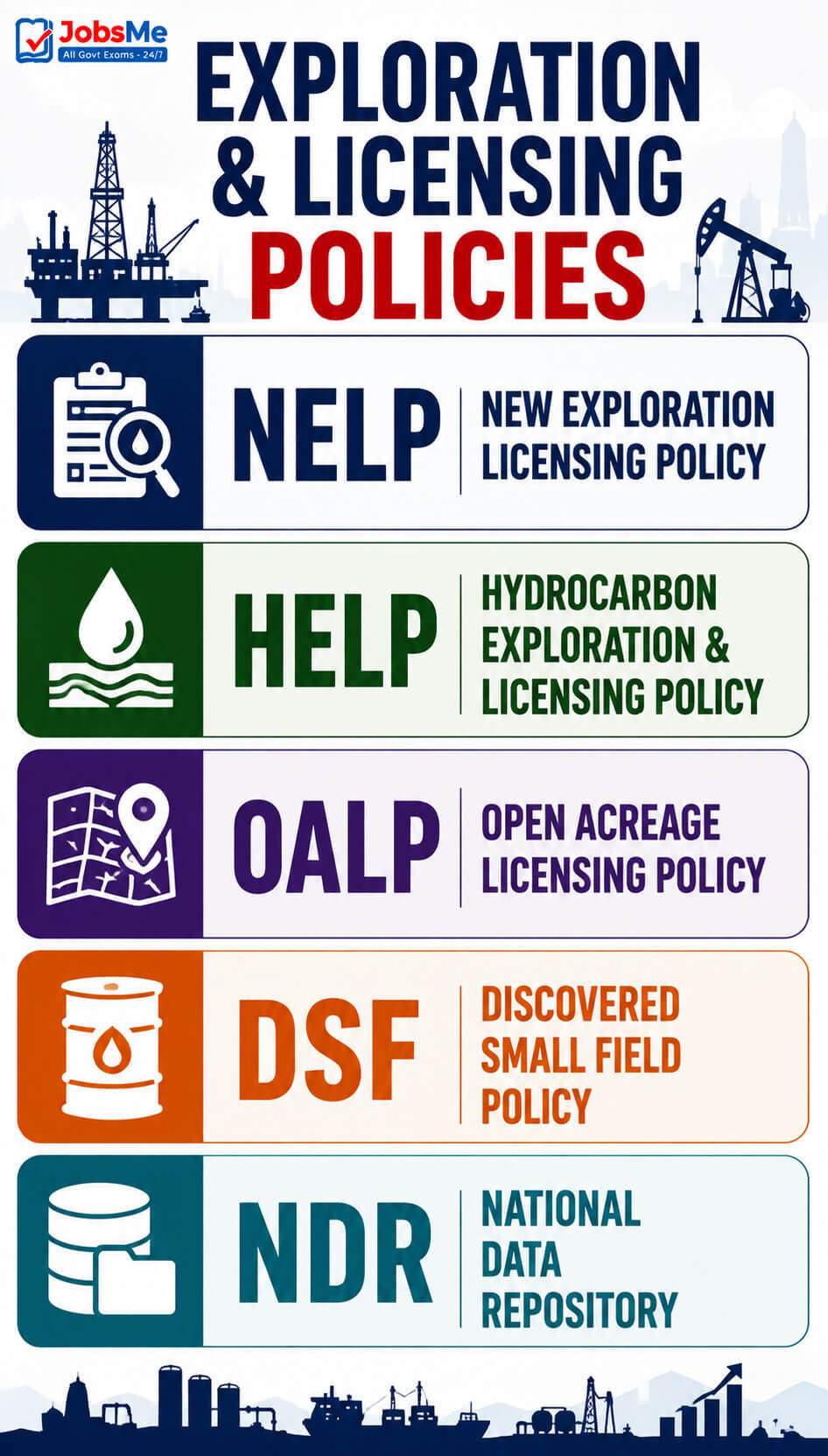
- New Exploration Licensing Policy (NELP): The earlier framework that opened exploration to private and foreign players. It was replaced because of regulatory rigidity and delays.
- Hydrocarbon Exploration and Licensing Policy (HELP): Introduced a single uniform licence for all hydrocarbons, replaced profit-sharing with a revenue-sharing model, and gave pricing and marketing freedom to explorers.
- Open Acreage Licensing Policy (OALP): Lets companies choose blocks of their own interest through continuous bidding rounds, encouraging exploration of frontier and unexplored areas.
- Discovered Small Field Policy (DSF): Monetises small and marginal oilfields quickly by bringing in smaller operators.
- National Data Repository (NDR): Provides easy access to geological and geophysical data to improve transparency and investment decisions.
Strategic Petroleum Reserves
- Indian Strategic Petroleum Reserves Ltd (ISPRL) is the special purpose vehicle that manages India's underground rock-cavern crude reserves.
- Phase I capacity is 5.33 MMT at three locations: Visakhapatnam in Andhra Pradesh (1.33 MMT), Mangaluru in Karnataka (1.5 MMT) and Padur in Karnataka (2.5 MMT). These were commissioned between 2015 and 2018.
- Phase II, approved in July 2021, adds 6.5 MMT of commercial-cum-strategic storage at Chandikhol in Odisha (4 MMT) and a second facility at Padur (2.5 MMT), on a public-private partnership basis.
- The International Energy Agency recommends holding reserves equal to about 90 days of net oil imports, a benchmark India is still working towards.
Significance, Drawbacks and Safety
Significance of the Refining Industry
- A major source of energy, employment and tax revenue for the government.
- Petroleum products are not only fuels but also feedstock for a wide range of consumer goods, plastics and petrochemicals.
- India is a net exporter of petrol, jet fuel, naphtha and gas oil, and refined products are among its largest export items, shipped to African, European and Asian markets.
- Refineries are the base of India's ambition to become a global refining and petrochemical hub.
Environmental Drawbacks
- Oil spills and leakages that contaminate marine and coastal ecosystems and harm fisheries and coral reefs.
- Air pollution from gas flaring, drilling operations and greenhouse gas emissions.
- Water pollution from drilling muds and chemical waste reaching surface water and groundwater.
- Land degradation and deforestation during onshore exploration and pipeline construction.
- Loss of biodiversity and disturbance of wildlife habitats in ecologically sensitive zones.
- Climate change impacts, acid rain and reduced water quality. Wastewaters, gas emissions, solid waste and aerosols generated in drilling, production, refining and transportation together contain over 800 different chemicals, with refining being the largest single source of pollution in the chain.
Refinery Safety
- Refining releases a variety of chemicals into the atmosphere and refineries usually emit a distinctive odour.
- Apart from air pollution, the main concerns are wastewater, industrial accident risks such as fire and explosion, and health effects of industrial noise.
- The BP Texas City refinery accident of 2005 is the standard case study. According to the United States Chemical Safety Board, a series of explosions occurred while restarting a hydrocarbon isomerisation unit, killing 15 workers and injuring about 180.
- Refiners normally carry out a major turnaround or overhaul roughly every four years to protect safety and reliability.
Challenges in Raising Domestic Crude Production
- Limited proven reserves: India holds less than 1 per cent of global proven crude reserves.
- High import dependence: Domestic output meets only a small share of demand, leaving India exposed to price shocks.
- Declining mature fields: Mumbai High and the Assam fields have crossed peak production. The annual decline has been contained at about 2 per cent, against a global average of about 6 per cent for mature fields.
- High cost of offshore and deep-water exploration, which needs advanced technology and heavy capital.
- Technological constraints in enhanced oil recovery and in ultra-deep and unconventional resources.
- Low exploration coverage: Several frontier and deep-water basins remain underexplored.
- Long gestation period: Oil projects take 10 to 15 years from exploration to commercial production.
- Regulatory and environmental hurdles that slow project execution.
Way Forward
- Accelerate exploration in frontier, deep-water and offshore basins.
- Adopt enhanced oil recovery, advanced seismic imaging and digital oilfield technologies.
- Improve recovery from mature fields through secondary and tertiary techniques.
- Simplify clearance processes to cut project delays.
- Attract private and foreign investment through policy stability and risk-sharing.
- Expand Strategic Petroleum Reserves to cushion supply disruptions.
- Acquire overseas oil assets to secure long-term crude supply.
- Promote energy efficiency, ethanol blending and conservation to moderate demand growth.
- Accelerate the shift to renewable and alternative energy to reduce long-term oil dependence.
Memory Tricks and Mnemonics
Trick 1: Assam's Four Refineries with "Do Good, Be Nice"
Assam has four refineries. Take the first letters D, G, B, N in order of age.
- Do Good, Be Nice equals Digboi (1901), Guwahati (1962), Bongaigaon (1974), Numaligarh (2000).
- Bonus link: all four are fed by Assam crude, and three of them belong to IOCL while Numaligarh belongs to NRL.
Trick 2: Gujarat's Big Four with "KJJV"
Gujarat also has four refineries, and it leads the country in capacity.
- Koyali, Jamnagar twins, Vadinar. One public sector unit, two Reliance units and one Nayara unit.
- Remember it as one government, two Reliance, one Nayara, totalling about 102 MMTPA.
Trick 3: IOCL's Nine Refineries in Date Order
Do not memorise IOCL's list randomly. Learn it as a timeline and the years come free.
- Digboi 1901, Guwahati 1962, Barauni 1964, Koyali 1965, Bongaigaon 1974, Haldia 1975, Mathura 1982, Panipat 1998, Paradip 2016.
- Notice the pattern: the 1960s gave three refineries, the mid-1970s gave two, then one each in 1982, 1998 and 2016.
Trick 4: Foreign Collaboration with "Guwahati Goes to Romania, Barauni and Koyali Board the Soviet Bus"
- G for Guwahati, R for Romania. Both are the odd ones out, so pair them.
- B and K board the Soviet bus, that is Barauni and Koyali were built with Soviet assistance.
- For Manali think of M for Madras, M for AMOCO, with Iran as the second partner.
Trick 5: Big and Small with "Jamnagar Jumbo, Tatipaka Tiny"
- Jamnagar is the Jumbo, the largest single-site refining complex in the world at 68.2 MMTPA.
- Tatipaka is Tiny, the smallest Indian refinery at just 0.066 MMTPA, and both begin with a hard consonant that matches their size adjective.
- Kochi is King of the PSUs at 15.5 MMTPA.
Trick 6: Name-to-State Shortcuts
- Guru Gobind Singh Refinery, so Punjab. A Sikh Guru's name points straight to Bathinda in Punjab.
- Mathura means Taj Mahal. The Mathura refinery is the one linked with pollution concerns for the Taj Mahal.
- Numaligarh means the Assam Accord. It was a promise made in the 1985 Assam Accord.
- Paradip means Odisha and pipelines. Odisha's only refinery, and the port from which crude will travel to Numaligarh.
Trick 7: The "Two-Refinery Trio" and the "MAT" Rule
- Only three states have exactly two refineries: Maharashtra, Andhra Pradesh, Tamil Nadu. Remember MAT.
- Maharashtra has HPCL Mumbai and BPCL Mumbai, Andhra Pradesh has Visakhapatnam and Tatipaka, and Tamil Nadu has Manali and Nagapattinam.
Trick 8: Contrast Trick for Firsts
- Oldest is Digboi, first public sector is Guwahati. Digboi in 1901 was private; the government arrived only in 1962.
- Oldest refinery is Digboi, oldest oilfield is also Digboi, but the largest oilfield is Mumbai High.
- Rajasthan is the largest onshore producer, Mumbai High is the largest producer overall. Onshore and offshore have different champions.
Additional Notes
Frequently Confused Facts
| Confusion | Correct Position |
|---|---|
| Mumbai High versus a refinery | Mumbai High is India's largest oilfield, located about 160 to 175 km off the Mumbai coast. It is not a refinery. Many notes wrongly call it India's largest refinery; that title belongs to the Jamnagar complex. |
| Oldest refinery versus first public sector refinery | Digboi (1901) is the oldest refinery in India. Guwahati (1962) is the first public sector refinery. |
| Digboi refinery versus Digboi oil well | The first oil well in the Digboi area was drilled in the 1860s; the refinery came up in 1901. Digboi holds both the oldest producing oil well and the oldest refinery. |
| Largest refinery versus largest public sector refinery | Jamnagar SEZ (35.2 MMTPA) is the largest single refinery. Kochi (15.5 MMTPA) is the largest public sector refinery. |
| Koyali versus Kochi | Koyali is in Gujarat and belongs to IOCL. Kochi is in Kerala and belongs to BPCL. Both begin with K, so link Koyali with the Gujarat Refinery name. |
| Manali versus Nagapattinam | Both are CPCL refineries in Tamil Nadu. Manali in Chennai is active at 10.5 MMTPA, while Nagapattinam has been shut since 1 April 2019 pending a new 9 MMTPA unit. |
| Barmer versus Pachpadra | Barmer is the oil-producing region with the Mangala field. The refinery is at Pachpadra in Balotra district, carved out of the old Barmer district, so both names appear in different sources. |
| Rava versus Rawa | The same offshore field in the Krishna-Godavari basin appears with both spellings; do not treat them as two fields. |
| PNGRB and crude production | PNGRB regulates refining, storage, transport, distribution and marketing, but not the production of crude oil and natural gas. |
| 26 versus 27 sedimentary basins | Current government material uses 26 sedimentary basins covering about 3.36 million square kilometres, while older geography notes say 27. Go with 26 unless the question quotes an older source. |
Repeating PYQ Patterns
- SSC CGL and CHSL: Straight state-matching questions, most often on Digboi, Guwahati, Barauni, Mathura, Panipat, Koyali, Bathinda and Jamnagar. Refinery-to-state matching sets appear almost every cycle.
- IBPS PO, Clerk and RRB: Company-linked questions such as which company operates the Kochi or Mangalore refinery, and current affairs questions about capacity expansions and new commissionings. Refinery news is also a favourite in descriptive and interview rounds.
- Railways (RRB NTPC and Group D): Oldest refinery, first public sector refinery, smallest refinery, and the state with the most refineries.
- UPSC Prelims: Conceptual and location-based questions, for example matching oilfields with basins, statements about HELP and OALP, PNGRB's jurisdiction, and Strategic Petroleum Reserve locations.
- Insurance exams such as LIC and NIACL: One-liner style questions on new refineries, import dependence percentages and India's global rank in refining.
- State PCS: Refineries and oilfields located within the concerned state, with extra weight on the year of commissioning and the operating company.
Quick Insight
This is a live topic, not just static data. The biggest recent development is the commissioning of the HPCL Rajasthan Refinery at Pachpadra, which achieved commercial operations on 22 June 2026 and made Rajasthan a refining state for the first time while pushing India's refinery count to 24. The project cost was revised by the Union Cabinet in April 2026 to about Rs 79,459 crore. In parallel, the Numaligarh expansion to 9 MMTPA and the associated Paradip-to-Numaligarh crude pipeline are transforming the energy map of the North East, and the new Cauvery Basin Refinery is being built at Nagapattinam. On the geopolitical side, the Vadinar refinery of Nayara Energy was placed under European Union sanctions in July 2025 because of its Russian ownership, and India has stated that it does not subscribe to unilateral sanctions. Meanwhile India's crude import dependence has touched a record high, ethanol blending in petrol crossed the 20 per cent mark in December 2025, and roughly 14,000 km of gas pipelines are being added to the existing network of about 16,000 km. Track these developments through our daily current affairs notes and test yourself on the fundamentals with the Static GK quiz series.
One-Liners for Quick Revision
- Oil refinery → A plant that converts crude oil into petrol, diesel, kerosene, LPG, naphtha, asphalt and fuel oils → Belongs to the downstream sector.
- Number of refineries in India → 24 → Official list showed 23 as on 1 April 2025, with Pachpadra added in June 2026.
- India's refining capacity → About 267 MMTPA → Up from just 62 MMTPA in 1998.
- India's global rank in refining → Fourth → After the United States, China and Russia.
- Digboi Refinery → Assam, IOCL, 1901, 0.65 MMTPA → Oldest refinery in India; set up by Assam Oil Company and taken over by IOCL in 1981.
- Guwahati Refinery → Assam, IOCL, 1962, 1.2 MMTPA → First public sector refinery of India, built with Romanian collaboration at Noonmati.
- Barauni Refinery → Bihar, IOCL, 1964, 6 MMTPA → Built with Soviet assistance in Begusarai district; expanding to 9 MMTPA.
- Koyali or Gujarat Refinery → Gujarat, IOCL, 1965, 13.7 MMTPA → Near Vadodara, built with Soviet assistance, processes Ankleshwar crude.
- Bongaigaon Refinery → Assam, IOCL, 1974, 2.7 MMTPA → Formerly Bongaigaon Refinery and Petrochemicals Ltd, merged into IOCL in 2009.
- Haldia Refinery → West Bengal, IOCL, 1975, 8 MMTPA → Only refinery in West Bengal and a major lube base oil producer.
- Mathura Refinery → Uttar Pradesh, IOCL, 1982, 8 MMTPA → Linked with pollution concerns for the Taj Mahal.
- Panipat Refinery → Haryana, IOCL, 1998, 15 MMTPA → Integrated with petrochemicals and being expanded to 25 MMTPA.
- Paradip Refinery → Odisha, IOCL, 2016, 15 MMTPA → Newest IOCL refinery and Odisha's only refinery.
- Manali Refinery → Tamil Nadu, CPCL, 1965, 10.5 MMTPA → Formerly Madras Refineries Ltd with AMOCO and the National Iranian Oil Company as partners.
- Nagapattinam or Cauvery Basin Refinery → Tamil Nadu, CPCL, 1993, capacity shown as zero → Shut since 1 April 2019; a new 9 MMTPA refinery is coming up.
- Mumbai Refinery of HPCL → Maharashtra, 1954, 9.5 MMTPA → Earliest post-Independence refinery; began as Standard Vacuum, became ESSO, nationalised in 1974.
- Visakhapatnam Refinery → Andhra Pradesh, HPCL, 1957, 15 MMTPA to Commissioned by Caltex; expanded from 8.3 → 15 MMTPA and now HPCL's largest.
- Mumbai Refinery of BPCL → Maharashtra, 1955, 12 MMTPA → Originally the Burmah Shell refinery at Trombay, nationalised in 1976.
- Kochi Refinery → Kerala, BPCL, 1963, 15.5 MMTPA → Largest public sector refinery in India and Kerala's only refinery.
- Bina Refinery → Madhya Pradesh, BPCL, 2011, 7.8 MMTPA → Built as Bharat Oman Refineries with Oman Oil Company; merged into BPCL in 2022.
- Numaligarh Refinery → Assam, NRL, 2000, 3 MMTPA → A commitment under the Assam Accord of 1985, in Golaghat district, expanding to 9 MMTPA.
- Mangalore Refinery → Karnataka, MRPL, 1996, 15 MMTPA → Karnataka's only refinery; ONGC took control in 2003.
- Tatipaka Refinery → Andhra Pradesh, ONGC, 2001, 0.066 MMTPA → Smallest refinery in India, a mini refinery in the Krishna-Godavari region.
- Guru Gobind Singh Refinery → Punjab, HMEL, Bathinda, 2012, 11.3 MMTPA → Punjab's only refinery; a joint venture of HPCL and the Mittal group.
- HPCL Rajasthan Refinery → Rajasthan, HRRL, Pachpadra in Balotra district, 2026, 9 MMTPA → India's 24th refinery; HPCL 74 per cent and Rajasthan government 26 per cent; commercial operations from 22 June 2026 with 2.4 MMTPA petrochemicals.
- Jamnagar DTA Refinery → Gujarat, Reliance Industries, 1999, 33 MMTPA → Built for the domestic market.
- Jamnagar SEZ Refinery → Gujarat, Reliance Industries, 2008, 35.2 MMTPA → Largest single refinery in India; the Jamnagar complex of 68.2 MMTPA is the world's largest at one site.
- Vadinar Refinery → Gujarat, Nayara Energy, 2006, 20 MMTPA → Formerly Essar Oil; India's second-largest single-location refinery.
- Largest refining company in India → Indian Oil Corporation Ltd → 70.25 MMTPA across nine refineries, about 31 per cent of national capacity.
- State with the highest refining capacity → Gujarat → About 102 MMTPA across four refineries.
- States with two refineries each → Maharashtra, Andhra Pradesh and Tamil Nadu → Remember the shortcut MAT.
- Oldest oil-producing state → Assam → Oil-bearing strata run about 320 km along the Brahmaputra Valley.
- Assam oilfields → Digboi, Naharkatiya and Moran-Hugrijan → Refined at Digboi, Guwahati, Bongaigaon and Barauni.
- Gujarat oilfields → Ankleshwar, Kalol, Mehsana, Nawgam, Kosamba, Kathana, Barkol, Sanand, Lunej and Ahmedabad → Ankleshwar is the most productive; crude goes to Koyali and Trombay.
- Rajasthan oilfields → Mangala, Saraswati and Rajeshwari → In the Barmer-Sanchor basin; Rajasthan is India's largest onshore crude producer.
- Mumbai High → Discovered in 1974, about 160 to 175 km off Mumbai → Largest oil-producing region in India, in Miocene strata, drilled first by the rig Sagar Samrat; formerly Bombay High.
- Bassein and Aliabet → Western offshore → Bassein lies south of Mumbai High; Aliabet is a small island in the Gulf of Khambhat.
- Rava or Rawa field → Krishna-Godavari offshore basin → Off the Andhra Pradesh coast, rich in both oil and gas.
- Cauvery basin oilfields → Narimanam and Kovilappal → Onshore Tamil Nadu, in Tertiary formations.
- Most productive oil areas of India → Mumbai High, Gulf of Khambhat and Assam → Offshore areas dominate total production.
- Sedimentary basins in India → 26 basins over about 3.36 million square kilometres → Older notes mention 27 basins.
- Unexplored reserves → 75 to 90 per cent still unexplored → Focus areas are the Andaman, Mahanadi and Kerala-Konkan basins.
- Areas of future potential → Jawalamukhi, Nurpur, Dharamsala and Bilaspur in Himachal Pradesh; Ludhiana, Hoshiarpur and Dasua in Punjab → Also the Gulf of Mannar, the area between Point Calimere and the Jaffna Peninsula, deepwater Bay of Bengal, the Mahanadi, Godavari, Krishna and Cauvery deltas, the sea between South Bengal and Baleshwar, and the Andaman and Nicobar offshore area.
- Petroleum formation → Needs porous and permeable sedimentary rock, an impervious cap rock and traps such as anticlines and fault traps → Most Indian petroleum formed in the Tertiary period.
- Composition of mineral oil → Hydrocarbons 90 to 95 per cent and other organic compounds 5 to 10 per cent → Trace organo-metallic compounds include vanadium and nickel.
- Crude oil import dependence → 88.7 per cent in 2025-26, a record high → Up from 85.5 per cent in 2021-22.
- Domestic crude production → About 28 MMT in 2025-26 → Down from 29.7 MMT in 2021-22 due to ageing fields.
- India's share of world oil reserves → Less than 1 per cent → West Asia holds over 50 per cent of global reserves.
- India's rank in oil consumption and import → Third → After the United States and China.
- Per capita energy consumption → 0.55 tonnes of oil equivalent → Global average is about 1.9 tonnes.
- PNGRB → Statutory body under the PNGRB Act, 2006, seated in Delhi → Regulates refining, storage, transport, distribution and marketing but not crude and gas production.
- PNGRB composition → Chairperson, Member (Legal) and three other members → Appointed by the Central Government; has civil court-like powers under Section 12.
- HELP → Single licence for all hydrocarbons with revenue sharing → Replaced NELP and gave pricing and marketing freedom.
- OALP → Companies choose their own blocks through continuous bidding → Encourages frontier area exploration.
- DSF and NDR → Discovered Small Field Policy monetises marginal fields; National Data Repository shares geological data → Both improve transparency and speed.
- Strategic Petroleum Reserves Phase I → 5.33 MMT at Visakhapatnam, Mangaluru and Padur → Managed by ISPRL and commissioned between 2015 and 2018.
- Strategic Petroleum Reserves Phase II → 6.5 MMT at Chandikhol in Odisha and Padur in Karnataka → Approved in July 2021 on a public-private partnership basis.
- Nodal ministry → Ministry of Petroleum and Natural Gas → Refinery data is published by the Petroleum Planning and Analysis Cell.
- BP Texas City accident → 2005, during restart of a hydrocarbon isomerisation unit → 15 workers killed and about 180 injured; the standard refinery safety case study.
- Upcoming projects → Numaligarh 3 to 9 MMTPA, Cauvery Basin 1 to 9 MMTPA, Panipat 15 to 25 MMTPA, Barauni 6 to 9 MMTPA and the proposed 60 MMTPA West Coast Refinery to National capacity is projected → reach about 309.5 MMTPA later this decade.
Once you have these one-liners fixed in memory, convert them into marks by attempting our daily current affairs quiz, which regularly features refinery and energy sector updates. Candidates targeting bank and insurance exams should also revise the energy sector angle in our banking awareness notes, since crude prices and the oil import bill directly affect inflation and the current account deficit. If you are yet to shortlist your target exams, check the newest openings on our latest government job notifications page and plan your preparation calendar accordingly.
Free quiz • No signup required
Put this topic into practice with Indian Cultural Institutions – Static GK MCQ Quiz. It is the quickest way to reinforce what you just learned.
Frequently Asked Questions
Which is the oldest oil refinery in India?
Which is the first public sector oil refinery of India?
How many oil refineries are there in India at present?
Which is the largest oil refinery in India?
Which is the largest public sector refinery in India?
Which state has the maximum number of oil refineries in India?
Which is the smallest oil refinery in India?
Is Mumbai High an oil refinery?
Which company owns the most refineries in India?
Does PNGRB regulate crude oil production in India?

About the author