NITI Aayog and Its Initiatives – Static GK & General Awareness for Competitive Exams with Memory Tricks
This article presents a complete guide to NITI Aayog and its major initiatives, covering its establishment, composition, objectives, and the difference between NITI Aayog and the erstwhile Planning Commission, along with flagship programmes like the Aspirational Districts Programme, Atal Innovation Mission, SDG India Index, and important indices. It includes key facts such as the year of establishment (2015), the full form (National Institution for Transforming India), the role of the Prime Minister as Chairperson, and the latest leadership, with memory tricks and one-liners for quick revision. All facts are arranged in exam-ready format to help UPSC, SSC, IBPS, RRB, PSU, and State PCS aspirants score better in General Awareness, Polity, and Economy sections.

Jump to section
Introduction
NITI Aayog, which stands for National Institution for Transforming India, is the apex public policy think tank of the Government of India. It was established on 1 January 2015 to replace the erstwhile Planning Commission, marking a shift from a top-down planning model to a bottom-up, participatory approach based on cooperative and competitive federalism. The Prime Minister of India serves as its ex-officio Chairperson, while a Vice-Chairperson and a Chief Executive Officer (CEO) lead its day-to-day functioning.
Questions on NITI Aayog and its initiatives appear regularly in UPSC Prelims, SSC CGL, IBPS PO, RRB NTPC, SBI Clerk, State PCS, and various Insurance and Defence exams. Questions typically ask about the year of establishment, its full form, which body it replaced, who heads it, and which flagship programme falls under it (such as the Atal Innovation Mission or the Aspirational Districts Programme). This article brings together every important fact about NITI Aayog in a structured, exam-ready format. To explore other related Static GK topics, you can refer to the Static GK section on thejobsme.com.
NITI Aayog is also closely linked to current affairs themes such as the annual SDG India Index rankings, the reconstitution of the body and new appointments, the Viksit Bharat @2047 vision, the launch of new indices, and Governing Council meetings chaired by the Prime Minister — making this topic doubly important for aspirants preparing for UPSC Mains and Banking Awareness sections, as well as for daily current affairs.
Core Concepts: Understanding NITI Aayog
NITI Aayog is neither a constitutional body (it is not created by the Constitution) nor a statutory body (it is not created by an Act of Parliament). It is an extra-constitutional, non-statutory body formed through a resolution of the Union Cabinet in 2015. Understanding its nature, structure, and functions helps students answer both direct and analytical questions.
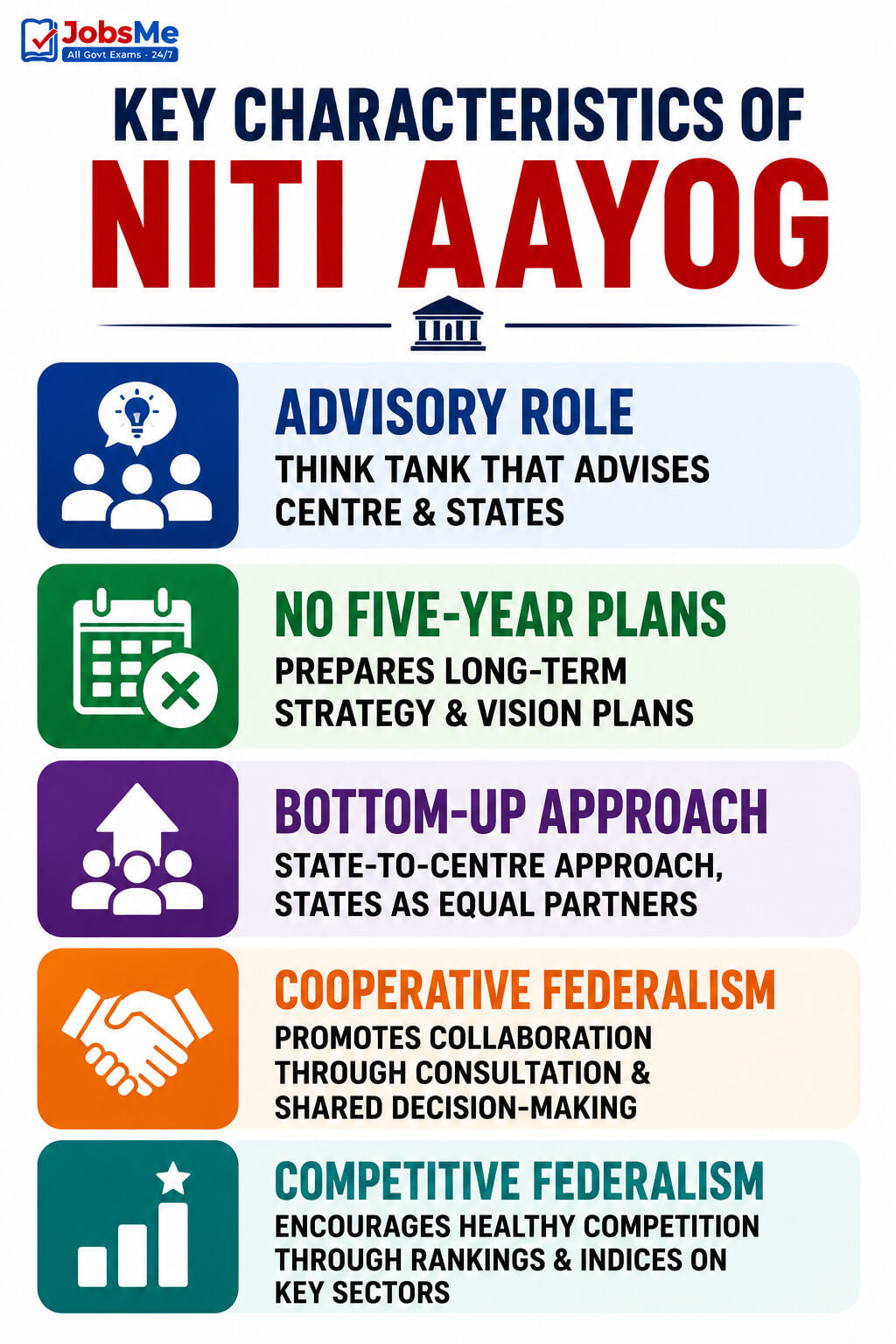
Key Characteristics
- Advisory Role: NITI Aayog is a think tank that advises the Central and State governments; it does not allocate funds to states.
- No Five-Year Plans: Unlike the Planning Commission, NITI Aayog does not prepare Five-Year Plans; it prepares long-term strategy documents and vision plans instead.
- Bottom-Up Approach: It follows a state-to-centre (bottom-up) approach, treating states as equal partners in policy-making.
- Cooperative Federalism: It promotes collaboration between the Centre and States through consultation and shared decision-making.
- Competitive Federalism: It encourages healthy competition among states through rankings and indices on health, education, water, innovation, and other sectors.
Composition of NITI Aayog
- Chairperson: The Prime Minister of India (ex-officio).
- Vice-Chairperson: Appointed directly by the Prime Minister; enjoys the rank of a Cabinet Minister.
- Governing Council: The highest decision-making body, comprising Chief Ministers of all States and Union Territories with legislatures, and Lieutenant Governors of other UTs.
- Chief Executive Officer (CEO): Appointed by the Prime Minister for a fixed tenure; holds the rank of Secretary to the Government of India.
- Full-Time Members, Ex-Officio Members, and Special Invitees: Experts from economics, science, health, agriculture, and serving Union Ministers.
- Regional Councils: Formed to address specific regional issues, convened by the Prime Minister.
NITI Aayog - Key Facts and Difference from Planning Commission
The following table lists the most exam-relevant facts about NITI Aayog and contrasts it with the Planning Commission. For more economy and polity topics, you can also check the Banking Awareness notes on thejobsme.com.
| Feature / Fact | Detail | Key Notes for Exams |
|---|---|---|
| Full Form | National Institution for Transforming India | "NITI" in Sanskrit means policy, morals, or conduct; in current usage it refers to policy. |
| Date of Establishment | 1 January 2015 | Formed by a resolution of the Union Cabinet; replaced the Planning Commission. |
| Replaced | Planning Commission (established 1950) | Planning Commission followed a top-down approach and prepared Five-Year Plans. |
| Nature | Extra-constitutional, non-statutory think tank | Neither a constitutional body nor created by an Act of Parliament. |
| Chairperson | Prime Minister of India (ex-officio) | Currently Prime Minister Narendra Modi. |
| First Vice-Chairperson | Arvind Panagariya | Served from January 2015 to August 2017; was earlier Chief Economist at the Asian Development Bank. |
| Current Vice-Chairperson | Ashok Kumar Lahiri | Economist appointed in 2026, succeeding Suman K. Bery; enjoys the rank of a Cabinet Minister. |
| First CEO | Sindhushree Khullar | Followed by Amitabh Kant (2016-2022) and B. V. R. Subrahmanyam (2022 onwards). |
| Approach | Bottom-Up (state-to-centre) | Opposite of the Planning Commission's top-down (centre-to-state) approach. |
| Fund Allocation Power | None | Acts only as an advisory body; fund allocation now rests with the Finance Ministry and Finance Commission. |
| Twin Mandate | Cooperative and competitive federalism + SDG monitoring | Nodal agency for adoption and monitoring of Sustainable Development Goals in India. |
| Two Hubs | Team India Hub and Knowledge & Innovation Hub | Team India Hub links states with the Centre; Knowledge Hub builds NITI Aayog as a resource centre. |
Major Initiatives and Programmes of NITI Aayog
NITI Aayog runs several flagship initiatives focused on governance, development outcomes, and innovation. The following table lists the most exam-relevant programmes along with their key features.
| Initiative | Launch Year | Key Features / Details |
|---|---|---|
| Aspirational Districts Programme (ADP) | January 2018 | Aims to rapidly transform 112 of India's most under-developed districts through Convergence, Collaboration, and Competition (the 3 Cs); progress tracked across 49 indicators using a monthly delta ranking system. |
| Aspirational Blocks Programme (ABP) | 2023 | Extends the aspirational model to the block level; targets 500 blocks across 27 States and 4 Union Territories to address localised development gaps. |
| Atal Innovation Mission (AIM) | 2016 | Flagship initiative to promote a culture of innovation and entrepreneurship; umbrella scheme covering Atal Tinkering Labs and Atal Incubation Centres; AIM 2.0 was approved in 2024 with a budget of Rs. 2,750 crore until March 2028. |
| Atal Tinkering Labs (ATLs) | Under AIM | Innovation labs set up in schools for students of grades 6 to 12 using tools like 3D printing, robotics, and IoT; over 10,000 ATLs operational; Union Budget 2025 announced 50,000 new ATLs over five years. |
| Atal Incubation Centres (AICs) | Under AIM | World-class business incubators at universities, institutions, and corporates providing mentorship, funding, and co-working space to startups. |
| SDG India Index | 2018 (first edition) | Tracks the progress of States and UTs on the United Nations Sustainable Development Goals across all 17 goals; India's composite score rose from 57 (2018) to 71 (2023-24); categories are Aspirant, Performer, Front-Runner, and Achiever. |
| National Multidimensional Poverty Index (MPI) | 2021 | Measures poverty beyond income across health, education, and standard of living; based on the global MPI methodology of UNDP and OPHI. |
| Development Monitoring and Evaluation Office (DMEO) | 2015 | Functions under NITI Aayog to monitor and evaluate the performance of government schemes and programmes. |
| Composite Water Management Index (CWMI) | 2018 | Assesses and ranks states on water resource management performance to encourage efficient water use. |
| Other Key Indices | Various | Includes the State Health Index, School Education Quality Index (SEQI), India Innovation Index, Export Preparedness Index, State Energy and Climate Index, Good Governance Index, and Fiscal Health Index. |
| Other Initiatives | Various | Includes the Women Entrepreneurship Platform (WEP), National Data and Analytics Platform (NDAP), Mission LiFE, Frontier Tech Hub, Methanol Economy, and campaigns like Shoonya and e-AMRIT for electric mobility. |
| Viksit Bharat @2047 | Ongoing | Roadmap reports to make India a "Developed India" by 2047 (the centenary of independence), aligned with Net Zero emissions by 2070. |
Components of the Atal Innovation Mission (AIM)
The Atal Innovation Mission acts as an umbrella structure with several focused components frequently asked in exams.
- Atal Tinkering Labs (ATLs): School-level innovation labs for grades 6-12.
- Atal Incubation Centres (AICs): Business incubators at universities and institutions.
- Atal Community Innovation Centres (ACICs): Innovation hubs for unserved and under-served Tier 2/3 cities, tribal, hilly, and coastal areas.
- Atal New India Challenges (ANIC): Funding and mentorship for technology-based solutions to national challenges.
- Mentor India (Mentors of Change): A network of thousands of mentors guiding entrepreneurs and innovators.
- AIM 2.0 New Programmes: Language Inclusive Program of Innovation (LIPI), Frontier Program, Deeptech Reactor, and the Annual Global Tinkering Olympiad.
Memory Tricks and Mnemonics
Trick 1: Year of Establishment — "New Year, NITI"
NITI Aayog was established on 1 January 2015 — the very first day of the year.
- "NITI Aayog began on New Year's Day 2015 — a fresh start replacing the old Planning Commission."
Trick 2: Full Form — "Nation Transforming India"
To remember National Institution for Transforming India, read the bold first letters of the key words: "NITI = Nation's Institution for Transforming India."
Trick 3: What NITI Aayog Does NOT Do — "No Funds, No Plans"
Remember the two big negatives that distinguish NITI Aayog from the Planning Commission:
- No fund allocation to states.
- No Five-Year Plans.
"NITI advises, it does not allocate."
Trick 4: The Three Cs of the Aspirational Districts Programme
The Aspirational Districts Programme works on the principle of 3 Cs:
- C → Convergence (of central and state schemes).
- C → Collaboration (between Centre, States, and districts).
- C → Competition (through delta ranking).
"112 districts compete, collaborate, and converge."
Trick 5: The "Atal" Family — "Tinker, Incubate, Community"

All Atal Innovation Mission components start with "Atal." Group them as:
- ATL → Atal Tinkering Labs → Schools (grades 6-12).
- AIC → Atal Incubation Centres → Universities and startups.
- ACIC → Atal Community Innovation Centres → Under-served regions.
- ANIC → Atal New India Challenges → National problem-solving.
Trick 6: SDG Index Categories — "A-P-F-A Ladder"
States are ranked on the SDG India Index using four categories, in ascending order:
- A → Aspirant (0-49).
- P → Performer (50-64).
- F → Front-Runner (65-99).
- A → Achiever (100).
"Aspirants Perform to become Front-Runners and finally Achievers."
Trick 7: Vice-Chairpersons in Order — "PaKuBeLa"
To remember the sequence of NITI Aayog Vice-Chairpersons:
- Pa → Arvind Panagariya (2015-2017).
- Ku → Rajiv Kumar (2017-2022).
- Be → Suman Bery (2022-2026).
- La → Ashok Lahiri (2026 onwards).
Additional Notes
Frequently Confused Facts
- NITI Aayog vs Planning Commission: NITI Aayog (2015) follows a bottom-up approach and does not allocate funds; the Planning Commission (1950) followed a top-down approach and allocated plan funds and prepared Five-Year Plans.
- Constitutional vs Statutory: NITI Aayog is neither — it is an extra-constitutional, non-statutory body set up by a Cabinet resolution, not by the Constitution or an Act of Parliament.
- Chairperson vs Vice-Chairperson: The Prime Minister is the Chairperson; the Vice-Chairperson (currently Ashok Lahiri) is appointed by the PM and runs the body functionally.
- Aspirational Districts vs Aspirational Blocks: ADP (2018) covers 112 districts; ABP (2023) covers 500 blocks across 27 states and 4 UTs.
- Atal Innovation Mission vs Atal Pension Yojana: AIM is a NITI Aayog innovation scheme; Atal Pension Yojana is a pension scheme under the PFRDA — both named after Atal Bihari Vajpayee but unrelated.
- SDG India Index vs Global SDG Index: The SDG India Index is prepared by NITI Aayog for Indian states; it is different from the global SDG Index released by the United Nations.
- CEO rank vs Vice-Chairperson rank: The CEO holds the rank of Secretary to the Government of India; the Vice-Chairperson holds the rank of a Cabinet Minister.
Repeating PYQ Patterns
Certain facts about NITI Aayog are asked repeatedly in competitive exams. The year of establishment (2015), the full form (National Institution for Transforming India), the body it replaced (Planning Commission), the Prime Minister as Chairperson, the fact that it does not allocate funds, and the parent body of the Atal Innovation Mission appear most often in UPSC Prelims, SSC CGL, and RRB NTPC papers. UPSC has directly asked which body the Atal Innovation Mission is set up under (answer: NITI Aayog, 2019) and how NITI Aayog's principles differ from the Planning Commission's. Banking exams (IBPS PO, SBI Clerk) frequently focus on the latest Vice-Chairperson, CEO, and recent indices such as the SDG India Index and Multidimensional Poverty Index. State PCS exams often ask about Aspirational Districts within their own state.
Quick Insight
NITI Aayog represents a fundamental shift in how India plans its development — from a single, powerful central planner to a collaborative platform where states are equal partners. Its indices, such as the SDG India Index and Health Index, have turned development into a friendly competition among states, nudging them to improve outcomes in health, education, and water management. With the Viksit Bharat @2047 vision now driving its agenda and its recent reconstitution adding experts from science, health, and deep technology, NITI Aayog is increasingly central to current affairs. For further reading on related Static GK and economy topics, you can refer to the Static GK guides and test yourself with the Banking Awareness Quiz on thejobsme.com.
One-Liners for Quick Revision
- NITI Aayog → National Institution for Transforming India → established 1 January 2015.
- Replaced → Planning Commission (set up in 1950).
- Nature → Extra-constitutional, non-statutory think tank → formed by Cabinet resolution.
- Chairperson → Prime Minister of India (ex-officio) → currently Narendra Modi.
- First Vice-Chairperson → Arvind Panagariya (2015-2017).
- Current Vice-Chairperson → Ashok Kumar Lahiri → succeeded Suman K. Bery in 2026.
- CEO rank → Secretary to the Government of India → past CEOs include Amitabh Kant and B. V. R. Subrahmanyam.
- Approach → Bottom-up (state-to-centre) → opposite of the Planning Commission's top-down model.
- Twin mandate → Cooperative & competitive federalism + SDG monitoring.
- Two hubs → Team India Hub and Knowledge & Innovation Hub.
- Highest body → Governing Council → comprises all CMs and LGs/Administrators of UTs.
- Does NOT → allocate funds or prepare Five-Year Plans.
- Aspirational Districts Programme → launched January 2018 → 112 districts → 49 indicators → 3 Cs.
- Aspirational Blocks Programme → launched 2023 → 500 blocks across 27 states and 4 UTs.
- Atal Innovation Mission → launched 2016 → flagship innovation scheme → AIM 2.0 approved 2024 (Rs. 2,750 crore till 2028).
- Atal Tinkering Labs → schools, grades 6-12 → over 10,000 labs → 50,000 new ATLs announced in Budget 2025.
- Atal Incubation Centres → startup incubators at universities and corporates.
- SDG India Index → first released 2018 → India's score rose from 57 (2018) to 71 (2023-24).
- SDG categories → Aspirant (0-49), Performer (50-64), Front-Runner (65-99), Achiever (100).
- National Multidimensional Poverty Index → measures poverty across health, education, living standards.
- DMEO → Development Monitoring and Evaluation Office → monitors government schemes.
- Key indices → Health Index, SEQI, India Innovation Index, Export Preparedness Index, Composite Water Management Index, Good Governance Index.
- Vision → Viksit Bharat @2047 → Developed India by 2047, Net Zero by 2070.
For more Static GK topics like Indian polity, schemes, and economy, explore the Static GK section on thejobsme.com. You can also test your knowledge with the Static GK Quiz, brush up your Daily Current Affairs, and check out the latest exam notifications at Latest Government Job Notifications.
Free quiz • No signup required
Put this topic into practice with Indian Cultural Institutions – Static GK MCQ Quiz. It is the quickest way to reinforce what you just learned.
Frequently Asked Questions
What is the full form of NITI Aayog and when was it established?
Which body did NITI Aayog replace?
Is NITI Aayog a constitutional or statutory body?
Who is the Chairperson of NITI Aayog?
Who was the first Vice-Chairperson of NITI Aayog?
Does NITI Aayog allocate funds to states?
Under which body is the Atal Innovation Mission set up?
What is the Aspirational Districts Programme?
What is the SDG India Index and who prepares it?
What is the difference between cooperative and competitive federalism in NITI Aayog?

About the author