Stock Exchanges of World Static GK: Complete List with Indices, Countries and Memory Tricks
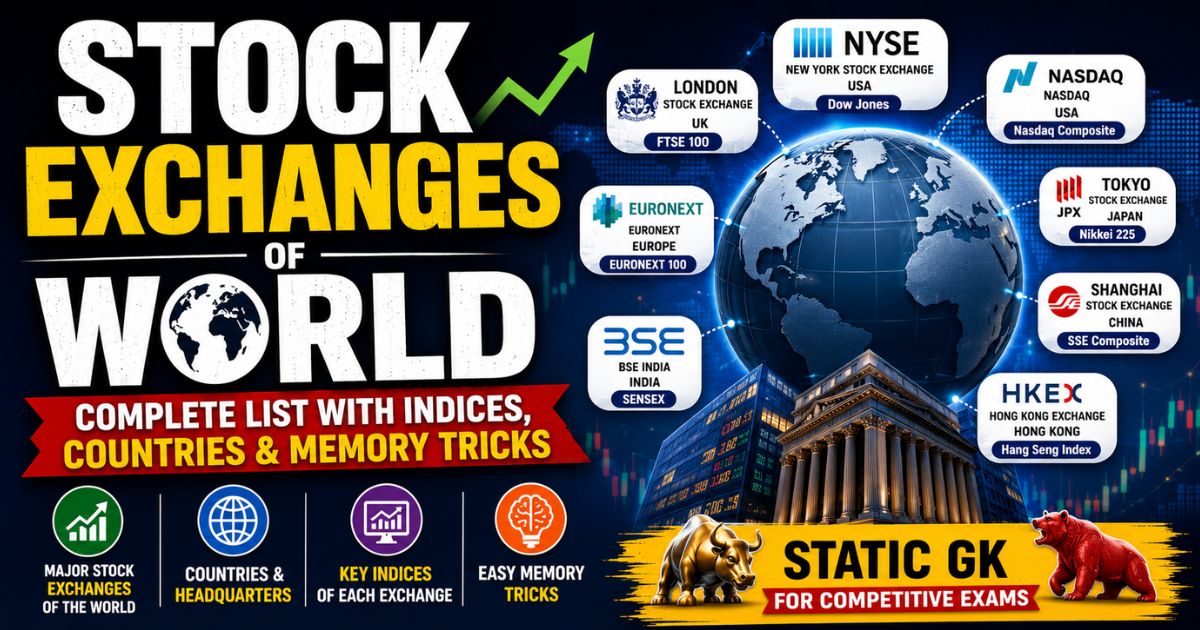
This article covers the complete list of major stock exchanges of the world along with their host cities, founding years, benchmark indices and exam-relevant facts. It also includes India's SEBI-recognised exchanges, the latest global market capitalisation ranking, frequently confused facts and easy mnemonics. Aspirants preparing for SSC, IBPS, RRB, Insurance, PSU and UPSC Prelims can revise the entire topic in one place using the tables and one-liners.
Jump to section
Introduction
Stock exchanges are among the most frequently tested areas of General Awareness in Indian government exams. Whether it is a one-mark question in SSC CGL asking which country's benchmark index is the Nikkei 225, an IBPS PO question on the world's first electronic stock exchange, or a UPSC Prelims statement-based question on SEBI and India's International Financial Services Centre, this single topic delivers steady returns for very little study time.
The reason is simple. Stock exchange facts are static in nature but sit right next to current affairs. The founding year of the Bombay Stock Exchange will never change, yet the same exchange appears in the news every month through index milestones, new listings and regulatory decisions. This overlap makes the topic a favourite for paper setters, because a single question can test both memory and awareness. Aspirants who build a strong foundation here also find Static GK notes on related economy topics much easier to absorb.
This article organises the entire topic into clean, revision-ready tables. You will get the world's largest exchanges by market capitalisation, exchange-to-index mappings continent by continent, the full list of India's SEBI-recognised exchanges, landmark firsts, memory tricks, commonly confused pairs and a complete set of one-liners for last-minute revision before the exam.
Core Concept Explanation
A stock exchange is a regulated marketplace where shares, bonds, debentures, exchange-traded funds and derivative contracts are bought and sold under a defined set of rules. It provides transparency in pricing, safety in settlement and liquidity to investors. Before moving to the lists, these basic terms must be clear because exams often test the concept rather than the name.
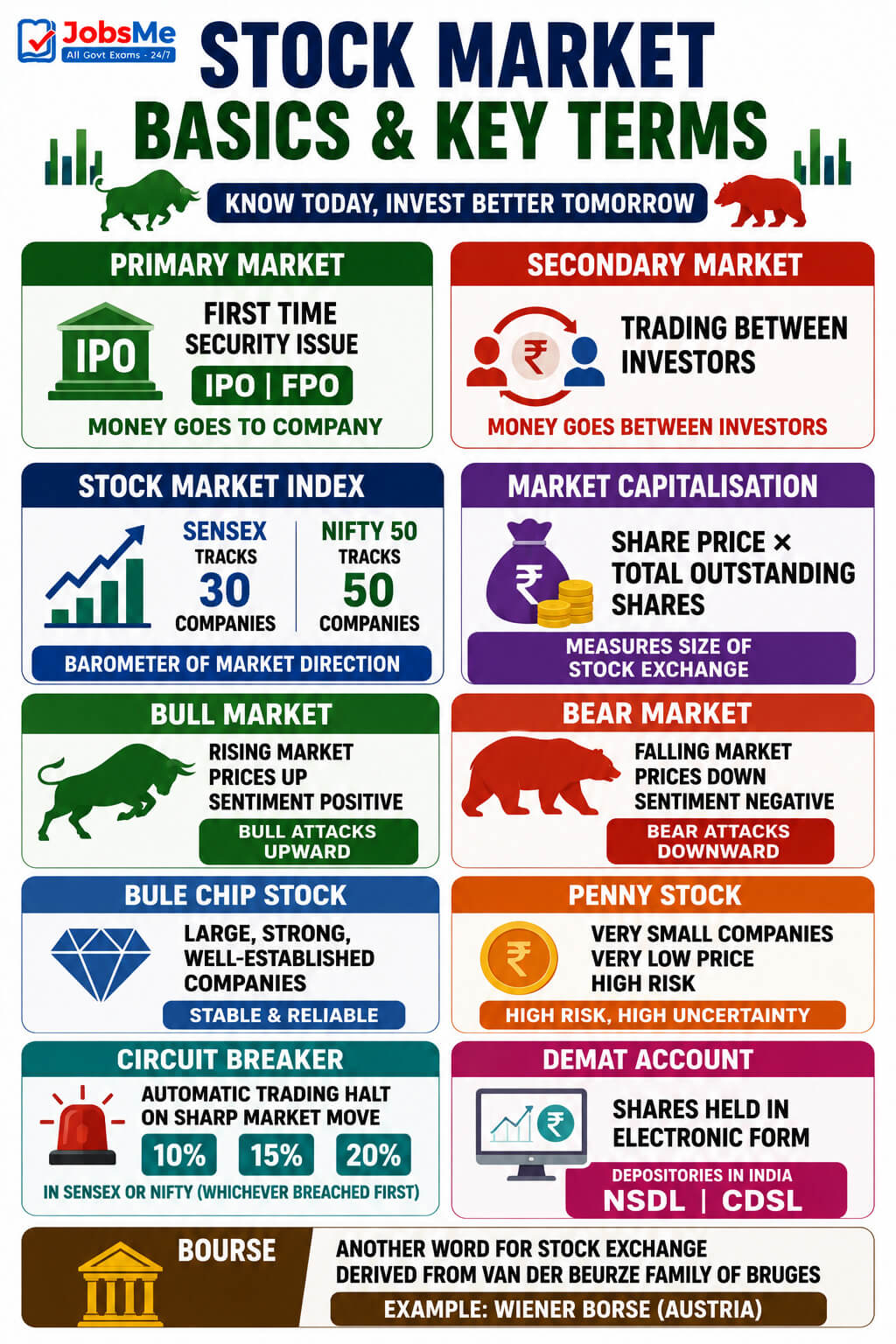
- Primary Market: The market where securities are issued for the first time. A company raises fresh capital here through an IPO (Initial Public Offering) or an FPO (Follow-on Public Offer). Money flows directly to the company.
- Secondary Market: The market where already-issued securities are traded between investors. This is what a stock exchange primarily operates. Money flows between investors, not to the company.
- Stock Market Index: A statistical measure that tracks the price movement of a selected group of stocks. The Sensex tracks 30 companies, the Nifty 50 tracks 50 companies. An index acts as a barometer of overall market direction.
- Market Capitalisation: Share price multiplied by the total number of outstanding shares. The size of a stock exchange is compared using the combined domestic market capitalisation of all companies primarily listed on it.
- Bull Market: A rising market where prices trend upward and investor sentiment is optimistic. A bull attacks by thrusting its horns upward.
- Bear Market: A falling market where prices trend downward. A bear attacks by swiping its paw downward.
- Blue Chip Stock: Shares of large, financially sound, well-established companies with a long record of stable earnings.
- Penny Stock: Shares of very small companies that trade at very low prices and carry high risk.
- Circuit Breaker: An automatic trading halt triggered when a benchmark index moves sharply. In India, market-wide circuit breakers apply at 10 percent, 15 percent and 20 percent movement in the Sensex or Nifty, whichever is breached first.
- Demat Account: An account that holds shares in electronic form instead of physical certificates. India's depositories are NSDL and CDSL.
- Bourse: Another word for a stock exchange, derived from the Van der Beurze family of Bruges. Many European exchanges still carry this name, such as Wiener Borse in Austria.
Exchanges are regulated by a national securities regulator. India's regulator is the Securities and Exchange Board of India (SEBI), the United States has the Securities and Exchange Commission (SEC), and the United Kingdom has the Financial Conduct Authority (FCA). A strong grasp of these regulators pays off across the entire Banking Awareness syllabus, since the same bodies appear in questions on capital markets, mutual funds and investor protection.
Major Stock Exchanges of the World
Top 10 Largest Stock Exchanges by Market Capitalisation
The ranking below is based on domestic market capitalisation as reported by the World Federation of Exchanges (WFE) for March 2026. In a major shift, Nasdaq overtook the New York Stock Exchange to become the world's largest exchange by this measure, and for the first time both Indian exchanges, NSE and BSE, entered the global top 10 together. Rankings move month to month, so remember the order rather than the exact figures.
| Rank | Stock Exchange | Country / Region | Approx. Market Cap (March 2026) | Key Features |
|---|---|---|---|---|
| 1 | Nasdaq | United States (New York) | About 35.0 trillion US dollars | Founded in 1971 as the world's first fully electronic stock exchange. Has no physical trading floor. Lists over 3,900 companies dominated by technology, semiconductors, artificial intelligence and biotechnology. Indices are the Nasdaq Composite and Nasdaq-100. Home to Apple, Microsoft, Nvidia, Amazon and Tesla. |
| 2 | New York Stock Exchange (NYSE) | United States (New York) | About 31.0 trillion US dollars | Founded in 1792 through the Buttonwood Agreement on Wall Street. Nicknamed the Big Board. Uses a hybrid model combining electronic matching with human Designated Market Makers on a physical floor. Primary home of the Dow Jones Industrial Average and S&P 500. Lists over 2,300 blue chip companies. |
| 3 | Shanghai Stock Exchange (SSE) | China (Shanghai) | About 10.2 trillion US dollars | Re-established in 1990. Lists over 2,200 companies including major state-owned enterprises such as ICBC and PetroChina. Indices are the SSE Composite and SSE 50. Operates A-shares in yuan for domestic investors and B-shares in US dollars open to foreign investors. |
| 4 | Euronext | Europe (headquartered in Amsterdam) | About 8.7 trillion US dollars | Created in 2000 by merging the Amsterdam, Brussels and Paris exchanges. Europe's largest exchange group, now spanning France, the Netherlands, Belgium, Ireland, Portugal, Italy, Greece and Norway. Indices include Euronext 100, CAC 40 and AEX. Lists LVMH, Airbus, ASML and TotalEnergies. |
| 5 | Japan Exchange Group (JPX) | Japan (Tokyo) | About 7.6 trillion US dollars | Formed in 2013 by merging the Tokyo Stock Exchange (established 1878) and the Osaka Securities Exchange. Asia's leading developed market. Indices are the Nikkei 225 and TOPIX. Lists Toyota, Sony and Mitsubishi UFJ Financial Group. |
| 6 | Shenzhen Stock Exchange (SZSE) | China (Shenzhen) | About 6.4 trillion US dollars | Established in 1990. The fastest riser in recent global rankings, moving from ninth to sixth position. Focused on technology, electric vehicles, renewable energy and advanced manufacturing. Operates the ChiNext board for high-growth firms. Index is the SZSE Component Index. Lists BYD, Ping An Insurance and CATL. |
| 7 | Hong Kong Exchanges and Clearing (HKEX) | Hong Kong | About 5.9 trillion US dollars | Formed in 2000 by merging the Stock Exchange of Hong Kong, Hong Kong Futures Exchange and Hong Kong Securities Clearing Company. Acts as the bridge between mainland China and global capital through the Stock Connect programmes. Benchmark index is the Hang Seng Index. Lists Tencent, HSBC and China Mobile. |
| 8 | TMX Group (Toronto Stock Exchange) | Canada (Toronto) | About 4.7 trillion US dollars | The Toronto Stock Exchange was founded in 1852, making it one of the oldest in North America. TMX Group also operates the TSX Venture Exchange. Strong concentration in energy, mining and financial services. Index is the S&P/TSX Composite. Lists Royal Bank of Canada, Shopify and Enbridge. |
| 9 | National Stock Exchange of India (NSE) | India (Mumbai) | About 4.3 trillion US dollars | Incorporated in 1992 and began operations in 1994. India's largest exchange by trading volume and turnover. First Indian exchange to introduce fully automated screen-based electronic trading. Benchmark index is the Nifty 50. Also the world's largest derivatives exchange by number of contracts traded. |
| 10 | BSE India (Bombay Stock Exchange) | India (Mumbai) | About 4.3 trillion US dollars | Founded in 1875, the oldest stock exchange in Asia. Located on Dalal Street, Mumbai. Lists over 5,500 companies, among the highest in the world by number of listings. Benchmark index is the S&P BSE Sensex, which tracks 30 blue chip stocks. |
Exchanges Ranked 11 to 15 Globally
These exchanges sit just outside the top 10 but appear regularly in question papers, especially the London Stock Exchange, which slipped out of the top 10 as Chinese, Indian and Canadian markets expanded.
| Rank | Stock Exchange | Country | Approx. Market Cap | Key Features |
|---|---|---|---|---|
| 11 | London Stock Exchange (LSE) | United Kingdom | About 4.0 trillion US dollars | Traces its origins to Jonathan's Coffee House in 1698 and was formally founded in 1801. Located at Paternoster Square, London. Hosts listings from more than 60 countries, making it one of the most internationally connected exchanges. Benchmark index is the FTSE 100. |
| 12 | Taiwan Stock Exchange (TWSE) | Taiwan | About 3.2 trillion US dollars | Established in 1961 and began trading in 1962. Heavily weighted towards semiconductors and electronics manufacturing. Benchmark index is the TAIEX, formally the TWSE Capitalization Weighted Stock Index. |
| 13 | Korea Exchange (KRX) | South Korea | About 3.1 trillion US dollars | Formed in 2005 by merging the Korea Stock Exchange, the KOSDAQ market and the Korea Futures Exchange. Headquartered in Busan. Main index is the KOSPI, with KOSDAQ serving smaller technology companies. |
| 14 | Saudi Exchange (Tadawul) | Saudi Arabia | About 2.8 trillion US dollars | The largest stock exchange in West Asia and the Arab world, located in Riyadh. Gained global prominence after the record listing of Saudi Aramco in 2019. Benchmark index is the Tadawul All Share Index, abbreviated as TASI. |
| 15 | Australian Securities Exchange (ASX) | Australia | About 2.3 trillion US dollars | Formed in 1987 by merging six state-based exchanges and headquartered in Sydney. Strong in mining, banking and resources. Indices are the S&P/ASX 200 and the All Ordinaries. |
Important Stock Exchanges of Asia and Their Indices
| Stock Exchange | Country | City / Headquarters | Benchmark Index | Key Features |
|---|---|---|---|---|
| Tokyo Stock Exchange (under JPX) | Japan | Tokyo | Nikkei 225 and TOPIX | Established in 1878, Asia's largest developed market. The Nikkei 225 is a price-weighted index compiled by the Nihon Keizai Shimbun newspaper. TOPIX is a broader capitalisation-weighted index of the Prime Market. |
| Shanghai Stock Exchange | China | Shanghai | SSE Composite Index | China's largest exchange, dominated by state-owned banks, energy and infrastructure companies. Base value of 100 set in December 1990. |
| Shenzhen Stock Exchange | China | Shenzhen | SZSE Component Index | China's technology and new-economy exchange. Operates the ChiNext board, comparable in purpose to Nasdaq. |
| Hong Kong Stock Exchange (HKEX) | Hong Kong | Hong Kong | Hang Seng Index | The Hang Seng Index was launched in 1969 with a base date of 31 July 1964 and base value of 100. Serves as the main gateway for mainland Chinese firms raising international capital. |
| Korea Exchange (KRX) | South Korea | Busan | KOSPI | KOSPI stands for Korea Composite Stock Price Index, with a base date of 4 January 1980 and base value of 100. Dominated by Samsung Electronics, SK Hynix and Hyundai. |
| Taiwan Stock Exchange | Taiwan | Taipei | TAIEX | Global centre for semiconductor listings, most notably TSMC. Index reflects nearly all listed common shares. |
| Singapore Exchange (SGX) | Singapore | Singapore | Straits Times Index (STI) | Formed in 1999 by merging the Stock Exchange of Singapore and the Singapore International Monetary Exchange. Southeast Asia's leading financial hub. Formerly hosted SGX Nifty derivatives on India's Nifty 50. |
| Bursa Malaysia | Malaysia | Kuala Lumpur | FTSE Bursa Malaysia KLCI | Formerly the Kuala Lumpur Stock Exchange. KLCI stands for Kuala Lumpur Composite Index and tracks the 30 largest companies. Also a global hub for Islamic finance and sukuk listings. |
| Indonesia Stock Exchange (IDX) | Indonesia | Jakarta | Jakarta Composite Index (IHSG) | Formed in 2007 by merging the Jakarta and Surabaya stock exchanges. Southeast Asia's largest market by number of listed companies in recent years. |
| Stock Exchange of Thailand (SET) | Thailand | Bangkok | SET Index | Began operations in 1975. Strong presence of energy, banking, tourism and healthcare companies. |
| Philippine Stock Exchange (PSE) | Philippines | Taguig, Metro Manila | PSEi | Traces its roots to the Manila Stock Exchange of 1927, making it among the oldest exchanges in Asia. Current form created in 1992 by merging the Manila and Makati exchanges. |
| Ho Chi Minh Stock Exchange (HOSE) | Vietnam | Ho Chi Minh City | VN-Index | Established in 2000 as Vietnam's main exchange. Hanoi Stock Exchange, with the HNX-Index, serves smaller companies and bonds. |
| Pakistan Stock Exchange (PSX) | Pakistan | Karachi | KSE-100 | Formed in 2016 by merging the Karachi, Lahore and Islamabad stock exchanges. The Karachi exchange itself dates back to 1947. |
| Dhaka Stock Exchange (DSE) | Bangladesh | Dhaka | DSEX | Established in 1954. Bangladesh also operates the Chittagong Stock Exchange, set up in 1995. |
| Colombo Stock Exchange (CSE) | Sri Lanka | Colombo | All Share Price Index (ASPI) | One of South Asia's oldest exchanges, with share trading in the country dating to 1896. Also publishes the S&P Sri Lanka 20 index. |
| Nepal Stock Exchange (NEPSE) | Nepal | Kathmandu | NEPSE Index | Established in 1993 and the only stock exchange in Nepal. Heavily weighted towards banking, insurance and hydropower companies. |
| Tel Aviv Stock Exchange (TASE) | Israel | Tel Aviv | TA-35 and TA-125 | Established in 1953. Notable for technology, defence and pharmaceutical listings. TA-35 tracks the 35 largest companies. |
| Dubai Financial Market (DFM) | United Arab Emirates | Dubai | DFM General Index | Established in 2000. The UAE also hosts Nasdaq Dubai for international listings and the Abu Dhabi Securities Exchange with the FTSE ADX General Index. |
| Qatar Stock Exchange (QSE) | Qatar | Doha | QE Index | Founded in 1995 as the Doha Securities Market and renamed in 2009. Dominated by banking, energy and telecom companies. |
| Borsa Istanbul | Turkiye | Istanbul | BIST 100 | Formed in 2013 by merging the Istanbul Stock Exchange, the Istanbul Gold Exchange and the Derivatives Exchange of Turkiye. |
Important Stock Exchanges of Europe and Their Indices
| Stock Exchange | Country | City | Benchmark Index | Key Features |
|---|---|---|---|---|
| London Stock Exchange (LSE) | United Kingdom | London | FTSE 100 | Formally founded in 1801 with origins in Jonathan's Coffee House, 1698. FTSE stands for Financial Times Stock Exchange and is nicknamed Footsie. Launched in 1984 with a base value of 1000. Lists HSBC, BP, Shell and Unilever. |
| Euronext Amsterdam | Netherlands | Amsterdam | AEX Index | Founded in 1602 by the Dutch East India Company (VOC), it is recognised as the world's oldest modern stock exchange. It was the first venue to trade transferable company shares rather than only commodities. |
| Euronext Paris | France | Paris | CAC 40 | CAC stands for Cotation Assistee en Continu. The index tracks 40 large French companies and was launched with a base value of 1000 in 1987. Formerly known as the Paris Bourse. |
| Frankfurt Stock Exchange (Deutsche Borse) | Germany | Frankfurt | DAX | Germany's principal exchange, operated by Deutsche Borse with the Xetra electronic platform. The DAX was launched in 1988 with 30 companies and was expanded to 40 companies in 2021. Frankfurt claims origins in 1585 as a currency exchange. |
| SIX Swiss Exchange | Switzerland | Zurich | Swiss Market Index (SMI) | Switzerland's principal exchange. SMI tracks 20 leading companies including Nestle, Roche and Novartis. SIX Group also owns Spain's BME exchange. |
| Bolsa de Madrid (BME Spanish Exchanges) | Spain | Madrid | IBEX 35 | Spain's main exchange, founded in 1831. Acquired by SIX Group of Switzerland in 2020. IBEX 35 tracks the 35 most liquid Spanish stocks. |
| Euronext Milan (formerly Borsa Italiana) | Italy | Milan | FTSE MIB | Italy's main exchange, acquired by Euronext in 2021 after previously being owned by the London Stock Exchange Group. MIB stands for Milano Indice di Borsa. |
| Nasdaq Stockholm (Nasdaq Nordic) | Sweden | Stockholm | OMX Stockholm 30 | Part of the Nasdaq Nordic group, which also operates the Copenhagen, Helsinki and Iceland exchanges. Notable for industrial and telecom listings. |
| Euronext Oslo (Oslo Bors) | Norway | Oslo | OBX Index | Founded in 1819 and acquired by Euronext in 2019. Strong presence of energy, shipping and seafood companies. |
| Wiener Borse | Austria | Vienna | ATX | Founded in 1771 by Empress Maria Theresa, making it one of the oldest exchanges in the world. ATX stands for Austrian Traded Index. |
| Warsaw Stock Exchange (GPW) | Poland | Warsaw | WIG20 | Re-established in 1991 after the fall of communism and now Central Europe's largest exchange. WIG stands for Warszawski Indeks Gieldowy. |
| Athens Stock Exchange (ATHEX) | Greece | Athens | ATHEX Composite Index | Founded in 1876 and now part of the Euronext group, extending Euronext's reach into southeastern Europe. |
| Moscow Exchange (MOEX) | Russia | Moscow | MOEX Russia Index and RTS Index | Formed in 2011 by merging MICEX and the RTS exchange. The MOEX index is denominated in roubles while the RTS index is denominated in US dollars. |
| Euronext Brussels | Belgium | Brussels | BEL 20 | One of the three founding members of Euronext in 2000. Belgium's Antwerp Bourse of 1531 is often cited as an early forerunner of the modern stock exchange. |
Important Stock Exchanges of Africa, the Americas and Oceania
| Stock Exchange | Country | City | Benchmark Index | Key Features |
|---|---|---|---|---|
| New York Stock Exchange | United States | New York (11 Wall Street) | Dow Jones Industrial Average and S&P 500 | The Dow Jones Industrial Average, created in 1896 by Charles Dow, is a price-weighted index of 30 large US companies. The S&P 500 tracks 500 leading US companies and is the most widely used benchmark for the US market. |
| Nasdaq | United States | New York (Times Square) | Nasdaq Composite and Nasdaq-100 | The world's first electronic stock market, launched in 1971. Nasdaq stands for National Association of Securities Dealers Automated Quotations. Technology-heavy composition. |
| Chicago Board Options Exchange (Cboe) | United States | Chicago | VIX (Volatility Index) | Founded in 1973 as the first US options exchange. The VIX, popularly called the fear index, measures expected market volatility. India's equivalent is the India VIX, computed by NSE. |
| Toronto Stock Exchange (TSX) | Canada | Toronto | S&P/TSX Composite | Founded in 1852 and operated by TMX Group. The world's leading listing venue for mining and natural resource companies. |
| B3 (Brasil Bolsa Balcao) | Brazil | Sao Paulo | Ibovespa (Bovespa Index) | Latin America's largest exchange, formed in 2017 by merging BM&FBOVESPA and CETIP. Ibovespa was launched in 1968 and is the region's most tracked benchmark. |
| Bolsa Mexicana de Valores (BMV) | Mexico | Mexico City | IPC (S&P/BMV IPC) | Founded in 1894 and the second largest exchange in Latin America. IPC stands for Indice de Precios y Cotizaciones. |
| Bolsas y Mercados Argentinos (BYMA) | Argentina | Buenos Aires | S&P MERVAL | Successor to the Buenos Aires Stock Exchange founded in 1854. MERVAL stands for Mercado de Valores. |
| Santiago Stock Exchange | Chile | Santiago | S&P IPSA | Founded in 1893. IPSA stands for Indice de Precios Selectivo de Acciones and tracks the most actively traded Chilean shares. |
| Johannesburg Stock Exchange (JSE) | South Africa | Johannesburg | FTSE/JSE All Share and Top 40 | Founded in 1887 during the gold rush, it is Africa's largest and oldest existing stock exchange. Strong in mining, resources and financial services. |
| Egyptian Exchange (EGX) | Egypt | Cairo and Alexandria | EGX 30 | Among the oldest exchanges in Africa and West Asia, with Alexandria established in 1883 and Cairo in 1903. Now operates as a single unified exchange. |
| Nigerian Exchange Group (NGX) | Nigeria | Lagos | NGX All-Share Index | Established in 1960 as the Lagos Stock Exchange and demutualised into NGX Group in 2021. West Africa's largest exchange. |
| Australian Securities Exchange (ASX) | Australia | Sydney | S&P/ASX 200 and All Ordinaries | Formed in 1987 from six state exchanges. Among the world's largest markets for mining and resources listings. |
| New Zealand Exchange (NZX) | New Zealand | Wellington | S&P/NZX 50 | Formed in its modern shape in 2003 after the consolidation of regional exchanges dating to 1870. |
Stock Exchanges of India Recognised by SEBI
India's securities market is regulated by SEBI, established as a non-statutory body on 12 April 1988 and granted statutory powers under the SEBI Act, 1992. The functioning of exchanges is governed by the Securities Contracts (Regulation) Act, 1956, usually abbreviated as SCRA. SEBI has de-recognised most regional exchanges since 2005, reducing an earlier count of over 20 active exchanges to a small handful.
| Exchange | Established | Headquarters | Segment | Key Features |
|---|---|---|---|---|
| Bombay Stock Exchange (BSE Ltd) | 1875 | Dalal Street, Mumbai | Equity, derivatives, debt, SME, mutual funds | Asia's oldest stock exchange, founded as The Native Share and Stock Brokers' Association under a banyan tree. Flagship index is the S&P BSE Sensex of 30 stocks, first compiled in 1986 with a base year of 1978-79 and base value 100. Lists over 5,500 companies. BSE was the first Indian exchange to list itself, in 2017. |
| National Stock Exchange of India (NSE) | Incorporated 1992, operations from 1994 | Bandra Kurla Complex, Mumbai | Equity, derivatives, currency, debt, SME | Set up on the recommendation of the Pherwani Committee and promoted by leading Indian financial institutions. First exchange in India to introduce fully automated screen-based electronic trading, ending the open outcry system. Flagship index is the Nifty 50, with a base date of 3 November 1995 and base value of 1000. World's largest derivatives exchange by number of contracts traded. |
| Multi Commodity Exchange of India (MCX) | 2003 | Mumbai | Commodity derivatives | India's largest commodity derivatives exchange, dealing in bullion, energy, base metals and agricultural commodities. Was brought under SEBI's regulation in 2015 when the Forward Markets Commission was merged into SEBI. |
| National Commodity and Derivatives Exchange (NCDEX) | 2003 | Mumbai | Agricultural commodity derivatives | India's leading exchange for agricultural commodity futures such as guar seed, castor seed, chana, soybean and cotton. Publishes the Agridex agricultural index. |
| India International Exchange (India INX) | 2017 | GIFT City, Gandhinagar, Gujarat | International securities and derivatives | India's first international stock exchange, a subsidiary of BSE, located in the GIFT City International Financial Services Centre. Offers extended trading hours and tax concessions to foreign investors. |
| NSE International Exchange (NSE IX or NSE IFSC) | 2017 | GIFT City, Gandhinagar, Gujarat | International securities and derivatives | Subsidiary of NSE at GIFT City. Hosts GIFT Nifty, the US dollar denominated Nifty derivative that replaced SGX Nifty from 3 July 2023 through the NSE IX-SGX Connect arrangement. |
| Metropolitan Stock Exchange of India (MSEI) | 2008 | Mumbai | Equity, derivatives, currency, debt | India's third national-level exchange, formerly MCX-SX. Retains SEBI recognition but operates with very limited trading activity. Its index is the SX40. |
| Calcutta Stock Exchange (CSE) | 1908 | Lyons Range, Kolkata | Equity | India's second oldest stock exchange. Retains SEBI recognition but has minimal operations and has sought voluntary exit. Its index was the CSE-40. |
Landmark Firsts and Superlatives

| Superlative | Answer | Key Features |
|---|---|---|
| World's oldest modern stock exchange | Amsterdam Stock Exchange, 1602 | Established to trade shares of the Dutch East India Company. Recognised by Guinness World Records as the oldest stock exchange. Now Euronext Amsterdam. The Antwerp Bourse of 1531 dealt mainly in bills and debt and is treated as a forerunner rather than a true stock exchange. |
| World's first initial public offering | Dutch East India Company (VOC), 1602 | The VOC issued printed, transferable shares to the public and permanent capital, creating the first genuine secondary market for equity. |
| World's first fully electronic stock exchange | Nasdaq, 1971 | Launched on 8 February 1971 with no physical trading floor, operating purely on a computerised quotation system. |
| World's largest stock exchange by market capitalisation | Nasdaq, as of March 2026 | Overtook the NYSE for the first time on the strength of technology and artificial intelligence listings. The NYSE held this title for decades before this shift. |
| World's largest derivatives exchange by contracts traded | National Stock Exchange of India (NSE) | Has topped the Futures Industry Association rankings by number of contracts traded every year since 2019. |
| Oldest stock exchange in Asia | Bombay Stock Exchange, 1875 | Founded as The Native Share and Stock Brokers' Association by Premchand Roychand and fellow brokers on Dalal Street, Mumbai. |
| Oldest existing stock exchange in Africa | Johannesburg Stock Exchange, 1887 | Founded to finance the Witwatersrand gold rush and remains Africa's largest exchange by market capitalisation. |
| India's first international stock exchange | India INX, 2017 | Located at GIFT City IFSC and promoted by BSE. Trades in US dollars with almost 22-hour trading availability. |
| India's first exchange with screen-based trading | National Stock Exchange | Introduced nationwide electronic trading in 1994, replacing the open outcry ring-based system and democratising market access beyond Mumbai. |
| Europe's largest stock exchange | Euronext | A pan-European exchange spanning eight countries under one unified trading platform, headquartered in Amsterdam. |
| Largest stock exchange by number of listed companies | BSE India | Over 5,500 listed companies, one of the highest counts of any exchange in the world. |
| Largest stock exchange in the Arab world | Saudi Exchange (Tadawul) | Riyadh-based exchange that gained global attention with the Saudi Aramco listing of 2019, at the time the world's largest IPO. |
Memory Tricks and Mnemonics
Trick 1: NASDAQ NOW Number One
The single biggest update in this topic is the change at the top. Remember the phrase Nasdaq Now Number one, NYSE Next. All three words begin with N and the order is alphabetically convenient because Nasdaq comes before New York. This one trick answers the most likely question from the entire topic.
Trick 2: The 1602 to 1971 Bookends
Two dates carry the maximum weight in this topic. Use Amsterdam sixteen-oh-two started it, Nasdaq nineteen seventy-one digitised it. Amsterdam is the world's oldest and Nasdaq is the world's first electronic. Every other founding year sits between these two bookends, so if a question offers an option before 1602 for a stock exchange, it is almost certainly wrong.
Trick 3: BSE is Older, NSE is Bolder
Use the rhyme BSE is Older, NSE is Bolder.
- Older reminds you BSE came first in 1875, is Asia's oldest, and has more listed companies.
- Bolder reminds you NSE came later in 1992, brought bold technology in the form of electronic trading, and leads in trading volume and derivatives.
Trick 4: Count the Letters for Sensex and Nifty
Students constantly swap the index numbers. Use letter counting instead of memorising: SENSEX has six letters, so think 3 doubled equals 30. NIFTY has five letters, so think 5 into 10 equals 50. Alternatively, Sensex is Shorter so it has fewer stocks at 30, Nifty is Fifty. The word Nifty itself contains the sound of fifty.
Trick 5: The FAN DAX CAT Mnemonic for Europe
Group Europe's four most-asked index and country pairs using FAN DAX CAT.
- F for FTSE, which belongs to the UK.
- DAX for Germany, easy to recall because both DAX and Deutschland begin with D.
- CAT for CAC 40, which belongs to France, since a cat in French is chat and both begin with C.
- AN for AEX in Amsterdam, Netherlands, since all three share the letter A or N.
The country and its index share a first letter in almost every European case, which makes this the fastest recall route.
Trick 6: The Asian NIKe SEng Story
Picture an athlete wearing NIKe shoes running through Tokyo, then meeting SEng in Hong Kong, and finally being COSPIed by a Korean police officer.
- NIKkei to Japan.
- Hang Seng to Hong Kong.
- KOSPI to Korea, where the K matches Korea directly.
- TAIEX to Taiwan, where the first three letters match the country name.
Trick 7: Two Cities, Two Indias, Two GIFTs
For the Indian list, remember Two in Mumbai, Two at GIFT, Two in Commodities.
- Two in Mumbai for the main equity pair, BSE and NSE.
- Two at GIFT for the international pair, India INX which belongs to BSE and NSE IX which belongs to NSE. Match the letters: I in INX for the Indian original BSE's subsidiary, and NSE IX because it repeats NSE.
- Two in Commodities for MCX which handles metals and energy, and NCDEX where the C stands for Crops and Commodities of the agricultural kind.
Trick 8: Bull Up, Bear Down
Never mix up market sentiment again with the image of the animals attacking. A bull thrusts its horns upward, so a bull market rises. A bear swipes its paw downward, so a bear market falls. The bronze Charging Bull statue near Wall Street reinforces the bull as the symbol of an optimistic market.
Additional Notes
Frequently Confused Facts
- Sensex versus Nifty 50: Sensex belongs to BSE and tracks 30 stocks. Nifty 50 belongs to NSE and tracks 50 stocks. Sensex base year is 1978-79 with base value 100. Nifty base date is 3 November 1995 with base value 1000.
- SEBI 1988 versus SEBI 1992: SEBI was created as a non-statutory body on 12 April 1988. It received statutory powers under the SEBI Act, 1992. Both years appear as options in the same question, so read whether the question asks about establishment or statutory status.
- India INX versus NSE IX: India INX is BSE's international exchange and is officially India's first international stock exchange. NSE IX, also called NSE IFSC, is NSE's international exchange and is where GIFT Nifty is traded. Both are located at GIFT City, Gandhinagar.
- Oldest in the world versus oldest in Asia: Amsterdam of 1602 is the world's oldest. BSE of 1875 is Asia's oldest. Frankfurt claims 1585 as a currency exchange but was not a share market at that time, and Antwerp of 1531 traded debt instruments rather than company shares.
- Largest by market cap versus largest by volume versus largest by listings: Nasdaq is largest by market capitalisation. NSE is India's largest by trading volume and the world's largest derivatives exchange by contract count. BSE has the highest number of listed companies among Indian exchanges.
- NYSE versus Nasdaq structure: NYSE follows a hybrid auction model with Designated Market Makers on a physical floor. Nasdaq is a fully electronic dealer market with no floor.
- Dow Jones versus S and P 500: The Dow tracks 30 companies and is price-weighted. The S and P 500 tracks 500 companies and is capitalisation-weighted, making it the broader and more representative benchmark.
- SGX Nifty versus GIFT Nifty: SGX Nifty traded on the Singapore Exchange until 2023. It transitioned to GIFT Nifty on NSE IX at GIFT City from 3 July 2023, bringing offshore Nifty trading under Indian regulation.
- MOEX versus RTS: Both are Russian indices on the Moscow Exchange. MOEX is quoted in roubles while RTS is quoted in US dollars.
- Shanghai versus Shenzhen: Shanghai hosts large state-owned banks, energy and infrastructure firms. Shenzhen hosts technology, electric vehicle and new-economy firms and runs the ChiNext board.
Repeating PYQ Patterns
- SSC CGL, CHSL and MTS: Straightforward one-liners such as the headquarters of an exchange, which country the Nikkei 225 belongs to, the founding year of BSE, and which is Asia's oldest stock exchange. Country-to-index matching sets appear almost every cycle.
- IBPS PO, Clerk, SBI PO and RRB Officer Scale: Focus falls on SEBI's role and years, Sensex and Nifty composition, market regulators, IPO and FPO definitions, depositories NSDL and CDSL, and recent index milestones. Banking Awareness sections lean on GIFT City and IFSC-related questions.
- RRB NTPC, Group D and ALP: Simple factual recall such as the number of stocks in the Sensex, which city hosts Dalal Street, and which is the world's first electronic exchange.
- Insurance exams such as LIC AAO, NIACL and UIIC: Emphasis on capital market structure, primary versus secondary market, market capitalisation concepts, and regulator jurisdiction between SEBI and IRDAI.
- UPSC Prelims and State PCS: Statement-based questions on SEBI's powers, the Securities Contracts (Regulation) Act 1956, participatory notes, foreign portfolio investors, IFSC and GIFT City, and the difference between primary and secondary markets.
- PSU recruitment such as SAIL, NTPC and BHEL: Business awareness questions on major global indices and recent large IPOs.
Regular practice makes this recall automatic. Attempt a mixed set on the Static GK quiz series after completing the tables above, and pair it with daily current affairs reading so that index milestones and new listings stay fresh in memory.
Quick Insight
Stock exchange questions increasingly carry a current affairs angle, which is why this static topic keeps refreshing itself. Three developments deserve attention. First, the entry of both NSE and BSE into the global top 10 simultaneously marks India's arrival as a major capital market, backed by a domestic investor base that has expanded dramatically over the past decade. Second, the shift of SGX Nifty to GIFT Nifty in 2023 moved a multi-billion dollar offshore derivative contract onto Indian soil, strengthening GIFT City's position as India's international financial gateway. Third, Nasdaq overtaking the NYSE signals how decisively technology and artificial intelligence now dominate global equity value.
There is also a practical dimension worth noting. Almost every modern exchange runs on electronic order matching, algorithmic surveillance and high-speed networks, which is why questions on trading technology, terms such as algorithmic trading and co-location, and basic computing concepts overlap with the Computer Awareness syllabus in banking and insurance exams.
One-Liners for Quick Revision
- Nasdaq to United States, New York to Founded 1971, world's first fully electronic stock exchange and currently the largest by domestic market capitalisation at about 35 trillion US dollars.
- New York Stock Exchange to United States, 11 Wall Street to Founded 1792 through the Buttonwood Agreement, nicknamed the Big Board, second largest at about 31 trillion US dollars.
- Shanghai Stock Exchange to China to Re-established 1990, third largest globally, index is the SSE Composite, operates A-shares and B-shares.
- Euronext to Pan-European, headquartered in Amsterdam to Created in 2000 from Amsterdam, Brussels and Paris, Europe's largest exchange spanning eight countries.
- Japan Exchange Group to Japan, Tokyo to Formed 2013 from Tokyo Stock Exchange and Osaka Securities Exchange, indices are Nikkei 225 and TOPIX.
- Shenzhen Stock Exchange to China to Established 1990, focused on technology and electric vehicles, runs the ChiNext board, index is the SZSE Component Index.
- Hong Kong Exchanges and Clearing to Hong Kong to Formed 2000, index is the Hang Seng, acts as the bridge between mainland China and global investors through Stock Connect.
- TMX Group and Toronto Stock Exchange to Canada to TSX founded 1852, index is the S and P TSX Composite, global leader for mining listings.
- National Stock Exchange of India to India, Bandra Kurla Complex Mumbai to Incorporated 1992 and began operations 1994, index is Nifty 50, world's largest derivatives exchange by contracts traded.
- BSE India to India, Dalal Street Mumbai to Founded 1875, Asia's oldest exchange, index is the S and P BSE Sensex of 30 stocks, over 5,500 listed companies.
- London Stock Exchange to United Kingdom to Origins in Jonathan's Coffee House 1698, formally founded 1801, index is FTSE 100 launched in 1984 with base value 1000.
- Taiwan Stock Exchange to Taiwan, Taipei to Established 1961, index is TAIEX, global centre for semiconductor listings.
- Korea Exchange to South Korea, Busan to Formed 2005 by merging three exchanges, index is KOSPI with base date 4 January 1980 and base value 100.
- Saudi Exchange or Tadawul to Saudi Arabia, Riyadh to Largest exchange in the Arab world, index is TASI, hosted the Saudi Aramco listing in 2019.
- Australian Securities Exchange to Australia, Sydney to Formed 1987 from six state exchanges, indices are S and P ASX 200 and All Ordinaries.
- Singapore Exchange to Singapore to Formed 1999, index is the Straits Times Index, formerly hosted SGX Nifty derivatives.
- Bursa Malaysia to Malaysia, Kuala Lumpur to Formerly Kuala Lumpur Stock Exchange, index is FTSE Bursa Malaysia KLCI, major hub for Islamic finance.
- Indonesia Stock Exchange to Indonesia, Jakarta to Formed 2007 by merging Jakarta and Surabaya exchanges, index is the Jakarta Composite Index or IHSG.
- Stock Exchange of Thailand to Thailand, Bangkok to Began operations 1975, index is the SET Index.
- Philippine Stock Exchange to Philippines, Metro Manila to Roots in the Manila Stock Exchange of 1927, among Asia's oldest, index is the PSEi.
- Ho Chi Minh Stock Exchange to Vietnam to Established 2000, index is the VN-Index, with the Hanoi Stock Exchange running the HNX-Index.
- Pakistan Stock Exchange to Pakistan, Karachi to Formed 2016 by merging Karachi, Lahore and Islamabad exchanges, index is the KSE-100.
- Dhaka Stock Exchange to Bangladesh to Established 1954, index is DSEX, with Chittagong Stock Exchange founded in 1995.
- Colombo Stock Exchange to Sri Lanka to Share trading dates to 1896, index is the All Share Price Index or ASPI.
- Nepal Stock Exchange to Nepal, Kathmandu to Established 1993, the country's only stock exchange, index is the NEPSE Index.
- Tel Aviv Stock Exchange to Israel to Established 1953, indices are TA-35 and TA-125, strong in technology and pharmaceuticals.
- Dubai Financial Market to United Arab Emirates to Established 2000, index is the DFM General Index, with Nasdaq Dubai and Abu Dhabi Securities Exchange also operating in the UAE.
- Qatar Stock Exchange to Qatar, Doha to Founded 1995 as Doha Securities Market and renamed in 2009, index is the QE Index.
- Borsa Istanbul to Turkiye to Formed 2013 by merging three Turkish exchanges, index is the BIST 100.
- Euronext Amsterdam to Netherlands to Founded 1602 by the Dutch East India Company, the world's oldest modern stock exchange, index is the AEX.
- Euronext Paris to France to Formerly the Paris Bourse, index is the CAC 40 launched in 1987 with base value 1000.
- Frankfurt Stock Exchange to Germany to Operated by Deutsche Borse using the Xetra platform, index is the DAX which expanded from 30 to 40 companies in 2021.
- SIX Swiss Exchange to Switzerland, Zurich to Index is the Swiss Market Index tracking 20 leading firms including Nestle, Roche and Novartis.
- Bolsa de Madrid to Spain to Founded 1831 and acquired by SIX Group in 2020, index is the IBEX 35.
- Euronext Milan to Italy to Formerly Borsa Italiana and acquired by Euronext in 2021, index is the FTSE MIB.
- Nasdaq Stockholm to Sweden to Part of Nasdaq Nordic which also covers Copenhagen, Helsinki and Iceland, index is the OMX Stockholm 30.
- Euronext Oslo to Norway to Founded 1819 and acquired by Euronext in 2019, index is the OBX.
- Wiener Borse to Austria, Vienna to Founded 1771 by Empress Maria Theresa, among the world's oldest exchanges, index is the ATX.
- Warsaw Stock Exchange to Poland to Re-established 1991, Central Europe's largest exchange, index is the WIG20.
- Athens Stock Exchange to Greece to Founded 1876 and now part of the Euronext group, index is the ATHEX Composite.
- Moscow Exchange to Russia to Formed 2011 by merging MICEX and RTS, indices are the MOEX Russia Index in roubles and the RTS Index in US dollars.
- Euronext Brussels to Belgium to A founding member of Euronext in 2000, index is the BEL 20.
- Chicago Board Options Exchange to United States, Chicago to Founded 1973 as the first US options exchange, publishes the VIX volatility index known as the fear index.
- B3 Brasil Bolsa Balcao to Brazil, Sao Paulo to Latin America's largest exchange formed in 2017, index is the Ibovespa launched in 1968.
- Bolsa Mexicana de Valores to Mexico, Mexico City to Founded 1894, Latin America's second largest exchange, index is the IPC.
- Bolsas y Mercados Argentinos to Argentina, Buenos Aires to Successor to the Buenos Aires exchange of 1854, index is the S and P MERVAL.
- Santiago Stock Exchange to Chile to Founded 1893, index is the S and P IPSA.
- Johannesburg Stock Exchange to South Africa to Founded 1887 during the gold rush, Africa's largest and oldest existing exchange, indices are FTSE JSE All Share and Top 40.
- Egyptian Exchange to Egypt to Alexandria established 1883 and Cairo in 1903, among the oldest in Africa and West Asia, index is the EGX 30.
- Nigerian Exchange Group to Nigeria, Lagos to Established 1960 as Lagos Stock Exchange and demutualised in 2021, index is the NGX All-Share Index.
- New Zealand Exchange to New Zealand, Wellington to Modern form created in 2003, index is the S and P NZX 50.
- Multi Commodity Exchange of India to India, Mumbai to Established 2003, India's largest commodity derivatives exchange for bullion, energy and metals.
- National Commodity and Derivatives Exchange to India, Mumbai to Established 2003, India's leading agricultural commodity futures exchange, publishes the Agridex.
- India International Exchange or India INX to India, GIFT City Gandhinagar to Launched 2017, India's first international stock exchange, a subsidiary of BSE.
- NSE International Exchange or NSE IX to India, GIFT City Gandhinagar to Launched 2017, hosts GIFT Nifty which replaced SGX Nifty from 3 July 2023.
- Metropolitan Stock Exchange of India to India, Mumbai to Established 2008 and formerly MCX-SX, index is the SX40, currently minimal trading activity.
- Calcutta Stock Exchange to India, Lyons Range Kolkata to Established 1908, India's second oldest exchange, now with negligible operations.
- SEBI to India's securities market regulator to Set up as a non-statutory body on 12 April 1988 and given statutory powers under the SEBI Act 1992, headquartered in Mumbai.
- Securities Contracts (Regulation) Act, 1956 to India to The law governing recognition and functioning of stock exchanges in India.
- Sensex to BSE benchmark to Tracks 30 blue chip stocks, first compiled in 1986, base year 1978-79 with base value 100, crossed the 80,000 mark for the first time in July 2024.
- Nifty 50 to NSE benchmark to Tracks 50 large-cap stocks, base date 3 November 1995 with base value 1000.
- Dow Jones Industrial Average to United States to Created in 1896 by Charles Dow, price-weighted index of 30 large US companies.
- S and P 500 to United States to Capitalisation-weighted index of 500 leading US companies, the most widely tracked benchmark of the US market.
- Circuit breaker in India to Market-wide trading halt to Triggered at 10 percent, 15 percent and 20 percent movement in the Sensex or Nifty, whichever is breached first.
- India VIX to Volatility index computed by NSE to Modelled on the Cboe VIX, a high reading indicates high expected market uncertainty.
- NSDL and CDSL to India's two depositories to Hold securities in electronic or dematerialised form, with NSDL established in 1996 and CDSL in 1999.
- World Federation of Exchanges to Global industry body to Publishes the monthly market capitalisation statistics used to rank exchanges worldwide.
- Futures Industry Association to Global derivatives trade body to Publishes annual rankings of derivatives exchanges by number of contracts traded, where NSE has led since 2019.
Once these one-liners feel comfortable, test yourself under exam conditions rather than simply re-reading. Work through a timed set on the Banking Awareness quizzes, follow it up with the daily current affairs quiz to catch fresh market updates, and keep an eye on the latest government job notifications so that your preparation stays aligned with the exams actually opening for applications.
Free quiz • No signup required
Put this topic into practice with Indian Cultural Institutions – Static GK MCQ Quiz. It is the quickest way to reinforce what you just learned.
Frequently Asked Questions
Which is the oldest stock exchange in the world?
Which is the largest stock exchange in the world by market capitalisation?
Which is the oldest stock exchange in Asia?
What is the difference between the Sensex and the Nifty 50?
Which was the world's first fully electronic stock exchange?
How many stock exchanges are recognised by SEBI in India?
Which is India's first international stock exchange?
What replaced SGX Nifty and where is it traded now?
Which stock exchange is the world's largest derivatives exchange?
When was SEBI established and when did it get statutory powers?

About the author