
Major Airports and Seaports of the World – Static GK & General Awareness for Competitive Exams with Memory Tricks
This article presents a complete, exam-ready list of the major airports and seaports of the world, covering the busiest airports by passenger traffic, international traffic, cargo and land area, along with the busiest container seaports, country-wise port lists and India's key aviation and maritime hubs. It includes the latest verified figures such as Atlanta (106.3 million passengers), Dubai (world's busiest international airport), Shanghai (55.06 million TEUs), Singapore (44.66 million TEUs) and King Fahd International Airport (largest airport by area). Memory tricks, frequently confused facts and one-liners are added so that UPSC, SSC, IBPS, RRB, PSU and State PCS aspirants can revise the entire topic quickly and score better in General Awareness and Geography sections.

Jump to section
- Introduction
- Core Concepts: Airports, Seaports and How They Are Ranked
- World's Busiest Airports by Total Passenger Traffic
- World's Busiest Airports by International Traffic, Cargo and Movements
- Largest Airports of the World by Land Area
- Busiest Airports of Europe
- Major Airports of India
- World's Busiest Seaports by Container Traffic
- Important Seaports of the World - Country-wise List
- Major Seaports of India
- Bonus: Busiest Railway Stations of the World and India
- Memory Tricks and Mnemonics
- Additional Notes
- One-Liners for Quick Revision
Introduction
Airports and seaports are the physical gateways of the global economy. Nearly all of the world's international cargo moves through seaports, while airports carry the high-value, time-sensitive share of world trade along with billions of passengers every year. Hartsfield-Jackson Atlanta International Airport is the world's busiest airport by passenger traffic, Dubai International Airport is the busiest for international passengers, Hong Kong International Airport leads in air cargo, and the Port of Shanghai has been the world's busiest container port for well over a decade. These are not random trivia items — each one reflects geography, trade routes and economic power.
Questions on major airports and seaports of the world appear regularly in UPSC Prelims, SSC CGL, SSC CHSL, IBPS PO, SBI Clerk, RRB NTPC, RRB Group D, Insurance, Defence and State PCS examinations. The usual patterns are simple and repetitive: which airport is the busiest, which port belongs to which country, which is the largest airport by area, and which port lies on which sea or strait. This article organises every important fact in tables, tricks and one-liners so that nothing is left to guesswork. For more topics in this section, you can go through the collection of Static GK notes for competitive exams.
This topic also overlaps heavily with current affairs — new port commissionings such as Vizhinjam, mega projects like Vadhavan and Galathea Bay, changes in global airport rankings, and trade disruptions at chokepoints such as the Strait of Malacca, the Strait of Hormuz and the Suez Canal. That makes it valuable for both Prelims-style matching questions and Mains-style answers on trade, logistics and infrastructure. Aspirants can pair this article with the daily current affairs updates to stay ready for both formats.
Core Concepts: Airports, Seaports and How They Are Ranked
Before memorising names and numbers, it helps to understand what is actually being measured. The same airport or port can rank first in one list and tenth in another, simply because the measuring unit is different. This single idea explains most of the confusion students face in this topic.
Key Terms You Must Know
- Port: A maritime facility with one or more wharves where ships dock to load and unload cargo and passengers. A port need not be on the coast — Hamburg (Germany), Manchester (UK) and Duluth (USA) lie many miles inland and are reached through rivers or canals.
- Harbour: A sheltered body of water where ships can anchor safely. A harbour is a natural or built shelter; a port is the commercial facility built around it.
- TEU (Twenty-Foot Equivalent Unit): The standard unit for measuring container volume, based on a 20-foot shipping container. A 40-foot container equals two TEUs. All container port rankings use TEUs.
- Transshipment hub: A port where containers are shifted from large deep-sea mother vessels to smaller regional feeder ships. Singapore is the world's largest transshipment hub.
- Draft: The depth of water a loaded ship needs. Deep-draft or deep-water ports such as Vizhinjam can receive the largest container vessels without dredging.
- Bunkering: The supply of marine fuel to ships. Singapore is the world's number one bunkering hub.
- Airport slot time: The pre-allocated permission for an airline to land or take off in a specific time window. It becomes critical at land-constrained airports such as Mumbai and London Heathrow.
- Dedicated Freight Corridor (DFC): High-capacity railway lines built only for freight. In India, DFCCIL runs the Western and Eastern DFCs, which speed up cargo movement to ports such as JNPA.

How Airports and Seaports Are Ranked
- Airports by total passengers: Departing, arriving, transferring and transit passengers added together. Ranked by Airports Council International (ACI).
- Airports by international passengers: Only cross-border passengers counted, which favours transit hubs like Dubai over domestic giants like Atlanta.
- Airports by cargo: Measured in metric tonnes of freight and mail handled.
- Airports by aircraft movements: Total take-offs and landings, which favours airports with many short-haul flights.
- Airports by land area: Physical size in square kilometres or square miles, which has nothing to do with how busy the airport is.
- Seaports by container traffic: Measured in TEUs. This is the most commonly asked list.
- Seaports by total cargo tonnage: Includes bulk cargo such as iron ore, coal and crude oil. Ningbo-Zhoushan leads this list even though Shanghai leads in TEUs.
Seaports handle over 90 per cent of international commercial cargo by volume and are responsible for roughly 70 per cent of global merchandise trade by value, which is exactly why examiners keep returning to this topic.
World's Busiest Airports by Total Passenger Traffic
The following table gives the top ten busiest airports of the world by total passenger traffic based on the latest full-year ACI World rankings. These ten airports together account for about 9 per cent of all global air passengers.
| Rank | Airport (Code) | City / Country | Passengers | Key Features and Exam Points |
|---|---|---|---|---|
| 1 | Hartsfield-Jackson Atlanta International (ATL) | Atlanta, United States | 106.3 million | World's busiest airport by passenger traffic and has held the title almost continuously since 1998. Primarily a domestic mega-hub; located within a two-hour flight of about 80 per cent of the US population. Uses a parallel runway layout allowing simultaneous landings and take-offs. |
| 2 | Dubai International (DXB) | Dubai, United Arab Emirates | 95.2 million | Second busiest overall but the world's busiest airport for international passengers. Acts as an intercontinental hub linking Europe, Asia, Africa and the Americas. Primary base of Emirates Airline; India is its single largest country market. |
| 3 | Tokyo Haneda (HND) | Tokyo, Japan | 91.7 million | Japan's largest airport and the main domestic and regional gateway to Greater Tokyo, complementing Narita Airport which handles more long-haul international traffic. |
| 4 | Dallas/Fort Worth International (DFW) | Dallas, United States | 85.7 million | One of the largest airports in the world by land area with seven runways and connectivity to over 260 destinations. Overwhelmingly a domestic hub. |
| 5 | Shanghai Pudong International (PVG) | Shanghai, China | 85.0 million | Recorded the biggest jump in the top ten, climbing from tenth to fifth on the strength of restored international connectivity and easier visa rules. China's busiest airport and a leading air cargo hub. Hub for China Eastern, Shanghai Airlines and Air China. |
| 6 | Chicago O'Hare International (ORD) | Chicago, United States | 84.9 million | Ranks first in the world for aircraft movements with about 860,000 take-offs and landings. Has eight runways, the highest of any major airport. |
| 7 | London Heathrow (LHR) | London, United Kingdom | 84.5 million | Europe's leading long-haul gateway and the world's second busiest airport for international passengers. Operates with only two runways, making slot management extremely tight. |
| 8 | Istanbul Airport (IST) | Istanbul, Turkey | 84.4 million | Opened in 2018 and is now Europe's busiest airport by total seats. Main hub of Turkish Airlines; handles domestic and international traffic from a single vast terminal. |
| 9 | Guangzhou Baiyun International (CAN) | Guangzhou, China | 83.6 million | Staged one of the sharpest recoveries in aviation history, rising from 57th position in 2022 back into the global top ten. Serves the Pearl River Delta manufacturing belt. |
| 10 | Denver International (DEN) | Denver, United States | 82.4 million | The largest airport in the United States by land area at about 53 square miles, and home to one of the world's longest commercial runways at 16,000 feet. Connects to roughly 215 destinations. |
Four of the top ten and five of the top twenty busiest airports are in the United States, reflecting the size of its domestic market, where domestic passengers form 80 to 95 per cent of traffic at these hubs. Global air travel touched an estimated 9.8 billion passengers in the latest reporting year.
World's Busiest Airports by International Traffic, Cargo and Movements
These three lists are different from the total-passenger list and are frequently mixed up in objective papers. Learn them separately.
Busiest International Passenger Airports
| Rank | Airport (Code) | Country | Key Features and Exam Points |
|---|---|---|---|
| 1 | Dubai International (DXB) | United Arab Emirates | World's busiest international airport for more than a decade. Almost all its traffic is international, which is why it beats Atlanta on this list despite ranking second overall. |
| 2 | London Heathrow (LHR) | United Kingdom | Europe's principal intercontinental gateway and Britain's main long-haul airport. |
| 3 | Amsterdam Schiphol (AMS) | Netherlands | Classic point-to-point and transfer hub of Western Europe; hub of KLM. Built on reclaimed land below sea level. |
| 4 | Seoul Incheon International (ICN) | South Korea | North-East Asia's premier international hub, regularly rated among the world's best airports for service quality. |
| 5 | Paris Charles de Gaulle (CDG) | France | France's largest airport and hub of Air France; also one of Europe's biggest cargo gateways. |
| 6 | Istanbul Airport (IST) | Turkey | Bridges Europe and Asia geographically and commercially; the fastest-rising major international hub of the last decade. |
| 7 | Singapore Changi (SIN) | Singapore | South-East Asia's leading transfer hub, repeatedly voted the world's best airport. Famous for the Jewel complex and the Rain Vortex. |
| 8 | Hong Kong International (HKG) | Hong Kong SAR, China | Doubles as the world's busiest cargo airport. Built on reclaimed land at Chek Lap Kok. |
| 9 | Frankfurt Airport (FRA) | Germany | Germany's largest airport, hub of Lufthansa, and one of Europe's top freight airports. |
| 10 | Madrid Adolfo Suarez-Barajas (MAD) | Spain | Spain's largest airport and the principal European gateway to Latin America; among the fastest-growing large hubs in Europe. |
Global Air Cargo Leaders
- Hong Kong International Airport (HKG): The world's busiest cargo airport, handling over 4.3 million metric tonnes of freight. Its advantage comes from proximity to the Pearl River Delta manufacturing region.
- Memphis International Airport (MEM), USA: Ranks second globally because it is the worldwide super-hub of FedEx Express, built around overnight express and e-commerce freight.
- Other regular names in the global top ten for cargo are Shanghai Pudong, Seoul Incheon, Taipei Taoyuan, Guangzhou Baiyun, Anchorage (Ted Stevens), Louisville Muhammad Ali, Miami and Doha Hamad International. The top ten cargo airports handle roughly one-quarter of global air freight.
Busiest Airports by Aircraft Movements
- Chicago O'Hare (ORD) is first with about 860,015 movements, having overtaken Atlanta.
- Atlanta (ATL) is second with about 807,625 movements, and Dallas/Fort Worth (DFW) third with about 743,394.
- Seven of the top ten airports for aircraft movements are in the United States, including Denver, Las Vegas, Los Angeles and Charlotte. Global aircraft movements reached about 101.5 million in the latest year.
Largest Airports of the World by Land Area
This list is decided purely by physical size, not by passenger numbers, and it is one of the most frequently asked airport questions in SSC and Railways exams.
| Rank | Airport | Area | Location | Key Features and Exam Points |
|---|---|---|---|---|
| 1 | King Fahd International Airport | About 299 square miles (roughly 780 sq km) | Dammam, Saudi Arabia | World's largest airport by land area. Began as a US airbase during the Gulf War and became a commercial airport in 1999. Has two runways and three terminal buildings, one of which is a dedicated royal terminal. Handles about 10 million passengers a year, showing that biggest does not mean busiest. |
| 2 | Denver International Airport (DIA) | About 53 square miles | Denver, Colorado, USA | Largest airport in the United States by area. Serves over 80 million passengers, links about 215 destinations, and has one of the world's longest runways at 16,000 feet. Known for its underground train between three concourses and its tented roof design. |
| 3 | Dallas/Fort Worth International Airport (DFW) | About 26 square miles | Dallas-Fort Worth, Texas, USA | Larger than the island of Manhattan. Offers access to about 260 destinations through 28 airlines and has two on-site hotels along with extensive retail and lounge facilities. |
| 4 | Orlando International Airport (MCO) | About 20 square miles | Orlando, Florida, USA | Serves the Orlando theme-park region with around 850 daily flights across 44 airlines. Notable for an on-site Hyatt hotel and over 120 shops and dining outlets. |
| 5 | Washington Dulles International Airport (IAD) | About 18 square miles | Dulles, Virginia, USA | Located about 26 miles west of Washington D.C. Serves roughly 60,000 passengers daily to more than 139 destinations. Famous for its Eero Saarinen-designed main terminal. |
| 6 | Beijing Daxing International Airport (PKX) | About 18 square miles | Beijing, China | Opened in 2019 and is the world's largest single-building airport terminal, with about 7.5 million square feet of terminal space and an eventual capacity of 75 million passengers. Nicknamed the "starfish" for its radial layout. |
| 7 | George Bush Intercontinental Airport (IAH) | About 17 square miles | Houston, Texas, USA | Texas's busiest airport for international travel. Has five runways, an inter-terminal train and an on-site hotel. |
| 8 | Shanghai Pudong International Airport (PVG) | About 15 square miles | Shanghai, China | Among the world's top three airports for air cargo and China's busiest airport by passenger volume. Hub for China Eastern, Shanghai Airlines and Air China. |
| 9 | Cairo International Airport (CAI) | About 14 square miles | Heliopolis, Egypt | Regularly rated the busiest airport in Africa and the primary hub for EgyptAir. Serves the Greater Cairo region. |
| 10 | Suvarnabhumi Airport (BKK) | About 12 square miles | Bangkok, Thailand | One of the largest airports in South-East Asia. The name Suvarnabhumi means "Golden Land" and was given by King Bhumibol Adulyadej. Has one of the tallest free-standing control towers in the world. |
Note that some rankings place King Khalid International Airport, Riyadh second by land area at about 225 square kilometres, because different lists include or exclude military and restricted zones. In exams, the safest and most commonly accepted answer for the largest airport in the world by area remains King Fahd International Airport, Dammam.
Busiest Airports of Europe
Europe's ranking is asked separately because the leader here is not the same as the world leader. Istanbul has displaced London Heathrow at the top on total seat capacity.
| Rank | Airport (Code) | Country | Key Features and Exam Points |
|---|---|---|---|
| 1 | Istanbul Airport (IST) | Turkey | Europe's busiest airport by total seats; reclaimed the title from London Heathrow. Hub of Turkish Airlines. |
| 2 | London Heathrow (LHR) | United Kingdom | Europe's busiest for international passengers and its most slot-constrained major airport. |
| 3 | Paris Charles de Gaulle (CDG) | France | Largest airport of France and a major cargo gateway; named after the former French President. |
| 4 | Frankfurt Airport (FRA) | Germany | Germany's largest airport and Lufthansa's home hub; a leading European freight airport. |
| 5 | Amsterdam Schiphol (AMS) | Netherlands | Hub of KLM; one of the few major airports located below sea level on reclaimed land. |
| 6 | Madrid Adolfo Suarez-Barajas (MAD) | Spain | Fastest-growing large hub in Western Europe and the main European gateway to Latin America. |
| 7 | Barcelona-El Prat (BCN) | Spain | Spain's second largest airport, driven by strong tourism and low-cost carrier traffic. |
| 8 | Rome Fiumicino (FCO) | Italy | Italy's busiest airport, officially named Leonardo da Vinci-Fiumicino Airport. |
| 9 | Istanbul Sabiha Gokcen (SAW) | Turkey | Istanbul's second airport, on the Asian side of the city; the fastest-growing airport in Europe by percentage. |
| 10 | Munich Airport (MUC) | Germany | Germany's second largest airport, named Franz Josef Strauss Airport. |
Major Airports of India
India is now the world's third largest domestic aviation market and the fifth largest overall by total passengers, ahead of Japan. Indian airports together handled more than 420 million passengers in the latest financial year.
| Rank | Airport (Code) | City / State | Passengers (latest year) | Key Features and Exam Points |
|---|---|---|---|---|
| 1 | Indira Gandhi International (DEL) | New Delhi, Delhi NCR | About 78.7 million | India's busiest airport and the largest aviation hub in South Asia. Has four runways and three operational terminals, with Terminal 3 among the largest terminal buildings in the world. Handles the highest international passenger volume in India and ranks in the global top fifteen. |
| 2 | Chhatrapati Shivaji Maharaj International (BOM) | Mumbai, Maharashtra | About 55.3 million | India's second busiest airport, working on a constrained site with two intersecting runways. Only one runway can be used at a time, making it one of the world's busiest single-runway operations at peak hours. |
| 3 | Kempegowda International (BLR) | Bengaluru, Karnataka | About 44.5 million | India's fastest-growing large airport, driven by IT and business travel. Named after Kempegowda I, the founder of Bengaluru. |
| 4 | Rajiv Gandhi International (HYD) | Hyderabad, Telangana | About 30.5 million | Located at Shamshabad; among India's highest-rated airports for service quality and one of the fastest growing by percentage. |
| 5 | Chennai International (MAA) | Chennai, Tamil Nadu | About 23.0 million | Major gateway for South India and South-East Asia routes; an important air cargo centre for the southern region. |
| 6 | Netaji Subhas Chandra Bose International (CCU) | Kolkata, West Bengal | About 21.8 million | Also called Dum Dum Airport; the principal gateway to Eastern and North-Eastern India, Bangladesh and Bhutan. |
| 7 | Sardar Vallabhbhai Patel International (AMD) | Ahmedabad, Gujarat | About 13.4 million | Gujarat's busiest airport and a key hub for West India's industrial belt. |
| 8 | Cochin International (COK) | Kochi, Kerala | About 11.1 million | The world's first fully solar-powered airport and India's first airport built under a public-private partnership. Winner of the UN Champion of the Earth award. |
| 9 | Pune Airport (PNQ) | Pune, Maharashtra | About 10.5 million | A civil enclave operating alongside an Indian Air Force station; serves Maharashtra's second-largest urban economy. |
Other names worth remembering are Daocheng Yading Airport (China), the highest civilian airport in the world at 4,411 metres, and India's newest large airports at Navi Mumbai and Noida (Jewar), which are designed to relieve pressure on Mumbai and Delhi respectively. Aspirants can test their recall of these facts using the Static GK practice quizzes.
World's Busiest Seaports by Container Traffic
Container throughput measured in TEUs is the standard basis for ranking seaports. Asian ports dominate almost completely, with China alone holding several of the top ten positions and around fifteen of the top twenty ports located in Asia.
| Rank | Port | Country | Container Traffic | Key Features and Exam Points |
|---|---|---|---|---|
| 1 | Port of Shanghai | China | About 55.06 million TEUs | World's busiest container port, holding the top position continuously since 2010. Located at the mouth of the Yangtze River Delta, it is the maritime outlet of China's industrial heartland. Includes the offshore Yangshan Deep-Water Port, connected to the mainland by the 32.5-kilometre Donghai Bridge, allowing mega-vessels to berth regardless of tides. |
| 2 | Port of Singapore | Singapore | About 44.66 million TEUs | World's largest transshipment hub and number one bunkering port. Situated at the southern tip of the Malay Peninsula overlooking the Strait of Malacca, a critical global chokepoint. The new Tuas Mega Port is planned to reach 65 million TEUs capacity and will be the world's largest automated container terminal. |
| 3 | Port of Ningbo-Zhoushan | China | Over 43 million TEUs | World's largest port by total cargo tonnage, and the first port ever to cross 1.4 billion tonnes in a year. Located on the East China Sea coast at Hangzhou Bay; a major hub for iron ore, crude oil and coal. |
| 4 | Port of Shenzhen | China | About 33 million TEUs | Export engine of the Pearl River Delta, made up of terminals such as Yantian, Shekou and Chiwan. Specialises in electronics and consumer goods. |
| 5 | Port of Qingdao | China | About 31 million TEUs | Major northern Chinese port on the Yellow Sea, handling containers, crude oil and iron ore; site of one of the world's most automated terminals. |
| 6 | Port of Guangzhou | China | About 25-26 million TEUs | Historic port on the Pearl River, once the terminus of the maritime Silk Road; today a leading domestic and coastal trade hub. |
| 7 | Port of Busan | South Korea | About 23-24 million TEUs | South Korea's largest port and North-East Asia's main transshipment gateway; one of only three non-Chinese ports in the global top ten. |
| 8 | Port of Tianjin | China | About 21-22 million TEUs | The sea gateway to Beijing and northern China; largest artificial deep-water harbour in mainland China. |
| 9 | Port of Hong Kong | Hong Kong SAR, China | About 14 million TEUs | Historically among the world's top ports and still a leading free-port and transshipment centre based at Kwai Tsing terminals. |
| 10 | Jebel Ali Port | Dubai, United Arab Emirates | About 15.5 million TEUs | World's largest man-made harbour and the busiest port in the Middle East. Operated by DP World; spread over roughly 134 square kilometres with about 67 berths. Described as the largest container port between Rotterdam and Singapore. |
| 11 | Port Klang | Malaysia | About 15.1 million TEUs | Malaysia's largest port, serving Kuala Lumpur; achieved its highest ever throughput since starting operations in 1973. |
| 12 | Port of Rotterdam | Netherlands | About 13.8 million TEUs | Largest and busiest port in Europe and the busiest port outside Asia. Located at the Rhine-Meuse-Scheldt delta; highly automated with robotic cranes and autonomous vehicles. |
| 13 | Port of Antwerp-Bruges | Belgium | About 13.5 million TEUs | Europe's second largest port, formed by the merger of Antwerp and Zeebrugge; a leading chemical and petrochemical cluster. |
| 14 | Port of Los Angeles | United States | About 10.3 million TEUs | Busiest port in the United States, marketed as "America's Port". Located in San Pedro Bay next to Long Beach. |
| 15 | Tanger Med | Morocco | About 10.2 million TEUs | Largest and busiest port in Africa and the leading Mediterranean transshipment hub. Sits on the Strait of Gibraltar where the Atlantic meets the Mediterranean, on the Suez-Gibraltar route that carries over 12 per cent of global trade. |
| 16 | Port of Long Beach | United States | About 9.5 million TEUs | Second busiest US port and twin of Los Angeles; together they form the main Pacific gateway for US imports from Asia. |
Another useful superlative: as per the latest available comparison, the Port of Helsinki (Finland) is the world's busiest passenger seaport, showing that ports are not judged only by cargo.
Important Seaports of the World - Country-wise List
Matching a port to its country is the single most repeated question type from this topic in SSC, Railways and Banking exams. The tables below group every important port region by region.
East Asia and Taiwan
| Port | Country / Region | Key Features |
|---|---|---|
| Shanghai | China | World's busiest container port; Yangtze River Delta; includes Yangshan deep-water facility. |
| Ningbo-Zhoushan | China | World's largest port by total cargo tonnage; bulk commodity hub on the East China Sea. |
| Shenzhen | China | Pearl River Delta export cluster of Yantian, Shekou and Chiwan terminals. |
| Guangzhou Harbour | China | Historic Pearl River port; ancient maritime Silk Road terminus. |
| Qingdao | China | Yellow Sea port of Shandong; highly automated container terminal. |
| Tianjin | China | Sea gateway to Beijing; largest artificial harbour in mainland China. |
| Xiamen | China | Fujian province port facing the Taiwan Strait; a former treaty port. |
| Dalian | China | Ice-free northern port serving Manchuria; major oil and grain terminal. |
| Yingkou | China | Liaoning province port on the Bohai Sea; serves the north-east industrial belt. |
| Lianyungang | China | Eastern terminus of the New Eurasian Land Bridge rail corridor to Europe. |
| Rizhao | China | Shandong bulk port specialising in iron ore and coal. |
| Dongguan | China | Pearl River Delta manufacturing port between Guangzhou and Shenzhen. |
| Fuzhou | China | Fujian capital's port on the Min River estuary. |
| Nanjing | China | Largest inland river port on the Yangtze, reachable by ocean-going ships. |
| Hong Kong | Hong Kong SAR, China | Free port and transshipment centre based at Kwai Tsing container terminals. |
| Kaohsiung | Taiwan | Taiwan's largest port and principal industrial and container gateway. |
| Busan | South Korea | South Korea's largest port; North-East Asia's transshipment hub. |
| Keihin Ports | Japan | Combined port group of Tokyo, Yokohama, Kawasaki and Yokosuka on Tokyo Bay. |
| Hanshin Port | Japan | Combined port group of Osaka and Kobe on the Seto Inland Sea. |
| Tokyo | Japan | Japan's leading container port serving the Greater Tokyo consumption market. |
South-East Asia
| Port | Country | Key Features |
|---|---|---|
| Singapore | Singapore | World's largest transshipment hub and bunkering port; on the Strait of Malacca. |
| Port Klang | Malaysia | Malaysia's largest port, serving Kuala Lumpur; operating since 1973. |
| Tanjung Pelepas | Malaysia | Johor port competing directly with Singapore for transshipment cargo; among the fastest growing in the region. |
| Laem Chabang | Thailand | Thailand's largest deep-sea port on the Gulf of Thailand, replacing Bangkok's river port. |
| Tanjung Priok | Indonesia | Indonesia's largest and busiest port, located in Jakarta. |
| Ho Chi Minh City | Vietnam | Vietnam's principal port cluster and one of the world's fastest-growing container gateways. |
| Manila | Philippines | The Philippines' main port on Manila Bay, handling the bulk of national trade. |
| Yangon (Rangoon) | Myanmar | Myanmar's chief port on the Yangon River, handling most of the country's seaborne trade. |
| Thilawa | Myanmar | Deep-sea port and special economic zone south of Yangon. |
| Sittwe | Myanmar | Rakhine State port on the Bay of Bengal, developed by India under the Kaladan Multi-Modal Transit Transport Project to reach North-East India. |
| Bassein (Pathein) | Myanmar | Delta port on the Pathein River in the Ayeyarwady region; rice-trade centre. |
| Moulmein (Mawlamyine) | Myanmar | Port at the mouth of the Thanlwin (Salween) River in Mon State. |
| Mergui (Myeik) | Myanmar | Southern Tanintharyi port known for fisheries and the Mergui Archipelago. |
South Asia
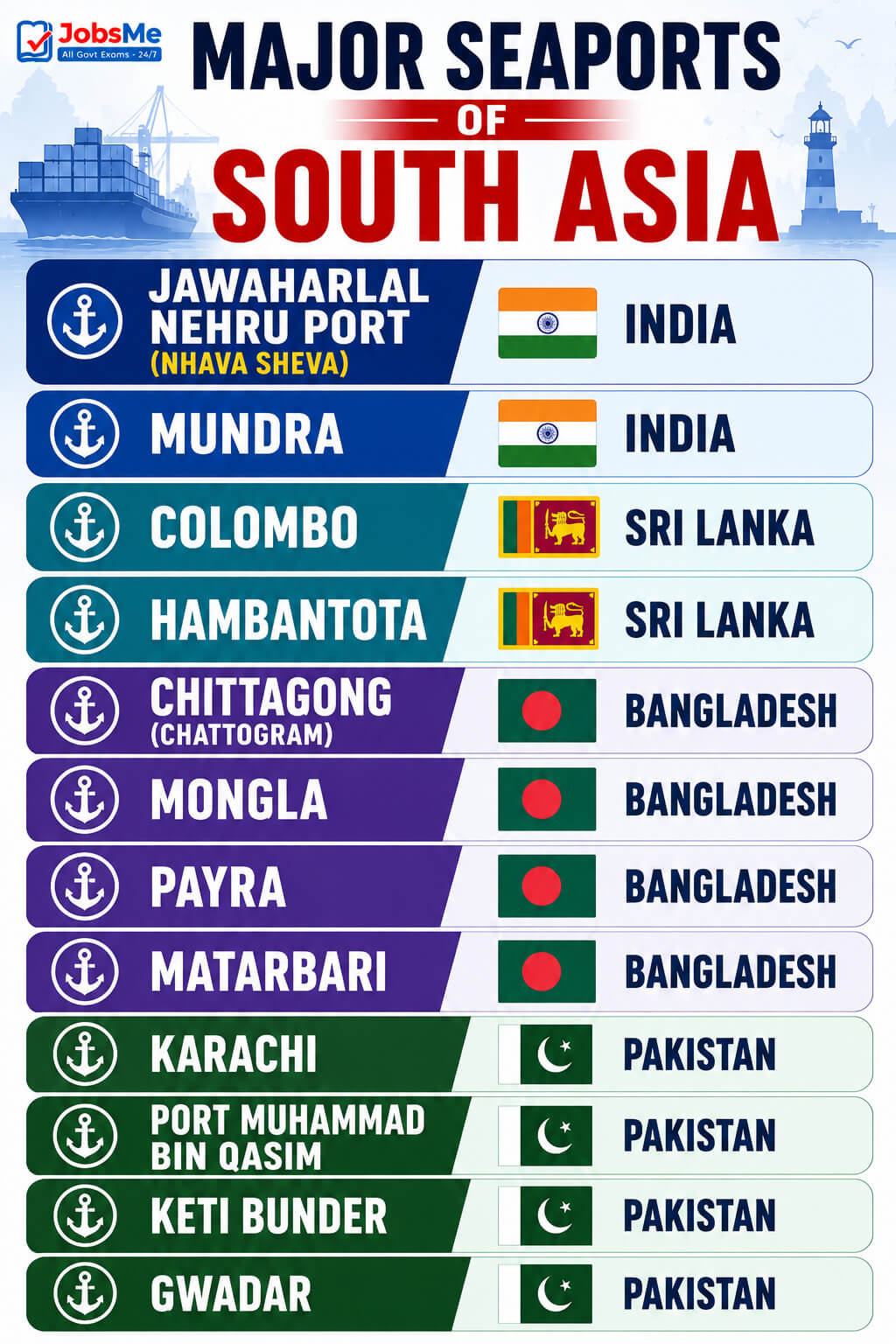
| Port | Country | Key Features |
|---|---|---|
| Jawaharlal Nehru Port (Nhava Sheva) | India | India's largest container port; located across Thane Creek from Mumbai. |
| Mundra | India | India's largest port by total cargo, on the Gulf of Kutch in Gujarat. |
| Colombo | Sri Lanka | South Asia's leading transshipment hub; long handled a large share of India's transshipped cargo. |
| Hambantota | Sri Lanka | Southern deep-water port developed with Chinese finance and leased to a Chinese firm; a key debt-diplomacy case study. |
| Chittagong (Chattogram) | Bangladesh | Bangladesh's principal port, handling the majority of its foreign trade. |
| Mongla | Bangladesh | Second largest Bangladeshi port, near the Sundarbans; usable by India for transit cargo. |
| Payra | Bangladesh | Bangladesh's third seaport, on the Rabnabad Channel in Patuakhali. |
| Matarbari | Bangladesh | Upcoming deep-sea port project in Cox's Bazar district, backed by Japanese assistance. |
| Karachi | Pakistan | Pakistan's oldest and largest port on the Arabian Sea. |
| Port Muhammad Bin Qasim | Pakistan | Second major Karachi-area port, built to serve Pakistan Steel Mills. |
| Keti Bunder | Pakistan | Small historic port in the Indus delta of Sindh. |
| Gwadar | Pakistan | Balochistan deep-sea port near the Strait of Hormuz; the maritime terminus of the China-Pakistan Economic Corridor (CPEC). |
West Asia and the Gulf
| Port | Country | Key Features |
|---|---|---|
| Jebel Ali | United Arab Emirates | World's largest man-made harbour; busiest port in the Middle East; operated by DP World. |
| Jeddah Islamic Port | Saudi Arabia | Saudi Arabia's largest Red Sea port and the traditional gateway for Hajj pilgrims to Mecca. |
| Salalah | Oman | Dhofar transshipment port on the Arabian Sea, outside the Strait of Hormuz. |
| Duqm | Oman | Special economic zone and deep-water port on the Arabian Sea with Indian participation. |
| Khasab | Oman | Port in the Musandam exclave overlooking the Strait of Hormuz. |
| Bandar Abbas | Iran | Iran's most important port, guarding the Strait of Hormuz; handles the bulk of Iranian trade. |
| Chabahar | Iran | Gulf of Oman port developed with Indian investment; gives India access to Afghanistan and Central Asia bypassing Pakistan; linked to the International North-South Transport Corridor. |
| Bandar Anzali | Iran | Iran's principal Caspian Sea port in Gilan province. |
| Bandar Khomeini | Iran | Persian Gulf port at the head of the Gulf, serving Khuzestan's petrochemical industry. |
| Bandar Mahshahr | Iran | Khuzestan port near Bandar Khomeini, handling petrochemical exports. |
| Bandar Noshahr | Iran | Caspian Sea port in Mazandaran province. |
| Bandar Taheri | Iran | Persian Gulf port in Bushehr province, close to the ancient site of Siraf. |
| Bushehr | Iran | Historic Persian Gulf port; also the site of Iran's first nuclear power plant. |
| Aden | Yemen | Natural harbour at the mouth of the Red Sea near the Bab-el-Mandeb strait; historically a key coaling and refuelling station. |
| Maalla Wharf | Yemen | Main container terminal within the port complex of Aden. |
| Hodeidah | Yemen | Yemen's principal Red Sea port and the main entry point for humanitarian aid. |
| Saleef | Yemen | Red Sea bulk port north of Hodeidah, used mainly for grain. |
| Ras Isa | Yemen | Red Sea oil terminal serving Yemen's crude exports. |
| Mokha (Mocha) | Yemen | Historic Red Sea port that gave its name to mocha coffee. |
Europe, Africa and the Americas
| Port | Country | Key Features |
|---|---|---|
| Rotterdam | Netherlands | Largest port in Europe; located on the Rhine-Meuse-Scheldt delta and highly automated. |
| Antwerp | Belgium | Europe's second largest port, on the River Scheldt; a global chemical cluster. Now Antwerp-Bruges after merger. |
| Hamburg | Germany | Germany's largest port and a classic inland river port on the Elbe, about 100 km from the North Sea. |
| Piraeus | Greece | Greece's largest port and the port of Athens; managed by China's COSCO and a key Belt and Road node in Europe. |
| Algeciras | Spain | Spanish port on the Strait of Gibraltar, a major Mediterranean transshipment hub. |
| Tanger Med | Morocco | Africa's largest and busiest container port, on the Strait of Gibraltar. |
| Lamu | Kenya | New deep-water port on Kenya's coast, the anchor of the LAPSSET corridor connecting Kenya, South Sudan and Ethiopia. |
| Los Angeles | United States | Busiest port in the United States, in San Pedro Bay, California. |
| Long Beach | United States | Twin of Los Angeles and second busiest US port; together they dominate Pacific trade. |
| New York-New Jersey | United States | Busiest port on the US East Coast, at the mouth of the Hudson River. |
| Vancouver | Canada | Canada's largest and most diversified port, on the Pacific coast of British Columbia. |
| Santos | Brazil | Largest port in Latin America; the principal export gateway for Brazilian coffee, sugar and soybeans. |
| Helsinki | Finland | Reported as the world's busiest passenger seaport, driven by Baltic ferry traffic. |
| Duluth | United States | Inland port on Lake Superior, reached from the Atlantic through the St Lawrence Seaway. |
| Manchester | United Kingdom | Inland port connected to the Irish Sea by the Manchester Ship Canal. |
Major Seaports of India
India has 13 government-designated Major Ports plus a large number of non-major and private ports. Six major ports lie on the west coast and six on the east coast, with Port Blair in the Andaman and Nicobar Islands added later as the thirteenth.
India's Major Ports and Key Private Ports
| Port | State / UT | Coast / Water Body | Key Features and Exam Points |
|---|---|---|---|
| Mundra Port | Gujarat | West coast, Gulf of Kutch | India's largest port by total cargo and its largest private port, operated by Adani Ports and SEZ (APSEZ). The first Indian port to handle over 200 million tonnes in a single year. Has deep-water berths able to receive very large crude carriers and mega container vessels; connected to the Western Dedicated Freight Corridor. |
| Jawaharlal Nehru Port Authority (JNPA / Nhava Sheva) | Maharashtra | West coast, Arabian Sea | India's largest container port, handling about 7.94 million TEUs and over half of India's container traffic. Located east of Mumbai across Thane Creek; ranked among the top 25 container ports of the world in the World Bank Container Port Performance Index. |
| Deendayal Port (formerly Kandla) | Gujarat | West coast, Gulf of Kutch | A tidal port and one of India's biggest by tonnage; handles crude oil, chemicals, salt, timber and edible oils. Built after Independence to replace Karachi. |
| Mumbai Port | Maharashtra | West coast, Arabian Sea | A natural harbour and one of India's oldest modern ports; now focuses on petroleum, general and liquid bulk after container traffic shifted to JNPA. |
| Mormugao Port | Goa | West coast, Arabian Sea | Historically India's premier iron ore exporting port, at the mouth of the Zuari river. |
| New Mangalore Port | Karnataka | West coast, Arabian Sea | Handles crude oil, LPG, petroleum products, iron ore pellets and fertilisers for Karnataka's refineries. |
| Cochin Port | Kerala | West coast, Arabian Sea (Willingdon Island) | Natural harbour port; its International Container Transshipment Terminal (ICTT) at Vallarpadam was India's first dedicated transshipment terminal. Strong in reefer and spice cargo. |
| Chennai Port | Tamil Nadu | East coast, Bay of Bengal | An artificial harbour and the oldest port on the east coast; a leading automobile export gateway handling around 1.8 million TEUs. |
| Kamarajar Port (Ennore) | Tamil Nadu | East coast, Bay of Bengal | India's first corporatised major port, created mainly to handle thermal coal for Tamil Nadu's power plants. |
| V.O. Chidambaranar Port (Tuticorin) | Tamil Nadu | East coast, Gulf of Mannar | An artificial deep-sea harbour; a pioneer in green hydrogen hub development and important for cargo to Sri Lanka. |
| Visakhapatnam Port | Andhra Pradesh | East coast, Bay of Bengal | India's deepest landlocked and protected port; handles iron ore, steel, fertilisers, crude and general cargo. Also home to the Eastern Naval Command. |
| Paradip Port | Odisha | East coast, Bay of Bengal | Often the largest government major port by cargo volume; an artificial deep-water port serving eastern India's mineral belt with iron ore, coal and fertilisers. |
| Syama Prasad Mookerjee Port (Kolkata-Haldia) | West Bengal | East coast, Hooghly River | India's only major riverine port, requiring continuous dredging. Serves eastern India, the North-East, Nepal and Bhutan; Haldia acts as its deep-draft dock complex. |
| Port Blair | Andaman and Nicobar Islands | Bay of Bengal | Declared the thirteenth major port; strategically placed near the Malacca Strait approaches. |
New and Upcoming Indian Mega Ports
- Vizhinjam International Seaport, Kerala: India's first deep-water container transshipment port, near Thiruvananthapuram, commissioned in 2025. Built by Adani Ports on a DBFOT public-private partnership model at about Rs 8,867 crore, with contributions from the Kerala Government, the Union Government's Viability Gap Funding and the concessionaire. It has a natural draft of 20 metres or more, lies only about 10 nautical miles from the main east-west shipping lane, and is India's first semi-automated and eco-friendly port. It received MSC Irina, the world's largest container ship by TEU capacity, and aims to cut India's dependence on Colombo, Singapore and Dubai, which have handled roughly 75 per cent of India's transshipped cargo.
- Vadhavan Port, Maharashtra: An all-weather natural deep-draft port planned in Palghar district, expected to become India's largest container port, able to berth 24,000-plus TEU vessels without dredging.
- Galathea Bay ICTT, Great Nicobar: A planned international container transshipment terminal positioned directly on the busy east-west trade route, designed to capture transshipment traffic currently going abroad.
- Total capacity: India's port cargo handling capacity has grown to roughly 2,762 million tonnes per annum, up from about 1,400 MTPA in 2013-14.
Bonus: Busiest Railway Stations of the World and India
Examiners often club transport hubs together in a single question set, so the busiest railway stations are worth learning alongside airports and seaports.
| Station | Location | Annual Footfall | Key Features |
|---|---|---|---|
| Shinjuku Station | Tokyo, Japan | Over 1.16 billion (about 3.5 million daily) | Holds the Guinness World Record as the world's busiest transport hub. Has 36 platforms and links JR East, private commuter lines and subway networks. |
| Shibuya Station | Tokyo, Japan | Over 1.02 billion | Second busiest in the world; famous for the Shibuya Scramble Crossing outside its exits. |
| Ikebukuro Station | Tokyo, Japan | About 843 million | Third busiest in the world and the main northern transit hub of Tokyo's commuter belt. |
| Howrah Junction | West Bengal, India | About 547 million | India's busiest and oldest major railway complex, with 23 platforms and 26 tracks. Terminal for Eastern and South Eastern Railway and the gateway to Eastern and North-Eastern India. |
| Sealdah Station | Kolkata, West Bengal | About 438 million | Key terminal of the Kolkata Suburban Railway with very high peak-hour commuter density. |
| New Delhi Railway Station | Delhi | About half a million daily | Main transit hub of Northern Railway, handling over 360 train movements a day; central node for Vande Bharat, Rajdhani and Shatabdi services. |
| Chhatrapati Shivaji Maharaj Terminus (CSMT) | Mumbai, Maharashtra | Very high suburban and long-distance volumes | A UNESCO World Heritage Site and headquarters of Central Railway; formerly Victoria Terminus. |
Memory Tricks and Mnemonics
Trick 1: Top Three Busiest Airports — "A D H" (Aa Dekh Hawai)
The top three busiest airports by total passengers, in order, are Atlanta, Dubai, Haneda.
- "A-D-H — Atlanta Dubai Haneda"
- Read it as the Hindi-sounding phrase "Aa Dekh Hawai" (come, look at the aircraft) and the order will stick.
Trick 2: Top Three Busiest Seaports — "SSN" (Super Ship Network)
The top three container ports, in order, are Shanghai, Singapore, Ningbo-Zhoushan.
- "SSN — Shanghai, Singapore, Ningbo"
- Extend it to five with SSN-SQ: Shanghai, Singapore, Ningbo, Shenzhen, Qingdao.
Trick 3: Biggest versus Busiest — "Fahd is Fat, Atlanta is Fast"
This is the single most common trap in this topic.
- "Fahd is Fat" — King Fahd International Airport, Dammam is the largest by area but handles only about 10 million passengers.
- "Atlanta is Fast" — Atlanta is the busiest by passengers at 106.3 million.
- Same logic for ports: "Shanghai counts boxes, Ningbo counts tonnes" — Shanghai leads in TEUs, Ningbo-Zhoushan leads in total cargo tonnage.
Trick 4: The Four Airport Crowns — "P-I-C-M"
Four different airports hold four different global titles. Remember PICM:
- Passengers → Atlanta
- International → Dubai
- Cargo → Hong Kong
- Movements → Chicago O'Hare
- "People to Atlanta, Immigrants to Dubai, Cargo to Hong Kong, Movements to Chicago."
Trick 5: "Bandar Means Port" — All Iranian Ports at Once
In Persian, Bandar literally means "port". So every Iranian name beginning with Bandar is automatically a port.
- Persian Gulf side: Bandar Abbas, Bandar Khomeini, Bandar Mahshahr, Bandar Taheri, Bushehr.
- Caspian Sea side: Bandar Anzali, Bandar Noshahr. Remember "A and N are on the North (Caspian)".
- Gulf of Oman side: Chabahar — the only Iranian port India is developing.
Trick 6: India's Three Port Crowns — "M-J-V"
Three different Indian ports hold three different titles:
- Mundra → largest by total cargo tonnage and largest private port.
- JNPA → largest by containers (TEUs).
- Vizhinjam → first deep-water transshipment port.
- "Mundra Moves tonnes, JNPA Juggles boxes, Vizhinjam Visits mother ships."
Trick 7: Artificial versus Natural Harbours of India
Group Indian ports by harbour type to answer a very common question pattern.
- Artificial harbours: Chennai, Paradip, Tuticorin (V.O. Chidambaranar). "C-P-T are Constructed Ports Totally."
- Natural harbours: Mumbai, Cochin, Visakhapatnam. "M-C-V are Made by Creation, not Contractors."
- Riverine port: Kolkata (Syama Prasad Mookerjee) is India's only major river port, on the Hooghly.
Trick 8: Chokepoint Ports — "Malacca, Hormuz, Gibraltar, Bab-el-Mandeb"
Link each strategic strait to the port that guards it. This is how UPSC frames map-based questions.
- Strait of Malacca → Singapore (and Tanjung Pelepas nearby).
- Strait of Hormuz → Bandar Abbas (Iran), with Gwadar and Khasab close by.
- Strait of Gibraltar → Tanger Med (Morocco) and Algeciras (Spain) facing each other.
- Bab-el-Mandeb → Aden (Yemen).
- "Ships Squeeze at Four Gates: Malacca, Hormuz, Gibraltar, Mandeb."
Trick 9: Inland Ports Are Not on the Sea — "HMD"
Three famous ports lie far inland and are reached by river or canal: Hamburg (Elbe), Manchester (Ship Canal), Duluth (Great Lakes and St Lawrence Seaway).
- "HMD — Harbours Miles Distant from the sea."
Additional Notes
Frequently Confused Facts
- Busiest airport versus busiest international airport: Atlanta is busiest overall; Dubai is busiest for international passengers. Atlanta wins because of huge domestic traffic.
- Busiest airport versus largest airport: Atlanta is busiest; King Fahd International, Dammam is largest by land area. Denver is the largest in the United States.
- Largest airport versus largest terminal building: King Fahd is largest by area; Beijing Daxing has the world's largest single-building airport terminal.
- Busiest container port versus busiest cargo port: Shanghai leads in containers (TEUs); Ningbo-Zhoushan leads in total cargo tonnage.
- Busiest port versus busiest transshipment port: Shanghai is busiest overall; Singapore is the largest transshipment and bunkering hub.
- Largest man-made harbour versus largest port in Europe: Jebel Ali is the largest man-made harbour; Rotterdam is Europe's largest port and the busiest outside Asia.
- Busiest port in Africa versus busiest airport in Africa: Tanger Med (Morocco) is Africa's busiest port; Cairo International (Egypt) is regularly rated Africa's busiest airport.
- Highest airport versus largest airport: Daocheng Yading (China) at 4,411 metres is the world's highest civilian airport; it is nowhere near the largest or busiest.
- Chabahar versus Gwadar: Chabahar (Iran) is developed with Indian involvement; Gwadar (Pakistan) is developed under CPEC with China. They lie close to each other on the same coastline.
- Colombo versus Vizhinjam: Colombo has long been South Asia's transshipment hub; Vizhinjam is India's answer to it and its first deep-water transshipment port.
- India's largest port versus India's largest container port: Mundra is largest by cargo tonnage; JNPA is largest by container volume. Paradip usually leads among government major ports.
- Yangon versus Rangoon: These are the same city and the same port — Rangoon is the older colonial name for Yangon. Similarly Bassein is Pathein, Moulmein is Mawlamyine, and Mergui is Myeik.
- Kandla versus Deendayal: Kandla Port was renamed Deendayal Port; Ennore was renamed Kamarajar Port; Kolkata Port was renamed Syama Prasad Mookerjee Port.
- Los Angeles versus Long Beach: Both are in San Pedro Bay, California. Los Angeles is the busiest US port; Long Beach is second.
Repeating PYQ Patterns
Certain facts from this topic are asked again and again. Busiest airport of the world (Atlanta), busiest international airport (Dubai), largest airport by area (King Fahd, Dammam), busiest cargo airport (Hong Kong), busiest container port (Shanghai), largest transshipment hub (Singapore), largest man-made harbour (Jebel Ali), largest port of Europe (Rotterdam), largest port of Africa (Tanger Med) and busiest railway station (Shinjuku) are the most repeated global facts in SSC CGL, SSC CHSL, RRB NTPC and IBPS papers. On the Indian side, examiners favour India's only riverine major port (Kolkata), India's deepest port (Visakhapatnam), India's first corporatised port (Kamarajar), India's largest container port (JNPA), India's largest port by cargo (Mundra), India's first transshipment port (Vizhinjam) and the number of major ports (13). UPSC Prelims prefers map-linked and strategic questions — Chabahar and the INSTC, Gwadar and CPEC, Sittwe and the Kaladan project, Hambantota and debt diplomacy, and ports located on named straits. Banking and Insurance exams lean towards port-to-country matching, while State PCS papers add the ports and airports of the concerned state.
Quick Insight
Airports and seaports are where geography turns into economics. Singapore is wealthy in large part because of a strait; Rotterdam matters because of a river delta; Dubai became an aviation superpower because it sits exactly halfway between Europe and Asia. India's recent push — Vizhinjam commissioned, Vadhavan and Galathea Bay under development, port capacity nearly doubled since 2013-14 — is an attempt to stop paying Colombo, Singapore and Dubai to handle Indian cargo. For Prelims this means learning names and superlatives; for Mains and interviews it means being able to explain why a particular location became a hub, and what happens to trade when a chokepoint like the Red Sea or the Strait of Hormuz is disrupted. Aspirants preparing for banking and insurance exams should also link this topic with trade finance and export-import basics covered in the banking awareness notes, and revise regularly using the daily current affairs quizzes.
One-Liners for Quick Revision
- World's busiest airport (total passengers) → Hartsfield-Jackson Atlanta International (ATL), USA → about 106.3 million passengers; leader almost continuously since 1998.
- World's busiest international airport → Dubai International (DXB), UAE → about 95.2 million total passengers; base of Emirates; India is its largest country market.
- Third busiest airport → Tokyo Haneda (HND), Japan → about 91.7 million; main domestic gateway to Greater Tokyo alongside Narita.
- Fourth busiest airport → Dallas/Fort Worth (DFW), USA → about 85.7 million; seven runways; larger than Manhattan.
- Biggest ranking jump → Shanghai Pudong (PVG), China → rose from 10th to 5th with about 85 million passengers; China's busiest airport.
- Busiest airport by aircraft movements → Chicago O'Hare (ORD), USA → about 860,015 movements; eight runways.
- Europe's busiest airport by total seats → Istanbul Airport (IST), Turkey → opened 2018; hub of Turkish Airlines.
- Europe's busiest for international passengers → London Heathrow (LHR), UK → only two runways, extremely slot-constrained.
- World's busiest cargo airport → Hong Kong International (HKG) → over 4.3 million metric tonnes; serves the Pearl River Delta.
- Second busiest cargo airport → Memphis International (MEM), USA → global super-hub of FedEx Express.
- Largest airport by land area → King Fahd International, Dammam, Saudi Arabia → about 299 square miles; former Gulf War airbase; commercial from 1999; has a royal terminal.
- Largest airport in the USA by area → Denver International (DIA) → about 53 square miles; 16,000-foot runway; about 215 destinations.
- World's largest single-building airport terminal → Beijing Daxing International (PKX), China → opened 2019; about 7.5 million sq ft; capacity up to 75 million.
- Busiest airport in Africa → Cairo International (CAI), Egypt → about 14 square miles; hub of EgyptAir.
- Highest civilian airport in the world → Daocheng Yading, Sichuan, China → 4,411 metres; opened 2013; 4,200-metre runway.
- Other large airports by area → Orlando (20 sq mi), Washington Dulles (18 sq mi), George Bush Intercontinental Houston (17 sq mi), Shanghai Pudong (15 sq mi), Suvarnabhumi Bangkok (12 sq mi).
- Other busy European airports → Paris Charles de Gaulle, Frankfurt, Amsterdam Schiphol, Madrid Barajas, Barcelona, Rome Fiumicino, Istanbul Sabiha Gokcen, Munich.
- India's busiest airport → Indira Gandhi International (DEL), New Delhi → about 78.7 million; four runways; largest hub in South Asia; Terminal 3 among the world's largest.
- India's second busiest airport → Chhatrapati Shivaji Maharaj International (BOM), Mumbai → about 55.3 million; two intersecting runways, effectively single-runway operation.
- India's fastest-growing large airport → Kempegowda International (BLR), Bengaluru → about 44.5 million passengers.
- Other major Indian airports → Rajiv Gandhi Hyderabad (30.5 million), Chennai (23.0 million), Netaji Subhas Chandra Bose Kolkata (21.8 million), Ahmedabad (13.4 million), Cochin (11.1 million), Pune (10.5 million).
- World's first fully solar-powered airport → Cochin International (COK), Kerala → also India's first PPP airport; UN Champion of the Earth awardee.
- India's aviation market rank → fifth largest in the world by total passengers, ahead of Japan; Indian airports handle over 420 million passengers a year.
- World's busiest container port → Port of Shanghai, China → about 55.06 million TEUs; number one since 2010; Yangshan deep-water port linked by the 32.5-km Donghai Bridge.
- World's largest transshipment and bunkering hub → Port of Singapore → about 44.66 million TEUs; on the Strait of Malacca; Tuas Mega Port planned for 65 million TEUs.
- World's largest port by total cargo tonnage → Ningbo-Zhoushan, China → over 43 million TEUs and first port to cross 1.4 billion tonnes of cargo.
- Other top Chinese ports → Shenzhen (about 33 million TEUs), Qingdao (about 31 million), Guangzhou, Tianjin, Xiamen, Dalian, Yingkou, Lianyungang, Rizhao, Dongguan, Fuzhou, Nanjing.
- Busiest port of South Korea → Busan → about 23-24 million TEUs; North-East Asia's transshipment gateway.
- Taiwan's largest port → Kaohsiung → main industrial and container gateway.
- Japan's port groups → Keihin Ports (Tokyo, Yokohama, Kawasaki, Yokosuka) and Hanshin Port (Osaka, Kobe); Tokyo is Japan's leading container port.
- World's largest man-made harbour → Jebel Ali, Dubai, UAE → about 15.5 million TEUs; 134 sq km; about 67 berths; run by DP World; busiest in the Middle East.
- Largest port of Europe → Rotterdam, Netherlands → about 13.8 million TEUs; busiest port outside Asia; Rhine-Meuse-Scheldt delta.
- Second largest port of Europe → Antwerp-Bruges, Belgium → about 13.5 million TEUs; on the River Scheldt; major chemical cluster.
- Germany's largest port → Hamburg → an inland river port on the Elbe, about 100 km from the North Sea.
- Greece's largest port → Piraeus → port of Athens, operated by China's COSCO; Belt and Road node.
- Spain's key transshipment ports → Algeciras on the Strait of Gibraltar and Valencia on the Mediterranean.
- Largest and busiest port of Africa → Tanger Med, Morocco → about 10.2 million TEUs; on the Strait of Gibraltar; Suez-Gibraltar route carries over 12 per cent of world trade.
- Kenya's new deep-water port → Lamu → anchor of the LAPSSET corridor linking Kenya, South Sudan and Ethiopia.
- Busiest port of the United States → Los Angeles → about 10.3 million TEUs; Long Beach is second with about 9.5 million; New York-New Jersey is busiest on the East Coast.
- Largest port of Latin America → Santos, Brazil → gateway for coffee, sugar and soybean exports.
- Canada's largest port → Vancouver, British Columbia → most diversified port on Canada's Pacific coast.
- World's busiest passenger seaport → Port of Helsinki, Finland → driven by Baltic ferry traffic.
- Famous inland ports → Hamburg (Germany), Manchester (UK), Duluth (USA) → all reached via rivers, canals or seaways.
- Malaysia's ports → Port Klang (about 15.1 million TEUs, largest, operating since 1973) and Tanjung Pelepas (fast-growing Johor transshipment rival to Singapore).
- Thailand's largest port → Laem Chabang → deep-sea port on the Gulf of Thailand.
- Indonesia's largest port → Tanjung Priok, Jakarta.
- Vietnam's main port cluster → Ho Chi Minh City → among the world's fastest-growing container gateways.
- Philippines' main port → Manila, on Manila Bay.
- Myanmar's ports → Yangon (Rangoon), Thilawa, Sittwe, Bassein (Pathein), Moulmein (Mawlamyine), Mergui (Myeik) → Sittwe is developed by India under the Kaladan Multi-Modal Transit Transport Project.
- Sri Lanka's ports → Colombo (South Asia's transshipment hub) and Hambantota (Chinese-financed and leased; debt-diplomacy case study).
- Bangladesh's ports → Chittagong (Chattogram, main port), Mongla (second, near the Sundarbans), Payra (third) and Matarbari (upcoming deep-sea port with Japanese support).
- Pakistan's ports → Karachi (oldest and largest), Port Muhammad Bin Qasim (serves Pakistan Steel Mills), Keti Bunder (Indus delta) and Gwadar (CPEC terminus near the Strait of Hormuz).
- Saudi Arabia's largest Red Sea port → Jeddah Islamic Port → traditional gateway for Hajj pilgrims.
- Oman's ports → Salalah (transshipment, outside Hormuz), Duqm (SEZ with Indian participation) and Khasab (Musandam exclave on the Strait of Hormuz).
- Iran's ports → Bandar Abbas (most important, on the Strait of Hormuz), Chabahar (Indian-developed, Gulf of Oman, INSTC link), Bandar Khomeini, Bandar Mahshahr, Bandar Taheri and Bushehr on the Persian Gulf, and Bandar Anzali and Bandar Noshahr on the Caspian Sea.
- Yemen's ports → Aden (natural harbour near Bab-el-Mandeb), Maalla Wharf (Aden's container terminal), Hodeidah (main Red Sea port), Saleef (grain), Ras Isa (oil terminal) and Mokha, which gave its name to mocha coffee.
- India's number of major ports → 13 government-designated major ports, with Port Blair added as the thirteenth.
- India's largest port by cargo → Mundra, Gujarat → first Indian port to cross 200 million tonnes; largest private port; on the Gulf of Kutch; run by Adani Ports.
- India's largest container port → JNPA (Nhava Sheva), Maharashtra → about 7.94 million TEUs; handles over half of India's container traffic; linked to the Western DFC.
- India's first deep-water transshipment port → Vizhinjam, Kerala → commissioned 2025; DBFOT PPP model; about Rs 8,867 crore; 20-metre natural draft; 10 nautical miles from the main shipping lane; received MSC Irina.
- India's only major riverine port → Syama Prasad Mookerjee Port, Kolkata → on the Hooghly, with Haldia as its deep-draft complex.
- India's deepest port → Visakhapatnam, Andhra Pradesh → deepest landlocked and protected harbour; also Eastern Naval Command headquarters.
- India's first corporatised major port → Kamarajar Port (Ennore), Tamil Nadu → built mainly for thermal coal.
- India's artificial harbours → Chennai, Paradip and Tuticorin (V.O. Chidambaranar); natural harbours include Mumbai, Cochin and Visakhapatnam.
- India's iron-ore export port → Mormugao, Goa → at the mouth of the Zuari river.
- India's first transshipment terminal → ICTT Vallarpadam at Cochin Port, Kerala.
- Renamed Indian ports → Kandla to Deendayal, Ennore to Kamarajar, Kolkata to Syama Prasad Mookerjee.
- Upcoming Indian mega ports → Vadhavan in Maharashtra (set to be India's largest container port) and Galathea Bay ICTT in Great Nicobar.
- India's total port capacity → about 2,762 million tonnes per annum, up from roughly 1,400 MTPA in 2013-14.
- World's busiest railway station → Shinjuku, Tokyo, Japan → over 1.16 billion passengers a year, about 3.5 million daily, 36 platforms; a Guinness World Record holder.
- Second and third busiest railway stations → Shibuya, Tokyo (over 1.02 billion) and Ikebukuro, Tokyo (about 843 million).
- India's busiest railway station → Howrah Junction, West Bengal → about 547 million passengers, 23 platforms and 26 tracks; Sealdah is second with about 438 million.
- UNESCO World Heritage railway terminus → Chhatrapati Shivaji Maharaj Terminus (CSMT), Mumbai → formerly Victoria Terminus; headquarters of Central Railway.
- Key units and terms → TEU is a 20-foot container unit and a 40-foot container equals two TEUs; ports handle over 90 per cent of international cargo by volume and about 70 per cent of merchandise trade by value.
Once you have revised these one-liners, attempt the topic-wise practice sets in the Static GK quiz section and keep an eye on new port and airport announcements through the daily current affairs page.
If you are also tracking vacancies while preparing, the latest government job notifications are updated regularly so that your general awareness revision and your application planning move together.
Free quiz • No signup required
Put this topic into practice with Indian Cultural Institutions – Static GK MCQ Quiz. It is the quickest way to reinforce what you just learned.
Frequently Asked Questions
Which is the busiest airport in the world?
Which is the busiest international airport in the world?
Which is the largest airport in the world by land area?
Which is the busiest cargo airport in the world?
Which is the busiest seaport in the world?
What is the difference between the busiest container port and the busiest cargo port?
Which is the largest man-made harbour in the world?
How many major ports does India have and which is the largest?
Why is Vizhinjam Port important for India?
Which airport is the highest in the world and which is Europe's busiest?

About the author