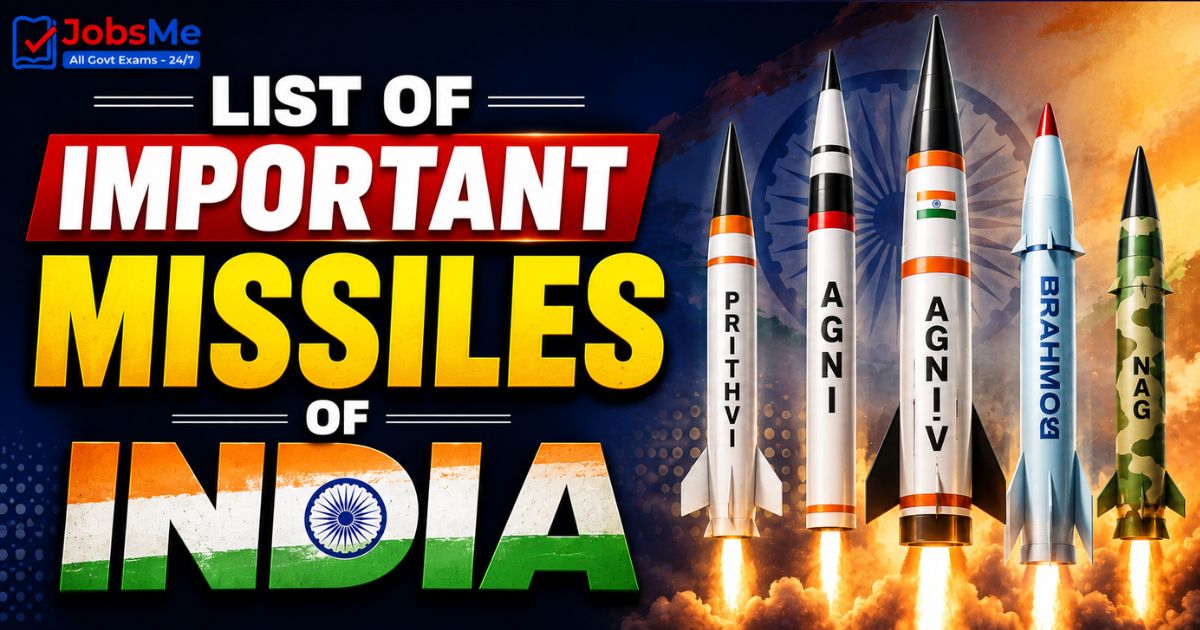
List of Important Missiles of India – Static GK & General Awareness for Competitive Exams with Memory Tricks
This article presents a complete list of important missiles of India, covering ballistic missiles (Agni, Prithvi), cruise missiles (BrahMos, Nirbhay), surface-to-air missiles (Akash, Barak-8), anti-tank missiles (Nag, Helina), anti-ship and submarine-launched missiles (Dhanush, K-15, K-4), along with their range, type, launch platform, and key facts. It includes high-frequency topics like the IGMDP, Agni-V MIRV (Mission Divyastra), Mission Shakti ASAT test, BrahMos in Operation Sindoor, and the new Pralay-based Integrated Rocket Force, with memory tricks and one-liners for quick revision. All facts are arranged in exam-ready format to help UPSC, SSC, IBPS, RRB, NDA, CDS, PSU, and State PCS aspirants score better in General Awareness and Science & Technology sections.
Jump to section
- Introduction
- Core Concepts: Understanding Missile Types and Classification
- Ballistic Missiles of India
- Cruise Missiles of India
- Surface-to-Air Missiles (SAM) of India
- Anti-Tank and Air-to-Air Missiles of India
- Anti-Ship and Submarine-Launched Missiles (SLBM) of India
- Other Important Programmes and Milestones
- Memory Tricks and Mnemonics
- Additional Notes
- One-Liners for Quick Revision
Introduction
India today ranks among the top missile powers in the world, with a full-spectrum arsenal built largely by the Defence Research and Development Organisation (DRDO). From the short-range Prithvi to the intercontinental-class Agni-V, and from the supersonic BrahMos cruise missile to the anti-tank Nag, India's missile systems cover land, sea, and air domains. The journey began with the Integrated Guided Missile Development Programme (IGMDP), launched in 1983 under Dr. A.P.J. Abdul Kalam, who came to be known as the "Missile Man of India."
Questions on missiles of India appear regularly in UPSC Prelims, SSC CGL, NDA, CDS, RRB NTPC, IBPS PO, SBI Clerk, State PCS, and various Defence, Insurance, and PSU exams. Questions typically ask the range or category of a particular missile, which missile is nuclear-capable, the meaning behind a name (like BrahMos), or which milestone made India the 4th or 6th nation in a particular technology. This article brings together every important missile in a structured, exam-ready format. To explore other related topics, you can refer to the Static GK section on thejobsme.com.
Missiles of India is also closely tied to current affairs themes such as Mission Divyastra (Agni-V MIRV test), the rail-based Agni-Prime launch, BrahMos's combat debut in Operation Sindoor, BrahMos export deals to the Philippines and Indonesia, and the creation of the new Integrated Rocket Force (IRF) — making this topic doubly important for aspirants preparing for UPSC GS Paper III (Science & Technology) and defence-focused exams. Aspirants can stay updated through Daily Current Affairs on thejobsme.com.
Core Concepts: Understanding Missile Types and Classification
A missile is a guided airborne ranged weapon capable of self-propelled flight, usually powered by a rocket motor or a jet engine. Missiles are classified in several ways — by launch mode, by trajectory, and by speed. Understanding these basic categories makes it far easier to remember individual missile names and their roles in the exam hall.
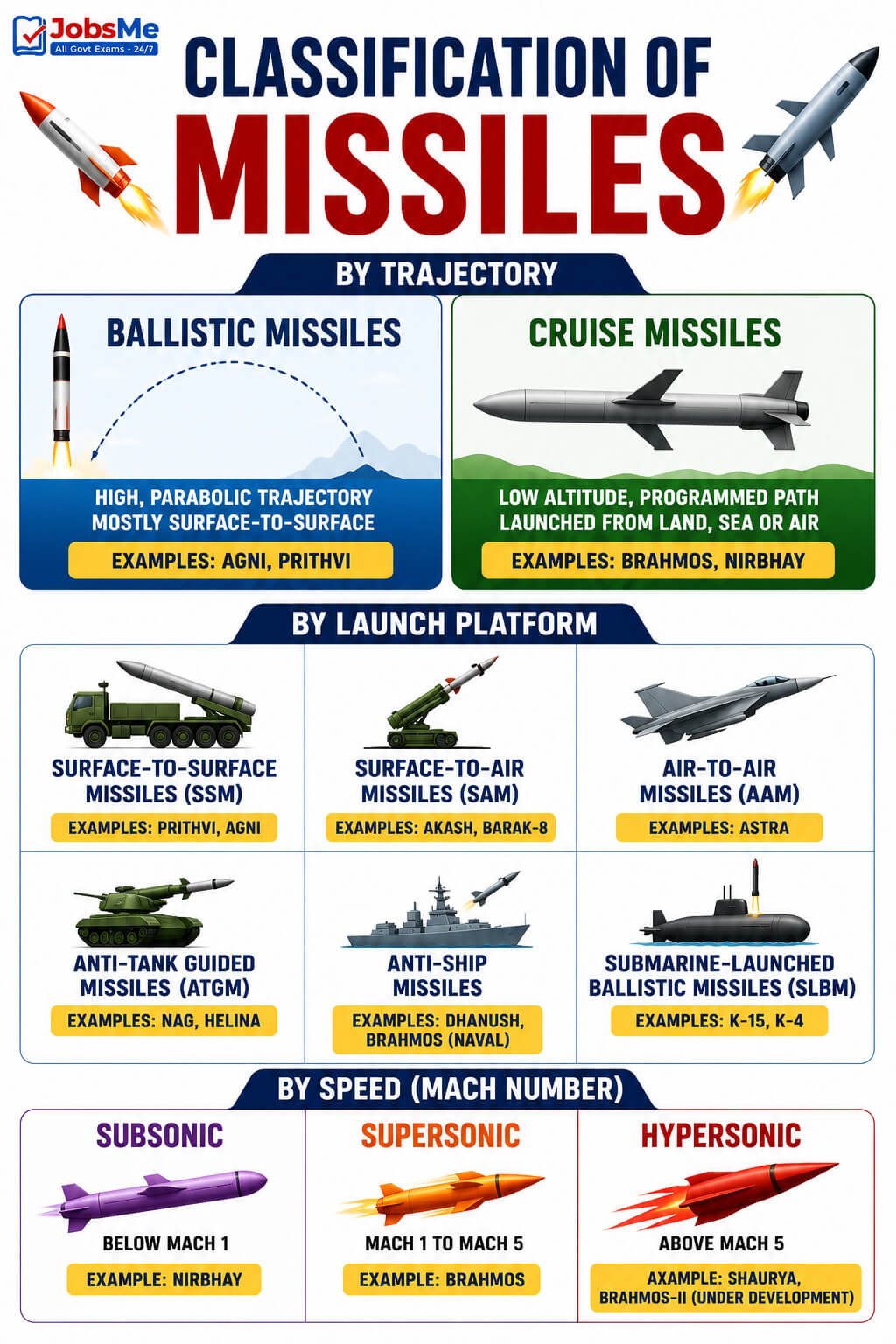
Classification by Trajectory
- Ballistic Missiles: Follow a high, parabolic (lofted) trajectory and travel mostly by unpowered free-fall flight after the initial boost phase. Mostly surface-to-surface. Examples: Agni and Prithvi series.
- Cruise Missiles: Guided missiles that fly at low altitudes along a programmed path, making them hard to detect. Can be launched from land, sea, or air. Examples: BrahMos (supersonic), Nirbhay (subsonic).
Classification by Launch Platform
- Surface-to-Surface Missiles (SSM): Launched from the ground/sea to hit ground/sea targets. Example: Prithvi, Agni.
- Surface-to-Air Missiles (SAM): Launched from the ground to intercept enemy aircraft and incoming missiles. Example: Akash, Barak-8.
- Air-to-Air Missiles (AAM): Fired from an aircraft to destroy another aircraft. Example: Astra.
- Anti-Tank Guided Missiles (ATGM): Designed to destroy armoured vehicles and tanks. Example: Nag, Helina.
- Anti-Ship Missiles: Designed to strike naval vessels. Example: Dhanush, BrahMos (naval).
- Submarine-Launched Ballistic Missiles (SLBM): Fired from submarines, forming the sea leg of the nuclear triad. Example: K-15, K-4.
Classification by Speed (Mach Number)
- Subsonic: Slower than the speed of sound (below Mach 1). Example: Nirbhay.
- Supersonic: Faster than sound but below Mach 5 (Mach 1 to Mach 5). Example: BrahMos.
- Hypersonic: At least five times the speed of sound (above Mach 5). Example: Shaurya, BrahMos-II (under development).
Ballistic Missiles of India
Ballistic missiles form the backbone of India's strategic deterrence. The following table covers the major ballistic missiles, their range, and key exam-critical details.
| Missile | Type / Range | Key Features / Details |
|---|---|---|
| Prithvi-I | Short-range surface-to-surface ballistic missile; 150 km | India's first indigenously developed ballistic missile, developed under IGMDP; named after "Earth"; Army version; single-stage, liquid-fuelled; can carry 1,000 kg warhead. |
| Prithvi-II | Short-range surface-to-surface ballistic missile; 250-350 km | Air Force version; nuclear-capable; carries 500-1,000 kg warhead; one of the lightest missiles in service; inducted into the Strategic Forces Command. |
| Prithvi-III (Dhanush) | Short-range ballistic missile; 350-600 km | Naval variant of Prithvi; ship-launched; designed to strike both naval and coastal targets; strengthens India's coastal security along its 7,516 km coastline. |
| Agni-I | Medium-range ballistic missile; about 700-1,200 km | First missile of the Agni family; "Agni" means "Fire" in Sanskrit; bridges the gap between Prithvi and longer-range Agni variants; nuclear-capable. |
| Agni-II | Intermediate-range ballistic missile; about 2,000-2,500 km | Two-stage, solid-fuelled; capable of carrying a 1,000 kg nuclear warhead; covers most of Pakistan and parts of China. |
| Agni-III | Intermediate-range ballistic missile; about 3,000-4,000 km | Last major missile developed under IGMDP (first tested 2007); two-stage solid propulsion; brings deeper Chinese targets within range. |
| Agni-IV | Intermediate-range ballistic missile; about 4,000 km | Introduced lighter composite structures and improved guidance accuracy; served as a transition step toward the canisterised Agni-V; road-mobile. |
| Agni-V | Intercontinental-class ballistic missile (ICBM); 5,000-5,500 km (some estimates up to 8,000 km) | India's longest-range operational missile; three-stage, solid-fuelled; canisterised and road-mobile; nuclear-capable; tested with MIRV technology under Mission Divyastra (11 March 2024), making India the 6th MIRV nation. A second advanced MIRV test was conducted on 8 May 2026. |
| Agni-Prime (Agni-P) | Medium-range ballistic missile; up to 1,000-2,000 km | Next-generation, two-stage, canisterised missile; first launched from a specially designed rail-based mobile launcher on 24 September 2025, improving mobility and survivability. |
| Agni-VI | Intercontinental ballistic missile (under development) | Expected to become India's first true ICBM with MIRV capability and extended range; still under development. |
| Shaurya | Hypersonic surface-to-surface missile; 700-800 km | Canister-launched land variant of the K-15 SLBM; reaches around Mach 7; high manoeuvrability and stealth; serves as a potent nuclear deterrent. |
| Pralay | Short-range quasi-ballistic surface-to-surface missile; 150-500 km | India's first indigenous quasi-ballistic missile; manoeuvres in its terminal phase, making it hard to intercept; forms the core of the new Integrated Rocket Force (IRF); phase-1 user trials completed July 2025. |
| Prahaar | Short-range tactical surface-to-surface missile; up to 150 km | Solid-fuelled, quick-reaction tactical battlefield missile; carries conventional warheads; bridges the gap between unguided rockets and longer-range ballistic missiles. |
Cruise Missiles of India
Cruise missiles fly at low altitudes along guided paths for precision strikes. The table below lists India's key cruise missiles.
| Missile | Type / Range | Key Features / Details |
|---|---|---|
| BrahMos | Supersonic cruise missile; about 290-500 km (extended after India joined MTCR in 2016); Mach 2.8-3 | India-Russia joint venture (BrahMos Aerospace); the world's fastest operational cruise missile; name combines BRAHmaputra (India) and MOScow (Russia); has land, ship, submarine, and air-launched (Su-30MKI) versions; first exported to the Philippines (2022) and Indonesia (2025); achieved its first combat use in Operation Sindoor (May 2025); 800 km variant under development. |
| Nirbhay | Long-range subsonic cruise missile; about 1,000-1,500 km | India's first indigenous long-range subsonic cruise missile; terrain-hugging flight like the Tomahawk; still under development with land, air, and submarine-launched versions planned. |
| BrahMos-II | Hypersonic cruise missile (under development); about 600 km; Mach 7-8 | Hypersonic variant of BrahMos being developed jointly by India and Russia; aims to make India a leader in hypersonic strike capability. |
Surface-to-Air Missiles (SAM) of India
Surface-to-air missiles protect India's airspace by intercepting enemy aircraft, drones, and incoming missiles.
| Missile | Type / Range | Key Features / Details |
|---|---|---|
| Akash | Medium-range surface-to-air missile; 30-60 km | Developed under IGMDP by DRDO, BEL, and OFB; can target aircraft, cruise missiles, and air-to-surface missiles up to altitudes of 18,000 m; variants include Akash-1S and the longer-range Akash-NG. |
| Trishul | Short-range, low-altitude surface-to-air missile; about 9 km | One of the five core IGMDP missiles; short-range quick-reaction SAM; later largely superseded by newer systems. |
| Barak-8 (MRSAM) | Medium-range surface-to-air missile; about 70-100 km | India-Israel joint venture (DRDO + IAI); used by both the Army and Navy; protects against aircraft, helicopters, and anti-ship missiles. |
| QRSAM | Quick-reaction surface-to-air missile; about 25-30 km | Indigenous DRDO system designed for rapid response; intended to replace older systems and provide mobile air defence to advancing army columns. |
| Prithvi Air Defence (PAD) / Advanced Air Defence (AAD) | Anti-ballistic missile interceptors; high-altitude (PAD) and low-altitude (AAD) | Two-tiered Ballistic Missile Defence (BMD) shield developed in response to missile threats; can intercept incoming missiles launched from up to 5,000 km away; supported by early-warning and tracking radars. |
Anti-Tank and Air-to-Air Missiles of India
These missiles support battlefield operations against armoured vehicles and enemy aircraft.
| Missile | Type / Range | Key Features / Details |
|---|---|---|
| Nag (Prospina) | Third-generation anti-tank guided missile (ATGM); 0.5-4 km | One of the five core IGMDP missiles; "fire-and-forget" technology; launched from the NAMICA carrier; uses a tandem HEAT warhead to penetrate modern armour. |
| Helina (Dhruvastra) | Helicopter-launched anti-tank guided missile; about 7-10 km | Helicopter-launched version of Nag; fired from the HAL Dhruv/Rudra; gives air-launched anti-armour capability. |
| MPATGM | Man-portable anti-tank guided missile; about 5-7 km (under development) | Lightweight, infantry-portable, fire-and-forget ATGM intended to replace older imported systems. |
| Astra | Beyond-visual-range air-to-air missile (BVRAAM); 70-110 km | India's first indigenous air-to-air missile; radar-guided; integrated with the Su-30MKI and Tejas fighter aircraft. |
| Rudram-1 | Anti-radiation missile (ARM); up to 100-250 km | India's first indigenous anti-radiation missile; homes in on enemy radar and communication emissions; used for Suppression of Enemy Air Defences (SEAD); operational on the Su-30MKI since 2022. |
Anti-Ship and Submarine-Launched Missiles (SLBM) of India
These missiles secure India's vast coastline and complete the sea leg of its nuclear triad.
| Missile | Type / Range | Key Features / Details |
|---|---|---|
| Dhanush | Ship-launched ballistic missile; 350 km | Naval variant of the Prithvi missile; ship-launched; enhances the Navy's ability to strike naval and coastal targets; nuclear-capable. |
| K-15 (Sagarika) | Submarine-launched ballistic missile (SLBM); about 750 km | Part of the "K" missile family named after Dr. A.P.J. Abdul Kalam; deployed on the INS Arihant; the Shaurya land-attack missile is derived from it. |
| K-4 | Submarine-launched ballistic missile (SLBM); about 3,500 km | Intermediate-range SLBM; ensures credible second-strike capability; deployed on Arihant-class submarines. |
| Varunastra | Heavyweight torpedo; about 40 km; subsonic | Indigenous anti-submarine warfare torpedo; capable of autonomous targeting; launched from ships and submarines. |
Other Important Programmes and Milestones
| Programme / Milestone | Year / Detail | Key Features / Significance |
|---|---|---|
| IGMDP (Integrated Guided Missile Development Programme) | Launched 1983; concluded 2008 | Directed by Dr. A.P.J. Abdul Kalam; produced five core missiles — Prithvi, Agni, Trishul, Akash, and Nag (mnemonic: PATNA); made India a missile-capable nation. |
| Mission Shakti | 27 March 2019 | India's first Anti-Satellite (ASAT) test; destroyed its own Microsat-R satellite at about 283 km altitude using a kinetic kill; India became the 4th ASAT nation after the USA, Russia, and China; joint DRDO + ISRO programme. |
| Mission Divyastra | 11 March 2024 | First flight test of Agni-V with MIRV (Multiple Independently Targetable Re-entry Vehicle) technology; India became the 6th MIRV nation after the USA, Russia, UK, France, and China. |
| HSTDV (Hypersonic Technology Demonstrator Vehicle) | Under development | A platform to test and validate hypersonic cruise missile technology, capable of speeds over Mach 5; supports the future BrahMos-II programme. |
| Nuclear Triad | Completed November 2018 | India's three-platform nuclear delivery capability — Land (Agni), Air (Su-30MKI/Mirage 2000), and Sea (K-15/K-4 from INS Arihant); the triad was completed when INS Arihant conducted its first deterrence patrol. |
Memory Tricks and Mnemonics
Trick 1: The Five IGMDP Missiles — "PATNA"
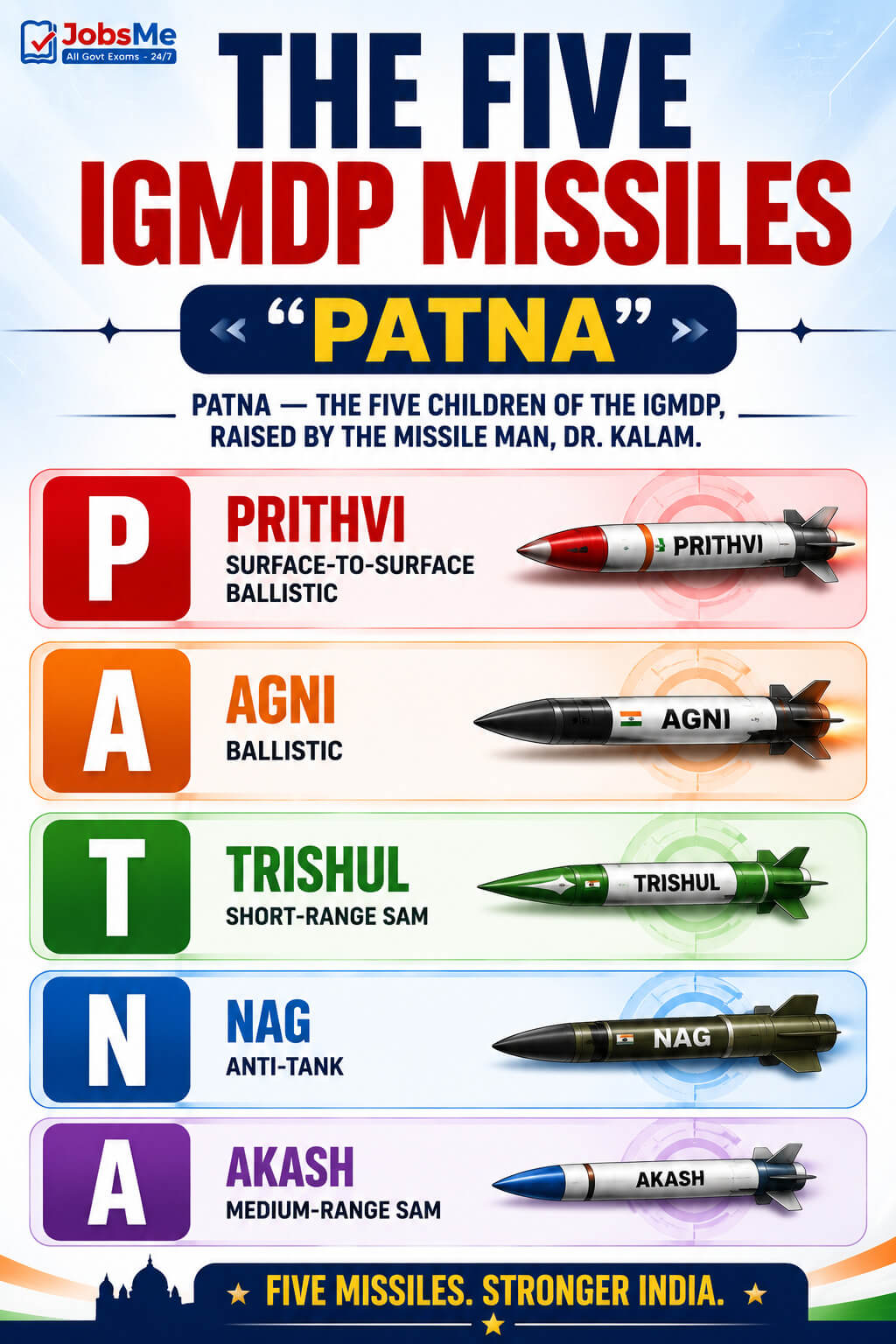
To remember the five core missiles developed under the IGMDP, use the city name PATNA:
- P → Prithvi (surface-to-surface ballistic).
- A → Agni (ballistic).
- T → Trishul (short-range SAM).
- N → Nag (anti-tank).
- A → Akash (medium-range SAM).
"PATNA — the five children of the IGMDP, raised by the Missile Man, Dr. Kalam."
Trick 2: BrahMos Name Origin — "Two Rivers, Two Nations"
To remember what BrahMos stands for and who built it:
- BRAH → Brahmaputra (river of India).
- MOS → Moskva / Moscow (Russia).
"BrahMos = Brahmaputra + Moscow — an India-Russia handshake at Mach 3."
Trick 3: Agni Range Ladder — "1-2-3-4-5 climbing the stairs"
Remember the Agni series ranges as a rising staircase:
- Agni-I → about 700-1,200 km.
- Agni-II → about 2,000-2,500 km.
- Agni-III → about 3,000-4,000 km.
- Agni-IV → about 4,000 km.
- Agni-V → 5,000+ km (ICBM-class).
"As the Roman number goes up, the range climbs higher — Agni means Fire, and the fire reaches farther."
Trick 4: The Two "Missions" — Shakti vs Divyastra
This is a classic confusion-trap. Keep them apart with this contrast:
- Mission Shakti (2019) → ASAT (satellite kill) → India became the 4th nation.
- Mission Divyastra (2024) → MIRV Agni-V (multiple warheads) → India became the 6th nation.
"Shakti shot the Sky (Satellite); Divyastra Divided the warheads (MIRV)."
Trick 5: India's "First Indigenous" Firsts
Several missiles are tagged "first indigenous" — a favourite exam target:
- Astra → first indigenous air-to-air (BVR) missile.
- Rudram-1 → first indigenous anti-radiation missile (destroys radar).
- Nirbhay → first indigenous long-range subsonic cruise missile.
- Prithvi → first indigenously developed ballistic missile.
- Pralay → first indigenous quasi-ballistic missile.
"A-R-N-P-P — five different firsts, five different families."
Trick 6: The Sea Leg — "K for Kalam"
The submarine-launched ballistic missiles are the "K" family, named after Dr. A.P.J. Abdul Kalam:
- K-15 (Sagarika) → about 750 km.
- K-4 → about 3,500 km.
"K is for Kalam — and K rises from the deep sea (INS Arihant)."
Trick 7: Speed Ladder — Subsonic, Supersonic, Hypersonic
Sort the famous cruise/strike missiles by their speed:
- Subsonic (below Mach 1) → Nirbhay.
- Supersonic (Mach 1-5) → BrahMos (Mach 3).
- Hypersonic (above Mach 5) → Shaurya, BrahMos-II.
"Nirbhay walks, BrahMos runs, Shaurya flies."
Additional Notes
Frequently Confused Facts
- BrahMos is NOT a DRDO-only missile — it is an India-Russia joint venture (BrahMos Aerospace). Do not write it as fully indigenous.
- Agni-V is ICBM-class, not a true ICBM — its range is around 5,000-5,500 km. The upcoming Agni-VI is expected to be India's first true ICBM.
- Mission Shakti vs Mission Divyastra — Shakti (2019) was the ASAT/satellite test (4th nation); Divyastra (2024) was the Agni-V MIRV test (6th nation).
- Astra vs Rudram — Astra is the first indigenous air-to-air missile; Rudram-1 is the first indigenous anti-radiation missile. Do not mix their roles.
- S-400 Triumf is NOT a DRDO product — it was purchased from Russia; it is not part of India's indigenous missile programme.
- Prithvi vs Dhanush — Dhanush is simply the naval, ship-launched variant of Prithvi.
Repeating PYQ Patterns
- IGMDP and Dr. Kalam — repeatedly asked in UPSC Prelims, NDA, and CDS (year of launch, director, the five missiles).
- BrahMos facts — the most-tested missile in competitive exams (name origin, speed, joint venture, first export to the Philippines).
- Agni-V range and MIRV — common in SSC CGL, Banking Awareness, and UPSC after Mission Divyastra.
- Mission Shakti ASAT — frequently asked in SSC, RRB, and State PCS (4th ASAT nation, year 2019).
- "First indigenous" tags — Astra, Rudram, Nirbhay appear directly as one-word answers in many exams.
Quick Insight
India has transformed from a missile-importing nation into a missile-exporting one in just four decades. The export of BrahMos to the Philippines (2022) and Indonesia (2025), the combat debut of BrahMos in Operation Sindoor (2025), and the creation of the Integrated Rocket Force built around the Pralay missile all reflect India's growing strategic confidence and its Atmanirbhar Bharat (self-reliance) push in defence. These developments regularly feature in current affairs, so reading them alongside static notes gives aspirants an edge. You can sharpen these facts with the Static GK notes and stay current with Daily Current Affairs on thejobsme.com.
One-Liners for Quick Revision
- IGMDP → launched 1983, concluded 2008 → directed by Dr. A.P.J. Abdul Kalam, the "Missile Man of India."
- Five IGMDP missiles → Prithvi, Agni, Trishul, Akash, Nag → mnemonic PATNA.
- DRDO → established 1958 → leads India's missile development.
- Prithvi-I → 150 km surface-to-surface → India's first indigenous ballistic missile (Army version).
- Prithvi-II → 250-350 km → Air Force version, nuclear-capable.
- Prithvi-III / Dhanush → 350-600 km → naval, ship-launched variant of Prithvi.
- Agni-I → about 700-1,200 km → medium-range; "Agni" means Fire.
- Agni-II → about 2,000-2,500 km → intermediate-range, two-stage solid fuel.
- Agni-III → about 3,000-4,000 km → last major IGMDP missile (tested 2007).
- Agni-IV → about 4,000 km → lighter composites, transition to Agni-V.
- Agni-V → 5,000-5,500 km → India's longest-range missile; MIRV tested under Mission Divyastra (2024).
- Agni-Prime (Agni-P) → up to 2,000 km → first rail-based mobile launch on 24 September 2025.
- Agni-VI → under development → expected to be India's first true ICBM.
- Shaurya → 700-800 km, Mach 7 → hypersonic, land variant of K-15.
- Pralay → 150-500 km → first indigenous quasi-ballistic missile; core of the Integrated Rocket Force.
- Prahaar → up to 150 km → short-range tactical battlefield missile.
- BrahMos → 290-500 km, Mach 2.8-3 → world's fastest operational cruise missile; India-Russia JV; first exported to the Philippines (2022).
- Nirbhay → 1,000-1,500 km → India's first indigenous long-range subsonic cruise missile.
- BrahMos-II → about 600 km, Mach 7-8 → hypersonic variant under development.
- Akash → 30-60 km → medium-range surface-to-air missile (IGMDP).
- Trishul → about 9 km → short-range, low-altitude SAM (IGMDP).
- Barak-8 (MRSAM) → 70-100 km → India-Israel joint venture; Army and Navy.
- QRSAM → 25-30 km → indigenous quick-reaction surface-to-air missile.
- PAD / AAD → two-tiered Ballistic Missile Defence interceptors.
- Nag (Prospina) → 0.5-4 km → third-generation, fire-and-forget anti-tank missile (IGMDP).
- Helina (Dhruvastra) → 7-10 km → helicopter-launched anti-tank missile.
- MPATGM → 5-7 km → man-portable anti-tank missile (under development).
- Astra → 70-110 km → India's first indigenous air-to-air (BVR) missile.
- Rudram-1 → 100-250 km → India's first indigenous anti-radiation missile (destroys radar).
- Dhanush → 350 km → ship-launched ballistic missile (naval Prithvi).
- K-15 (Sagarika) → about 750 km → submarine-launched ballistic missile; "K" family named after Kalam.
- K-4 → about 3,500 km → intermediate-range SLBM for second-strike capability.
- Varunastra → about 40 km → indigenous heavyweight anti-submarine torpedo.
- Mission Shakti → 27 March 2019 → ASAT test; India became the 4th ASAT nation.
- Mission Divyastra → 11 March 2024 → Agni-V MIRV test; India became the 6th MIRV nation.
- Nuclear Triad → completed November 2018 → Land (Agni) + Air (Su-30/Mirage) + Sea (K-15/K-4).
- HSTDV → hypersonic technology demonstrator → speeds over Mach 5.
To lock in these facts, test yourself with the Static GK Quiz and revise the broader Banking Awareness notes on thejobsme.com. You can also keep an eye on upcoming defence and government vacancies at Latest Government Job Notifications.
Free quiz • No signup required
Put this topic into practice with Indian Cultural Institutions – Static GK MCQ Quiz. It is the quickest way to reinforce what you just learned.
Frequently Asked Questions
What is the IGMDP and who is associated with it?
Which is the longest-range missile of India?
What does the name BrahMos stand for?
What is the difference between Mission Shakti and Mission Divyastra?
Which is India's first indigenous air-to-air missile?
Is BrahMos developed entirely by India?
What are the main categories of Indian missiles?
What is the K missile family and why is it named so?
What is the Pralay missile and why is it important?
Which missile is known as India's first anti-radiation missile?

About the author