ISRO Missions List – Static GK & General Awareness for Competitive Exams with Memory Tricks
This article presents a complete list of ISRO missions, covering India's first satellite Aryabhata (1975), the indigenous SLV-3 launch, lunar missions Chandrayaan-1, 2 and 3, the Mars Orbiter Mission (Mangalyaan), the solar mission Aditya-L1, AstroSat, XPoSat, NavIC, NISAR, Axiom-4, and future missions like Gaganyaan, Chandrayaan-4, the Venus Orbiter Mission and the Bharatiya Antariksh Station, along with launch dates, launch vehicles, and key achievements. It includes memory tricks, frequently confused facts, and one-liners for quick revision. All facts are arranged in exam-ready format to help UPSC, SSC, IBPS, RRB, PSU, and State PCS aspirants score better in General Awareness, Science and Technology, and Current Affairs sections.
Jump to section
Introduction
The Indian Space Research Organisation (ISRO) is India's national space agency, officially established on 15 August 1969 under the visionary leadership of Dr. Vikram Sarabhai, who is often regarded as the Father of the Indian Space Programme. India's space journey actually began earlier, in 1963, with the launch of a sounding rocket from the Thumba Equatorial Rocket Launching Station (TERLS) in Kerala, where a converted church and a coconut tree shed served as the first rocket workshop. From these humble beginnings, ISRO has grown into one of the world's most efficient and cost-effective space agencies, with missions spanning Earth observation, navigation, astronomy, solar science, lunar and planetary exploration, and human spaceflight.
Questions on ISRO missions appear regularly in UPSC Prelims, SSC CGL, IBPS PO, RRB NTPC, SBI Clerk, State PCS, and various Insurance and Defence exams, often as part of Science and Technology and Current Affairs. Typical questions ask about the launch year of a mission, the launch vehicle used, the orbit or destination, "firsts" achieved by India, and the names of landers and rovers. This article brings together every important ISRO mission in a structured, exam-ready format. To stay updated with the latest space-related news, you can refer to the Daily Current Affairs section on thejobsme.com.
ISRO missions are also closely linked to ongoing current affairs themes such as the Chandrayaan-3 South Pole landing, the declaration of National Space Day, the Aditya-L1 solar observatory reaching the L1 point, the NISAR launch, India's first astronaut on the International Space Station via Axiom-4, and upcoming projects like Gaganyaan and the Bharatiya Antariksh Station, making this topic doubly important for aspirants preparing for both Prelims and Mains.
Core Concepts: Understanding ISRO and Its Missions
ISRO's work is organised around different categories of satellites, launch vehicles, and exploration missions. Understanding these categories helps students remember individual missions and answer related questions confidently.
Categories of ISRO Missions and Satellites
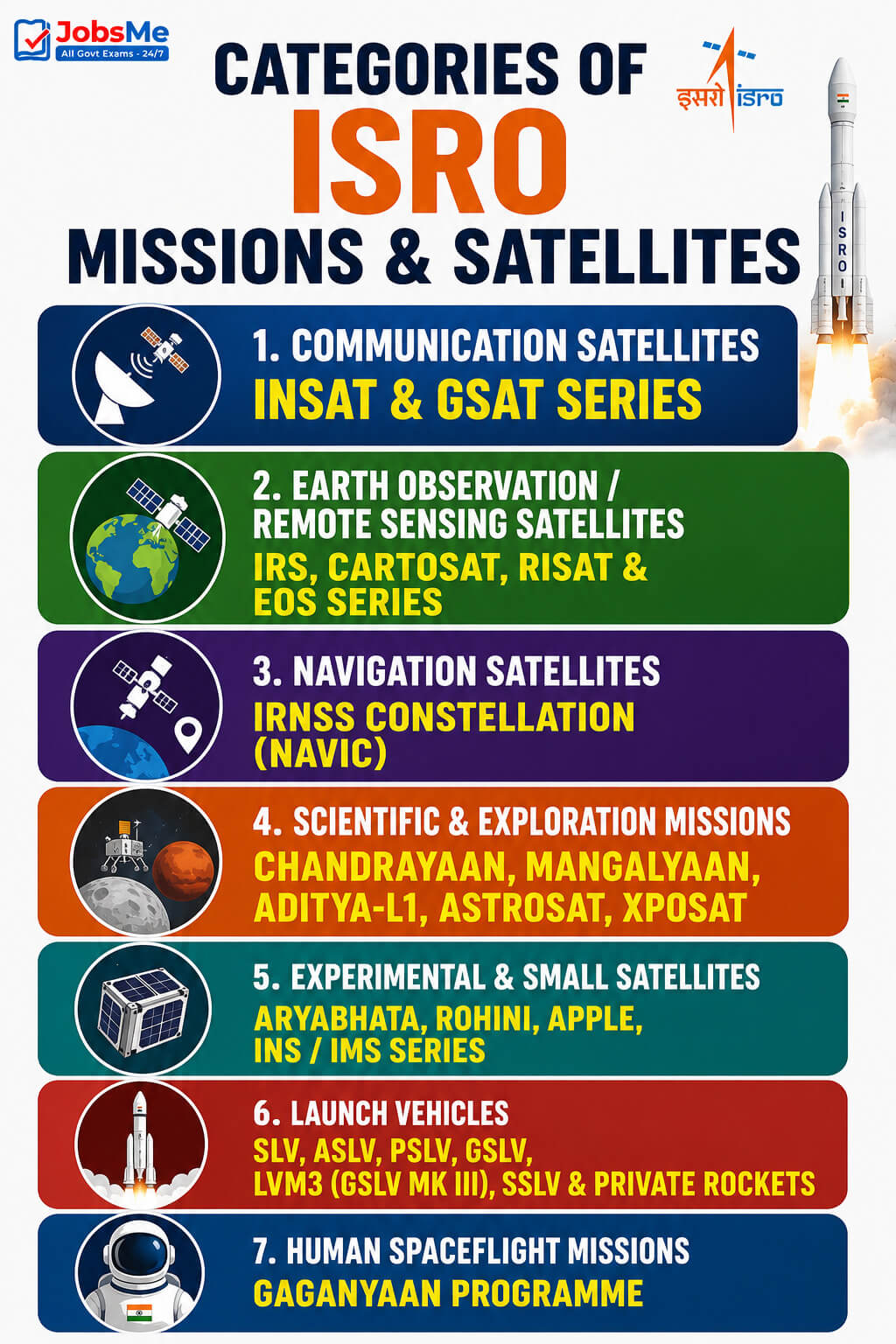
- Communication Satellites: The INSAT and GSAT series provide telecommunication, television broadcasting, and meteorology services from geostationary orbit.
- Earth Observation / Remote Sensing Satellites: The IRS, Cartosat, RISAT, and EOS series provide imagery for agriculture, water resources, urban planning, and disaster management.
- Navigation Satellites: The IRNSS constellation, branded as NavIC, provides India's independent positioning and timing services.
- Scientific and Exploration Missions: Chandrayaan (lunar), Mangalyaan (Mars), Aditya-L1 (Sun), AstroSat and XPoSat (astronomy) explore space and the solar system.
- Experimental and Small Satellites: Aryabhata, Rohini, APPLE, and the INS/IMS series demonstrate new technologies.
- Launch Vehicles: India evolved through SLV, ASLV, PSLV, GSLV, and LVM3 (GSLV Mk III), and is now adding SSLV and private rockets.
- Human Spaceflight Missions: The Gaganyaan programme aims to send Indian astronauts to low Earth orbit using indigenous technology.
ISRO by the Numbers
- Established: 15 August 1969 under Dr. Vikram Sarabhai.
- Total Spacecraft Missions: 133 (including 3 Nano and 1 Micro Satellite).
- Launch Missions: 104, with the 100th launch achieved in January 2025.
- Foreign Satellites Launched: 434, from over 34 countries including the USA, UK, and Singapore.
- Re-entry Missions and POEMs: 9.
- Human Spaceflight Missions: 1 (Gaganyaan programme).
- Budget Growth: from approximately ₹5,615 crore (2013-14) to ₹13,416 crore (2025-26), with 328+ space startups and 100% FDI allowed in selected activities.
Major ISRO Missions - Launch Details and Achievements
The following table lists the most exam-relevant ISRO missions along with their launch year, launch vehicle, and key details. For more on Science and Technology topics, you can explore the Static GK section on thejobsme.com.
Early Satellites and Launch Vehicles
| Mission / Satellite | Year | Key Details |
|---|---|---|
| Aryabhata | 1975 | India's first satellite, completely designed and built in India; launched on 19 April 1975 from the Soviet Union's Kapustin Yar using a Kosmos-3M (C-1 Intercosmos) rocket; this 360-kg satellite was designed for X-ray astronomy, solar physics, and aeronomy; faced technical issues after reaching orbit but gave India valuable lessons in satellite design. |
| SLV-3 / Rohini RS-1 | 1980 | Launched on 18 July 1980, the Satellite Launch Vehicle-3 (SLV-3) was India's first indigenous satellite launch vehicle and placed the Rohini satellite into orbit; developed by a team led by Dr. APJ Abdul Kalam; marked India's first homegrown satellite launch. |
| APPLE | 1981 | India's first indigenous experimental communication satellite placed in Geostationary Transfer Orbit (GTO). |
| IRS-1A | 1988 | India's first indigenous remote sensing satellite, launched by a Vostok rocket from the USSR; began India's large remote sensing constellation for agriculture, water resources, and disaster management. |
| PSLV (Polar Satellite Launch Vehicle) | 1993 (first launch), 1994 (first success) | India's most reliable and versatile launch vehicle, known for cost-effectiveness and precision; the workhorse that launched Chandrayaan-1, Mangalyaan, and Aditya-L1; capable of multi-satellite deployment. |
| GSLV (Geosynchronous Satellite Launch Vehicle) | 2001 (GSLV-D1) | Developed to launch heavier payloads into geostationary orbit; GSLV-D5 (2014) showcased the indigenous cryogenic upper stage; GSLV-F04 (2007) placed INSAT-4CR in orbit. |
| GSLV Mk III / LVM3 | 2017 (Mk III-D1) | India's heaviest launch vehicle; GSLV Mk III-D1 (2017) launched GSAT-19; used for Chandrayaan-2, Chandrayaan-3, and heavy communication satellites. |
Earth Observation, Communication, and Navigation Satellites
| Mission / Series | Year | Key Details |
|---|---|---|
| RISAT-1 | 2012 | India's first radar imaging satellite, launched on 26 April 2012 aboard PSLV-C19 from Satish Dhawan Space Centre; operates in C-band with Synthetic Aperture Radar (SAR), giving all-weather, day-and-night imaging for agriculture, forestry, soil moisture, and disaster management. |
| RISAT-2 / EOS Series | 2009, 2020 onward | RISAT-2 launched in 2009; ISRO later renamed remote sensing satellites as Earth Observation Satellites (EOS) — EOS-01 (2020), EOS-04 (2022, radar imaging for agriculture); EOS-09/RISAT-1B was lost in the PSLV-C61 failure of May 2025. |
| INSAT Series | 1983 onward | The Indian National Satellite System, one of Asia-Pacific's largest domestic communication satellite systems; INSAT-1B (1983) was the first successful INSAT; INSAT-2A (1992) was the first ISRO-built multipurpose satellite; provides TV broadcasting, telecom, and meteorology. |
| GSAT Series | 2000s onward | Geostationary communication satellites for broadband and mobile telephony; GSAT-7 (Rukmini, 2013) serves the Indian Navy; GSAT-11 (2018) was India's heaviest satellite built (3,423 kg); CMS-03/GSAT-7R (2025) was the heaviest satellite launched from Indian soil (4,410 kg by LVM3). |
| EDUSAT | 2004 | India's first dedicated education satellite for distance learning. |
| NavIC / IRNSS | 2018 (operational) | The Navigation with Indian Constellation system, India's indigenous satellite-based navigation system comparable to the US GPS; began with IRNSS-1A on 1 July 2013; consists of seven satellites in geostationary and geosynchronous orbits; covers India and up to 1,500 km around it. |
| Oceansat (IRS-P4) | 1999 | India's first ocean observation satellite. |
| SARAL | 2013 | Joint India-France mission for oceanography. |
Lunar, Planetary, and Astronomy Missions
| Mission | Launch Date / Vehicle | Key Details |
|---|---|---|
| Chandrayaan-1 | 22 October 2008 / PSLV-C11 (PSLV-XL) | India's first mission to the Moon; an orbiter-only mission that carried 11 instruments from NASA, ESA, Bulgaria, and others; its groundbreaking discovery was the detection of water molecules (H₂O ice) on the Moon, especially near the poles; made India the 4th country to reach the Moon; lost contact in August 2009 after about 10 months but the mission was fully achieved. |
| Mars Orbiter Mission (Mangalyaan) | 5 November 2013 / PSLV-C25 | India's first interplanetary mission; reached Mars orbit on 24 September 2014 on its first attempt, making India the first country to succeed on a maiden Mars attempt and Asia's first Mars mission; ISRO became the 4th space agency to reach Mars (after USSR, NASA, ESA); world's cheapest Mars mission at about $74 million (₹450 crore); carried five instruments and discovered dust storms; mission ended in October 2022 after fuel depletion. |
| AstroSat | 28 September 2015 / PSLV-C30 | India's first dedicated multi-wavelength space observatory; simultaneously observes celestial sources in visible, ultraviolet, and X-ray bands from a single satellite; studies black holes, neutron stars, pulsars, supernovae, and galaxies; still operational. |
| Chandrayaan-2 | 22 July 2019 / GSLV Mk III (LVM3-M1) | Consisted of an orbiter, the Vikram lander, and the Pragyan rover; aimed to explore the Moon's south polar region; the Vikram lander crash-landed about 2.1 km from target in September 2019, but the orbiter remains fully functional and continues mapping lunar water ice and minerals; the orbiter has 8 instruments including a high-resolution camera. |
| Chandrayaan-3 | 14 July 2023 / LVM3-M4 | The Vikram lander soft-landed near the Moon's South Pole on 23 August 2023, making India the first country to land near the lunar South Pole and the 4th country to soft-land on the Moon; the Pragyan rover confirmed the presence of sulphur; had NO orbiter — only a propulsion module, lander, and rover; the propulsion module was later moved to Earth orbit and operated till August 2024; 23 August is now celebrated as National Space Day. |
| Aditya-L1 | 2 September 2023 / PSLV-C57 | India's first dedicated solar mission; placed at the Sun-Earth Lagrange Point 1 (L1), about 1.5 million km from Earth, in January 2024, giving a constant uninterrupted view of the Sun; studies the corona, chromosphere, photosphere, solar wind, solar flares, and space weather; carries 7 payloads including the Visible Emission Line Coronagraph (VELC). |
| XPoSat | 1 January 2024 / PSLV-C58 | India's first dedicated X-ray polarimetry mission and only the world's second (after NASA's IXPE of 2021); studies X-ray polarisation of pulsars, black hole binaries, active galactic nuclei, and supernova remnants; payloads are POLIX (polarimetry) and XSPECT (spectroscopy); placed in Low Earth Orbit. |
Record-Setting and Milestone Missions
| Mission | Year | Key Details |
|---|---|---|
| PSLV-C37 | 2017 | On 15 February 2017, the PSLV set a then world record by deploying 104 satellites in a single mission; included the primary payload Cartosat-2D and 103 nano-satellites from countries including the USA, UAE, and Kazakhstan; demonstrated ISRO's reliability in complex multi-satellite deployment. |
| GSAT-6A | 2018 | Launched on 29 March 2018 aboard a GSLV Mk II; a high-power S-band communication satellite with one of ISRO's largest unfurlable antennas, designed for mobile communication in remote areas; contact was lost after launch due to a power system anomaly. |
| SpaDeX | January 2025 | India's first successful docking in space, making India the 4th country to achieve in-space docking after Russia, the USA, and China. |
| Axiom Mission 4 (Ax-4) | 2025 | Marked India's first human presence on the International Space Station; launched on 25 June 2025, it enabled Indian astronaut Shubhanshu Shukla to spend 18 days aboard the ISS until 15 July 2025; experiments covered muscle atrophy, microbial behaviour, and crop growth; supported the Gaganyaan programme. |
| NISAR | 2025 | The NASA-ISRO Synthetic Aperture Radar, launched on 30 July 2025; the world's first dual-frequency radar imaging satellite using both L-band and S-band; placed at 743 km Sun-Synchronous Polar Orbit and maps Earth every 12 days; studies earthquakes, landslides, glaciers, forests, and agriculture for climate and disaster monitoring. |
Upcoming and Planned ISRO Missions
| Mission | Timeline | Key Details |
|---|---|---|
| Gaganyaan | 2025-2026 | India's human spaceflight programme, developed jointly by ISRO and HAL to carry three astronauts to low Earth orbit; Gaganyaan-1, 2 and 3 are uncrewed test flights; the crewed Gaganyaan-4 (planned 2026) aims to make India the 4th nation to independently send humans to space. |
| Chandrayaan-4 | ~2027-28 | A lunar sample return mission approved on 14 September 2024 with a budget of about ₹2,104 crore; will require two LVM3 launches due to its mass; includes transfer, lander, ascender, and re-entry modules that dock in lunar orbit to collect and return samples to Earth. |
| Venus Orbiter Mission (Shukrayaan) | Planned ~29 March 2028 | India's second interplanetary mission after Mangalyaan; will orbit Venus to study its atmosphere, cloud dynamics, greenhouse effects, and surface-atmosphere interactions. |
| Lunar Polar Exploration Mission (LUPEX / Chandrayaan-5) | 2028-29 | A joint ISRO-JAXA (Japan) initiative targeting the Moon's south polar region with a lander and rover; aims to study water ice in Permanently Shadowed Regions for future human missions. |
| Bharatiya Antariksh Station | 2028-2035 | India's proposed space station; designed to weigh about 20 tonnes and orbit Earth at roughly 400 km altitude; astronauts may stay 15 to 20 days conducting microgravity experiments; represents India's long-term human spaceflight vision. |
Memory Tricks and Mnemonics
Trick 1: Launch Vehicle Evolution — "SAPGL"
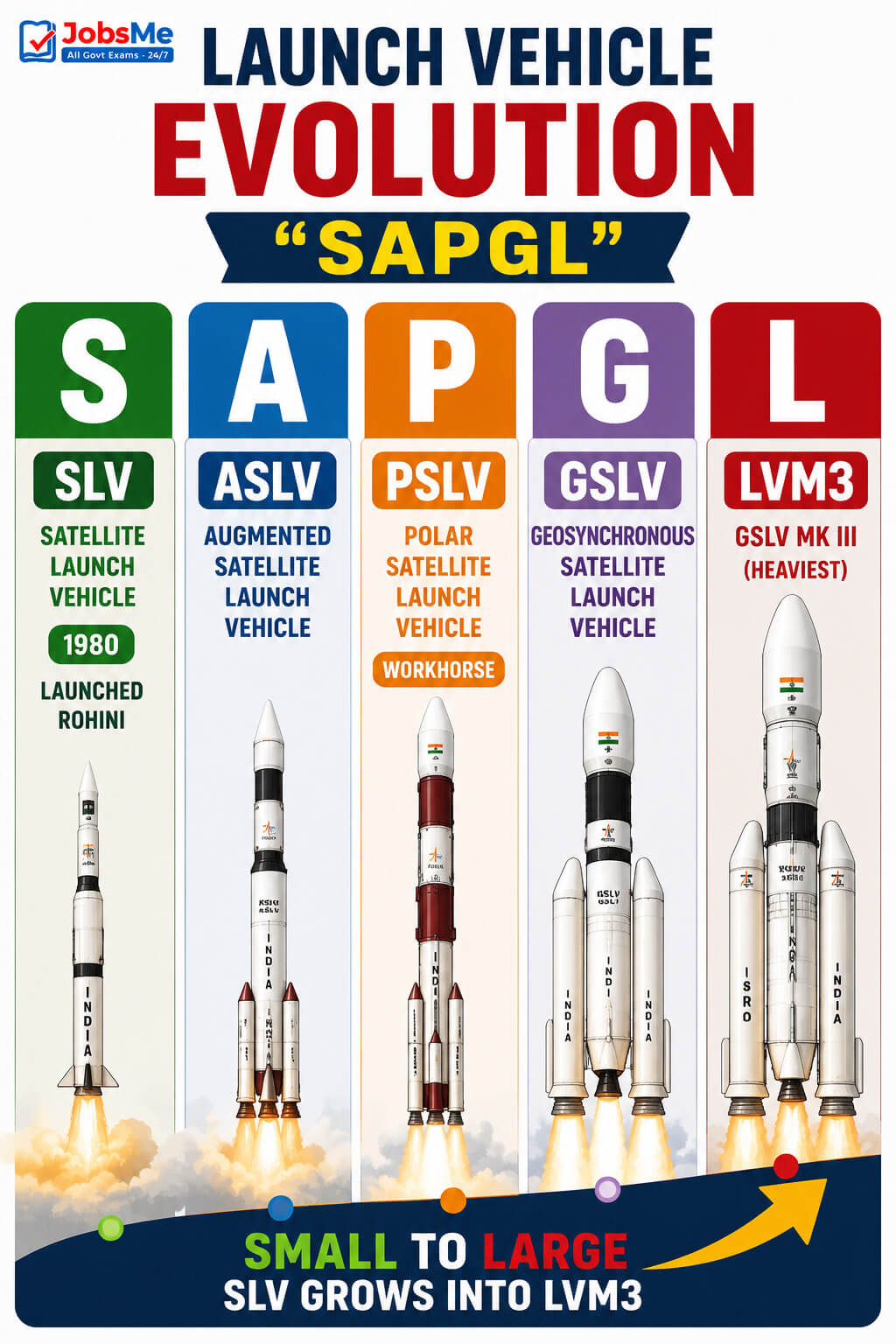
Remember the evolution of India's launch vehicles in order using "SAPGL":
- S → SLV (Satellite Launch Vehicle, 1980, launched Rohini).
- A → ASLV (Augmented Satellite Launch Vehicle).
- P → PSLV (Polar Satellite Launch Vehicle, the workhorse).
- G → GSLV (Geosynchronous Satellite Launch Vehicle).
- L → LVM3 (GSLV Mk III, the heaviest).
"Small to Large — SLV grows into LVM3."
Trick 2: The Three Chandrayaans — "OOL"
Remember what each Chandrayaan carried using "OOL":
- Chandrayaan-1 (2008) → Orbiter only; discovered water on the Moon.
- Chandrayaan-2 (2019) → Orbiter + Vikram Lander + Pragyan Rover; lander crashed, orbiter works.
- Chandrayaan-3 (2023) → No orbiter; Lander + Rover + propulsion module; successful South Pole soft landing.
"One orbits, Two adds a rover, Three lands."
Trick 3: India's Space "Firsts"
The most commonly asked "first" missions:
- First satellite → Aryabhata (1975).
- First indigenous launch → Rohini via SLV-3 (1980).
- First lunar mission → Chandrayaan-1 (2008).
- First interplanetary mission → Mangalyaan / MOM (2013).
- First astronomy satellite → AstroSat (2015).
- First solar mission → Aditya-L1 (2023).
- First X-ray polarimetry mission → XPoSat (2024).
- First docking in space → SpaDeX (2025).
Trick 4: Lagrange Point — "Aditya at L1"
Remember that Aditya-L1 sits at the Sun-Earth Lagrange Point 1 (L1), about 1.5 million km from Earth. The "L1" is right there in the name. "Aditya means Sun, L1 means the spot — Aditya-L1 watches the Sun without interruption."
Trick 5: Landers and Rovers — "Vikram and Pragyan"
- Vikram (the lander) is named after Dr. Vikram Sarabhai, the father of India's space programme.
- Pragyan (the rover) means "wisdom" in Sanskrit.
"Vikram lands, Pragyan roves."
Trick 6: The "4th Country / 4th Agency" Pattern
India became the 4th in several space achievements:
- 4th country to reach the Moon (Chandrayaan-1).
- 4th space agency to reach Mars (Mangalyaan, after USSR, NASA, ESA).
- 4th country to soft-land on the Moon (Chandrayaan-3).
- 4th country to dock in space (SpaDeX, after Russia, USA, China).
"Moon, Mars, Soft-landing, Docking — India is the Fourth in all four."
Trick 7: Cheapest and Record Missions
- Cheapest Mars mission → Mangalyaan ($74 million / ₹450 crore).
- 104 satellites in one go → PSLV-C37 (2017 world record).
- World's first dual-band SAR → NISAR (L-band + S-band).
Additional Notes
Frequently Confused Facts
- Chandrayaan-1 vs Chandrayaan-3: Chandrayaan-1 (2008) discovered water on the Moon but was an orbiter only; Chandrayaan-3 (2023) achieved the first soft landing near the South Pole. Do not mix the achievements.
- Chandrayaan-2 vs Chandrayaan-3: Chandrayaan-2 had an orbiter, lander, and rover (lander crashed); Chandrayaan-3 had NO orbiter — only a propulsion module, lander, and rover, and it landed successfully.
- Launch year vs Mars-orbit year of Mangalyaan: Mangalyaan was launched on 5 November 2013 but reached Mars orbit on 24 September 2014. Exams often test the orbit-insertion year.
- Aditya-L1 launch vs arrival: Launched on 2 September 2023 but reached the L1 point only in January 2024.
- AstroSat vs XPoSat: AstroSat (2015) is a multi-wavelength observatory; XPoSat (2024) is dedicated to X-ray polarimetry only.
- PSLV vs GSLV vs LVM3: PSLV is the reliable workhorse for polar/lighter payloads; GSLV and LVM3 (GSLV Mk III) carry heavier payloads to geostationary orbit. Chandrayaan-1 used PSLV, while Chandrayaan-2 and 3 used LVM3.
- NavIC vs GPS: NavIC is India's own regional system covering India and up to 1,500 km around it; GPS is the US global system.
- NISAR vs RISAT: NISAR (2025) is a NASA-ISRO joint mission and the world's first dual-band (L+S) SAR; RISAT-1 (2012) was India's first single-band (C-band) radar imaging satellite.
- Vikram Sarabhai vs Vikram lander: Dr. Vikram Sarabhai is the father of India's space programme; the Vikram lander on Chandrayaan-2 and 3 is named after him.
- GSAT-7 (Rukmini): A communication satellite built for the Indian Navy, not a navigation satellite.
Repeating PYQ Patterns
Certain ISRO missions are asked repeatedly in competitive exams. Aryabhata (1975, first satellite), Chandrayaan-1 (water on Moon), Mangalyaan (first-attempt Mars success, cheapest Mars mission), Chandrayaan-3 (South Pole landing, National Space Day), Aditya-L1 (L1 point solar mission), PSLV-C37 (104 satellites), and NavIC appear most often in UPSC Prelims, SSC CGL, and RRB NTPC papers. Banking exams (IBPS PO, SBI Clerk) frequently focus on launch years, launch vehicles, and recent missions like NISAR and Axiom-4 in their Current Affairs and General Awareness sections. State PCS and Defence exams add details such as the launch vehicle used and the names of landers and rovers. To revise space-related current affairs, you can attempt the Daily Current Affairs Quiz on thejobsme.com.
Quick Insight
ISRO missions are more than scientific milestones — they reflect India's growing strategic and technological strength. The Chandrayaan-3 landing near the lunar South Pole on 23 August 2023, now marked as National Space Day, placed India among the world's leading space powers, while Aditya-L1 and NISAR demonstrate India's ability to undertake complex solar and Earth-observation science. With the Gaganyaan human spaceflight programme, the planned Bharatiya Antariksh Station, and a fast-growing private space sector with over 328 startups, ISRO remains one of the most important topics in current affairs for aspirants. For more Static GK and science topics, refer to the Static GK notes and stay updated with the Latest Government Job Notifications on thejobsme.com.
One-Liners for Quick Revision
- ISRO → Indian Space Research Organisation → established 15 August 1969 under Dr. Vikram Sarabhai.
- TERLS → Thumba Equatorial Rocket Launching Station, Kerala → site of India's first sounding rocket launch in 1963.
- Aryabhata → India's first satellite (1975) → launched by USSR's Kosmos-3M rocket.
- SLV-3 / Rohini → India's first indigenous launch (1980) → led by Dr. APJ Abdul Kalam's team.
- APPLE → first indigenous experimental communication satellite (1981) → in GTO.
- IRS-1A → first indigenous remote sensing satellite (1988).
- INSAT-1B → first successful INSAT (1983); INSAT-2A → first ISRO-built multipurpose satellite (1992).
- EDUSAT → India's first dedicated education satellite (2004).
- Oceansat (IRS-P4) → India's first ocean observation satellite (1999).
- RISAT-1 → India's first radar imaging satellite (2012) → C-band SAR, all-weather imaging.
- Chandrayaan-1 → India's first lunar mission (2008, PSLV-C11) → discovered water on the Moon.
- Mangalyaan (MOM) → first interplanetary mission (2013, PSLV-C25) → Mars orbit in first attempt (2014), cheapest Mars mission.
- GSAT-7 (Rukmini) → communication satellite for the Indian Navy (2013).
- AstroSat → India's first multi-wavelength space observatory (2015, PSLV-C30).
- PSLV-C37 → world record of 104 satellites in one launch (2017).
- GSAT-6A → S-band communication satellite (2018) → contact lost after launch.
- NavIC / IRNSS → India's navigation system (operational 2018) → seven satellites, began with IRNSS-1A (2013).
- GSAT-11 → India's heaviest satellite built (2018, 3,423 kg).
- Chandrayaan-2 → orbiter + Vikram lander + Pragyan rover (2019, LVM3) → lander crashed, orbiter works.
- Chandrayaan-3 → first soft landing near lunar South Pole (23 August 2023, LVM3) → National Space Day; no orbiter.
- Aditya-L1 → India's first solar mission (2023, PSLV-C57) → at Sun-Earth L1, 1.5 million km away.
- XPoSat → India's first X-ray polarimetry mission (2024, PSLV-C58) → world's second after NASA's IXPE.
- SpaDeX → India's first space docking (2025) → 4th country after Russia, USA, China.
- Axiom-4 (Ax-4) → India's first astronaut on the ISS (2025) → Shubhanshu Shukla, 18 days.
- NISAR → NASA-ISRO joint Earth observation mission (2025) → world's first dual-band (L+S) SAR.
- Gaganyaan → India's human spaceflight programme → three astronauts to low Earth orbit, by ISRO and HAL.
- Chandrayaan-4 → planned lunar sample return mission (~2027-28) → two LVM3 launches.
- Venus Orbiter Mission (Shukrayaan) → India's second interplanetary mission (planned 2028).
- LUPEX / Chandrayaan-5 → joint ISRO-JAXA lunar polar mission (2028-29).
- Bharatiya Antariksh Station → India's proposed space station (2028-2035) → about 20 tonnes at 400 km altitude.
- ISRO record → 133 spacecraft missions, 104 launch missions, 434 foreign satellites launched.
For more Static GK topics like Indian launch vehicles, scientific discoveries, and important days, explore the Static GK Quiz on thejobsme.com. You can also strengthen your General Awareness with the Daily Current Affairs notes and check out the latest exam updates at Latest Government Job Notifications.
Free quiz • No signup required
Put this topic into practice with Indian Cultural Institutions – Static GK MCQ Quiz. It is the quickest way to reinforce what you just learned.
Frequently Asked Questions
When was ISRO established and under whose leadership?
Which was India's first satellite and how was it launched?
Which ISRO mission discovered water on the Moon?
Why is the Mars Orbiter Mission (Mangalyaan) considered historic?
What made Chandrayaan-3 a major milestone for India?
What is the difference between Chandrayaan-2 and Chandrayaan-3?
What is the Aditya-L1 mission and where is it placed?
What record did the PSLV-C37 mission set in 2017?
What is NavIC and how is it different from GPS?
What is the objective of the Gaganyaan mission?

About the author