Indian Railways Zones Static GK: All 18 Zones, Headquarters and 70 Divisions List
This article gives the complete, updated list of Indian Railways zones, their headquarters, establishment years, divisions and the states they cover, including the newly operational South Coast Railway zone. It also explains the zone-division-Railway Board structure, corrects the most commonly confused facts, and provides memory tricks plus one-liners for fast revision before SSC, RRB, IBPS, UPSC and State PCS exams.
Jump to section
Introduction
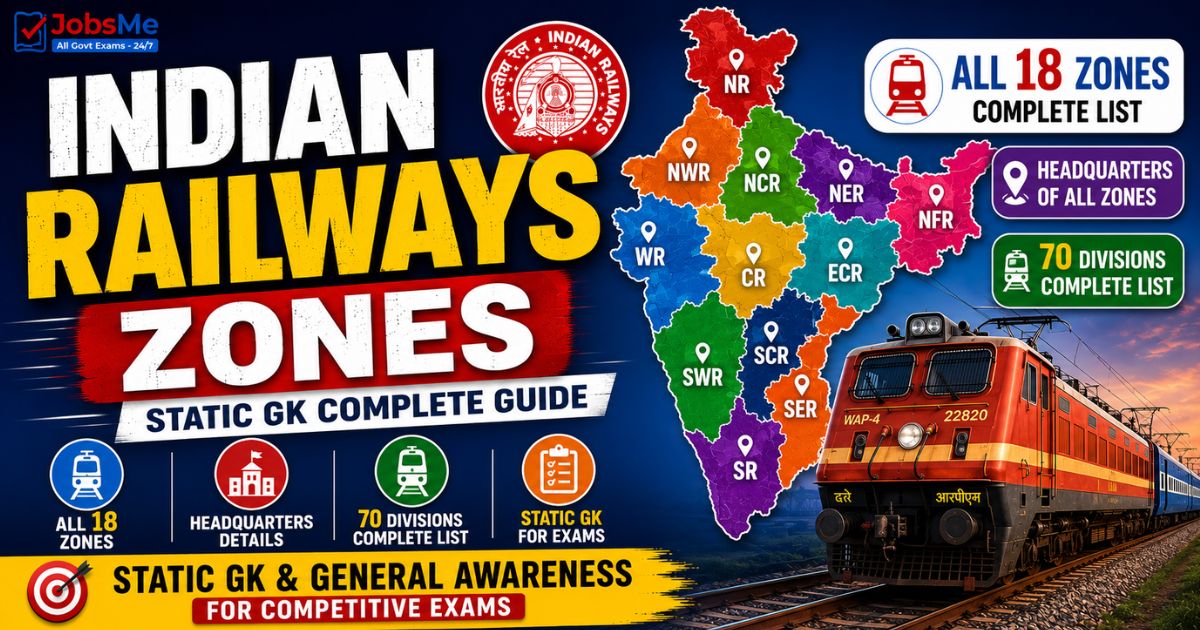
Indian Railways is the fourth largest railway network in the world and the largest run under a single management. To administer a network of this size, the Ministry of Railways divides it vertically into zones, and each zone is further divided into divisions. As on 1 June 2026, Indian Railways has 18 zonal railways and 70 divisions, following the creation of the South Coast Railway (SCoR) zone with headquarters at Visakhapatnam and the new Rayagada division under East Coast Railway.
Indian Railways Zones Static GK is one of the highest-yielding General Awareness topics in competitive exams. Questions on zonal headquarters, the oldest and newest zones, and the number of divisions appear almost every year in RRB NTPC, RRB Group D, RRB ALP, SSC CGL, SSC CHSL, IBPS PO, IBPS Clerk, Insurance and State PCS papers. Because the facts are fixed and easy to memorise, this chapter can fetch guaranteed marks with very little revision time. You can pair this chapter with other high-return chapters in our Static GK notes for competitive exams.
The list below is fully updated for the 2026 restructuring, in which South Central Railway was reduced from six divisions to three, the Waltair division was renamed Visakhapatnam division, and Rayagada became the 70th division of Indian Railways. Many older books and PDFs still show 17 zones and 68 divisions, so read the updated table carefully.
Core Concept: Zone, Division and the Administrative Chain
Indian Railways works as a matrix organisation. Geographically it is split into zones; functionally it is split into departments such as traffic, engineering, mechanical, electrical, signal and telecommunication, stores, personnel, accounts, security and safety.

- Ministry of Railways is the apex ministry, headed by the Union Minister of Railways.
- Railway Board is the highest executive body. The Chairman of the Railway Board, who is also the Chief Executive Officer, reports to the Ministry of Railways. The Board was reduced from eight members to five in December 2019.
- Zone is the largest field unit, headed by a General Manager (GM), who reports to the Railway Board.
- Division is the basic operating unit, headed by a Divisional Railway Manager (DRM), who reports to the General Manager of the zone.
- Station level work is handled by station masters and area officers under the division.
Three points are frequently tested and frequently misunderstood:
- Zonal and divisional boundaries are decided by operational and administrative need, not by state boundaries. That is why a single state can fall under several zones, and a single zone can spread across several states.
- Metro Railway, Kolkata is a full zone but has no divisions. It is the only zone that runs purely urban rapid transit services.
- Konkan Railway is not a zone. It is run by Konkan Railway Corporation Limited (KRCL), a public sector undertaking jointly owned by the Ministry of Railways and the states of Maharashtra, Goa, Karnataka and Kerala. Some coaching material counts it as a nineteenth zone, which is why you see both 18 and 19 in different books.
Complete List of Indian Railways Zones, Headquarters and Divisions
Zone-wise Master Table (Updated as on 1 June 2026)
| Zone (Code) | Headquarters | Established | Divisions | Key Features and Exam Points |
|---|---|---|---|---|
| Southern Railway (SR) | Chennai, Tamil Nadu | 14 April 1951 | 6 - Chennai, Madurai, Palakkad, Salem, Tiruchirappalli, Thiruvananthapuram | The oldest zone of independent India and the first zone created under zonal reorganisation. Formed by merging the Madras and Southern Mahratta Railway, the South Indian Railway and the Mysore State Railway. Covers Tamil Nadu, Kerala, Puducherry and small parts of Andhra Pradesh and Karnataka. |
| Central Railway (CR) | Chhatrapati Shivaji Maharaj Terminus (CSMT), Mumbai, Maharashtra | 5 November 1951 | 5 - Mumbai CSMT, Bhusawal, Nagpur, Pune, Solapur | Successor of the Great Indian Peninsula Railway, on whose line India's first passenger train ran in 1853. Handles the heavy Mumbai suburban network on the Central line. Covers Maharashtra, Madhya Pradesh and parts of Karnataka. |
| Western Railway (WR) | Churchgate, Mumbai, Maharashtra | 5 November 1951 | 6 - Mumbai Central, Vadodara, Ratlam, Ahmedabad, Rajkot, Bhavnagar | Successor of the Bombay, Baroda and Central India Railway. Runs the Western line Mumbai suburban services and the busy Mumbai-Ahmedabad corridor. Covers Maharashtra, Gujarat, Madhya Pradesh, Rajasthan and Dadra and Nagar Haveli and Daman and Diu. |
| Northern Railway (NR) | Baroda House, New Delhi | 14 April 1952 | 6 - Delhi, Ambala, Firozpur, Jammu, Lucknow, Moradabad | The largest zone by route kilometres. Covers Delhi, Haryana, Punjab, Himachal Pradesh, Uttarakhand, most of Uttar Pradesh, Jammu and Kashmir and Chandigarh. Its Jammu division, the 69th division of Indian Railways, was inaugurated on 6 January 2025 with 742.1 route km carved out of the Firozpur division, and controls the Udhampur-Srinagar-Baramulla Rail Link, the Chenab bridge and the Anji Khad bridge. |
| Eastern Railway (ER) | Fairlie Place, Kolkata, West Bengal | 14 April 1952 | 4 - Howrah, Sealdah, Asansol, Malda | Carved out of the erstwhile East Indian Railway and part of the Bengal Nagpur Railway. Howrah, one of India's oldest and busiest terminals, falls under this zone. Covers West Bengal, Jharkhand and parts of Bihar. |
| North Eastern Railway (NER) | Gorakhpur, Uttar Pradesh | 14 April 1952 | 3 - Izzatnagar, Lucknow, Varanasi | Gorakhpur station under this zone has the world's longest railway platform at about 1,366 metres. Covers eastern and central Uttar Pradesh, western Bihar and small parts of Uttarakhand and Haryana. |
| South Eastern Railway (SER) | Garden Reach, Kolkata, West Bengal | 1955 | 4 - Adra, Chakradharpur, Kharagpur, Ranchi | Formed out of the Bengal Nagpur Railway and known as a heavy coal, iron ore and mineral freight zone. Kharagpur, under this zone, has one of the longest platforms in India. Covers West Bengal, Jharkhand and Odisha. |
| Northeast Frontier Railway (NFR) | Maligaon, Guwahati, Assam | 15 January 1958 | 5 - Katihar, Alipurduar, Rangiya, Lumding, Tinsukia | The lifeline of the North East. Serves Assam, Arunachal Pradesh, Nagaland, Manipur, Mizoram, Tripura, Meghalaya, Nagaland and parts of West Bengal and Bihar. Manages strategic projects such as the Bogibeel bridge and the Jiribam-Imphal line. |
| South Central Railway (SCR) | Rail Nilayam, Secunderabad, Telangana | 2 October 1966 | 3 - Secunderabad, Hyderabad, Nanded | Reduced from six divisions to three from 1 June 2026, after Guntakal, Guntur and Vijayawada went to South Coast Railway. It also gained the Raichur-Wadi and Pagidipalli-Vishnupuram sections. Now covers Telangana and parts of Maharashtra, Karnataka and Andhra Pradesh. |
| East Central Railway (ECR) | Hajipur, Bihar | 1 October 2002 | 5 - Danapur, Dhanbad, Pandit Deen Dayal Upadhyaya (Mughalsarai), Samastipur, Sonpur | Created out of Eastern and North Eastern Railways. The Dhanbad division is one of the highest freight earning divisions of Indian Railways because of coal loading. Covers Bihar, Jharkhand and parts of Uttar Pradesh. |
| North Western Railway (NWR) | Jaipur, Rajasthan | 1 October 2002 | 4 - Jaipur, Ajmer, Bikaner, Jodhpur | Created out of Northern and Western Railways. Retains the largest surviving metre gauge and heritage rail network, and connects the desert districts of Rajasthan. Covers Rajasthan and parts of Haryana, Punjab and Gujarat. |
| East Coast Railway (ECoR) | Bhubaneswar, Odisha | 1 April 2003 | 3 - Khurda Road, Sambalpur, Rayagada | Consistently among the highest freight loading and highest revenue earning zones because of iron ore, coal and steel traffic. Its new Rayagada division, the 70th division of Indian Railways, started on 1 June 2026, carved out of the erstwhile Waltair division. Covers Odisha and parts of Andhra Pradesh and Chhattisgarh. |
| North Central Railway (NCR) | Prayagraj, Uttar Pradesh | 1 April 2003 | 3 - Prayagraj, Agra, Jhansi | Sits on the busiest trunk routes of the country, including the Delhi-Howrah and Delhi-Chennai corridors, which is why it is often called the workhorse of Indian Railways. Headquarters was earlier called Allahabad. Covers Uttar Pradesh, Madhya Pradesh and Rajasthan. |
| South East Central Railway (SECR) | Bilaspur, Chhattisgarh | 1 April 2003 | 3 - Bilaspur, Nagpur, Raipur | A leading coal freight zone, with very high loading from Korba and the Chhattisgarh coalfields. Bilaspur is the only zonal headquarters in Chhattisgarh. Covers Chhattisgarh and parts of Madhya Pradesh, Maharashtra and Odisha. |
| South Western Railway (SWR) | Hubballi, Karnataka | 1 April 2003 | 3 - Hubballi, Bengaluru, Mysuru | Formed from parts of Southern and South Central Railways. The Bengaluru division carries very heavy suburban and inter-city passenger traffic. Covers Karnataka and parts of Tamil Nadu, Andhra Pradesh, Telangana, Goa and Maharashtra. |
| West Central Railway (WCR) | Jabalpur, Madhya Pradesh | 1 April 2003 | 3 - Jabalpur, Bhopal, Kota | Formed from parts of Central and Western Railways. The Kota division handles the high-speed Delhi-Mumbai trunk section. Covers Madhya Pradesh, Rajasthan and parts of Uttar Pradesh and Maharashtra. |
| Metro Railway, Kolkata (MTP) | Kolkata, West Bengal | 29 December 2010 | Nil (no divisions) | The only metro or rapid transit zone of Indian Railways and the only zone without divisions. It runs the Kolkata Metro, India's first metro, which began commercial service on 24 October 1984. It made Kolkata the only city with three zonal headquarters. |
| South Coast Railway (SCoR) | Visakhapatnam, Andhra Pradesh | Announced 27 February 2019; operational 1 June 2026 | 4 - Guntakal, Guntur, Vijayawada, Visakhapatnam | The newest zone of Indian Railways, promised under the Andhra Pradesh Reorganisation Act, 2014 and notified by gazette in May 2026. Carved out of South Central Railway and East Coast Railway, with a route length of about 3,532 km and roughly 385 stations. Sandeep Mathur was its first General Manager. The temporary headquarters is at Siripuram, Visakhapatnam, while the permanent headquarters is planned at Arilova. |
Konkan Railway: The Corporation That Is Not a Zone
| Item | Detail | Why It Matters in Exams |
|---|---|---|
| Konkan Railway (KR) | Run by Konkan Railway Corporation Limited; headquarters at CBD Belapur, Navi Mumbai; incorporated in 1990; line commissioned on 26 January 1998; about 741 km from Roha in Maharashtra to Thokur in Karnataka | It is a public sector undertaking, not a zonal railway. It has two operating regions, Ratnagiri and Karwar, instead of divisions. Its shareholders are the Ministry of Railways along with Maharashtra, Goa, Karnataka and Kerala. Counting it gives the figure of 19 zones seen in older material. |
Zone Count and Division Count: The Numbers to Write in the Exam
| Question Asked | Correct Answer (as on 2026) | Explanation |
|---|---|---|
| Total zonal railways | 18 | 17 geographical zones plus Metro Railway, Kolkata. Konkan Railway is excluded because it is a corporation. |
| Total divisions | 70 | 68 divisions until 2024, then Jammu became the 69th on 6 January 2025 and Rayagada the 70th on 1 June 2026. |
| Zones at the start of zonal reorganisation | 6 | Southern, Central, Western, Northern, Eastern and North Eastern, created between April 1951 and April 1952. |
| Oldest zone | Southern Railway | Created on 14 April 1951, the first zone of independent India. |
| Newest zone | South Coast Railway | Announced in 2019 and made operational on 1 June 2026, with headquarters at Visakhapatnam. |
| Newest division | Rayagada (East Coast Railway) | Operational from 1 June 2026, carved out of the former Waltair division in Odisha. |
| Zones with the most divisions | Northern, Southern and Western Railway (6 each) | South Central Railway also had six until 31 May 2026, but now has three. |
| Zone with no division | Metro Railway, Kolkata | It operates only rapid transit corridors, so the division structure does not apply. |
| City with three zonal headquarters | Kolkata | Eastern Railway at Fairlie Place, South Eastern Railway at Garden Reach and Metro Railway. |
| City with two zonal headquarters | Mumbai | Central Railway at CSMT and Western Railway at Churchgate. |
States and Union Territories Covered by Each Zone
| Zone | States and Union Territories Covered | Anchor Points to Remember |
|---|---|---|
| Northern Railway | Delhi, Haryana, Punjab, Himachal Pradesh, Uttarakhand, Uttar Pradesh, Jammu and Kashmir, Chandigarh | Largest zone by route length; New Delhi, Amritsar, Lucknow and Jammu are key stations. |
| North Central Railway | Uttar Pradesh, Madhya Pradesh, Rajasthan | Prayagraj, Agra Cantt and Jhansi sit on the busiest trunk routes. |
| North Eastern Railway | Uttar Pradesh, Bihar, parts of Uttarakhand and Haryana | Gorakhpur has the world's longest platform. |
| Northeast Frontier Railway | Assam, Arunachal Pradesh, Nagaland, Manipur, Mizoram, Tripura, Meghalaya, parts of West Bengal and Bihar | Only zone serving all eight North Eastern states; headquarters is Maligaon, not Katihar. |
| North Western Railway | Rajasthan, parts of Haryana, Punjab and Gujarat | Largest metre gauge and heritage network. |
| Eastern Railway | West Bengal, Jharkhand, parts of Bihar | Howrah and Sealdah terminals. |
| East Central Railway | Bihar, Jharkhand, parts of Uttar Pradesh | Dhanbad division for coal freight; headquarters at Hajipur, not Patna. |
| East Coast Railway | Odisha, parts of Andhra Pradesh and Chhattisgarh | Top freight earner; new Rayagada division. |
| Southern Railway | Tamil Nadu, Kerala, Puducherry, parts of Andhra Pradesh and Karnataka | Oldest zone; six divisions. |
| South Central Railway | Telangana, parts of Andhra Pradesh, Maharashtra and Karnataka | Now only three divisions after the 2026 reorganisation. |
| South Coast Railway | Most of Andhra Pradesh, with parts of Telangana, Karnataka and Tamil Nadu | Newest zone; headquarters Visakhapatnam. |
| South Eastern Railway | West Bengal, Jharkhand, Odisha | Mineral and coal freight; headquarters Garden Reach. |
| South East Central Railway | Chhattisgarh, parts of Madhya Pradesh, Maharashtra and Odisha | Coal loading leader; headquarters Bilaspur. |
| South Western Railway | Karnataka, parts of Tamil Nadu, Andhra Pradesh, Telangana, Goa and Maharashtra | Bengaluru division has heavy passenger traffic. |
| Central Railway | Maharashtra, Madhya Pradesh, parts of Karnataka | CSMT and the Mumbai Central line suburban system. |
| Western Railway | Maharashtra, Gujarat, Madhya Pradesh, Rajasthan, Dadra and Nagar Haveli and Daman and Diu | Churchgate headquarters and the Western line suburban system. |
| West Central Railway | Madhya Pradesh, Rajasthan, parts of Uttar Pradesh and Maharashtra | Kota division on the Delhi-Mumbai trunk route. |
| Metro Railway, Kolkata | West Bengal (Kolkata metropolitan area) | Only urban transit zone; no divisions. |
| Konkan Railway (corporation) | Maharashtra, Goa, Karnataka | Roha to Thokur; two regions, Ratnagiri and Karwar. |
Memory Tricks and Mnemonics
Trick 1: Mumbai is Central to the West

Mumbai has exactly two zonal headquarters, and the trick fixes both the zones and the exact buildings.
- "Central Shivaji, Western Churchgate"
- Central Railway - Chhatrapati Shivaji Maharaj Terminus.
- Western Railway - Churchgate.
Trick 2: Kolkata Eats South by Metro
Kolkata is the only city with three zonal headquarters. Read the first letters of the phrase as E, S, M.
- "Kolkata Eats South by Metro" - Eastern Railway (Fairlie Place), South Eastern Railway (Garden Reach), Metro Railway.
Trick 3: The 1-2 Rule for the Six Founding Zones
The first six zones were created in just two years, and the year splits them neatly.
- 1951: Southern (April), Central and Western (November). Remember "SCW came first".
- 1952: Northern, Eastern and North Eastern, all on 14 April. Remember "NEN came next".
- Then the two singles: South Eastern in 1955 and Northeast Frontier in 1958.
Trick 4: The 2002-2003 New Zone Batch
Seven zones were created in this short window, and this is where most students lose marks.
- 1 October 2002 (only two): "Hajipur and Jaipur are Pur-pur pair" - East Central Railway (Hajipur) and North Western Railway (Jaipur).
- 1 April 2003 (five zones): "BP-JHB" - Bhubaneswar (East Coast), Prayagraj (North Central), Jabalpur (West Central), Hubballi (South Western), Bilaspur (South East Central).
Trick 5: The Headquarters That Do Not Match the Zone Name
Examiners love zones whose headquarters city sounds unrelated to the zone name. Learn these six as one block.
- North Eastern Railway - Gorakhpur, not Guwahati.
- Northeast Frontier Railway - Maligaon, Guwahati, not Katihar.
- East Central Railway - Hajipur, not Patna.
- South East Central Railway - Bilaspur, not Raipur.
- South Western Railway - Hubballi, not Bengaluru.
- West Central Railway - Jabalpur, not Bhopal.
Trick 6: The Four "South" Zones Ladder
Four zone names begin with South, and this ladder keeps them separate.
- "South = Chennai, South Central = Secunderabad, South Coast = Visakhapatnam, South Eastern = Kolkata, South East Central = Bilaspur, South Western = Hubballi"
- Contrast tip: SCR vs SCoR - one extra small "o" means the new coastal zone at Visakhapatnam.
- Contrast tip: SER vs SECR - adding "C" moves you inland from Kolkata to Bilaspur.
Trick 7: The Six-Sixers
Only three zones have six divisions each. Remember them as the six-sixers.
- "North, South and West hit sixes" - Northern Railway, Southern Railway and Western Railway have 6 divisions each.
- Five divisions: East Central and Northeast Frontier. Four divisions: Eastern, South Eastern, North Western and South Coast.
Trick 8: The 2026 Story Trick for the Newest Zone
Build one sentence and you get five facts at once.
- "In 2026, Vizag took three from Secunderabad and half of Waltair, and Rayagada was born."
- Vizag = South Coast Railway headquarters. Three from Secunderabad = Guntakal, Guntur, Vijayawada. Half of Waltair = renamed Visakhapatnam division. Rayagada = 70th division under East Coast Railway.
Additional Notes
Frequently Confused Facts
- 18 zones or 19 zones: The correct official figure is 18 zonal railways. The figure 19 appears when Konkan Railway is wrongly counted as a zone.
- Central Railway vs Western Railway headquarters: Central Railway is at CSMT, Western Railway is at Churchgate. Many notes wrongly print Western Railway as CSMT.
- Northeast Frontier Railway vs North Eastern Railway: NFR is at Maligaon, Guwahati and serves the North East; NER is at Gorakhpur and serves eastern Uttar Pradesh and Bihar. Katihar is only a division of NFR.
- East Coast Railway vs East Central Railway: ECoR is at Bhubaneswar in Odisha; ECR is at Hajipur in Bihar.
- Division vs production unit: Chittaranjan Locomotive Works, Diesel Locomotive Works Varanasi and Rail Wheel Factory Yelahanka are production units, not divisions. Older lists wrongly show them inside zone division lists.
- Old names still printed in books: Allahabad is now Prayagraj, Mughalsarai is Pandit Deen Dayal Upadhyaya Junction, Waltair is Visakhapatnam, Palghat is Palakkad, Trichy is Tiruchirappalli, Trivandrum is Thiruvananthapuram, Hubli is Hubballi, Bangalore is Bengaluru and Mysore is Mysuru.
- Oldest zone vs first metro zone: Southern Railway is the oldest zone (1951); Metro Railway Kolkata is the first and only metro zone (2010).
- GM vs DRM: A General Manager heads a zone; a Divisional Railway Manager heads a division and reports to the General Manager.
Repeating PYQ Patterns
- RRB NTPC, RRB Group D and RRB ALP: Direct one-line questions on zonal headquarters, the newest zone, the number of zones and divisions, and which city has three zonal headquarters. Expect at least one question in most shifts.
- SSC CGL, CHSL and MTS: Usually asked as a match-the-following of zone and headquarters, or as a single fact such as the world's longest platform or the oldest zone.
- IBPS PO, Clerk, RRB and Insurance exams: Asked in current affairs form, for example the creation of South Coast Railway, the Jammu division or the Rayagada division, so keep this chapter linked with your monthly revision from our daily current affairs notes.
- UPSC Prelims and State PCS: Rarely a direct question, but the zone-division structure appears in questions on public administration, the Railway Board and freight corridors.
- The most repeated single facts are Southern Railway as the oldest zone, Northern Railway as the largest zone, Gorakhpur for the longest platform, Hajipur for East Central Railway and Visakhapatnam for South Coast Railway. Test yourself on these with our Static GK quizzes and then look for the relevant vacancies on our latest government job notifications page.
Quick Insight
The 2026 reorganisation is a rare event in Indian Railways history because a zone actually became smaller: South Central Railway went from six divisions to three so that a full coastal zone could be created for Andhra Pradesh, a commitment made in the Andhra Pradesh Reorganisation Act, 2014. At the same time, the Jammu division in 2025 gave the Kashmir valley its own administrative control after the Udhampur-Srinagar-Baramulla Rail Link was completed. Both changes show the same principle at work: as traffic, freight and strategic importance grow in a region, Indian Railways splits the map to bring decision making closer to the ground. Since examiners pick their static questions from exactly these fresh developments, it pays to revise this chapter alongside your daily reading and to attempt questions on it in our daily current affairs quizzes.
One-Liners for Quick Revision
- Total zonal railways in India - 18 - as on 1 June 2026, including Metro Railway, Kolkata.
- Total divisions in Indian Railways - 70 - each headed by a Divisional Railway Manager.
- Zonal reorganisation began - 14 April 1951 - starting with six zones formed by 1952.
- Southern Railway - Chennai, 14 April 1951 - oldest zone, 6 divisions: Chennai, Madurai, Palakkad, Salem, Tiruchirappalli, Thiruvananthapuram.
- Central Railway - CSMT Mumbai, 5 November 1951 - 5 divisions: Mumbai CSMT, Bhusawal, Nagpur, Pune, Solapur.
- Western Railway - Churchgate Mumbai, 5 November 1951 - 6 divisions: Mumbai Central, Vadodara, Ratlam, Ahmedabad, Rajkot, Bhavnagar.
- Northern Railway - Baroda House, New Delhi, 14 April 1952 - largest zone by route km, 6 divisions: Delhi, Ambala, Firozpur, Jammu, Lucknow, Moradabad.
- Eastern Railway - Fairlie Place, Kolkata, 14 April 1952 - 4 divisions: Howrah, Sealdah, Asansol, Malda.
- North Eastern Railway - Gorakhpur, 14 April 1952 - 3 divisions: Izzatnagar, Lucknow, Varanasi.
- South Eastern Railway - Garden Reach, Kolkata, 1955 - 4 divisions: Adra, Chakradharpur, Kharagpur, Ranchi.
- Northeast Frontier Railway - Maligaon, Guwahati, 15 January 1958 - 5 divisions: Katihar, Alipurduar, Rangiya, Lumding, Tinsukia.
- South Central Railway - Secunderabad, 2 October 1966 - reduced to 3 divisions from 1 June 2026: Secunderabad, Hyderabad, Nanded.
- East Central Railway - Hajipur, 1 October 2002 - 5 divisions: Danapur, Dhanbad, Pandit Deen Dayal Upadhyaya, Samastipur, Sonpur.
- North Western Railway - Jaipur, 1 October 2002 - 4 divisions: Jaipur, Ajmer, Bikaner, Jodhpur.
- East Coast Railway - Bhubaneswar, 1 April 2003 - 3 divisions: Khurda Road, Sambalpur, Rayagada.
- North Central Railway - Prayagraj, 1 April 2003 - 3 divisions: Prayagraj, Agra, Jhansi.
- South East Central Railway - Bilaspur, 1 April 2003 - 3 divisions: Bilaspur, Nagpur, Raipur.
- South Western Railway - Hubballi, 1 April 2003 - 3 divisions: Hubballi, Bengaluru, Mysuru.
- West Central Railway - Jabalpur, 1 April 2003 - 3 divisions: Jabalpur, Bhopal, Kota.
- Metro Railway, Kolkata - Kolkata, 29 December 2010 - only metro zone and the only zone with no divisions.
- South Coast Railway - Visakhapatnam, operational 1 June 2026 - newest zone, 4 divisions: Guntakal, Guntur, Vijayawada, Visakhapatnam.
- South Coast Railway route length - about 3,532 km - with roughly 385 stations and Sandeep Mathur as first General Manager.
- Konkan Railway - CBD Belapur, Navi Mumbai - a public sector undertaking, not a zone, running about 741 km from Roha to Thokur with two regions.
- Konkan Railway commissioned - 26 January 1998 - jointly owned by the Ministry of Railways with Maharashtra, Goa, Karnataka and Kerala.
- 69th division of Indian Railways - Jammu, Northern Railway - inaugurated 6 January 2025, 742.1 km, carved from Firozpur division.
- 70th division of Indian Railways - Rayagada, East Coast Railway - operational 1 June 2026, carved from the former Waltair division.
- Waltair division - renamed Visakhapatnam division - transferred from East Coast Railway to South Coast Railway.
- City with three zonal headquarters - Kolkata - Eastern, South Eastern and Metro Railway.
- City with two zonal headquarters - Mumbai - Central Railway at CSMT and Western Railway at Churchgate.
- World's longest railway platform - Gorakhpur, about 1,366 m - under North Eastern Railway.
- First passenger train in India - 16 April 1853 - Bombay to Thane, a distance of 34 km.
- Kolkata Metro - first metro in India - commercial services began 24 October 1984, made a zone in 2010.
- Head of a zone - General Manager - reports directly to the Railway Board.
- Head of a division - Divisional Railway Manager - reports to the General Manager of the zone.
- Apex executive body - Railway Board - headed by the Chairman and Chief Executive Officer under the Ministry of Railways.
- Legal basis of South Coast Railway - Andhra Pradesh Reorganisation Act, 2014 - announced in February 2019 and notified in May 2026.
- Basis of zonal boundaries - operational and administrative need, not state boundaries - so one state can fall under several zones.
- Zones with the most divisions - Northern, Southern and Western Railway - six divisions each.
- Production units often mistaken for divisions - Chittaranjan Locomotive Works, Diesel Locomotive Works Varanasi, Rail Wheel Factory Yelahanka.
Revise this chapter once a week and attempt a timed set of questions to lock the headquarters into memory. Start with our Static GK practice quizzes, then move on to banking-oriented General Awareness with our banking awareness notes. Once you are confident, check the newest openings on our government jobs notifications page and keep your daily reading going with our current affairs section.
Free quiz • No signup required
Put this topic into practice with Indian Cultural Institutions – Static GK MCQ Quiz. It is the quickest way to reinforce what you just learned.
Frequently Asked Questions
How many railway zones are there in India in 2026?
Which is the newest railway zone of Indian Railways?
Which is the oldest railway zone in India?
How many divisions does Indian Railways have now?
Which divisions were transferred to the South Coast Railway zone?
Why does South Central Railway now have only three divisions?
Which city has the highest number of zonal headquarters in India?
Is Konkan Railway a zone of Indian Railways?
Which zone has no divisions and why?
Who heads a railway zone and a railway division?

About the author