
Indian Navy Ships and Submarines – Static GK & General Awareness for Competitive Exams with Complete List and Memory Tricks
This article presents a complete, updated list of Indian Navy ships and submarines, covering aircraft carriers, nuclear and conventional submarines, destroyers, frigates, corvettes, amphibious ships, patrol vessels and auxiliary ships, along with their class, builder and commissioning year. It includes key platforms such as INS Vikrant, INS Vikramaditya, INS Arihant, INS Arighaat, INS Aridhaman, the Kalvari-class Scorpene submarines, the Visakhapatnam-class destroyers and the Nilgiri-class stealth frigates, plus project codes like Project 15B, Project 17A, Project 75 and Project 75(I). All facts are arranged in exam-ready tables with memory tricks and one-liners to help UPSC, SSC, IBPS, RRB, PSU, Defence and State PCS aspirants score better in General Awareness, Defence Current Affairs and Internal Security sections.
Jump to section
- Introduction
- Core Concepts: Warships, Submarines and Naval Terminology
- Indian Naval Fleet Overview
- Aircraft Carriers of the Indian Navy
- Submarines of the Indian Navy
- Destroyers of the Indian Navy
- Frigates of the Indian Navy
- Corvettes of the Indian Navy
- Amphibious Warfare Ships of the Indian Navy
- Patrol Vessels and Fast Attack Craft
- Auxiliary, Survey and Support Ships
- Project Codes, Shipyards and Naval Facts for Quick Marks
- Memory Tricks and Mnemonics
- Additional Notes
- One-Liners for Quick Revision
Introduction
The Indian Navy is the naval warfare branch of the Indian Armed Forces and the principal guardian of India's 7,500 km coastline, its Exclusive Economic Zone and its sea lines of communication across the Indian Ocean Region. As of 2026, the Navy operates a fleet of roughly 145 to 150 warships and submarines, including two aircraft carriers, three nuclear ballistic missile submarines and sixteen conventional submarines, with a stated goal of crossing 200 ships and submarines by 2035. Questions on Indian Navy ships and submarines are a permanent part of General Awareness and Static GK sections in competitive exams.
Questions from this topic appear regularly in UPSC Prelims and Mains (GS Paper 3 - Internal Security), SSC CGL, SSC CHSL, IBPS PO, IBPS Clerk, SBI PO, RRB NTPC, RRB Group D, CDS, AFCAT, Indian Navy SSR/AA, Insurance and PSU exams. Typical questions ask which class a particular ship belongs to, which shipyard built it, in which year it was commissioned, what a project code such as Project 17A or Project 75(I) stands for, or which submarine completes India's nuclear triad. For structured revision of related General Awareness topics, you can use the Static GK notes section on TheJobsMe.
This topic also overlaps heavily with defence current affairs, because the Indian Navy is commissioning warships at an unprecedented pace. The Navy inducted 10 ships and one submarine in 2025 and planned a record 19 warships in 2026, which works out to roughly one new indigenous warship or submarine every 40 days. That means a single article on Static GK is not enough on its own, and aspirants should track new commissionings through the daily current affairs updates as well.
Core Concepts: Warships, Submarines and Naval Terminology
Before memorising ship names, it is important to understand what a warship is and how warships are classified. A warship is a naval vessel built specifically for combat. Compared with merchant ships, warships are faster, more manoeuvrable, more heavily armed and designed to survive battle damage. They carry ammunition, missiles, guns, sensors and in many cases aircraft.
A short historical background is also useful for descriptive papers. Naval warfare is more than three thousand years old, and the Greeks, Egyptians, Hittites, Persians and Chinese all used warships. Ancient Greek and Roman warships were rowed by oars, and crews fought hand to hand once ships closed in. After cannons were developed, ships became too heavy for oars and shifted to sails. By the mid-seventeenth century, European colonial powers used warships to dominate the seas. The nineteenth-century Industrial Revolution introduced steam engines and ended the age of sail. Britain then developed the Dreadnought battleships in the early twentieth century, armed with very heavy calibre guns and steam turbine propulsion, but most were scrapped under the Washington Naval Treaty of 1922. Torpedoes and submarines were developed to counter such heavy ships, and the arrival of naval aircraft in the Second World War created a new category altogether: the aircraft carrier.
Seven Major Types of Warships
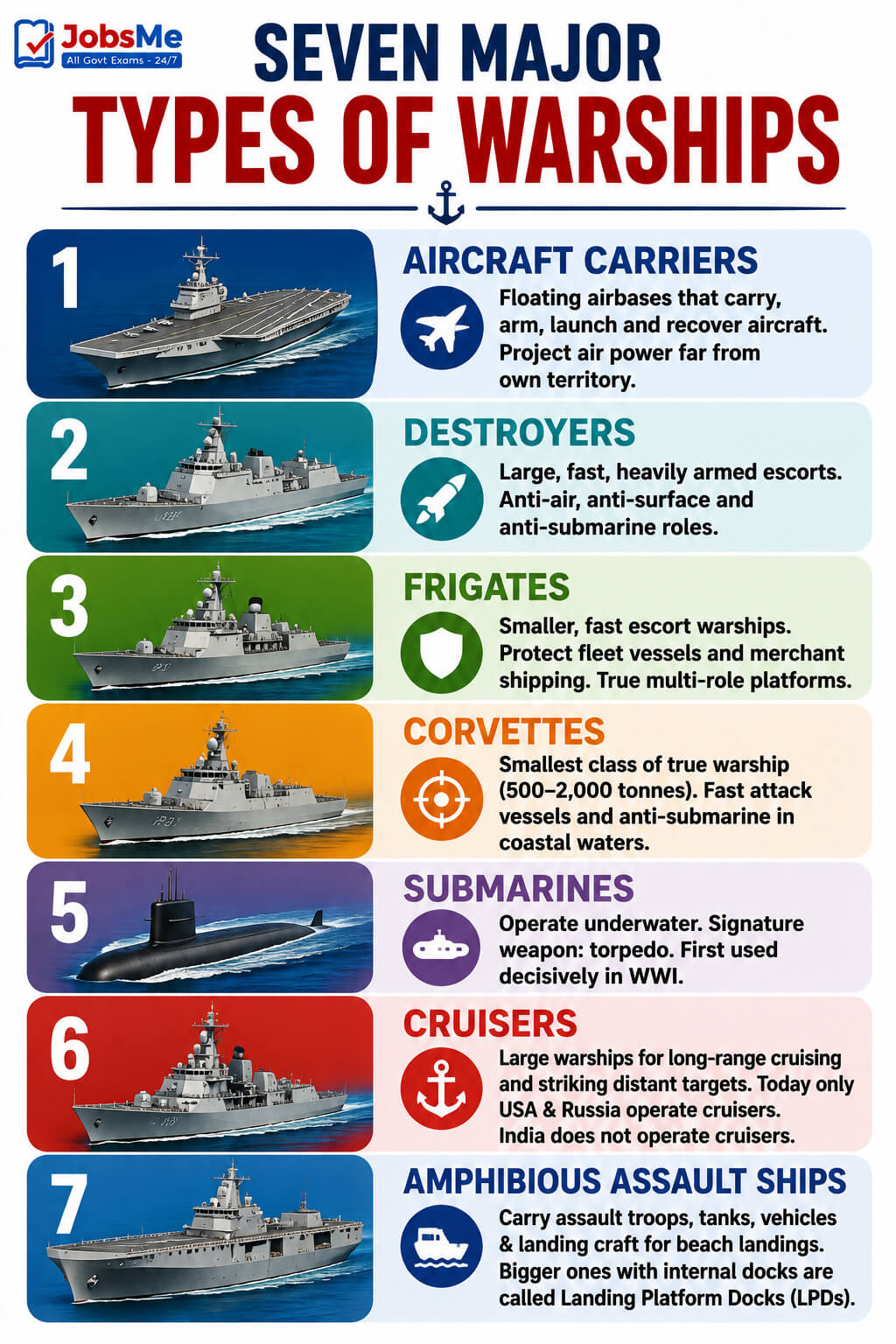
- Aircraft Carriers: Floating airbases with a full-length flight deck and facilities to carry, arm, launch and recover aircraft. They allow a nation to project air power far from its own territory without depending on land bases.
- Destroyers: Large, fast, heavily armed escorts that protect a convoy, fleet or carrier battle group. They combine anti-air, anti-surface and anti-submarine roles and carry guided missile systems.
- Frigates: Smaller and faster escort warships used to protect fleet vessels and merchant shipping from threats, especially hostile submarines. They are true multi-role platforms.
- Corvettes: The smallest class of true warship, generally in the 500 to 2,000 tonne range, used as fast attack vessels and for anti-submarine work in coastal waters.
- Submarines: Warships that operate underwater, first used decisively in the First World War when Germany used them against surface shipping. Their signature weapon is the torpedo, a self-propelled underwater missile. The first working submarine is credited to the Dutch inventor Cornelis Drebbel, who tested it on the River Thames in the early seventeenth century.
- Cruisers: Large warships built for long-range cruising, able both to defend a fleet and to strike distant targets. Today only the United States and Russia maintain cruisers, as most navies abandoned them because of very high cost. India does not operate cruisers.
- Amphibious Assault Ships: Large armoured vessels that carry assault troops, tanks, vehicles and smaller landing craft for beach landings. Because they can dock landing craft internally, the bigger ones are called Landing Platform Docks (LPDs).
Classification of Submarines: SSK, SSN and SSBN
Submarines are classified by propulsion and by the role of their main armament. This three-way classification is one of the most frequently asked concepts from this topic.
| Type | Full Form | Key Features and Applications |
|---|---|---|
| SSK | Diesel-Electric Attack Submarine (SS = submarine, K = hunter-killer) | Smaller in size. Uses diesel engines on the surface and electric batteries when submerged. Very quiet, and quieter still when fitted with Air Independent Propulsion. Used for coastal defence, anti-submarine warfare, intelligence gathering and reconnaissance. Examples without AIP include the Swedish Gotland class; the Russian Kilo class is operated with variants by many navies. India's Kalvari, Sindhughosh and Shishumar classes are all SSKs. |
| SSN | Submersible Ship Nuclear (nuclear-powered attack submarine) | Larger and faster than an SSK. Powered by a nuclear reactor, giving virtually unlimited range and endurance limited only by food and maintenance. Used for offensive anti-ship and anti-submarine operations, intelligence gathering and surveillance. Example: the United States Navy's Virginia class. India has no SSN in service at present. |
| SSBN | Sub-Surface Ballistic Nuclear (nuclear-powered ballistic missile submarine) | Designed to carry and launch Submarine-Launched Ballistic Missiles (SLBMs). Larger, nuclear-powered and fitted with advanced missile systems. Their purpose is strategic nuclear deterrence and assured second-strike capability, not routine combat. Example: the United States Navy's Ohio class. India operates the indigenous Arihant class. |
Submarine Technology in Brief
- Propulsion: Submarines use battery-electric propulsion, diesel-electric engines, Air Independent Propulsion (AIP) or nuclear reactors.
- Air Independent Propulsion (AIP): Gives extra underwater endurance to non-nuclear submarines, allowing them to stay submerged for around two weeks instead of a few days. AIP has no large moving machinery, which makes an AIP submarine virtually silent and even stealthier than a nuclear submarine, because reactor cooling pumps and turbines on nuclear boats generate detectable noise. DRDO has developed an indigenous fuel-cell AIP plug for the Kalvari class.
- Weapons: Submarines carry both offensive and defensive weapons, including torpedoes, cruise missiles and ballistic missiles. Submarine-launched ballistic missiles with nuclear warheads are the most important armament, because they convert a submarine from a merely offensive platform into a strategic one.
- Navigation: Because light barely penetrates deep water, submarines navigate almost blind. They use GPS on the surface and inertial guidance systems when submerged.
- SONAR: Submarines emit and analyse sound waves to detect and track other vessels. Active sonar uses sound generated by the submarine and reflected off the target, while passive sonar only listens to sound generated by the target. Sonar also detects obstacles and underwater threats. India uses indigenous sonars such as USHUS, the Panchendriya unified submarine sonar and communication suite, and HUMSA-NG on surface ships.
- Communication: Submarines use Very Low Frequency (VLF) and Extremely Low Frequency (ELF) radio to transmit and receive messages while submerged, and these systems are integrated with the wider command and control network.
Indian Naval Fleet Overview
The Indian naval fleet is organised into broad categories by role. The table below is the fastest way to fix the structure of the fleet in memory before learning individual ship names.
| Category | Role or Purpose | Indian Examples |
|---|---|---|
| Aircraft Carriers | Power projection and air operations at sea | INS Vikramaditya, INS Vikrant |
| Submarines | Stealth operations, underwater strike and nuclear deterrence | Arihant class (SSBN), Kalvari class, Sindhughosh class, Shishumar class |
| Destroyers | Offensive and defensive combat, fleet air defence | Visakhapatnam class, Kolkata class, Delhi class, Rajput class |
| Frigates | Escort missions and multi-role warfare | Nilgiri class, Shivalik class, Tushil class, Talwar class, Brahmaputra class |
| Corvettes | Coastal defence, anti-submarine and patrol duties | Kamorta class, Kora class, Khukri class, Arnala class, Mahe class |
| Amphibious Ships | Troop and vehicle transport, beach landings, disaster relief | INS Jalashwa, Magar class, Shardul class, LCU Mk-IV |
| Patrol Vessels | Surveillance, coastal security and EEZ protection | Saryu class, Sukanya class, Car Nicobar class |
| Auxiliary and Support Ships | Logistics, refuelling, survey, diving support and training | Deepak class tankers, Sandhayak class survey ships, Nistar class DSVs, INS Tir |
Aircraft Carriers of the Indian Navy
Aircraft carriers are the core of India's naval power because they act as mobile airbases at sea. India has operated four aircraft carriers since 1961, and two are in service today. India is one of a very small group of nations that has both operated and built an aircraft carrier.
| Carrier | Class and Origin | Displacement | Commissioned | Key Details |
|---|---|---|---|---|
| INS Vikramaditya (R33) | Modified Kiev class, Russia | About 45,000 tonnes | 2013 | Originally the Soviet carrier Admiral Gorshkov, extensively rebuilt at Sevmash Shipyard in Russia and handed over to India in November 2013. Uses the STOBAR (Short Take-Off But Arrested Recovery) system with a ski-jump ramp and operates MiG-29K fighters. Home base Karwar (INS Kadamba). |
| INS Vikrant (R11) | Vikrant class, IAC-1, India | About 45,000 tonnes | 2022 | India's first indigenously designed and built aircraft carrier and the largest warship ever built in India. Designed by the Navy's Warship Design Bureau and built by Cochin Shipyard Limited, Kochi, at a cost of about ₹20,000 crore. Around 90 per cent of the hull, 50 per cent of the machinery and 30 per cent of weapons and sensors are indigenous. Has over 2,300 compartments and can operate about 30 aircraft. Commissioned by the Prime Minister on 2 September 2022, when the Navy also adopted its new ensign. |
| INS Vikrant (1961) — decommissioned | Majestic class, United Kingdom | About 19,500 tonnes | 1961 | India's first aircraft carrier, acquired from Britain as HMS Hercules. Played a decisive role in the 1971 Indo-Pak War in the Bay of Bengal. Decommissioned in 1997. The name was revived for the indigenous carrier of 2022. |
| INS Viraat — decommissioned | Centaur class, United Kingdom | About 28,700 tonnes | 1987 | Formerly HMS Hermes of the Royal Navy, which served in the Falklands War. Held a record as one of the longest-serving warships in the world and was decommissioned in 2017. |
India's next step is IAC-2, a second indigenous aircraft carrier of roughly 45,000 tonnes planned as an improved repeat of INS Vikrant, again at Cochin Shipyard Limited, with a redesigned flight deck optimised for unmanned aerial vehicle operations alongside fighters. Approval has been progressing through the Defence Procurement Board and the Defence Acquisition Council, with clearance expected around 2026. The long-term aim is a three-carrier force so that two carriers are always operationally available while one is in refit.
Submarines of the Indian Navy
India operates a mix of nuclear-powered and diesel-electric submarines. As of 2026 the submarine arm consists of three SSBNs and sixteen conventional attack submarines spread across three classes, with no SSN in service. The three conventional classes are the German-origin Shishumar class, the Russian-origin Sindhughosh class and the indigenously built Kalvari class.
Nuclear Ballistic Missile Submarines (SSBN) - Arihant Class
The Arihant class was developed indigenously under the secretive Advanced Technology Vessel (ATV) programme and built at the Shipbuilding Centre, Visakhapatnam. These boats give India the sea-based leg of its nuclear triad, and they are based at Visakhapatnam under the Eastern Naval Command.
| Submarine | Hull No. | Displacement | Commissioned | Key Details |
|---|---|---|---|---|
| INS Arihant | S2 | 6,000 tonnes | 2016 | India's first indigenous nuclear ballistic missile submarine. Launched in 2009 and commissioned in 2016. Features a double hull with advanced sensors, periscopes and weapon systems. Can carry either 12 K-15 (Sagarika) SLBMs of 750 km range or 4 K-4 SLBMs of 3,500 km range. Completed its first deterrence patrol in late 2018, formally establishing India's nuclear triad. |
| INS Arighaat | S3 | About 7,000 tonnes | 2024 | India's second SSBN and an upgraded version of INS Arihant, commissioned at Visakhapatnam in August 2024 in the presence of the Defence Minister. Carries a heavier and longer-range missile load than the lead boat. |
| INS Aridhaman | S4 | About 7,000 tonnes | 2026 | India's third and largest Arihant-class SSBN, launched in November 2021 and commissioned at Visakhapatnam on 3 April 2026. Configured for a larger missile load including the longer-range K-4 and future K-5 SLBMs. With three boats in service, India can theoretically rotate one submarine on patrol, one in refit and one in training. |
| S4 star (expected name INS Arisudan) | Under trials | About 7,000 tonnes | Expected around 2027 | India's fourth SSBN, launched in October 2024 and undergoing sea trials. A larger and heavier S5 class of around 13,000 to 14,000 tonnes is planned for the future as India's true strategic submarine. |
Kalvari Class (Project 75) - Indigenous Scorpene Submarines
The Kalvari class comprises six diesel-electric attack submarines built at Mazagon Dock Shipbuilders Limited (MDL), Mumbai, under Project 75, with technology transfer from Naval Group of France based on the Scorpene design. All six boats are now in service. They are among the quietest conventional submarines in the world and are armed with heavyweight torpedoes and anti-ship missiles.
| Submarine | Hull No. | Commissioned | Key Details |
|---|---|---|---|
| INS Kalvari | S21 | 2017 | Lead boat of Project 75, commissioned in December 2017 by the Prime Minister. Named after the tiger shark and after India's first submarine, the Foxtrot-class INS Kalvari of 1967. |
| INS Khanderi | S22 | 2019 | Second boat of the class, named after the island fort of Khanderi off the Maharashtra coast associated with Chhatrapati Shivaji Maharaj. Based at Karwar. |
| INS Karanj | S23 | 2021 | Third boat, named after an island near Mumbai. Commissioned in March 2021. |
| INS Vela | S24 | 2021 | Fourth boat, named after a stingray. Commissioned in November 2021. |
| INS Vagir | S25 | 2023 | Fifth boat, named after the sand shark and nicknamed the Sand Shark. Commissioned in January 2023. |
| INS Vagsheer | S26 | 2025 | Sixth and final boat of Project 75, commissioned on 15 January 2025 at Mumbai along with INS Nilgiri and INS Surat in a rare triple commissioning by the Prime Minister. Described as one of the most silent and versatile diesel-electric submarines in the world. |
Sindhughosh Class (Kilo Class) - Russian Origin
The Sindhughosh class is India's variant of the Russian Kilo class (Project 877EKM) diesel-electric submarine. A total of ten boats were acquired from the Soviet Union and later Russia between 1986 and 2000, and several have since been retired. They carry satellite sensors, radar, sonar and electronic surveillance equipment along with anti-ship and anti-submarine weapons, and many have been retrofitted with the Klub-S (3M-54E) cruise missile system.
| Submarine | Hull No. | Status | Key Details |
|---|---|---|---|
| INS Sindhuraj | S57 | In service | Commissioned in 1987. Displaces about 3,076 tonnes submerged. |
| INS Sindhuratna | S59 | In service | Commissioned in 1988. Underwent a major mid-life upgrade in Russia. |
| INS Sindhukesari | S60 | In service | Commissioned in 1988. In 2023 it became the first Indian submarine to make a port call at Jakarta, Indonesia. |
| INS Sindhukirti | S61 | In service | Refitted indigenously at Hindustan Shipyard Limited, Visakhapatnam, demonstrating India's submarine repair capability. |
| INS Sindhuvijay | S62 | In service | Commissioned in 1991 and later modernised in Russia with the Klub-S missile fit. |
| INS Sindhurashtra | S65 | In service | The last of the ten Kilo-class boats delivered to India, commissioned in 2000. Based at Visakhapatnam. |
| INS Sindhughosh | S55 | Decommissioned in December 2025 | Lead boat of the class, commissioned on 30 April 1986 and decommissioned after nearly four decades of service. |
| INS Sindhudhvaj | S56 | Decommissioned in 2022 | Name means flag bearer at sea, and its crest depicted a grey nurse shark. Known as the flag bearer of indigenisation and the only submarine awarded the Chief of Naval Staff Rolling Trophy for Innovation. Retired on 16 July 2022 after 35 years. |
| INS Sindhurakshak | S63 | Decommissioned in 2017 | Severely damaged by onboard explosions in August 2013, formally decommissioned in 2017 and later sunk in deep water. |
| INS Sindhuvir | S58 | Transferred to Myanmar in 2020 | Handed over to the Myanmar Navy, where it serves as UMS Minye Theinkhathu. India's first ever submarine transfer to a friendly foreign navy. |
Shishumar Class - German Origin
The Shishumar class consists of four diesel-electric submarines of the German Type 209/1500 design, inducted under technology transfer from Germany, with the first two built at Howaldtswerke-Deutsche Werft in Kiel and the next two assembled at Mazagon Dock, Mumbai. They carry advanced sensors optimised for anti-submarine and anti-ship warfare in the Arabian Sea.
| Submarine | Hull No. | Commissioned | Key Details |
|---|---|---|---|
| INS Shishumar | S44 | 1986 | Lead boat of the class, built in Germany. Name means porpoise. Displaces about 1,850 tonnes submerged. |
| INS Shankush | S45 | 1986 | Second boat, also built in Germany, and later given a life-extension refit at Mazagon Dock. |
| INS Shalki | S46 | 1992 | India's first indigenously assembled submarine, built at Mazagon Dock, Mumbai, a landmark in Indian submarine construction. |
| INS Shankul | S47 | 1994 | Fourth and last boat of the class, also assembled at Mazagon Dock. |
Nuclear-Powered Attack Submarines (SSN) and Future Submarine Projects
- No SSN in service: India currently has no nuclear-powered attack submarine in commission. The Akula-class INS Chakra II, leased from Russia, was returned and decommissioned in 2021. An earlier INS Chakra, a Charlie-class boat, was leased from the Soviet Union between 1988 and 1991 and made India the sixth nation to operate a nuclear submarine.
- Project 77: India's indigenous SSN programme. The Cabinet Committee on Security cleared construction of nuclear-powered attack submarines, to be built with participation from Indian industry, marking a major shift from leasing to building.
- Project 75(I): A programme for six advanced diesel-electric submarines with Air Independent Propulsion, to be built by Mazagon Dock Shipbuilders Limited as Indian strategic partner with ThyssenKrupp Marine Systems (TKMS) of Germany, based on the Type 214 and Type 212 lineage. Cost negotiations were concluded in the range of about ₹66,000 to ₹70,000 crore, making it one of the largest conventional submarine contracts in the world. Note carefully that Project 75(I) submarines are conventional with AIP, not nuclear.
- Project 76: India's attempt at a fully indigenous conventional submarine design by the Navy's Directorate of Naval Design (Submarine Design Group) with Indian industry participation, without any foreign design partner.
- Persistent shortfall: India's submarine numbers remain well below requirement for a two-front maritime scenario across a vast ocean, and only a small number of boats can be fitted with AIP. The Navy has also flagged that budgetary limits, project delays and rapid advances in undersea warfare and anti-submarine technology make modernisation a continuous challenge.
Destroyers of the Indian Navy
Destroyers are the heavy hitters of the surface fleet. India operates about 13 destroyers across four classes, all built at Mazagon Dock Shipbuilders Limited except the Russian-origin Rajput class. Modern Indian destroyers carry BrahMos supersonic cruise missiles in vertical launchers and Barak-8 / MR-SAM surface-to-air missiles.
| Destroyer | Class and Project | Displacement | Commissioned | Key Details |
|---|---|---|---|---|
| INS Visakhapatnam | Visakhapatnam class, Project 15B | 7,400 tonnes | 2021 | Lead ship of India's most advanced stealth destroyer class, an upgraded derivative of the Kolkata class with better stealth shaping and higher automation. |
| INS Mormugao | Visakhapatnam class, Project 15B | 7,400 tonnes | 2022 | Named after the historic port town of Mormugao in Goa. Commissioned in December 2022. |
| INS Imphal | Visakhapatnam class, Project 15B | 7,400 tonnes | 2023 | The first Indian warship named after a city in the North East, honouring Manipur. Test fired an extended-range BrahMos before commissioning. |
| INS Surat | Visakhapatnam class, Project 15B | 7,400 tonnes | 2025 | Fourth and final Project 15B destroyer, commissioned on 15 January 2025 at Mumbai. Around 75 per cent indigenous content, and described as one of the most technologically advanced destroyers in the world. |
| INS Kolkata | Kolkata class, Project 15A | 7,400 tonnes | 2014 | Lead ship of the indigenously designed and built Kolkata-class guided missile destroyers, commissioned on 16 August 2014. |
| INS Kochi | Kolkata class, Project 15A | 7,400 tonnes | 2015 | Second ship of the class, fitted with the Barak-8 long-range surface-to-air missile system. |
| INS Chennai | Kolkata class, Project 15A | 7,400 tonnes | 2016 | Third ship of the class. Took part in anti-piracy operations in the Gulf of Aden and Arabian Sea. |
| INS Delhi | Delhi class, Project 15 | 6,200 tonnes | 1997 | Lead ship of India's first class of indigenously built destroyers, a landmark in Indian naval development. Built at Mazagon Dock Limited, Mumbai. |
| INS Mysore | Delhi class, Project 15 | 6,200 tonnes | 1999 | Second Delhi-class destroyer, part of the Eastern Fleet. |
| INS Mumbai | Delhi class, Project 15 | 6,200 tonnes | 2001 | Third vessel of the Delhi-class guided missile destroyers, also built at Mazagon Dock Limited, Mumbai. |
| INS Rana | Rajput class, Kashin-II derivative | 4,974 tonnes | 1982 | Indian derivative of the Soviet Kashin-class destroyer. The Rajput class was India's first guided missile destroyer class. |
| INS Ranvir | Rajput class | 4,974 tonnes | 1986 | Soviet-built destroyer, later modified to carry BrahMos missiles. |
| INS Ranvijay | Rajput class | 4,974 tonnes | 1987 | Last of the Rajput-class destroyers in service. The lead ship INS Rajput, which was the first Indian ship to be fitted with BrahMos, was decommissioned in 2021. |
Frigates of the Indian Navy
Frigates are versatile escort warships covering anti-submarine, anti-air and surface warfare. India's frigate fleet is undergoing the fastest change of any category because of Project 17A.
Nilgiri Class (Project 17A) - Latest Indigenous Stealth Frigates
Seven Project 17A frigates were ordered, split between Mazagon Dock Shipbuilders Limited (four ships) and Garden Reach Shipbuilders and Engineers, Kolkata (three ships). Each displaces about 6,670 tonnes, roughly five per cent larger than the Shivalik class, with a sleeker hull, reduced radar cross section, advanced surveillance radars, electronic warfare suites, supersonic surface-to-surface missiles, surface-to-air missiles and rapid-fire guns. Every ship in the class is named after an Indian hill or mountain range.
| Frigate | Builder | Commissioned | Key Details |
|---|---|---|---|
| INS Nilgiri | Mazagon Dock, Mumbai | 15 January 2025 | Lead ship of Project 17A, commissioned together with INS Surat and INS Vagsheer. Named after the Nilgiri hills. Later joined the Eastern Fleet at Visakhapatnam. |
| INS Udaygiri | Mazagon Dock, Mumbai | 26 August 2025 | Commissioned along with INS Himgiri. The pair were together marked as India's 100th and 101st indigenously built warships, a milestone under the Navy's Aatmanirbhar Vision 2047. |
| INS Himgiri | Garden Reach Shipbuilders, Kolkata | 26 August 2025 | First Project 17A ship built by GRSE, launched in December 2020. |
| INS Taragiri | Mazagon Dock, Mumbai | 3 April 2026 | Named after a hill range in the Garhwal Himalayas. Revives the name of a Leander-class frigate that served from 1980 to 2013. |
| INS Dunagiri | Garden Reach Shipbuilders, Kolkata | 21 June 2026 | Named after a peak in Uttarakhand. Commissioned at Kolkata by the Prime Minister together with INS Sanshodhak and INS Agray in a rare triple commissioning where all three ships were fully designed and built in India with over 75 per cent indigenous content and support from more than 200 MSMEs. |
| INS Mahendragiri | Mazagon Dock, Mumbai | 11 July 2026 | Named after a peak in the Eastern Ghats in Odisha. The sixth Project 17A frigate to enter service, inducted into the Eastern Fleet at Visakhapatnam within about 1.5 years of the lead ship. |
| INS Vindhyagiri | Garden Reach Shipbuilders, Kolkata | Yet to be commissioned | Seventh and last ship of the class, named after the Vindhya range, launched in August 2023 and awaiting delivery. A follow-on class called Project 17B is planned. |
Other Frigate Classes in Service
| Class | Ships | Displacement | Key Details |
|---|---|---|---|
| Shivalik class (Project 17) | INS Shivalik (2010), INS Satpura (2011), INS Sahyadri (2012) | 6,200 tonnes | India's first indigenously built stealth frigates, constructed at Mazagon Dock with low observability features. Project 17A is their direct follow-on. |
| Tushil class (Project 1135.6 follow-on) | INS Tushil (9 December 2024), INS Tamal (1 July 2025) | About 3,900 to 4,000 tonnes | Upgraded Krivak III class frigates built at Yantar Shipyard, Kaliningrad, Russia, with about 26 per cent Indian content and 33 Indian-made systems. Armed with BrahMos, vertically launched Shtil-1 missiles, a 100 mm gun, AK-630 close-in weapon systems, RBU-6000 rocket launchers and HUMSA-NG sonar. INS Tamal is the last warship India inducted from a foreign source. Tushil means Protector Shield. Two similar ships of the Triput class are being built at Goa Shipyard Limited with Russian technology transfer. |
| Talwar class (Project 11356) | INS Talwar (2003), INS Trishul (2003), INS Tabar (2004) | 4,035 tonnes | Built at Baltiysky Shipyard, St Petersburg, Russia. All serve with the Western Fleet, the Sword Arm of the Indian Navy. |
| Teg class (Project 11356 follow-on) | INS Teg (2012), INS Tarkash (2012), INS Trikand (2013) | 4,035 tonnes | Second batch of Talwar-lineage frigates, built at Yantar Shipyard, Kaliningrad, and fitted with BrahMos in place of the earlier Klub missile. |
| Brahmaputra class (Project 16A) | INS Brahmaputra (2000), INS Betwa (2004), INS Beas (2005) | 3,850 tonnes | Indigenous frigates built by Garden Reach Shipbuilders and Engineers, Kolkata, and named after Indian rivers. |
| Godavari class (Project 16) | INS Godavari, INS Ganga, INS Gomati — all decommissioned | 3,850 tonnes | India's first indigenously designed frigate class, an important milestone in warship design. All three have been decommissioned. |
Corvettes of the Indian Navy
Corvettes are smaller, agile warships used for coastal patrol, anti-submarine warfare and quick-response missions. This is another category being transformed, because India is inducting 16 Anti-Submarine Warfare Shallow Water Craft (ASW SWC) ordered in April 2019 in two batches of eight each from Garden Reach Shipbuilders (Arnala class) and Cochin Shipyard Limited (Mahe class). These replace the ageing Abhay class and are expected to be fully inducted by 2028.
| Class | Ships | Displacement | Key Details |
|---|---|---|---|
| Kamorta class (Project 28) | INS Kamorta (23 August 2014), INS Kadmatt (2016), INS Kiltan (2017), INS Kavaratti (2020) | 3,300 tonnes | India's first indigenously built stealth anti-submarine warfare corvettes, built by Garden Reach Shipbuilders and named after islands in the Lakshadweep group. INS Kamorta was commissioned at Visakhapatnam and is equipped to operate in Nuclear, Biological and Chemical (NBC) warfare conditions. INS Kiltan was the first Indian warship with a superstructure made of carbon fibre composite. |
| Arnala class (ASW SWC, GRSE) | INS Arnala (18 June 2025), INS Androth (6 October 2025), INS Anjadip (27 February 2026), INS Agray (21 June 2026) | About 900 to 1,500 tonnes | Named after Indian coastal forts and islands such as Arnala fort in Maharashtra and Androth island in Lakshadweep. About 77 metres long with more than 80 per cent indigenous content. Along with the Mahe class, these are the largest Indian warships driven by a diesel engine and waterjet combination. Carry lightweight torpedoes, indigenous ASW rockets and advanced sonar. GRSE received the Raksha Mantri Award 2022 for designing the most silent ship of the Indian Navy. |
| Mahe class (ASW SWC, CSL) | INS Mahe (24 November 2025), INS Malvan (22 July 2026) | About 900 tonnes | Built by Cochin Shipyard Limited and named after historic coastal towns such as Mahe on the Malabar Coast and Malvan in Maharashtra. About 78 metres long, top speed 25 knots, endurance 1,800 nautical miles. Fitted with the indigenous Abhay hull-mounted sonar and a low-frequency variable-depth sonar. INS Mahe is nicknamed the Silent Hunter of the Western Seaboard. |
| Kora class (Project 25A) | INS Kora (1998), INS Kirch (2001), INS Kulish (2001), INS Karmuk (2004) | 1,400 tonnes | Dedicated anti-surface warfare missile corvettes built by Garden Reach Shipbuilders. |
| Khukri class (Project 25) | INS Kuthar (1990), INS Khanjar (1991) | 1,350 tonnes | Successors to the Navy's Petya II corvettes. INS Khukri, the lead ship, was decommissioned in 2021, and INS Kirpan was gifted to Vietnam in 2023. |
| Veer class (Tarantul I) | INS Vibhuti, INS Vipul, INS Nashak, INS Prabal, INS Pralaya and others | About 455 tonnes | Small Soviet-origin missile corvettes used as fast attack craft. Being progressively retired as newer platforms enter service. |
| Abhay class (Project 1241PE) | INS Abhay, INS Ajay, INS Akshay, INS Agray — retired | About 480 tonnes | Soviet-origin ASW corvettes. INS Abhay was decommissioned in October 2025, and the class is being replaced by the Arnala and Mahe classes, which have revived names such as Agray and Ajay. |
Amphibious Warfare Ships of the Indian Navy
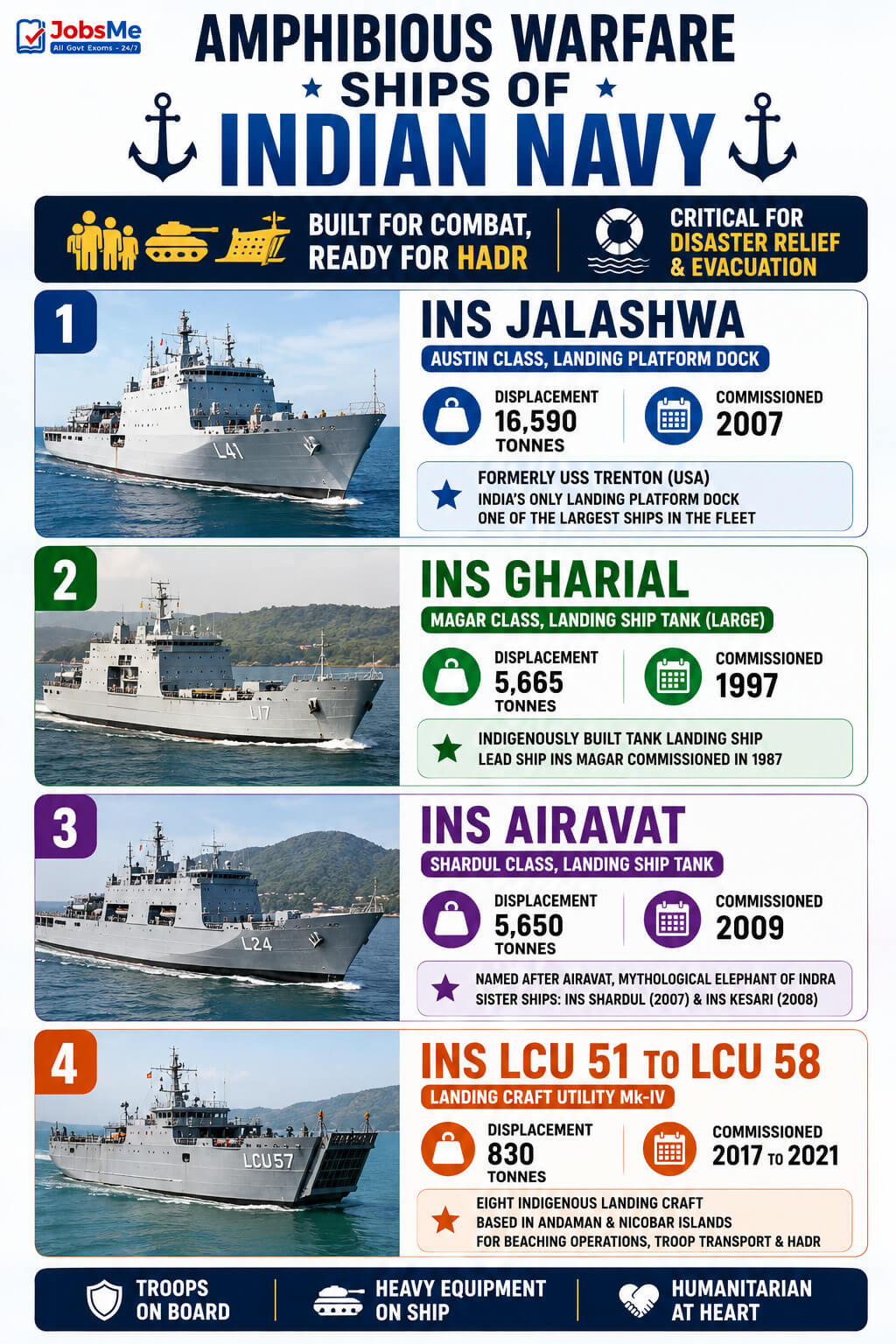
Amphibious ships transport troops, tanks and equipment for beach landings and are equally important for Humanitarian Assistance and Disaster Relief (HADR) missions, which is why they are often in the news during cyclones, tsunamis and evacuation operations.
| Ship | Class | Displacement | Commissioned | Key Details |
|---|---|---|---|---|
| INS Jalashwa | Austin class, Landing Platform Dock | 16,590 tonnes | 2007 | Formerly USS Trenton of the United States Navy, purchased from the USA and commissioned in 2007. It is India's only Landing Platform Dock and, after the aircraft carriers, one of the largest ships in the fleet. Played a major role in evacuation missions. |
| INS Gharial | Magar class, Landing Ship Tank (Large) | 5,665 tonnes | 1997 | Indigenously built tank landing ship, based at Visakhapatnam. Lead ship INS Magar was commissioned in 1987. |
| INS Airavat | Shardul class, Landing Ship Tank | 5,650 tonnes | 2009 | Named after Airavat, the mythological elephant of Indra, and often called the Asian Elephant of the fleet. A follow-on of the Magar class and an integral part of India's amphibious warfare capability. Sister ships are INS Shardul (2007) and INS Kesari (2008). |
| INS LCU 51 to LCU 58 | Landing Craft Utility Mk-IV | 830 tonnes | 2017 to 2021 | Eight indigenous landing craft built by Garden Reach Shipbuilders and mostly based in the Andaman and Nicobar Islands for beaching operations, troop transport and HADR duties. |
Patrol Vessels and Fast Attack Craft
Patrol vessels handle coastal surveillance, interdiction, search and rescue and protection of India's Exclusive Economic Zone. Most are built by Goa Shipyard Limited and Garden Reach Shipbuilders.
| Class | Ships | Displacement | Key Details |
|---|---|---|---|
| Saryu class (Naval Offshore Patrol Vessels) | INS Saryu (2013), INS Sunayna (2013), INS Sumedha (2014), INS Sumitra (2014) | 2,300 tonnes | The largest Naval Offshore Patrol Vessels of the Indian Navy, built by Goa Shipyard Limited for EEZ surveillance, anti-piracy patrols and escort duties. INS Sumitra was commissioned on 4 September 2014 and has carried out several anti-piracy and rescue missions in the Gulf of Aden and Arabian Sea. |
| Sukanya class (Offshore Patrol Vessels) | INS Sukanya, INS Subhadra, INS Suvarna, INS Savitri, INS Sharada, INS Sujata | 1,900 tonnes | Large-hull patrol vessels of South Korean origin, later fitted out in India. INS Subhadra was modified as a trials platform for the Dhanush ballistic missile. Several are used as training ships. |
| Car Nicobar class (Fast Attack Craft) | INS Car Nicobar, INS Chetlat, INS Cheriyam, INS Kondul and others | 293 tonnes | Water-jet propelled fast attack craft built by Garden Reach Shipbuilders and named after Indian islands. Used for coastal patrol and low-intensity maritime operations. |
| Bangaram class and Trinkat class | INS Bangaram, INS Bitra, INS Batti Malv, INS Trinkat and others | 260 to 270 tonnes | Small indigenous patrol craft used mainly in the Andaman and Nicobar Islands and the Lakshadweep group. |
| Immediate Support Vessels and Fast Interceptor Craft | Various numbered craft | Under 100 tonnes | Inducted after the 2008 Mumbai attacks to strengthen coastal security and rapid response along the coastline. |
Auxiliary, Survey and Support Ships
The auxiliary fleet keeps the combat fleet at sea. It includes replenishment tankers, survey vessels, diving support vessels, torpedo recovery vessels, missile tracking ships and training ships. These ships appear in exams mostly through current affairs, because several have been commissioned very recently.
| Ship or Class | Type | Key Details |
|---|---|---|
| Deepak class | Fleet replenishment tankers | INS Deepak (2011) and INS Shakti (2011), built in Italy. They refuel and resupply warships at sea, extending the fleet's reach. INS Jyoti and INS Aditya are the other major tankers. |
| Sandhayak class (2023 class) | Survey Vessels (Large) | Four indigenous 3,400-tonne hydrographic survey ships built by Garden Reach Shipbuilders: INS Sandhayak (February 2024), INS Nirdeshak (December 2024), INS Ikshak (6 November 2025) and INS Sanshodhak (21 June 2026). Each is about 110 metres long, carries four Survey Motor Boats, autonomous and remotely operated underwater vehicles and a Dhruv helicopter. They replace the older Sandhayak class and support navigation safety and the blue economy. INS Ikshak, meaning The Guide, is the first of the class based at the Southern Naval Command, Kochi. |
| Nistar class | Diving Support Vessels (DSV) | INS Nistar was commissioned on 18 July 2025 at Visakhapatnam, built by Hindustan Shipyard Limited with over 80 per cent indigenous content and participation of about 120 MSMEs. Fitted with an Integrated Saturation Diving System, Submarine Rescue System, remotely operated vehicles and side-scan sonar, able to work at depths of around 300 metres. Its sister ship is INS Nipun. Only a few navies in the world have this deep-sea saturation diving and submarine rescue capability, which positions India as a preferred submarine rescue partner in the region. |
| INS Astradharini | Torpedo launch and recovery vessel | Indigenously designed vessel commissioned in October 2015, which replaced the older INS Astravahini. Used to launch and recover torpedoes during trials. |
| INS Dhruv | Ocean surveillance and missile tracking ship | India's first satellite and ballistic missile tracking ship, inducted in 2021. Supports missile tests and long-range surveillance. |
| INS Sagardhwani | Marine acoustic research ship | Operated in support of DRDO's Naval Physical and Oceanographic Laboratory for acoustic and oceanographic research. |
| Training ships and sail training vessels | Training platforms | INS Tir is the dedicated cadet training ship. INS Tarangini and INS Sudarshini are sail training ships. INSV Tarini and INSV Mhadei are ocean-going sailing vessels used for all-women circumnavigation expeditions such as Navika Sagar Parikrama. INSV Kaundinya, a traditionally built stitched ship reviving ancient Indian shipbuilding, was inducted in May 2025. |
Project Codes, Shipyards and Naval Facts for Quick Marks
Project codes are among the most reliable sources of easy marks in this topic, because a single table replaces dozens of separate facts.
Indian Navy Project Codes
| Project Code | Class and Type | Builder and Partner |
|---|---|---|
| Project 15 | Delhi class destroyers | Mazagon Dock, Mumbai — India's first indigenous destroyers |
| Project 15A | Kolkata class destroyers | Mazagon Dock, Mumbai |
| Project 15B | Visakhapatnam class stealth destroyers | Mazagon Dock, Mumbai — completed with INS Surat in 2025 |
| Project 16 and 16A | Godavari and Brahmaputra class frigates | Mazagon Dock and Garden Reach Shipbuilders |
| Project 17 | Shivalik class stealth frigates | Mazagon Dock, Mumbai — first indigenous stealth frigates |
| Project 17A | Nilgiri class stealth frigates | Mazagon Dock (4 ships) and Garden Reach Shipbuilders (3 ships) |
| Project 25 and 25A | Khukri and Kora class corvettes | Garden Reach Shipbuilders, Kolkata |
| Project 28 | Kamorta class ASW corvettes | Garden Reach Shipbuilders, Kolkata |
| Project 75 | Kalvari class Scorpene submarines | Mazagon Dock with Naval Group, France — all six commissioned |
| Project 75(I) | Six conventional submarines with AIP | Mazagon Dock with ThyssenKrupp Marine Systems, Germany |
| Project 76 | Fully indigenous conventional submarine design | Indian Navy Directorate of Naval Design with Indian industry |
| Project 77 | Indigenous nuclear-powered attack submarines (SSN) | Indian shipyards with Indian industry participation |
| Advanced Technology Vessel (ATV) | Arihant class SSBNs | Shipbuilding Centre, Visakhapatnam |
| IAC-1 and IAC-2 | Indigenous aircraft carriers | Cochin Shipyard Limited, Kochi |
Major Indian Shipyards
- Mazagon Dock Shipbuilders Limited (MDL), Mumbai: Destroyers, frigates and submarines. India's premier warship and submarine yard.
- Garden Reach Shipbuilders and Engineers (GRSE), Kolkata: Frigates, corvettes, ASW craft, survey vessels and landing craft.
- Cochin Shipyard Limited (CSL), Kochi: Aircraft carriers and Mahe-class ASW craft.
- Goa Shipyard Limited (GSL), Goa: Patrol vessels, Triput-class frigates and coast guard ships.
- Hindustan Shipyard Limited (HSL), Visakhapatnam: Diving support vessels, fleet support ships and submarine refits.
- Shipbuilding Centre (SBC), Visakhapatnam: Nuclear submarines under the ATV programme.
Essential Indian Navy General Awareness Facts
- Motto of the Indian Navy: Sham No Varunah, meaning may the Lord of the Waters be auspicious unto us.
- Navy Day: 4 December, commemorating Operation Trident, the attack on Karachi harbour during the 1971 Indo-Pak War.
- Chief of the Naval Staff: Admiral Krishna Swaminathan took charge as the 27th Chief of the Naval Staff on 31 May 2026, succeeding Admiral Dinesh Kumar Tripathi.
- Commands: Western Naval Command at Mumbai, Eastern Naval Command at Visakhapatnam, Southern Naval Command at Kochi, which is the training command, plus the tri-service Andaman and Nicobar Command at Sri Vijaya Puram.
- Fleets: The Western Fleet is called the Sword Arm and the Eastern Fleet is called the Sunrise Fleet. The Eastern Naval Command also hosts India's strategic submarine force.
- Key bases: INS Kadamba at Karwar under Project Seabird is India's largest naval base project, and INS Varsha at Rambilli in Andhra Pradesh is being developed as a dedicated nuclear submarine base.
- New ensign: The Navy adopted a new ensign inspired by the seal of Chhatrapati Shivaji Maharaj on 2 September 2022, the same day INS Vikrant was commissioned.
- Indigenisation: The Indian Naval Indigenisation Plan (INIP) 2015 to 2030 guides self-reliance. More than 40 indigenous warships and submarines have been delivered since 2014, around 67 per cent of naval capital acquisitions in the last decade came from domestic industry, and roughly 50 ships and submarines are under construction in Indian yards.
- Budget: The Navy's allocation rose from about ₹49,623 crore in 2020-21 to about ₹1,03,548 crore in 2025-26, a sharp increase in its share of total defence spending.
Memory Tricks and Mnemonics
Trick 1: Four Carriers, All Starting with V — "Vikrant, Viraat, Vikramaditya, Vikrant"
India has operated exactly four aircraft carriers since 1961, and every name begins with the letter V:
- Vikrant (1961) → first carrier, British-built, hero of the 1971 war, retired 1997.
- Viraat (1987) → ex-HMS Hermes, retired 2017.
- Vikramaditya (2013) → ex-Admiral Gorshkov, Russian-built, in service.
- Vikrant (2022) → first made-in-India carrier, in service.
"Four V's, two flying today — one from Russia, one from Kochi."
Trick 2: Submarine Classes — "KSS + A"
India has three conventional submarine classes plus one nuclear class:
- K → Kalvari class, India-built with French Scorpene design (Project 75), 6 boats.
- S → Sindhughosh class, Russian Kilo class, 6 boats in service.
- S → Shishumar class, German Type 209, 4 boats.
- A → Arihant class, indigenous nuclear SSBN, 3 boats.
"KSS carry torpedoes, A carries the nuclear promise." Total: 16 conventional plus 3 nuclear equals 19 submarines.
Trick 3: Six Kalvari Boats — "Ka-Kha-Ka, Ve-Va-Va"
The six Project 75 submarines in commissioning order:
- Kalvari (2017) → Khanderi (2019) → Karanj (2021)
- Vela (2021) → Vagir (2023) → Vagsheer (2025)
"First three are K's, last three are V's — and all six are named after sea creatures or island forts."
Trick 4: The Three SSBNs — "ARI Means Enemy"
All three Indian SSBNs begin with ARI, the Sanskrit word for enemy, and each name promises to defeat that enemy:
- ARIhant (2016) → Slayer of Enemies → the first, 6,000 tonnes.
- ARIghaat (2024) → Destroyer of Enemies → the second, upgraded.
- ARIdhaman (2026) → Vanquisher of Foes → the third and largest.
"ARI three times, 2016 - 2024 - 2026, and the triad is complete."
Trick 5: Destroyer Ladder — "Delhi, Kolkata, Visakhapatnam" is 15, 15A, 15B
Indian destroyer projects follow a clean city-and-code sequence:
- Project 15 → Delhi class (1997 onwards) → first indigenous destroyers, 6,200 tonnes.
- Project 15A → Kolkata class (2014 onwards) → 7,400 tonnes.
- Project 15B → Visakhapatnam class (2021 onwards) → 7,400 tonnes, stealth.
"Delhi, Kolkata, Visakhapatnam — capital, metro, port. And the odd one out is Rajput, the Russian-origin class."
Trick 6: Frigates — "Giri is Indian, T is Russian"
This one trick separates almost the entire frigate fleet:
- Names ending in giri (hills) → Project 17A Nilgiri class, built in India: Nilgiri, Himgiri, Udaygiri, Taragiri, Dunagiri, Mahendragiri, Vindhyagiri.
- Names beginning with T → Russian-built Talwar, Teg and Tushil classes: Talwar, Trishul, Tabar, Teg, Tarkash, Trikand, Tushil, Tamal.
- Names of rivers → Brahmaputra class: Brahmaputra, Betwa, Beas. Decommissioned Godavari class: Godavari, Ganga, Gomati.
- Shivalik, Satpura, Sahyadri → Project 17, the first Indian stealth frigates.
"Hills are homemade, T's come from Kaliningrad."
Trick 7: Corvettes — "All K's, plus A and M for the new hunters"
Older corvette classes are almost all K, while the new anti-submarine craft are A and M:
- Kamorta class → Project 28, ASW, GRSE, Lakshadweep island names.
- Kora class → Project 25A, anti-surface.
- Khukri class → Project 25, weapon names: Khukri, Kuthar, Khanjar, Kirpan.
- Arnala class → new ASW SWC by GRSE: Arnala, Androth, Anjadip, Agray.
- Mahe class → new ASW SWC by CSL: Mahe, Malvan.
"A for Arnala from the Ganga side (GRSE, Kolkata), M for Mahe from the Malabar side (CSL, Kochi)."
Trick 8: Missile Ranges — "K Number Up, Range Up"
India's submarine-launched ballistic missiles are all named K after Dr APJ Abdul Kalam, and the range rises with the number:
- K-15 (Sagarika) → about 750 km → 12 can be carried on INS Arihant.
- K-4 → about 3,500 km → 4 can be carried on INS Arihant.
- K-5 → about 5,000 to 6,000 km → planned for the larger boats.
"Sagarika is short and sharp at 750; K-4 crosses continents at 3,500." Remember the counter-intuitive part: the smaller-numbered K-15 has the shorter range.
Trick 9: Project Numbers — "15 Destroy, 17 Escort, 28 Hunt, 75 Dive"
- 15 family → Destroyers.
- 17 family → Frigates.
- 28 → Corvettes for anti-submarine warfare.
- 75 family → Submarines, with 75 for Scorpene, 75(I) for AIP boats, 76 for fully indigenous conventional, 77 for nuclear attack.
"Fifteen destroys, seventeen escorts, twenty-eight hunts, seventy-five dives."
Trick 10: Shipyard Map — "M-G-C-G-H, West to East"
- MDL → Mumbai → destroyers, frigates, submarines.
- GSL → Goa → patrol vessels and Triput-class frigates.
- CSL → Kochi → aircraft carriers and Mahe-class ASW craft.
- GRSE → Kolkata → corvettes, ASW craft, survey vessels.
- HSL → Visakhapatnam → diving support vessels and submarine refits.
"Carriers from Kochi, submarines from Mumbai, submarine hunters from Kolkata."
Additional Notes
Frequently Confused Facts
- SSK vs SSN vs SSBN: SSK is a diesel-electric attack submarine, SSN is a nuclear-powered attack submarine, and SSBN is a nuclear-powered ballistic missile submarine. India has SSKs and SSBNs but no SSN in service.
- AIP vs nuclear stealth: A common trap is to assume nuclear submarines are the quietest. In fact AIP submarines are quieter, because reactor cooling pumps and turbines on nuclear boats produce detectable noise.
- Project 75 vs Project 75(I) vs Project 76 vs Project 77: Project 75 is the completed French Scorpene programme (Kalvari class). Project 75(I) is the German TKMS programme for six conventional AIP submarines, not nuclear. Project 76 is a fully indigenous conventional design. Project 77 is the indigenous nuclear attack submarine programme.
- INS Vikrant (1961) vs INS Vikrant (2022): The first was British-built and fought in the 1971 war; the second is India's first indigenous carrier built at Cochin Shipyard. Same name, two entirely different ships.
- INS Vikramaditya vs INS Vikrant: Vikramaditya is Russian-built (modified Kiev class, 2013); Vikrant is India-built (2022). Both displace about 45,000 tonnes and both use the STOBAR system.
- INS Kalvari (1967) vs INS Kalvari (2017): The first was a Soviet Foxtrot-class boat and India's first submarine; the second is the lead Scorpene-class boat under Project 75.
- Nilgiri class (1972) vs Nilgiri class (2019): The old Nilgiri class were Leander-class frigates built under British licence. The new Nilgiri class is Project 17A. Several Project 17A names such as Taragiri and Vindhyagiri also revive older Leander-class names.
- Arnala class vs Mahe class: Both are Anti-Submarine Warfare Shallow Water Craft of similar size ordered in 2019. Arnala class is built by GRSE, Kolkata; Mahe class is built by Cochin Shipyard Limited. Differences appear in the gun deck, mast, funnel and stern design.
- INS Jalashwa vs INS Airavat: Jalashwa is a Landing Platform Dock bought from the United States (ex-USS Trenton, 16,590 tonnes). Airavat is a much smaller indigenous Shardul-class Landing Ship Tank (5,650 tonnes).
- Sandhayak class vs Saryu class: Sandhayak class are survey vessels built by GRSE, while Saryu class are offshore patrol vessels built by Goa Shipyard. Both have S names, so read the question carefully.
- INS Nistar vs INS Nirdeshak: Nistar is a Diving Support Vessel for submarine rescue built by HSL; Nirdeshak is a survey vessel built by GRSE.
- Kolkata vs Kamorta: INS Kolkata is a destroyer of Project 15A built by Mazagon Dock; INS Kamorta is an ASW corvette of Project 28 built by GRSE. Both were commissioned in 2014.
- INS Tamal vs INS Nilgiri: INS Tamal is Russian-built at Yantar Shipyard and is the last warship imported by India; INS Nilgiri is India-built at Mazagon Dock. Both entered service within months of each other.
- Cruisers: India has no cruisers. Only the United States and Russia still operate them. Do not confuse cruisers with destroyers.
Repeating PYQ Patterns
Certain facts from this topic repeat almost every year. UPSC Prelims favours conceptual and strategic questions: the meaning of the nuclear triad, the role of INS Arihant in second-strike capability, what SSBN and AIP mean, and which programme a project code refers to. SSC CGL, SSC CHSL and RRB NTPC favour direct factual matching: which shipyard built INS Vikrant (Cochin Shipyard Limited), which is India's first indigenous aircraft carrier, which was India's first indigenously built destroyer class (Delhi class), which was the first indigenous ASW stealth corvette (INS Kamorta), and commissioning years of major ships. Banking exams such as IBPS PO, IBPS Clerk and SBI Clerk concentrate on the previous six to twelve months of commissionings, so INS Aridhaman, INS Taragiri, INS Dunagiri, INS Mahendragiri, INS Anjadip, INS Agray, INS Sanshodhak and INS Malvan are high-value names for the current cycle. Defence exams such as CDS, AFCAT and Navy SSR/AA go deeper into displacement, propulsion, armament and base ports. State PCS exams often add a local angle, asking about ships named after places in the state, such as INS Imphal for Manipur, INS Mormugao for Goa, INS Mahendragiri for Odisha and INS Malvan for Maharashtra. Practise these regularly with the Static GK quiz and keep pace with new inductions through the daily current affairs quiz.
Quick Insight
The Indian Navy's ship list is no longer a static table to be memorised once; it changes every few weeks. In 2025 the Navy inducted ten ships and one submarine, and 2026 was planned as its biggest year ever with about 19 commissionings, roughly one new platform every 40 days. Two shifts explain this pace. First, integrated modular construction, in which hulls, superstructures and internal systems are built as pre-fitted blocks of about 250 tonnes and then assembled, has cut build times sharply. Second, indigenisation has moved from slogan to supply chain: most new ships carry over 75 to 80 per cent Indian content, are designed by the Navy's own Warship Design Bureau and involve hundreds of MSMEs. The strategic driver is equally clear. China's navy is far larger by hull count and commissions many more major combatants each year, and Chinese and Pakistani submarine activity in the Indian Ocean is rising, which is why India is inducting sixteen anti-submarine shallow water craft and expanding its SSBN fleet. For aspirants this means defence questions increasingly reward reading direction rather than lists, and staying updated matters as much as memorising. For the latest exam calendars and vacancy alerts alongside your preparation, check the latest government job notifications, and for banking-focused general awareness, use the banking awareness notes.
One-Liners for Quick Revision
- Indian Navy motto → Sham No Varunah → may the Lord of the Waters be auspicious unto us.
- Navy Day → 4 December → commemorates Operation Trident against Karachi in the 1971 war.
- Chief of the Naval Staff → Admiral Krishna Swaminathan → 27th CNS, took charge 31 May 2026.
- Naval Commands → Western at Mumbai, Eastern at Visakhapatnam, Southern at Kochi, plus tri-service Andaman and Nicobar Command.
- Fleet strength → about 145 to 150 warships and submarines → target of over 200 by 2035.
- Aircraft carriers in service → INS Vikramaditya and INS Vikrant → two carriers, both about 45,000 tonnes.
- INS Vikramaditya → modified Kiev class → ex-Admiral Gorshkov from Russia, commissioned 2013, operates MiG-29K.
- INS Vikrant (R11) → first indigenous aircraft carrier → built by Cochin Shipyard Limited, commissioned 2 September 2022, largest ship built in India.
- INS Vikrant (1961) → India's first carrier → British-built Majestic class, hero of 1971, decommissioned 1997.
- INS Viraat → ex-HMS Hermes → commissioned 1987, decommissioned 2017.
- IAC-2 → planned second indigenous carrier → about 45,000 tonnes at Cochin Shipyard, designed for UAV operations.
- INS Arihant (S2) → India's first SSBN → launched 2009, commissioned 2016, 6,000 tonnes, carries 12 K-15 or 4 K-4 SLBMs.
- INS Arighaat (S3) → second SSBN → commissioned 2024, upgraded version of Arihant.
- INS Aridhaman (S4) → third SSBN → commissioned 3 April 2026 at Visakhapatnam, about 7,000 tonnes.
- Arihant class programme → Advanced Technology Vessel (ATV) → built at Shipbuilding Centre, Visakhapatnam.
- Nuclear triad → land, air and sea legs → INS Arihant completed the sea leg with its first deterrence patrol in 2018.
- Kalvari class → Project 75 → six Scorpene submarines built at Mazagon Dock with France's Naval Group.
- Kalvari class boats → Kalvari (2017), Khanderi (2019), Karanj (2021), Vela (2021), Vagir (2023), Vagsheer (2025).
- INS Vagsheer → sixth and last Project 75 boat → commissioned 15 January 2025 with INS Nilgiri and INS Surat.
- Sindhughosh class → Russian Kilo class (Project 877EKM) → ten acquired, six in service, fitted with Klub-S missiles.
- INS Sindhughosh → lead Kilo-class boat → commissioned 1986, decommissioned December 2025.
- INS Sindhudhvaj → flag bearer of indigenisation → decommissioned 16 July 2022 after 35 years.
- INS Sindhuvir → transferred to Myanmar in 2020 → serves as UMS Minye Theinkhathu.
- Shishumar class → German Type 209 → four boats: Shishumar, Shankush, Shalki, Shankul.
- INS Shalki → India's first indigenously assembled submarine → built at Mazagon Dock, commissioned 1992.
- SSN status → none in service → INS Chakra II (Akula class, leased from Russia) decommissioned in 2021.
- Project 75(I) → six AIP submarines → Mazagon Dock with TKMS Germany, cost about ₹66,000 to ₹70,000 crore, conventional not nuclear.
- Project 76 → fully indigenous conventional submarine design → no foreign design partner.
- Project 77 → indigenous nuclear-powered attack submarine (SSN) programme.
- AIP advantage → about two weeks submerged endurance → makes conventional boats quieter than nuclear ones.
- Visakhapatnam class → Project 15B stealth destroyers → Visakhapatnam (2021), Mormugao (2022), Imphal (2023), Surat (2025).
- INS Imphal → first Indian warship named after a North East city → honours Manipur.
- INS Surat → last Project 15B destroyer → commissioned 15 January 2025, about 75 per cent indigenous content.
- Kolkata class → Project 15A → INS Kolkata (16 August 2014), INS Kochi (2015), INS Chennai (2016), 7,400 tonnes each.
- Delhi class → Project 15 → India's first indigenous destroyers: Delhi (1997), Mysore (1999), Mumbai (2001), built at Mazagon Dock.
- Rajput class → Soviet Kashin-II derivative → Rana, Ranvir, Ranvijay in service; lead ship INS Rajput was the first ship fitted with BrahMos, retired 2021.
- Nilgiri class → Project 17A stealth frigates → seven ships, 6,670 tonnes, four by Mazagon Dock and three by GRSE.
- Project 17A commissionings → Nilgiri (January 2025), Udaygiri and Himgiri (August 2025), Taragiri (April 2026), Dunagiri (June 2026), Mahendragiri (July 2026); Vindhyagiri pending.
- INS Udaygiri and INS Himgiri → India's 100th and 101st indigenously built warships → commissioned 26 August 2025.
- Shivalik class → Project 17 → India's first indigenous stealth frigates: Shivalik (2010), Satpura (2011), Sahyadri (2012).
- Tushil class → upgraded Krivak III frigates → INS Tushil (9 December 2024) and INS Tamal (1 July 2025) from Yantar Shipyard, Kaliningrad.
- INS Tamal → last warship imported from a foreign source → eighth Project 1135.6 frigate, armed with BrahMos and Shtil-1.
- Triput class → two Talwar-lineage frigates being built at Goa Shipyard Limited with Russian technology transfer.
- Talwar class → Talwar, Trishul, Tabar → built at Baltiysky Shipyard, St Petersburg, part of the Western Fleet.
- Teg class → Teg, Tarkash, Trikand → built at Yantar Shipyard, commissioned 2012 to 2013.
- Brahmaputra class → Project 16A → Brahmaputra, Betwa, Beas, built by GRSE and named after rivers.
- Godavari class → Project 16 → India's first indigenously designed frigates, all decommissioned.
- Kamorta class → Project 28 → India's first indigenous ASW stealth corvettes: Kamorta (23 August 2014), Kadmatt, Kiltan, Kavaratti.
- INS Kamorta → commissioned at Visakhapatnam → able to operate in Nuclear, Biological and Chemical warfare conditions.
- ASW SWC programme → 16 shallow water anti-submarine craft ordered April 2019 → eight from GRSE (Arnala class) and eight from CSL (Mahe class), replacing the Abhay class.
- Arnala class → INS Arnala (18 June 2025), INS Androth (6 October 2025), INS Anjadip (27 February 2026), INS Agray (21 June 2026).
- Mahe class → INS Mahe (24 November 2025) and INS Malvan (22 July 2026), built by Cochin Shipyard Limited.
- ASW SWC distinction → largest Indian warships using diesel engine and waterjet propulsion → over 80 per cent indigenous content, about 77 to 78 metres long.
- Kora class → Project 25A anti-surface corvettes → Kora, Kirch, Kulish, Karmuk.
- Khukri class → Project 25 corvettes → Kuthar and Khanjar in service; INS Kirpan was gifted to Vietnam in 2023.
- Veer class → Soviet-origin Tarantul I missile corvettes → about 455 tonnes, being phased out.
- INS Jalashwa → India's only Landing Platform Dock → ex-USS Trenton bought from the USA, commissioned 2007, 16,590 tonnes.
- Magar class → Landing Ship Tank (Large) → INS Magar (1987) and INS Gharial (1997).
- Shardul class → follow-on of Magar class → Shardul (2007), Kesari (2008), Airavat (2009); INS Airavat is named after Indra's mythological elephant.
- LCU Mk-IV → eight indigenous landing craft by GRSE → mostly based in the Andaman and Nicobar Islands.
- Saryu class → largest Naval Offshore Patrol Vessels → Saryu, Sunayna, Sumedha, Sumitra, built by Goa Shipyard Limited; INS Sumitra commissioned 4 September 2014.
- Sukanya class → offshore patrol vessels → INS Subhadra was modified as a Dhanush missile trials platform.
- Car Nicobar class → water-jet fast attack craft → named after Indian islands, built by GRSE.
- Sandhayak class (2023) → Survey Vessels (Large) → Sandhayak (February 2024), Nirdeshak (December 2024), Ikshak (6 November 2025), Sanshodhak (21 June 2026), each 3,400 tonnes from GRSE.
- INS Ikshak → meaning The Guide → first Survey Vessel (Large) based at Southern Naval Command, Kochi.
- INS Nistar → India's first indigenous Diving Support Vessel → commissioned 18 July 2025, built by Hindustan Shipyard Limited, dives to about 300 metres.
- INS Nipun → second Nistar-class Diving Support Vessel → for submarine rescue and saturation diving.
- INS Astradharini → torpedo launch and recovery vessel → commissioned 2015, replaced INS Astravahini.
- INS Dhruv → India's first satellite and ballistic missile tracking ship → inducted 2021.
- Deepak class → fleet replenishment tankers → INS Deepak and INS Shakti, both commissioned 2011.
- Training ships → INS Tir (cadet training), INS Tarangini and INS Sudarshini (sail training), INSV Tarini and INSV Mhadei (ocean sailing), INSV Kaundinya (stitched ship, 2025).
- Project codes → 15 family for destroyers, 17 family for frigates, 28 for ASW corvettes, 75 family for submarines.
- Shipyards → MDL Mumbai, GRSE Kolkata, CSL Kochi, GSL Goa, HSL Visakhapatnam, SBC Visakhapatnam for nuclear submarines.
- New naval ensign → adopted 2 September 2022 → inspired by the seal of Chhatrapati Shivaji Maharaj.
- Key bases → INS Kadamba at Karwar under Project Seabird; INS Varsha at Rambilli for nuclear submarines.
- Indigenisation record → over 40 indigenous warships and submarines delivered since 2014 → about 67 per cent of naval capital acquisitions from Indian industry.
- Navy budget → about ₹49,623 crore in 2020-21 → about ₹1,03,548 crore in 2025-26.
- Commissioning pace → 10 ships and 1 submarine in 2025 → about 19 warships planned for 2026, roughly one platform every 40 days.
- Types of warships → seven major types → frigates, aircraft carriers, destroyers, corvettes, submarines, cruisers and amphibious assault ships; India operates all except cruisers.
- Washington Naval Treaty of 1922 → led to the scrapping of Dreadnought battleships after the First World War.
- First submarine inventor → Cornelis Drebbel of the Netherlands → tested on the River Thames in the early seventeenth century.
For more Static GK topics such as Indian Army and Air Force equipment, defence exercises and important days, explore the Static GK section on TheJobsMe. You can also strengthen your general awareness score with the computer awareness quiz.
Keep revising this topic every few weeks, because new warships are being commissioned almost every month. Bookmark the banking awareness notes for the general awareness section of bank exams, and track fresh vacancies through the Latest Government Job Notifications page.
Free quiz • No signup required
Put this topic into practice with Indian Cultural Institutions – Static GK MCQ Quiz. It is the quickest way to reinforce what you just learned.
Frequently Asked Questions
How many aircraft carriers does the Indian Navy have in 2026?
Which is India's first indigenously built aircraft carrier?
What is the difference between SSK, SSN and SSBN submarines?
Which submarine completed India's nuclear triad?
How many SSBNs does India have and what are their names?
What is Project 75 and how is it different from Project 75(I)?
Which are the six Kalvari-class submarines of the Indian Navy?
What is Project 17A and which ships belong to it?
Which were India's 100th and 101st indigenously built warships?
What is the difference between the Arnala class and the Mahe class?

About the author