Aircraft in Indian Service – Complete List of Indian Military Aircraft, Static GK & General Awareness for Competitive Exams with Memory Tricks
This article presents a complete, updated list of aircraft in Indian service across the Indian Air Force, Indian Navy, Army Aviation Corps and Indian Coast Guard, covering fighter jets, transport aircraft, helicopters, AEW&C and AWACS platforms, tankers, trainers and drones with their country of origin, type, variant and role. It includes iconic platforms like the Sukhoi Su-30MKI, Dassault Rafale, HAL Tejas, Mirage 2000, MiG-29UPG, Jaguar, C-17 Globemaster III, C-130J Super Hercules, C-295, AH-64E Apache, CH-47F Chinook, HAL Prachand, Netra AEW&C and MQ-9B Predator, along with the retirement of the MiG-21 and future programmes such as Tejas Mk1A, Tejas Mk2, AMCA and MRFA. All facts are arranged in exam-ready format with memory tricks and one-liners to help UPSC, SSC, IBPS, RRB, PSU, Defence and State PCS aspirants score better in General Awareness and Defence Current Affairs.
Jump to section
- Introduction
- Core Concepts: How Military Aircraft Are Classified
- Indian Air Force Combat Aircraft - Fighter Jets
- Special Mission Aircraft - AEW&C, AWACS and Aerial Refuellers
- Transport Aircraft of the Indian Air Force
- Helicopters in Indian Service
- Trainer Aircraft of the Indian Air Force
- Unmanned Aerial Vehicles and Remotely Piloted Aircraft
- Naval Air Arm Aircraft of the Indian Navy
- Army Aviation Corps and Indian Coast Guard Aircraft
- Future Aircraft Programmes and Recent Acquisitions
- Memory Tricks and Mnemonics
- Additional Notes
- One-Liners for Quick Revision
Introduction
India operates one of the largest and most diverse military air fleets in the world, with close to 2,000 aircraft spread across the Indian Air Force (IAF), the Indian Navy's Naval Air Arm, the Army Aviation Corps and the Indian Coast Guard. What makes this fleet unusual is its mix of origins: Russian Sukhoi Su-30MKI and MiG-29UPG fighters, French Rafale and Mirage 2000 jets, American C-17 Globemaster III airlifters and AH-64E Apache helicopters, British-origin Jaguar and Hawk aircraft, and a growing line of indigenous platforms such as the HAL Tejas, HAL Dhruv, HAL Prachand and the DRDO Netra AEW&C. No other major air force runs this many platforms from this many countries in parallel.
Questions on aircraft in Indian service appear almost every year in UPSC Prelims, SSC CGL, SSC CHSL, IBPS PO, RRB NTPC, RRB Group D, CDS, AFCAT, NDA, Territorial Army, Insurance and State PCS examinations. The most common question patterns are aircraft-to-country matching, identifying which platform is indigenous, naming the role of a specific aircraft, and statement-based questions on new acquisitions such as the Rafale-Marine deal or the C-295 programme. This article organises every important platform into clean, exam-ready tables. To build a strong base in related General Awareness topics, you can also work through the Static GK notes section on TheJobsMe.
Defence aviation is also one of the highest-yielding areas in current affairs, because the fleet changes every year. The MiG-21 was formally retired on 26 September 2025, the first Made-in-India C-295 rolled out of Vadodara in May 2026, the Netra Mk1 AEW&C received Final Operational Clearance in June 2026, and the Multi-Role Fighter Aircraft (MRFA) proposal for 114 Rafale jets received Acceptance of Necessity on 12 February 2026. Aspirants should therefore read this Static GK base along with the daily current affairs updates to stay ahead of the latest inductions and retirements.
Core Concepts: How Military Aircraft Are Classified
Before memorising names, it helps to understand the vocabulary that examiners use. Most objective questions test whether you can match a platform to the correct category, so these definitions are worth learning first.
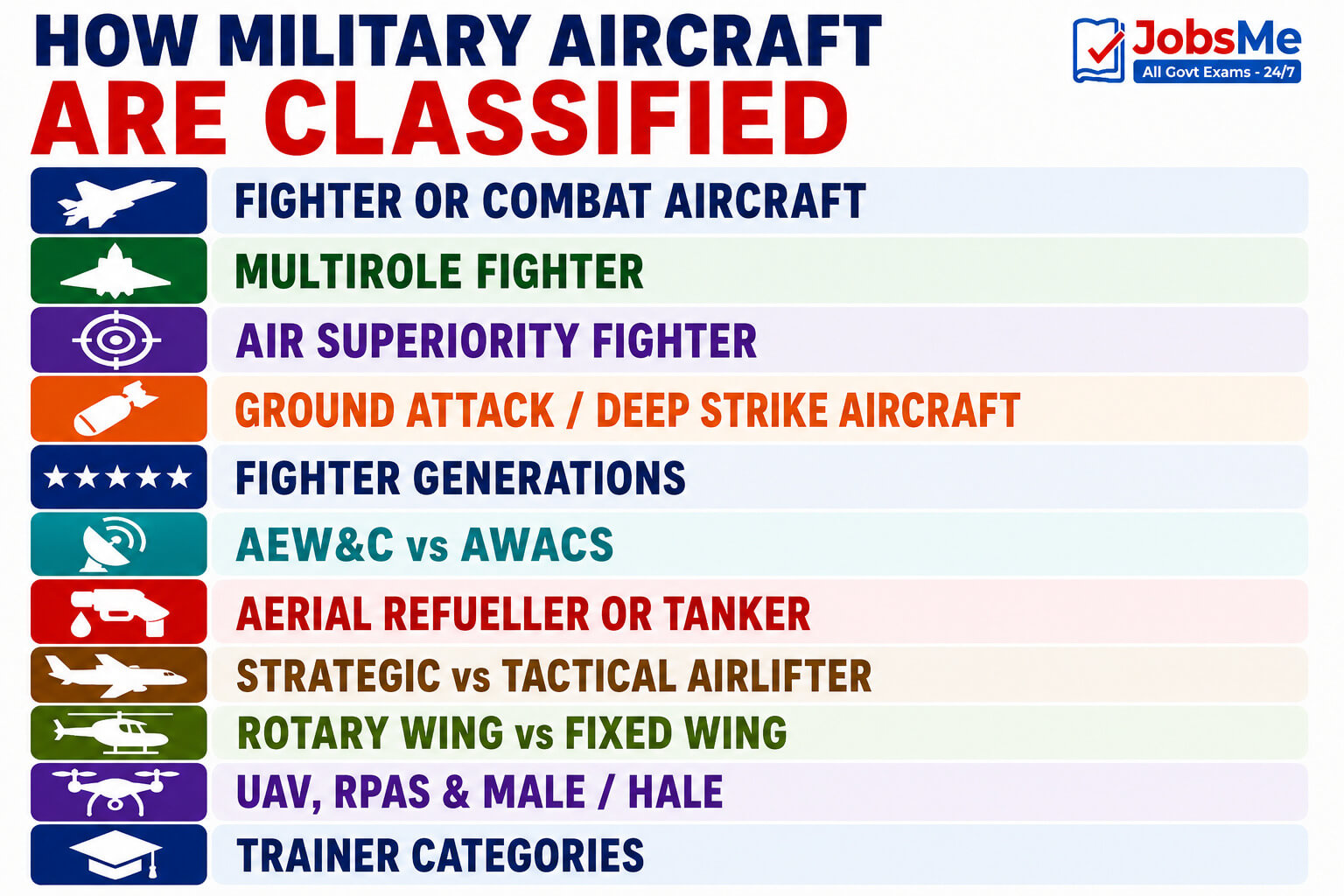
- Fighter or combat aircraft - Armed aircraft designed for air-to-air and air-to-ground combat. Examples in Indian service include the Su-30MKI, Rafale and Tejas.
- Multirole fighter - A single aircraft able to switch between air superiority, ground attack, reconnaissance and maritime strike in the same mission profile. The Rafale is marketed as an omnirole fighter, a step beyond multirole.
- Air superiority fighter - Optimised primarily for shooting down enemy aircraft and controlling airspace, such as the MiG-29UPG.
- Ground attack or deep-penetration strike aircraft - Built to strike targets deep inside enemy territory at low altitude, such as the SEPECAT Jaguar.
- Fighter generations - A shorthand for technology level. The Jaguar is roughly 3.5 to 4 generation, the Mirage 2000 and MiG-29UPG are 4th generation, the Su-30MKI, Rafale and Tejas Mk1A sit at 4.5 generation, and the upcoming AMCA is India's 5th generation stealth programme.
- AEW&C versus AWACS - Both are flying radar stations. AEW&C (Airborne Early Warning and Control) uses a smaller business-jet class platform with limited coverage, like the Netra. AWACS (Airborne Warning and Control System) uses a large aircraft with full circular coverage, like the Phalcon on the Il-76.
- Aerial refueller or tanker - Transfers fuel in flight to extend the combat radius of fighters. India's tanker is the Ilyushin Il-78MKI.
- Strategic versus tactical airlifter - A strategic airlifter such as the C-17 moves very heavy loads over intercontinental distances. A tactical airlifter such as the C-130J or C-295 lands close to the battlefield on short, rough or semi-prepared strips.
- Rotary wing versus fixed wing - Helicopters are rotary wing; conventional aircraft with wings are fixed wing. Rotary-wing roles include attack, utility, heavy-lift, anti-submarine warfare (ASW) and search and rescue (SAR).
- UAV, RPAS and MALE or HALE - An Unmanned Aerial Vehicle or Remotely Piloted Aircraft System flies without a pilot on board. MALE means Medium Altitude Long Endurance and HALE means High Altitude Long Endurance. The MQ-9B Predator is a HALE platform.
- Trainer categories - Pilot training moves through three stages: basic trainer (HTT-40, Pilatus PC-7 Mk II), intermediate jet trainer (HAL Kiran) and advanced jet trainer (BAE Hawk Mk132).
Indian Air Force Combat Aircraft - Fighter Jets
Combat aircraft form the backbone of the IAF. The sanctioned strength of the IAF is 42 fighter squadrons, but the actual number in service is around 29 to 30 squadrons, a shortfall caused mainly by the retirement of the MiG-21 fleet and slow replacement inductions. Each squadron typically holds about 18 aircraft.
| Aircraft | Origin | Type / Role | Variant | Approximate Strength | Key Features and Exam Points |
|---|---|---|---|---|---|
| Sukhoi Su-30MKI | Russia, licence-built in India | 4.5-generation twin-engine, two-seat heavy multirole and air superiority fighter | Su-30MKI | Around 260 | The largest fleet and operational backbone of the IAF, licence-produced by HAL Nashik. MKI stands for Modernizirovannyi Kommercheskii Indiski and is unique to India, combining a Russian airframe and engine with French and Israeli electronics and Indian weapons. Fitted with Thrust Vectoring Control (TVC) and canards, enabling extreme manoeuvres such as Pugachev's Cobra. Carries the BrahMos-A air-launched cruise missile, Astra BVRAAM and R-77. The Super Sukhoi programme will upgrade an initial batch of 84 aircraft with the indigenous Virupaksha AESA radar, new electronic warfare suite and Indian weapons; 12 additional aircraft have also been ordered from HAL. |
| Dassault Rafale | France | 4.5-generation twin-engine omnirole fighter | Rafale EH (single-seat), Rafale DH (twin-seat) | 36 | Acquired under the 2016 Inter-Governmental Agreement with France and inducted between 2020 and 2022 into No. 17 Squadron "Golden Arrows" at Ambala and No. 101 Squadron "Falcons" at Hasimara. Features the RBE2-AA AESA radar, the SPECTRA electronic warfare and self-protection suite, and cold-start capability for high-altitude airbases. Key weapons are the long-range Meteor air-to-air missile, the SCALP deep-strike cruise missile and the HAMMER precision-guided munition. |
| HAL Tejas | India | Light Combat Aircraft, single-engine multirole fighter | Mk1 and Mk1 Trainer | Around 40 in two squadrons | Designed by the Aeronautical Development Agency (ADA) and produced by HAL Bengaluru under the LCA programme launched in 1983. It is the world's smallest and lightest multirole supersonic fighter, with a glass cockpit, fly-by-wire flight controls and roughly 45 per cent composite airframe. Achieved Initial Operational Clearance in 2013 and Final Operational Clearance in 2019. Operated by No. 45 Squadron "Flying Daggers" and No. 18 Squadron "Flying Bullets" at Sulur. |
| HAL Tejas Mk1A | India | Upgraded light multirole fighter | Mk1A | 180 on order | The upgraded Tejas with an AESA radar, an advanced electronic warfare suite, an in-flight refuelling probe, beyond-visual-range missile capability and improved maintainability. The IAF ordered 83 aircraft in February 2021 (about ₹47,500 crore) and 97 more in September 2025, taking the order book to 180. A third production line at Nashik was inaugurated in October 2025, lifting HAL's capacity to about 24 aircraft a year. Deliveries were delayed mainly by the supply of GE F404-IN20 engines. |
| Dassault Mirage 2000 | France | 4th-generation single-engine multirole and precision-strike fighter | Mirage 2000I / 2000TI (upgraded from 2000H / 2000TH) | Around 40 | Inducted from 1985 and known for its delta-wing design and bombing accuracy. Delivered laser-guided bombs against high-altitude targets in the 1999 Kargil War, a capability no other IAF aircraft had at the time, and carried out the Balakot air strike in February 2019. A mid-life upgrade contracted in 2011 extends its service life to around 2030 to 2035. |
| Mikoyan MiG-29 | Russia | 4th-generation twin-engine air superiority fighter and interceptor | MiG-29UPG | Around 60 in three squadrons | Inducted in the 1980s and modernised to the UPG (upgraded) standard with a new radar, glass cockpit, mid-air refuelling capability and R-77 and Kh-31 missile integration. Highly agile and used for air defence and point defence, based mainly at Adampur and Jamnagar. The fleet enters its retirement window in the late 2020s, to be replaced by the Tejas Mk1A and MRFA. |
| SEPECAT Jaguar (Shamsher) | United Kingdom and France (Anglo-French), licence-built by HAL | Twin-engine deep-penetration strike and ground-attack aircraft | DARIN III (also IS, IM, IB) | Around 120 | Inducted from 1979 and named Shamsher, meaning sword of justice. Uniquely suited to low-level deep strike at high subsonic speed over rugged and high-altitude terrain, and long the IAF's designated nuclear-strike-capable platform. The DARIN III standard adds a new mission computer, displays, navigation and weapons integration. It is one of the oldest fighters still in front-line service anywhere in the world; the original Rolls-Royce Adour engine line has closed, and the fleet is being phased out through the late 2020s. |
| Mikoyan-Gurevich MiG-21 Bison | Soviet Union | Supersonic fighter and interceptor (retired) | Type 77, Type 96, Bis, Bison | Nil, retired on 26 September 2025 | India's first supersonic fighter, inducted at Chandigarh in 1963, with more than 870 aircraft procured over six decades. It fought in the 1965 and 1971 wars, the 1999 Kargil conflict and the 2019 Balakot follow-up engagement. It was formally decommissioned on 26 September 2025 at Chandigarh Air Force Station, the last operating unit being No. 23 Squadron "Panthers". Air Chief Marshal A. P. Singh flew the final sortie with the call sign Badal 3. |
Special Mission Aircraft - AEW&C, AWACS and Aerial Refuellers
Special mission aircraft do not fight directly but decide the outcome of air battles by providing early warning, radar coverage, electronic intelligence and in-flight fuel. This category has become a favourite area for statement-based questions.
| Aircraft or System | Origin | Type / Role | Approximate Strength | Key Features and Exam Points |
|---|---|---|---|---|
| DRDO Netra AEW&C | India, on a Brazilian Embraer ERJ-145 platform | Airborne Early Warning and Control | 3 | Indigenous system developed by DRDO's Centre for Airborne Systems (CABS), Bengaluru. Uses an Active Electronically Scanned Array (AESA) radar mounted on the fuselage giving 240-degree coverage, not a rotating dome. Achieved Initial Operational Clearance in 2017 and Final Operational Clearance in June 2026. It supported the 2019 Balakot strikes and Operation Sindoor in May 2025. Because it is indigenous, India controls its software, source codes and upgrade path. |
| Beriev A-50EI Phalcon | Russian Il-76 airframe with an Israeli radar | Airborne Warning and Control System (AWACS) | 3 | An Israeli EL/W-2090 AESA radar in a rotodome mounted on a Russian Il-76 aircraft, giving full 360-degree "eye in the sky" coverage over a range of roughly 400 km. It is the true AWACS in Indian service, as distinct from the smaller Netra AEW&C. |
| Netra Mk1A | India, on Embraer EMB-145 | Upgraded AEW&C (on order) | 6 approved | Cleared by the Defence Acquisition Council in March 2025 and by the Cabinet Committee on Security later that year. Retains 240-degree coverage but adds improved Gallium Nitride (GaN) based sensors, with a shorter delivery timeline than the Mk2. |
| Netra Mk2 (AWACS India) | India with Airbus, on ex-Air India Airbus A321 | Next-generation AEW&C (under development) | 6 approved | Approved by the Cabinet Committee on Security on 17 July 2025 at about ₹19,000 crore. Uses a derivative of the indigenous Uttam AESA radar with a dorsal antenna plus a nose antenna for roughly 300 to 360-degree coverage and detection beyond 450 km, plus ballistic-missile tracking to support India's BMD network. Deliveries are expected by the early 2030s. |
| Ilyushin Il-78MKI | Soviet Union and Uzbekistan | Aerial refuelling tanker | 6 | India's only dedicated mid-air refueller, fitted with an Israeli fuel-transfer system. It extends the combat radius and endurance of fighters and transport aircraft, effectively multiplying the reach of the entire fleet. |
| Gulfstream III SRA, Gulfstream G100 and Global 5000 | United States and Israel | Electronic intelligence (ELINT) and surveillance | Around 7 in total | Small special-mission jets used for signals and electronic intelligence gathering along the borders and for maritime and airspace surveillance. The Gulfstream G100 is based on the Israeli IAI 1125 Astra business jet. |
Transport Aircraft of the Indian Air Force
Transport aircraft carry troops, cargo, artillery and humanitarian relief, and are the reason India can sustain operations in Ladakh, Siachen and the North East. They are also India's main tool for evacuation missions abroad and for disaster relief under Humanitarian Assistance and Disaster Relief (HADR) operations.
| Aircraft | Origin | Type / Role | Variant | Approximate Strength | Key Features and Exam Points |
|---|---|---|---|---|---|
| Boeing C-17 Globemaster III | United States | Strategic heavy-lift airlifter | C-17 | 11 | The heaviest airlifter in Indian service, able to carry about 77 tonnes of cargo including main battle tanks such as the T-90 and Arjun. It has short take-off and landing (STOL) capability on short and unpaved runways and is based at Hindon. Regularly used for foreign evacuation and disaster-relief missions. |
| Ilyushin Il-76 (Gajraj) | Soviet Union | Strategic airlifter | Il-76MD | Around 17 | Nicknamed Gajraj, meaning king of elephants. It was India's principal heavy-lift aircraft before the C-17 and the same airframe carries the Phalcon AWACS and the Il-78MKI tanker. |
| Lockheed Martin C-130J Super Hercules | United States | Tactical and special-operations airlifter | C-130J-30 | Around 12 | Used for special forces insertion, medical evacuation and supply airdrops. Its defining capability is landing on Advanced Landing Grounds (ALGs) in rough high-altitude terrain such as Daulat Beg Oldie (DBO), the world's highest airstrip, and on the Kargil and Nyoma strips. |
| Antonov An-32 (Sutlej) | Soviet Union and Ukraine | Medium tactical transport | An-32RE | Around 100 | Named Sutlej, this is the workhorse of routine logistics. Its high-mounted engines and rugged design let it operate in extreme heat and mountainous terrain, making it ideal for Himalayan and North East supply runs. |
| Airbus C-295 | Spain, with 40 aircraft assembled in India | Tactical airlifter | C-295MW | 56 contracted | Contracted in September 2021 for ₹21,935 crore: 16 aircraft in fly-away condition from Seville, Spain and 40 built in India by Tata Advanced Systems Limited (TASL) at the Vadodara Final Assembly Line, inaugurated in October 2024. This is the first military aircraft final assembly line run by the private sector in India, and the first Made-in-India C-295 was rolled out in May 2026. It replaces the ageing Avro HS-748 fleet, carries a 9-tonne payload or up to 71 troops or 50 paratroopers, and has a rear ramp door for rapid loading. India is the largest global customer for the type. |
| Hawker Siddeley HS-748 (Avro) | United Kingdom, licence-built by HAL | Light transport, being phased out | HS-748 | Declining, under replacement | A 1960s-era aircraft licence-built by HAL that is being progressively replaced by the C-295. Some airframes have served as flying testbeds, including for the Netra AEW&C programme. |
| Dornier Do-228 | Germany, licence-built by HAL Kanpur | Light transport, communication and surveillance | Do-228-201 | Around 50 with the IAF | A small twin-turboprop used for light transport, communication duties, pilot training and coastal surveillance. It is also the most widely used maritime patrol platform of the Indian Navy and the Indian Coast Guard. |
| Boeing 777-300ER, Boeing 737 and Embraer Legacy 600 | United States and Brazil | VVIP and VIP transport | Air India One (B777), 737-700, Legacy 600 | Around 9 in total | Operated by the Air Headquarters Communication Squadron for the President, Vice-President and Prime Minister. The Boeing 777-300ER aircraft, using the call sign Air India One, are fitted with self-protection suites including missile warning and countermeasure systems. |
Helicopters in Indian Service
Helicopters are indispensable in India because of its terrain: glaciers, deserts, jungles, island territories and the world's highest battlefield. The rotary-wing fleet is shared across the IAF, Army Aviation Corps, Navy and Coast Guard, so the same helicopter often appears in more than one service.
| Helicopter | Origin | Type / Role | Variant | Approximate Strength | Key Features and Exam Points |
|---|---|---|---|---|---|
| Boeing AH-64E Apache | United States | Multirole attack helicopter | AH-64E and AH-64E(I) | 22 with the IAF and 6 with the Army | Often called the flying tank. Fitted with the Longbow Fire Control Radar above the rotor mast, armed with Hellfire missiles, 70 mm rockets and a 30 mm chain gun that is slaved to the pilot's helmet sight. The IAF received 22 under a 2015 deal, delivered between 2019 and 2021. The Army's six Apaches, ordered in 2020, went to the newly raised 451 Army Aviation Squadron at Jodhpur, with the first three arriving in July 2025 and the last three on 16 December 2025; these wear desert camouflage for the western sector. |
| Boeing CH-47F Chinook | United States | Heavy-lift transport helicopter | CH-47F | 15 | Instantly recognisable by its tandem rotors and the absence of a tail rotor. It lifts heavy artillery such as the M777 ultra-light howitzer, vehicles, engineering equipment and troops into high-altitude positions, and is also used for disaster relief and firefighting. |
| HAL Prachand (Light Combat Helicopter) | India | Indigenous light attack helicopter | LCH Prachand | 156 on order | Prachand means fierce. It was conceived after the 1999 Kargil War, when the Kargil Review Committee noted India had no dedicated high-altitude attack helicopter. First flight was on 29 March 2010 and it was formally inducted and named on 3 October 2022. It is the only attack helicopter in the world able to take off and land at an altitude of about 5,000 metres, such as the Siachen Glacier, while carrying a meaningful weapon load. Two contracts signed on 28 March 2025 worth about ₹62,700 crore cover 156 helicopters: 66 for the IAF and 90 for the Army. |
| Mil Mi-17V-5 | Russia | Medium-lift utility helicopter | Mi-17V-5 | Around 200 to 250 | The most numerous helicopter in the IAF, used for troop transport, armed support, casualty evacuation, search and rescue, and election and disaster-relief duty. Its high-altitude performance makes it central to operations in the northern and north-eastern sectors. |
| HAL Dhruv (Advanced Light Helicopter) | India | Multirole utility helicopter | ALH Mk I to Mk IV | Around 300 across all four services | India's flagship indigenous helicopter, used for transport, casualty evacuation, search and rescue, and coastal surveillance by all four services. It also flies with the Sarang helicopter display team of the IAF and has been exported. |
| HAL Rudra | India | Armed or weaponised utility helicopter | ALH Mk IV Weapon System Integrated | Around 90 | The weaponised version of the Dhruv, fitted with a 20 mm turret gun, rocket pods, anti-tank guided missiles and air-to-air missiles. Rudra is armed utility, whereas Prachand is a purpose-built attack helicopter, and examiners frequently test this distinction. |
| HAL Chetak | France (Aerospatiale Alouette III), licence-built by HAL | Liaison, utility, training and SAR | Chetak | Around 130 across services | A veteran light helicopter in service since the 1960s, used for liaison, casualty evacuation, training and shipborne duties with the Navy and Coast Guard. It is being replaced progressively by the Dhruv and by the planned Light Utility Helicopter. |
| HAL Cheetah and Cheetal | France (SA 315B Lama), licence-built by HAL | High-altitude liaison and utility | Cheetah, Cheetal (re-engined) | Around 60 across services | The lifeline of the Siachen Glacier, capable of operating at extreme altitude where heavier helicopters cannot. The parent Lama design holds the world record for the highest helicopter landing and take-off. The Cheetal is the re-engined version with a more powerful turbine. |
| Mil Mi-24, Mi-25 and Mi-35 | Russia | Attack helicopter, being retired | Mi-24, Mi-25, Mi-35 | Small residual number | India's first dedicated attack helicopters, nicknamed the flying tank by their designers and used in the IPKF operations in Sri Lanka. They are being replaced by the Apache and the Prachand. |
Trainer Aircraft of the Indian Air Force
Pilot training in India follows a three-stage system, and questions often ask which aircraft belongs to which stage. A shortage of trainers is one reason the IAF has had to limit pilot intake, which is why the indigenous HTT-40 programme matters.
| Aircraft | Origin | Type / Stage | Variant | Approximate Strength | Key Features and Exam Points |
|---|---|---|---|---|---|
| Pilatus PC-7 Mk II | Switzerland | Stage I basic trainer | PC-7 Mk II | 75 | Acquired from 2009 after the indigenous HPT-32 Deepak was grounded following a series of fatal crashes. The IAF needs about 181 basic trainers but holds only 75 PC-7s, and the balance is to be met by the HTT-40. |
| HAL HTT-40 | India | Stage I basic trainer | Hindustan Turbo Trainer-40 | 70 on order with an option for 38 more | A fully aerobatic, tandem-seat turboprop developed by HAL's Aircraft Research and Design Centre, Bengaluru, powered by a Honeywell TPE331-12B engine and fitted with an air-conditioned glass cockpit and a zero-zero ejection seat. Contracted in March 2023 for about ₹6,838 crore. The first series-production aircraft, TH-4001, flew on 24 October 2025, and a second production line was opened at Nashik. It replaces the retired HPT-32 Deepak. |
| HAL Kiran | India | Stage II intermediate jet trainer | Kiran Mk I, Mk IA, Mk II | Around 70 | A long-serving indigenous jet trainer used for intermediate training and previously by the Surya Kiran aerobatic team. Its replacement, the indigenous Intermediate Jet Trainer (IJT) approved in 1999, is still not in service, making this one of India's longest-pending aviation programmes. |
| BAE Systems Hawk Mk132 | United Kingdom, licence-built by HAL | Stage III advanced jet trainer | Hawk Mk132, Hawk-i | Around 100 with the IAF and 17 with the Navy | Bridges the gap between basic training and front-line fighters, teaching air combat, weapon delivery and formation flying. It equips the Surya Kiran Aerobatic Team (SKAT) and the indigenously upgraded Hawk-i has been used as a testbed for Indian weapons and avionics. |
| HAL Tejas Trainer | India | Twin-seat conversion trainer | Tejas Mk1 Trainer | Around 8 delivered, more on order | The two-seat version of the Tejas, used to convert pilots onto the LCA. Ten trainers are part of the 83-aircraft Mk1A contract. |
| Pipistrel Virus SW 80 | Slovenia | Microlight ab-initio trainer | Virus SW 80 | 72 | A very light, low-cost aircraft used at the National Defence Academy and Air Force Academy for initial flying exposure and to reduce flying hours on costlier trainers. |
Unmanned Aerial Vehicles and Remotely Piloted Aircraft
Drones have moved from a supporting role to the centre of Indian military planning, especially after Operation Sindoor in May 2025. This is currently one of the most heavily tested areas in defence current affairs.
| System | Origin | Type / Role | Variant | Status | Key Features and Exam Points |
|---|---|---|---|---|---|
| General Atomics MQ-9B Predator | United States | High Altitude Long Endurance (HALE) armed remotely piloted aircraft | MQ-9B SkyGuardian (land) and SeaGuardian (maritime) | 31 contracted on 15 October 2024 | A tri-service contract worth about ₹32,000 crore under the US Foreign Military Sales route: 15 SeaGuardian for the Navy and 8 each for the Army and the IAF. It flies up to 50,000 feet with an endurance of 30 to 40 hours and can carry Hellfire missiles and precision bombs. About 10 will arrive fly-away and 21 will be assembled in India, with an MRO facility in the country. India is the first non-NATO country to acquire the type, and the Navy had earlier leased two SeaGuardians from 2020. |
| IAI Heron | Israel | Medium Altitude Long Endurance surveillance UAV | Heron 1, Heron Mk II, Heron TP | Around 70 across services | The mainstay surveillance drone of the Indian armed forces, used for border and maritime monitoring. The Heron Mk II adds satellite communication for beyond-line-of-sight control, and the larger Heron TP can carry heavier payloads. |
| IAI Searcher Mk II | Israel | Tactical surveillance UAV | Searcher Mk I and Mk II | In service across services | A shorter-range tactical drone used for artillery observation, battlefield reconnaissance and target acquisition in support of ground formations. |
| DRDO TAPAS-BH (Rustom-2) and Archer-NG | India | MALE surveillance and armed UAV under development | TAPAS-BH-201, Archer-NG | Under development and trials | TAPAS stands for Tactical Airborne Platform for Aerial Surveillance Beyond Horizon and is developed by DRDO's Aeronautical Development Establishment (ADE), Bengaluru. Archer-NG is a smaller armed drone intended for surveillance and precision strike. |
| IAI Harop and Harpy | Israel | Loitering munition, also called a suicide or kamikaze drone | Harop, Harpy | In service | A loitering munition circles over a target area and then dives onto the target, destroying itself in the process. These systems were used in Operation Sindoor in May 2025 to strike air-defence and radar installations. |
Naval Air Arm Aircraft of the Indian Navy
The Naval Air Arm operates carrier-based fighters, long-range maritime patrol aircraft, anti-submarine helicopters and airborne early warning helicopters. India operates two aircraft carriers, INS Vikramaditya and the indigenous INS Vikrant, both using the STOBAR configuration, that is Short Take-Off But Arrested Recovery with a ski-jump ramp.
| Aircraft | Origin | Type / Role | Variant | Approximate Strength | Key Features and Exam Points |
|---|---|---|---|---|---|
| Mikoyan MiG-29K and MiG-29KUB | Russia | Carrier-based multirole fighter | MiG-29K (single-seat), MiG-29KUB (twin-seat trainer) | Around 40 | In service since 2009 and the current fighter for INS Vikramaditya and INS Vikrant. Persistent serviceability and accident-rate concerns are the reason the Navy chose the Rafale-M as its future carrier fighter. |
| Dassault Rafale-Marine (Rafale-M) | France | Carrier-based omnirole fighter (on order) | Rafale-M single-seat and twin-seat trainer | 26 on order | An Inter-Governmental Agreement signed on 28 April 2025 worth about ₹63,000 crore covers 22 single-seat carrier fighters and 4 twin-seat land-based trainers, chosen over the Boeing F/A-18 after trials at the Shore Based Test Facility, Goa. Deliveries run from about 2028 to 2031. It will replace the MiG-29K, and India becomes the first country outside France to operate the carrier-based Rafale and the only country to fly both land and naval versions. |
| Boeing P-8I Neptune | United States | Long-range maritime patrol and anti-submarine warfare | P-8I | 12 | India's most capable submarine hunter, based at INS Rajali, Arakkonam and at Goa. Derived from the Boeing 737 airliner and fitted with a magnetic anomaly detector, sonobuoys, torpedoes and Harpoon anti-ship missiles. It was also deployed for land surveillance during the 2020 Ladakh standoff. |
| Kamov Ka-31 | Russia | Shipborne airborne early warning helicopter | Ka-31 | Around 14 | Provides the fleet's airborne early warning using a large planar array radar that folds under the fuselage. It acts as the eye of the carrier battle group, detecting low-flying aircraft and sea-skimming missiles beyond the ship's own radar horizon. |
| Kamov Ka-28 | Russia | Shipborne anti-submarine warfare helicopter | Ka-28 (export Ka-27) | Around 14 | Fitted with coaxial contra-rotating rotors and armed with torpedoes and depth charges. Aspirants must separate Ka-31 for early warning from Ka-28 for submarine hunting. |
| Sikorsky MH-60R Seahawk | United States | Multi-mission anti-submarine and search and rescue helicopter | MH-60R | 24 contracted, deliveries in progress | Contracted in 2020 under the Foreign Military Sales route to replace the ageing Sea King fleet. Commissioned into INAS 334 at Kochi, it carries dipping sonar, torpedoes and anti-ship missiles and is considered among the world's best naval helicopters. |
| Westland Sea King | United Kingdom | Anti-submarine warfare, SAR and utility helicopter | Mk 42B, Mk 42C, UH-3H | Around 20, being replaced | A long-serving heavy naval helicopter used for anti-submarine work, commando assault and search and rescue. It is being replaced by the MH-60R Seahawk. |
| Dornier Do-228 | Germany, licence-built by HAL | Short-range maritime surveillance | Do-228-201 | Around 29 with the Navy | The most numerous maritime surveillance aircraft of the Navy, used for coastal patrol, exclusive economic zone surveillance, pollution monitoring and search and rescue. |
| Ilyushin Il-38SD Sea Dragon | Soviet Union | Maritime patrol and anti-submarine warfare, retired | Il-38SD | Phased out | Served the Navy for more than four decades with INAS 315 "Winged Stallions" before being phased out, its role passing to the P-8I Neptune. |
| HAL Dhruv, HAL Chetak, BAE Hawk and HAL Kiran | India, France and United Kingdom | Utility, liaison and training | ALH, Chetak, Hawk Mk132, Kiran | Around 90 in total | Shipborne utility and liaison duties are handled by the Dhruv and Chetak, while naval pilots train on the Hawk Mk132 and Kiran alongside their IAF counterparts. |
Army Aviation Corps and Indian Coast Guard Aircraft
These two arms are frequently overlooked by aspirants, yet questions on them do appear, especially on the Army's Apache squadron and the Coast Guard's surveillance fleet.
Army Aviation Corps

| Aircraft | Origin | Type / Role | Approximate Strength | Key Features and Exam Points |
|---|---|---|---|---|
| HAL Dhruv | India | Utility helicopter | Around 145 with more on order | The Army's principal utility helicopter for troop movement, casualty evacuation, observation and logistics support to ground formations. |
| HAL Rudra | India | Armed utility helicopter | Around 75 | Provides armed escort and close support to mechanised formations with a turret gun, rockets and anti-tank guided missiles. |
| HAL Prachand | India | Light attack helicopter | 90 of the 156 ordered are for the Army | Dedicated high-altitude attack helicopter for anti-armour and anti-infantry strikes along the northern and western borders. |
| Boeing AH-64E Apache | United States | Attack helicopter | 6 | Operated by the 451 Army Aviation Squadron at Jodhpur, raised in March 2024, with all six delivered by December 2025 under a deal worth about 600 million US dollars. Configured in desert camouflage for the Rajasthan sector. |
| HAL Chetak and HAL Cheetah | France, licence-built by HAL | Liaison and high-altitude utility | Around 40 | Still the only helicopters able to routinely operate from the highest Siachen posts, awaiting replacement by the Light Utility Helicopter. |
| IAI Heron, IAI Searcher and SWITCH UAV | Israel and India | Surveillance UAVs | In service with more on order | Provide real-time surveillance for ground formations. The Indian-made SWITCH is a vertical take-off and landing drone designed for high-altitude reconnaissance. |
Indian Coast Guard
| Aircraft | Origin | Type / Role | Approximate Strength | Key Features and Exam Points |
|---|---|---|---|---|
| Dornier Do-228 | Germany, licence-built by HAL | Maritime reconnaissance and patrol | Around 23 | The workhorse of coastal surveillance, used for anti-smuggling patrol, fisheries protection, pollution monitoring and search and rescue across India's exclusive economic zone. |
| HAL Dhruv (ALH Mk III) | India | Advanced light helicopter for maritime SAR | Around 20 | The Mk III version is fitted with a surveillance radar, electro-optical sensors and a medical intensive-care unit for casualty evacuation at sea. |
| HAL Chetak | France, licence-built by HAL | Light utility and SAR helicopter | Around 17 | Used from shore bases and Coast Guard ships for boarding operations, rescue and liaison, and being replaced progressively by the Dhruv. |
Future Aircraft Programmes and Recent Acquisitions
This is the section most closely linked to current affairs. Every programme below has been in the news between 2025 and 2026 and can be asked in either a Static GK or a current affairs framing.
| Programme | Category | Quantity and Value | Status and Key Facts |
|---|---|---|---|
| HAL Tejas Mk1A | Indigenous light multirole fighter | 180 aircraft; about ₹47,500 crore for 83 and roughly ₹62,000 crore for 97 | 83 ordered in February 2021 and 97 in September 2025. Deliveries were delayed by GE F404-IN20 engine supply and radar integration, with the first squadron targeted for the 2026-27 window. A third production line opened at Nashik in October 2025. |
| HAL Tejas Mk2 (Medium Weight Fighter) | Indigenous 4.5-generation medium fighter | Development programme | A heavier development of the Tejas with a maximum take-off weight of about 17.5 tonnes, a 6.5-tonne payload across 11 hardpoints, close-coupled canards and the more powerful General Electric F414-INS6 engine of about 98 kN thrust. The prototype rollout and maiden flight fall in the 2026 window, with production planned from around 2029. It is intended to replace the Jaguar, Mirage 2000 and MiG-29 fleets. |
| Advanced Medium Combat Aircraft (AMCA) | Indigenous fifth-generation stealth fighter | About ₹15,000 crore for the prototype phase | Cleared by the Cabinet Committee on Security in March 2024 and designed by the Aeronautical Development Agency (ADA). A twin-engine, roughly 25-tonne stealth fighter with internal weapons bays, serpentine air intakes, sensor fusion, an indigenous AESA radar and supercruise capability. In May 2026 the RFP for five flying prototypes and one structural test specimen went to three private-led bidders: Tata Advanced Systems as a solo bidder, a Bharat Forge-led consortium with BEML and Data Patterns, and an L&T-led consortium with BEL and Dynamatic Technologies. The Mk1 will use the GE F414 while the Mk2 is planned around a 120 kN engine co-developed by Safran and DRDO's GTRE. First flight is targeted for the early 2030s. |
| Multi-Role Fighter Aircraft (MRFA) | Imported and locally built multirole fighter | 114 Rafale jets; about ₹3.25 lakh crore, roughly 36 to 40 billion US dollars | The Defence Acquisition Council granted Acceptance of Necessity on 12 February 2026, ahead of the French President's visit, converting a long-pending multi-vendor tender into a government-to-government Rafale deal. The structure is 18 aircraft fly-away from France and 96 built in India, and a Letter of Request was issued to France in June 2026. This would be India's largest-ever combat aircraft acquisition and would bring the newer F4 standard to the IAF. |
| Super Sukhoi upgrade | Mid-life upgrade of existing fighters | Initial batch of 84 Su-30MKI | To be executed by HAL at Nashik with DRDO, replacing the Russian radar with the indigenous Virupaksha AESA radar, adding an Indian electronic warfare suite, a new mission computer and larger cockpit displays, and integrating Astra Mk1 and Mk2 and Rudram weapons. It aims to turn the fleet into a 4.5-plus generation force and keep it relevant into the 2050s. |
| Airbus C-295 Made-in-India | Tactical airlifter | 56 aircraft; ₹21,935 crore | The first Made-in-India C-295 rolled out of the Vadodara Final Assembly Line in May 2026, ahead of the scheduled September 2026 date. Over 85 per cent of structural and final assembly work plus 13,000 detail parts are done in India with 37 Indian suppliers onboarded, and all 40 India-built aircraft are due by August 2031. |
| DRDO Netra Mk1A and Netra Mk2 | Airborne early warning and control | 6 plus 6 aircraft; Mk2 approved at about ₹19,000 crore | A two-track expansion of India's flying radar fleet: six Netra Mk1A on Embraer EMB-145 jets for the near term and six Netra Mk2 on ex-Air India Airbus A321 airframes for the 2030s, taking the AEW&C and AWACS fleet close to triple its present size. |
| HAL Prachand (LCH) production order | Indigenous light attack helicopter | 156 helicopters; about ₹62,700 crore | Signed on 28 March 2025, this was among the largest indigenous defence contracts ever placed, covering 66 for the IAF and 90 for the Army, with deliveries beginning in the third year after signature at roughly 30 helicopters a year. |
| MQ-9B Predator | Armed HALE remotely piloted aircraft | 31 aircraft; about ₹32,000 crore | Signed on 15 October 2024 as a tri-service acquisition with a maintenance, repair and overhaul facility in India, split 15 Navy, 8 Army and 8 IAF, of which 21 will be assembled in India. |
| Dassault Rafale-Marine | Carrier-based fighter | 26 aircraft; about ₹63,000 crore | Signed on 28 April 2025 as India's largest naval fighter deal, comprising 22 single-seat and 4 twin-seat aircraft for INS Vikrant and INS Vikramaditya, with deliveries between about 2028 and 2031. The package also upgrades ten IAF Rafales for buddy-buddy refuelling. |
Memory Tricks and Mnemonics
The aircraft list looks intimidating because of the sheer number of names. These tricks group the platforms by pattern so that one clue unlocks several answers.
Trick 1: Country Ladder — "Russia Fights, France Strikes, Britain Trains, India Rises"
Sort the fighter fleet by country of origin and the matching questions solve themselves.
- Russia gives the S and M: Sukhoi Su-30MKI and MiG-29UPG, plus the Mi-17 and Mi-35 helicopters and the Il-76 and Il-78 heavies.
- France gives the two R-and-M jets: Rafale and Mirage 2000, plus the Chetak and Cheetah helicopter designs.
- Britain gives the J and H: Jaguar and Hawk, plus the older Avro HS-748 and the naval Sea King.
- America gives the C and A: C-17, C-130J, CH-47F Chinook and the AH-64E Apache, plus the P-8I and MQ-9B.
- India gives the T, D, P and R: Tejas, Dhruv, Prachand and Rudra, plus Netra, HTT-40 and Kiran.
Remember: Russia Fights, France Strikes, Britain Trains, America Lifts, India Rises.
Trick 2: Netra versus Phalcon — "Native is Narrow, Foreign is Full"
This is the single most frequently confused pair in defence GK, and the trick is pure alliteration.
- Netra = Native (Indian, DRDO), Narrow (240 degrees), No dome (flat AESA antenna on the fuselage), on a small Embraer jet.
- Phalcon = Foreign (Israeli radar), Full circle (360 degrees), on a fat Il-76 with a rotodome.
Netra has Narrow eyes; Phalcon has a Full sweep.
Trick 3: Transport Weight Ladder — "17, 76, 130, 32, 295, 228"
Read the numbers in that exact order and you get the transport fleet from heaviest to lightest.
- C-17 Globemaster III — strategic, about 77 tonnes, tanks.
- Il-76 Gajraj — strategic, the old heavyweight.
- C-130J Super Hercules — tactical, special operations, high-altitude landing grounds.
- An-32 Sutlej — medium tactical, Himalayan supply.
- C-295 — tactical, 9 tonnes, replacing the Avro.
- Do-228 — light transport and surveillance.
Seventeen carries the tank, Two-two-eight carries the mail.
Trick 4: Helicopter Roles — "A Attacks, C Carries, M Moves, D Delivers"
The first letter of each American and Russian helicopter tells you its job.
- Apache Attacks — attack helicopter with Hellfire missiles and a 30 mm chain gun.
- Chinook Carries — heavy-lift cargo with tandem rotors and M777 howitzers underslung.
- Mi-17 Moves — medium-lift utility that moves troops and stores.
- Dhruv Delivers — utility and casualty evacuation across all four services.
Apache Attacks, Chinook Carries, Mi-17 Moves, Dhruv Delivers.
Trick 5: The Indigenous Rotary Ladder — "Dhruv, Rudra, Prachand equals Utility, Armed, Attack"
All three come from the same HAL family, and the escalation of firepower matches the escalation of the name.
- Dhruv — the base Advanced Light Helicopter, unarmed utility.
- Rudra — the same Dhruv with weapons bolted on, hence armed utility (ALH Mk IV Weapon System Integrated).
- Prachand — a purpose-built narrow-fuselage attack helicopter, and the only attack helicopter in the world able to operate at about 5,000 metres.
Dhruv is Dutiful, Rudra is Rough, Prachand is Peak — and Peak means 5,000 metres at Siachen.
Trick 6: Rafale Number Chain — "36 plus 26 plus 114"
Every Rafale question in Indian exams reduces to three numbers in ascending order of drama.
- 36 — IAF Rafales under the 2016 deal, at Ambala and Hasimara.
- 26 — Navy Rafale-M under the April 2025 agreement, for INS Vikrant.
- 114 — the MRFA proposal cleared in February 2026, split 18 fly-away plus 96 made in India.
Three-Six flies from land, Two-Six flies from sea, One-One-Four is the future.
Trick 7: The Indigenous Fighter Staircase — "Mk1, Mk1A, Mk2, AMCA"
India's own fighter programmes climb a single staircase, and the order never changes.
- Tejas Mk1 — in service, IOC 2013, FOC 2019.
- Tejas Mk1A — 180 on order, remember it as 83 plus 97 equals 180.
- Tejas Mk2 (MWF) — 17.5 tonnes, GE F414 engine, canards, replaces Jaguar and Mirage.
- AMCA — fifth generation, stealth shaping, internal weapons bay, five prototypes, first flight in the early 2030s.
One, One-A, Two, then Stealth. Light to Medium to Invisible.
Trick 8: Naval Kamov Pair — "31 Sees, 28 Sinks"
Both Kamov helicopters look similar with coaxial rotors, but the numbers separate the roles.
- Ka-31 — the 3 looks like an eye turned sideways, so 31 sees, meaning airborne early warning with a folding planar array radar.
- Ka-28 — 28 sinks, meaning anti-submarine warfare with torpedoes and depth charges.
Ka-31 Sees the sky, Ka-28 Sinks the sub.
Additional Notes
Frequently Confused Facts
- Netra versus Phalcon — Netra is Indian, on an Embraer platform, with 240-degree AESA coverage. Phalcon is an Israeli radar on a Russian Il-76 with 360-degree rotodome coverage over about 400 km.
- Chetak versus Cheetah — Both are HAL licence-built French designs. Chetak is the Alouette III, used for liaison and naval utility work. Cheetah is the SA 315B Lama, the high-altitude specialist of the Siachen Glacier. Chetak is the general-purpose one; Cheetah climbs higher.
- Rudra versus Prachand — Rudra is an armed Dhruv, that is a utility helicopter given weapons. Prachand is a purpose-built attack helicopter with a narrow tandem cockpit.
- Apache versus Chinook — Both are Boeing products from the United States. Apache AH-64E is an attack helicopter; Chinook CH-47F is a heavy-lift transport with tandem rotors.
- C-17 versus C-130J versus C-295 — C-17 is a strategic heavy airlifter of about 77 tonnes. C-130J is a tactical special-operations airlifter for advanced landing grounds. C-295 is a lighter tactical airlifter of 9 tonnes replacing the Avro.
- MiG-29UPG versus MiG-29K — UPG is the upgraded land-based IAF interceptor. MiG-29K and MiG-29KUB are the Navy's carrier-based versions with folding wings and arrester hooks.
- Rafale EH and DH versus Rafale-M — EH is the IAF single-seater and DH the IAF twin-seater. Rafale-M is the Navy's carrier variant with a strengthened undercarriage and arrester hook.
- SkyGuardian versus SeaGuardian — Both are MQ-9B variants. SkyGuardian is the land-surveillance version for the Army and IAF; SeaGuardian is the maritime version with a sea-search radar for the Navy.
- Tejas Mk2 versus AMCA — Tejas Mk2 is a 4.5-generation medium fighter with external weapons. AMCA is a fifth-generation stealth fighter with internal weapons bays. Mk2 flies first; AMCA follows in the 2030s.
- Il-76 versus Il-78 versus A-50EI — All three share the same Ilyushin airframe. Il-76 is the transport, Il-78MKI is the aerial refueller, and the A-50EI is the Phalcon AWACS.
- HTT-40 versus HPT-32 versus Kiran — HPT-32 Deepak was the older basic trainer that was grounded; HTT-40 is its new indigenous replacement; Kiran is the intermediate jet trainer.
- AEW&C versus AWACS — Both provide flying radar coverage. AEW&C uses smaller platforms with partial coverage; AWACS uses large aircraft with full circular coverage and greater endurance.
Repeating PYQ Patterns
- SSC CGL, CHSL and RRB NTPC — Straight matching questions: which country made the Rafale, which aircraft is indigenous, what is the full form of LCA, HAL and DRDO, and who manufactures the Tejas. The safest preparation is to know aircraft, country and role for every entry in the tables above.
- UPSC Prelims — Statement-based questions on distinctive claims. The most repeated triggers are the Prachand's 5,000-metre capability, the C-295 being the first private-sector military aircraft assembly line in India, and the 240-degree versus 360-degree difference between Netra and Phalcon.
- Banking and Insurance exams such as IBPS PO, SBI Clerk, LIC and NIACL — Almost always current affairs framed: the value and date of the Rafale-M deal, the MRFA Acceptance of Necessity, the number of aircraft in the C-295 and Prachand contracts, and the MiG-21 retirement. Candidates covering these should also revise the banking awareness notes where defence-sector financing and PSU topics overlap.
- CDS, AFCAT, NDA and Territorial Army — Deeper service-specific detail: squadron names and numbers such as No. 17 Golden Arrows and No. 45 Flying Daggers, base locations such as Ambala, Hasimara, Sulur and Jodhpur, aerobatic teams such as Surya Kiran and Sarang, and the three-stage pilot training structure.
- State PCS and PSU exams — Questions on indigenisation and Make in India: the Vadodara C-295 line, the Nashik Tejas line, HAL's Bengaluru facilities, and private-sector entry into the AMCA programme.
- Interview and descriptive stages — The squadron shortfall of about 29 to 30 against a sanctioned 42, dependence on multiple foreign suppliers, and the balance between imports and indigenous development are standard discussion themes.
Quick Insight
The Indian air fleet is in the middle of the biggest generational transition in its history, and that is exactly why examiners keep returning to it. On one side, legacy platforms are leaving: the MiG-21 retired on 26 September 2025 after six decades, the Jaguar is being phased out through the late 2020s, and the MiG-29 and Mirage 2000 fleets are approaching the end of their upgraded lives. On the other side, indigenous programmes are finally maturing: the Tejas Mk1A is entering squadron service, the Tejas Mk2 has reached the flight-test threshold, the Prachand has the largest indigenous helicopter order ever placed, the Netra received Final Operational Clearance in June 2026, and the first Made-in-India C-295 rolled out of a private-sector assembly line in May 2026.
Two structural themes tie all of this together. The first is the squadron shortfall: the IAF is authorised 42 fighter squadrons but operates around 29 to 30, which is what drives the urgency behind the 114-aircraft MRFA decision and the accelerated Tejas Mk1A production. The second is Atmanirbhar Bharat in aerospace: private companies such as Tata Advanced Systems, Larsen & Toubro and Bharat Forge are now bidding to build fighter prototypes and assemble transport aircraft, a role that belonged exclusively to HAL for six decades. Operation Sindoor in May 2025 also pushed drones, loitering munitions and airborne early warning to the front of policy discussion. Aspirants should track these developments through current affairs coverage and test their retention with the daily current affairs quiz.
One-Liners for Quick Revision
- Sukhoi Su-30MKI → Russia, licence-built at HAL Nashik → 4.5-generation twin-seat heavy multirole fighter, largest IAF fleet at around 260, carries BrahMos-A, thrust vectoring control.
- Super Sukhoi → Upgrade of an initial 84 Su-30MKI → Indigenous Virupaksha AESA radar, Indian EW suite, Astra and Rudram integration, executed by HAL with DRDO.
- Dassault Rafale → France → 4.5-generation omnirole fighter, 36 aircraft, Ambala No. 17 Golden Arrows and Hasimara No. 101 Falcons, Meteor and SCALP and HAMMER weapons, SPECTRA EW suite.
- HAL Tejas Mk1 → India, ADA design and HAL production → World's smallest lightweight multirole supersonic fighter, IOC 2013 and FOC 2019, No. 45 Flying Daggers and No. 18 Flying Bullets at Sulur.
- HAL Tejas Mk1A → India → 180 on order, that is 83 in February 2021 plus 97 in September 2025, AESA radar and in-flight refuelling probe, third production line at Nashik.
- HAL Tejas Mk2 (MWF) → India → 17.5-tonne medium weight fighter, GE F414-INS6 engine, close-coupled canards, 6.5-tonne payload on 11 hardpoints, replaces Jaguar and Mirage 2000 and MiG-29.
- AMCA → India, ADA with private-sector partners → Fifth-generation twin-engine stealth fighter, about 25 tonnes, internal weapons bays and serpentine intakes, CCS cleared in March 2024 at about ₹15,000 crore, five prototypes, first flight targeted in the early 2030s.
- MRFA → 114 Rafale jets → Acceptance of Necessity on 12 February 2026, 18 fly-away plus 96 made in India, about ₹3.25 lakh crore, government-to-government route, F4 standard.
- Mirage 2000 → France → Delta-wing single-engine multirole fighter, inducted 1985, Kargil 1999 laser-guided bombing and Balakot 2019 strike, upgraded to Mirage 2000I standard.
- MiG-29UPG → Russia → Twin-engine air superiority interceptor, around 60 aircraft, based at Adampur and Jamnagar, mid-air refuelling and R-77 and Kh-31 missiles.
- SEPECAT Jaguar Shamsher → Anglo-French, licence-built by HAL → Deep-penetration low-level strike aircraft, inducted 1979, DARIN III upgrade, nuclear-capable, being phased out in the late 2020s.
- MiG-21 Bison → Soviet Union → India's first supersonic fighter, inducted at Chandigarh in 1963, over 870 procured, retired on 26 September 2025 with No. 23 Squadron Panthers.
- DRDO Netra AEW&C → India on Embraer ERJ-145 → 240-degree AESA coverage, developed by CABS Bengaluru, IOC 2017 and FOC in June 2026, used in Balakot 2019 and Operation Sindoor 2025.
- Beriev A-50EI Phalcon → Israeli EL/W-2090 radar on a Russian Il-76 → 360-degree AWACS coverage up to about 400 km, three aircraft in service.
- Netra Mk1A and Netra Mk2 → India → Six Mk1A on Embraer EMB-145 and six Mk2 on ex-Air India Airbus A321, Mk2 approved on 17 July 2025 at about ₹19,000 crore with roughly 300 to 360-degree coverage.
- Ilyushin Il-78MKI → Soviet Union and Uzbekistan → India's only aerial refuelling tanker, six aircraft, Israeli fuel-transfer system, extends fighter combat radius.
- Boeing C-17 Globemaster III → United States → Strategic heavy airlifter, 11 aircraft, about 77 tonnes payload, carries T-90 and Arjun tanks, based at Hindon.
- Ilyushin Il-76 Gajraj → Soviet Union → Strategic airlifter, around 17 aircraft, the same airframe used for the Phalcon AWACS and Il-78 tanker.
- C-130J Super Hercules → United States → Tactical special-operations airlifter, around 12 aircraft, lands at Advanced Landing Grounds such as Daulat Beg Oldie.
- Antonov An-32 Sutlej → Soviet Union and Ukraine → Medium tactical transport, around 100 aircraft, ideal for Himalayan and North East supply missions.
- Airbus C-295 → Spain with 40 built in India → 56 aircraft for ₹21,935 crore, 16 fly-away from Seville, first Made-in-India aircraft rolled out from the Tata-Airbus Vadodara line in May 2026, replaces the Avro HS-748, 9-tonne payload or 71 troops.
- Dornier Do-228 → Germany, licence-built at HAL Kanpur → Light transport and maritime surveillance, used by the IAF, Navy and Coast Guard.
- Air India One → Boeing 777-300ER → VVIP transport for the President, Vice-President and Prime Minister, operated by the Air Headquarters Communication Squadron with self-protection suites.
- Boeing AH-64E Apache → United States → Attack helicopter called the flying tank, Longbow fire control radar, Hellfire missiles and 30 mm chain gun, 22 with the IAF and 6 with the Army's 451 Squadron at Jodhpur completed in December 2025.
- Boeing CH-47F Chinook → United States → Heavy-lift transport helicopter with tandem rotors, 15 aircraft, lifts the M777 ultra-light howitzer to high-altitude positions.
- HAL Prachand (LCH) → India → Only attack helicopter in the world able to take off and land at about 5,000 metres, first flight 29 March 2010 and inducted 3 October 2022, 156 ordered on 28 March 2025 for about ₹62,700 crore with 66 IAF and 90 Army.
- Mil Mi-17V-5 → Russia → Medium-lift utility helicopter, the most numerous IAF helicopter at around 200 to 250, strong high-altitude performance.
- HAL Dhruv (ALH) → India → Multirole utility helicopter used by all four services, around 300 in total, flies with the Sarang display team.
- HAL Rudra → India → Weaponised Dhruv, ALH Mk IV Weapon System Integrated, 20 mm turret gun, rockets and anti-tank guided missiles.
- HAL Chetak → French Alouette III licence-built by HAL → Light liaison, training and naval utility helicopter in service since the 1960s.
- HAL Cheetah and Cheetal → French SA 315B Lama licence-built by HAL → High-altitude lifeline of the Siachen Glacier, the parent design holds the world helicopter altitude landing record.
- Mil Mi-24, Mi-25 and Mi-35 → Russia → India's first attack helicopters, used in the Sri Lanka IPKF operations, now being replaced by Apache and Prachand.
- Pilatus PC-7 Mk II → Switzerland → Stage I basic trainer, 75 aircraft, acquired after the HPT-32 Deepak was grounded.
- HAL HTT-40 → India → Indigenous basic trainer, 70 ordered in March 2023 for about ₹6,838 crore with an option for 38 more, Honeywell TPE331-12B engine, first production aircraft TH-4001 flew on 24 October 2025.
- HAL Kiran → India → Stage II intermediate jet trainer, around 70 aircraft, replacement Intermediate Jet Trainer still pending since 1999.
- BAE Hawk Mk132 → United Kingdom, licence-built by HAL → Stage III advanced jet trainer, flies with the Surya Kiran Aerobatic Team, indigenous Hawk-i used as a weapons testbed.
- Pipistrel Virus SW 80 → Slovenia → Microlight ab-initio trainer, 72 aircraft, used at the NDA and Air Force Academy.
- MQ-9B Predator → United States → HALE armed remotely piloted aircraft, 31 contracted on 15 October 2024 for about ₹32,000 crore, 15 Navy SeaGuardian and 8 each for Army and IAF, 50,000 feet ceiling and 30 to 40 hours endurance, 21 to be assembled in India.
- IAI Heron → Israel → MALE surveillance UAV, Heron Mk II adds satellite communication, Heron TP carries heavier payloads.
- IAI Searcher Mk II → Israel → Tactical surveillance UAV for artillery observation and battlefield reconnaissance.
- DRDO TAPAS-BH and Archer-NG → India, ADE Bengaluru → Indigenous MALE surveillance and armed UAV programmes under development.
- IAI Harop and Harpy → Israel → Loitering munitions or kamikaze drones used against radar and air-defence targets in Operation Sindoor.
- MiG-29K and MiG-29KUB → Russia → Carrier-based multirole fighters of the Navy since 2009, around 40 aircraft on INS Vikramaditya and INS Vikrant.
- Dassault Rafale-M → France → 26 carrier fighters signed on 28 April 2025 for about ₹63,000 crore, 22 single-seat and 4 twin-seat, deliveries between 2028 and 2031, India the first Rafale-M operator outside France.
- Boeing P-8I Neptune → United States → Long-range maritime patrol and anti-submarine aircraft, 12 in service, based at INS Rajali Arakkonam, Boeing 737 derived, also used in the 2020 Ladakh standoff.
- Kamov Ka-31 → Russia → Shipborne airborne early warning helicopter with a folding planar array radar, around 14 in service.
- Kamov Ka-28 → Russia → Shipborne anti-submarine helicopter with coaxial rotors, torpedoes and depth charges.
- Sikorsky MH-60R Seahawk → United States → Multi-mission naval helicopter, 24 contracted in 2020, commissioned into INAS 334 at Kochi, replaces the Sea King.
- Westland Sea King → United Kingdom → Anti-submarine, SAR and commando assault helicopter, Mk 42B and Mk 42C variants, being replaced by the MH-60R.
- Ilyushin Il-38SD Sea Dragon → Soviet Union → Maritime patrol aircraft of INAS 315 Winged Stallions, phased out after more than four decades, role taken over by the P-8I.
- Army Aviation Corps → India → Operates Dhruv, Rudra, Prachand, Chetak, Cheetah, six AH-64E Apaches at Jodhpur, and Heron, Searcher and SWITCH UAVs.
- Indian Coast Guard aviation → India → Around 23 Dornier Do-228 for maritime reconnaissance plus HAL Dhruv Mk III and Chetak helicopters for search and rescue and boarding operations.
- IAF squadron strength → Sanctioned 42 fighter squadrons → Actual strength around 29 to 30 squadrons of roughly 18 aircraft each, the shortfall driving the MRFA and Tejas Mk1A acquisitions.
- Aerobatic teams → Surya Kiran flies the BAE Hawk Mk132 and Sarang flies the HAL Dhruv → Akash Ganga is the IAF skydiving team.
Once you have memorised these one-liners, reinforce them by attempting the Static GK quiz and by revising related General Awareness chapters in the Static GK notes library. For upcoming Defence, Air Force and PSU recruitment cycles where this topic carries direct weight, keep checking the latest government job notifications so that no application deadline is missed.
Free quiz • No signup required
Put this topic into practice with Indian Cultural Institutions – Static GK MCQ Quiz. It is the quickest way to reinforce what you just learned.
Frequently Asked Questions
Which is the largest fighter aircraft fleet of the Indian Air Force?
When was the MiG-21 retired from the Indian Air Force?
What is the difference between the Netra AEW&C and the Phalcon AWACS?
Why is the HAL Prachand considered unique among attack helicopters?
Which is the first military aircraft to be assembled by the private sector in India?
How many Rafale aircraft has India ordered in total?
What is the difference between the Tejas Mk1A, the Tejas Mk2 and the AMCA?
Which aircraft does the Indian Navy use for long-range maritime patrol and submarine hunting?
How many MQ-9B Predator drones has India acquired and how are they distributed?
What is the sanctioned squadron strength of the Indian Air Force and what is the actual strength?

About the author