List of Elephant Reserves in India – Static GK & General Awareness for Competitive Exams with Memory Tricks
This article presents a complete, exam-ready list of all 33 Elephant Reserves in India established under Project Elephant (1992), covering their states, years of notification, and area, along with key facts about the first, latest, largest, and smallest reserves. It also includes the SAIEE 2025 DNA-based census findings, elephant corridors, conservation status, memory tricks, frequently confused facts, and one-liners for quick revision. All facts are arranged in exam-ready format to help UPSC, SSC, IBPS, RRB, PSU, and State PCS aspirants score better in General Awareness, Environment, and Static GK sections.
Jump to section
Introduction
Elephant Reserves are specially designated areas created to protect wild Asian elephants, their natural habitats, and migration corridors. They were established under Project Elephant, a Centrally Sponsored Scheme launched in February 1992 by the Ministry of Environment, Forest and Climate Change (MoEFCC). As of 2026, India has 33 Elephant Reserves spread across 14 states, covering an area of nearly 80,778 sq km, organised within 10 elephant landscapes.
This topic carries high weightage in the Environment and Static GK sections of UPSC Prelims, SSC CGL, IBPS PO, RRB NTPC, SBI Clerk, State PCS, and various Insurance and Defence exams. Questions usually ask about the total number of reserves, the first and latest reserve, the largest and smallest reserve, the state with the most reserves, or which reserve lies in which state. To explore other related Static GK topics, you can refer to the Static GK section on thejobsme.com.
The subject is also closely tied to current affairs, such as the first-ever DNA-based elephant census (SAIEE 2025), World Elephant Day (12 August), the merger of Project Elephant with Project Tiger, and ongoing concerns about human-elephant conflict — making it doubly important for aspirants preparing for UPSC Mains and Essay papers as well.
Core Concepts: Project Elephant and Elephant Reserves

An Elephant Reserve is an administrative management designation, not a statutory category. This is a key distinction that exam setters often test.
- Project Elephant: Launched in February 1992 as a Centrally Sponsored Scheme by the MoEFCC; provides financial and technical support to states with free-ranging elephant populations; implemented in 22 states and Union Territories.
- Not statutory: Unlike Tiger Reserves, Elephant Reserves are NOT explicitly recognised under the Wildlife (Protection) Act, 1972. They overlap with Tiger Reserves, Wildlife Sanctuaries, and Reserved Forests, which carry legal protection.
- Legal status of the elephant: Listed in Schedule I of the Wildlife (Protection) Act, 1972 — the highest level of protection; classified as Endangered on the IUCN Red List; listed under CITES Appendix I.
- National Heritage Animal: The Asian elephant (Elephas maximus) was declared the National Heritage Animal of India on 22 October 2010.
- Global share: India is home to over 60% of the global population of wild Asian elephants — the largest in the world.
- Keystone and umbrella species: Elephants maintain the structure of forest ecosystems, so protecting them indirectly protects many other species.
Complete List of Elephant Reserves in India (State-Wise)
The following table lists all 33 Elephant Reserves in India along with their state, year of notification, area, and key features. The number in brackets after each state shows the total number of reserves in that state.
| S. No | Elephant Reserve | State (Total) | Year | Area (sq km) | Key Features |
|---|---|---|---|---|---|
| 1 | Rayala ER | Andhra Pradesh (1) | 2003 | 766.0 | Only elephant reserve in Andhra Pradesh; lies in the southern dry forests bordering Tamil Nadu and Karnataka. |
| 2 | Kameng ER | Arunachal Pradesh (2) | 2002 | 1892.0 | Part of the North-East landscape; supports trans-boundary elephant movement near Assam and Bhutan. |
| 3 | South Arunachal ER | Arunachal Pradesh | 2008 | 1957.5 | Covers the southern hill forests of Arunachal Pradesh; rich biodiversity in the Eastern Himalaya. |
| 4 | Chirang-Ripu ER | Assam (5) | 2003 | 2600.0 | Connects to Manas National Park; vital for the India-Bhutan (Manas-Royal Manas) trans-boundary corridor. |
| 5 | Dhansiri-Lungding ER | Assam | 2003 | 2740.0 | Located in central Assam; important migratory link in the Karbi Anglong region. |
| 6 | Dihing-Patkai ER | Assam | 2003 | 937.0 | Lies in the eastern rainforests of Assam; overlaps with the Dihing-Patkai (Dehing Patkai) landscape. |
| 7 | Kaziranga-Karbi Anglong ER | Assam | 2003 | 3270.0 | Overlaps with Kaziranga Tiger Reserve; one of the most important elephant habitats in the North-East. |
| 8 | Sonitpur ER | Assam | 2003 | 1420.0 | Located on the north bank of the Brahmaputra; a major human-elephant conflict zone. |
| 9 | Sarguja-Jashpur ER | Chhattisgarh (2) | 2011 | 1143.3 | Covers the northern districts of Chhattisgarh; part of the East-Central landscape with rising elephant movement. |
| 10 | Lemru ER | Chhattisgarh | 2021 | 1995.0 | Notified in 2021 to reduce human-elephant conflict in the Korba-Hasdeo coal belt region. |
| 11 | Singhbhum ER | Jharkhand (1) | 2001 | 13440.0 | The first Elephant Reserve in India and the largest by area; lies in the Saranda forests of Jharkhand. |
| 12 | Dandeli ER | Karnataka (2) | 2015 | 2321.0 | Located in the northern Western Ghats of Karnataka; overlaps with the Kali (Dandeli-Anshi) Tiger Reserve. |
| 13 | Mysuru ER | Karnataka | 2002 | 8055.9 | Core of the Western Ghats elephant population; connects Bandipur, Nagarhole, and Mudumalai forests. |
| 14 | Anamudi ER | Kerala (4) | 2002 | 3728.0 | Named after Anamudi, the highest peak in South India; part of the southern Western Ghats landscape. |
| 15 | Nilambur ER | Kerala | 2002 | 1419.0 | Located in northern Kerala; known for teak plantations and dense moist deciduous forest. |
| 16 | Periyar ER | Kerala | 2002 | 3742.0 | Overlaps with Periyar Tiger Reserve; famous for elephant sightings during boat safaris on Periyar Lake. |
| 17 | Wayanad ER | Kerala | 2002 | 1200.0 | Connects Karnataka and Tamil Nadu forests; a key node in the Nilgiri Biosphere elephant landscape. |
| 18 | Garo Hills ER | Meghalaya (1) | 2001 | 3500.0 | Only reserve in Meghalaya; covers the Garo Hills, home to one of the densest elephant populations in the North-East. |
| 19 | Intanki ER | Nagaland (2) | 2005 | 202.0 | Located in Peren district; overlaps with the Intanki National Park. |
| 20 | Singphan ER | Nagaland | 2018 | 23.5 | The smallest Elephant Reserve in India; lies near the Assam border in Mon district. |
| 21 | Mahanadi ER | Odisha (3) | 2002 | 1038.3 | Located in central Odisha along the Mahanadi basin; overlaps with Satkosia Tiger Reserve. |
| 22 | Mayurbhanj ER | Odisha | 2001 | 3213.8 | Overlaps with Simlipal Tiger Reserve and Biosphere Reserve; one of Odisha's prime elephant habitats. |
| 23 | Sambalpur ER | Odisha | 2002 | 426.9 | Located in western Odisha; an important conflict-mitigation zone along forest fringes. |
| 24 | Anamalai ER | Tamil Nadu (5) | 2003 | 1457.2 | Overlaps with Anamalai Tiger Reserve; part of the connected Western Ghats forest complex. |
| 25 | Coimbatore ER | Tamil Nadu | 2003 | 565.5 | Located near the Coimbatore plateau; a busy human-elephant interface zone. |
| 26 | Nilgiri ER | Tamil Nadu | 2003 | 4662.4 | The largest landscape elephant reserve; core of the Nilgiri Biosphere Reserve and India's most important elephant landscape. |
| 27 | Srivilliputhur ER | Tamil Nadu | 2003 | 1249.1 | Located in the southern Western Ghats; overlaps with the Srivilliputhur-Megamalai Tiger Reserve. |
| 28 | Agasthyamalai ER | Tamil Nadu | 2022 | 1197.5 | The 32nd Elephant Reserve, notified on World Elephant Day (12 August 2022); lies at the southern tip of the Western Ghats. |
| 29 | Uttar Pradesh ER | Uttar Pradesh (2) | 2009 | 744.0 | The first reserve in Uttar Pradesh; lies in the Shivalik-terai belt of the state. |
| 30 | Terai ER | Uttar Pradesh | 2022 | 3072.3 | The 33rd and latest Elephant Reserve; spans the Dudhwa-Pilibhit landscape; the second reserve in Uttar Pradesh. |
| 31 | Shivalik ER | Uttarakhand (1) | 2002 | 5406.0 | Only reserve in Uttarakhand; covers Rajaji and Corbett landscapes in the Shivalik-terai region. |
| 32 | Eastern Dooars ER | West Bengal (2) | 2002 | 977.5 | Located in the North Bengal Dooars; a high human-elephant conflict and train-collision zone. |
| 33 | Mayurjharna ER | West Bengal | 2002 | 414.0 | Located in the Purulia-Bankura belt of southern West Bengal; part of the East-Central landscape. |
State-Wise Count of Elephant Reserves
Knowing how many reserves each state has is one of the most frequently asked points. The following table summarises the state-wise distribution.
| State | Number of Elephant Reserves | Key Details |
|---|---|---|
| Assam | 5 | Joint highest with Tamil Nadu; includes Kaziranga-Karbi Anglong and Sonitpur. |
| Tamil Nadu | 5 | Joint highest with Assam; includes Nilgiri (largest landscape ER) and Agasthyamalai. |
| Kerala | 4 | Includes Periyar, Anamudi, Nilambur, and Wayanad. |
| Odisha | 3 | Includes Mayurbhanj, Mahanadi, and Sambalpur. |
| Arunachal Pradesh | 2 | Kameng and South Arunachal. |
| Chhattisgarh | 2 | Sarguja-Jashpur and Lemru (2021). |
| Karnataka | 2 | Mysuru and Dandeli; Karnataka has the highest elephant population in India. |
| Nagaland | 2 | Intanki and Singphan (smallest ER in India). |
| Uttar Pradesh | 2 | Uttar Pradesh ER and Terai ER (33rd and latest). |
| West Bengal | 2 | Eastern Dooars and Mayurjharna; highest number of elephant corridors in India. |
| Andhra Pradesh | 1 | Rayala ER only. |
| Jharkhand | 1 | Singhbhum ER — first and largest reserve in India. |
| Meghalaya | 1 | Garo Hills ER only. |
| Uttarakhand | 1 | Shivalik ER only. |
Elephant Census 2025 (SAIEE) and Population Facts
The 2025 Synchronous All-India Elephant Estimation (SAIEE) is India's first-ever DNA-based elephant census, providing a new scientific baseline. The table below lists the most important population facts.
| Fact | Detail / Key Point |
|---|---|
| SAIEE 2025 estimate | Approximately 22,446 wild elephants (range 18,255-26,645); India's first DNA-based census, released 15 October 2025. |
| Methodology | DNA mark-recapture using over 21,000 dung samples across 20 states; identified about 4,065 unique individuals. Considered more accurate than visual counts. |
| Comparison with 2017 | The 2017 visual census recorded 29,964 elephants. The 2025 figure is NOT directly comparable due to different methods; the apparent fall is largely methodological. |
| Regional concentration | Western Ghats hosts about 53% of India's elephants; the other major stronghold is the North-East. |
| Top states by population | Karnataka has the highest population, followed by Assam and Tamil Nadu (as per recent estimates). |
| Conduct | Jointly conducted by the MoEFCC, Project Elephant, and the Wildlife Institute of India (WII). |
Memory Tricks and Mnemonics
Trick 1: First, Latest, Largest, Smallest — "FLLS"
These four extreme facts are the single most asked points. Lock them with "FLLS":
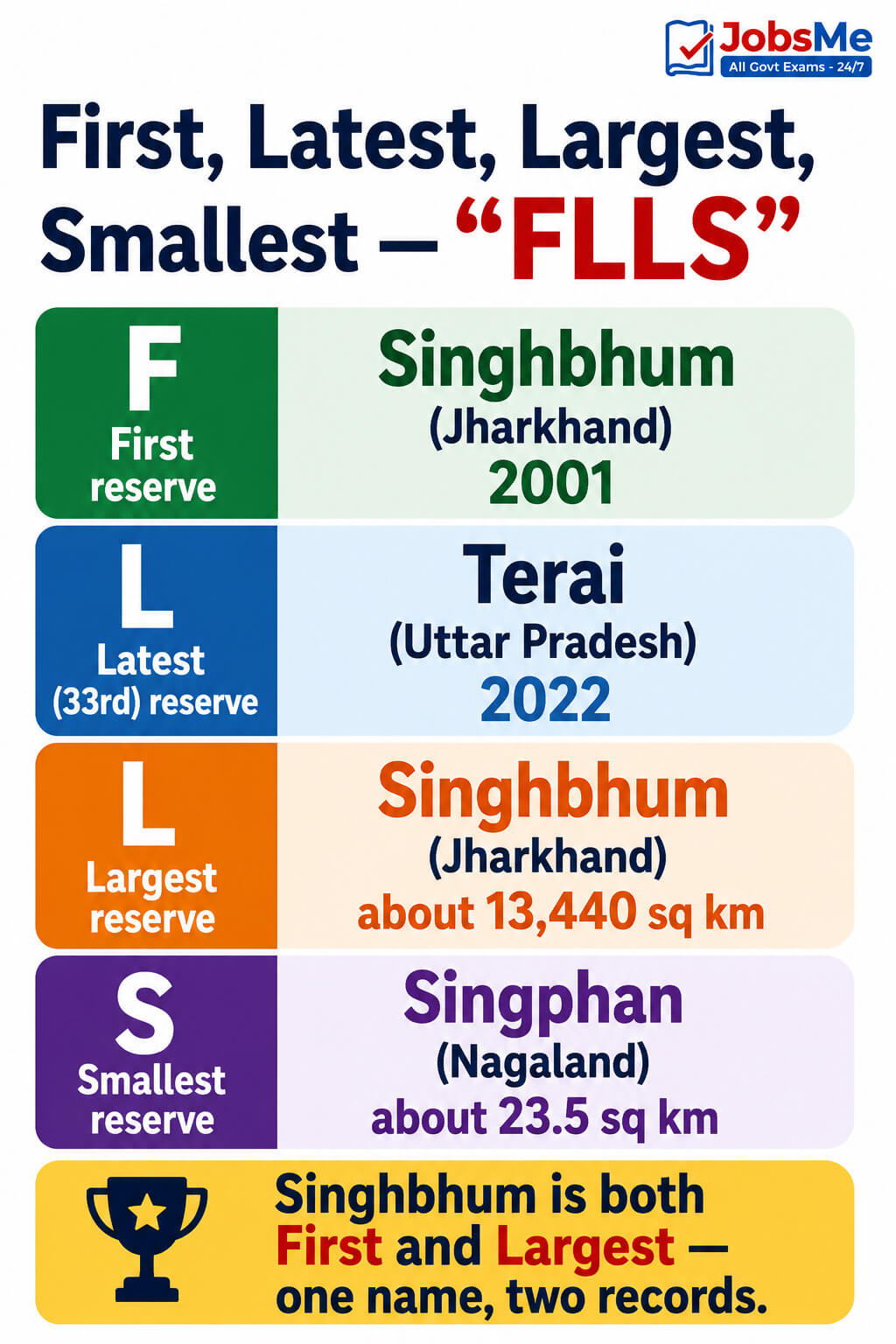
- F → First reserve → Singhbhum (Jharkhand), 2001.
- L → Latest (33rd) reserve → Terai (Uttar Pradesh), 2022.
- L → Largest reserve → Singhbhum (Jharkhand), about 13,440 sq km.
- S → Smallest reserve → Singphan (Nagaland), about 23.5 sq km.
"Singhbhum is both First and Largest — one name, two records."
Trick 2: States with Five Reserves — "AT the Top"
Two states share the maximum number of reserves (5 each). Remember them as "AT":
- A → Assam.
- T → Tamil Nadu.
"Assam and Tamil Nadu sit AT the top with five each."
Trick 3: Kerala's Four Reserves — "PAWN"
Kerala has four reserves; use the acronym "PAWN":
- P → Periyar.
- A → Anamudi.
- W → Wayanad.
- N → Nilambur.
Trick 4: Project Elephant Key Numbers — "1992-33-14"
Three numbers cover most direct questions on Project Elephant:
- 1992 → Year Project Elephant was launched.
- 33 → Total Elephant Reserves in India.
- 14 → Number of states with Elephant Reserves.
"Nineteen-ninety-two, thirty-three reserves, fourteen states."
Trick 5: The Big Conservation Dates — "92-2010-22"
- 1992 → Project Elephant launched.
- 2010 → Elephant declared National Heritage Animal (22 October).
- 2022 → Terai (33rd) and Agasthyamalai (32nd) reserves notified; both linked to 2022.
Trick 6: Reserve vs Tiger Reserve Status — "ER is Not Statutory"
A common trap: Elephant Reserves are an administrative designation and are NOT statutory under the Wildlife (Protection) Act, 1972 — unlike Tiger Reserves. Remember the contrast:
- Elephant Reserve → administrative designation, no direct statutory backing.
- Tiger Reserve → statutory, backed by the Wildlife (Protection) Act and managed under NTCA.
"Tigers get the law; elephants get the landscape."
Trick 7: The 2025 Census in One Line — "DNA = 22,446"
For the SAIEE 2025 census, fix one anchor:
- First DNA-based census → SAIEE 2025.
- Estimate → about 22,446 wild elephants.
- Earlier 2017 visual count → 29,964 (not directly comparable).
"DNA gives 22,446 — a new baseline, not a real crash."
Additional Notes
Frequently Confused Facts
- First vs Largest reserve: Both titles belong to the same reserve — Singhbhum in Jharkhand. First by notification (2001) and largest by area (about 13,440 sq km).
- Latest (33rd) vs 32nd reserve: The 33rd and latest is Terai (Uttar Pradesh, 2022); the 32nd is Agasthyamalai (Tamil Nadu, notified on World Elephant Day, 12 August 2022).
- Smallest reserve: Singphan in Nagaland (about 23.5 sq km), not Intanki — both are in Nagaland, which causes confusion.
- Project Elephant vs Project Tiger launch years: Project Tiger began in 1973; Project Elephant in 1992. Project Elephant was later merged with Project Tiger under an integrated framework.
- Largest landscape ER vs Largest ER by area: Nilgiri ER (Tamil Nadu) is the most important and largest elephant landscape, but Singhbhum (Jharkhand) is the largest reserve by area.
- Statutory protection: The elephant (Schedule I) is statutorily protected, but the Elephant Reserve as a unit is not — a distinction worth remembering.
- Highest population vs Most reserves: Karnataka has the highest elephant population, but Assam and Tamil Nadu have the most reserves (5 each).
- National Heritage Animal year: 2010 (not 1992, the Project Elephant year).
Repeating PYQ Patterns
Certain facts are asked repeatedly across competitive exams. The total number of reserves (33), the launch year of Project Elephant (1992), the first reserve (Singhbhum, Jharkhand), the latest reserve (Terai, Uttar Pradesh), the largest reserve (Singhbhum), the smallest reserve (Singphan, Nagaland), and the National Heritage Animal status (2010) appear most often in UPSC Prelims, SSC CGL, and RRB NTPC papers. Banking exams (IBPS PO, SBI Clerk) frequently ask matching-type questions linking a reserve to its state. State PCS exams add region-specific reserves — Tamil Nadu PSC asks about Nilgiri and Agasthyamalai, Assam PSC about Kaziranga-Karbi Anglong, Kerala PSC about Periyar, and Uttar Pradesh PSC about Terai and Shivalik landscapes. Environment and current-affairs sections increasingly test the SAIEE 2025 DNA census.
Quick Insight
Elephant Reserves are more than dots on a map — they are living corridors that hold India's elephant heritage together. With nearly 80,778 sq km across 14 states and 150 identified elephant corridors, these reserves protect not only elephants but the entire web of forest life that depends on them. The 2025 DNA-based census marks a turning point: for the first time, India can track individual elephants and build an accurate baseline for the future. As human settlements, highways, and railways expand into elephant country, corridors and conflict mitigation have become central to conservation policy. For further reading on related Static GK topics, you can explore the Static GK notes and test your understanding with the Static GK Quiz on thejobsme.com.
One-Liners for Quick Revision
- Project Elephant → Launched February 1992 → Centrally Sponsored Scheme by MoEFCC.
- Total Elephant Reserves → 33 → spread across 14 states, about 80,778 sq km.
- Elephant landscapes → 10 → reserves are organised within these.
- First Elephant Reserve → Singhbhum (Jharkhand) → notified 2001.
- Latest (33rd) Reserve → Terai (Uttar Pradesh) → notified 2022, Dudhwa-Pilibhit landscape.
- 32nd Reserve → Agasthyamalai (Tamil Nadu) → notified on World Elephant Day, 12 August 2022.
- Largest Reserve (area) → Singhbhum (Jharkhand) → about 13,440 sq km.
- Smallest Reserve → Singphan (Nagaland) → about 23.5 sq km.
- Largest landscape Reserve → Nilgiri (Tamil Nadu) → core of the Nilgiri Biosphere Reserve.
- States with most Reserves → Assam and Tamil Nadu → 5 each.
- Kerala Reserves → 4 → Periyar, Anamudi, Wayanad, Nilambur.
- Odisha Reserves → 3 → Mayurbhanj, Mahanadi, Sambalpur.
- Rayala ER → Andhra Pradesh → only reserve in the state.
- Garo Hills ER → Meghalaya → only reserve in the state.
- Shivalik ER → Uttarakhand → only reserve in the state.
- Kaziranga-Karbi Anglong ER → Assam → overlaps with Kaziranga Tiger Reserve.
- Periyar ER → Kerala → overlaps with Periyar Tiger Reserve, famous for boat-safari elephant sightings.
- Mayurbhanj ER → Odisha → overlaps with Simlipal Tiger Reserve.
- Lemru ER → Chhattisgarh → notified 2021 to reduce conflict in the Hasdeo coal belt.
- Asian Elephant → Elephas maximus → Endangered (IUCN), Schedule I (WPA 1972), CITES Appendix I.
- National Heritage Animal → Asian Elephant → declared 22 October 2010.
- India's global share → over 60% of wild Asian elephants → largest in the world.
- SAIEE 2025 → first DNA-based census → about 22,446 wild elephants (range 18,255-26,645).
- 2017 census → 29,964 elephants → visual method, not directly comparable to 2025.
- Western Ghats → about 53% of India's elephants → most important elephant region.
- Highest population state → Karnataka → followed by Assam and Tamil Nadu.
- Elephant Reserves status → administrative designation → NOT statutory under WPA 1972 (unlike Tiger Reserves).
- Elephant Corridors → 150 identified (2023 report) → West Bengal has the most corridors.
- World Elephant Day → 12 August → annual awareness day.
- Hathi Mere Sathi → awareness campaign → MoEFCC with Wildlife Trust of India.
- Project merger → Project Elephant merged with Project Tiger → integrated conservation framework.
For more Static GK topics like national parks, tiger reserves, and biosphere reserves, explore the Static GK section on thejobsme.com. You can also test your knowledge with the Static GK Quiz and check the latest exam updates at Latest Government Job Notifications.
Free quiz • No signup required
Put this topic into practice with Indian Cultural Institutions – Static GK MCQ Quiz. It is the quickest way to reinforce what you just learned.
Frequently Asked Questions
How many Elephant Reserves are there in India?
When was Project Elephant launched and by whom?
Which is the first Elephant Reserve in India?
Which is the latest and 33rd Elephant Reserve in India?
Which is the smallest Elephant Reserve in India?
Which states have the maximum number of Elephant Reserves?
Are Elephant Reserves protected under the Wildlife Protection Act, 1972?
When was the elephant declared the National Heritage Animal of India?
What did the 2025 elephant census (SAIEE) reveal?
Which is the most important elephant landscape in India?

About the author