DRDO Labs and Locations Static GK: Complete List of DRDO Laboratories, Clusters and Cities
This article gives you the complete, cluster-wise list of DRDO labs and their locations, along with the full form of each laboratory, its area of research and the systems it is famous for. It also covers DRDO's structure, seven technology clusters, Young Scientist Laboratories, defence PSUs, memory tricks and exam one-liners. Aspirants of UPSC, SSC CGL, IBPS, RRB, Defence and State PCS exams can use it as a single-stop revision resource for the DRDO portion of General Awareness.
Jump to section
- Introduction
- What is DRDO? Core Concepts Explained
- DRDO at a Glance: Key Static GK Facts
- DRDO Labs and Locations: Cluster-Wise Complete List
- City-Wise Distribution of DRDO Labs
- Defence PSUs and Other Military Establishments
- DRDO Mandate, Challenges and the Way Forward
- Memory Tricks and Mnemonics
- Additional Notes
- One-Liners for Quick Revision
Introduction
The Defence Research and Development Organisation (DRDO) is India's premier military research agency and one of the most frequently tested topics in the Science and Technology section of General Awareness. Almost every year, one or more questions appear in the form of "which DRDO laboratory is located at X" or "which lab developed Y system". Because the answers are pure factual recall, this is one of the easiest scoring areas in the entire Static GK syllabus, provided you revise the lab-location pairs in an organised way.
DRDO was formed on 1 January 1958 by merging the Technical Development Establishments (TDEs) of the Indian Army and the Directorate of Technical Development and Production (DTDP) of the Indian Ordnance Factories with the Defence Science Organisation (DSO). It began with just 10 laboratories and today operates a network of more than 50 laboratories and establishments spread across roughly 22 cities, working under seven technology clusters. Its motto, "Balasya Mulam Vigyanam", means "Strength's origin is in science".
This article organises every important DRDO lab by cluster, city and specialisation so that you can revise it in one sitting. If you are building your Science and Technology notes from scratch, pair this article with our wider Static GK notes for competitive exams to cover the related defence and organisation topics as well.
What is DRDO? Core Concepts Explained

Before memorising the lab list, it helps to understand how DRDO is organised. Examiners often frame questions around the parent ministry, the head of the organisation, the cluster system and the mandate, not just the lab names.
- Parent body: DRDO functions under the Department of Defence Research and Development (DDR&D), which is a department of the Ministry of Defence, Government of India.
- Headquarters: DRDO Bhawan, Rajaji Marg, New Delhi.
- Head of the organisation: DRDO is headed by the Secretary, Department of Defence R&D, who is also the Chairman, DRDO. This officer also acts as Scientific Adviser to the Defence Minister. The post is filled by the Appointments Committee of the Cabinet (ACC).
- Chief Controllers: The head is assisted by senior scientists designated as Chief Controllers of R&D, and each technology cluster is led by a Director General.
- First head: The renowned physicist Dr D S Kothari was the first Director of DRDO.
- Manpower: Roughly 5,000 scientists supported by about 25,000 scientific, technical and support staff.
- Service cadre: The Defence Research and Development Service (DRDS) was constituted in 1979 for Group A scientists of the organisation.
- Foundation Day: Observed every year on 1 January. The 68th DRDO Foundation Day was marked on 1 January 2026.
Banking and insurance aspirants should note that defence research organisations are treated as part of the wider institutions and organisations segment of General Awareness, so this topic sits comfortably alongside our banking awareness notes in your revision plan.
DRDO's vision is to make India prosperous by building a world-class science and technology base and to give the armed forces a decisive edge through internationally competitive systems. Its mission covers the design, development and production of advanced sensors, weapon systems, platforms and allied equipment, delivering technological solutions that improve combat effectiveness and troop welfare, and creating infrastructure, skilled manpower and a strong technology base.
What is a Technology Cluster?
A technology cluster is a family of DRDO laboratories grouped by subject domain and headed by a Director General, so that labs working on similar technologies plan and execute projects together. The seven technology clusters are:
- Aeronautical Systems (Aero)
- Missiles and Strategic Systems (MSS)
- Armament and Combat Engineering Systems (ACE)
- Naval Systems and Materials (NSM)
- Electronics and Communication Systems (ECS)
- Micro Electronic Devices, Computational Systems and Cyber Systems (MED and CoS)
- Life Sciences (LS)
DRDO at a Glance: Key Static GK Facts
| Parameter | Detail and Exam Note |
|---|---|
| Full form | Defence Research and Development Organisation. It is the research and development wing of the Ministry of Defence and India's largest research organisation by spread of disciplines. |
| Founded | 1 January 1958, by merging TDEs of the Indian Army, DTDP of the Indian Ordnance Factories and the Defence Science Organisation. It started with only 10 laboratories. |
| Motto | "Balasya Mulam Vigyanam" in Sanskrit, meaning "Strength's origin is in science" or "the source of strength is science". A very frequently asked one-liner. |
| Headquarters | DRDO Bhawan, Rajaji Marg, New Delhi. Do not confuse it with the Ministry of Defence office in South Block. |
| Number of labs | More than 50 laboratories and establishments, commonly quoted in exams as 52 across about 22 cities, under seven technology clusters. |
| First Director | Dr D S Kothari, a distinguished physicist who later chaired the University Education Commission known as the Kothari Commission. |
| Head today | Secretary, DDR&D and Chairman, DRDO. Dr Samir V Kamat held the post from August 2022 until his tenure ended on 31 May 2026, after which Defence Secretary Rajesh Kumar Singh was given additional charge pending a regular appointment. Always cross-check the latest holder before the exam. |
| Ministry and Minister | Ministry of Defence; the Defence Minister is the minister responsible, and the DRDO chief is his Scientific Adviser. |
| Budget | About Rs 26,816 crore in 2025-26, which is roughly 8 per cent of the total defence budget. |
| Flagship programme | The Integrated Guided Missile Development Programme (IGMDP), launched in 1983 under Dr A P J Abdul Kalam, who is called the Missile Man of India. |
DRDO Labs and Locations: Cluster-Wise Complete List
The tables below give the abbreviation, expanded full form, city and state, and the specialisation with signature systems for each laboratory. Learn the abbreviation plus city pair first, because that is the format in which questions are usually asked.
1. Missiles and Strategic Systems (MSS) Cluster
| Lab | Full Form | Location | Specialisation and Key Systems |
|---|---|---|---|
| DRDL | Defence Research and Development Laboratory | Hyderabad, Telangana | The nodal missile design lab and the nerve centre of the Hyderabad missile complex. Works on tactical and strategic missiles, ramjet and scramjet propulsion and hypersonic technology. Associated with Akash, Astra and QRSAM. |
| ASL | Advanced Systems Laboratory | Hyderabad, Telangana | Solid rocket propulsion, large composite motor casings and launch systems for long-range strategic missiles. Central to the Agni family of ballistic missiles. |
| RCI | Research Centre Imarat | Hyderabad (Kanchanbagh area), Telangana | Missile avionics, navigation, guidance, control and seeker technology. Founded under the leadership of Dr A P J Abdul Kalam and central to the Mission Shakti anti-satellite interceptor. |
| ITR | Integrated Test Range | Chandipur, Balasore, Odisha | India's main missile flight-test range with tracking radars, telemetry and range instrumentation. Launches also take place from Dr A P J Abdul Kalam Island, formerly Wheeler Island, off the Odisha coast. |
| TBRL | Terminal Ballistics Research Laboratory | Chandigarh | Terminal ballistics, warhead design, blast and shock studies, penetration mechanics and high-speed photography of detonation events. |
| CHESS | Centre for High Energy Systems and Sciences | Hyderabad, Telangana | High energy and directed energy weapons such as laser-based systems, including counter-drone laser platforms. |
| CAS | Centre for Advanced Systems | Hyderabad, Telangana | Production engineering, integration and industry interface support for missile and strategic system programmes. |
2. Aeronautical Systems (Aero) Cluster
| Lab | Full Form | Location | Specialisation and Key Systems |
|---|---|---|---|
| ADE | Aeronautical Development Establishment | Bengaluru, Karnataka | Design of unmanned aerial vehicles, flight control systems and avionics integration. Behind Nishant, Lakshya, Rustom or TAPAS, Archer and the Ghatak stealth UCAV programme. |
| ADRDE | Aerial Delivery Research and Development Establishment | Agra, Uttar Pradesh | Parachutes, aerial delivery systems, decelerators, aerostats and lighter-than-air systems. Also develops recovery parachutes used in space and missile programmes. |
| CABS | Centre for Airborne Systems | Bengaluru, Karnataka | Airborne surveillance and early warning platforms. Developed the Netra AEW&C system and works on the larger AWACS programme. |
| GTRE | Gas Turbine Research Establishment | Bengaluru, Karnataka | Aero gas turbine engines. Known for the Kaveri engine programme and small turbofan engines for unmanned platforms. |
| CEMILAC | Centre for Military Airworthiness and Certification | Bengaluru, Karnataka | The certification authority for military aircraft, airborne stores and systems. It does not design aircraft, it clears them as airworthy. |
3. Armament and Combat Engineering Systems (ACE) Cluster
| Lab | Full Form | Location | Specialisation and Key Systems |
|---|---|---|---|
| ARDE | Armament Research and Development Establishment | Pune, Maharashtra | Guns, small arms, ammunition, warheads and artillery. Associated with the ATAGS 155 mm towed howitzer, the Pinaka rocket and infantry weapon development. |
| HEMRL | High Energy Materials Research Laboratory | Pune, Maharashtra | Propellants and explosives for rockets, missiles and ammunition, plus pyrotechnics and igniters. Supplied the solid propellant for the Mission Shakti interceptor. |
| ACEM | Advanced Centre for Energetic Materials | Nashik, Maharashtra | Pilot-scale processing and production technology for energetic materials, working as the scale-up partner of HEMRL. |
| CVRDE | Combat Vehicles Research and Development Establishment | Avadi, Chennai, Tamil Nadu | Tracked combat vehicles, transmissions and turrets. Developed the Arjun main battle tank, the Abhay infantry combat vehicle and the MUNTRA unmanned tracked vehicle family. |
| VRDE | Vehicles Research and Development Establishment | Ahmednagar, Maharashtra | Wheeled vehicles, mobility trials, mine-protected vehicles and automotive testing for the armed forces. |
| R&DE(E) | Research and Development Establishment (Engineers) | Pune, Maharashtra | Combat engineering systems and weapon platforms: bridging systems such as Sarvatra, mobile missile launchers, and the Daksh remotely operated bomb-disposal vehicle. |
| PXE | Proof and Experimental Establishment | Chandipur, Balasore, Odisha | Proof testing and evaluation of medium and large calibre weapons and their ammunition. Historically the oldest of the DRDO test establishments, tracing back to 1895. |
| CFEES | Centre for Fire, Explosive and Environment Safety | Delhi | Fire safety, explosive safety and environment safety standards for defence storage and installations, including fire suppression for naval ships. |
| SFC | Special Fabrication or SF Complex | Jagdalpur, Chhattisgarh | Propellant processing and specialised fabrication support for the armament and missile programmes. |
4. Naval Systems and Materials (NSM) Cluster
| Lab | Full Form | Location | Specialisation and Key Systems |
|---|---|---|---|
| NPOL | Naval Physical and Oceanographic Laboratory | Kochi, Kerala | Sonar systems and underwater surveillance. Developed the HUMSA hull-mounted sonar, USHUS submarine sonar, Nagan towed array and the Mihir dunking sonar. |
| NSTL | Naval Science and Technological Laboratory | Visakhapatnam, Andhra Pradesh | Underwater weapons: torpedoes such as Varunastra and Takshak, naval mines, decoys and ship hydrodynamics and stealth studies. |
| NMRL | Naval Materials Research Laboratory | Ambernath, Maharashtra | Naval materials, anti-corrosion and stealth coatings, and the Air Independent Propulsion (AIP) fuel cell system for conventional submarines. |
| DMRL | Defence Metallurgical Research Laboratory | Hyderabad, Telangana | Metallurgy and advanced alloys: titanium alloys, superalloys for engines, armour steel and the Kanchan composite armour used on the Arjun tank. |
| DMSRDE | Defence Materials and Stores Research and Development Establishment | Kanpur, Uttar Pradesh | Textiles, polymers and composites: bulletproof jackets, ballistic helmets, special coatings, rubber and specialty stores for the services. |
| DL (also DLJ) | Defence Laboratory, Jodhpur | Jodhpur, Rajasthan | Camouflage and concealment, desert warfare technology, isotope applications and dust and sand environmental studies. |
5. Electronics and Communication Systems (ECS) Cluster
| Lab | Full Form | Location | Specialisation and Key Systems |
|---|---|---|---|
| LRDE | Electronics and Radar Development Establishment | Bengaluru, Karnataka | India's principal radar lab. Developed Rajendra for Akash, the Uttam AESA fire control radar, Ashwini and Arudhra surveillance radars and weapon locating radars. |
| IRDE | Instruments Research and Development Establishment | Dehradun, Uttarakhand | Electro-optics and optical instruments: thermal imagers, night vision devices, tank sights, laser range finders and periscopes. |
| DEAL | Defence Electronics Applications Laboratory | Dehradun, Uttarakhand | Military communication: radio and troposcatter communication, satellite communication terminals, millimetre wave links and data links for airborne platforms. |
| DLRL | Defence Electronics Research Laboratory | Hyderabad, Telangana | Electronic warfare: radar warning receivers, jammers and EW suites such as Samyukta and Divya Drishti. |
| MTRDC | Microwave Tube Research and Development Centre | Bengaluru, Karnataka | Microwave tubes and vacuum electronic devices such as travelling wave tubes, which power radars and electronic warfare transmitters. |
| DARE | Defence Avionics Research Establishment | Bengaluru, Karnataka | Aircraft avionics and airborne electronic warfare suites, including self-protection jammers and radar warning systems for combat aircraft. |
6. Micro Electronic Devices, Computational Systems and Cyber Systems (MED and CoS) Cluster
| Lab | Full Form | Location | Specialisation and Key Systems |
|---|---|---|---|
| SSPL | Solid State Physics Laboratory | Delhi | Semiconductor and solid-state materials: gallium nitride and gallium arsenide devices, monolithic microwave integrated circuits and infrared detectors for radars and seekers. |
| CAIR | Centre for Artificial Intelligence and Robotics | Bengaluru, Karnataka | Artificial intelligence, robotics, secure military networks, command and control software and unmanned ground vehicles in the light weight category. |
| SAG | Scientific Analysis Group | Delhi | Cryptology, cipher design and cryptanalysis, and information security for strategic communication. |
| ANURAG | Advanced Numerical Research and Analysis Group | Hyderabad, Telangana | Worked on computational systems, processors and high performance computing. Frequently listed in older exam material, but it has since ceased to function as an independent laboratory after DRDO's restructuring. |
| JCB | Joint Cypher Bureau | Delhi | Cypher systems and secure coding support for the three services. |
7. Life Sciences (LS) Cluster
| Lab | Full Form | Location | Specialisation and Key Systems |
|---|---|---|---|
| DEBEL | Defence Bioengineering and Electromedical Laboratory | Bengaluru, Karnataka | Aircrew life support: oxygen systems, on-board oxygen generation, anti-G suits, aviation helmets and biomedical devices. |
| DFRL | Defence Food Research Laboratory | Mysuru, Karnataka | Food science and combat rations: ready-to-eat packs, retort processing, shelf-life extension and high altitude nutrition for troops. |
| DIPAS | Defence Institute of Physiology and Allied Sciences | Delhi | Human physiology under extreme conditions: high altitude acclimatisation, heat and cold stress, soldier work physiology and nutrition. |
| DIPR | Defence Institute of Psychological Research | Delhi | Psychological research: personnel selection tests, aptitude assessment, leadership studies and stress management for the armed forces. |
| INMAS | Institute of Nuclear Medicine and Allied Sciences | Delhi | Nuclear medicine, radiation protection and medical management of radiation casualties, plus radiopharmaceuticals and imaging. |
| DRDE | Defence Research and Development Establishment | Gwalior, Madhya Pradesh | Chemical and biological warfare defence: detection kits, protective gear, decontamination systems and antidotes against NBC threats. |
| DIHAR | Defence Institute of High Altitude Research | Leh, Ladakh | High altitude agro-animal research: cold desert farming, greenhouse technology, seabuckthorn products and fresh food supply for troops in Ladakh. |
| DIBER | Defence Institute of Bio-Energy Research | Haldwani, Uttarakhand | Bio-energy and bio-fuel, herbal and medicinal plant research and hill agro-technology for defence needs. |
| DRL | Defence Research Laboratory | Tezpur, Assam | Health and hygiene in the North East: vector-borne disease control, water purification, entomology and tropical medicine. |
8. Other Important Establishments, Centres and Field Laboratories
| Establishment | Full Form | Location | Function |
|---|---|---|---|
| SASE | Snow and Avalanche Study Establishment | Chandigarh with field stations in the Himalaya | Avalanche forecasting, snow physics, glacier studies and avalanche control for troops in high altitude areas. |
| DTRL | Defence Terrain Research Laboratory | Delhi | Worked on terrain analysis and geospatial intelligence. It no longer functions as an independent lab and its work was merged with SASE, though it still appears in older question banks. |
| LASTEC | Laser Science and Technology Centre | Delhi | Worked on laser technology and directed energy research. Like DTRL and ANURAG, it has ceased to exist as a separate laboratory after restructuring. |
| DESIDOC | Defence Scientific Information and Documentation Centre | Delhi | The information and documentation hub of DRDO. Publishes technical journals, manages libraries and scientific databases. |
| ISSA | Institute for Systems Studies and Analyses | Delhi | Systems analysis, war gaming, operations research and simulation for force planning and weapon system evaluation. |
| CEPTAM | Centre for Personnel Talent Management | Delhi | Recruitment of technical and administrative cadres. This is the body that issues the widely awaited DRDO CEPTAM recruitment notifications. |
| RAC | Recruitment and Assessment Centre | Delhi | Recruitment of scientists to the Defence Research and Development Service and assessment of scientific manpower. |
| ITM | Institute of Technology Management | Mussoorie, Uttarakhand | Training and technology management education for DRDO scientists and defence technology managers. |
| DIAT | Defence Institute of Advanced Technology | Girinagar, Pune, Maharashtra | A deemed university under DRDO offering postgraduate and doctoral programmes in defence technology. |
| ADA | Aeronautical Development Agency | Bengaluru, Karnataka | The programme management agency for the Light Combat Aircraft. It designed the LCA Tejas and leads the AMCA fifth generation fighter programme. |
| DIC | DRDO Integration Centre | Panagarh, West Bengal | Systems integration and assembly support for large defence systems. |
| JCBCAT | Jagdish Chandra Bose Centre for Advanced Technology | Jadavpur, Kolkata, West Bengal | Research on strategic systems in partnership with Jadavpur University. |
| ACRHEM | Advanced Centre for Research in High Energy Materials | Hyderabad, Telangana | A centre of excellence on high energy materials, hosted at the University of Hyderabad. |
| RIC | Research and Innovation Centre | Chennai, Tamil Nadu | Centre of excellence for sensors and MEMS, set up with IIT Madras. |
| CoPT | Centre of Propulsion Technology | Mumbai, Maharashtra | Centre of excellence on propulsion technology, hosted at IIT Bombay. |
| JATC | Joint Advanced Technology Centre | Delhi | Research on photonics, plasmonics and quantum photonics, hosted with IIT Delhi. |
9. DRDO Young Scientist Laboratories (DYSL)
The five DRDO Young Scientist Laboratories were inaugurated by the Prime Minister on 2 January 2020. Their defining feature is that every member, including the Director, is under 35 years of age. Each lab owns one futuristic technology area, and the city-to-technology mapping is a favourite exam question.
| Laboratory | Focus Area | Location | Why It Matters |
|---|---|---|---|
| DYSL-AI | Artificial Intelligence | Bengaluru, Karnataka | Machine learning and autonomous decision support for defence applications, sitting alongside CAIR in the same city. |
| DYSL-QT | Quantum Technologies | Mumbai, Maharashtra | Quantum key distribution, quantum sensing and secure communication research. |
| DYSL-CT | Cognitive Technologies | Chennai, Tamil Nadu | Human-machine interface, brain-computer interaction and cognitive load research for soldiers. |
| DYSL-AT | Asymmetric Technologies | Kolkata, West Bengal | Technologies for asymmetric and unconventional warfare threats. |
| DYSL-SM | Smart Materials | Hyderabad, Telangana | Shape memory alloys, self-healing materials and adaptive structures. |
City-Wise Distribution of DRDO Labs
Many questions simply ask which city hosts a given lab, or which of the given labs is not located in a stated city. Revising the list city-wise makes elimination much faster in the exam hall.
| City or Region | DRDO Labs and Establishments | Character of the Cluster |
|---|---|---|
| Delhi | SSPL, SAG, JCB, DESIDOC, ISSA, CFEES, DIPAS, DIPR, INMAS, CEPTAM, RAC, JATC, and the headquarters DRDO Bhawan | The headquarters, life sciences and cyber-cryptology hub. Delhi hosts the largest number of DRDO establishments. |
| Hyderabad | DRDL, ASL, RCI, CHESS, CAS, DLRL, DMRL, ACRHEM, DYSL-SM | The missile and strategic systems capital of India, along with metallurgy and electronic warfare. |
| Bengaluru | ADE, CABS, GTRE, CEMILAC, DARE, DEBEL, LRDE, MTRDC, CAIR, ADA, DYSL-AI | The aeronautics, radar and AI hub, and the base of the LCA Tejas programme. |
| Pune | ARDE, HEMRL, R&DE(E), DIAT | The armament, explosives and combat engineering hub. |
| Chandigarh | TBRL, SASE | Ballistics plus snow and avalanche studies. An easy pair to remember together. |
| Dehradun | IRDE, DEAL | Optics and communication. Both start with the sound of "D" for Dehradun in the case of DEAL. |
| Chennai and Avadi | CVRDE (Avadi), RIC, DYSL-CT | Combat vehicles plus sensors and cognitive technology. |
| Chandipur and Balasore, Odisha | ITR, PXE | The national test ranges for missiles and armaments. |
| Visakhapatnam | NSTL | Underwater weapons, aligned with the Eastern Naval Command. |
| Kochi | NPOL | Sonar and oceanography, aligned with the Southern Naval Command. |
| Other single-lab cities | Agra (ADRDE), Ahmednagar (VRDE), Ambernath (NMRL), Nashik (ACEM), Kanpur (DMSRDE), Gwalior (DRDE), Jodhpur (DL), Mysuru (DFRL), Leh (DIHAR), Haldwani (DIBER), Tezpur (DRL), Mussoorie (ITM), Jagdalpur (SFC), Panagarh (DIC), Kolkata (JCBCAT and DYSL-AT), Mumbai (CoPT and DYSL-QT), Coimbatore (DRDO-Bharathiar University Centre of Excellence) | These one-lab cities are the highest-yield facts, because a unique city makes a clean single-answer question. |
Defence PSUs and Other Military Establishments
Questions on DRDO are often clubbed with defence public sector undertakings. Note the headquarters and the year of establishment, since both are asked.
| Organisation | Headquarters | Established | Key Note |
|---|---|---|---|
| Garden Reach Shipbuilders and Engineers Limited (GRSE) | Kolkata, West Bengal | 1934 | The oldest of these establishments. Builds warships, frigates and survey vessels. |
| Bharat Electronics Limited (BEL) | Bengaluru, Karnataka | 1954 | The main production partner for DRDO radars, electronic warfare systems and communication equipment. |
| Goa Shipyard Limited (GSL) | Vasco-da-Gama, Goa | 1957 | Builds patrol vessels for the Navy and the Coast Guard. |
| Mazagon Dock Shipbuilders Limited (MDL) | Mumbai, Maharashtra | 1960 | India's submarine and destroyer yard, builder of the Scorpene class submarines. |
| Bharat Earth Movers Limited (BEML) | Bengaluru, Karnataka | 1964 | Makes heavy earthmoving and rail equipment and high mobility military vehicles. |
| Hindustan Aeronautics Limited (HAL) | Bengaluru, Karnataka | 1964 | Formed in 1964 from earlier aircraft companies whose origin goes back to 1940. Produces LCA Tejas, Dhruv and Tejas Mk1A. |
| Bharat Dynamics Limited (BDL) | Hyderabad, Telangana | 1970 | The missile production agency for DRDO designs such as Akash, Astra and anti-tank missiles. |
DRDO Mandate, Challenges and the Way Forward
Mandate and Responsibilities
- Indigenous design, development and production of state-of-the-art weapon systems needed by the armed forces.
- Providing futuristic technologies in missiles, armaments, electronics, combat vehicles and allied areas.
- Developing countermeasures against nuclear, biological and chemical threats, along with advanced materials, robotics and artificial intelligence.
- Supporting Indian industry through Transfer of Technology so that the domestic defence ecosystem becomes globally competitive.
- Achieving self-reliance or Atmanirbharta in critical defence technologies and building indigenous R&D and manufacturing capacity.
Notable Achievements by Cluster
- Aeronautics: LCA Tejas combat aircraft, Lakshya and Nishant unmanned aerial vehicles, aerostats, avionics and parachute systems.
- Missiles and Strategic Systems: Strategic missiles Agni, Prithvi and Dhanush; tactical missiles Akash, Nag and Trishul; and the BrahMos supersonic cruise missile developed as an Indo-Russian joint venture.
- Naval Systems and Materials: Sonars HUMSA, Nagan, USHUS and Mihir, torpedoes, naval mines, submarine technologies and special naval materials.
- Armament and Combat Engineering: Arjun main battle tank, Pinaka multi barrel rocket launcher, artillery guns, ammunition and explosives.
- Electronics and Communication: A wide family of radars, electronic warfare suites and secure communication systems.
- Micro Electronics and Cyber Systems: Semiconductor devices, artificial intelligence platforms and cyber security solutions.
- Life Sciences: Life support systems, NBC protection, diagnostics and combat food research.
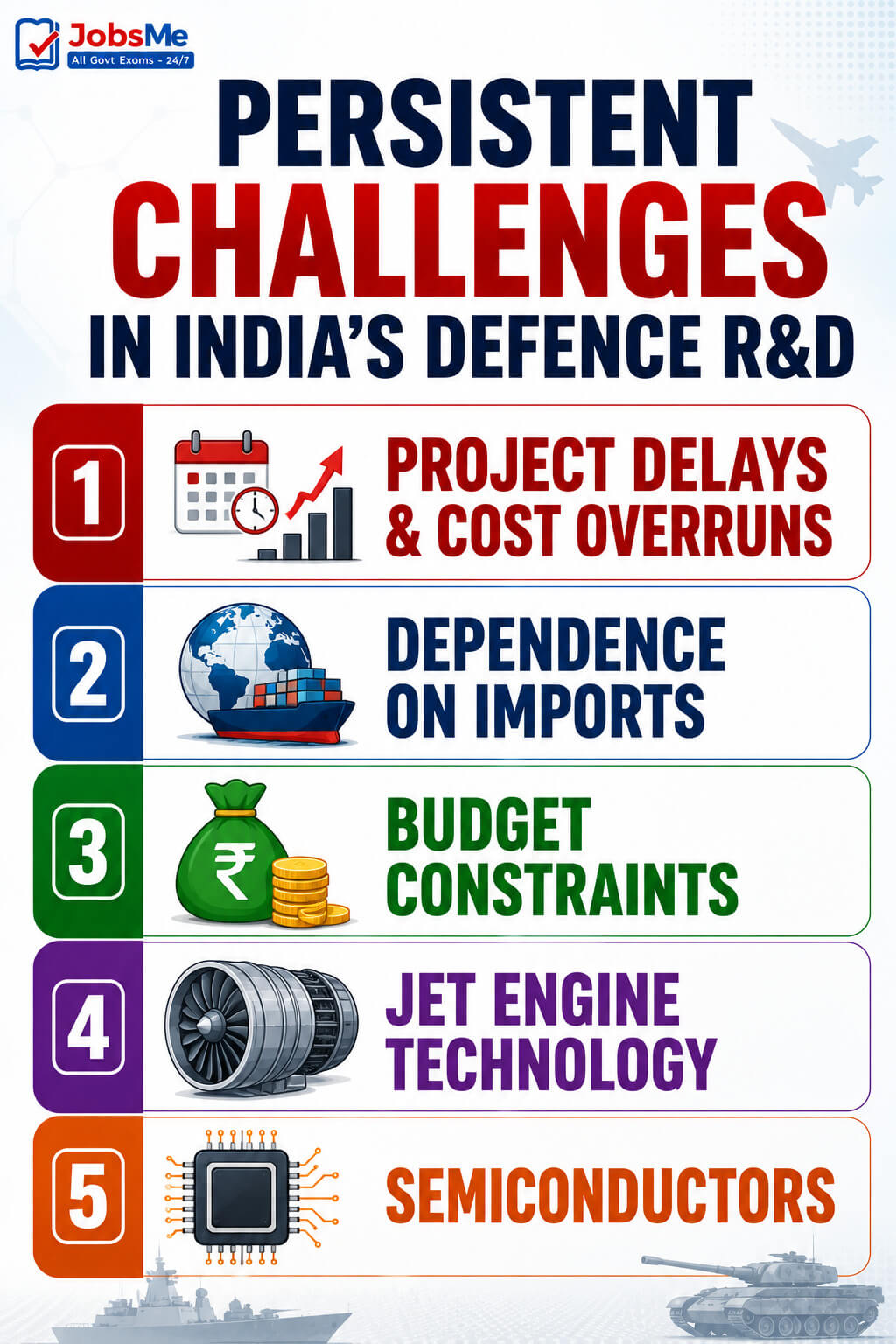
Persistent Challenges
| Challenge | Explanation and Example |
|---|---|
| Project delays and cost overruns | Complex programmes often slip on timelines. The LCA Tejas took more than three decades to mature. Causes include overambitious scope, changing user requirements, technical hurdles and weak project management, and delays create both cost escalation and opportunity costs for the services. |
| Dependence on imports | Critical components and subsystems for aircraft, submarines and electronics are still imported, and there is over-reliance on foreign Original Equipment Manufacturers for design consultancy in some areas. |
| Budget constraints | DRDO receives roughly 8 per cent of the defence budget, which limits talent retention, infrastructure creation and advanced research compared with leading defence nations. |
| Jet engine technology | India still imports engines for combat aircraft and tanks because of difficulties in mastering single crystal turbine blades and advanced cooling. The LCA Tejas flies on imported GE F404 engines. |
| Semiconductors | The absence of commercial-scale semiconductor fabrication in India means chips for radars, avionics and electronic warfare systems are largely imported. |
Way Forward
- Talent management: Merit-based pay, fast-track promotion for high performers and sponsorship for higher studies.
- Academia collaboration: Joint research projects, sponsored academic chairs, student internships and faculty sabbaticals.
- Defence PSU reforms: Strategic partnerships and joint ventures with private firms, higher R&D spending and greater operational autonomy.
- Startup ecosystem: Access to DRDO test infrastructure, funding and purchase guarantees through schemes such as iDEX, along with relaxed procurement norms.
- Structural reform: Based on the recommendations of the K VijayRaghavan Committee, the government is consolidating laboratories, setting up a Defence Technology Council and opening national test facilities to private industry.
Memory Tricks and Mnemonics
Trick 1: The Hyderabad Missile Trio, "DAR"
Remember the three core missile labs of Hyderabad with the word DAR, as in "missiles that inspire dar", the Hindi word for fear:
- D for DRDL, the design lab
- A for ASL, the propulsion lab
- R for RCI, the avionics and guidance lab
DAR is in Hyderabad, so all missile design, propulsion and guidance sits in Hyderabad.
Trick 2: Bengaluru's Sky Story, "A CAB GLIDES to CEMILAC"
Almost everything that flies is designed in Bengaluru. Use the sentence A CAB GLIDES to CEMILAC and DARE not delay:
- ADE, CABS, GTRE, LRDE, I and D for CAIR and DEBEL, E for MTRDC electronics, S for the DYSL-AI smart lab
- Closed by CEMILAC, the certifier, and DARE, the avionics EW lab
If a question is about aircraft, engines, radars, UAVs or airworthiness, the default answer city is Bengaluru.
Trick 3: The Navy Follows the Coast
Every naval lab sits on or near the coast, matched to a naval command:
- NPOL in Kochi, west coast, Southern Naval Command, works on sonar: Kochi Kaan sunta hai, Kochi listens.
- NSTL in Visakhapatnam, east coast, Eastern Naval Command, works on torpedoes: Vizag ka Var, Vizag strikes.
- NMRL in Ambernath near Mumbai, works on materials and AIP: M for Materials, M for Maharashtra.
Trick 4: The Pune Boom Box, "A HR"
Anything that explodes or drives is developed in Pune. Remember A HR team makes Pune go boom:
- A for ARDE, guns and ammunition
- H for HEMRL, high energy materials
- R for R&DE(E), engineering systems and bridges
Nashik holds ACEM, which scales up what HEMRL invents, so Maharashtra owns the explosives chain end to end.
Trick 5: Odisha is the Range, Chandigarh is the Impact
Contrast the two test locations that students mix up:
- Odisha, Chandipur has ITR for missile flight and PXE for gun and ammunition proof. Both are about launching and firing.
- Chandigarh has TBRL for terminal ballistics, which is about what happens at the target, and SASE for snow and avalanche.
Launch in the east, impact study in the north.
Trick 6: Life Sciences Follow the Terrain, "LEH HAI TEZ"
Every life sciences lab is placed where its problem physically exists:
- LEH has DIHAR for high altitude farming, because Leh is the cold desert.
- HAldwani has DIBER for bio-energy, because Uttarakhand hills grow the biomass.
- TEZpur has DRL for health and hygiene, because the North East faces vector-borne disease.
- Mysuru has DFRL for food, and Gwalior has DRDE for chemical and biological defence.
Leh grows, Haldwani fuels, Tezpur heals, Mysuru feeds, Gwalior protects.
Trick 7: Delhi Handles Brains, Paper and Secrets
Delhi labs deal with the human body, information and cryptography rather than hardware:
- Body and mind: DIPAS for physiology, DIPR for psychology, INMAS for nuclear medicine.
- Secrets: SAG for cryptology and JCB for cypher.
- Paper and analysis: DESIDOC for documentation and ISSA for systems analysis.
- Chips: SSPL for semiconductors, the one hardware lab in the group.
If a lab studies people, papers or passwords, look for Delhi.
Trick 8: The DYSL City Chain, "BAMCHK"
For the five Young Scientist Laboratories, chain city to technology alphabetically by technology:
- Artificial Intelligence to Bengaluru
- Asymmetric Technologies to Kolkata
- Cognitive Technologies to Chennai, both start with C
- Quantum Technologies to Mumbai
- Smart Materials to Hyderabad
Only Cognitive and Chennai share a letter, so lock that one first and the rest fall into place. Remember also that everyone in a DYSL, including the Director, is under 35.
Additional Notes
Frequently Confused Facts
- DRDL versus DRDE versus DRDO: DRDL is the missile laboratory at Hyderabad, DRDE is the chemical and biological defence establishment at Gwalior, and DRDO is the parent organisation. One letter changes the entire answer.
- DEAL versus DLRL: DEAL at Dehradun builds communication systems, while DLRL at Hyderabad builds electronic warfare systems. Remember D for Dehradun and Data links, and L for electronic warfare in Hyderabad.
- LRDE versus IRDE: LRDE at Bengaluru makes radars, and IRDE at Dehradun makes instruments and optics. R for Radar in Bengaluru, I for Instruments in Dehradun.
- ADE versus ADRDE versus ADA: ADE Bengaluru designs UAVs, ADRDE Agra makes parachutes and aerostats, and ADA Bengaluru manages the LCA Tejas programme. Agra is the odd city out.
- CVRDE versus VRDE: CVRDE at Avadi in Chennai handles tracked combat vehicles such as the Arjun tank, while VRDE at Ahmednagar handles wheeled vehicles. The extra C stands for Combat and for Chennai.
- ITR versus PXE: Both are at Chandipur in Balasore district, but ITR tests missiles and PXE proof-tests guns and ammunition.
- CEPTAM versus RAC: CEPTAM recruits technical and administrative staff, while RAC recruits scientists into DRDS.
- DIPAS versus DIPR: DIPAS studies physiology, the body, and DIPR studies psychology, the mind. Both are in Delhi.
- Dr A P J Abdul Kalam Island versus ITR Chandipur: The island, formerly Wheeler Island, is the launch complex for strategic missiles, while Chandipur on the mainland houses the test range instrumentation. Both are in Odisha.
- Motto attribution: "Balasya Mulam Vigyanam" belongs to DRDO, not to ISRO or the Indian Army. Do not confuse it with other organisational mottos.
Repeating PYQ Patterns
- UPSC Prelims: Statement-based questions on which agency developed a particular system, and questions clubbing DRDO with ISRO, BARC and defence PSUs. Mains GS Paper 3 asks about indigenisation, cost overruns and the Atmanirbhar Bharat push in defence.
- SSC CGL, CHSL and MTS: Direct one-liners on the DRDO headquarters, foundation year, motto and single lab-city pairs such as DFRL Mysuru, DRDE Gwalior and CVRDE Avadi.
- IBPS PO, Clerk and RRB banking exams: Current affairs based questions on recent DRDO missile tests, technology transfers and leadership changes rather than the full lab list.
- RRB NTPC, Group D and ALP: Simple factual questions on the full form of DRDO, its founding year of 1958, its headquarters at New Delhi and famous labs.
- Defence exams such as NDA, CDS and AFCAT: The most detailed treatment, including cluster names, specific systems, the DYSL labs and test range locations.
- Insurance exams such as LIC AAO and NIACL: Occasional questions in the general awareness section, usually linked to a recent DRDO news item.
- Overlap areas: DRDO's work on semiconductors, artificial intelligence and cyber security often appears in the computing section as well, so revise it together with your computer awareness notes and the matching computer awareness quiz.
- State PCS: Extra weight on the DRDO lab located inside the state, for example DRDE for Madhya Pradesh, DL for Rajasthan, DRL for Assam and NSTL for Andhra Pradesh.
Quick Insight
DRDO is currently going through the most significant restructuring in its history. Following the recommendations of the K VijayRaghavan Committee, the government has been consolidating laboratories with overlapping charters, and labs such as DTRL, LASTEC and ANURAG have already stopped functioning as independent entities. The reform blueprint proposes merging existing labs into a smaller number of large national laboratories, opening four national test facilities to private industry, and separating the post of Secretary R&D from the Chairman of DRDO for better accountability. On the operational side, DRDO-developed systems drew wide attention for their performance during Operation Sindoor, and the organisation has been assigned a central role in the Sudarshan Chakra initiative to build a layered air defence shield over vital installations. For the exam, this means the classic lab-location pairs remain the safest answers, while the reform vocabulary and recent test events belong to your current affairs revision.
Because DRDO questions increasingly arrive through news items rather than static lists, it is worth pairing this topic with our daily current affairs notes and testing yourself with the Static GK quiz series so that both the fixed facts and the moving parts stay fresh.
Aspirants targeting bank and insurance recruitment can reinforce the same organisational facts through the banking awareness quiz, where questions on national institutions and their headquarters appear regularly.
One-Liners for Quick Revision
- DRDO → Defence Research and Development Organisation → research and development wing of the Ministry of Defence.
- Foundation → 1 January 1958 → formed by merging TDEs of the Army, DTDP of the Ordnance Factories and the Defence Science Organisation.
- Starting size → 10 laboratories in 1958 → now more than 50 labs, commonly quoted as 52, across about 22 cities.
- Motto → Balasya Mulam Vigyanam → Strength's origin is in science.
- Headquarters → DRDO Bhawan, Rajaji Marg, New Delhi.
- Head → Secretary, Department of Defence R&D and Chairman, DRDO to also Scientific Adviser to the Defence Minister, appointed by the ACC.
- First Director → Dr D S Kothari → physicist and later head of the Kothari Education Commission.
- Dr Samir V Kamat → Chairman DRDO from August 2022 → tenure ended 31 May 2026, after which the Defence Secretary held additional charge.
- DRDS → Defence Research and Development Service → constituted in 1979 for Group A scientists.
- Technology clusters → seven → Aeronautical Systems, Missiles and Strategic Systems, Armament and Combat Engineering, Naval Systems and Materials, Electronics and Communication Systems, Micro Electronic Devices with Computational and Cyber Systems, and Life Sciences.
- IGMDP → Integrated Guided Missile Development Programme → launched 1983 under Dr A P J Abdul Kalam, the Missile Man of India.
- DRDL → Hyderabad → core missile design lab, associated with Akash, Astra and QRSAM.
- ASL → Hyderabad → solid propulsion and launch systems for the Agni series.
- RCI → Hyderabad, Kanchanbagh → missile avionics, guidance and seekers, founded under Dr Kalam.
- CHESS → Hyderabad → directed energy and laser weapons.
- CAS → Hyderabad → production and integration support for missile programmes.
- DLRL → Hyderabad → electronic warfare, including Samyukta and Divya Drishti.
- DMRL → Hyderabad → metallurgy, titanium, superalloys and Kanchan armour.
- ITR → Chandipur, Balasore, Odisha → missile flight testing, with launches from Dr A P J Abdul Kalam Island, formerly Wheeler Island.
- PXE → Chandipur, Balasore, Odisha → proof testing of medium and large calibre armaments.
- TBRL → Chandigarh → terminal ballistics, warheads and blast studies.
- SASE → Chandigarh with Himalayan field stations → snow physics and avalanche forecasting.
- ADE → Bengaluru → UAVs including Nishant, Lakshya, TAPAS, Archer and Ghatak.
- ADRDE → Agra → parachutes, decelerators, aerostats and lighter-than-air systems.
- CABS → Bengaluru → airborne early warning, developer of Netra AEW&C.
- GTRE → Bengaluru → aero gas turbine engines and the Kaveri programme.
- CEMILAC → Bengaluru → military airworthiness certification authority.
- DARE → Bengaluru → aircraft avionics and airborne electronic warfare suites.
- LRDE → Bengaluru → radars including Rajendra, Uttam AESA, Ashwini and Arudhra.
- MTRDC → Bengaluru → microwave tubes and travelling wave tubes.
- CAIR → Bengaluru → artificial intelligence, robotics and secure military networks.
- DEBEL → Bengaluru → oxygen systems, anti-G suits and aircrew life support.
- ADA → Bengaluru → programme agency for LCA Tejas and the AMCA fighter.
- ARDE → Pune → guns, ammunition and the ATAGS howitzer.
- HEMRL → Pune → propellants, explosives and pyrotechnics.
- R&DE(E) → Pune → combat engineering, Sarvatra bridge and the Daksh bomb disposal robot.
- DIAT → Girinagar, Pune → deemed university for defence technology education.
- ACEM → Nashik → scale-up and production technology for energetic materials.
- CVRDE → Avadi, Chennai → Arjun main battle tank, Abhay ICV and MUNTRA unmanned vehicles.
- VRDE → Ahmednagar → wheeled vehicles and automotive trials.
- CFEES → Delhi → fire, explosive and environment safety.
- SFC → Jagdalpur, Chhattisgarh → propellant and specialised fabrication.
- NPOL → Kochi → sonar systems HUMSA, USHUS, Nagan and Mihir.
- NSTL → Visakhapatnam → torpedoes Varunastra and Takshak, plus naval mines and decoys.
- NMRL → Ambernath → naval materials and the AIP fuel cell for submarines.
- DMSRDE → Kanpur → textiles, polymers, composites and bulletproof jackets.
- DL or DLJ → Jodhpur → camouflage, desert warfare technology and isotopes.
- IRDE → Dehradun → electro-optics, thermal imagers and tank sights.
- DEAL → Dehradun → military communication, satellite terminals and data links.
- SSPL → Delhi → semiconductor and solid-state materials such as gallium nitride devices.
- SAG → Delhi → cryptology and cryptanalysis.
- JCB → Delhi → cypher systems for the services.
- ANURAG → Hyderabad → computational systems, now no longer an independent laboratory.
- DTRL → Delhi → terrain research, merged into SASE and no longer independent.
- LASTEC → Delhi → laser science and technology, no longer an independent laboratory.
- DESIDOC → Delhi → scientific information, documentation and DRDO publications.
- ISSA → Delhi → systems analysis, war gaming and simulation.
- DEBEL, DFRL, DIPAS, DIPR, INMAS, DRDE, DIHAR, DIBER and DRL → the nine core Life Sciences labs.
- DFRL → Mysuru → combat rations, retort processing and food preservation.
- DIPAS → Delhi → human physiology at high altitude and under heat and cold stress.
- DIPR → Delhi → psychological assessment and personnel selection.
- INMAS → Delhi → nuclear medicine and radiation protection.
- DRDE → Gwalior → chemical and biological warfare defence and decontamination.
- DIHAR → Leh → high altitude agro-animal research and seabuckthorn products.
- DIBER → Haldwani → bio-energy, bio-fuel and medicinal plant research.
- DRL → Tezpur → health, hygiene and vector-borne disease control in the North East.
- CEPTAM → Delhi → recruitment of technical and administrative cadres.
- RAC → Delhi → recruitment of scientists into DRDS.
- ITM → Mussoorie → technology management training.
- DIC → Panagarh, West Bengal → systems integration.
- JCBCAT → Jadavpur, Kolkata → advanced strategic systems research.
- ACRHEM → Hyderabad → centre of excellence for high energy materials.
- RIC → Chennai → centre of excellence for sensors and MEMS.
- CoPT → Mumbai → centre of excellence for propulsion technology.
- JATC → Delhi → photonics, plasmonics and quantum photonics.
- DRDO-Bharathiar University Centre of Excellence → Coimbatore → life sciences research.
- DYSL → five Young Scientist Laboratories → inaugurated 2 January 2020, everyone including the Director aged under 35.
- DYSL-AI → Bengaluru → artificial intelligence.
- DYSL-QT → Mumbai → quantum technologies.
- DYSL-CT → Chennai → cognitive technologies.
- DYSL-AT → Kolkata → asymmetric technologies.
- DYSL-SM → Hyderabad → smart materials.
- Delhi → the city with the most DRDO establishments → also the headquarters city.
- Hyderabad → the missile and strategic systems capital → DRDL, ASL, RCI, CHESS, CAS, DLRL and DMRL.
- Bengaluru → the aeronautics and radar hub → ADE, CABS, GTRE, CEMILAC, DARE, LRDE, MTRDC, CAIR and DEBEL.
- Budget → about Rs 26,816 crore in 2025-26 → roughly 8 per cent of the defence budget.
- Manpower → about 5,000 scientists → supported by roughly 25,000 technical and support staff.
- Mission Shakti → 27 March 2019 → anti-satellite test that made India the fourth country with proven ASAT capability, after the United States, Russia and China.
- GRSE → Kolkata → established 1934, the oldest among the listed defence establishments.
- BEL → Bengaluru → established 1954, main production partner for DRDO electronics.
- Goa Shipyard Limited → Vasco-da-Gama → established 1957.
- Mazagon Dock Shipbuilders → Mumbai → established 1960, submarine and destroyer builder.
- BEML → Bengaluru → established 1964, heavy earthmoving and rail equipment.
- HAL → Bengaluru → established 1964, with roots going back to 1940.
- BDL → Hyderabad → established 1970, missile production agency.
- Key challenges → project delays, import dependence, budget constraints, jet engine technology and semiconductor fabrication.
- Reform driver → K VijayRaghavan Committee → proposes consolidation into large national laboratories, a Defence Technology Council and open national test facilities.
Once you have finished this list, lock the facts in by attempting the daily current affairs quiz and the topic-wise Static GK question sets, since DRDO questions appear in both the static and the current affairs halves of the paper.
If you are simultaneously tracking vacancies in defence research and public sector organisations, keep an eye on the latest government job notifications so that a DRDO CEPTAM or scientist recruitment cycle does not pass you by.
Free quiz • No signup required
Put this topic into practice with Indian Cultural Institutions – Static GK MCQ Quiz. It is the quickest way to reinforce what you just learned.
Frequently Asked Questions
When was DRDO established and how was it formed?
How many laboratories does DRDO have and how are they organised?
Which DRDO laboratory is located in Mysuru and what does it do?
What is the difference between DRDL, DRDE and DRDO?
Which laboratories are located at Chandipur in Odisha?
What are DRDO Young Scientist Laboratories and where are they located?
What is the motto of DRDO and what does it mean?
Which DRDO laboratory developed the Arjun main battle tank?
Who heads DRDO and what is the current position on leadership?
Why is DRDO being restructured and which labs have been affected?

About the author