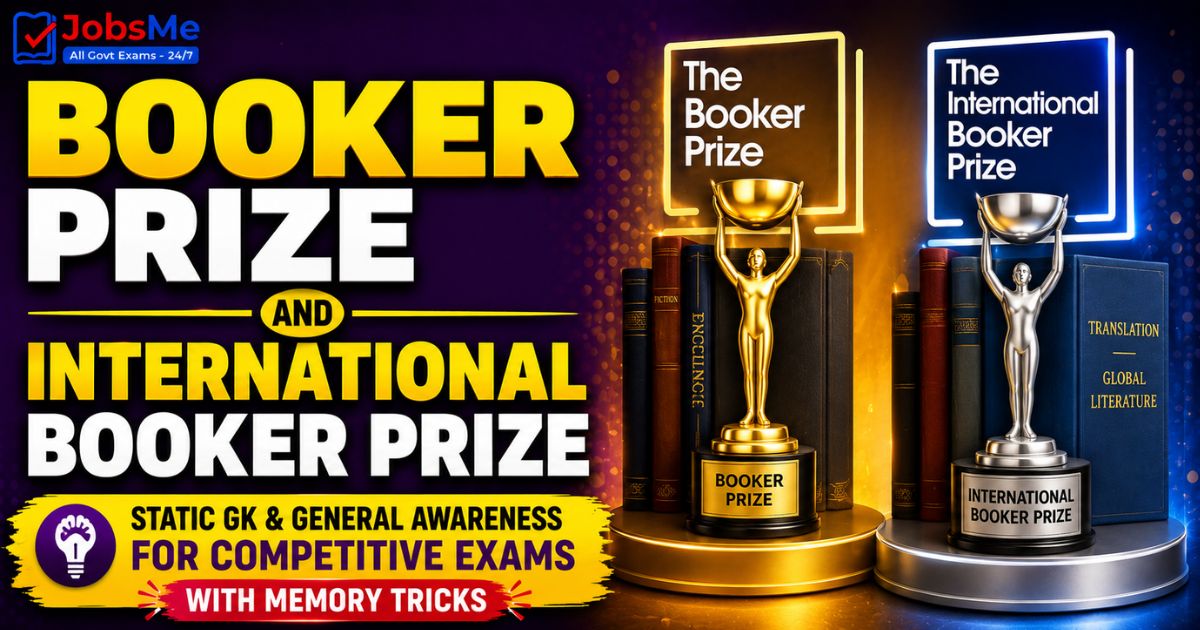
Booker Prize and International Booker Prize – Static GK & General Awareness for Competitive Exams with Memory Tricks
This article covers everything you need to know about the Booker Prize and the International Booker Prize for competitive exams — what each prize is, how they differ, the prize money, eligibility rules, and the complete list of Indian and Indian-origin winners such as V. S. Naipaul, Salman Rushdie, Arundhati Roy, Kiran Desai, Aravind Adiga, Geetanjali Shree, and Banu Mushtaq. It includes the latest winners (David Szalay's Flesh for the 2025 Booker Prize and Banu Mushtaq's Heart Lamp for the 2025 International Booker Prize), memory tricks, frequently confused facts, and quick-revision one-liners. All facts are arranged in exam-ready format to help UPSC, SSC, IBPS, RRB, PSU, and State PCS aspirants score better in the General Awareness and current affairs sections.
Jump to section
Introduction
The Booker Prize and the International Booker Prize are among the most prestigious literary awards in the world, and questions about them appear almost every year in the awards and honours section of competitive exams. Whether it is a headline-grabbing win by an Indian author or a general question on prize money and eligibility, these two prizes are firm favourites of examiners for UPSC Prelims, SSC CGL, IBPS PO, RRB NTPC, SBI Clerk, State PCS, and various Insurance and Defence exams.
Many students confuse the two prizes, but they are distinct awards run by the same foundation. The Booker Prize is given for a novel written originally in English, while the International Booker Prize is given for a work of fiction translated into English from another language. India has a proud record in both, from Salman Rushdie and Arundhati Roy on the original English side to Geetanjali Shree and Banu Mushtaq on the translated side. To explore other related awards and honours topics, you can refer to the Static GK section on thejobsme.com.
Because winners are announced every year, this topic overlaps strongly with current affairs. Fresh wins routinely feature in daily news, so aspirants should track both the historical list and the latest announcements. You can stay updated through the Daily Current Affairs updates on thejobsme.com to catch each year's Booker winners as they are declared.
Core Concepts: Understanding the Two Booker Prizes
The Booker Prize Foundation administers two separate literary awards. Knowing the exact difference between them is the single most tested point in exams, so it is worth learning clearly.
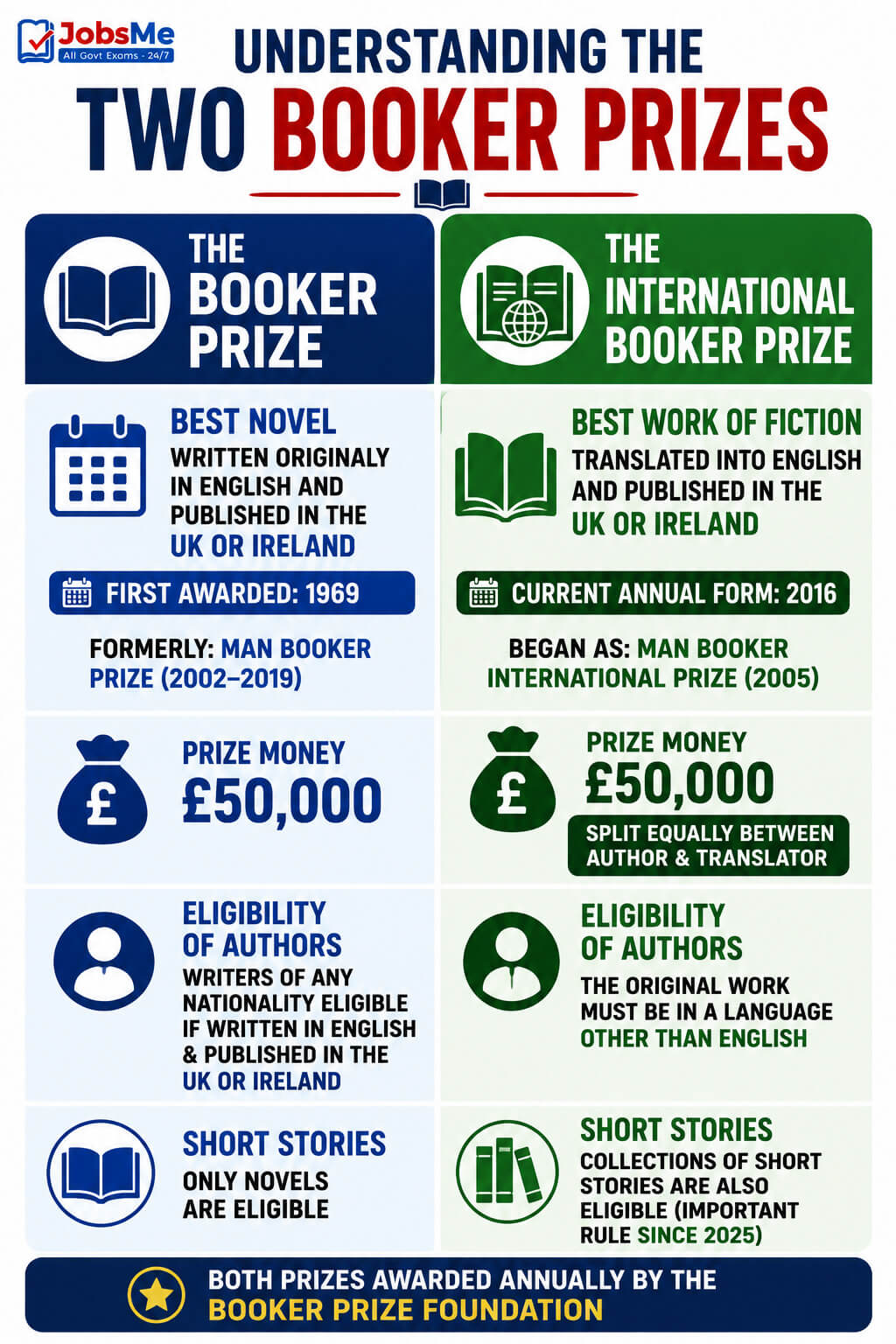
- The Booker Prize: Awarded annually for the best novel written originally in English and published in the United Kingdom or Ireland. It was first awarded in 1969. It was formerly known as the Man Booker Prize (2002-2019), named after sponsor the Man Group.
- The International Booker Prize: Awarded annually for a single work of fiction that has been translated into English and published in the UK or Ireland. In its current annual form it dates from 2016. It began in 2005 as the Man Booker International Prize.
- Prize money: Both prizes carry a purse of £50,000. For the International Booker Prize, this amount is split equally between the author and the translator, recognising the vital role of translation.
- Eligibility of authors: For the Booker Prize, writers of any nationality are eligible as long as the book is written in English and published in the UK or Ireland. For the International Booker Prize, the original work must be in a language other than English.
- Short stories: The Booker Prize is only for novels, but the International Booker Prize also allows collections of short stories, a rule that became historically important in 2025.
Indian and Indian-Origin Winners of the Booker Prize
The Booker Prize (original English fiction) has been won by several Indian and Indian-origin authors over the decades. The table below lists them with the winning book, year, and key exam-relevant details.
| Author | Winning Book | Year | Key Details |
|---|---|---|---|
| V. S. Naipaul | In a Free State | 1971 | The first author of Indian origin to win the Booker Prize; a Trinidad-born British writer of Indian descent. In a Free State is a collection of three stories exploring identity and the post-colonial mindset. Naipaul later won the Nobel Prize in Literature in 2001. |
| Salman Rushdie | Midnight's Children | 1981 | An Indian-British author; the novel is a magical-realism epic tracing India's post-colonial history through Saleem Sinai, born at the exact moment of India's independence. It was later voted the "Booker of Bookers", cementing its status as one of the greatest Booker winners. |
| Arundhati Roy | The God of Small Things | 1997 | Roy's debut novel, set in Kerala, made her the first Indian woman and first non-expatriate Indian to win the Booker Prize. It explores love, caste, and family through the twins Estha and Rahel. |
| Kiran Desai | The Inheritance of Loss | 2006 | Daughter of noted novelist Anita Desai; her novel is set in the Himalayan foothills against the backdrop of the Gorkhaland movement and explores globalisation, migration, and identity. |
| Aravind Adiga | The White Tiger | 2008 | A debut novel and the fourth Indian-born author to win; it is a darkly humorous look at class conflict, corruption, and poverty in modern India, told through the character Balram Halwai. It was later adapted into a film. |
Indian Winners of the International Booker Prize
On the translated-fiction side, India has produced two winners, both of which were major national events. These are extremely high-probability exam facts.
| Author | Book (Translator) | Year | Original Language | Key Details |
|---|---|---|---|---|
| Geetanjali Shree | Tomb of Sand / Ret Samadhi (translated by Daisy Rockwell) | 2022 | Hindi | The first Indian author and first Hindi-language book to win the International Booker Prize. Set in the shadow of Partition, it follows an elderly woman after the death of her husband. Shree was born in Mainpuri and lives in New Delhi. |
| Banu Mushtaq | Heart Lamp (translated by Deepa Bhasthi) | 2025 | Kannada | The second Indian author to win, and the first winner ever translated from Kannada. It is also the first short story collection to win the prize; its 12 stories, written over about 30 years, chronicle the lives of women in patriarchal communities of southern India. Mushtaq is a lawyer and women's rights activist. Translator Deepa Bhasthi became the first Indian translator to win. |
Latest Winners (Most Exam-Relevant)
Examiners love the most recent winners. Learn these two facts along with the year and country of the author.
| Prize | Latest Winner | Book | Key Details |
|---|---|---|---|
| Booker Prize 2025 | David Szalay | Flesh | Szalay became the first British-Hungarian author to win the Booker Prize. The 2025 judging panel was chaired by 1993 winner Roddy Doyle, the first Booker winner to chair a Booker jury. The ceremony was held at Old Billingsgate, London, on 10 November 2025. |
| International Booker Prize 2025 | Banu Mushtaq (author) and Deepa Bhasthi (translator) | Heart Lamp | Announced on 20 May 2025 at the Tate Modern in London. First short story collection and first Kannada work to win. The £50,000 prize was split equally between author and translator. |
Memory Tricks and Mnemonics
Use these tricks to lock in the most confusing parts of this topic quickly.
Trick 1: Booker vs International Booker — the "E vs T" rule
Remember the key difference with two letters:
- Booker = English original.
- International Booker = Translated into English.
Just chant: "E for English, T for Translated" and you will never mix them up.
Trick 2: Indian English-Booker winners — "NRRDA"
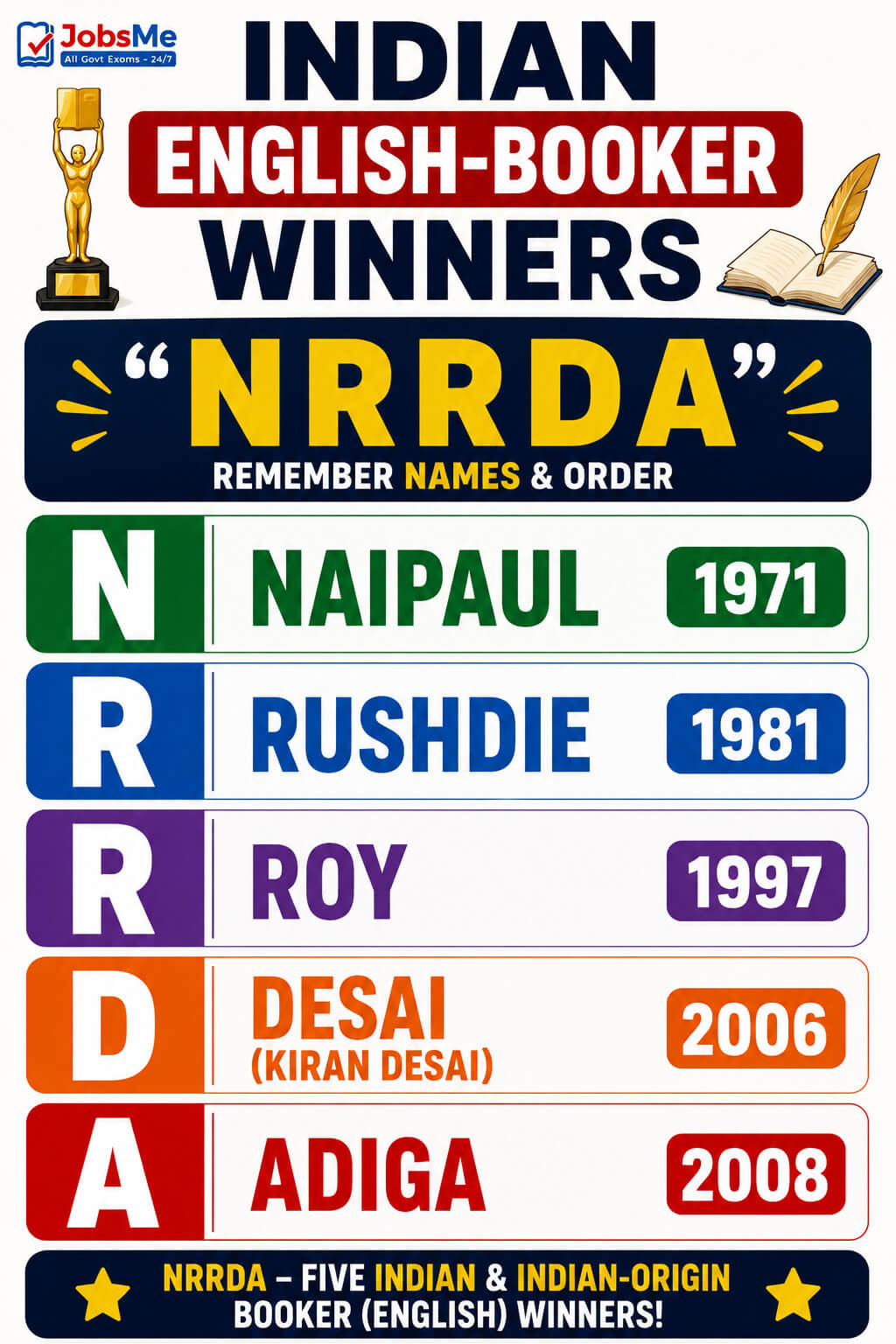
For the five Indian and Indian-origin Booker (English) winners, use the acronym N-R-R-D-A:
- N - Naipaul (1971)
- R - Rushdie (1981)
- R - Roy (1997)
- D - Desai / Kiran Desai (2006)
- A - Adiga (2008)
The order is also chronological, so "NRRDA" gives you both the names and the sequence.
Trick 3: The two Indian International Booker winners — "Two languages, two women"
Both Indian International Booker winners are women writing in Indian languages:
- Geetanjali Shree → Hindi → 2022 → "Two 2s" (2022) → first Indian winner.
- Banu Mushtaq → Kannada → 2025 → short stories → second Indian winner.
Trick 4: Prize money — "Fifty for fiction"
Both Booker prizes carry £50,000. Remember "Fifty for Fiction". For the International Booker, the fifty splits in two — half to author, half to translator — so picture the note being torn neatly down the middle.
Trick 5: Founding years — "69 and O-Five to Sixteen"
Use this rhythm:
- Booker Prize started in 1969.
- International Booker began in 2005 and became annual in 2016.
Trick 6: Rushdie's double honour — "Midnight's Children rules the night"
Salman Rushdie's Midnight's Children not only won in 1981 but was also voted the best of all Booker winners ("Booker of Bookers"). Link "Midnight = the best, rules the whole Booker night."
Trick 7: Heart Lamp firsts — "First stories, First Kannada, First Indian translator"
Heart Lamp achieved three firsts. Repeat the chant of three: "First short-story collection, first Kannada book, first Indian translator (Deepa Bhasthi)."
Additional Notes
Frequently Confused Facts
- Booker Prize vs International Booker Prize: Booker is for novels written in English; International Booker is for fiction translated into English. Do not mix the winners of the two lists.
- Geetanjali Shree vs Banu Mushtaq: Shree (2022, Hindi, novel Tomb of Sand) was the first Indian to win the International Booker; Mushtaq (2025, Kannada, short stories Heart Lamp) was the second.
- Arundhati Roy vs Kiran Desai: Roy won in 1997 (The God of Small Things, first Indian woman to win the Booker); Kiran Desai won in 2006 (The Inheritance of Loss) and is the daughter of Anita Desai.
- Man Booker vs Booker: The prize was called the Man Booker Prize from 2002 to 2019 (sponsored by the Man Group) and reverted to simply "the Booker Prize" from 2019.
- Author-only vs shared prize: The Booker Prize money goes to the author; the International Booker Prize money is split equally between author and translator.
Repeating PYQ Patterns
In SSC CGL, RRB NTPC, and IBPS exams, the most common questions ask "Who won the Booker/International Booker Prize this year?" and "Which language/book won?" In UPSC Prelims and State PCS, questions lean towards the difference between the two prizes, the prize money, and the historical list of Indian winners. The Indian winners — especially Arundhati Roy, Aravind Adiga, Geetanjali Shree, and Banu Mushtaq — are the highest-frequency names.
Quick Insight
The Booker prizes are strongly linked to current affairs because winners are announced fresh every year, usually in May (International Booker) and October-November (Booker Prize). Recent Indian wins have boosted regional-language literature — Hindi in 2022 and Kannada in 2025 — reflecting a wider global interest in translated Indian fiction. For exam preparation, always pair the static list below with the latest year's result. You can practise these facts with the Static GK Quiz and revise related awards through the Static GK notes on thejobsme.com.
One-Liners for Quick Revision
- Booker Prize → Given for a novel written originally in English → First awarded in 1969.
- International Booker Prize → Given for fiction translated into English → Annual since 2016, began in 2005.
- Prize money → £50,000 for both → Split equally between author and translator for the International Booker.
- Man Booker Prize → Former name (2002-2019) → Sponsored by the Man Group.
- V. S. Naipaul → In a Free State (1971) → First Indian-origin Booker winner; later Nobel laureate (2001).
- Salman Rushdie → Midnight's Children (1981) → Voted "Booker of Bookers".
- Arundhati Roy → The God of Small Things (1997) → First Indian woman to win the Booker.
- Kiran Desai → The Inheritance of Loss (2006) → Daughter of Anita Desai.
- Aravind Adiga → The White Tiger (2008) → Debut novel; fourth Indian-born winner.
- Geetanjali Shree → Tomb of Sand / Ret Samadhi (2022) → First Indian and first Hindi book to win the International Booker; translated by Daisy Rockwell.
- Banu Mushtaq → Heart Lamp (2025) → Second Indian winner; first Kannada work and first short story collection to win.
- Deepa Bhasthi → Translator of Heart Lamp (2025) → First Indian translator to win the International Booker.
- David Szalay → Flesh (2025) → Booker Prize 2025 winner; first British-Hungarian author to win.
- Roddy Doyle → Chaired the 2025 Booker jury → First Booker winner (1993) to chair a Booker judging panel.
- Heart Lamp firsts → First short story collection, first Kannada book, first Indian translator → Announced at the Tate Modern, London.
To keep testing yourself on such awards and honours facts, attempt the Daily Current Affairs Quiz and revise the latest news through Daily Current Affairs. For the newest recruitment updates, check the Latest Government Job Notifications on thejobsme.com.
Free quiz • No signup required
Put this topic into practice with Indian Cultural Institutions – Static GK MCQ Quiz. It is the quickest way to reinforce what you just learned.
Frequently Asked Questions
What is the difference between the Booker Prize and the International Booker Prize?
How much prize money is given with the Booker Prize and the International Booker Prize?
Who was the first Indian to win the International Booker Prize?
Who won the International Booker Prize in 2025?
Who was the first Indian woman to win the Booker Prize?
Which Indian authors have won the Booker Prize for English-language fiction?
In which year was the Booker Prize first awarded, and what was its former name?
Why is Salman Rushdie's Midnight's Children considered special among Booker winners?
Who won the Booker Prize in 2025?
Who was the first Indian translator to win the International Booker Prize?

About the author